|
Getting your Trinity Audio player ready...
|
Sino–US Port Fee Truce Brings Temporary Stability to Global Sea Freight Markets
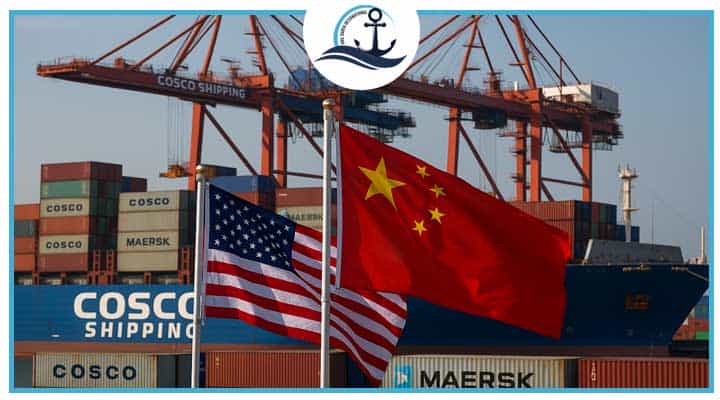
The long-anticipated suspension of reciprocal port fees between the United States and China has officially come into force, marking a rare moment of relief for global shipping companies and sea freight stakeholders. The one-year pause became effective today at 13:01 Beijing time, following last week’s high-level meeting between President Donald Trump and President Xi Jinping, which eased tensions across the maritime trade environment.
A Break From Months of Uncertainty
The port fees—first introduced on October 14—had created significant instability across the shipping sector.
The U.S. initially imposed the charges as part of a strategic attempt to curb China’s dominance in shipbuilding, a field where Chinese yards hold a powerful global position. In response, China implemented its own fees, creating a loop of costs and operational disruptions for carriers involved in transpacific sea freight, vessel scheduling, and port calls.
This back-and-forth quickly increased complexity for shipping lines operating between major gateways such as Los Angeles, Long Beach, Shanghai, and Ningbo, affecting everything from slot planning to bunker strategies
Mixed Reactions Inside the U.S.
Although shipping associations and logistics organizations have widely welcomed the truce, several U.S. trade unions were quick to criticize the decision.
Their joint statement argued that suspending the fees undermines ongoing efforts to revitalize America’s commercial shipbuilding sector.
According to the unions, the rollback comes at a critical moment:
- Billions of dollars in new vessel orders are flowing back into Chinese shipyards.
- American shipyard workers are “once again sidelined,” despite years of industry downturns.
This internal disagreement highlights the broader political tension surrounding maritime industrial policy in the U.S.
Relief for Carriers and Global Supply Chains
On the other side, shipping organisations, freight forwarders, and global import–export bodies have expressed strong support for the suspension.
They note that the dual port fees had introduced:
- operational inefficiencies
- cost unpredictability
- increased friction across already stressed supply chains
For carriers handling Asia–US sea freight, the fee freeze brings immediate clarity and helps stabilize vessel deployment and container flow at a time when geopolitical pressure is already reshaping trade routes.
Analysts: A Pause, Not a Resolution
Industry analysts warn that the current truce should not be mistaken for a permanent settlement.
Both major U.S. political parties—Democrats and Republicans—continue to support policies aimed at rebuilding domestic shipbuilding capacity, meaning future regulatory changes remain highly possible.
Hartland commented:
“Although the US–China pause on tariffs and port fees is a welcome breather, it is hard not to escape the reality that shipyards and fleets will stay at the center of the strategic rivalry.”
Braemar’s latest outlook echoed this sentiment, describing the suspension as “more of a tactical timeout than a lasting deal,” especially considering how swiftly geopolitical positions have shifted over the past year.
What It Means for Sea Freight Operators
For now, global carriers, NVOCCs, and freight forwarders—particularly those moving large volumes across the Pacific—are watching developments closely.
If the suspension remains intact for the full year:
- volatility in sea freight pricing may decrease
- container scheduling could become more predictable
- bunker planning and fleet allocation may stabilize
However, a political shift could quickly reverse this progress, placing the maritime sector back in the center of one of the most unusual trade disputes seen in recent years.