|
Getting your Trinity Audio player ready...
|
Emerging DG Identification Tech: AI, Sensors & Packaging
In today’s global logistics environment, the accurate identification of dangerous goods (DG) has become one of the most critical safety and compliance challenges—particularly for trade flows moving through Dubai. As a strategic gateway connecting Asia, Europe, and Africa, Dubai handles increasing volumes of hazardous cargo across maritime, air, bulk, and breakbulk operations. Even a minor error in DG identification can result in shipment delays, regulatory penalties, or serious safety incidents at ports and terminals.
The volume of dangerous goods shipments through Dubai continues to grow exponentially, driven by industries such as chemicals, pharmaceuticals, and energy. To stay competitive, businesses must adopt technologies that enable faster processing and enhanced safety standards. Anil Darya Shipping, as one of Dubai’s leading logistics providers, plays a key role in ensuring that hazardous materials are handled safely, efficiently, and in full compliance with local and international regulations.
Traditional DG identification methods—largely dependent on manual declarations, paperwork checks, and human interpretation—are no longer sufficient for the complexity of modern supply chains. This reality has accelerated the adoption of DG identification technology, driven by artificial intelligence, smart sensors, and intelligent packaging systems that enable earlier risk detection and more accurate compliance decisions.
Key Shifts Defining Modern DG Identification
- Modern DG identification is no longer limited to labels and paperwork.Today’s DG identification technology integrates AI-based document analysis, sensor-driven cargo monitoring, and smart packaging data to form a single compliance framework. This has become especially critical for shipments moving through Dubai’s sea ports, air cargo terminals, and free zones, where regulatory scrutiny is high and safety concerns are paramount.
- Regulatory pressure and operational risk are increasing simultaneously.As DG volumes grow across maritime, air, bulk, and breakbulk cargo, even small classification errors can trigger inspections, roll-overs, or rejected bookings, making early-stage identification essential rather than reactive. With the continuous development of international regulations like the IMDG Code and IATA guidelines, companies need to stay ahead of compliance changes to avoid costly delays and penalties.
- Technology is shifting DG control from reactive to predictive.AI logistics platforms and connected devices now allow forwarders to detect misdeclaration risks, environmental deviations, and compliance gaps before cargo reaches ports such as Jebel Ali or airline acceptance points. This shift from a reactive approach (addressing issues after they occur) to a predictive one (preventing issues before they arise) is crucial in ensuring seamless transportation of DG.
Why DG Identification Accuracy Is No Longer Optional
Misdeclared or improperly identified dangerous goods remain one of the leading causes of logistics disruptions worldwide. In Dubai, where DG compliance enforcement is strict, incorrect classification often leads to container holds, vessel roll-overs, or forced re-routing. This is particularly relevant under evolving international frameworks such as the IMDG Amendment 42-24, where updated classification and documentation rules directly affect hazardous cargo acceptance.
Even a minor error in classification could lead to serious consequences, including the contamination of cargo, damage to the environment, or even the loss of life. For example, improper handling of flammable materials like lithium batteries or chemicals in the wrong environmental conditions can lead to fires, leaks, or explosions. Such incidents can result in heavy fines, legal consequences, and reputational damage for logistics companies.
Accurate DG identification today must address multiple layers at once—regulatory classification, physical cargo condition, and transport-mode compatibility. Technology-enabled identification helps logistics providers reduce errors that manual checks frequently miss, particularly when DG shipments are routed through complex, multi-leg supply chains. In this context, Dubai’s advanced infrastructure and growing emphasis on innovation make it a fertile ground for the implementation of high-tech solutions to enhance DG safety and compliance.
AI as the Core Engine of DG Identification Technology
Artificial intelligence has become the backbone of next-generation DG identification. Instead of relying on static declarations, AI systems dynamically analyze shipping documents, safety data sheets (SDS), HS codes, and regulatory databases to identify discrepancies in real time. These systems use machine learning algorithms to improve their accuracy and efficiency over time.
AI-powered DG identification supports early detection of misdeclared hazardous cargo, automatic UN number and hazard class matching, document consistency checks before booking confirmation, and reduced reliance on manual intervention. This minimizes human error, which is especially critical when dealing with hazardous materials that require precise handling and transportation.
For example, AI systems can analyze shipping documents for inconsistencies such as incorrect product descriptions, missing hazard labels, or improper packing instructions. These automated checks save time and reduce the chance of mistakes. AI also plays a critical role in ensuring that DG is properly categorized according to the latest safety standards and regulations.
In Dubai-based logistics operations, AI is increasingly applied during pre-shipment screening—well before cargo reaches the port gate. This proactive approach is particularly effective when integrated with multimodal DG transport workflows, where consistency across sea, air, and land legs is essential. Logistics companies that adopt AI-driven systems can ensure smoother operations and faster transit times, all while staying compliant with stringent local and international regulations.
Companies such as Anil Darya Shipping use AI-driven identification to minimize risk exposure and ensure DG shipments comply with both international standards and UAE-specific requirements.
Smart Sensors: From Static Labels to Live Risk Monitoring
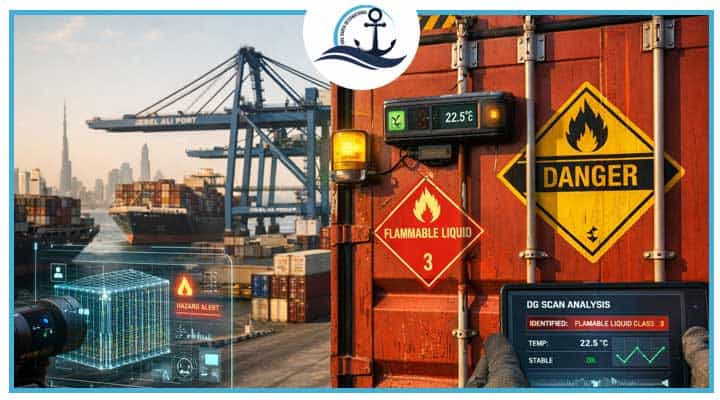
While AI strengthens classification accuracy, smart sensors address the physical behavior of dangerous goods in transit. Sensors embedded in containers or transport units continuously monitor temperature, pressure, humidity, and shock—critical factors for flammable, reactive, or sensitive DG cargo.
Smart sensor deployment enables logistics teams to detect unsafe environmental conditions in real time, respond before cargo reaches critical risk thresholds, and support faster clearance through verified data. For example, if the temperature of a container carrying flammable chemicals exceeds safe levels, a sensor can trigger an alert to prevent further risks.
This capability is particularly valuable in Dubai, where ports increasingly rely on technology-driven safety assurance. Sensor-based monitoring aligns closely with the advanced DG handling infrastructure at Jebel Ali as a regional DG hub, reducing delays and enhancing cargo safety across high-volume trade lanes. Sensors also help companies meet compliance requirements by providing real-time data on temperature-sensitive goods or hazardous chemicals, ensuring that shipments remain within the prescribed safety parameters.
The use of sensors also contributes to reducing human error, as the automated alerts and real-time monitoring allow logistics teams to take quick, informed actions without waiting for manual checks.
How Technology Integrates DG Identification Across Operations
- DG identification technology now works across multiple risk layers.Instead of a single compliance checkpoint, modern systems combine document validation, physical condition monitoring, and regulatory cross-checking to reduce safety incidents during transport. This multi-faceted approach increases efficiency and minimizes delays, ultimately leading to smoother operations and improved safety outcomes for DG cargo.
- AI and sensors support faster, cleaner operational decisions.Real-time data allows logistics teams to act before issues escalate—adjusting routes, triggering inspections early, or preventing high-risk cargo from entering restricted transport modes. This proactive decision-making capability is critical when transporting DG, especially through busy ports and air terminals like those in Dubai.
- This integrated approach is especially effective in high-volume hubs like Dubai.With strict compliance controls and complex cargo flows, logistics operators increasingly rely on technology-driven DG identification to maintain safety without slowing throughput. This integrated approach helps companies like Anil Darya Shipping ensure that DG cargo moves efficiently while adhering to the highest safety standards.
Smart Packaging: Turning the Package into a Compliance Asset
Smart packaging represents a shift from passive containment to active compliance support. By integrating RFID tags, QR codes, and embedded sensors, packaging itself becomes part of the DG identification system—carrying digital classification data throughout the supply chain. This data can include detailed information about the cargo’s hazardous nature, its handling instructions, and its current condition, all of which can be monitored and updated in real time.
Smart packaging supports:
- instant access to DG handling instructions
- faster warehouse and terminal handovers
- improved traceability for high-risk cargo
- better alignment with AI logistics and smart packaging UAE initiatives
In Dubai’s digitally evolving logistics ecosystem, smart packaging complements AI and sensor technologies by ensuring DG information remains accessible, accurate, and verifiable at every stage of transport. It also provides a digital record of the goods, making it easier to track shipments and ensure that they remain compliant with safety standards throughout their journey.
DG Identification Across Sea, Air, Bulk & Breakbulk Cargo
DG identification challenges vary significantly by transport mode. A cargo approved for maritime transport may require additional controls or reclassification for air or sea–air routing. Technology-enabled DG identification reduces this risk by validating cargo compliance across different modes, including sea–air freight solutions from Dubai.
This capability is especially relevant for bulk and breakbulk hazardous cargo, where misidentification often leads to costly delays and safety interventions. Early identification ensures smoother acceptance and safer handling across all transport stages, whether by sea, air, or land.
Frequently Asked Questions (FAQ)
AI analyzes documents, product data, and regulatory rules simultaneously, identifying inconsistencies that manual checks often overlook.
While not mandatory for all shipments, sensors are increasingly recommended for temperature-sensitive or high-risk DG cargo.
No. Smart packaging complements mandatory labels by adding digital traceability and live data.
Yes. Early risk detection and verified data reduce inspections, roll-overs, and compliance-related holds.
Conclusion
The future of hazardous cargo handling is no longer paper-driven. DG identification technology, powered by AI, smart sensors, and intelligent packaging, is reshaping how dangerous goods are classified, monitored, and transported—particularly in advanced logistics hubs like Dubai.
Logistics providers that adopt these technologies gain not only compliance advantages but also improved safety, operational efficiency, and customer confidence. As the industry continues to evolve, the role of technology in ensuring the safe, efficient transport of DG will only increase.
If your DG shipments move through Dubai and require precise classification, risk mitigation, and regulatory compliance, Anil Darya International L.L.C-FZ provides technology-driven DG logistics solutions across sea, air, bulk, and breakbulk transport.