
Cargo Insurance for Breakbulk and Project Shipments: What to Check
Why carrier liability is not enough for breakbulk and project cargo, and the five things to check in a cargo insurance policy.
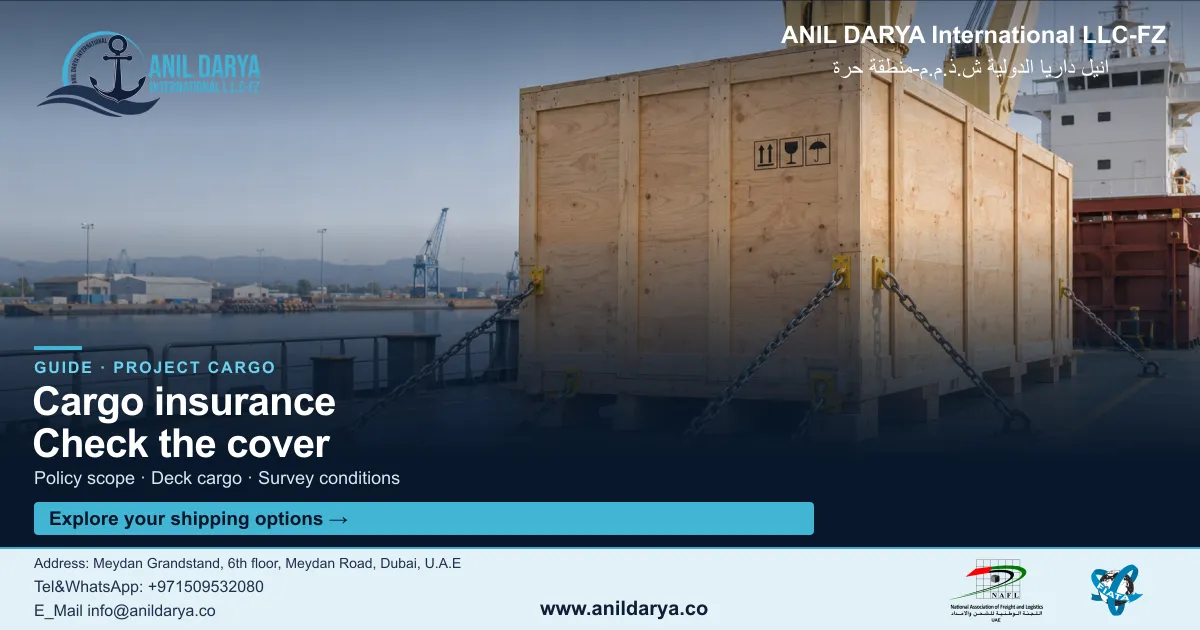
Breakbulk and project cargo needs its own cargo insurance policy, because the carrier's liability is limited and usually far below the cargo's value. When you check a policy, focus on five things: the scope of cover, how deck cargo is treated, the insured value, the exclusions and the conditions you must meet before a claim is paid. This article walks through each one.
Why the carrier's liability is not enough
Under the Hague-Visby Rules, which apply to many bills of lading, a sea carrier's liability for loss or damage is limited to 666.67 Special Drawing Rights (SDR) per package or 2 SDR per kilo of gross weight, whichever is higher. The carrier also has defences, for example for damage caused by perils of the sea. For a transformer or a turbine, that limit can be a small fraction of the value. Only your own cargo insurance closes that gap.
1. Scope of cover
Most marine cargo policies are based on the Institute Cargo Clauses:
- Clauses (A): the widest cover, "all risks" subject to listed exclusions.
- Clauses (B) and (C): named perils only, such as fire, sinking, stranding and collision. (C) is the narrowest.
For high-value project cargo, (A) is the usual choice. Check whether the policy covers the full journey, including storage at ports and the road leg to site, not only the sea voyage.
2. Deck cargo
A lot of breakbulk travels on deck. Many policies treat on-deck cargo differently, often limiting cover to named risks like jettison and washing overboard. If your bill of lading says "shipped on deck at shipper's risk", tell your insurer and confirm the cover in writing.
3. Insured value
Cargo is commonly insured for the invoice value plus freight plus a margin to cover extra costs after a loss. Under Incoterms 2020, a seller who must insure under CIF or CIP has to cover at least 110% of the contract price, and many buyers use the same level. For project cargo, also think about delay. A standard cargo policy does not pay for losses caused by late delivery. If a late arrival would stop a project, ask about delay in start-up (DSU) cover, which is arranged separately.
4. Exclusions to read carefully
- Insufficient packing or preparation for the voyage. If the packing was not suitable, the claim can be refused.
- Ordinary wear, leakage or loss of weight.
- Delay, as above.
- Inherent vice, meaning damage caused by the nature of the cargo itself, such as rust on unprotected steel.
- War and strikes, which are covered only if added by separate clauses.
5. Conditions and surveys
For heavy or high-value pieces, insurers often require a marine warranty surveyor to approve the lift plans, stowage and lashing before loading. If the policy has this condition and it is not met, the cover may not apply. Build the surveyor's attendance into the schedule.
General average
If the ship's master sacrifices cargo or spends money to save the voyage, all cargo owners share the cost under general average, even if their own cargo was not damaged. Without insurance, the carrier can hold your cargo until you pay your share or give security. A cargo policy normally covers this.
Checklist before shipping
- Is the cover (A), (B) or (C), and does it run warehouse to warehouse?
- Is deck stowage covered, and on what terms?
- Is the insured value right, and do you need delay cover?
- Does the policy require a warranty surveyor?
- Do photos and condition reports exist from before loading?
Good packing and lashing reduce the chance of a claim in the first place. See breakbulk damage prevention.
Ship your project cargo with us
Anil Darya can arrange cargo insurance alongside breakbulk and project cargo shipping. Send us the cargo description, its value, the route and how it will be stowed to info@anildarya.co, and we will include insurance options with the freight quote. This article is general guidance; the policy wording decides what is covered.
Sources
- Hague-Visby Rules (Brussels Protocol 1968, SDR Protocol 1979), text via UNCITRAL / CMI: comitemaritime.org (reviewed 9 November 2026)
- ICC, Incoterms 2020: iccwbo.org (reviewed 9 November 2026)
- Lloyd's Market Association, Institute Cargo Clauses (2009): lmalloyds.com (reviewed 9 November 2026)