
The 9 Dangerous Goods Classes Explained for Shippers
A plain guide to the nine UN dangerous goods classes used in sea freight, with examples and how to classify your cargo.
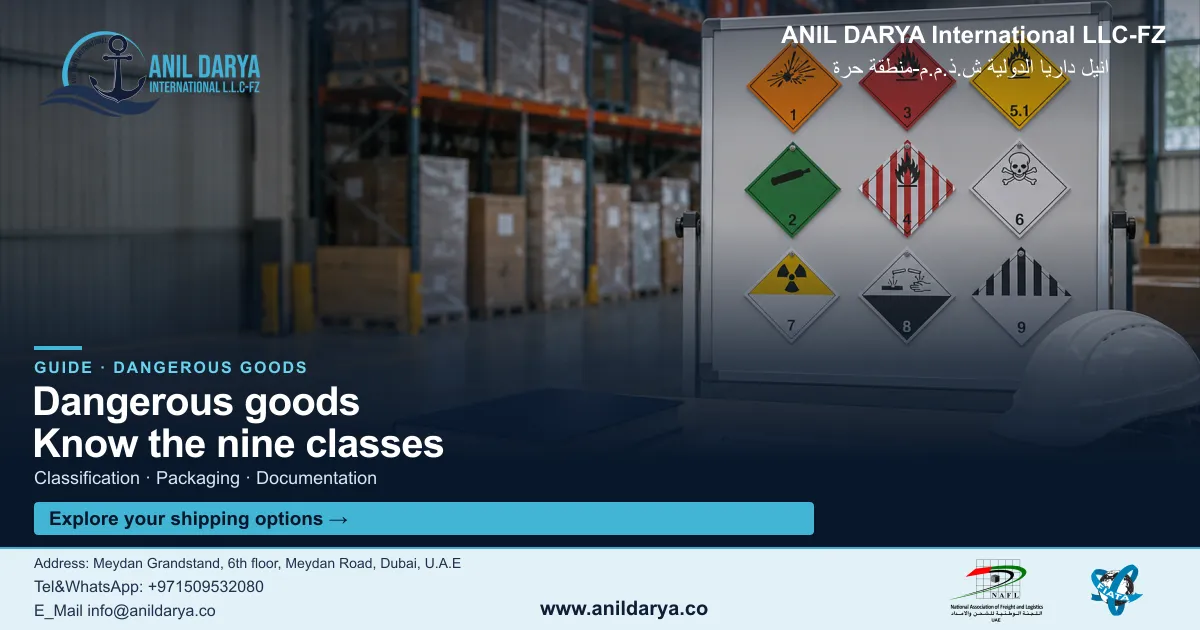
Every dangerous good shipped internationally belongs to one of nine hazard classes set by the UN Model Regulations. Sea transport follows the same system through the IMDG Code. The class tells the carrier what the main danger is, which decides the label on the package, where the container can be stowed on the ship and what it can travel next to. Here is what each class covers, with everyday examples.
Class 1: Explosives
Substances and articles that can explode or burn very fast, such as fireworks, ammunition, airbag inflators and some detonators. Class 1 is split into divisions 1.1 to 1.6 by how violent the hazard is. Very few carriers accept the most dangerous divisions, and sailings are limited.
Class 2: Gases
- 2.1 Flammable gases: propane, butane, aerosols with flammable propellant.
- 2.2 Non-flammable, non-toxic gases: nitrogen, carbon dioxide, many fire extinguishers.
- 2.3 Toxic gases: chlorine, ammonia.
Class 3: Flammable liquids
Liquids that give off flammable vapour at low temperatures, such as paints, solvents, perfumes, some adhesives and fuels. The flashpoint matters here and has to be stated on the DG declaration when it is 60°C or lower.
Class 4: Flammable solids and related substances
- 4.1 Flammable solids: matches, some metal powders.
- 4.2 Liable to spontaneous combustion: some oily materials, activated carbon.
- 4.3 Dangerous when wet: substances that give off flammable gas in contact with water, such as calcium carbide.
Class 5: Oxidizers and organic peroxides
- 5.1 Oxidizing substances: calcium hypochlorite (pool chlorine), ammonium nitrate.
- 5.2 Organic peroxides: used in plastics and resins. Some need temperature control.
Class 6: Toxic and infectious substances
- 6.1 Toxic substances: many pesticides, some chemicals used in industry.
- 6.2 Infectious substances: medical and biological samples. Rarely shipped by sea.
Class 7: Radioactive material
Medical isotopes, some industrial gauges and nuclear fuel. This class has its own strict rules and specialist carriers.
Class 8: Corrosive substances
Substances that damage skin or metal, such as acids, alkalis, battery fluid and many cleaning chemicals.
Class 9: Miscellaneous dangerous goods
Hazards that do not fit the other classes. This includes lithium batteries, dry ice, some magnetized materials, vehicles and engines, and substances that are dangerous to the environment. Class 9 is one of the most common classes in container shipping.
Packing groups
Within most classes, substances are also given a packing group showing the level of danger: I (high), II (medium) or III (low). The packing group decides how strong the packaging must be. It appears on the DG declaration next to the UN number and class.
Subsidiary risks and marine pollutants
Some goods have more than one hazard. A flammable liquid that is also toxic has Class 3 as the main class and 6.1 as a subsidiary risk, and both labels go on the package. Substances harmful to the marine environment also carry the marine pollutant mark, whatever their class.
How to find your cargo's class
- Check section 14 (transport information) of the product's Safety Data Sheet.
- Confirm the UN number, proper shipping name, class and packing group against the current IMDG Code.
- If the SDS is old or unclear, ask the manufacturer for an updated one before booking.
Many DG bookings are rejected because the classification on the documents does not match. Our article on why shipping lines reject dangerous goods covers the usual reasons.
Ship your dangerous goods with us
Anil Darya handles dangerous goods shipping by sea from the UAE. Send your cargo description, the SDS and your route to info@anildarya.co for a shipment-specific review. This article is a general overview; the current IMDG Code is the reference for any real shipment.