
Project Cargo Logistics Explained: From Route Survey to Final Delivery
The six stages of a project cargo move, from early planning and route survey to delivery and handover at site.
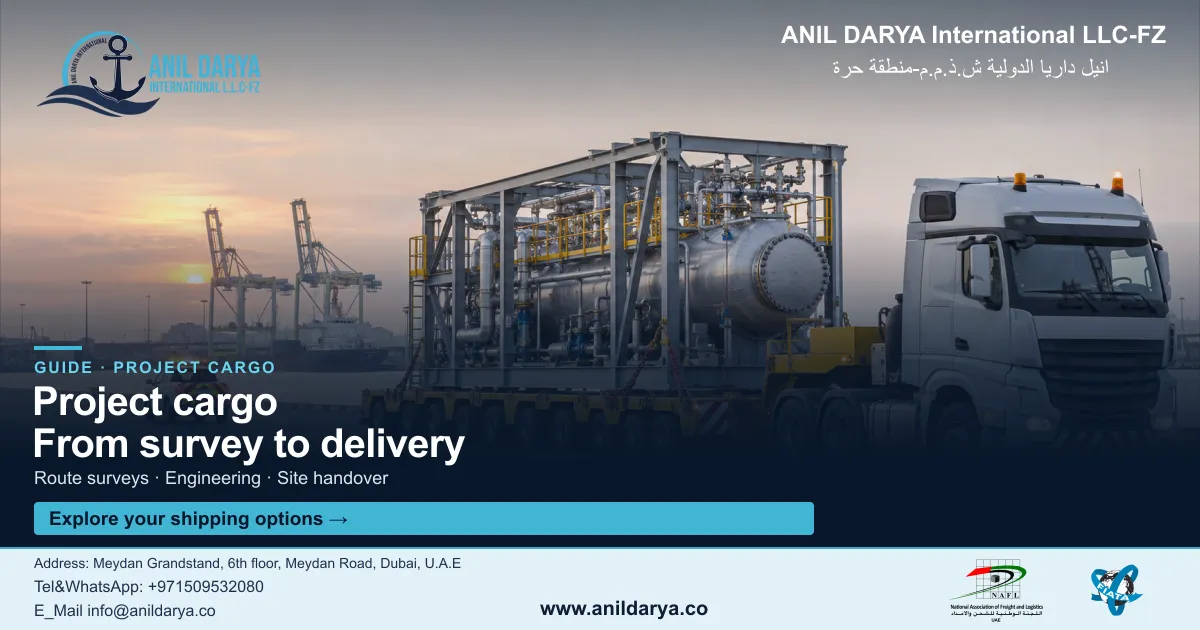
Project cargo logistics is the planning and transport of large, heavy or high-value equipment for a specific project, such as a power plant, a refinery unit or a desalination plant. Unlike regular shipping, every move is planned around the cargo: its size, weight, lifting points and the date it has to be on site. A typical project runs through six stages, from feasibility to handover at the site, and most problems come from skipping or rushing one of them.
1. Feasibility and early planning
This starts before the equipment is even built. The logistics team looks at the expected dimensions and weights and asks a simple question: can this piece physically get from the factory to the site? The answer may change how the equipment is designed or split. A module that is 20 cm too wide for a bridge on the route can cost far more to move than to redesign.
2. Route survey
A route survey checks every part of the journey for the heaviest and largest pieces:
- Port of loading and discharge: berth depth, quay load capacity, crane availability, storage area.
- Road route: bridge weight limits, overhead cables, roundabouts, tight turns, road gradients.
- Site access: the final approach, ground conditions and where the crane will stand for offloading.
The surveyor drives the route, measures clearances and photographs problem points. The result is a report that tells you whether the route works, what has to be removed or reinforced, and which permits you need.
3. Engineering
Once the route is known, engineers prepare the technical plans:
- Lift plans for each crane lift, showing crane type, rigging and load at the working radius.
- Stowage plans showing where each piece goes on the vessel.
- Lashing and securing calculations for the sea voyage.
- Transport plans for the road move, including trailer type and axle loads.
The manufacturer's drawings with the centre of gravity and lifting points are the starting point for all of these. Without them, nobody can plan a safe lift.
4. Permits and approvals
Oversized road moves need permits from the road authorities in each country or emirate the cargo passes through. Some moves are only allowed at night or with a police escort. Port authorities may need advance notice for heavy lifts. Import permits for the equipment itself may be needed too. These approvals often take longer than the transport, so start them early.
5. Transport
This is the part people picture: loading at origin, the sea voyage on a breakbulk or heavy-lift vessel, discharge, and the road move to site. With good planning, this stage is the least eventful. Daily updates, photo reports at each handover and a named contact for each leg keep everyone informed.
6. Delivery and handover
At the site, the cargo is offloaded onto its foundation or a laydown area. Someone from the receiver should inspect it with the transport team and sign the delivery record, noting any damage. That record is what any later insurance claim depends on.
Where project cargo moves go wrong
- Drawings arrive late, so lift plans and stowage plans are rushed.
- The route survey is skipped for the road leg because "the road looks fine".
- Permits are applied for after the vessel has sailed.
- Nobody is clearly responsible for the handover between the sea and road legs.
If you want to understand the document side in the UAE, read breakbulk documents and the port process in the UAE. For background on demand in the region, see Dubai project cargo and heavy-lift demand.
Plan your project shipment with us
Anil Darya handles breakbulk and project cargo through Jebel Ali and other UAE ports. Share the equipment list with dimensions, weights and drawings, the factory and site locations, and your required delivery window through our rate inquiry form or at info@anildarya.co, and our team will review the options.