
SDS (MSDS) for Shipping: Why Carriers Ask for It Before a DG Booking
What an SDS (MSDS) is, which sections carriers check before a dangerous goods booking, and how to avoid delays.
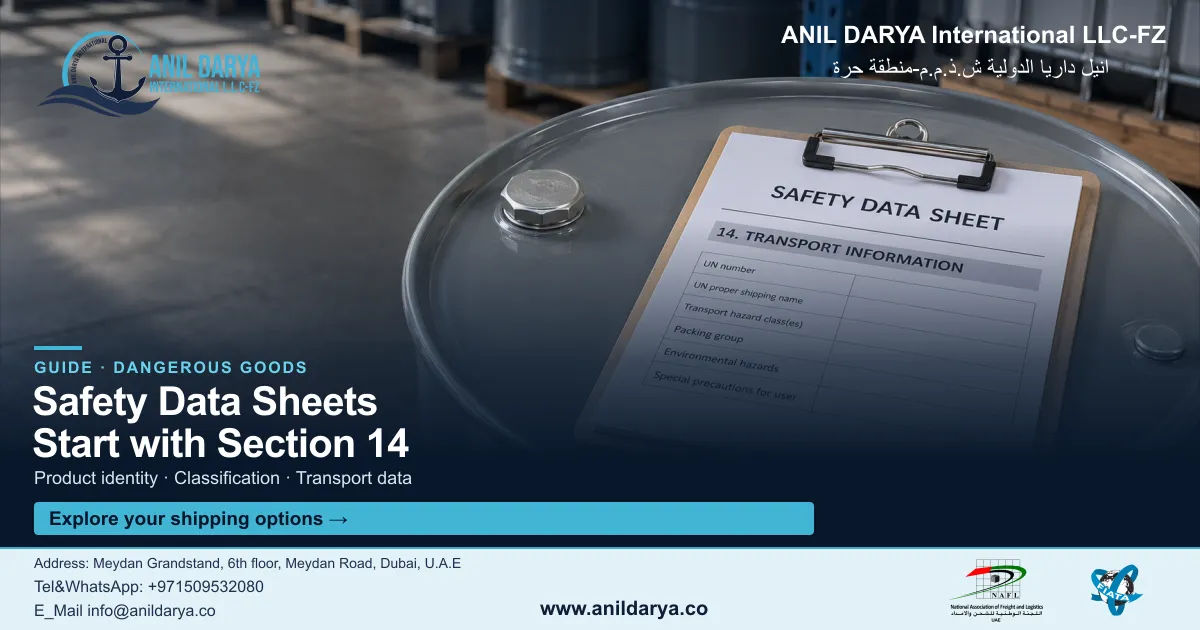
A Safety Data Sheet (SDS), still often called an MSDS, is the document that describes a chemical product's hazards and how to handle it safely. Carriers ask for it before accepting a dangerous goods booking because it is the quickest way to check that your cargo is classified correctly. If the SDS and your booking disagree, the booking stops until they match. Here is what carriers look for and how to avoid delays.
SDS and MSDS: the same thing
MSDS (Material Safety Data Sheet) is the older name. Under the UN Globally Harmonized System of Classification and Labelling of Chemicals (GHS), the format is called SDS and has 16 fixed sections. Carriers and forwarders use both names for the same document.
The sections carriers read first
- Section 1, Identification: product name, supplier and emergency phone number.
- Section 2, Hazard identification: the hazards under GHS.
- Section 3, Composition: the hazardous ingredients and their concentrations.
- Section 9, Physical and chemical properties: flashpoint, boiling point, form.
- Section 14, Transport information: UN number, proper shipping name, transport hazard class, packing group and marine pollutant status. This is the section a DG desk checks against your booking.
Why carriers need it before booking
The carrier is responsible for stowing and segregating dangerous goods safely on the ship. To do that it needs the right UN number, class and packing group. The SDS is independent evidence of those details, prepared by the manufacturer. Carriers use it to:
- Confirm the classification on your DG declaration.
- Check whether the product is accepted on that route and vessel at all.
- Spot hazards that need special stowage, such as temperature control or "away from heat".
- Plan the emergency response if something goes wrong at sea.
Problems that delay a booking
- Section 14 is blank or says "not regulated" while sections 2 and 3 show real hazards. The carrier will question it.
- The SDS is old. Many carriers want a recent version, often issued within the last few years, and one that reflects the current IMDG Code.
- The product name doesn't match the commercial invoice or packing list.
- The SDS is not in English. International carriers generally need an English version.
- The SDS covers a different concentration or formulation from what is actually being shipped.
What if my cargo is not dangerous?
Many chemicals are not regulated for transport. If your product's SDS shows no transport classification, carriers may still ask for the SDS and sometimes a signed non-DG declaration from the shipper. Having both ready avoids questions at booking, especially for products whose names sound hazardous, like cleaners, paints or batteries.
An SDS is not a DG declaration
The SDS describes the product. The dangerous goods declaration describes the shipment: how many packages, what quantity, how it is packed. You need both for a DG booking. Our guide to the reasons shipping lines reject DG bookings explains how the two documents are checked together.
Checklist
- English SDS, recent issue date, 16 sections.
- Section 14 filled in and matching your booking.
- Product name matching the invoice and packing list.
- Non-DG declaration ready if the product is not regulated.
Send us your SDS
Anil Darya checks SDS and DG documents as part of our dangerous goods shipping service. Email the SDS, the product description, quantities and route to info@anildarya.co and we will tell you what the carrier will need.