
Shipping Container Types and Sizes: 20ft, 40ft, 40HC, Reefer and Open Top
A guide to standard and special shipping containers, their sizes and when to use each.
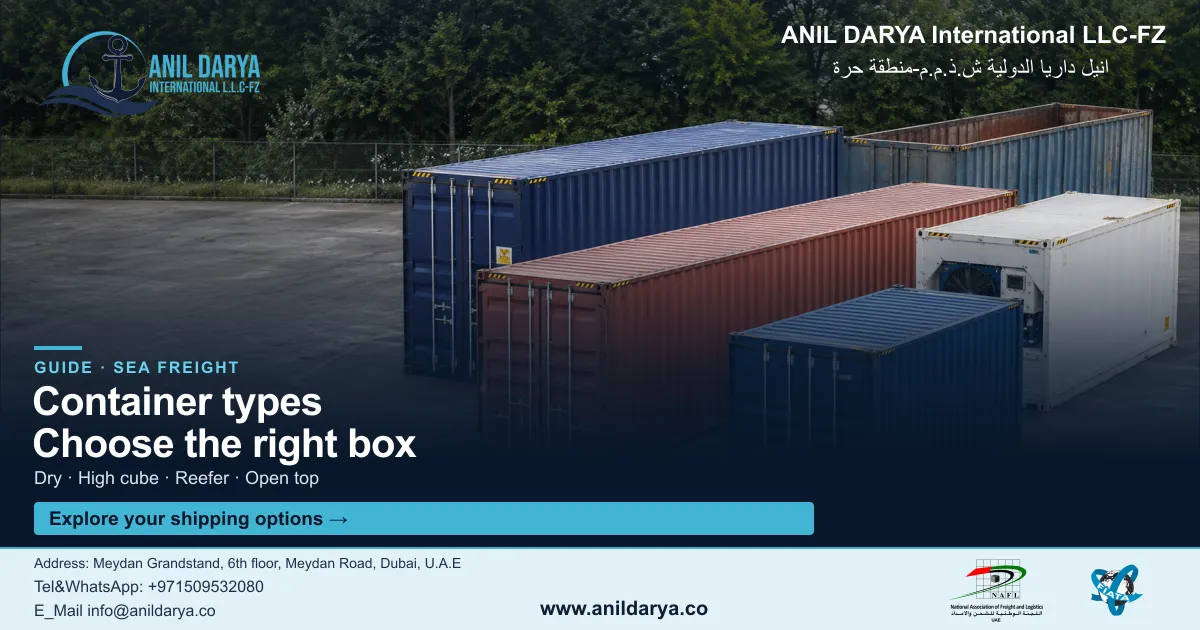
Most sea freight moves in three standard boxes: the 20ft, the 40ft and the 40ft high cube. All are 8 feet wide. The 20ft and 40ft are 8ft 6in tall, and the high cube is 9ft 6in tall. For cargo that needs cooling, top loading or extra width, there are reefers, open tops and flat racks. Choosing the right box affects your freight cost, how much fits and whether the cargo can be loaded at all.
Standard dry containers
External dimensions are fixed by the ISO 668 standard. Internal dimensions vary a little by manufacturer, so treat the figures below as typical and check the carrier's specification before loading.
- 20ft dry (20DV): external 6.06 m long, 2.44 m wide, 2.59 m high. Internal roughly 5.9 x 2.35 x 2.39 m, about 33 cbm. Good for heavy, dense cargo like steel, tiles or bagged goods, because you reach the weight limit before the volume limit.
- 40ft dry (40DV): external 12.19 m long, same width and height. Internal roughly 12.0 x 2.35 x 2.39 m, about 67 cbm. Good for general cargo.
- 40ft high cube (40HC): external 2.90 m high, about 30 cm taller inside than a standard 40ft. About 76 cbm. Good for light, bulky cargo like furniture or cartons of consumer goods.
ISO 668 sets the maximum gross mass (box plus cargo) for these sizes at 30,480 kg. The actual payload is lower, because you subtract the container's own weight, and road weight limits at origin or destination can lower it further. Ask your forwarder for the realistic payload on your route.
Special containers
- Reefer (refrigerated): keeps cargo at a set temperature for food, pharmaceuticals and some chemicals. Slightly less internal space because of the insulation and cooling unit.
- Open top: has a removable tarpaulin roof so cargo can be loaded by crane from above. Used for tall machinery or cargo that can't go through the doors.
- Flat rack: a floor with end walls and no sides or roof. Used for oversized, heavy or wide cargo like vehicles, boats or machinery. Cargo can hang over the sides as out-of-gauge cargo, at extra cost.
- ISO tank: a tank inside a container frame for bulk liquids, including some dangerous goods.
If your cargo is too big for a standard box, see flat rack, open top or breakbulk to choose between them.
How to choose
- Heavy and compact cargo: 20ft. You'll hit the weight limit before the space runs out.
- Light and bulky cargo: 40HC. The extra height adds usable volume for little extra cost on many routes.
- Temperature-sensitive cargo: reefer.
- Tall or crane-loaded cargo: open top.
- Wide, very heavy or awkward cargo: flat rack, or breakbulk if it's larger still.
Common mistakes
- Loading a 20ft to its volume and finding it is over the road weight limit.
- Planning pallet layouts on external dimensions instead of internal ones and door openings.
- Booking a standard 40ft when a 40HC would have fitted the whole order in one box.
- Declaring the wrong gross weight. Under SOLAS, every packed export container needs a verified gross mass (VGM) before loading.
Book the right container
Anil Darya books FCL and LCL sea freight in all standard and special container types through Jebel Ali. Send your cargo dimensions, weights, packing and route to info@anildarya.co and we will recommend the box that fits.