|
Getting your Trinity Audio player ready...
|
Suez Canal Traffic Still 60% Below Pre-Crisis Levels
More than three months after the last reported Houthi attack, traffic through the Suez Canal remains dramatically depressed, highlighting how cautious ship operators continue to be about returning to the Red Sea route.
According to data released by BIMCO, it has now been 100 days since the most recent attack on a commercial vessel, when the bulk carrier Minervagracht was hit on September 29. Although the Houthis later announced a halt to attacks, shipping volumes through the canal have yet to show a meaningful recovery.
Shipping Confidence Yet to Return to the Red Sea
BIMCO’s chief shipping analyst, Niels Rasmussen, said that during the first week of 2026, vessel transits through the Suez Canal were still around 60% lower than in the same period of 2023, before widespread diversions around the Cape of Good Hope began.
Despite the absence of recent attacks, operators remain reluctant to reroute vessels back through the Red Sea, particularly in container shipping and long-haul sea freight services, where schedule reliability and crew safety remain critical concerns.
Since November 2023, nearly 100 vessels have been attacked or hijacked in the region. While incidents peaked toward the end of 2023, the sharp decline in Suez Canal traffic only became evident from January 2024 onward. Since then, quarterly deadweight tonnage transiting the canal has consistently remained between 51% and 64% below pre-crisis levels.
Container Shipping Still Avoiding the Suez Route
The downturn has been especially severe in container shipping. BIMCO figures show that in the fourth quarter of 2025, container vessel transits were 86% lower than in 2023, underlining the scale of disruption to global liner networks and East–West sea freight corridors.
By contrast, other shipping segments have fared slightly better. Over the same period:
- Bulk carrier transits were down about 55%
- Crude tanker movements fell by roughly 32%
- Product tanker traffic declined by just 19%
Product tankers have emerged as the main exception to the broader trend, as higher freight rate premiums have encouraged a gradual return to the canal. In late 2025, product tanker transits were only 19% below 2023 levels, compared with a 45% drop recorded during 2024.
Early Signs of a Gradual Return
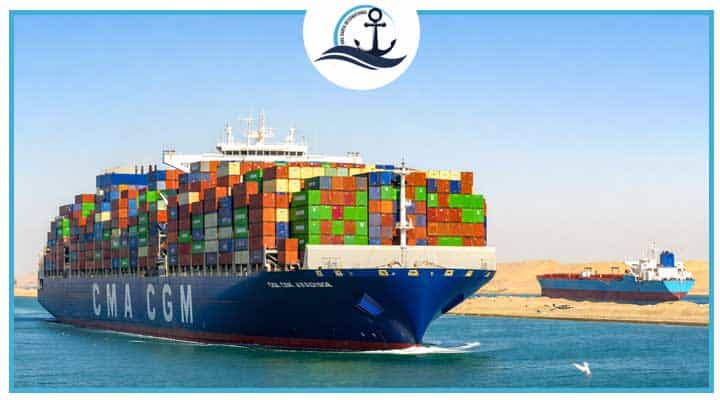
Some major carriers have begun cautiously testing the waters. CMA CGM has announced plans to return its MEDEX and INDAMEX services to Suez Canal routings from January 2026. Maersk also took a tentative step in December, when the Maersk Sebarok became the first Maersk vessel to transit the canal since early 2024.
However, Maersk stressed that further sailings will depend on security conditions continuing to meet internal safety thresholds, reinforcing the view that any recovery will be gradual rather than immediate.
War Risk Premiums Fall, But Uncertainty Remains
One factor that could support a wider return is the easing of insurance costs. S&P Global reported in early December that war risk premiums for Red Sea transits had fallen to around 0.2% of hull value, the lowest level since November 2023.
Even so, BIMCO cautions that a full normalisation of traffic would have broader market implications. While a return to the Suez Canal would reduce operating costs for owners, it would also release capacity back into the market. BIMCO estimates that a complete recovery could reduce containership demand by around 10%, with smaller reductions of 2% to 3% expected across other sectors.
“A normalisation of ship transits now appears more likely than at any point over the past two years,” Rasmussen said, “but the pace of recovery remains uncertain.”