
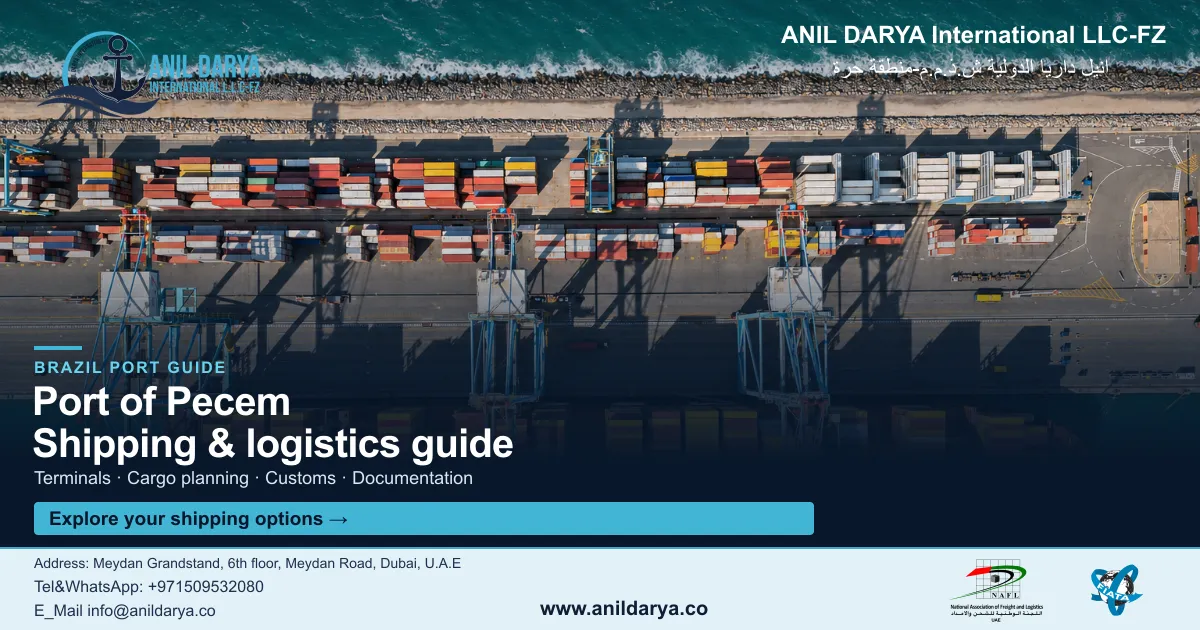
Port of Pecem shipping means using an offshore terminal on Brazil's northeast coast, about 60 km from Fortaleza in Ceara state. Pecem handled a record of about 21 million tonnes and over 700,000 TEU in 2025, and it takes iron ore, fuels, containers, general cargo and project cargo across three piers. This guide covers how the port is built, what it handles, and both directions of the lane: shipping from Dubai to Pecem, and shipping from Pecem to Dubai for UAE importers.
Port of Pecem guide: key facts at a glance
| Item | Detail |
|---|---|
| Official name | Terminal Portuario do Pecem, part of the Complexo do Pecem |
| Manager | CIPP S/A, a joint venture between the Government of Ceara and the Port of Rotterdam |
| Location | West coast of Ceara, between Caucaia and Sao Goncalo do Amarante, about 60 km from Fortaleza |
| UN/LOCODE | BRPEC |
| Layout | Offshore terminal: Pier 1, Pier 2 and the TMUT multipurpose terminal, behind a 2,770 m L-shaped breakwater |
| Berths | Ten in operation; an 11th berth (350 m of quay) is planned at the TMUT |
| Draft | Natural depth 15.4 m; operational draft 15.30 m at TMUT berths 7, 8 and 9 |
| Largest container ships | Up to 366 m long and 49 m beam at the TMUT berths |
| Cargo in 2025 | About 20.96 million tonnes, a record, up 7% |
| Containers in 2025 | About 706,500 TEU, up 27% on 555,409 TEU in 2024 |
| Imports and exports in 2025 | 12.7 million tonnes landed, 7.8 million tonnes shipped |
| Container terminal service provider | APM Terminals Pecem |
| Free zone | ZPE Ceara, Brazil's first operating export processing zone, next to the port |
| Customs status | Bonded (alfandegado) since April 2002; cleared by the Receita Federal |
| Share of Ceara port activity | 79.8% |
Where is the Port of Pecem and what does it serve?
Pecem sits on the west coast of Ceara, between the towns of Caucaia and Sao Goncalo do Amarante, about 60 km from Fortaleza. It is not a river or estuary port. It was built as an offshore terminal: road bridges run out from the shore to piers in deep water, and a breakwater shelters the berths from waves and currents. The access bridges run 1,789 m to Pier 1 and 2,143 m to Pier 2.
The port is the sea gate of a much larger industrial complex. The Complexo do Pecem covers more than 19,000 hectares and includes the ZPE Ceara export processing zone, which offers 6,182 hectares for investment and is described by its operator as the first ZPE to start operating in Brazil. Heavy industry here is why the port's top import is iron ore and why cast iron is among its top exports.
For cargo from the UAE, the hinterland is Fortaleza and the rest of Ceara, plus parts of the north and northeast that ship goods by coastal feeder. Pecem now carries 79.8% of Ceara's port activity, so for most Ceara consignees it is the port to book.
How the Port of Pecem is laid out: Pier 1, Pier 2 and the TMUT
All berths are offshore. Cargo moves between the storage yard on land and the piers by truck or conveyor over the access bridge. That is the main difference from a city port: your container or project piece always makes a bridge transfer between ship and yard.
| Facility | Main cargo | What it means for you |
|---|---|---|
| Pier 1 | Solid bulk, liquid bulk, non-containerised general cargo | Steel, bagged and breakbulk cargo can berth here |
| Pier 2 | Liquid bulk | Fuels and chemicals; expansion of Pier 2 is in the works |
| TMUT (Terminal de Multiplas Utilidades) | Containers, solid bulk, containerised and non-containerised general cargo | Where container ships call; berths 7, 8 and 9 are cleared for 15.30 m draft |
| Breakwater | L-shaped berm breakwater, 2,770 m | Shelters the piers for year-round work |
The port has ten berths in operation. The Pecem Verde programme, worth R$ 675 million and planned over 40 months, adds new berths at Pier 2 and the TMUT. The TMUT berth, berth 11, is planned with 350 m of quay and 1.3 million m3 of dredging.
How deep is Pecem and what ships can berth?
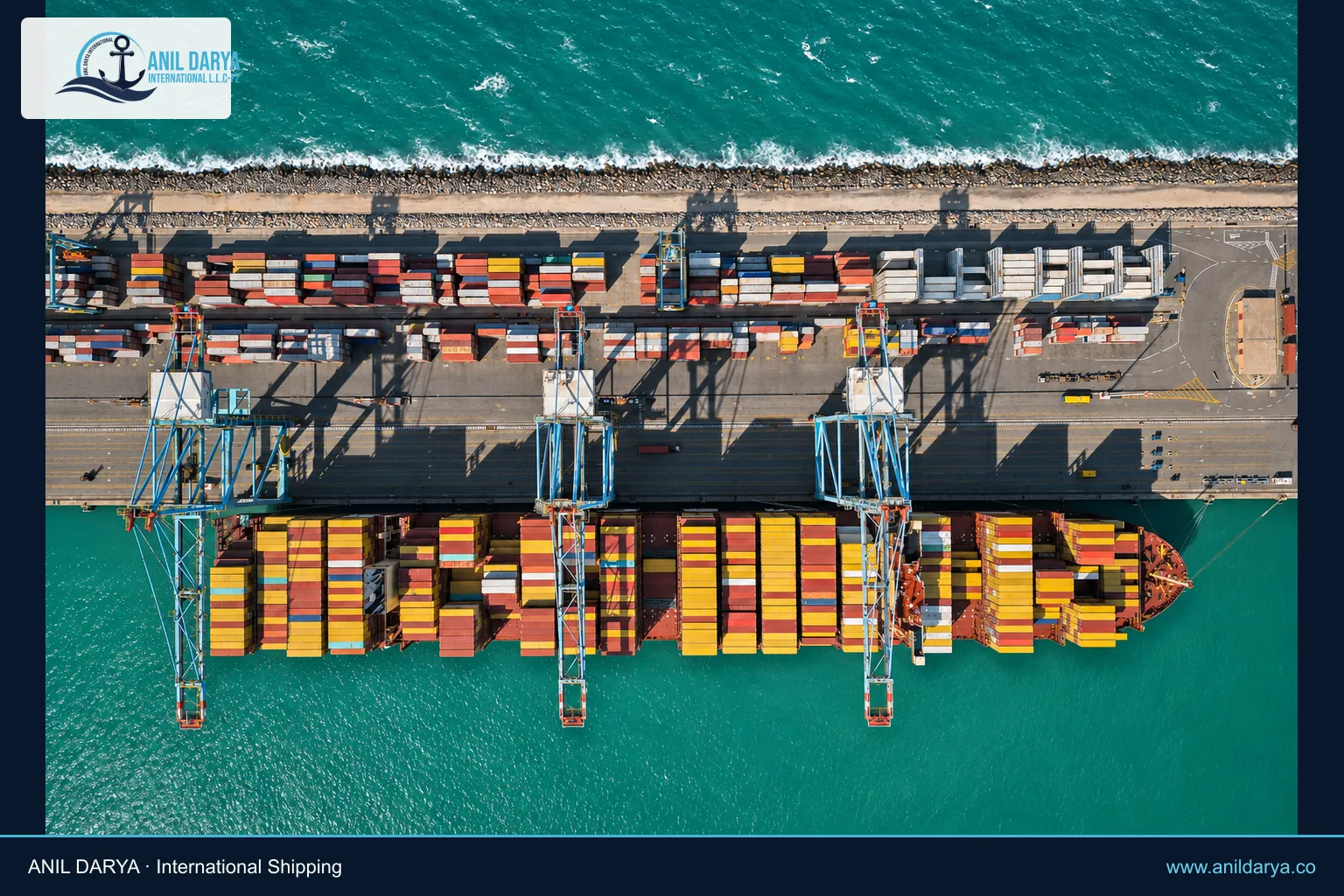
The port reports a natural depth of 15.4 m. In 2020 the Brazilian Navy's port captaincy for Ceara set an operational draft of 15.30 m for TMUT berths 7, 8 and 9, and allowed container ships up to 366 m long, 49 m beam and about 14,000 TEU. In August 2024 the 366 m MSC Jewel became the largest ship to call at the port.
What cargo moves through the Port of Pecem?
Pecem set a record in 2025 with about 20.96 million tonnes. Imports were 12.7 million tonnes, up 4.84%, and exports 7.8 million tonnes, up 11.12%. The mix tells you what the port is built for.
| Direction | Top products in 2025 | Tonnes |
|---|---|---|
| Imports | Iron ore and other ores | 3,894,627 |
| Imports | Cereals | 455,137 |
| Imports | Mineral fuels | 369,198 |
| Imports | Organic chemicals | 286,845 |
| Exports | Salt | 736,911 |
| Exports | Cast iron | 508,734 |
| Exports | Plastics | 271,522 |
| Exports | Organic chemicals | 221,566 |
Fresh fruit is a growing export. Shipments of melons, watermelons and papayas rose 27% in 2025, and fruit as a whole rose 14%.
On the long-haul side, Pecem is linked to 29 terminals abroad: 6 in the United States, 13 in Europe, 8 in Asia and 2 in South America.
Containers at Pecem
Containers drove the 2025 record. The port moved about 706,500 TEU, up 27% on 2024. APM Terminals, which provides container operations at Pecem, reported 706,524 TEU and its best ever month in August 2025 at over 70,000 TEU. Lines listed by APM Terminals at Pecem are Log-In Logistica, Maersk, COSCO, MSC, CMA CGM, Hapag-Lloyd and ONE.
Coastal shipping (cabotage) is a big part of the box trade. Reports covering 2022 to 2025 put cabotage at about 63% of container traffic, and in April 2025 the port listed seven cabotage lines and three long-haul lines. For you, that means many boxes reach Pecem on a coastal feeder after being transshipped at another Brazilian port.
The Asia line and what it means for cargo from the UAE
In 2025 MSC started a weekly Asia service at Pecem, called the Santana service, with APM Terminals as the terminal partner. When it was announced in April 2025, the planned rotation ran from China through South Korea, Panama, the Dominican Republic, Pecem, Suape, Salvador, Santos, India and Singapore. In its first 12 months it moved more than 103,000 TEU, about 15% of Pecem's containers, and about 47% of that volume was transshipment.
No published schedule we found shows a direct UAE call into Pecem. Cargo from Jebel Ali reaches Pecem through a transshipment hub, either on a deep-sea loop that calls Pecem or by coastal feeder from another Brazilian port. Cogoport's port data lists Mundra, Cochin and Pipavav in India among the inbound port pairs for Pecem, which fits a routing via the Indian west coast.
[AMIR-FACT: the carriers and transshipment hub we actually use from Jebel Ali to Pecem, whether the box arrives on a deep-sea call or a coastal feeder, and our real port-to-port days in 2026]
Container options to Pecem: FCL, LCL and reefer
Most cargo we would send from the UAE to Pecem moves in containers. Your choice is mainly about volume and how much handling the goods can take.
| Option | Fits | What to check for Pecem |
|---|---|---|
| FCL 20ft or 40ft | Full loads, machinery, building materials, chemicals in drums | Whether the carrier's service calls Pecem or ends at another port with a feeder |
| LCL | Small shipments, samples, spare parts | Whether the consolidator offers Pecem or only Santos, so you do not face an extra domestic leg |
| Reefer | Chilled or frozen food, some chemicals | Set temperature and ventilation on the booking, and a plug at every transshipment port |
| Flat rack or open top | Out-of-gauge machinery and steel | Carrier acceptance at the hub and on the coastal feeder |
For LCL, ask for a rate that ends at Pecem, not "Brazil". A rate to the southeast plus a domestic leg north can cost more than a small FCL. Our sea freight service can price both.
Breakbulk, project cargo and dangerous goods at Pecem
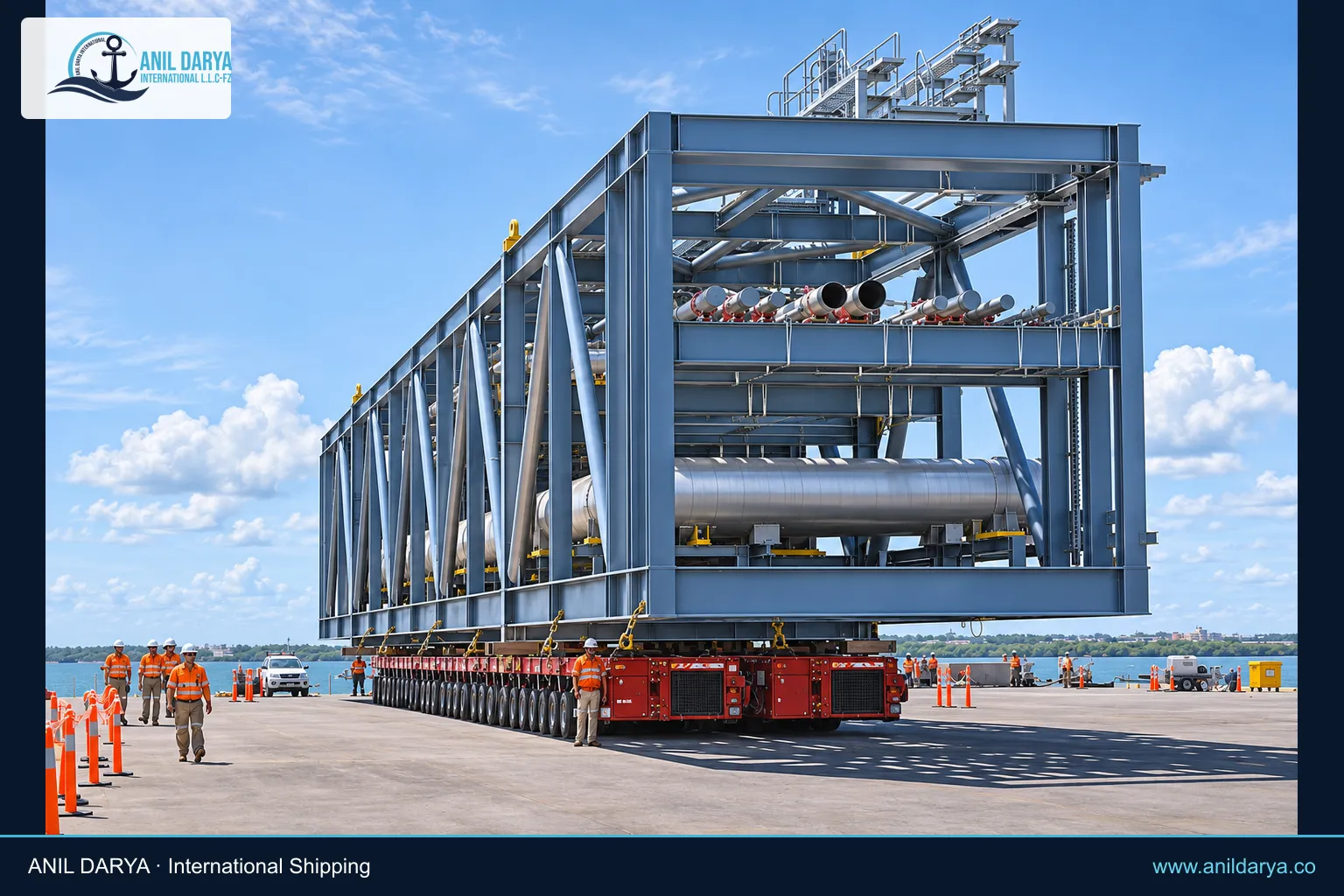
The port lists project cargo and oversized non-containerised cargo among its core cargo types, together with finished steel products such as plates and coils. Pier 1 takes non-containerised general cargo, and the TMUT takes both containerised and non-containerised cargo. The industrial complex around the port, with its steel plant, energy projects and free zone, is the main source of project moves.
When we plan a project or breakbulk shipment from the UAE to Pecem, we work in this order:
- Collect drawings, weights, dimensions and lifting points for every piece.
- Choose flat racks on a container service or conventional breakbulk tonnage.
- Confirm which pier the vessel will use, since everything must cross the access bridge to reach the yard.
- Agree lashing and securing with the carrier, and get the consignee's road plan from the port to the site.
- Line up customs before arrival so the cargo does not sit in storage.
Our guide to flat rack, open top and out-of-gauge cargo covers equipment limits, and our break bulk and project cargo team handles the UAE side.
Pecem handles liquid bulk at two piers, and organic chemicals and mineral fuels are among its top imports, so the port is used to hazardous cargo. For dangerous goods in containers, the rules that matter most are the carrier's and every transshipment port's acceptance of your IMDG class. We collect the SDS, UN number, class and packing group, and the signed DG declaration, then get acceptance from the line before you commit to a sailing. The Brazilian importer must also check whether the product needs consent from a Brazilian agency. Our dangerous goods shipping team runs these checks.
For full shiploads of bulk, see our bulk cargo service.
Inland links from the Port of Pecem: road, rail and free zone
Most containers leave by truck on the 60 km road to Fortaleza. A 22.5 km rail branch from the Transnordestina Logistica north line serves bulk today, and a new Transnordestina terminal at Pecem is expected in 2028, targeting 6 million tonnes in its first year. The ZPE Ceara free zone next to the port suits manufacturers that import inputs and export output.
Projects due in the next few years include a R$ 600 million tank terminal in 2027, the Transnordestina terminal in 2028, a green hydrogen hub and an LPG terminal.
Customs at the Port of Pecem: a short summary
The terminal has been a bonded customs area since April 2002, and clearance follows the same national rules as any Brazilian port. Our Santos guide covers the full Duimp process and the tax list. Here is the short version and what to watch at Pecem.
| Step | Who does it | What to watch at Pecem |
|---|---|---|
| Importer habilitation (Radar) | Brazilian importer | The Duimp is for importers outside the limited modality, so check the buyer's status before you ship |
| NCM code and agency consent | Importer and customs broker | Food, chemicals and regulated goods may need consent before loading |
| Duimp registration | Importer or its representative | Can be registered before the cargo arrives, which avoids yard time on the offshore terminal |
| Taxes and release | Importer and broker | II, IPI, PIS/COFINS, AFRMM, ICMS and the Siscomex fee are paid before release |
The government lists the documents common to every import declaration: bill of lading, commercial invoice, packing list, proof of origin, cargo manifest and documents that prove the sale. From the UAE, you send a matching invoice and packing list, the bill of lading, a certificate of origin if the importer needs one, and ISPM 15 marked wood packaging. Restricted goods such as food and cosmetics often need ANVISA or MAPA approval, so the importer should confirm this first.
Cogoport's port data showed average import dwell at Pecem of about 10 to 15 days between September 2025 and January 2026, so early document work pays.
Shipping from Dubai to Pecem: step by step
- Confirm the destination is Pecem (BRPEC), not the Port of Fortaleza, and give the consignee's city.
- Check with the importer that its habilitation is active and that NCM codes and any agency consents are settled.
- Send us the cargo details: commodity, HS code, weight, volume, packing, Incoterm and pickup point in the UAE.
- We quote FCL, LCL or breakbulk options and book space with a carrier that delivers to Pecem through a hub.
- We arrange trucking to Jebel Ali Port and UAE export clearance.
- For DG, reefer or out-of-gauge cargo, we get acceptance from the carrier and each hub before loading.
- We check the draft bill of lading against your invoice and packing list, then release the bill after sailing.
- The consignee's broker registers the Duimp, ideally before the vessel reaches Pecem.
- After release, the box is collected at the port and trucked to the consignee, and the empty goes back within free time.
How to ship from Pecem to Dubai
We also handle the reverse lane for UAE importers. Shipping from Pecem to Dubai fits the cargo the port already exports: fresh fruit in reefers, salt, cast iron, plastics and organic chemicals were among its top exports in 2025. We book space with carriers from Pecem through a hub to Jebel Ali Port, Khalifa Port or Sharjah, and take over at the UAE end. We have no office in Brazil, so the export side at origin is handled by the supplier or its forwarding agent.
| Stage | Who does it | What happens |
|---|---|---|
| Booking | We book with the carrier | Space from Pecem to the UAE port, with the hub and empty pickup confirmed for the supplier |
| Brazilian export clearance | Supplier or its origin agent | The exporter files a DU-E in the Portal Unico; the cargo is presented to customs, released, and the carrier reports the loading |
| Bill of lading | Carrier, checked by us | We check consignee, weights and HS codes against the invoice before release |
| UAE customs clearance | We arrange it through a licensed clearing agent | Declaration filed before arrival; duty in Dubai is 5% of CIF value for most goods |
| Delivery | We arrange it | Truck from the terminal to your site or free zone, empty returned within free time |
- Send us the supplier's details, the cargo, the Incoterm (FOB Pecem is common) and the UAE delivery address.
- We quote and book space, and send the booking to the supplier with the cut-off dates.
- The supplier stuffs the box, files the DU-E and gets the cargo released by Brazilian customs.
- We collect the invoice, packing list, certificate of origin and bill of lading, plus any UAE permit for restricted goods such as food.
- We file the UAE declaration before the vessel arrives, pay duty on your behalf if agreed, collect the delivery order and deliver.
Dubai Customs needs a customs business code from the importer, or a licensed clearing agent with the owner's authorisation. Import VAT also applies, and how it is paid depends on your VAT registration.
[AMIR-FACT: the carriers and hub we actually use from Pecem to Jebel Ali, and our real port-to-port days for this direction]
Free time, storage and demurrage at Pecem
Each carrier sets its own container free time at Pecem, and the terminal charges storage on its own tariff. We do not quote a figure here. Ask for both on the quote, especially if your box arrives on a coastal feeder, since free time may start at the first Brazilian port.
Send documents to the broker before the vessel sails. Slow clearance also raises the state ICMS tax, since storage goes into its base. Our article on demurrage and detention explains how the charges build up.
Pecem, Suape or Santos: which port fits your cargo?
| Question | Pecem | Suape | Santos |
|---|---|---|---|
| Where is the consignee? | Ceara and the north of the northeast | Pernambuco and the central northeast | Sao Paulo state and the southeast |
| Main strength | Iron ore, steel, fuels, fruit exports, free zone next door | Liquid bulk, vehicles, two container terminals | Largest service network in Brazil |
| Container route from the UAE | Via a hub or coastal feeder | Via a hub or coastal feeder | More direct deep-sea options |
If two ports could work, ask us to price both. In a country as long as Brazil, the inland or coastal leg often decides the total cost.
Checklist before you ship to the Port of Pecem
- Port code BRPEC on the booking, quote and bill of lading.
- Importer's habilitation active and broker named.
- NCM codes agreed; ANVISA or MAPA consent in place for regulated goods.
- Invoice and packing list match in weights, pieces and descriptions.
- Wood packaging ISPM 15 marked.
- Routing known: deep-sea call or coastal feeder, and which hub.
- For reefers, set temperature and ventilation on the booking.
- For DG, UN number, class, SDS and DG declaration ready, and every hub's acceptance confirmed.
- For breakbulk, drawings, weights and lifting points sent, and the pier confirmed.
- Free time and storage terms known before the box sails.
- For imports to the UAE: supplier ready to file the DU-E, UAE permits in hand and a customs business code or clearing agent authorised.
Common mistakes when shipping to Pecem
- Booking to Fortaleza when the cargo should go to Pecem, or the reverse. They are different ports with different codes.
- Accepting an LCL rate "to Brazil" that ends in the southeast, then paying for a long domestic leg north.
- Assuming free time starts at Pecem when the box first lands at a transshipment port in Brazil.
- Letting the box sail before NCM codes and agency consents are settled.
- Forgetting that every hub on a transshipped lane must accept your DG class.
- On imports to Dubai, waiting for the vessel to arrive before applying for a food or other UAE permit.
Frequently asked questions
Where is Pecem port located?
The Port of Pecem is on the west coast of Ceara state in northeast Brazil, between Caucaia and Sao Goncalo do Amarante, about 60 km from Fortaleza.
What is the port code for Pecem?
The UN/LOCODE for Pecem is BRPEC. Use it on bookings and bills of lading so the cargo is not sent to Fortaleza by mistake.
Who manages the port at Pecem?
The port is managed by CIPP S/A, a joint venture between the Government of Ceara and the Port of Rotterdam. APM Terminals provides container operations at the terminal.
How deep is the water at Pecem?
The port reports a natural depth of 15.4 m. The Brazilian Navy set an operational draft of 15.30 m at TMUT berths 7, 8 and 9, for container ships up to 366 m long.
Is there a direct ship from Dubai to Pecem?
We found no published direct UAE call at Pecem. Cargo from Jebel Ali usually moves through a transshipment hub and then on a deep-sea loop or a coastal feeder that calls Pecem.
Can you arrange shipping from Pecem to Dubai?
Yes. We book space with carriers from Pecem to Jebel Ali, Khalifa Port or Sharjah through a hub. The supplier or its agent handles Brazilian export clearance, and we arrange UAE customs clearance and delivery.
Can Pecem handle project cargo and heavy lifts?
Yes. The port lists project cargo and oversized non-containerised cargo among its cargo types. Pier 1 and the TMUT take non-containerised general cargo, and steel plates and coils move through the port.
How do I clear goods at the Port of Pecem?
The Brazilian importer or its broker registers a Duimp in the Portal Unico, which can be done before the cargo arrives, pays the import taxes and attaches the documents. The Receita Federal then releases the goods or selects them for checks.
Get a quote for Port of Pecem shipping
Send us your cargo details and the delivery city, and we will come back with a routing and a price, from Dubai to Pecem or from Pecem to Dubai. Use our freight rate inquiry form, or contact our team to talk through a breakbulk, project or DG shipment first. You can also read more about our Dubai freight forwarding team.
Sources
- Complexo do Pecem: home page (CIPP S/A joint venture, location, 2025 cargo total)
- Complexo do Pecem: Porto (piers, breakwater, cargo types)
- Complexo do Pecem: History (piers, start of operations, customs status 2002)
- O Povo: Pecem grows 7% with 20.9 million tonnes in 2025 (February 2026)
- Movimento Economico: Santana line moves 103,000 TEU in a year (May 2026)
- DatamarNews: Pecem to launch direct route to China (April 2025)
- DatamarNews: New bathymetry increases capacity at Pecem (July 2020)
- Movimento Economico: Largest ship in Pecem's history (August 2024)
- Portal In: Pecem turns 23 (depth, berths, Pecem Verde, lines), April 2025
- IAPH World Ports: Pecem container growth and infrastructure works (September 2025)
- APM Terminals: Pecem (2025 TEU, shipping lines)
- Wikipedia (Portuguese): Porto do Pecem (bridges, berths, rail branch)
- ZPE Ceara: export processing zone
- Cogoport: Port of Pecem data (dwell times, port pairs)
- Receita Federal: Preparing the Duimp
- Gov.br: Declare imported goods (documents)
- Invest and Export Brasil: Tax treatment on imports
- Receita Federal: Export via DU-E in the Portal Unico
- Dubai Customs: FAQ (duty rate, business code, clearing agents)
- UAE Government portal: Customs duty
- FreightAmigo: Shipping from Dubai to Brazil (Radar, ANVISA/MAPA, ISPM 15)
Reviewed: 10 November 2026