
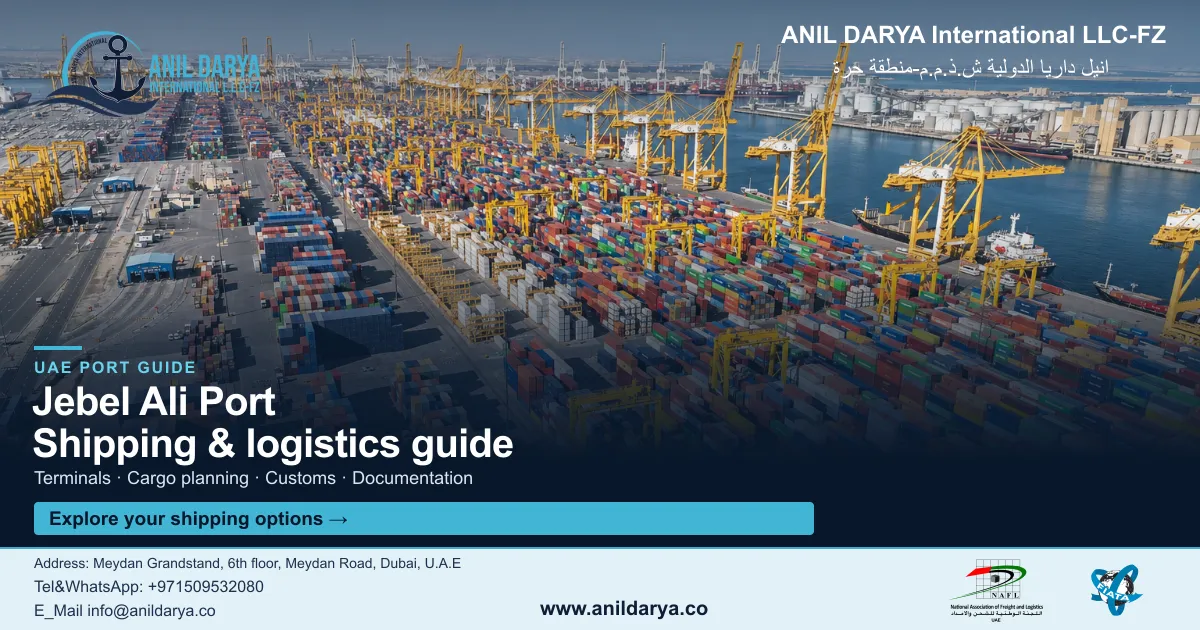
Jebel Ali port shipping covers most of the sea cargo that moves in and out of Dubai: containers, breakbulk, project cargo, vehicles and dangerous goods. The port is run by DP World, sits next to the Jebel Ali Free Zone (Jafza), and clears cargo through Dubai Customs. This guide covers the terminals, the port rules for dangerous goods, customs and how we move your cargo through the port.
Jebel Ali port guide: key facts at a glance
| Item | Detail |
|---|---|
| Operator | DP World |
| Port regulator for safety (EHS) | Trakhees, part of Ports, Customs and Free Zone Corporation (PCFC) |
| Customs authority | Dubai Customs |
| UN/LOCODE | AEJEA |
| Location | Jebel Ali, about 35 km southwest of Dubai city |
| Container terminals | Four (T1 to T4) |
| Annual container capacity | 19.4 million TEU |
| Containers handled in 2024 | 15.5 million TEU |
| Breakbulk handled in 2024 | 5.4 million metric tonnes, up 23% on 2023 |
| Berths and quay (whole port) | Over 100 berths, 25 km of quay |
| Shipping network | Over 80 weekly services to more than 150 ports |
| Vehicle storage | 75,000 CEU |
| Cargo types | Containers (dry and reefer), breakbulk, dry bulk, liquid bulk, Ro-Ro, project and out-of-gauge cargo, IMDG dangerous goods |
| Free zone next door | Jafza, over 11,000 businesses |
| Standard customs duty (Dubai) | 5% of CIF value (alcohol 50%, cigarettes 100%) |
| Import VAT | 5% standard rate |
Where is Jebel Ali Port and how does cargo reach it?
Jebel Ali Port is on the coast at Jebel Ali, about 35 km southwest of Dubai city. It sits directly next to Jafza, and Jafza lists Al Maktoum International Airport as a nearby hub, which matters if you plan sea-air moves or split shipments between modes.
DP World describes multimodal access by sea, air and land, with road, rail and inland waterway links and direct connections to Dubai's economic zones. For most shippers the practical link is the truck. Trucks enter the terminals on time slots booked through the Vehicle Booking System (VBS), and DP World also sells premium gate slots and direct truck access.
A simple rule: if your consignee is in Jafza, Dubai South or the Dubai industrial areas, the inland leg is short. For Abu Dhabi or the northern emirates, compare the truck cost against a closer port.
Which terminals does Jebel Ali Port have?
Jebel Ali is a multipurpose port with container, general cargo, liquid bulk and Ro-Ro operations on one site. The terminal on your booking decides where your truck goes.
Container terminals T1 to T4
| Terminal | Quay length | Berths | Quay cranes | Area |
|---|---|---|---|---|
| Terminal 1 | 3,242 m | 10 | 37 | 133.34 ha |
| Terminal 2 | 2,911 m | 8 | 32 | 184.56 ha |
| Terminal 3 | 1,860 m | 5 | 19 | 82.29 ha |
| Terminal 4 | 1,180 m | 3 | 13 | 76.44 ha |
Your carrier's service decides the terminal. Check it on the arrival notice before you book a truck.
Vehicles and Ro-Ro at Terminal 4
In 2025 DP World opened a 2.6 million sq ft vehicle yard at Terminal 4, adding 13,000 CEU of storage and taking the port's total to 75,000 CEU. A new 800 m quay there can work up to three Ro-Ro vessels at once, and Ro-Ro operations moved from Terminal 1 to the Terminal 4 zone. The port handled 545,000 vehicles in the first half of 2025, with imports making up 65% of that total.
Services inside the port
| Service area | What DP World offers |
|---|---|
| Quayside | Deep-water access, quad or dual lift container handling |
| Yard | Container repair, scanning and weighing, fumigation, reefer monitoring |
| Storage | Covered warehouses, container stack storage, empty depot management, project cargo storage |
| Intermodal | Barge access, road transport including DP World trucking, VBS gate slots |
| Value-added | Car stuffing and de-stuffing in containers, onsite vehicle inspections, customs agency services, logistics park facilities, digital track and trace |
What cargo can you ship through Jebel Ali?
Here is how each cargo type DP World lists usually moves through the port.
| Cargo type | How it moves | What to plan |
|---|---|---|
| General goods in containers | FCL or LCL through T1 to T4 | Terminal on the booking, free time, truck slot |
| Chilled and frozen food | Reefer containers on plug-in slots | Set temperature, ventilation, food import permits |
| Vehicles | Ro-Ro at the Terminal 4 zone, or cars stuffed in containers | Vehicle documents, inspection, storage time |
| Steel, machinery, equipment | Breakbulk on general cargo vessels, or flat racks | Lifting points, lashing, trailer type |
| Oversized and heavy-lift pieces | Project cargo on heavy-lift or breakbulk vessels | Drawings, lift plan, road permits |
| Chemicals and other DG | IMDG containers under port safety rules | Class limits on storage, approvals before arrival |
| Liquid and dry bulk | Bulk berths and liquid operations | Discharge plan, receiving facility, surveys |
FCL and LCL shipping to Jebel Ali Port
Most cargo through Jebel Ali moves in containers. You have two main options.
- FCL (full container load). You book a whole 20ft or 40ft box. It suits larger shipments and cargo you do not want handled with other goods.
- LCL (less than container load). Your cargo shares a container with other shippers and is consolidated or deconsolidated at a container freight station. It suits small volumes but adds handling and a few extra steps.
With LCL imports, the shared container is unpacked first, then your part is released, so your release also depends on the consolidator's paperwork. Send documents early and make sure carton marks match the packing list.
Reefer cargo needs a plug-in slot and monitoring, which the terminal provides. Tell us the set temperature and ventilation at booking. The break-even point between the two is often lower than people think. Our guide to FCL vs LCL costs walks through the maths. If you are unsure, ask us to price both.
Breakbulk, heavy-lift and project cargo at Jebel Ali
DP World reports 5.4 million tonnes of breakbulk in 2024, with imports making up about 80% of breakbulk shipments. The port has dedicated terminals for breakbulk, Ro-Ro and heavy-lift cargo, and DP World lists project cargo (out-of-gauge) and project cargo storage among its services.
Typical cargo includes steel, machinery, transformers and construction equipment. Cargo that fits a container but is too tall or wide goes on flat racks or open tops. Cargo that does not fit a container at all moves as conventional breakbulk on general cargo or heavy-lift vessels.
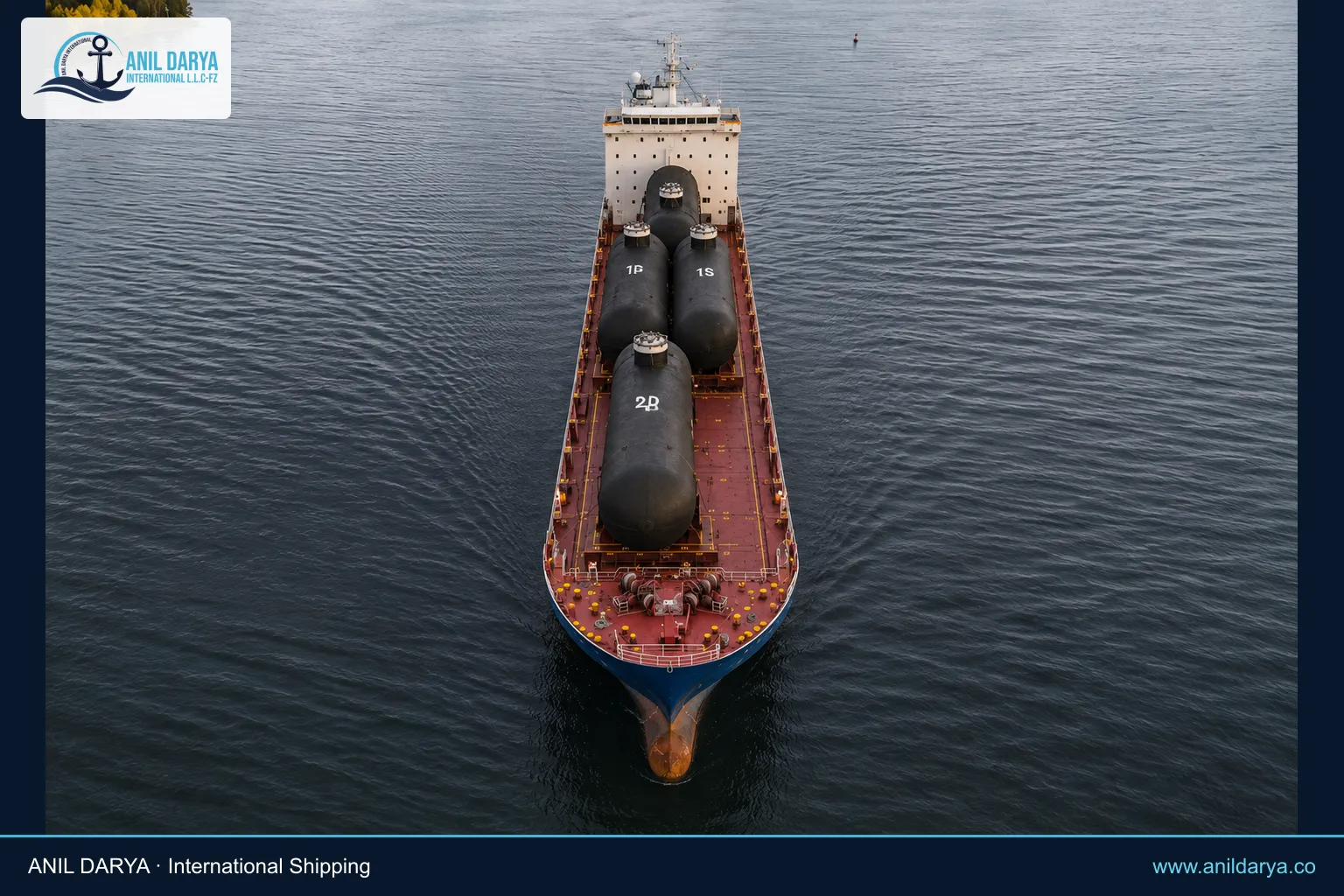
When you ship project cargo through Jebel Ali with us, we plan it in this order:
- Collect drawings, dimensions, weights and centre of gravity for each piece.
- Choose the vessel type: flat rack on a container ship, or conventional breakbulk or heavy-lift tonnage.
- Agree lifting, lashing and securing with the carrier and the terminal.
- Plan the road move from the quay, including any permits and escort the route needs.
- Line up customs so the cargo can leave the port quickly and avoid storage charges.
A useful decision rule: if a piece fits a 40ft flat rack by size and weight, a container service usually gives you more sailings. If it does not, you need breakbulk or heavy-lift tonnage, and the sailing date drives the whole plan. See our break bulk and project cargo service for what we cover.
Dangerous goods at Jebel Ali: what the port rules say
DP World lists IMDG dangerous goods among the cargo types the port handles. On top of the IMDG Code, the port safety regulator Trakhees (EHS, Ports and Maritime) issues circulars for specific classes. These set packaging rules and, most importantly, how long DG containers may stay in the port. The table below summarises the circulars we could read in full.
| Class | Circular | Import | Export | Transshipment |
|---|---|---|---|---|
| Class 8 (corrosives) | EHS/PM/04/12, July 2012 | Clear within 3 working days | No more than 3 working days in port | No more than 10 days in port |
| Class 1.4S (explosives, safety class) | EHS/PM/02/2013, May 2013 | No storage in port | No storage in port | Up to 8 days, with prior permission from the concerned authority (for example Dubai Police) |
| Class 2.1, UN 1057 (lighters and refills), 1 June to 30 September | Circular 01 of 2024, January 2024 | Direct delivery only, no storage | Accepted on the day of export only | Reefer containers only |
The Class 8 circular also limits stacking for packaging that is not UN-certified (plastic drums of 200 litres and above in a single tier) and asks for a Container Packing Certificate at loading. Cargo that needs temperature control must move in reefers. Breaking these rules can lead to fines.
Other classes, including Class 5, also have local requirements, which we confirm with the carrier and terminal for each booking. Circulars change, so treat the table as a planning guide.
What you need to provide for any DG booking:
- A correct UN number, proper shipping name, class and packing group.
- A Safety Data Sheet (SDS/MSDS) for each product.
- A Dangerous Goods Declaration signed by a trained person.
- UN-approved packaging, marks and labels on the packages and placards on the container.
- Any permit the UAE authorities require for your product.
Because import storage limits are short, prepare the customs declaration and the delivery order before the vessel arrives. Our dangerous goods shipping team checks the paperwork and the carrier's acceptance before you commit to a sailing.
Customs clearance at Jebel Ali: documents, duty and VAT
Dubai Customs handles declarations for cargo entering or leaving through Jebel Ali. Declarations are filed online through the Dubai Trade portal into Dubai Customs' Mirsal 2 system. Each declaration is risk-assessed, and the declarant then gets a clearance or a hold message. If the cargo is selected for inspection, it is examined before release.
Which documents does Dubai Customs need?
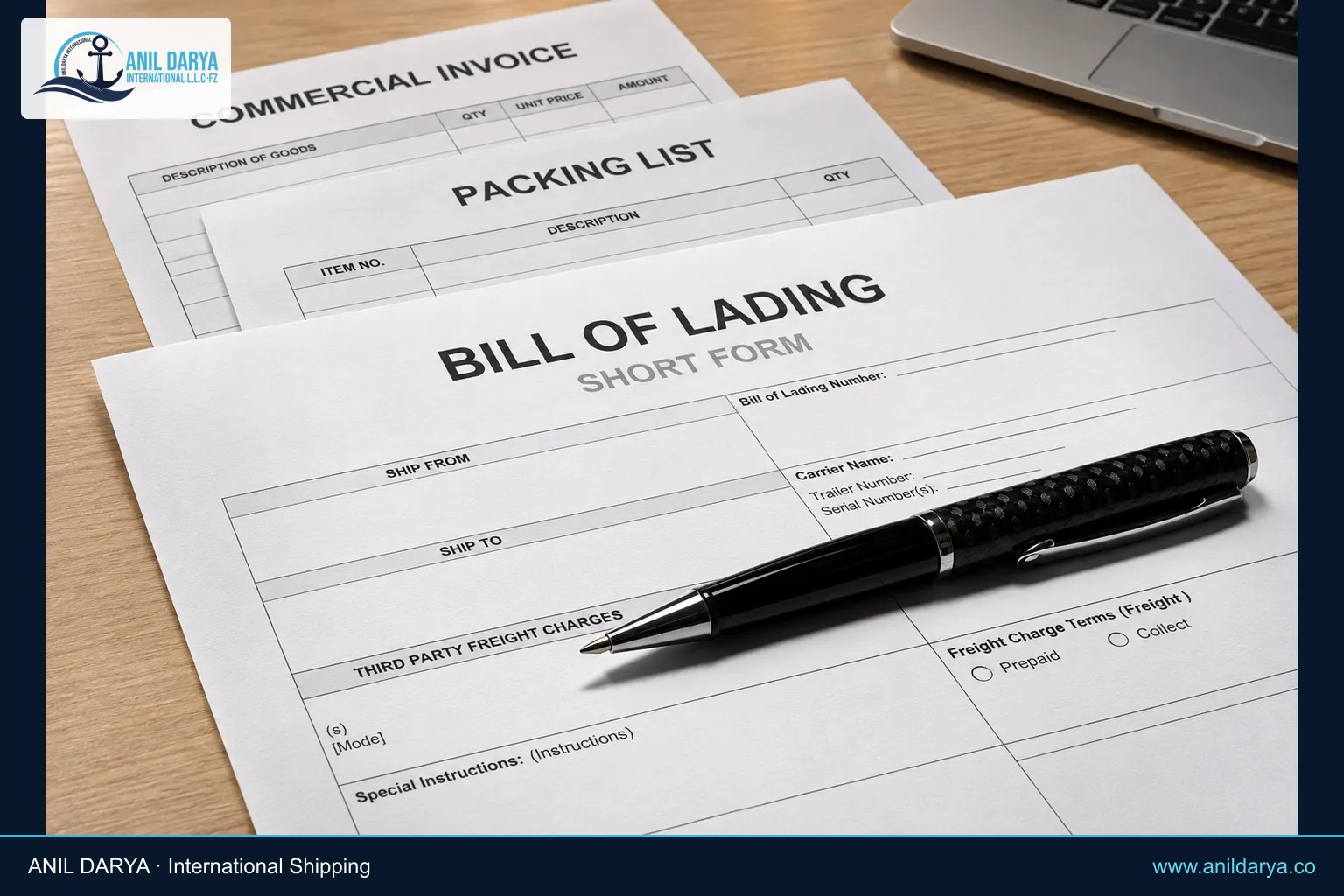
For a customs declaration, Dubai Customs lists an invoice, a packing list, a certificate of origin and a permit from the relevant authority if the goods are restricted. Sea cargo also needs the bill of lading and, on import, a delivery order from the shipping line. The table shows how this changes by cargo type.
| Cargo type | Core documents | Usually also needed |
|---|---|---|
| General cargo (FCL or LCL) | Invoice, packing list, certificate of origin, bill of lading, delivery order | Nothing more if goods are not restricted |
| Food and reefer cargo | Core set | Permit from the relevant food authority, health certificates from origin |
| Dangerous goods | Core set | DG declaration, SDS, any permit for the product, port approvals where the class requires them |
| Breakbulk and project cargo | Core set, with piece-by-piece packing list | Drawings and weights for the terminal, road permits for oversized moves |
| Vehicles | Core set | Vehicle ownership and specification documents |
| Restricted goods (for example medicines, telecom equipment, some chemicals) | Core set | Permit from the competent authority before clearance |
A missing permit is one of the most common reasons containers sit in the yard. Apply before the vessel arrives.
How much is customs duty and import VAT?
In Dubai, customs duty is 5% of the CIF value (cost, insurance and freight) for most goods. Alcohol is charged at 50% and cigarettes at 100%. Some goods carry different rates or are exempt, so check the rate for your HS code.
Import VAT is 5% on top. If the importer is VAT-registered and has linked its customs registration number to the Federal Tax Authority, no VAT is charged at import and it is accounted for on the VAT return instead. If the importer is not registered, VAT must be paid before customs releases the goods.
Who can file the declaration?
Any business that uses Dubai Customs services must register and get a customs business code, which is done online through Dubai Trade. Clearing agents with a Dubai Economic Department clearing and forwarding licence can also file, as long as they have their own business code and the owner's authorisation. If you do not have a code, we arrange clearance through a licensed clearing agent acting on your authorisation.
Which declaration type do you need?
| What happens to the goods | Declaration | Duty effect |
|---|---|---|
| Sold or used in the UAE mainland | Import for local use | Duty and VAT paid on import |
| Moved into Jafza | Free zone transfer | Duty applies only if goods later enter the mainland |
| Imported temporarily, then sent out again | Import for re-export or temporary admission | A deposit equal to the duty, refunded when goods are re-exported on time |
| Passing through to another country | Transit | Goods are not imported into the UAE |
Getting the declaration type right at the start saves duty refunds and amendments later.
Jebel Ali Port or Jafza: where should your cargo be delivered?
Jebel Ali Port is the seaport. Jafza is the free zone next to it, operating since 1985 and home to over 11,000 businesses. They are different delivery points with different paperwork.
- Deliver to the mainland if the goods will be sold or used in the UAE. Duty and VAT apply at import.
- Deliver into Jafza if you hold a Jafza licence and want to store, repack or re-export the goods.
- Use re-export or transit if the cargo is only passing through Dubai on its way to another market.
We explain the re-export side for bulk and breakbulk cargo in our guide to Jafza re-export.
How to ship to Jebel Ali Port: import step by step
This is how we handle a typical import through Jebel Ali. We book space, arrange clearance, trucking and documents. The terminal handles the cargo on the quay.
- Tell us about the cargo. Commodity, HS code, weight, volume or dimensions, origin and the Incoterm you agreed with your supplier.
- Get a quote and pick the routing. We compare carrier services into Jebel Ali and confirm which terminal each uses.
- Book space. For DG, reefer or out-of-gauge cargo we get carrier acceptance first.
- Check documents before sailing. Invoice, packing list, certificate of origin, permits and the draft bill of lading. We check that names, weights and HS codes match across all of them.
- File the declaration before arrival. We file the right declaration on Dubai Trade so clearance is ready when the vessel berths.
- Pay charges and collect the delivery order. Duty, VAT if due, and the shipping line's local charges are settled, and the line issues the delivery order.
- Book the truck and deliver. We book the VBS slot at the right terminal and deliver to your site or warehouse.
- Return the empty. We return the container to the depot the line names, within free time, and send you the closing documents.
Exporting from Jebel Ali: step by step
- Confirm the cargo. We check whether the goods need an export permit or a certificate of origin.
- Book space and get the cut-offs. The carrier gives you the vessel, the terminal, and the cut-off times for documents and container gate-in.
- Release the empty and stuff the container. We arrange the empty container, stuffing at your site or a warehouse, and the seal. DG cargo is packed and placarded to the IMDG Code.
- File the export or re-export declaration. Use export for UAE goods and re-export for goods that came in from abroad.
- Gate-in before the cut-off. The truck delivers the full container to the terminal on a booked slot. DG containers must meet the port's storage limits, so we time the gate-in close to the sailing.
- Bill of lading. We send the instructions, check the draft and release the final bill after sailing.
Free time, demurrage and detention at Jebel Ali
Shipping lines give free days for their container. After that, demurrage runs while the full container stays in the port, and detention while you keep it outside. Free days and daily rates differ by carrier and container type, so read them on your quote and arrival notice.
Three things keep these costs down: file the declaration before arrival, have permits ready before the vessel berths, and book delivery and empty return before the free time starts. Ask for extra free time at booking if clearance will be slow. Our article on demurrage and detention shows how the charges are calculated.
Checklist before you ship
- HS code confirmed for every item.
- Invoice, packing list and bill of lading show the same weights, piece counts and consignee.
- Certificate of origin issued and, if needed, legalised.
- Permits for restricted goods applied for before the vessel arrives.
- Consignee in the UAE has an active customs business code, or a licensed agent is authorised to file.
- VAT registration linked to the customs code, if you want to defer import VAT.
- Declaration type chosen: local import, free zone, re-export or transit.
- For DG: SDS, DG declaration, packaging and labels, carrier acceptance, and a plan that meets the class storage limit.
- For project cargo: drawings, lifting points and a road route plan.
- Free time on the container agreed with the carrier.
- Cargo insurance arranged, which matters most for high-value goods and heavy lifts.
Common mistakes
- Wrong declaration type. Declaring goods for local import when they are going to be re-exported means you pay duty you may not owe.
- Mismatched documents. A different weight on the invoice and the bill of lading can hold clearance until it is fixed.
- Late permits. Applying for a permit after the vessel arrives runs up storage and container charges.
- Ignoring free time. Every extra day after free time adds demurrage or detention. Plan the delivery before the cargo lands.
- Wrong terminal on the truck booking. The truck goes to the wrong gate and you lose the slot.
- Treating DG like general cargo. Undeclared or misdeclared dangerous goods can be rejected, delayed or fined.
- No VAT link on the customs code. A VAT-registered importer who has not linked the codes pays VAT up front instead of deferring it.
Jebel Ali or another UAE port: which fits your cargo?
Jebel Ali is the default choice for most containers to and from Dubai. Other ports can make sense in some cases:
| Your situation | Port to compare | Why |
|---|---|---|
| Containers for Dubai, Jafza or re-export | Jebel Ali | Largest service network and the free zone next door |
| Site in Abu Dhabi or the western region | Shipping through Khalifa Port in Abu Dhabi | Can cut the inland truck leg |
| Cargo for Sharjah or the northern emirates | Sharjah port shipping, or Saqr Port in Ras Al Khaimah | Closer to some northern consignees |
| East coast delivery, bulk or liquid cargo | Fujairah port shipping | East coast location and bulk handling |
We compare the two Dubai-area options in our Jebel Ali and Sharjah port comparison.
The right port depends on where the cargo finally goes, the carriers on your trade lane and the cargo type. We can price more than one port so you can compare the total cost to your door.
Frequently asked questions
Who operates Jebel Ali Port?
DP World operates Jebel Ali Port. It runs the four container terminals as well as the general cargo, liquid bulk and Ro-Ro operations at the port.
How many terminals does Jebel Ali Port have?
Jebel Ali has four container terminals, T1 to T4, plus dedicated areas for breakbulk, heavy-lift, liquid bulk and Ro-Ro cargo. Your carrier's service decides which container terminal your box uses.
What is the port code for Jebel Ali?
The UN/LOCODE for Jebel Ali is AEJEA. You will see it on bookings, bills of lading and tracking systems.
What documents do I need to clear cargo at Jebel Ali?
Dubai Customs asks for a commercial invoice, packing list, certificate of origin and any permit needed for restricted goods. For sea cargo you also need the bill of lading and, on import, a delivery order.
What is the customs duty on goods imported through Jebel Ali?
Customs duty in Dubai is 5% of the CIF value for most goods, with 50% on alcohol and 100% on cigarettes. Import VAT of 5% also applies, though VAT-registered importers can defer it to their VAT return.
Do I need a customs broker to clear goods at Jebel Ali?
You need a customs business code to file a declaration yourself. If you do not have one, a licensed clearing agent with its own code and your authorisation can file for you.
Can I ship dangerous goods through Jebel Ali?
Yes, Jebel Ali handles IMDG dangerous goods. Some classes have strict storage limits set by the port regulator, for example Class 8 imports must be cleared within 3 working days, so plan clearance before the vessel arrives.
Is Jebel Ali Port the same as Jafza?
No. Jebel Ali Port is the seaport run by DP World, and Jafza is the free zone next to it with over 11,000 businesses. Goods can move from the port into Jafza under a free zone declaration.
Can I import goods temporarily and send them out again without paying duty?
Yes. For temporary admission or import for re-export, Dubai Customs takes a deposit equal to the duty and refunds it when the goods are re-exported within the allowed time.
Get a quote for Jebel Ali Port shipping
Send us your cargo details and we will come back with a routing and a price for shipping through Jebel Ali. Use our freight rate inquiry form, or contact our team if you want to talk through a breakbulk, project or DG shipment first. You can also read more about our Dubai freight forwarding team.
Sources
- DP World: Jebel Ali Port (terminals, services, cargo types, connectivity)
- DP World: Highest cargo volumes at Jebel Ali Port since 2015 (February 2025)
- DP World: Vehicle capacity expansion at Jebel Ali (August 2025)
- Dubai Customs: Submit Customs Declaration
- Dubai Customs: Frequently asked questions (duty rate, business code, clearing agents, deposits)
- Dubai Customs: Mirsal 2 declaration channels
- UAE Government portal: Customs duty and tariff
- Federal Tax Authority: VAT guide (VAT rate and import VAT)
- Trakhees EHS circular EHS/PM/04/12: Class 8 cargo
- Trakhees EHS circular EHS/PM/02/2013: Class 1.4S containers
- Trakhees circular 01 of 2024: Class 2.1 UN 1057
- Jafza: About Jebel Ali Free Zone
- Wikipedia: Port of Jebel Ali (location, UN/LOCODE)
Reviewed: 9 November 2026