
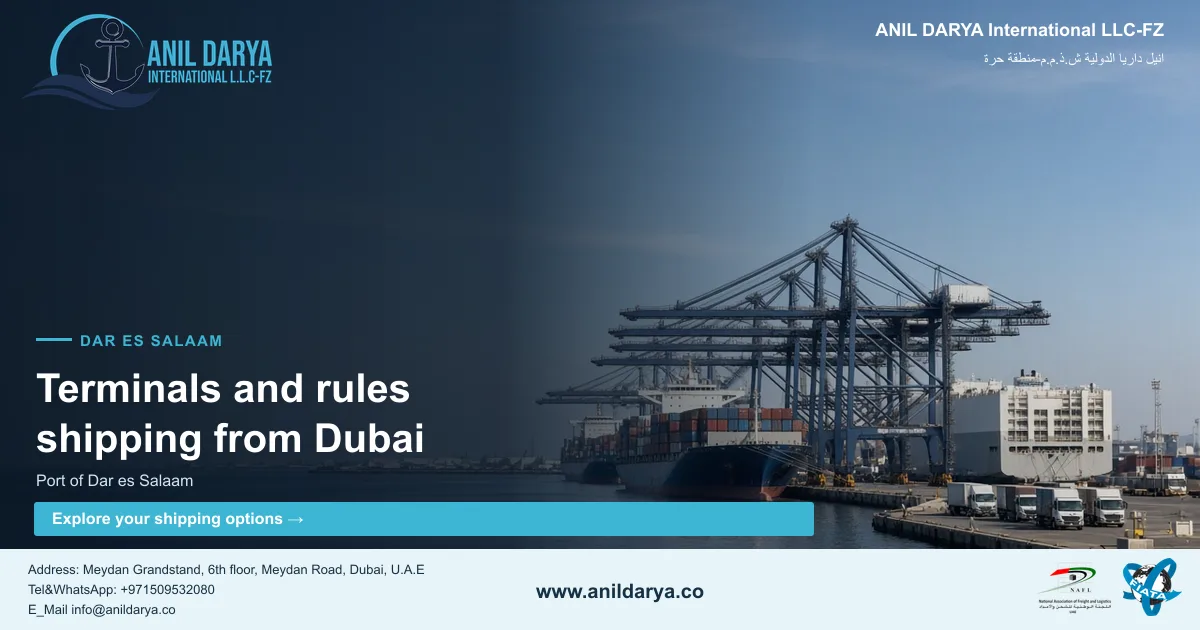
Dar es Salaam port shipping covers about 95% of Tanzania's international trade and a large share of the cargo for Zambia, the DRC, Rwanda, Burundi, Malawi, Uganda and Zimbabwe. The port is owned by the Tanzania Ports Authority (TPA), with DP World running the multi-purpose terminal and Adani Ports running Container Terminal 2. This guide covers the berths, cargo types, port rules and charges, customs, and how to ship to Dar es Salaam from Dubai. We ship both ways: from Dubai to Dar es Salaam, and from Dar es Salaam to Dubai.
Dar es Salaam port shipping: key facts at a glance
| Item | Detail |
|---|---|
| Port authority | Tanzania Ports Authority (TPA) |
| UN/LOCODE | TZDAR |
| Location | Kurasini, Dar es Salaam, on Tanzania's central coast |
| Share of national trade | About 95% of Tanzania's international trade |
| Rated capacity | 14.1 million tonnes dry cargo, 6.0 million tonnes bulk liquid |
| Quay | About 2,600 m, berths numbered 0 to 11, plus 2 oil jetties and a single point mooring |
| Draft (TPA) | Berths 0 to 7: 14.5 m. Berths 8 to 11: 13.5 m |
| Maximum vessel length | 305 m LOA |
| Port area | 1,090,000 sq m |
| Multi-purpose terminal | DP World, Terminal 1, berths 0 to 7, 30-year concession, operating since April 2024 |
| Container Terminal 2 | Adani Ports via TICTS, berths 8 to 11, rated 1 million TEU a year |
| Customs | Tanzania Revenue Authority, declarations in TANCIS |
| Free storage, FCL import | 5 days local, 15 days transit (TPA tariff, January 2026) |
| Landlocked countries served | Zambia, DR Congo, Burundi, Rwanda, Malawi, Uganda, Zimbabwe |
| Shipping Dar es Salaam to Dubai | Export documents in TANCIS by a licensed agent; import declaration with Dubai Customs, 5% duty and 5% VAT for most goods |
Who runs the port of Dar es Salaam?
TPA owns and regulates the port and sets the tariff. Since 2024, two private operators have run most of the cargo berths under 30-year concessions:
- DP World runs the multi-purpose Terminal 1 (berths 0 to 7). It took over in April 2024 on a build, operate and transfer basis and has committed over USD 500 million to the terminal.
- Adani Ports runs Container Terminal 2 (berths 8 to 11) through Tanzania International Container Terminal Services (TICTS). Adani signed its concession in May 2024.
This split matters to you. Your shipping line's service decides which terminal your container uses, and that decides where your clearing agent and truck go. Check the terminal on the arrival notice.
Terminals and berths at Dar es Salaam port
| Berth or facility | Operator | Main use | Draft or capacity |
|---|---|---|---|
| Berth 0 | DP World | Pure car carriers (Ro-Ro vehicles) | 12.9 m chart datum |
| Berths 1 to 4 | DP World | Breakbulk and dry bulk vessels | 14.5 m |
| Berths 5 to 7 | DP World | Containers, 550 m quay, two vessels at once | 14.5 m |
| Berths 8 to 11 (CT2) | Adani Ports (TICTS) | Containers, four berths | 13.5 m (TPA); 1 million TEU a year |
| Grain terminal | DP World | Grain, with bagging | 30,000 tonne silo |
| Kurasini Oil Jetty and single buoy mooring | TPA | Bulk oils and crude | Listed in the TPA tariff |
CT2 handled 0.82 million TEU in 2023, about 83% of Tanzania's container volume, according to Adani. DP World lists over 8,000 TEU of container yard capacity at Terminal 1, stacked up to 5 high, a general cargo yard for 150,000 tonnes and a 12,000 sq m warehouse for export services.
Inland container depots (ICDs)
When the quay yards fill up, containers and vehicles are moved to inland container depots near the port. DP World describes these as port extension facilities used to decongest the terminal. The UN Logistics Cluster notes that removal and storage fees apply once cargo is sent to an ICD. Ask your clearing agent where your box will be held before you plan collection.
What cargo can you ship through Dar es Salaam?
| Cargo type | Where it moves | What to plan |
|---|---|---|
| Dry containers (FCL, LCL) | DP World berths 5 to 7 or Adani CT2 | Terminal on the booking, TANCIS lodgement before arrival |
| Reefer containers | Container berths | 30% surcharge on handling cold storage cargo |
| Vehicles | Berth 0 car carrier operations or in containers | Excise by vehicle age, PVoC for used vehicles |
| Steel, machinery, project cargo | Berths 1 to 4, or flat racks on container ships | 30% surcharge on out-of-gauge handling, inland permits |
| Grain and dry bulk | Berths 1 to 4 and the grain terminal | Discharge rate, bagging, trucks or wagons on standby |
| Fuel and liquid bulk | Oil jetties and single buoy mooring | Receiving tanks, surveys |
| Dangerous goods | All terminals, under TPA DG rules | Direct delivery, daily surcharge after 24 hours |
Container shipping at Dar es Salaam: FCL, LCL and reefer
Most general cargo from the UAE arrives in 20ft and 40ft containers. With FCL you get a sealed box and a single consignee, so release depends only on your own documents. With LCL, the container is stripped first and your share is released after the consolidator's paperwork clears, which uses up free time.
TPA gives domestic import FCL containers 5 free days after discharge and posting in the TRA system. From day 6 to day 15 it charges USD 20 per day for a 20ft box and USD 40 for a larger one, and double that after day 15. Shipping line demurrage runs separately. Our guide to demurrage and detention shows how both clocks add up.
For reefers, tell us the set temperature at booking and make sure food permits are ready before the vessel arrives. Our sea freight service books FCL, LCL and reefer space.
Breakbulk, project and bulk cargo at Dar es Salaam
Dar es Salaam is a busy breakbulk port. Construction, mining and energy projects in Tanzania and its neighbours bring steel, machinery and heavy lifts. DP World's Terminal 1 has four berths (1 to 4) at 14.5 m for breakbulk and dry bulk ships.
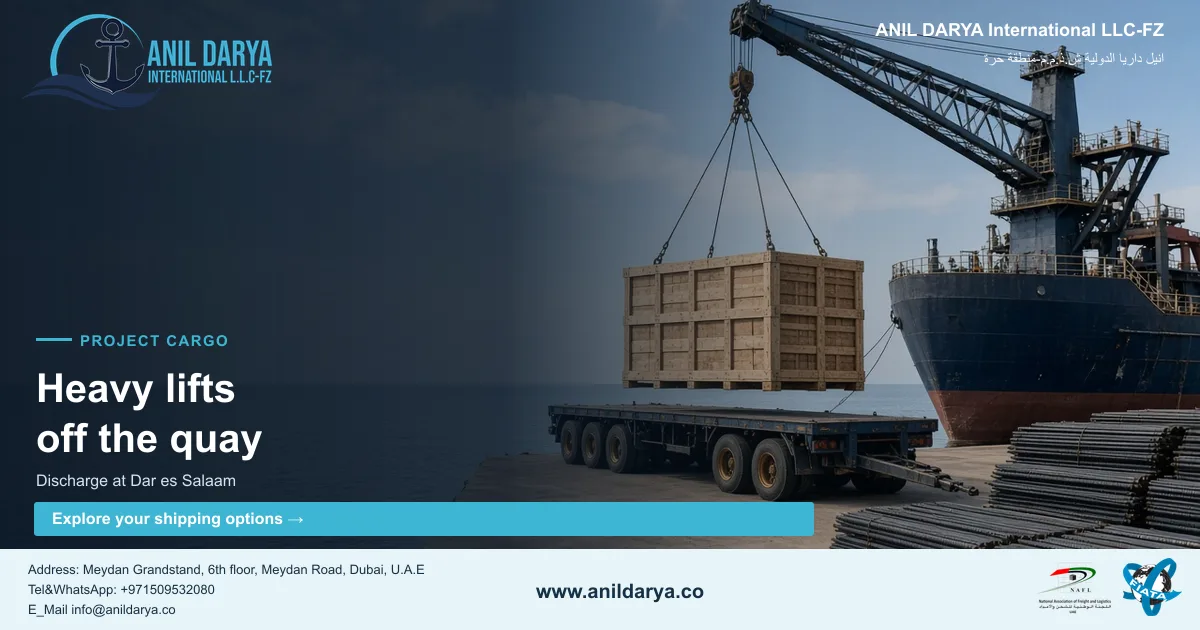
Plan these points before you book:
- Send drawings, dimensions, weights and the centre of gravity for each piece.
- Choose flat rack or open top on a container service, or a breakbulk or heavy-lift vessel.
- Budget for TPA's 30% surcharge on handling out-of-gauge cargo.
- Arrange trucks or wagons for direct delivery from the quay, which avoids port storage.
- Plan the inland route, including permits for wide or heavy loads.
Our article on flat rack, open top and breakbulk options helps you pick the right equipment, and our break bulk and project cargo service handles the lift and lashing plan.
For grain, fertiliser and other dry bulk, the DP World grain terminal offers a 30,000 tonne silo with bagging. TPA gives grain 10 free storage days for domestic cargo and 15 for transit. For bulk parcels and charters from the UAE, see our bulk cargo service.
Vehicles are a growing trade. DP World reports that the car carrier RAMHAN discharged 779 car equivalent units in just over 27 hours in 2026, and that discharge time for comparable cargo fell from over 300 hours to under 28 hours.
Dangerous goods at Dar es Salaam: what TPA requires
TPA's January 2026 tariff sets clear rules for IMDG cargo:
| Rule | What it means for you |
|---|---|
| DG must be declared by class, not trade name, on all clearance documents | Product names alone are not accepted |
| DG cargo is secured and guarded by TPA's Fire and Safety Unit after discharge | The cargo is held in a controlled area |
| 24 hours free time after discharge, then a daily surcharge | USD 24 per TEU for containers, USD 1.20 per harbour tonne for conventional cargo |
| 10% surcharge on handling DG cargo | Applies to loose and containerised cargo |
The practical answer is direct delivery. TPA defines it as cargo discharged straight from the ship onto the consignee's truck, wagon or pipeline without using port storage. That needs a lodged declaration, paid taxes and transport on the quay when the ship berths. Our dangerous goods shipping team checks DG documents and carrier acceptance before the cargo leaves the UAE.
Some chemicals, including chemicals used by mining companies, are exclusive items that only TASAC may clear into Mainland Tanzania. Keep them on their own bill of lading.
Free storage and port charges at Dar es Salaam
| Cargo | Free storage (TPA, January 2026) |
|---|---|
| Domestic import FCL container | 5 days after discharge and posting in the TRA system |
| Transit import FCL container | 15 days after the ship completes discharge |
| Domestic import conventional cargo | 5 days |
| Transit import conventional cargo | 15 days |
| Domestic export FCL container | 5 days from acceptance |
| Transit export FCL container or cargo | 21 days |
| Empty containers | 5 days after stripping advice |
| Dangerous goods | 24 hours |
Two deadlines matter most. Import cargo with no documents accepted within 21 days of the vessel breaking bulk can be moved to a customs warehouse or ICD with all charges due. Entered goods left in the port for more than 90 days can be sold.
Customs clearance at Dar es Salaam port
TRA clears goods under the East African Community Customs Management Act 2004. The importer appoints a licensed clearing and forwarding agent, who lodges the declaration in TANCIS. TRA urges agents to lodge at least 7 days before arrival. TPA's own advice is the same: give your shipping documents to a registered clearing agent, who lodges them with TPA and TRA.
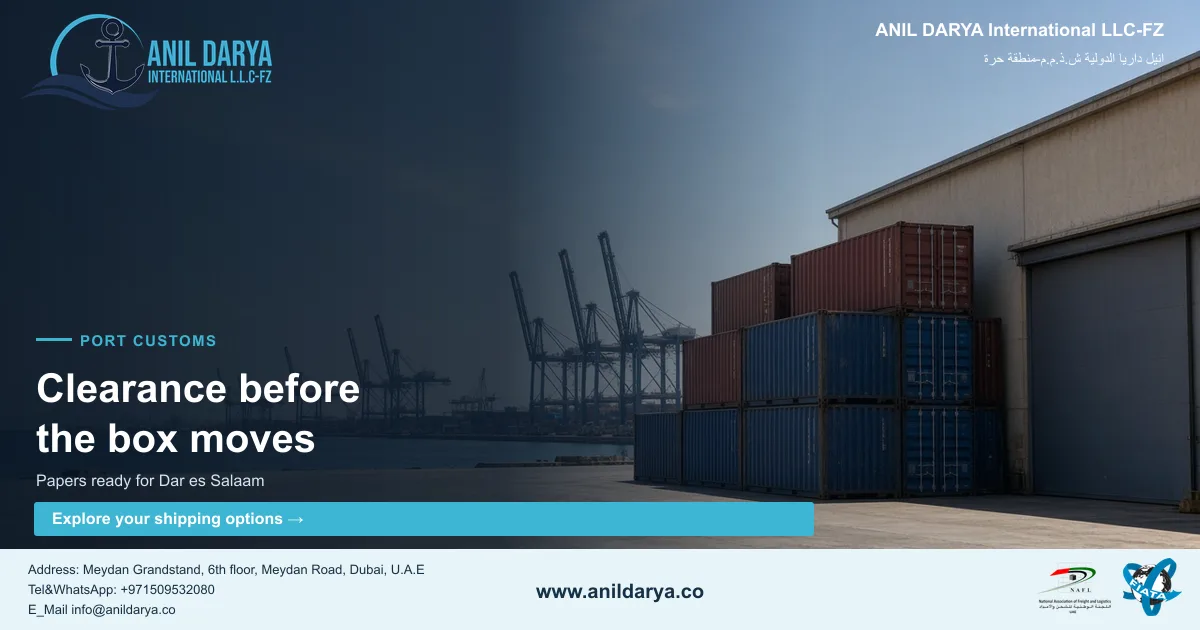
Documents for clearance
- Final commercial invoice and packing list.
- Bill of lading or air waybill.
- Agent's authorisation letter from the importer.
- Import permits from TMDA, TBS, TASAC or other bodies, if required.
- TBS Certificate of Conformity for goods under the PVoC programme.
- Exemption documents, if a duty exemption applies.
TANCIS rejects incomplete declarations and vague goods descriptions automatically. Use the same goods description on every document.
Collecting cargo from the port
TPA receives and delivers cargo 24 hours a day, 7 days a week. To collect, the trucker needs the vessel name and voyage number, the ocean bill of lading number, the case numbers and marks, and the delivery order.
Duty and taxes
Goods from the UAE pay the EAC Common External Tariff: 0%, 10%, 25% or 35% depending on the goods. VAT is 18%, the Railway Development Levy is 2% of CIF and the Customs Processing Fee is 0.6% of FOB.
Transit cargo through Dar es Salaam to landlocked countries
Transit cargo gets 15 days of free storage for import FCL containers, three times the local allowance. The way it clears depends on the destination:
- Rwanda, Burundi and Uganda use the EAC Single Customs Territory. One declaration is lodged in the destination country, and the goods move under electronic cargo tracking or a regional bond.
- Zambia, Malawi, the DRC and Zimbabwe are outside it. The cargo moves through Tanzania under transit procedures and clears as an import at destination.
The UN Logistics Cluster lists the main links out of the port. By road, the A7 runs to Dodoma, Mwanza, Arusha and Mbeya, and the B12 continues to Tunduma for Zambia and on to Malawi. By rail, TAZARA runs towards Zambia, and the TRC central line runs to Tabora, Mwanza and Kigoma.
How to ship from Dubai to Dar es Salaam: step by step
Two carrier-published services show the options from the UAE. Emirates Shipping Line's weekly GIA service lists 15 days from Jebel Ali to Dar es Salaam. GT Lines' KTX shuttle, launched in August 2026, lists 9 days from Khorfakkan, sailing every 10 days. See our guide to Jebel Ali port shipping for the UAE side.
- Send us the cargo details: commodity, HS code, weight, dimensions, pickup address and final destination.
- Check PVoC and permits. We confirm whether a TBS Certificate of Conformity is needed before loading.
- Pick the load port and service. We compare Jebel Ali and Khorfakkan sailings and the Dar es Salaam terminal each one uses.
- Book space. For DG, reefer or out-of-gauge cargo we get carrier acceptance first.
- Stuff, inspect and seal. The PVoC agent inspects if needed, then we truck the container to the UAE terminal.
- File the UAE export declaration with Dubai Customs and gate in before the cut-off.
- Release documents. We send the bill of lading, invoice, packing list and CoC to the consignee's clearing agent in Dar es Salaam.
- Pre-lodge in TANCIS at least 7 days before arrival, then pay duties and collect within the free period.
[AMIR-FACT: our real experience at Dar es Salaam port (typical days from berthing to release on our shipments, or one real case), and which carrier or terminal we normally use]
How to ship from Dar es Salaam to Dubai
We also handle the other direction: shipping from Dar es Salaam to Dubai, with arrival at Jebel Ali, Khalifa Port or Sharjah port. We book the space with the carrier and run the UAE side. The Tanzanian export papers stay with the shipper or its Tanzania agent.
Two published services run this way. GT Lines lists 9 days between Dar es Salaam and Khorfakkan in both directions on its KTX shuttle. Emirates Shipping Line's GIA service goes from Dar es Salaam via Nhava Sheva and Mundra to Jebel Ali, and its July 2025 schedule lists 15 days.
The Tanzania export side
- Licensed agent. TRA requires the exporter to appoint a licensed clearing and forwarding agent, who uploads the documents to TANCIS before the goods are examined and released.
- Documents. The invoice, the packing list, the exporter's TIN certificate, an authorization letter, and export certificates from the relevant authority: agriculture for crops, livestock and fisheries, minerals, natural resources, or TMDA for health products.
- Export levies. Most exports are free of duty and taxes, but TRA lists levies on some goods. Raw cashew nuts, for example, pay 15% of FOB value or USD 160 per tonne, whichever is higher.
- Stuffing and loading. Cargo is stuffed at a container freight station under TRA supervision, and the shipping line files the export manifest after loading.
The UAE import side
We file the import declaration with Dubai Customs before the vessel arrives. Dubai Customs asks for the commercial invoice, the packing list, the certificate of origin and a permit from the relevant authority for restricted goods, and the carrier releases the cargo against the bill of lading. Customs duty in Dubai is 5% of the CIF value for most goods, with 50% on alcohol and 100% on cigarettes. Import VAT is 5%. A VAT-registered importer accounts for it on its VAT return under the reverse charge; anyone else pays it before the goods are released.
- Send us the shipper's details in Dar es Salaam, the cargo, the HS code and the UAE delivery address.
- We book space from Dar es Salaam and send the booking and cut-offs to the shipper.
- The shipper or its trucker stuffs the container and delivers it to the CFS or terminal named on the booking.
- The shipper or its Tanzania agent files the export declaration in TANCIS.
- We check the draft bill of lading against the invoice, packing list and certificate of origin.
- We file the UAE declaration with Dubai Customs before the vessel arrives.
- We arrange payment of the duty and VAT and collect the delivery order from the carrier.
- We truck the container to your site and return the empty to the depot the line names within free time.
[AMIR-FACT: the carriers we actually use from Dar es Salaam to Jebel Ali/Khalifa/Sharjah and our real transit days in this direction]
Checklist before you ship to Dar es Salaam
- HS code confirmed and PVoC status checked.
- Licensed clearing agent appointed by the importer.
- Invoice, packing list and bill of lading match.
- Local or transit status fixed before the vessel arrives.
- TASAC exclusive items on a separate bill of lading.
- Terminal (DP World or Adani CT2) checked on the arrival notice.
- Trucks or wagons booked for direct delivery of DG and breakbulk.
- Free time on the container agreed with the line.
Common mistakes at Dar es Salaam port
- Lodging the declaration after arrival. Only 5 free days apply to local containers.
- Shipping PVoC goods without a Certificate of Conformity.
- Leaving DG cargo in the port. The daily surcharge starts after 24 hours.
- Declaring transit cargo as local. You lose the 15-day transit free period and the wrong regime has to be corrected.
- Ignoring the 21-day overstay rule. Cargo can move to a customs warehouse with all charges due.
- Assuming every container goes to the same terminal. Check DP World or CT2 on the arrival notice.
Frequently asked questions
Who operates the port of Dar es Salaam?
The Tanzania Ports Authority owns and regulates it. DP World runs the multi-purpose Terminal 1 (berths 0 to 7) and Adani Ports runs Container Terminal 2 (berths 8 to 11), both on 30-year concessions.
What is the port code for Dar es Salaam?
The UN/LOCODE is TZDAR. You will see it on bookings, bills of lading and carrier schedules.
How deep is Dar es Salaam port?
TPA lists 14.5 m draft at berths 0 to 7 and 13.5 m at berths 8 to 11. DP World lists berth 0 for car carriers at 12.9 m chart datum.
How many free storage days does Dar es Salaam port give?
Under TPA's January 2026 tariff, domestic import containers get 5 free days and transit import containers get 15. Dangerous goods get 24 hours.
How long does shipping from Dubai to Dar es Salaam take?
Emirates Shipping Line lists 15 days from Jebel Ali on its weekly GIA service, and GT Lines lists 9 days from Khorfakkan on its KTX service. Clearance and delivery come on top.
Can Dar es Salaam port handle breakbulk and heavy lifts?
Yes. DP World's berths 1 to 4 take breakbulk and dry bulk ships at 14.5 m draft. TPA adds a 30% surcharge on handling out-of-gauge cargo.
Can I ship dangerous goods to Dar es Salaam?
Yes, if declared by IMDG class. TPA guards DG cargo after discharge and charges a daily surcharge after 24 hours, so plan direct delivery.
Which countries use Dar es Salaam port for transit?
TPA lists Zambia, DR Congo, Burundi, Rwanda, Malawi, Uganda and Zimbabwe among the landlocked countries it serves.
Can you ship from Dar es Salaam to Dubai?
Yes. The shipper's licensed clearing agent files the export documents in TANCIS. We book the space, file the Dubai Customs declaration, arrange payment of the 5% duty and 5% import VAT where due, and deliver from Jebel Ali, Khalifa Port or Sharjah.
Get a quote for Dar es Salaam port shipping
Send your cargo details through our freight rate inquiry form for sailings and a price to Dar es Salaam, or contact our team to plan breakbulk, bulk or DG cargo. You can also read about our Dubai freight forwarding team.
Sources
- Tanzania Ports Authority: Dar es Salaam Port (capacity, quay, drafts, LOA, area, trade share, landlocked countries)
- Tanzania Ports Authority: Tariff Book Sea Ports, January 2026
- Tanzania Ports Authority: FAQ (clearing and collecting cargo)
- DP World: Dar es Salaam terminal infrastructure
- DP World: Dar es Salaam overview (concession, investment)
- DP World: Record efficiency at Dar es Salaam port (July 2026)
- Adani Ports press release: Container Terminal 2 concession (31 May 2024)
- Maritime Executive: Adani takes over berths 8 to 11 (June 2024)
- Tanzania Revenue Authority: Import procedures
- Tanzania Revenue Authority: Taxes and duties at a glance 2025/2026
- Tanzania Revenue Authority: Value Added Tax (18% on imports)
- Tanzania Revenue Authority: Single Customs Territory
- Tanzania Bureau of Standards: Pre-shipment Verification of Conformity
- Clyde & Co: TASAC exclusive items regulations, GN No. 184 of 2025
- Logistics Cluster: Tanzania port assessment (ICDs, hinterland road and rail)
- Emirates Shipping Line: GIA service advisory, 25 July 2025
- GT Lines: KTX Khorfakkan Tanzania Express announcement, 27 July 2026
- Dubai Customs: Submit customs declaration (invoice, packing list, certificate of origin, permits)
- UAE Government portal: Customs duty (5% of CIF in Dubai, alcohol 50%, cigarettes 100%; GCC-origin goods and the 40% test)
- Federal Tax Authority: VAT Taxable Person Guide, chapter 9 Import of goods (5% rate, reverse charge, payment before release)
- TRA: Export procedures (licensed agent, TANCIS, documents, export levies)
Reviewed: 10 November 2026