
Preservation of equipment for shipping: VCI, desiccant and sealed wraps for long sea voyages
How to protect oil and gas equipment from corrosion on long sea voyages: VCI, desiccant and barrier foil, nitrogen blankets, oil mist, and what to check when the cargo arrives.
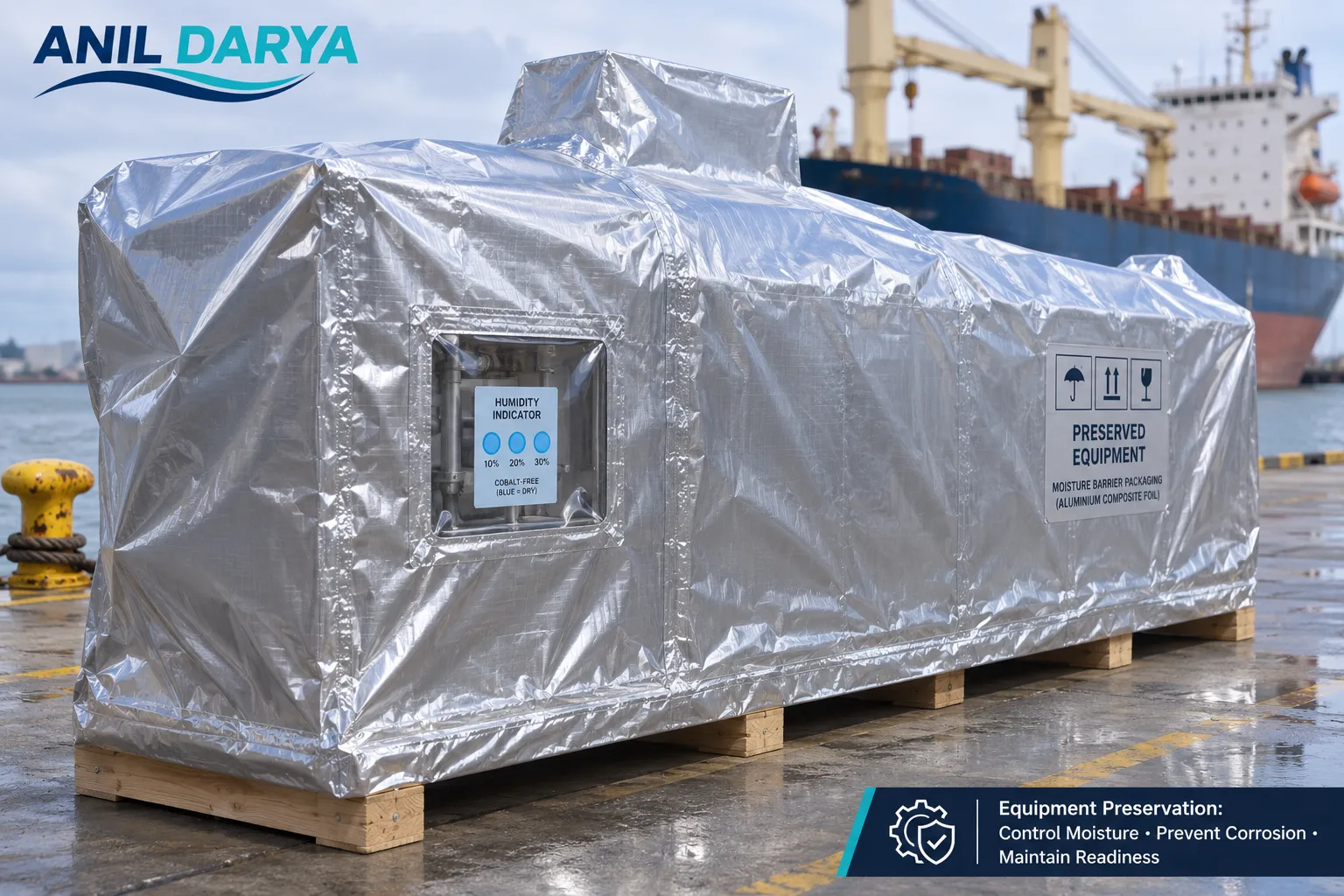
Preservation of equipment for shipping is the work that stops a new compressor, valve skid or pump from arriving rusty after six weeks at sea. Oil and gas equipment is often built in one country, shipped across oceans, then left in a laydown yard for months before installation. Salt air, temperature swings and trapped moisture do the damage, usually where nobody can see it: inside casings, under flanges and on machined faces. This guide explains the main methods used on project cargo, how to choose between them, and what to check when the cargo arrives.
The equipment maker's preservation specification comes first. Use what follows to ask the right questions and to plan the logistics around it.
Why sea voyages are hard on equipment
The GDV Container Handbook explains the mechanism. Warm air picks up moisture, and when it cools below its dew point the water condenses. On longer voyages temperature and humidity vary considerably, and sun on a steel deck or container roof drives large day-night swings. The result is "container sweat" on inner surfaces that drips onto cargo, and "cargo sweat" that forms directly on the cargo.
The handbook also notes that a closed box container is only spray-tight, not water-tight. Break bulk cargo on deck has no box at all. Moisture also comes from inside the shipment: wet timber dunnage, damp packaging and pallets all release water as they warm. Corrosion, discoloration and collapsed packaging are the typical results.
Time adds to the risk. Writing in Machinery Lubrication, Douglas Branham notes that machinery may sit in a storage yard for up to three years and goes through daily thermal cycles that draw moisture and dust in. A preservation plan has to cover the voyage and the wait at the other end.
Main methods for preservation of equipment for shipping
| Method | How it works | Good for | Watch out for |
|---|---|---|---|
| VCI (volatile corrosion inhibitor) film, paper or emitters | Inhibitor vapour fills an enclosed space and forms a thin protective layer on bare metal | Machined parts, spares, valve internals, bearing housings | Needs an enclosed space and clean, dry metal; does not remove water |
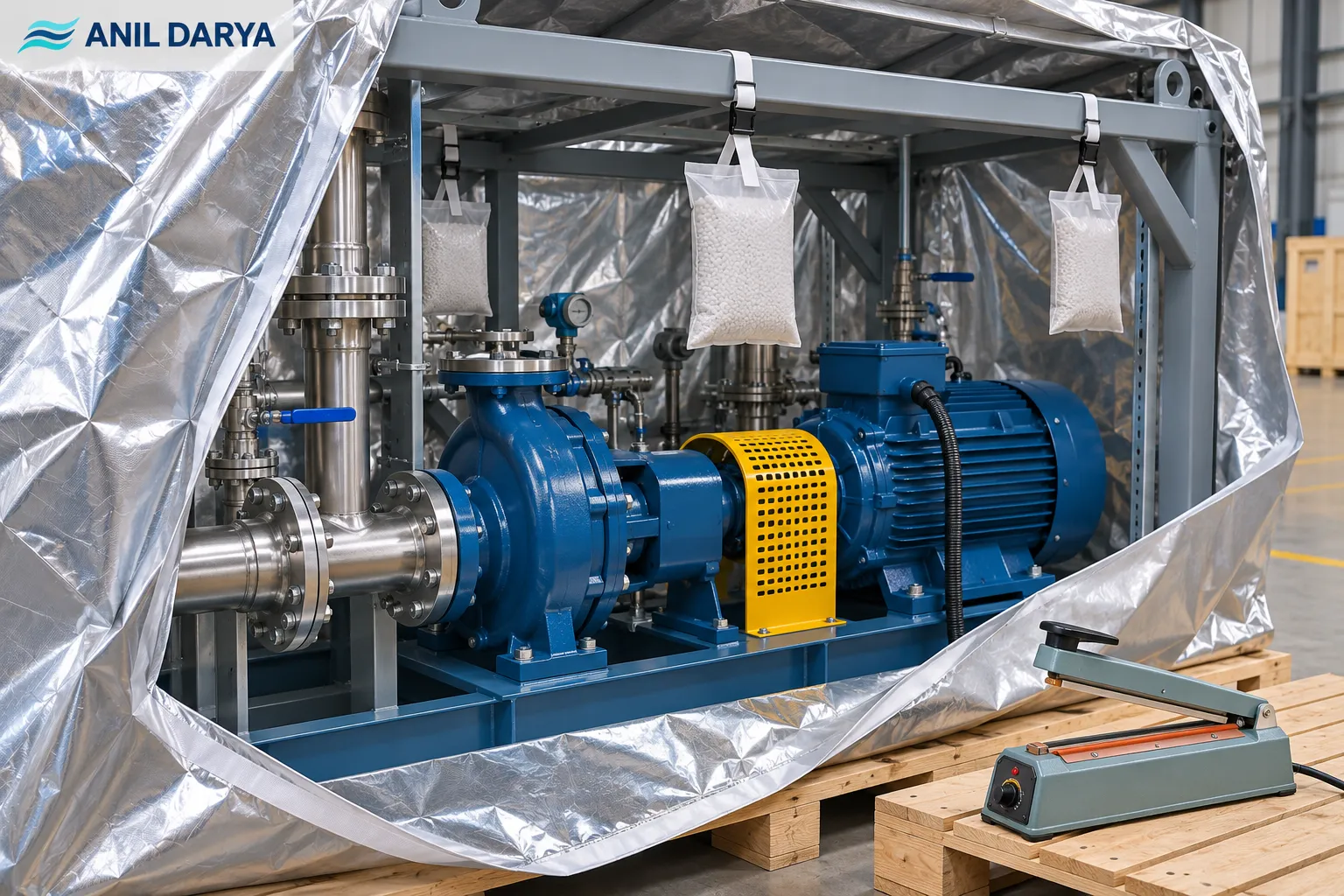
| Desiccant in a sealed barrier foil | Desiccant bags absorb moisture inside an airtight wrap | Whole skids, panels, electrical and instrument items | Foil must stay intact; bags must not touch the goods |
| Nitrogen blanket or purge | Casing or container held at slight positive pressure with dry nitrogen | Compressors, turbines, vessels with internals | Needs pressure checks and cylinders; asphyxiation risk on opening |
| Oil mist or preservative oil | A thin oil film on bearings, seals and internals | Rotating machinery in storage | Oil must be approved by the maker and the user |
| Coatings and rust-preventive compounds | Removable film on exposed external surfaces | Flange faces, shafts, unpainted steel | Must be removed before assembly where the maker says so |
API RP 686, the API recommended practice for machinery installation, covers preservation in field storage. As quoted in Machinery Lubrication, it says oil mist should be considered when more than 10 pieces of equipment are stored more than six months from the time of shipment, and should protect the bearings, bearing housings, seal areas and process end.
VCI: what it does and where it fails
VCI products release corrosion-inhibiting compounds into an enclosed airspace. The vapour spreads, reaches bare metal and forms a microscopic protective layer, according to ZERUST. A sealed enclosure keeps the vapour concentration up. When the pack is opened the vapour dissipates without residue, and parts can usually go to painting, welding or assembly without cleaning or degreasing. Multimetal formulations exist for assemblies that mix steel, aluminium and copper alloys.
The limits matter more than the brochure claims:
- Distance: one supplier, iPack, says the VCI material should be no more than 6 inches from the product, with no barrier between the VCI material and the metal surface.
- Condition: metal must go in free of moisture, dust, dirt and rust. VCI does not repair or reverse corrosion already present.
- Shelf life: the same supplier says not to hold VCI stock for more than six months before use.
- Enclosure: an open crate or torn film lets the vapour escape.
Suppliers also disagree on combining VCI with other methods in the same pack, so ask the VCI maker before adding desiccant or oil.
Desiccant and sealed barrier foil
For large skids and packages, the desiccant method in a sealed barrier wrap is the workhorse. The GDV packaging handbook (TIS) sets out how it works and where it goes wrong.
- The wrap must be a barrier impermeable to water vapour. PE film lets some vapour through; aluminium composite film performs much better, with water vapour permeability below 0.1 g/m²d.
- The method is effective for keeping humidity in the package below 40% relative humidity, and the TIS sample calculation uses 40% as the admissible final humidity.
- Seal the foil immediately after the desiccant bags go in. Seal every puncture point, such as bolt holes, for example with rubber layers.
- Hang the bags in the upper part of the package for air circulation, and use many small bags rather than a few big ones.
- Keep the bags off the goods. Wet desiccant in contact with steel promotes corrosion.
- Test airtightness by pumping air out and watching the cover, then let air back in so the desiccant can work.
TIS gives three years as the maximum guaranteed transport and storage time for the method, and notes that even minor damage to the foil considerably reduces its effect. Humidity indicators in the package let inspectors check without cutting the wrap. Turbomachinery Magazine adds that desiccant may need frequent replacement in high humidity and that periodic inspection of purges and desiccants is required.
Nitrogen blankets for casings and containers
Rotating equipment with internals that cannot be wrapped is often kept under dry nitrogen. In Turbomachinery Magazine, Saipem engineers describe using the compressor casing itself as the container: connections flanged and taped, the casing pressurised slightly above atmospheric, about 15 to 20 mbar held inside, and the cylinder changed if pressure drops below about 20 to 30 mbar. Factory-installed dry gas seals can then ship in place.
For high-value items, Turbomachinery Magazine suggests purged shipping or storage containers, heavier packaging such as MIL-STD-2073 methods 30 or higher for offshore work, and onboard nitrogen blanket systems, with inspection windows for visual checks.
Nitrogen is an asphyxiant. The UK HSE calls asphyxiation a major risk with inert gas, particularly in confined spaces, and calls for oxygen monitoring and a permit to work. Label every nitrogen-filled casing and container, and put the warning in the shipping documents as well. The same logic applies to power transformers shipped under gas, covered in our .
Planning equipment preservation for a long voyage
A good method can still fail at the hand-overs between the maker, the packer, the shipping line and the site. A short checklist for oil and gas cargo:
- Get the maker's preservation specification and the expected storage time before packing starts.
- Decide who re-checks preservation at each stop: factory, loading port, transhipment, discharge port, site.
- Book stowage that matches the method. Foil-wrapped skids and electrical items belong under deck when the ship allows it; our sea freight and break bulk pages explain the booking options.
- Keep dunnage and packing timber dry. The Container Handbook warns against wet dunnage, pallets and packaging.
- Protect wraps from lashing. Chains and wires cut foil, so use edge protectors and lash to the skid or frame.
- Write the next inspection date and method on the package and in the packing list.
For containerised parts, the IMO/ILO/UNECE Code of Practice for Packing of Cargo Transport Units (CTU Code) is the reference for packing and securing. For break bulk on deck, the IMO CSS Code covers stowage and securing. Our flat rack and open top guide helps decide which equipment can go in a container at all, and break bulk damage prevention covers handling risks.
Gas turbines have their own locks and preservation steps on top of all this; see our . Larger plant moves are covered on the page.
Inspection on arrival
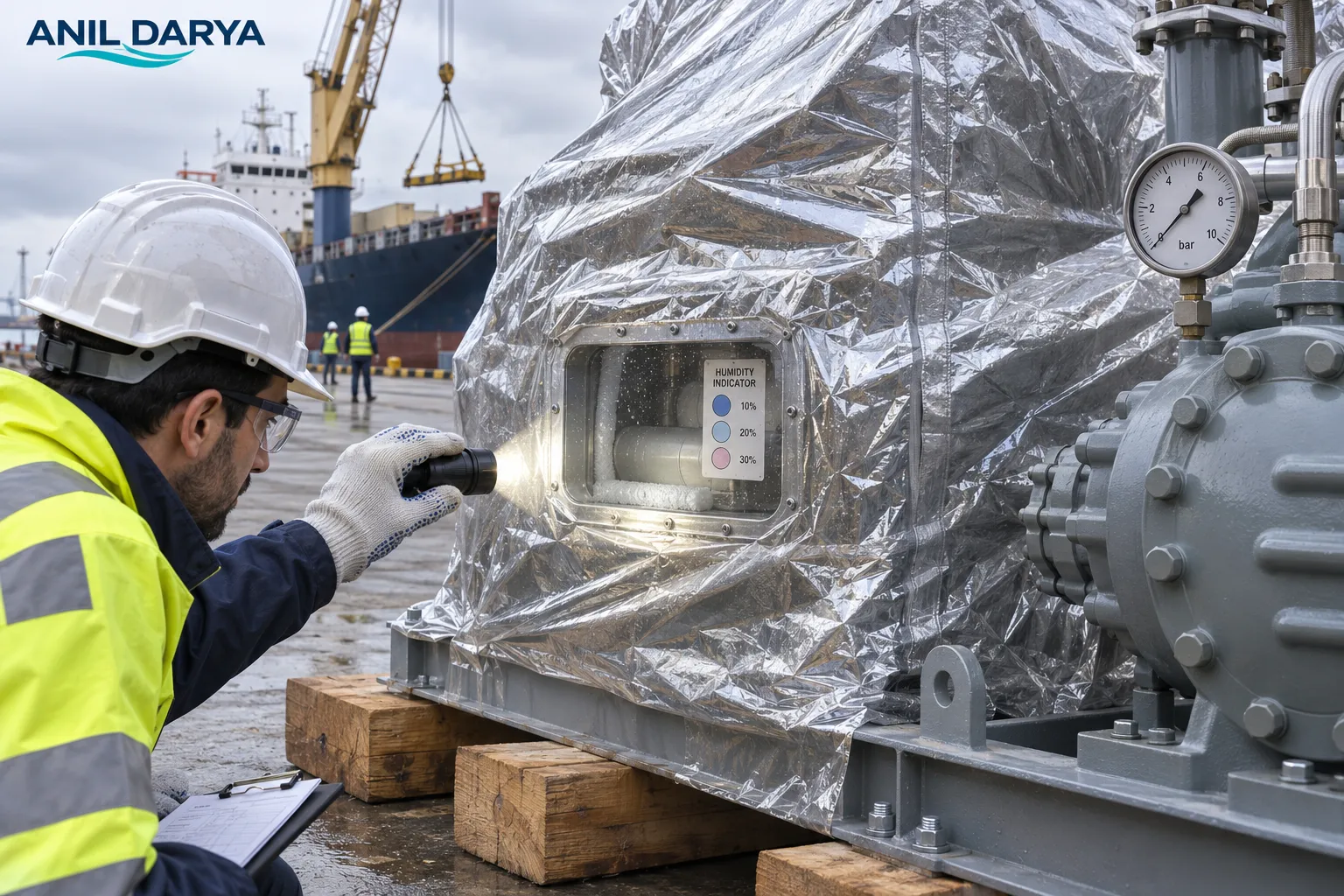
Inspect before signing for the cargo. Check wraps for tears and punctures, read the humidity indicators, record nitrogen pressures, and look under covers at flange faces and machined surfaces where the maker allows it. Photograph anything wrong and note it on the delivery receipt. If the cargo goes into storage, the preservation clock keeps running: reseal, replace desiccant where needed, and keep a log. Our article on break bulk documents and the port process in the UAE explains the paperwork at discharge, and project cargo insurance explains what the underwriter will want from that inspection.
[AMIR-FACT: Whether we arrange preservation re-checks or storage in Dubai or Jebel Ali for waiting project cargo, and with which type of contractor]
Free consultation on preservation of equipment for shipping
Tell us what the equipment is, how it will be packed, the maker's preservation specification if you have one, weights and dimensions, origin and destination, and how long it may wait at site. A photo of the packed unit helps.
Our specialists reply straight away by email, and arrange a meeting when that is more useful. We come back with ship types and stowage that suit the packing, under deck or on deck, the surveys and lift planning the cargo needs, the document list, the checks at the destination port, and a route into the UAE, out of Dubai or cross-trade, where the cargo travels on the shipping line's own bill of lading released through us as agent for the line. The preservation method stays the maker's call; we plan the voyage and the re-check points around it. You can also write to us through the contact page.
Frequently asked questions
What is VCI packing?
Packing that uses film, paper or emitters containing a volatile corrosion inhibitor. The vapour forms a thin protective layer on bare metal inside a closed package and dissipates when the pack is opened.
Is VCI or desiccant better for sea freight?
They do different jobs. VCI inhibits corrosion on metal; desiccant removes moisture from the air in a sealed wrap. Large skids often use a barrier foil with desiccant, while spares and machined parts often use VCI.
How long does desiccant preservation last?
The GDV packaging handbook gives three years as the maximum guaranteed transport and storage time for the desiccant method, provided the foil stays airtight and the quantity is calculated for the package.
How do I keep moisture out of equipment in a container?
Use dry dunnage and packaging, seal the equipment in a barrier wrap with enough desiccant, and keep the bags away from the goods. Condensation forms when warm moist air cools below its dew point.
Why are compressors shipped with nitrogen?
Dry nitrogen at a slight positive pressure keeps humid air out of the casing. Saipem engineers describe holding about 15 to 20 mbar inside a compressor casing during preservation.
What should be checked when preserved equipment arrives?
Wrap condition, humidity indicators, nitrogen pressure, flange covers and exposed machined faces. Record and photograph any damage before signing the receipt.
Does the equipment maker's procedure override general guides?
Yes. The maker's preservation specification sets the method, materials and intervals. Use this guide to plan around it, not to replace it.
Sources
- IMO: IMO/ILO/UNECE Code of Practice for Packing of Cargo Transport Units (CTU Code)
- IMO: Code of Safe Practice for Cargo Stowage and Securing (CSS Code)
- UK HSE: Inerting, technical measures
- TIS / GDV Packaging Handbook: The desiccant method
- GDV Container Handbook: Climatic stresses
- Machinery Lubrication: Oil mist lubrication, how to preserve equipment (API RP 686 references)
- Turbomachinery Magazine: Compressor preservation (Saipem)
- Turbomachinery Magazine: Protecting new equipment before installing offshore
- ZERUST: How does VCI work
- iPack: VCI, how it works
Reviewed: 16 November 2026