
Anil Darya International L.L.C-FZ is a Dubai-based freight forwarder offering sea freight, air cargo, dangerous goods, bulk cargo and break bulk / project cargo services, and a member of FIATA and NAFL.
[CHATGPT-IMAGE: COVER | 1536x1024 | Land drilling rig mast section lifted onto a multipurpose heavy lift ship | Quayside in daylight, a long lattice rig mast hanging from two ship cranes working in tandem, substructure boxes and mud tanks staged on the quay with tag numbers painted on them, lashing crew in coveralls seen from behind, no company names on the hull | template: ANIL DARYA (navy & turquoise, logo top-left) | Rig mast section lifted by ship cranes during drilling rig transport by sea]
Drilling rig transport by sea is a different job from the rig moves you see trucked between well pads. When a rig has to cross an ocean, a land rig is broken down into hundreds of pieces and shipped as break bulk, while a jack-up is either towed or carried dry on a heavy transport ship. Anil Darya International L.L.C-FZ is a Dubai freight forwarder that plans and books these moves with heavy-lift and multipurpose shipping lines, marine surveyors and local contractors, and coordinates them from the old location to the new well site, into the UAE, out of Dubai, or between two other countries.
This page is written for the people who have to make the move happen: drilling contractors, rig owners, buyers of used rigs and operators' logistics teams. It covers how each rig type travels by sea, which approvals the insurers will ask for, and what we need from you to plan it.
Three kinds of drilling rig transport by sea
The first question is not the route. It is what kind of rig you have, because that decides whether it travels as cargo, floats on its own hull, or rides on another ship.
| Rig type | How it usually travels by sea | Main approvals and checks |
|---|---|---|
| Land rig (mast, substructure, power, mud system) | Rigged down, tagged and shipped piece by piece as break bulk on a multipurpose or heavy lift ship, with small items in containers | Weights and centre of gravity per piece, lifting points, stowage and lashing plan, pre-loading survey |
| Jack-up, short field move | Wet tow by tugs on its own hull, legs raised | Tow plan, approved tugs, weather window, seabed survey at the new location |
| Jack-up, long or international move | Dry transport on a semi-submersible heavy transport ship or a submersible barge | Marine warranty surveyor review, certificate of approval, loading and ballast plan, seafastening design |
| Semi-submersible or drillship | Self-propelled or towed; a semi can also travel dry on a heavy transport ship | Tow or voyage approval, weather routing, class and insurer conditions |
Most of our enquiries fall in the first and third rows. Land rigs move between countries when a contract ends or a used rig is sold. Jack-ups move between basins when the next drilling campaign is thousands of miles away.
Land rigs: rig-down, tagging and break bulk stowage
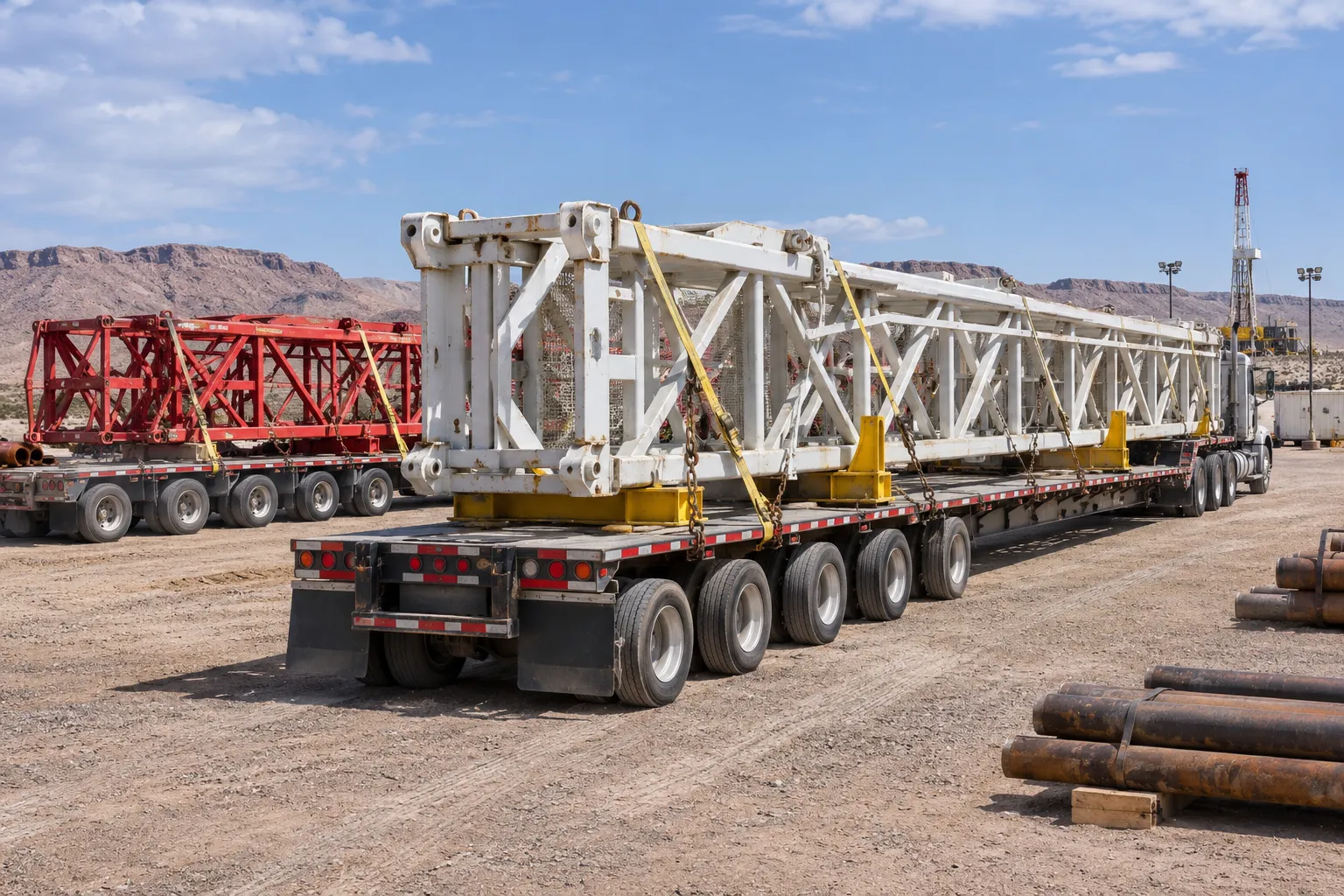
A land rig is a kit of large steel assemblies. The US safety regulator OSHA lists the main parts that go up on every location: the substructure, the rig floor and mast or derrick, the power system, the circulating system with its mud tanks and mud pumps, and the auxiliary equipment. Rigging down is the reverse of rigging up. That is your packing list in its rawest form.
Derrick sections, mud pits and substructure boxes usually exceed container height and width, so they travel as individual pieces, each lifted onto the ship and secured on its own. Drill pipe, spares, tools and small fittings can still go in containers. A mixed shipment like this is normal, and it often costs less than putting everything in the hold.
[CHATGPT-IMAGE: INLINE | 1536x1024 | Rig components tagged and staged for break bulk loading | Wide view of a port laydown area with mud tanks, a doghouse, drawworks skid, coiled cables in crates and mast sections on timber dunnage, each piece with a large painted tag number and weight, a surveyor with a clipboard seen from behind | template: ANIL DARYA (navy & turquoise, logo top-left) | Land rig pieces tagged with numbers and weights before loading on a break bulk ship]
A land rig move by sea works or fails on the paperwork done before the first lift:
- Every item gets a number, dimensions, weight and, for anything heavy, a centre of gravity. The same number goes on the piece, the packing list and the stowage plan.
- Pins, cables and hoses are match-marked to the socket they came from, so the rig-up crew at the new site is not guessing.
- Lugs and pad eyes are checked, or added, so the ship's cranes can pick each piece without damage.
- Engines, generators and electrical houses are sealed against salt air for the voyage. Our article on preserving equipment for long voyages goes deeper.
- Heavy pieces go in the hold and long or light ones on deck. The lift plan, lashing and stowage calculations for each piece are prepared and issued by our own specialists, and an independent marine warranty surveyor approves them where the insurer or charterer asks for it.
For pieces that will travel on deck or as out-of-gauge cargo, our guide to flat racks, open tops and out-of-gauge cargo explains when a flat rack is enough and when a piece has to go loose on the ship. The general method for this kind of shipment is on our break bulk shipping page.
[AMIR-FACT: photos of a real rig or heavy piece being lifted on one of our shipments, cleared for use on the website]
Jack-up drilling rig transport: wet tow, dry tow or heavy transport ship
A jack-up has a hull that floats and legs that are jacked down to the seabed on location. For a move, the legs are raised and the unit floats. PetroWiki, the Society of Petroleum Engineers' reference, gives two basic ways to move a mobile offshore drilling unit: a wet tow with tugs, or a dry tow on a heavy lift ship or barge.
The choice comes down to distance, time and risk:
- In a wet tow, tugs pull the rig on its own hull. In an interview with Offshore Technology, a marine consultancy chief put a jack-up wet tow at around 3 to 4 knots. That suits field moves, which PetroWiki defines as usually under 500 miles in the same area with a safe haven nearby.
- In dry transport, the rig is loaded on a semi-submersible heavy transport ship and carried as deck cargo. PetroWiki calls this the most expensive transport, but it usually runs above 10 knots, two to three times faster than a wet tow depending on the unit. The same page puts the insurance rate at a third to a quarter of a wet tow's.
- PetroWiki also mentions non-propelled submersible barges. They load the same way as heavy lift ships and then travel under tow.
The same interview put the crossover at roughly 1,000 miles: beyond that, dry transport is probably the preferred option, because the rig arrives weeks earlier and starts earning sooner. PetroWiki makes the same point: if collecting the contract day rate matters, the heavy lift ship is cheaper overall because it gets to location much faster.
[CHATGPT-IMAGE: INLINE | 1536x1024 | Jack-up rig carried dry on a semi-submersible heavy transport ship | Open sea on a clear day, a jack-up rig with three lattice legs raised high sitting on the long flat deck of a semi-submersible ship, accommodation block at the bow, calm swell, no names or logos on hull or rig | template: ANIL DARYA (navy & turquoise, logo top-left) | Jack-up drilling rig on the deck of a semi-submersible heavy transport ship during an ocean voyage]
How the float-on works: the heavy transport ship floods its ballast tanks until its long cargo deck sits below the surface. Tugs position the floating rig over the deck, the ship pumps out ballast, and the deck rises under the rig until it sits dry. The reverse happens at the destination. Our article on compares this ship with the other options, and the step-by-step explanation of each method is in .
Approvals for drilling rig transport: surveyor, certificate and stability
A rig move is a non-routine marine operation, and insurers treat it that way. PetroWiki notes that, depending on the drilling contractor's arrangement with the underwriters and a third-party surveyor, a surveyor may or may not have to be present during the move. For long international moves, it lists conditions such as tug hookup and emergency lines, watertightness of openings, weather forecasting, class and regulatory compliance, routing of the tow and a post-tow inspection.
Skuld, a marine insurer, lists transport of heavy objects on deck, including mobile offshore units, among the operations where it asks for a marine warranty surveyor (MWS). The MWS reviews the calculations, procedures and voyage plans, inspects the vessel and equipment, and, when satisfied, issues a certificate of approval. DNV's service specification for marine warranty survey, DNV-SE-0080, names that certificate of approval as the main deliverable of the process. DNV-ST-N001, the companion standard, covers load-out and voyages.
For a dry transport, the documents the surveyor typically wants to see include:
- the loading procedure and ballast sequence of the heavy transport ship;
- stability calculations for the ship with the rig on deck;
- the cribbing and seafastening design, with the forces on each weld and stopper;
- the voyage plan, weather limits and the route;
- the rig's own transport condition: legs secured, cantilever skidded in, deck load within limits.
A drilling manual guide to jack-up moves adds that towing vessels are inspected and approved by the warranty surveyor, and that a 72-hour weather forecast is checked before the rig jacks down. The rig owner prepares the rig, and the ship operator runs the ballast and loading. Our specialists prepare the lift, lashing and stowage calculations that fall to the cargo side and get every document to the surveyor in time, so the certificate is signed before the loading window closes. The detail on how the survey works is in our article on .
Land rigs shipped as break bulk usually do not need a full MWS, but cargo insurers may still ask for a pre-loading survey and lashing check. Our article on break bulk and project cargo insurance explains what underwriters look for.
Import of used rigs at the destination
Most rigs that cross borders are second-hand. That brings two questions at the destination: how customs treats used heavy equipment, and whether the rig is entering permanently or temporarily for one contract. The answer changes by country and sometimes by free zone, so we check it with the destination broker before the rig leaves.
For rigs coming into the UAE, we handle the import declaration at the discharge port and arrange payment of the duty and VAT, then move the pieces to site. For rigs leaving Dubai, we prepare the export documents and coordinate with the importer's broker at the other end. Our article on break bulk documents and the port process in the UAE lists the paperwork for the UAE side.
[AMIR-FACT: for the countries we ship rigs to most often, the used-equipment import rules we have met (age limits, inspection certificates, temporary admission for drilling contracts) and the UAE treatment of used rigs entering for re-export]
Both directions and cross-trade
Rig moves rarely follow a simple line to and from Dubai. A rig finishing a contract in one country may be sold to a buyer in another, with the cargo never touching the UAE. We plan three patterns:
- Into the UAE: rigs and rig packages discharged at Jebel Ali Port or Khalifa Port, cleared and trucked to the yard or well site.
- Out of Dubai: rigs stored or refurbished in the UAE and loaded for an overseas contract.
- Cross-trade: country A to country B, booked with the line from Dubai. You receive the shipping line's own bill of lading, issued and released to you through us as agent for the line. Destination clearance is agreed with the consignee's broker before the rig ships, so nobody discovers an import rule after arrival.
From the port to the new well site
The sea leg is often the easy part. The road from the port to a desert or jungle location decides how heavy each piece can be, how tall the loads can stand, and how many trips the haulier will need. A route survey checks bridges, power lines, bends and soft ground before the first truck moves.
On discharge, we arrange inland haulage with local heavy transport contractors, staging space at the port if the site is not ready, and delivery in the order the rig-up crew needs. Getting that sequence right matters: OSHA's rigging-up steps start with the substructure, then the rig floor and mast, so the substructure should arrive first and the camp and spares can follow.
[AMIR-FACT: who we work with for port-to-site haulage in the UAE and how far inland we have delivered rig loads]
What drives time and cost for drilling rig transport by sea
We do not publish rates for rig moves, because no two are the same. These are the factors that move the number and the calendar:
- Rig type and size. A land rig in pieces needs hold and deck space on a liner or a part charter. A jack-up needs a heavy transport ship with enough deck area and draught.
- Distance and season. Longer voyages and rough months mean stronger seafastening and wider weather margins.
- Ship availability. There are few semi-submersible heavy transport ships, so an early booking gives more choice of loading date.
- Port limits: water depth for ballasting down, quay strength, crane reach and staging area at both ends.
- Surveyor scope, document reviews and attendance at loading and discharge.
- Permits, escorts and the number of road loads at each end.
Whether a liner sailing or a charter fits your rig is covered in break bulk liner vs charter. Our break bulk quote checklist lists the data that turns a rough idea into a firm offer.
Free rig move consultation before you book
Before you commit to a ship or a date, send us what you know about the rig and we will tell you how we would move it. There is no charge and no obligation.
What helps us most: the rig type and model, the equipment list or the last rig-down packing list, weights and dimensions of the heaviest and largest pieces, centre of gravity for anything above a few tons, photos of the rig as it stands, the current location, the destination well site or port, and the date it must be drilling.
What you get back: whether the rig should travel as break bulk, by wet tow or on a heavy transport ship; which surveys and approvals the move will need; the documents list for export and import; the checks we would run at the destination port; and a suggested route, whether the rig is coming into the UAE, leaving Dubai or moving cross-trade. If you are earlier in the project, our page shows the wider range of equipment we handle.
Our specialists answer rig move enquiries straight away, by email, and we arrange an in-person meeting when the move needs one. The heavy oil and gas work we can point to so far is a refinery project in Iraq and parts for a refinery project in Saudi Arabia. A rig move uses the same planning discipline: piece lists, lift and lashing calculations, and a delivery sequence the site can live with.
[AMIR-FACT: whether we visit the rig yard or rig site before quoting, in the UAE and abroad, and which vessel types were used on the Iraq and Saudi refinery shipments]
You can also send the details through our contact page.
Frequently asked questions
Can oil rigs be moved?
Yes. Land rigs are designed to be rigged down and moved, and offshore jack-ups float once their legs are raised. Over long distances, land rigs travel as break bulk cargo and jack-ups usually travel dry on a heavy transport ship.
How do you move an oil rig across the ocean?
A land rig is taken apart, tagged and loaded piece by piece on a multipurpose or heavy lift ship. A jack-up is either towed by tugs or floated onto a semi-submersible ship that ballasts down, lifts it out of the water and carries it as deck cargo.
How long does a rig move by sea take?
It depends on distance and method. A jack-up wet tow runs at around 3 to 4 knots, while dry transport on a heavy lift ship usually runs above 10 knots. Add preparation, loading, approvals and the inland leg. We give a schedule once we know the rig and the route.
Can a land rig be shipped in containers?
Only the smaller parts. Drill pipe, tools, spares and fittings fit in containers or on flat racks. Mast sections, substructure boxes, mud tanks and power units are usually too wide or too tall and ship as break bulk.
Who issues the certificate of approval for a rig move?
The marine warranty surveyor appointed for the operation. The certificate identifies the operation, the vessels and equipment, and any conditions. It is a requirement of the insurance, so the move should not start without it.
Can you ship a rig between two countries without it passing through Dubai?
Yes. We book cross-trade moves where the rig sails directly from the origin to the destination. You receive the shipping line's own bill of lading, released to you through us as agent for the line, and destination clearance is agreed before shipping.
Do you deliver to the well site?
Yes. We arrange the inland leg with local heavy transport contractors after discharge, including route checks, permits and delivery in the order the rig-up crew needs.
Do you own the ships or tugs?
No. We plan and book the move with heavy-lift and multipurpose shipping lines, tug and heavy transport operators, surveyors and local contractors, and coordinate them from loading to delivery.
Sources
- PetroWiki (SPE): MODU mobilization
- PetroWiki (SPE): Jackups
- OSHA: Oil and gas well drilling eTool, rigging up
- DNV: DNV-SE-0080 Noble Denton marine services, marine warranty survey
- DNV: DNV-ST-N001 Marine operations and marine warranty
- IMO: Code of Safe Practice for Cargo Stowage and Securing (CSS Code)
- Skuld: The marine warranty surveyor
- Offshore Technology: How to move the world's largest rigs
- Drilling Manual: Rig move operations guide and checklist
- Green Worldwide: Breakbulk shipment of drilling equipment (case study)
Reviewed: 16 November 2026