
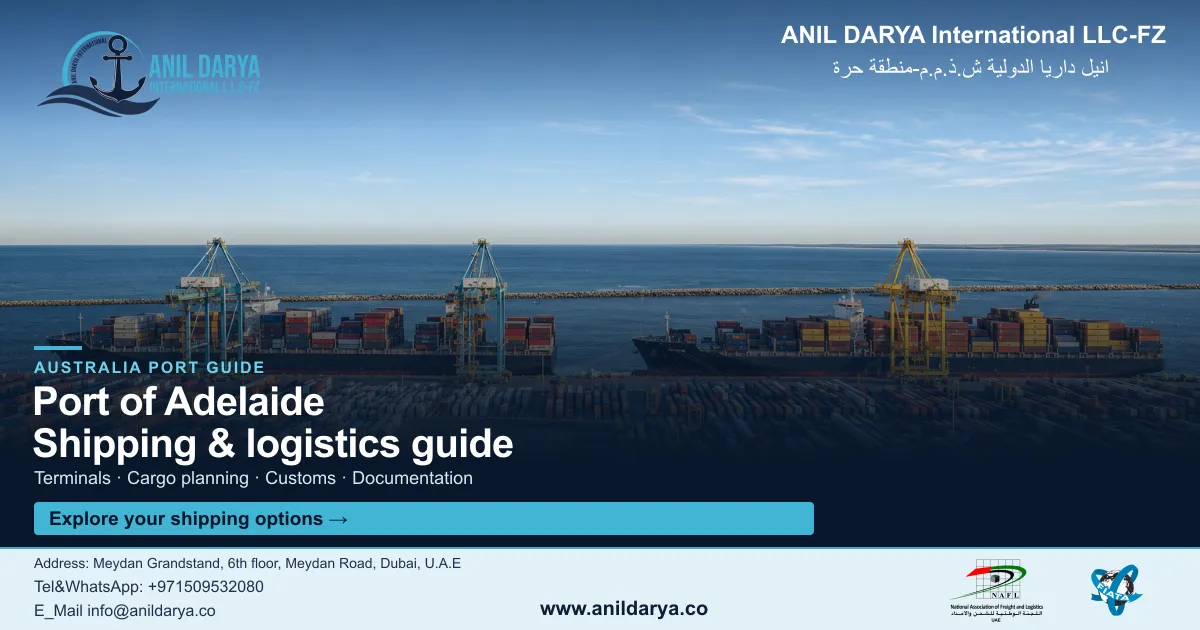
Port of Adelaide shipping runs through one place for containers: the Flinders Adelaide Container Terminal at Outer Harbor, South Australia's only container terminal. The port is privately owned and run by Flinders Port Holdings, and it also handles grain, fuel, vehicles, steel, fertilisers and breakbulk at Outer Harbor, the Inner Harbour and Osborne. This guide covers the berths and their limits, the dangerous goods notice rule, a short customs summary, published transit indications and how to ship from Dubai step by step. We ship both ways: from Dubai to Adelaide, and from Adelaide to Dubai with UAE clearance on arrival.
Port of Adelaide at a glance
| Item | Detail |
|---|---|
| Owner and operator | Flinders Port Holdings, a private company (Flinders Ports runs the marine side) |
| UN/LOCODE | AUADL |
| Location | Port Adelaide is 14 km north-west of Adelaide. Outer Harbor is about 22 km north-west of the city centre |
| Port type | Tidal port on the Port River |
| Container terminal | Flinders Adelaide Container Terminal (FACT), Outer Harbor berths 6 and 7 |
| Container quay | 660 m, declared depth 14.2 m at both berths |
| Terminal equipment | 3 post-Panamax quay cranes, 22 straddle carriers, plus forklifts and reachstackers |
| Direct shipping services at FACT | Seven |
| Outer Harbor limits | Max LOA 350 m, max beam 49 m, maintained depth 14.2 m below LAT |
| Inner Harbour and Osborne limits | Max LOA 206 m, max beam 32.2 m, maintained depth 9.3 m below LAT |
| Mean high spring tide | 2.4 m |
| Upgrade under way | AU$350 million at FACT plus AU$40 million of plant, including a 135 m berth extension and two new cranes due mid-2027 |
| DG cargo notice | Hazardous cargo list to Flinders Ports at least 2 business days before the vessel arrives |
| Customs and biosecurity | Australian Border Force (ABF) and the Department of Agriculture, Fisheries and Forestry (DAFF) |
| GST on imports | 10% of the value of the taxable importation |
| Shipping Adelaide to Dubai | Export Declaration to the ABF in the ICS when required; UAE entry at Jebel Ali, Khalifa Port or Sharjah |
What is the Port of Adelaide and who runs it?
The Port of Adelaide is South Australia's main general cargo port. Flinders Port Holdings owns and operates it, and the same group runs six regional ports in the state: Port Giles, Port Lincoln, Wallaroo, Port Pirie, Klein Point and Thevenard. Those regional ports mostly ship grain and minerals. Almost every container to or from South Australia uses Adelaide.
The port has three working areas, and the one on your booking decides where the truck goes:
- Outer Harbor. At the mouth of the Port River. Containers, grain, fuel, motor vehicles, general cargo and the passenger terminal.
- Inner Harbour. Upriver on the Port River, close to Port Adelaide itself. Fertilisers, steel, scrap metal, soda ash, cement, limestone, grain and petroleum products.
- Osborne. Between the two, with a berth for acid, breakbulk, general cargo, grain and cement.
Port traffic is controlled by Adelaide VTS. The port is tidal, which matters most for deep-loaded breakbulk and bulk ships.
Vessel limits in each area
| Area | Max LOA | Max beam | Maintained depth (below LAT) | Swing basin |
|---|---|---|---|---|
| Outer Harbor | 350 m | 49 m | 14.2 m | 400 m (opposite OH 2) and 505 m (opposite OH 6) |
| Inner Harbour and Osborne | 206 m | 32.2 m | 9.3 m | 330 m, just south of IH berth 27 |
Flinders Ports says allowable depths are at least 0.3 m less than the declared berth depths, and its port rules ask every ship to keep at least 30 cm under keel clearance through the next lowest tide within 24 hours of its arrival or departure. For a shipper, this means one thing: a heavy breakbulk ship bound for the Inner Harbour may have to load lighter, or wait for the tide.
Which berths at the Port of Adelaide handle your cargo?
Flinders Ports publishes a berth list with declared depths and the main commodities at each berth. Here is the part that matters for cargo from the UAE.
| Berth | Declared depth | Max LOA | Main cargo |
|---|---|---|---|
| OH 6 | 14.2 m | 300 m | Containers |
| OH 7 | 14.2 m | 300 m | Containers, ores |
| OH 8 | 16.2 m | 300 m | Grain and seeds (Viterra loading wharf) |
| OH 4 | 13.8 m | 300 m | Petroleum products, motor vehicles |
| OH 1 | 11.5 m | 300 m | General cargo |
| OH 2 and OH 3 | 11.2 m | 300 m | Passenger terminal, motor vehicles |
| OSB 1 (Osborne) | 10 m | 185 m | Breakbulk, general cargo, acid, grain, cement |
| IH 18 to IH 20 | 10 m | 206 m | Fertilisers, scrap metal, steel, textiles, soda ash, forestry products |
| IH 29 | 10 m | 206 m | Mineral sands, livestock, sulphur, fertilisers, scrap metal |
| IH M | 10.7 m | 206 m | Petroleum products |
| IH H | 11.2 m | 206 m | Cement and cement clinker |
Two practical points come out of this table. Container ships always use OH 6 or OH 7. Steel, fertiliser and other breakbulk lots usually discharge upriver at the Inner Harbour or Osborne, where the length limit is 206 m, so the ship you charter or book must fit that limit.
The container terminal at Outer Harbor
FACT sits on Outer Harbor berths 6 and 7, with 660 m of quay. It works Panamax and post-Panamax ships with three post-Panamax quay cranes and 22 straddle carriers, and it is linked by rail to the national network. Flinders Port Holdings bought the terminal outright in 2012 and has since added 14 hybrid straddle carriers in three years.
The terminal is in the middle of a large upgrade. In October 2025 Flinders announced AU$350 million for the terminal and a further AU$40 million for plant over two years. The works include:
- A 135 m berth extension, on an 18-month build after six months of planning.
- Two new super-post-Panamax ship-to-shore cranes with 65-tonne twin-lift capacity, expected on site mid-2027.
- When both are in service, room to work two 366 m ships at the same time.
Works on an operating quay can affect berth windows, so watch the arrival notice for berth changes in 2026 and 2027.
What cargo can you ship through the Port of Adelaide?
Flinders Ports lists the principal commodities as grain and seeds, limestone, petroleum products, motor vehicles, metals and scrap, cement and clinker, fertilisers, iron ore, iron and steel, breakbulk and general cargo, mineral sands, mineral concentrates and containers. Port data lists main imports such as timber, phosphate rock, sulphur, refined petroleum, paper, textiles, iron and steel and motor vehicles, and exports such as wheat, barley, wine, malt, meat, wool, livestock and scrap metal.
| Cargo from the UAE | Where it lands | What to plan |
|---|---|---|
| General goods in containers (FCL, LCL) | FACT, Outer Harbor berths 6 and 7 | Carrier service and transshipment hub, packing declaration, clean container |
| Reefer cargo | FACT | Set temperature, food import conditions |
| Steel, pipes, structures | Inner Harbour or Osborne breakbulk berths, or flat racks via FACT | 206 m length limit upriver, lifting plan, road permits |
| Vehicles and mobile machinery | Outer Harbor berths 2 to 4 | Import approval for road vehicles, cleaning before loading |
| Chemicals and other dangerous goods | FACT or the berth named by Flinders Ports | DG list 2 business days before arrival, Class 1 and Class 7 approvals |
| Fertiliser, sulphur, cement in bulk | Inner Harbour berths | Charter party, discharge rate, berth depth |
Cogoport's port data lists Adelaide to Jebel Ali among the export port pairs, so the lane is used in both directions. Import space from the Gulf goes via a transshipment hub.
Port of Adelaide shipping for containers: FCL and LCL
Most cargo from Dubai to South Australia moves in containers through FACT. You have two options:
- FCL (full container load). You book a whole 20ft or 40ft box. It suits larger shipments and anything you do not want handled with other cargo.
- LCL (less than container load). Your cargo shares a box and is unpacked at a container freight station in Adelaide. It suits small volumes, but the release depends on the whole container clearing customs and biosecurity first.
A practical rule for Adelaide: sailings are less frequent than at Melbourne or Sydney, so cut-offs are tighter and a missed connection at the transshipment hub costs more days. If the delivery date is firm, choose FCL or book LCL with a consolidator that runs a direct Adelaide box, not one that trucks from Melbourne. Our guide to FCL vs LCL shipping costs shows where the break-even usually falls.
Which carriers call at Adelaide?
Cogoport's capacity snapshot for March 2026 named five operators with tracked capacity into Adelaide: COSCO, CMA CGM, Maersk, MSC and Hapag-Lloyd. Its port pairs list Adelaide exports to Jebel Ali and Nhava Sheva, and imports from many Indian ports. Use these third-party figures to know which lines to ask, not as a schedule.
How long does shipping from Dubai to Adelaide take?
Every routing from the UAE to Adelaide in Fluent Cargo's schedule data changes ship at least once. These are its published indications:
| Routing | Published time | Transfers | Frequency | Carriers named |
|---|---|---|---|---|
| Khor Fakkan to Adelaide (sea) | About 36 days 14 hours | 1 | Every 1 to 2 weeks | Maersk, Hapag-Lloyd |
| Jebel Ali to Adelaide (sea, quickest listed) | About 64 days 11 hours | 2 | Every 2 to 4 weeks | CMA CGM |
| Dubai (DXB) to Adelaide (ADL) by air | About 12 hours 25 minutes | Direct | Every 1 to 2 days | Emirates |
The gap between the two sea routings shows why the transshipment hub matters more than the UAE port you load at. These are published indications, not a promise. Always check the arrival date on your booking.
[AMIR-FACT: the carriers or services we actually book from Jebel Ali or Khor Fakkan to Adelaide, the transshipment hub they use, and our typical port-to-port days on this lane in 2026]
Air cargo is the fast option for urgent parts and samples. Our air cargo service handles general and DG cargo by air from Dubai.
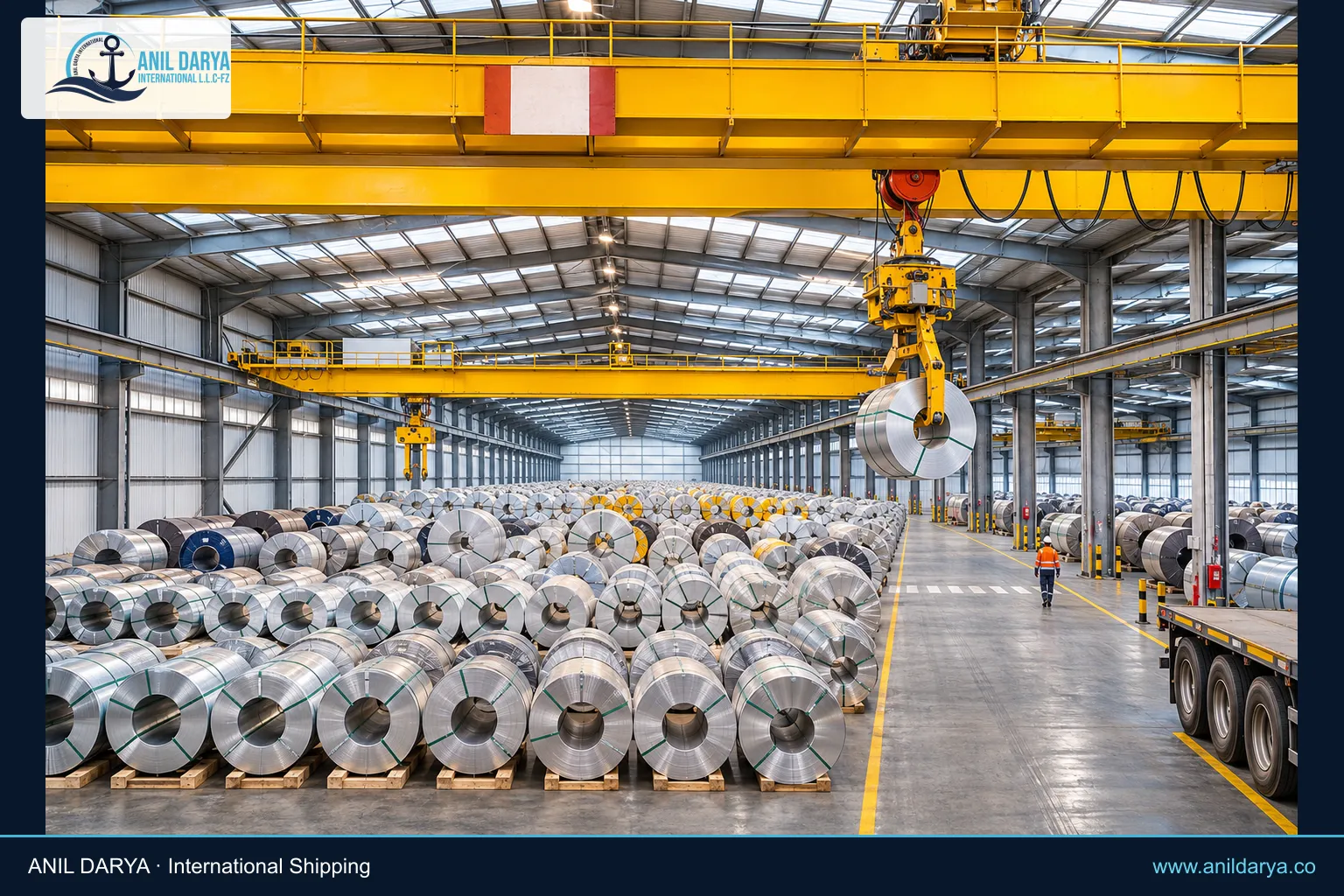
Breakbulk and project cargo at Adelaide
Steel, machinery, structures and project modules for South Australia often move as breakbulk. Two things shape a breakbulk plan here.
- The 206 m limit upriver. The Inner Harbour and Osborne berths take ships up to 206 m long and 32.2 m wide, with maintained depth of 9.3 m. A larger multipurpose ship has to use an Outer Harbor berth.
- Tide and under keel clearance. Deep-loaded ships plan around the tide. The draft your cargo allows decides which berth and which tide window the ship gets.
A simple decision rule: if a piece fits a 40ft flat rack or open top, a container service via a transshipment hub gives more sailings than breakbulk tonnage. If it does not fit, you need a breakbulk or heavy-lift ship calling Adelaide, and the berth and tide plan come first. See our breakbulk and project cargo service and the guide to flat rack, open top and out-of-gauge cargo.
Dangerous goods at the Port of Adelaide
DG rules at Adelaide are written into the Flinders Ports Master Port Rules and the VTS user guide. They are short, but the timing catches shippers out.
| Rule | What it means for your cargo |
|---|---|
| Hazardous cargo list at least 2 business days before arrival | The vessel's agent sends the DG list, with UN numbers, to Flinders Ports. Weekends do not count, so a Monday arrival needs the list by the previous Thursday |
| Australian Standard AS 3846 applies | Flinders Ports has adopted AS 3846, the standard for handling and transport of dangerous cargoes in port areas, for all DG work in its ports |
| Class 1 (explosives) needs approval before entry | Every Class 1 item on board is listed on a Schedule 0 form and sent to SafeWork SA, whether it is loaded, discharged, transshipped or stays on board |
| Class 7 (radioactive) is referred to the EPA | Radioactive cargo goes to the Environment Protection Authority radiation team for approval |
The carrier's own DG acceptance comes first. On the Dubai side we get the DG declaration, safety data sheet, packing and labelling right so the agent can file the list on time. Our dangerous goods shipping team handles IMDG bookings from the UAE.
A rule of thumb for DG to Adelaide: if your cargo is Class 1 or Class 7, ask the carrier for a booking only after the consignee has confirmed with the agent that the approval route is open. Everything else follows the normal IMDG booking process, with the 2-day list as the hard deadline.
Customs and biosecurity at Adelaide: a short summary
Customs and biosecurity rules are national, and our Melbourne guide covers them in more detail. Here is the short version.
- The importer, or a licensed customs broker acting for them, lodges an import declaration (form B650, the N10) for sea cargo with the ABF. Declarations go through the ABF's Integrated Cargo System.
- Customs duty depends on the tariff classification and origin of the goods.
- GST is 10% of the value of the taxable importation: customs value, plus duty, plus transport and insurance to Australia. Some importers can defer GST to their Business Activity Statement.
- DAFF runs biosecurity clearance alongside customs. Both must release a shipment before it leaves the terminal.
- Every container needs a packing declaration. Timber packaging needs treatment, and used machinery and vehicles must arrive clean of soil and plant material.
Keep biosecurity simple: clean boxes, treated or no timber, and clean used equipment before it leaves the UAE. Cleaning in Adelaide costs more and holds the whole container.
Documents for an Adelaide import
| Document | Why it is needed |
|---|---|
| Commercial invoice | Customs value, description and tariff classification |
| Packing list | Matches goods to packages for customs and biosecurity |
| Bill of lading | Release from the carrier at FACT or the breakbulk berth |
| Packing declaration | Tells DAFF what packaging is in the container |
| Timber treatment certificate | Only when timber pallets, crates or dunnage are used |
| Certificate of origin | Only if the importer claims a preferential duty rate |
| DG declaration and SDS | Only for dangerous goods |
How to ship from Dubai to the Port of Adelaide: step by step
- Confirm the cargo details. HS code, weight, dimensions, packaging, and whether any item is DG or a used machine.
- Agree the Incoterm. It decides who books the freight and who pays the destination charges. Our Incoterms 2020 guide for sea freight explains the common choices.
- Pick the UAE port and routing. Compare the routings from Jebel Ali Port and Khor Fakkan, because the transshipment hub drives the transit time.
- Book space. We book with the carrier and confirm the vessel, the hub and the estimated arrival at Outer Harbor.
- Prepare the packing. Use treated or non-timber packaging, clean the container and clean any used equipment before loading.
- Arrange trucking and export clearance in the UAE. We handle the export declaration and deliver the box to the terminal before the cut-off.
- Send the documents. The consignee's customs broker needs the invoice, packing list, bill of lading and packing declaration before arrival.
- For DG, file early. The vessel's agent needs your DG details in time to send the list to Flinders Ports 2 business days before arrival.
- Clearance in Adelaide. The broker lodges the N10, pays duty and GST, and handles the DAFF referral.
- Collect and return. The consignee's transport company picks up the box from FACT and returns the empty within the carrier's free time.
We work with the consignee's customs broker in Adelaide. We do not have an office in Australia, and we do not clear goods there ourselves. Our sea freight service covers the booking, the documents and the UAE side of the move.

How to ship from the Port of Adelaide to Dubai
We also handle the other direction: shipping from Adelaide to Dubai, with arrival at Jebel Ali, Khalifa Port or Sharjah port. We book the space with the carrier and run the UAE side. The Australian export papers stay with the shipper or its Australian agent.
The Australia export side
- When a declaration is needed. Goods must be reported to the Australian Border Force on an Export Declaration if they are worth more than AUD 2,000, need an export permit (whatever their value), are under a duty drawback claim, or are dutiable or excisable goods with the duty unpaid.
- Who lodges it. The exporter, the owner of the goods or their agent, electronically through the Integrated Cargo System or on form B957 at an ABF counter. The ABF recommends a customs broker. A declaration can be lodged up to six months before export, one per consignment.
- Permits. Check early whether the cargo needs an export permit. If it does, the declaration is needed whatever the value.
- Pickup. The shipper or its trucker delivers the box to Flinders Adelaide Container Terminal at Outer Harbor inside the carrier's cut-off.
The UAE import side
On arrival, the declaration goes to Dubai Customs with the commercial invoice, packing list, certificate of origin and any permit for restricted goods, and we match it against the bill of lading. Customs duty in Dubai is 5% of the CIF value for most goods, with 50% on alcohol and 100% on cigarettes. Import VAT is 5% of the customs value including freight and insurance. A VAT-registered importer whose customs number is linked with the Federal Tax Authority accounts for it on its VAT return instead of paying at the port. The importer needs a Dubai Customs business code, or clears through a licensed clearing agent with the owner's authorization.
- Send us the shipper's details in South Australia, the cargo, the HS code and the UAE delivery address.
- We book space from Outer Harbor and send the booking and cut-offs to the shipper.
- The shipper or its trucker stuffs the box and delivers it to the terminal inside the cut-off.
- The shipper or its customs broker lodges the Export Declaration in the ICS, with any export permit.
- We check the draft bill of lading against the invoice and packing list, and track the hub connection.
- We file the UAE declaration before arrival and arrange payment of the duty and VAT.
- We collect the delivery order, truck the box to your site and return the empty inside free time.
[AMIR-FACT: the carriers we actually use from Adelaide to Jebel Ali/Khalifa/Sharjah and our real transit days in this direction]
Checklist before you ship to Adelaide
- HS code and duty rate confirmed with the Australian importer's broker.
- Routing and transshipment hub confirmed, with the published transit checked against your delivery date.
- Packing declaration ready, and timber packaging treated or replaced.
- Used machinery and vehicles cleaned and inspected before loading.
- Import approval in place for any road vehicle.
- For DG: DG declaration, SDS and UN numbers sent to the carrier early enough for the 2-business-day list.
- For breakbulk: ship length checked against the 206 m limit if the cargo goes to the Inner Harbour or Osborne.
- Free time and empty return terms agreed, so demurrage does not start before clearance.
Common mistakes when shipping to the Port of Adelaide
- Assuming a direct sailing. Published routings from the UAE all transship, so plan for at least one change of ship.
- Booking LCL that goes via Melbourne. Your goods may be trucked or railed into South Australia after unpacking, which adds days.
- Sending the DG details late. The 2-business-day rule counts working days, and Class 1 needs SafeWork SA approval before the ship enters port.
- Untreated pallets and dirty machinery. These cause biosecurity holds that affect every consignment in the box.
- Letting free time run out. Clearance delays turn into demurrage and detention quickly. Our guide to demurrage and detention explains how they are charged.
Adelaide or another Australian port?
| If your consignee is in | Usually ship to | Why |
|---|---|---|
| Adelaide and South Australia | Adelaide (FACT) | Shortest road leg, no interstate trucking |
| Western Victoria near the South Australian border | Compare Adelaide and Melbourne | Melbourne has more sailings, Adelaide may have the shorter truck leg |
| Victoria, New South Wales, Queensland | Melbourne, Sydney or Brisbane | More direct services and shorter inland legs |
| Western Australia | Fremantle | Fremantle handles almost all of the state's container trade |
Frequently asked questions
What is the port code for Adelaide?
The UN/LOCODE for the Port of Adelaide is AUADL. You will see it on bookings, bills of lading and tracking systems.
Who owns and runs the Port of Adelaide?
Flinders Port Holdings, a private company, owns and operates the Port of Adelaide and six regional ports in South Australia. Its Flinders Adelaide Container Terminal handles the state's containers.
Where do containers arrive in Adelaide?
Containers arrive at the Flinders Adelaide Container Terminal on Outer Harbor berths 6 and 7. The terminal has 660 m of quay, three post-Panamax cranes and a rail link to the national network.
How deep is the water at the Port of Adelaide?
Outer Harbor has a maintained depth of 14.2 m below lowest astronomical tide, and the container berths have a declared depth of 14.2 m. The Inner Harbour and Osborne have a maintained depth of 9.3 m.
How long does shipping from Dubai to Adelaide take?
Fluent Cargo lists Khor Fakkan to Adelaide at about 36 days 14 hours with one transfer, and Jebel Ali to Adelaide at about 64 days with two transfers. These are published indications. Confirm the arrival date on your booking.
Do I need to notify the port about dangerous goods?
Yes. The vessel's agent must send a hazardous cargo list with UN numbers to Flinders Ports at least 2 business days before arrival. Class 1 cargo needs SafeWork SA approval through a Schedule 0 form before the ship enters port.
Is GST charged on goods imported through Adelaide?
Yes. GST on imports is 10% of the value of the taxable importation, which includes customs value, duty, and transport and insurance to Australia. Some registered importers can defer it to their Business Activity Statement.
Can breakbulk ships use the Inner Harbour?
Yes, if they fit. The Inner Harbour and Osborne take ships up to 206 m long and 32.2 m wide. Larger ships use the Outer Harbor berths, which take up to 350 m.
Is the Adelaide container terminal being expanded?
Yes. Flinders announced AU$350 million for the terminal plus AU$40 million for plant, including a 135 m berth extension and two new cranes expected mid-2027. After that it can work two 366 m ships at once.
Can you handle shipping from Adelaide to Dubai?
Yes. We book space with the carrier from Outer Harbor, the shipper or its customs broker lodges the Export Declaration where one is needed, and we clear the cargo through UAE customs and deliver it in the UAE. Most goods pay 5% duty on the CIF value plus 5% import VAT.
Get a quote for Port of Adelaide shipping
Send us your cargo details and we will come back with a routing and a price from the UAE to Adelaide. Use our freight rate inquiry form, or contact our team if you want to plan a breakbulk, project or DG shipment first. You can also read more about our Dubai freight forwarding team.
Sources
- Flinders Port Holdings: Port Adelaide (berths, depths, limits, commodities, FACT equipment)
- Flinders Port Holdings: Flinders Adelaide Container Terminal
- Flinders Ports: Master Port Rules GUI-FP-113 (DG list, AS 3846, Class 1 Schedule 0, under keel clearance)
- Flinders Ports: VTS User Guide (DG manifests, Class 1 and Class 7 approvals)
- Flinders Ports: Port Adelaide Port Rules GUI-FP-120
- Shipping Australia: Flinders invests near $400m in FACT (October 2025)
- Wikipedia: Outer Harbor, South Australia (distance from city, channel dredging)
- ShipNext: Adelaide port data (LOCODE, imports and exports)
- Cogoport: Port of Adelaide (operator capacity and port pairs)
- iContainers: Port of Adelaide (only dedicated container terminal)
- Sealogic: Freight forwarding in Adelaide (ICS, DAFF, sailing frequency)
- Fluent Cargo: Dubai to Adelaide sea and air schedule data
- Australian Border Force: How to import (form B650, N10)
- Australian Border Force: GST and other taxes when importing
- Australian Border Force: Export declaration (who lodges, ICS or B957, six months, one per consignment)
- Australian Border Force: Export requirements (AUD 2,000, permits, drawback)
- Dubai Customs: Submit a customs declaration (invoice, packing list, certificate of origin, permits)
- Dubai Customs: FAQ (5% of CIF value, business code, licensed clearing agents)
- UAE Government portal: Clearing customs and paying customs duty (alcohol 50%, cigarettes 100%)
- Federal Tax Authority: VAT guide, section 3.5 (import VAT at 5% and deferral to the VAT return)
Reviewed: 10 November 2026