
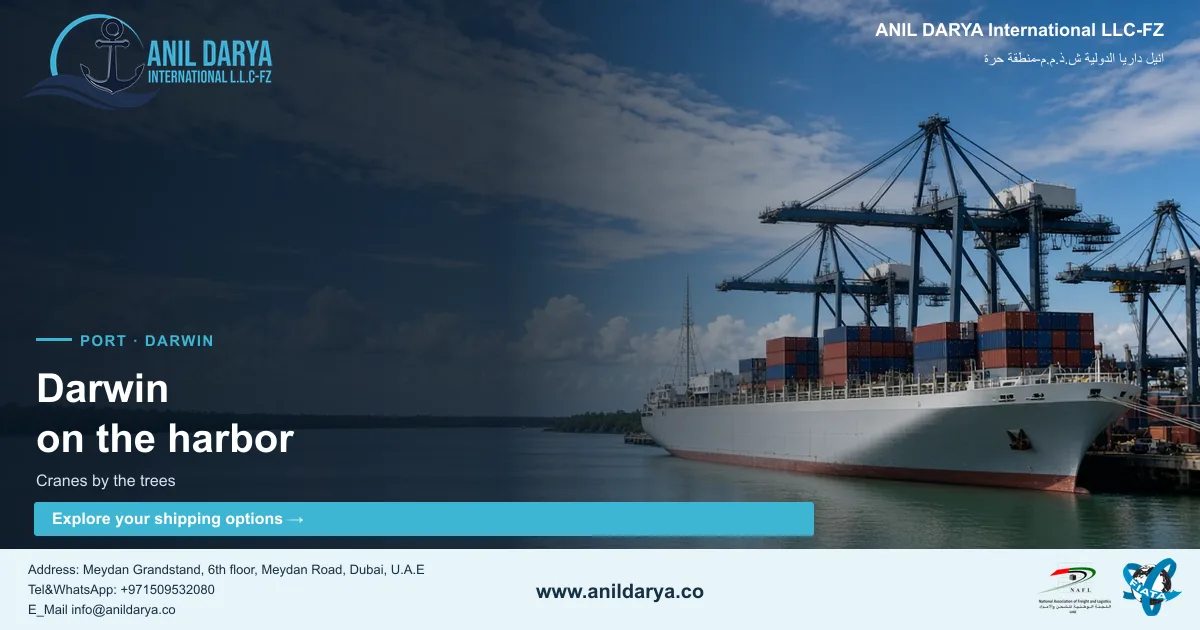
Port of Darwin shipping runs through one multi-user cargo wharf, East Arm Wharf, on Darwin Harbour in Australia's Northern Territory. It is a small, mixed port: containers on regional services from Southeast Asia, live cattle exports, fuel, bulk ore and heavy-lift cargo for oil, gas and mining projects. This guide covers the berths and depths, what the port handles, its dangerous goods time limits and the cyclone season. It also covers shipping from Dubai to Darwin and shipping from Darwin to Dubai, since we move cargo both ways.
Port of Darwin at a glance
| Item | Detail |
|---|---|
| Port operator | Darwin Port Operations Pty Ltd (trading as Darwin Port) |
| UN/LOCODE | AUDRW |
| Location | East Arm, Darwin Harbour, Northern Territory; Australia's northernmost port |
| Cargo wharf | East Arm Wharf (EAW): 4 berths along 865 m of continuous quay |
| Declared depths at EAW (2026) | 12.0 m to 13.2 m below chart datum, by berth |
| Other facilities | Marine Supply Base (offshore supply vessels), Fort Hill Wharf (cruise and naval) |
| Stevedores at EAW | LINX Stevedoring, Qube and Aurizon |
| Cargo handling gear | Mobile harbour and crawler cranes run by the stevedores; mobile harbour cranes up to 550 t for hire |
| Common user yard | 10 ha sealed hardstand, 4,000 m² transit shed, 190 reefer outlets |
| Rail | Rail link to the Adelaide to Darwin railway; intermodal yard with 924 TEU ground slots and two 200 m sidings |
| Container services | Four lines listed, ships of about 1,000 to 2,000 TEU |
| Livestock exported, 2024-25 | 377,371 head |
| LNG vessel visits, 2024-25 | 158 |
| Cyclone season | November to April |
| Customs and biosecurity | Australian Border Force (ABF); Department of Agriculture, Fisheries and Forestry (DAFF) |
| Import GST | 10% of the value of the taxable importation |
Where is the Port of Darwin and what does it serve?
Darwin is the closest Australian port to Asia. Darwin Port calls it the only port between Townsville and Fremantle with full access to multi-modal transport. Behind the wharf you have the national highway network, the Adelaide to Darwin railway and Darwin International Airport.
The port has three commercial facilities:
- East Arm Wharf. The cargo wharf. All containers, general cargo, vehicles, livestock, bulk ore and bulk liquids go through here.
- Marine Supply Base. A dedicated base for offshore supply vessels serving oil and gas fields in the Arafura and Timor Seas and off Western Australia. It is leased and run by ASCO.
- Fort Hill Wharf. A 300 m wharf near the city centre for cruise and naval ships.
A simple rule: Darwin makes sense when the cargo is used in the Northern Territory, for example a mine, a gas project or a Darwin importer. For consignees on the east coast, a direct east coast port is usually better, and we cover the main one in our Melbourne guide.
East Arm Wharf: berths, depths and the yard
East Arm Wharf opened in 2000 and has one continuous quay line. Darwin Port allocates berths flexibly along it, so the berth numbers below describe the usual use, not a fixed rule.
| Berth | Completed | Length | Main use | Declared depth 2026 (below chart datum) |
|---|---|---|---|---|
| Berth 1 | 2000 | 150 m | Containers, project cargo, livestock, general cargo | 12.5 m |
| Berth 2 | 2000 | 250 m | Bulk ore, with a rail-mounted ship loader; other cargo possible | 13.2 m |
| Berth 3 | 2004 | 200 m | Containers, general cargo, livestock | 12.8 m |
| Berth 4 | 2004 | 265 m | Bulk liquids and fuel; can also take containers and general cargo | 12.0 m |
The design depth alongside is 12 m at chart datum, and the Regional Harbour Master declares the actual depths each year. Ships carrying liquid or dry bulk must be accepted by Darwin Port before arrival. Pilotage is compulsory for ships of 50 m and longer.
What the common user yard offers
| Facility | Detail | Why it matters to you |
|---|---|---|
| Sealed hardstand | 10 ha | Laydown for breakbulk and project pieces |
| Transit shed | 4,000 m² | Covered storage after discharge |
| Reefer outlets | 190 on the hardstand | Limited plug-in points, so book reefers early |
| Wash-down facility | For cargo and containers | Used when biosecurity finds contamination |
| Quarantine and customs | Undercover inspection area | Inspections can happen at the wharf |
| Intermodal terminal | About 180 m x 240 m yard, 924 TEU ground slots, two 200 m rail sidings | Containers can move by rail towards Alice Springs and Adelaide |
A new container yard at East Arm opened at the end of June 2025. Trade press reported that daily truck slot availability rose 33% and daily container deliveries rose 35% after it opened.
The supply base and the cruise wharf
The Marine Supply Base has three berths with declared depths of 8.5 m and 7.7 m and loads offshore supply vessels. If your cargo is a spare for an offshore platform, ask whether it should go to the supply base rather than East Arm Wharf. Fort Hill Wharf takes cruise ships up to 350 m long and handles no commercial cargo.
What cargo can you ship through the Port of Darwin?
Darwin Port lists general cargo, containers, motor vehicles, livestock, dry bulk, bulk liquids, bulk minerals such as iron ore and manganese, and heavy lift and oversized cargo. Here is how that looks for cargo coming from the UAE.
| Cargo from the UAE | Where it goes | What to plan |
|---|---|---|
| General goods (FCL) | EAW Berths 1 or 3, then the common user yard | Transshipment hub, ABF and DAFF documents, truck booking |
| Small shipments (LCL) | Unpacked after discharge | Whether your LCL moves direct or via another Australian port |
| Chilled and frozen food | Reefer outlets on the hardstand | Only 190 outlets, import permits under BICON |
| Machinery, steel, project pieces | Flat racks or breakbulk at EAW | Heavy-lift approval, crane hire, gate size limits |
| Vehicles and plant on wheels | EAW general cargo berths | Cleanliness for biosecurity, ABF import rules for vehicles |
| Dangerous goods | EAW under port notice PN/003 | 48-hour notice to the port, class time limits |
| Fuel and liquid bulk | Berth 4 bulk liquids facility | Port acceptance of the ship before arrival |
Container services at Darwin and what they mean for shipping from Dubai to Darwin
Darwin is a regional container port, not a mainline hub. Darwin Port's 2026 handbook lists four container lines with ships of about 1,000 to 2,000 TEU calling at intervals of less than 10 days.
| Line | Published rotation | Frequency |
|---|---|---|
| ANL | Singapore - Surabaya - Dili - Darwin | Every 10 days |
| COSCO | Yangpu - Hong Kong - Townsville - Brisbane - Lae - Port Moresby - Darwin | Every 21 days |
| PIL | Singapore - Dili - Darwin - Surabaya | Every 10 days |
| Swire Shipping | Singapore - Dili - Darwin - Surabaya | Every 10 days |
None of these services starts in the Gulf. A container from Jebel Ali therefore travels on a mainline ship to a hub, then on one of these regional services into Darwin. On the published rotations, Singapore is the common link. That has three effects on your shipment:
- Your transit time depends on the hub connection, not only on sailing days.
- A missed connection can add a full 10-day cycle on the Singapore loops.
- DG, reefer and out-of-gauge cargo needs acceptance on both legs.
[AMIR-FACT: the carriers and hub we actually use between Jebel Ali and Darwin, and our typical port-to-port days in each direction in 2026]
For FCL, the box is discharged at East Arm, cleared by ABF and DAFF, and delivered by truck or rail. For LCL, ask us at quote stage how your cargo is routed, because small volumes to Darwin may be consolidated differently from cargo to the big east coast ports. Our guide to FCL vs LCL costs shows where a full box starts to pay off, which on a long feeder route is often earlier than you expect.
Breakbulk, heavy-lift and project cargo at Darwin
Project cargo is where Darwin earns its place. Oil and gas, mining and infrastructure projects in the north bring in modules, vessels, transformers and heavy plant. Heavy-lift work at East Arm Wharf needs prior consultation and approval from Darwin Port. The stevedores hire out mobile harbour cranes of up to 550 t, and the handbook sets crawler and mobile crane loadings for each berth.
| Limit or rule | Figure |
|---|---|
| Notice for oversize cargo | At least 1 week before arrival |
| EAW gate, maximum vehicle height | 10 m |
| EAW gate, maximum vehicle width | 13.4 m |
| Crawler cranes allowed on Berths 1 to 3 | 120 t and 180 t, set back from the crane rail |
| Mobile cranes | Max outrigger load 115 t, max bearing pressure 200 kPa |
| Hardstand for laydown | 10 ha common user area |
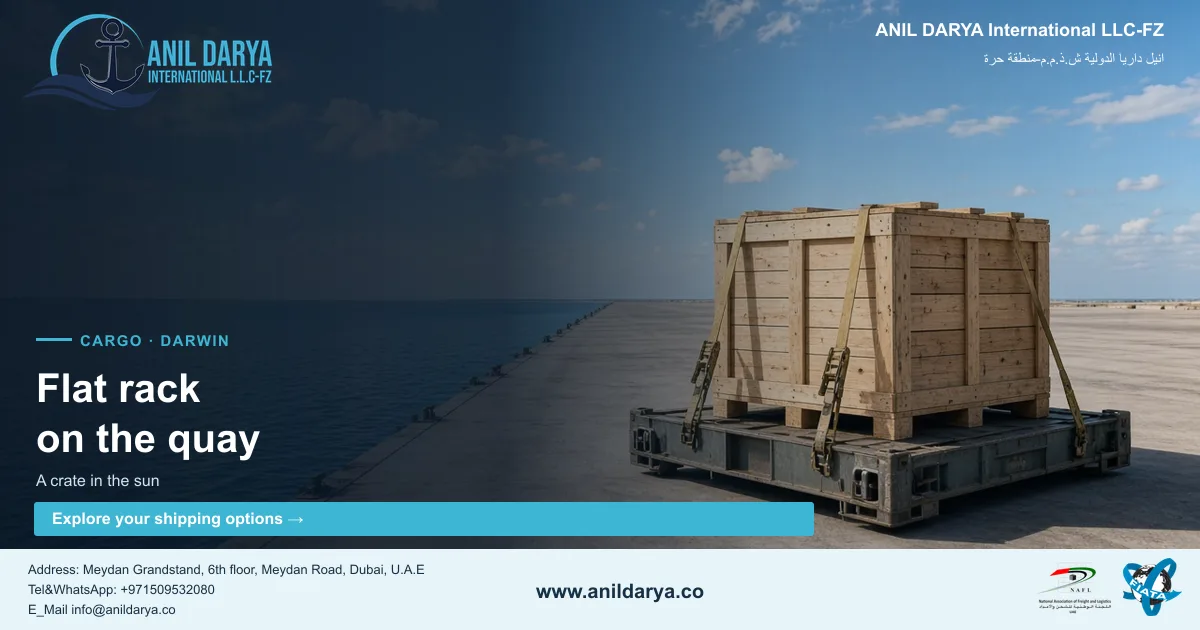
When we plan a project shipment from the UAE into Darwin, we work in this order:
- Collect drawings, weights, dimensions and centre of gravity for each piece.
- Check each piece against the 10 m by 13.4 m gate limit, and agree an exit plan with Darwin Port for anything bigger.
- Give Darwin Port at least one week's notice and request heavy-lift approval.
- Book the crane and laydown space with the stevedore.
- Line up ABF and DAFF clearance and the road move, including Northern Territory oversize permits.
A decision rule: if every piece fits a 40 ft flat rack, a container route gives more sailings but adds a transshipment and a second lift. If even one piece does not, plan around a breakbulk or heavy-lift sailing and build the rest of the shipment around that date. See our break bulk and project cargo service and our guide to flat racks, open tops and out-of-gauge cargo.
Dangerous goods at the Port of Darwin: notice and time limits
Darwin Port's port notice PN/003 sets the rules for dangerous goods inside the port limits. It applies to goods loaded, unloaded or in transit.
- Notice. Darwin Port needs at least 48 hours' notice of dangerous goods entering the port. Ships may be refused entry if the notice is missing.
- Manifest. Before dangerous goods enter the wharf by land, they must be declared with a manifest to the receival and delivery yard.
- Time limits. Each class may stay in the port only for a set period, shown below.
| Time limit | Classes | Notes |
|---|---|---|
| 2 hours | Class 1 explosives | Only Division 1.4 may be stored in the port area |
| 12 hours ("red line" cargo) | Class 2.1, Class 2.3, and Packing Group I of Classes 3, 4.1, 4.2, 4.3, 5.1, 6.1 and 8 | Applies above 500 kg; smaller quantities can apply to stay up to 5 days |
| 24 hours | Class 7 radioactive | No exceptions |
| 5 days ("green line" cargo) | All other goods in Classes 2, 3, 4, 5, 6, 8 and 9 | Can be extended depending on wharf operations |
In practice, red line cargo has to leave the wharf on the day it lands, so have the customs entry and the truck ready before the feeder arrives.
For any DG booking you need the UN number, class and packing group, an SDS, a signed DG declaration, UN-approved packaging and labels, and acceptance on the mainline leg, the feeder leg and at the hub. Our dangerous goods shipping team checks the documents and every acceptance before you commit to a sailing.
Customs and biosecurity at the Port of Darwin
Darwin follows the same national rules as every Australian port. Here is the short version. Our Melbourne guide covers documents, charges and the stink bug season in full.
- ABF clears the goods. A consignment worth over AUD 1,000 needs a full Import Declaration (N10), and all duties, taxes and charges are paid before release. ABF encourages first-time or occasional importers to use a licensed customs broker.
- GST is 10% of the value of the taxable importation: customs value, plus transport and insurance to Australia, plus any duty.
- The Australia-UAE CEPA has been in force since 1 October 2025. Goods of UAE origin may qualify for its preferential rate. Goods made elsewhere and shipped from Dubai take the rate for their real origin.
- DAFF checks the container, packaging and goods for biosecurity risk. East Arm Wharf has an undercover quarantine and customs area and a cargo and container wash-down facility, and Darwin Port has approved arrangements for cargo quarantine clearance.
Check BICON, DAFF's import conditions database, before you ship food, plant or animal products, used machinery or timber packaging.
Cyclone season and local working days in Darwin
Darwin sits in the southern zone for tropical cyclones. The season runs from November to April, and the port can be affected at any time in that period. When a cyclone alert is in force, ships may be put on short notice to sail and must stay ready to leave.
For cargo arriving or sailing between November and April, leave slack in the dates, secure laydown cargo for high winds and ask for extra free time on containers.
The Northern Territory also has its own public holidays: May Day, Darwin Show Day and Picnic Day. Confirm stevedore working arrangements on those days before you plan a tight DG delivery.
How to ship from Dubai to the Port of Darwin: step by step
Our Jebel Ali port shipping guide covers the UAE export side in detail. On the Australian side we work with the consignee's customs broker.
- Send us the cargo details: commodity, tariff code, weight, volume or dimensions, packaging, and the Incoterm agreed with your buyer.
- Confirm the Australian side. The consignee has a licensed customs broker and has checked BICON for any import conditions or permits.
- We compare routings: the mainline carrier, the hub and the feeder service into Darwin, or a direct breakbulk sailing for project cargo.
- Book space. For DG, reefer or out-of-gauge cargo we get acceptance on every leg first, and we send Darwin Port's notices on time.
- Pack to Australian rules: clean container, treated or non-timber packaging, and a packing declaration.
- We arrange UAE trucking, export clearance and gate-in at Jebel Ali before the cut-off.
- After sailing, we send the bill of lading, invoice, packing list, packing declaration and any certificates to the broker.
- The broker lodges the N10 and pays duty and GST. DAFF assesses the biosecurity risk and may inspect at the wharf.
- Once ABF and DAFF release the cargo, the haulier collects it from East Arm Wharf.
- The empty goes back to the depot the line names, within free time.
How to ship from Darwin to Dubai
Shipping from Darwin to Dubai runs the same chain in reverse. Export containers load at East Arm Wharf onto a regional service, usually towards Singapore on the published rotations, and connect there to a mainline ship for Jebel Ali. We book the space with the carriers and handle everything from arrival in the UAE. The shipper or its Australian agent handles export clearance with ABF and the paperwork at origin.
- Send us the cargo details, the pickup address in the Northern Territory and the Incoterm agreed with your supplier.
- We book space on a carrier serving Darwin and confirm the hub, the vessel and the cut-offs at East Arm Wharf.
- The shipper or its Australian agent arranges the empty container, packing, export clearance and delivery to the wharf before the cut-off. Ask the line early about empty equipment, because Darwin is a small container port.
- For dangerous goods, Darwin Port's 48-hour notice and class time limits apply to cargo being loaded too, so the box should reach the wharf close to the sailing.
- The shipper sends us the invoice, packing list, certificate of origin and any permit. We check them against the bill of lading before the ship sails.
- We file the UAE declaration before arrival. Dubai Customs asks for an invoice, packing list, certificate of origin and a permit for restricted goods. Duty in Dubai is 5% of the CIF value for most goods, and import VAT also applies.
- After release we collect the delivery order, book the truck and deliver to your site, a free zone or a re-export warehouse. Cargo can also come in through Khalifa Port or Sharjah if that is closer to you.
The UAE importer needs a Dubai Customs business code, or a licensed clearing agent with its own code and your authorisation can file for you.
Checklist before you ship to Darwin
- Port of discharge on the booking is Darwin (AUDRW), and the hub is named.
- Consignee's customs broker named and given the documents early.
- Tariff code and origin checked for duty, GST and any CEPA claim.
- BICON checked; permits and treatment certificates in hand.
- Container clean inside and out; packaging declared.
- For reefers: set temperature and a plug-in slot confirmed.
- For DG: SDS, DG declaration, acceptance on every leg, and a delivery plan that meets the class time limit.
- For project cargo: drawings, gate size check, heavy-lift approval and one week's oversize notice.
- Free time agreed with a buffer for a missed feeder connection.
Common mistakes when shipping to the Port of Darwin
- Booking DG cargo without the 48-hour notice to Darwin Port. The ship can be refused entry.
- Letting red line DG cargo sit on the wharf. It must leave within 12 hours.
- Shipping a piece taller than 10 m or wider than 13.4 m on its transport without an exit plan for the wharf gate.
- Packing in untreated timber or shipping a dirty container. DAFF can order treatment or wash-down at the importer's cost.
Darwin or another Australian port?
| Your situation | Port to compare | Why |
|---|---|---|
| Consignee in Darwin or the Northern Territory | Darwin | Shortest inland leg; rail south from East Arm |
| Offshore oil and gas supplies | Darwin, Marine Supply Base | Dedicated base for offshore supply vessels |
| Consignee in Perth or Western Australia | Fremantle | Direct West Australian gateway |
| Consignee in Melbourne, Sydney or Brisbane | The east coast port nearest the consignee | Mainline services and far shorter delivery |
| Consignee in South Australia | Adelaide | Closer than Darwin by road or rail |
Darwin Port's 2025 Master Plan says container capacity could rise to 300,000 TEU over 30 years, about 12.5 times current throughput. For now, plan on the port as it is today.
Frequently asked questions
Which company operates the Port of Darwin?
Darwin Port Operations Pty Ltd, trading as Darwin Port, runs the commercial port. It operates East Arm Wharf for cargo and Fort Hill Wharf for cruise ships.
Where do container ships berth in Darwin?
Container ships berth at East Arm Wharf, usually at Berths 1 and 3, which have declared depths of 12.5 m and 12.8 m in 2026. Berth 4 can also take containers when it is not handling bulk liquids.
Is there a direct container service from Dubai to Darwin?
The container lines listed by Darwin Port run from Singapore or China, not from the Gulf. Cargo from Jebel Ali normally transships at a hub, often Singapore, onto a regional service into Darwin.
How much notice does Darwin Port need for dangerous goods?
Darwin Port needs at least 48 hours' notice of dangerous goods entering the port, under port notice PN/003. Some classes may stay only 2, 12 or 24 hours, and most others 5 days.
Can the Port of Darwin handle heavy-lift cargo?
Yes. Heavy-lift work at East Arm Wharf needs prior approval from Darwin Port, and the stevedores hire mobile harbour cranes of up to 550 t. Oversize cargo needs at least one week's notice.
Does the cyclone season affect shipping to Darwin?
The cyclone season runs from November to April. Ships may be put on short notice to leave during an alert, so leave slack in delivery dates and free time for cargo arriving in those months.
What import tax applies to goods landed at Darwin?
GST of 10% applies to the value of the taxable importation, which includes the customs value, freight, insurance and any duty. Duty depends on the tariff code and origin, and UAE-origin goods may qualify under the Australia-UAE CEPA.
How does shipping from Darwin to Dubai work?
The container loads at East Arm Wharf on a regional service, transships at a hub such as Singapore and continues to Jebel Ali. The shipper handles Australian export clearance, and we clear the cargo with Dubai Customs and deliver it in the UAE.
Get a quote for Port of Darwin shipping
Send us your cargo details and we will come back with a routing and a price for shipping to Darwin, including the hub and the feeder connection. Use our freight rate inquiry form, or contact our team to talk through a project, heavy-lift or DG shipment first. You can also read about our Dubai freight forwarding team and our sea freight service.
Sources
- Darwin Port: home page (services, 2024-25 trade figures)
- Darwin Port: East Arm and Fort Hill Wharf overview
- Darwin Port: Port Handbook 2026 (berths, depths, yard, container services, cranes, cyclone season, biosecurity)
- Darwin Port: Port Notice PN/003 Dangerous Goods
- Darwin Port: Port Notice PN/018 Movement of Cargo at East Arm Wharf (January 2026)
- Darwin Port: Master Plan release (October 2025)
- Ports Australia: Darwin Port member profile
- Daily Cargo News: New Darwin port container yard builds capacity (July 2025)
- Wikipedia: Port Darwin (East Arm Wharf opening)
- ShipNext: Darwin port data (UN/LOCODE)
- Australian Border Force: Import declarations
- Australian Border Force: GST and other taxes when importing
- Dubai Customs: Frequently asked questions (duty rate, business code, clearing agents)
- Dubai Customs: Submit Customs Declaration (documents)
- Austrade: Australia-UAE CEPA
Reviewed: 10 November 2026