
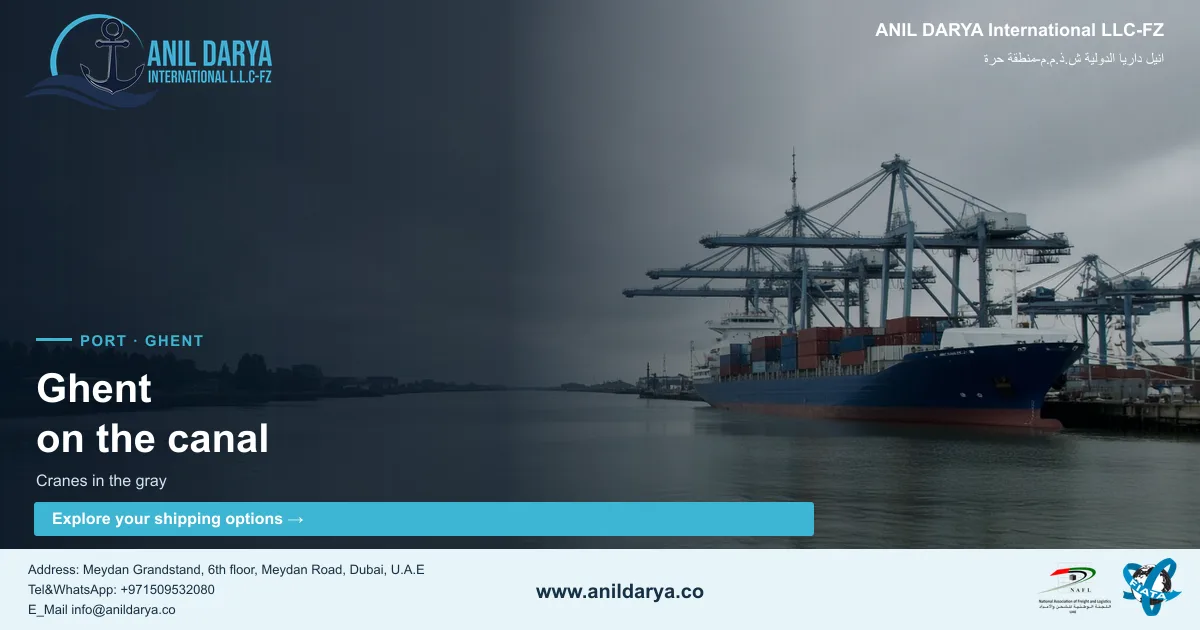
Port of Ghent shipping is mostly about bulk, steel, breakbulk, vehicles and liquids, not deepsea containers. Ghent is a seaport about 30 km inland on the Ghent-Terneuzen Canal, and since 2018 it has been part of North Sea Port, a cross-border port with Terneuzen and Vlissingen in the Netherlands. For shipping from Dubai to Ghent, this guide covers how ships reach Ghent, what each part of the port handles, how containers from the UAE usually get there, and what customs needs at the Ghent end. It also covers shipping from Ghent to Dubai, for steel, machinery, chemicals and other cargo bound for the UAE.
Port of Ghent guide: key facts at a glance
| Item | Detail |
|---|---|
| Port authority | North Sea Port (Ghent, Terneuzen and Vlissingen), formed by a merger in 2018 |
| UN/LOCODE | BEGNE |
| Location | About 30 km inland, on the Ghent-Terneuzen Canal |
| Sea access | Through the New Lock at Terneuzen (Netherlands): 427 m long, 55 m wide, 16.44 m deep |
| Draught on the canal | 12.5 m |
| North Sea Port sea cargo 2025 | 67 million tonnes, up 0.4% |
| Inland shipping 2025 | 61.5 million tonnes (128.5 million tonnes in total) |
| Cargo mix 2025 (sea cargo) | Dry bulk 55%, liquid bulk 22%, breakbulk 14%, Ro-Ro 6%, containers 3% |
| Import and export split | 70% imports, 30% exports |
| Port area (all of North Sea Port) | 9,100 hectares over 60 km, 550+ companies |
| Main Ghent logistics zones | Kluizendok-Rieme-Noord and Mercatordok-Skaldenpark |
| Border control post | Yes, in Ghent, with customs, food safety and lab checks |
| Dangerous goods notice | At least 24 hours before handling, through ENIGMA+ |
| Import VAT (Belgium) | 21% standard, reduced rates 6% and 12% |
What is the Port of Ghent today?
Since the 2018 merger, North Sea Port publishes one set of figures for its Belgian and Dutch sites, so the 67 million tonnes of sea cargo in 2025 cover Ghent, Terneuzen and Vlissingen together. Iron ore, fertilisers and scrap drove dry bulk up 2.1% in 2025, while breakbulk fell 8.7% on fewer machines, engines and appliances and less unprocessed paper. Containers grew 7.8% in tonnes but still make up only 3% of sea cargo.
The trend in 2026 is upward again. In the third quarter of 2026 North Sea Port handled 17.2 million tonnes by sea, up 1.6% and its strongest quarter in four years. General cargo jumped 20.5% in that quarter on higher steel volumes, which is the segment most UAE shippers to Ghent care about.
If your cargo is mainly containers, Antwerp is the Belgian gateway with deepsea terminals. Ghent makes sense when your consignee sits in the Ghent port area or when the cargo is bulk, steel, vehicles or project pieces.
How do ships reach Ghent? The Terneuzen lock and the canal
Seagoing ships come in from the Western Scheldt, pass the lock complex at Terneuzen in the Netherlands, and sail up the Ghent-Terneuzen Canal into Belgium. The lock is the gate, and the canal draught decides the ship size.
| Point | What applies |
|---|---|
| New Lock Terneuzen | 427 m long, 55 m wide, 16.44 m deep; fully operational from 1 August 2025 |
| Largest ship through the lock | 366 m long, 49 m wide, 14.5 m draught |
| Canal draught to Ghent | 12.5 m today; ships of 12.5 m draught can now pass the locks at any tide |
| Deepening | North Sea Port is studying 14.5 m draught up to the first kilometre beyond the lock, a project that could take up to 20 years |
| Lock booking | Register in the GTi-tool at least 6 hours before arrival; the lock time and mooring place are then issued |
| Port call registration | Through ENIGMA+, which also handles pilot, towage and waste requests |
For a shipper this means two things. A Panamax-size bulk carrier or a multipurpose ship can reach Ghent directly. A large container ship cannot, so your container usually lands at a deepsea port first. The ship agent handles the lock and canal steps, but the 12.5 m limit is worth checking whenever a charter or heavy-lift vessel is nominated for Ghent.
Which terminals and docks does the Port of Ghent have?
Ghent is a long string of docks along the canal, each with its own operators. North Sea Port groups the main logistics areas into hotspots. The two in Ghent are below.
| Zone | Warehousing | Draught | What happens there |
|---|---|---|---|
| Kluizendok-Rieme-Noord | 700,000 m² | 12.5 m | Interface Terminal Gent, a multimodal terminal with water, rail and road access; Van Hoorebeke Timber for breakbulk |
| Mercatordok-Skaldenpark | 650,000 m² | 12.5 m | DFDS Ro-Ro and container terminal; DSV Solutions 110,000 m² pharma and healthcare warehouse; Katoen Natie 350,000 m² of warehousing and the border control post |
Other docks include the Sifferdok and Rodenhuizedok, where North Sea Port shows recycling and biofuel operators such as De Mol Recycling and Cargill. Steel and bulk terminals sit along the canal, and ArcelorMittal runs a steelworks in the port. The berth on your bill of lading or the receiver's instructions tells you which dock the ship goes to.
What cargo does the Port of Ghent handle?
| Cargo | Share of sea cargo 2025 | What to know |
|---|---|---|
| Dry bulk | 55% | Agribulk, salt, sugar, iron ore, fertilisers, solid fuels, ferro alloys, construction materials; 2.2 million tonnes of agribulk storage at the quays |
| Liquid bulk | 22% | Biofuels, urea, animal oils and fats, chemicals; 4.5 million m³ of tank storage and 15 tank terminals across North Sea Port |
| Breakbulk and project cargo | 14% | Steel products, machinery, timber, paper; about 9.7 million tonnes of seaborne breakbulk |
| Ro-Ro | 6% | Vehicles, trailers and machinery; flat for five years |
| Containers | 3% | Mostly shortsea and barge-fed; 7.8% growth in tonnes in 2025 |
The automotive industry shapes the Ghent end of the port. Volvo Car Ghent builds over 200,000 cars a year, Volvo Trucks Ghent about 40,000 trucks, and Honda runs its European Distribution Centre there with about 500 staff. Parts and finished vehicles move through the port's Ro-Ro and logistics sites.
Bulk and breakbulk shipping from Dubai to Ghent
Ghent is a bulk and breakbulk port first, so this is where a direct call makes most sense. Typical cargo from the UAE that suits Ghent includes steel, fertilisers and other bulk minerals, construction materials, machinery and project pieces for plants in the port area.
Here is how we plan these moves:
- Confirm the cargo, quantity and the receiver's berth in Ghent. The receiver's terminal decides the dock and the discharge gear.
- Check the ship against the canal. With a 12.5 m draught limit, the vessel size and loaded draught must fit before you fix a charter or book a parcel.
- Book the vessel type. Bulk goes on a bulk carrier, steel and project pieces on a multipurpose or heavy-lift ship, and smaller lots may go in containers or on flat racks to Antwerp with an onward leg.
- Agree discharge, storage and survey at the Ghent terminal through the receiver or its agent.
- Line up customs before the ship arrives so cargo can leave the quay without storage delays.
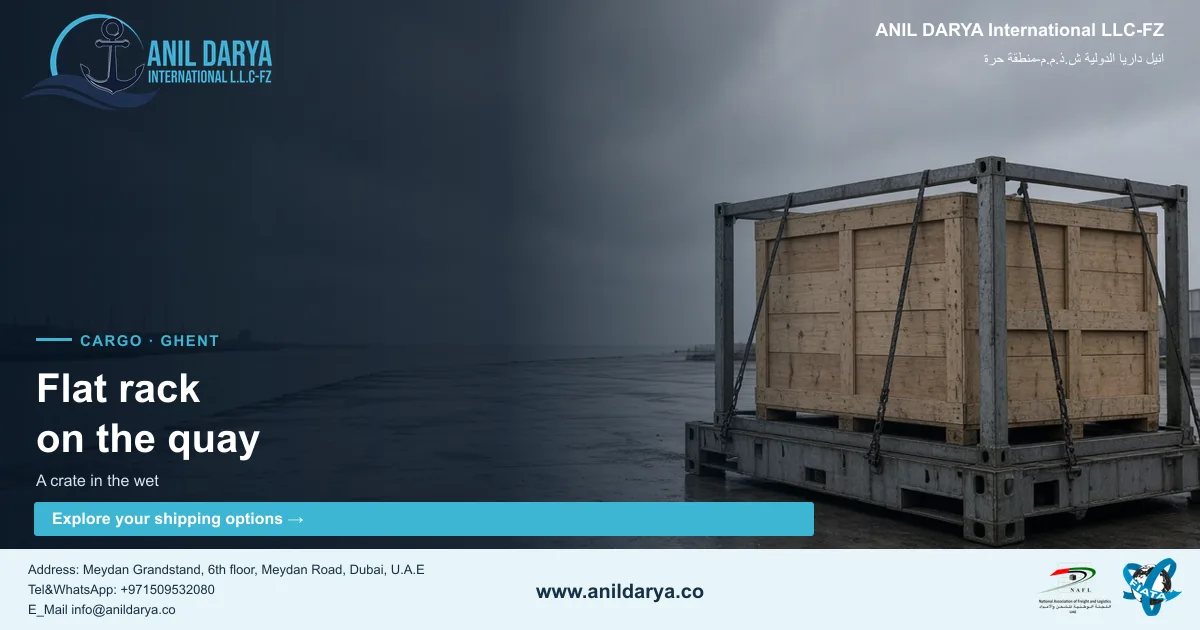
A simple decision rule: if your lot fills a whole ship or a large parcel, a direct call at Ghent saves a second handling. If it is a few pieces, a regular container or breakbulk service to Antwerp plus barge or truck to Ghent is often faster to arrange. Our bulk cargo shipping service and break bulk and project cargo team plan both routes. For cargo that is slightly too big for a box, see flat rack and open top options for out-of-gauge cargo.
Container shipping from Dubai to Ghent: via Antwerp
We did not find a deepsea container service from the Gulf that calls Ghent in North Sea Port's published information, and containers are only 3% of the port's sea cargo. In practice, a container from Jebel Ali usually discharges at Antwerp-Bruges and then reaches Ghent by barge, rail or truck. Fluent Cargo, a route aggregator, lists its quickest Dubai to Ghent sea routing as Jebel Ali to Antwerp-Bruges in about 34 days with one transfer, which shows the usual pattern rather than a fixed schedule.
[AMIR-FACT: our real routing and transit days from Jebel Ali to Ghent (discharge port, onward barge, rail or truck leg) and the carriers we actually book on this lane]
| Onward leg from Antwerp | What is available | When it suits |
|---|---|---|
| Barge | DFDS offers a container barge service between Ghent and Antwerp, and between Ghent and Rotterdam | Regular flows, heavy boxes, no rush |
| Rail | Over 300 trains leave North Sea Port each week; the Kluizendok terminal has rail access | Large volumes to sites with a rail siding |
| Truck | Road link between the two ports | Single boxes and urgent cargo |
Inland shipping already carries 58% of North Sea Port's hinterland traffic, rail 9% and road 31%, so barge is a normal option here, not a special one. When you compare quotes, compare the full door cost including the onward leg and the free time at Antwerp.
Dangerous goods at the Port of Ghent
North Sea Port applies the Ghent Port Police Regulations on top of international, European and national law. Any handling of dangerous goods must be notified at least 24 hours in advance through ENIGMA+, or requested through the Harbour Master's Office. Handling covers loading, unloading, storing, transferring, keeping on board and transhipping.
The ship's agent or terminal makes that notice, but it relies on your data. For any DG shipment to Ghent you need:
- UN number, proper shipping name, class and packing group for each product.
- A Safety Data Sheet and a signed Dangerous Goods Declaration.
- IMDG-compliant packaging, labels and placards.
- The carrier's acceptance for every leg, including the barge or train from Antwerp.
The port lists certified ADR storage for hazardous substances, and the DFDS Ghent route accepts IMDG classes 1.1 to 1.6, 2, 3, 4, 5.1, 6, 8 and 9. Because Antwerp-Bruges has its own notice rules, a DG box via Antwerp needs both ports' requirements covered. Our dangerous goods shipping team checks each leg before you commit.
Customs at the Port of Ghent: a short summary
Ghent applies the same Belgian and EU customs rules as Antwerp, so this is the short version.
| Point | Rule |
|---|---|
| Before loading in the UAE | The carrier files the Entry Summary Declaration at least 24 hours before loading for deepsea containers; from 1 June 2026 every consignment entering the EU needs a valid ENS in ICS2 |
| On arrival | Goods sit in temporary storage under customs supervision for no longer than 90 days |
| Importer ID | EORI number; a non-EU business gets one when it first lodges a declaration |
| Duty | EU TARIC rate by goods code and origin; TARIC does not show VAT |
| UAE origin | No EU-UAE trade agreement is in force; negotiations were formally launched on 28 May 2025 |
| Import VAT | 21% standard; an ET 14.000 authorisation lets a business filing Belgian VAT returns report import VAT on the return, with its EORI linked to its Belgian VAT number |
What is specific to Ghent is the border control post. It handles customs, food safety and lab checks in one place, and it also takes cargo that arrived via Antwerp. That means a food or feed container discharged in Antwerp and barged to Ghent can have its checks done in Ghent. Ghent also has three approved inspection centres for veterinary products: Katoen Natie for packaged pet food, and SEA-Tank Terminal and Ghent Renewables for bulk oils, fats and fish oil.
Before the ship sails, decide where clearance will happen: at Antwerp, in transit to Ghent, or in Ghent itself. That choice changes who files and when, so agree it with the consignee's customs broker.
Shipping from Dubai to Ghent: step by step
- Share the cargo details. Commodity, HS code, weight, volume or dimensions, Incoterm and the exact Ghent delivery address or berth.
- Choose the route. Direct vessel to Ghent for bulk and large breakbulk lots; container to Antwerp plus barge, rail or truck for most other cargo.
- Book space. We book with the carrier and, for DG, reefer or out-of-gauge cargo, get acceptance first.
- Prepare documents in the UAE. Commercial invoice, packing list, certificate of origin and the draft bill of lading, all with matching weights and descriptions.
- Arrange UAE trucking and export clearance. We handle origin pickup, export declaration and gate-in at Jebel Ali Port or another UAE port.
- Send the document set to the consignee's broker. They file the Belgian import or transit declaration, ideally before arrival.
- Plan the onward leg. Book the barge, train or truck to Ghent within the carrier's free time at the discharge port.
- Deliver and return the empty. Return the container to the depot the line names, inside free time.
Our sea freight service covers the booking and UAE side. The Belgian side runs through the consignee or its clearing agent.
How to ship from the Port of Ghent to Dubai
We also move cargo the other way, from Ghent into Jebel Ali, Khalifa Port or Sharjah. We book the space with the carrier, and the shipper or its origin agent handles pickup paperwork and the EU export declaration at the Ghent end. We take over for UAE clearance and delivery.
- Share the cargo and pickup details. Commodity, HS code, weights, the pickup address and the Incoterm agreed with your supplier.
- Book the routing. For containers, the usual pattern is a truck, barge or train from Ghent to Antwerp and a deepsea service from there to Jebel Ali. For a full bulk or breakbulk lot, a ship can load at the Ghent berth directly if it fits the 12.5 m canal draught.
- Export formalities at origin. The shipper or its customs agent files the EU export declaration and provides the commercial invoice, packing list and certificate of origin.
- Check documents before sailing. We match weights, HS codes and the consignee on the invoice, packing list and draft bill of lading, and flag any UAE permit the goods need.
- Clear customs in the UAE. Dubai Customs asks for the invoice, packing list, certificate of origin and a permit for restricted goods. Duty in Dubai is 5% of the CIF value for most goods (50% on alcohol, 100% on cigarettes).
- Pay or defer VAT. The UAE VAT rate is 5%. A VAT-registered importer accounts for import VAT under the reverse charge; otherwise it is paid before release.
- Deliver in the UAE. We collect the delivery order, book the truck and deliver to your site, free zone or warehouse, then return the empty.
The importer needs a customs business code, or a licensed clearing agent with the owner's authorisation can file for it. If the goods will be re-exported, ask about a temporary admission or re-export declaration, where Dubai Customs takes a deposit equal to the duty and refunds it when the goods leave on time. For Abu Dhabi consignees, Khalifa Port in Abu Dhabi can shorten the truck leg.
Free time and demurrage when cargo goes via Antwerp
When your box discharges at Antwerp, the free time clock starts there, and a slow barge booking or a customs hold eats into it. Ask for extra free time at booking if the onward leg will take a while. Our guide to demurrage and detention explains the charges.
Ghent, Antwerp or Zeebrugge: which Belgian port fits?
| Your cargo | Port to choose | Why |
|---|---|---|
| Bulk lots for plants in the Ghent area | Ghent | Direct discharge at the receiver's dock, no second handling |
| Steel and project cargo for Ghent receivers | Ghent, or Antwerp plus barge | Depends on lot size and sailing options |
| Containers, FCL or LCL | Antwerp, then barge, rail or truck | Deepsea container services and many sailings |
| Vehicles and Ro-Ro cargo | Zeebrugge or Antwerp | Deepsea Ro-Ro services |
Checklist before you ship to Ghent
- Delivery dock or terminal in Ghent confirmed with the receiver.
- Vessel draught checked against the 12.5 m canal limit for any direct call.
- Routing agreed: direct to Ghent, or via Antwerp with a named onward mode.
- HS codes checked in TARIC, including any quota or anti-dumping measure.
- Importer's EORI number and Belgian VAT position confirmed.
- Place of clearance agreed: Antwerp, transit, or the Ghent border control post.
- For food and feed: health certificates and the inspection site agreed.
- For DG: SDS, DG declaration, packaging and acceptance for every leg.
- Free time at the discharge port long enough for the onward leg.
- Cargo insurance arranged to the final Ghent address.
Common mistakes with Ghent shipments
- Booking a container to "Ghent" without checking the discharge port. The box lands in Antwerp and nobody has booked the onward leg.
- Ignoring the canal draught. A ship loaded deeper than the canal allows cannot reach the Ghent quay.
- Clearing in the wrong place. Clearing at Antwerp when the checks were planned in Ghent, or the other way round, causes holds.
- Treating the barge leg as free. It needs its own booking, cost and, for DG, its own acceptance.
- Missing the import VAT set-up. Without ET 14.000 and a linked EORI, VAT is paid at clearance.
- Forgetting steel measures. TARIC shows tariff quotas and anti-dumping duties by goods code, so check it before you price a steel shipment.
Frequently asked questions
How do I start shipping from Dubai to Ghent?
Send us the cargo details and the Ghent delivery address. We book space from Jebel Ali, usually to Antwerp with an onward barge, rail or truck leg, or direct to Ghent for large bulk and breakbulk lots.
Can you handle shipping from Ghent to Dubai?
Yes. We book the carrier from Ghent or Antwerp to Jebel Ali, Khalifa Port or Sharjah. The shipper or its agent files the EU export declaration, and we handle UAE customs, where duty is 5% of the CIF value for most goods, and delivery.
Is the Port of Ghent part of North Sea Port?
Yes. Since a merger in 2018, Ghent, Terneuzen and Vlissingen form North Sea Port, a cross-border port of 9,100 hectares across Belgium and the Netherlands. Figures are published for North Sea Port as a whole.
What is the port code for Ghent?
The UN/LOCODE for Ghent is BEGNE. Check whether your bill of lading shows BEGNE or Antwerp's BEANR, because that tells you where the container is discharged.
Can container ships from the UAE call directly at Ghent?
We did not find a deepsea container service from the Gulf calling Ghent in the port's published information. Containers from the UAE usually discharge at Antwerp-Bruges and reach Ghent by barge, rail or truck.
What cargo is the Port of Ghent best for?
Dry bulk is the largest segment, at 55% of North Sea Port's sea cargo in 2025, followed by liquid bulk at 22% and breakbulk at 14%. Steel, agribulk, fertilisers, vehicles and machinery are typical.
Can I ship dangerous goods to Ghent?
Yes. Handling of dangerous goods must be notified at least 24 hours in advance through ENIGMA+ or the Harbour Master's Office, under the Ghent Port Police Regulations.
How big can ships be to reach Ghent?
The canal to Ghent has a 12.5 m draught limit. The New Lock at Terneuzen takes ships up to 366 m long and 49 m wide, but the canal draught is what limits ships going on to Ghent.
What is the import VAT rate in Ghent?
Belgium's standard VAT rate is 21%, with reduced rates of 6% and 12%. A business that files Belgian VAT returns can defer import VAT to its return with an ET 14.000 authorisation.
Get a quote for Port of Ghent shipping
Send us your cargo details and the Ghent delivery address, and we will price the direct and the via-Antwerp options, in either direction. Use our freight rate inquiry form, or contact our team to talk through a bulk, steel or project shipment first. You can also read more about our Dubai freight forwarding team.
Sources
- North Sea Port: Home (port area, companies, Ghent 30 km inland, 2025 volumes)
- North Sea Port: What is North Sea Port (2018 merger, sub-areas, 9,100 ha)
- North Sea Port: 2025 cargo results (January 2026)
- North Sea Port: Third quarter 2026 results (October 2026)
- North Sea Port: Cargo (bulk, breakbulk, Ro-Ro, containers, Ghent terminals)
- North Sea Port: Logistic hotspots in Ghent
- North Sea Port: Multimodal port (modal split, trains, quays)
- North Sea Port: Automotive (Volvo, Honda)
- North Sea Port: Chemicals (tank storage, ADR storage)
- North Sea Port: Trade facilitation (border control posts, inspection centres)
- North Sea Port: Shipping (GTi-tool lock booking, ENIGMA+)
- North Sea Port: Permits and reports (dangerous goods notification)
- Rijkswaterstaat: New Lock Terneuzen fully operational from 1 August 2025
- SWZ Maritime: New Lock Terneuzen and the 12.5 m canal draught
- DFDS: Gothenburg-Ghent route and Ghent container barges
- Fluent Cargo: Dubai to Ghent routings
- Harbours Review: Ghent port (terminal and stevedore list incl. ArcelorMittal)
- Wikipedia: Port of Ghent (UN/LOCODE, history, Kluizendok)
- European Commission Access2Markets: Customs clearance documents and procedures
- European Commission: ICS2
- European Commission: EU customs tariff (TARIC)
- European Commission: EU-UAE agreement negotiations
- Your Europe: VAT rates in EU countries
- Eurofiscalis: ET 14.000 VAT deferment in Belgium
- Dubai Customs: Submit customs declaration (documents)
- Dubai Customs: FAQ (duty rate, business code, clearing agents, deposits)
- UAE Government portal: Customs duty and tariff
- Federal Tax Authority: VAT guide (5% rate, reverse charge on imports)
Reviewed: 10 November 2026