
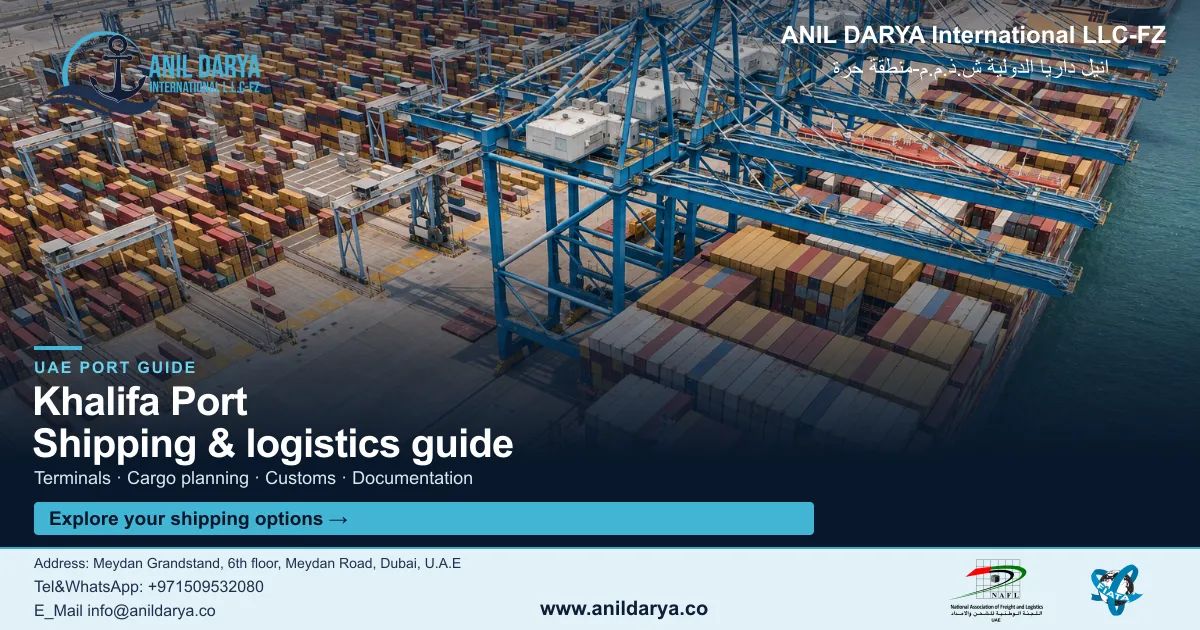
Khalifa Port is Abu Dhabi's main deep-water gateway, run by AD Ports Group. It handles containers, general cargo, breakbulk, RoRo, dry bulk and liquids. For Khalifa Port Abu Dhabi shipping, you book with a carrier that calls there, clear customs through ATLP, the Advanced Trade and Logistics Platform, and truck the cargo out. Anil Darya books the space, prepares the documents and arranges clearance and trucking for you.
Khalifa Port at a glance
| Item | Detail |
|---|---|
| Operator | AD Ports Group |
| Official inauguration | 12 December 2012 |
| Site | Reclaimed land 4 km out to sea, close to KEZAD |
| Container capacity | 9.6 million TEU a year (10.5 million TEU once the CMA terminal expansion is complete) |
| Container throughput 2025 | 6.6 million TEU, up 21.6% on 2024 |
| General cargo capacity | 37 million freight tonnes |
| Berths | 36 |
| Total quay wall | 10,795 m |
| Depth alongside | 18.5 m |
| Ship-to-shore cranes | 33 |
| Shipping lines and links | More than 25 lines with direct links to 70 destinations (AD Ports, 2021) |
| Global ranking | 34th in the Lloyd's List Top 100 Container Ports 2026 |
| Customs platform | ATLP, with pre-arrival clearance through ATLP or TAMM |
Which Khalifa Port terminal handles your cargo?
AD Ports lists eight service lines at Khalifa Port: containers, general cargo, breakbulk, RoRo, dry bulk, liquid and gas, warehousing and storage, and marine services. Your cargo type and your carrier decide which terminal you use.
| Terminal | Partner | Cargo | Key figures |
|---|---|---|---|
| Abu Dhabi Terminals (ADT) | MSC | Containers | 5.3 million TEU, 6 berths, 2,095 m quay, 18.5 m alongside, 22 STS cranes, 106 automated stacking cranes |
| CSP Abu Dhabi Terminal | COSCO Shipping Ports | Containers | 35-year concession; 2.5 million TEU capacity (2021 figure) |
| CMA Terminals Khalifa Port | CMA CGM | Containers | 800 m quay, 18.5 m alongside; more than 1.3 million TEU handled in its first full year; expanding to 2.7 million TEU |
| South Quay | AD Ports | General cargo, breakbulk | 9 berths, 823,000 sqm yard, 3 km quay wall, 18.5 m draft |
| Khalifa Port Logistics (KPL) | AD Ports | General cargo, breakbulk | 8 berths, 1.3 million sqm yard, 3 km quay wall, 8 to 16 m draft |
| Autoterminal Khalifa Port | Autoterminal Barcelona | RoRo, vehicles | Dedicated RoRo hub with a technical centre |
ADT was the region's first semi-automated container terminal. In practice, the terminal matters for cut-offs, gate appointments and where your truck collects the box, so we confirm it at booking.
What cargo can you ship through Khalifa Port Abu Dhabi?
| Cargo | Where it is handled | What to plan for |
|---|---|---|
| Dry containers (FCL and LCL) | ADT, CSP or CMA terminal, by carrier | Carrier choice fixes the terminal |
| Steel, machinery, modules, long pieces | South Quay or KPL | Pre-arrival meeting, stowage plan, trucks and permits |
| Vehicles and rolling equipment | Autoterminal Khalifa Port | Vehicle import permits |
| Dry bulk, liquid and gas | Listed AD Ports services at Khalifa | We confirm berth and handling with the port for each shipment |
| Dangerous goods | Any of the above, under the DG guideline | Advance notice, direct delivery for some classes |
| Reefer cargo | Container terminals | AD Ports does not publish reefer plug numbers for Khalifa, so we confirm acceptance with the carrier |
Container shipping to Khalifa Port: FCL or LCL?
With three carrier-linked terminals, Khalifa Port gets direct calls from MSC, COSCO and CMA CGM services. That matters when your consignee is in Abu Dhabi city, Mussafah or KEZAD, because you avoid a long road haul from another port.
FCL suits you when you fill most of a 20ft or 40ft box, or when the cargo should not be handled by others. LCL suits smaller lots. Your cargo is consolidated with other shippers and deconsolidated after arrival, so allow extra days for unpacking and release. Not every origin has a direct LCL service into Khalifa, so we check the routing before quoting. Our article on choosing between FCL and LCL has a simple break-even rule. If you are weighing Khalifa against another port for the same shipment, our Dubai freight forwarding team can price both.
Transit times and sailings
Transit time depends on the service, not the port. Some services call Khalifa directly and others tranship in another hub first. We quote from the carrier's current schedule and tell you which kind of service you are booking, rather than giving a fixed number that may be out of date.
Khalifa Port breakbulk and project cargo
Khalifa has a lot of room for loose cargo. South Quay offers 18.5 m draft and a 3 km quay, and KPL adds another 8 berths and 1.3 million sqm of yard. That gives room for steel, machinery, modules and long pieces that do not fit in a container.
How the general cargo terminal process works
AD Ports publishes a step-by-step journey for general cargo at Khalifa Port:
- You or your agent email a facility enquiry with the vessel schedule, volume in tonnes, commodity, mode of operation and trucking needs.
- The vessel agent files the voyage declaration on ATLP with pre-arrival documents, crane and lifting appliance certificates, and the manifest and discharge list.
- A pre-arrival meeting with port operations, online or in person, reviews the stowage plan and the operations plan.
- The vessel agent raises service requests on ATLP for gangs, equipment and gear, hire and any vessel shifting.
- At discharge, the cargo condition is checked and a damage report and daily vessel report are signed.
- The vessel agent pays the stevedoring invoice online.
For exports the order is similar. The vessel agent sends a cargo acceptance email, a surveyor can be appointed, and the cargo agent uploads the export bill of entry and packing list on ATLP before the cargo goes to the terminal.
Bringing in project machinery under temporary admission
If heavy machinery is coming in for a project and will leave again, GCC customs rules allow temporary admission instead of paying duty outright. Under the GCC Unified Guide (2025), equipment not available in local markets can be admitted for six months, extendable in the same steps up to three years. Customs asks for a copy of the contract with the government or investment entity, catalogues, and colour photos of items without serial numbers. Temporary admission ends when the goods are re-exported, moved into a free zone or bonded warehouse, or cleared for local use with duty paid.
For heavy or out-of-gauge pieces, we collect drawings, weights, centre of gravity and lifting points early, then plan the vessel, the discharge method and the road permits as one job. See our break bulk and project cargo service and the step-by-step breakbulk documents and port process in the UAE.
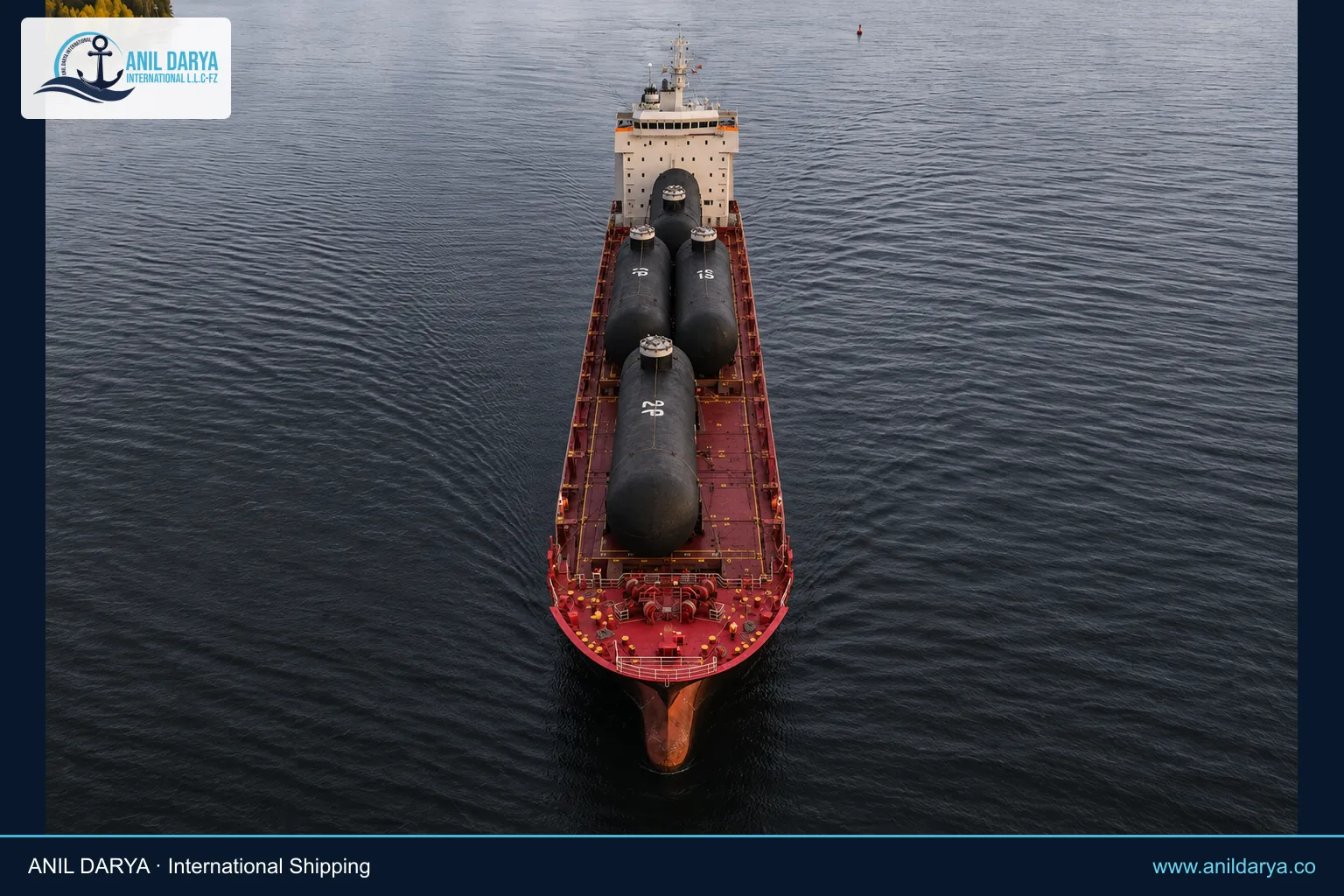
Dangerous goods at Khalifa Port: notice periods and storage limits
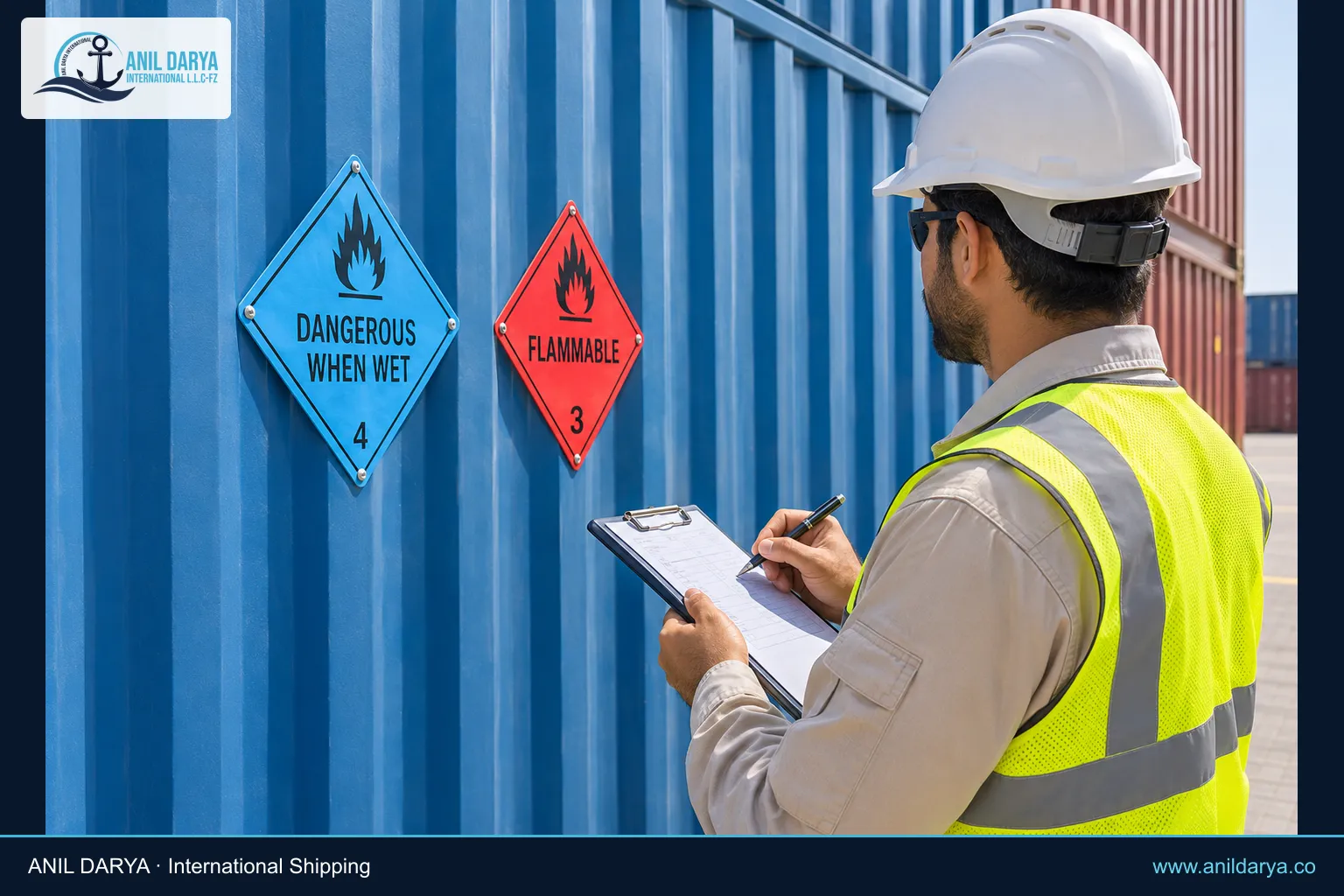
Abu Dhabi Ports' Dangerous Goods Guideline (Issue 3, in force from 1 January 2022) applies across its ports, including Khalifa. Every DG shipment imported, exported or in transit must be notified to Abu Dhabi Ports. All DG must be packed, marked, labelled and placarded to the IMDG Code, and the terminal can refuse cargo that is not.
Notice periods
- Imports: the ship agent notifies 24 to 48 hours before the vessel arrives. The Harbour Master can accept less for vessels that trade regularly.
- Exports: notice goes to the terminal 6 hours before berthing.
- Class 1, Class 7 and Packing Group I exports (other than Class 5.2): at least 72 hours before arrival.
Rules by class
| Cargo | Rule at Abu Dhabi Ports |
|---|---|
| Class 1 explosives | Prior approval from UAE authorities; direct delivery or loading only. At Khalifa, import and export (except 1.4) only at designated North Quay berths: ADT berths 4 to 6 and COSCO berths 7 to 9. Transhipment (except 1.4) not allowed without an exemption. |
| Class 1.4S containers | Storage allowed for transhipment only, up to 10 days |
| Class 7 radioactive | Prior approval from UAE authorities; direct delivery or loading only |
| Class 8 corrosives | Imports cleared within 10 working days; exports stored no more than 5 working days; transhipment no more than 10 days |
| Class 6.1 anti-knock mixtures (UN 1649) | Daily storage charge after 2 free days for import and export, 7 free days for transhipment |
| Class 2.1 gas lighters (UN 1057) | Imports on direct delivery in the summer months; exports accepted only on the day of loading; transhipment only in reefer containers |
| Any DG as breakbulk | Direct delivery only |
| Unclaimed DG | May be auctioned, disposed of or returned to origin after 30 days, at the owner's cost |
If cargo will stay longer than these limits, the consignee or carrier must apply to the terminal for an extension, with the UN number, a risk assessment and the safety data sheet. Abu Dhabi Ports approves it.
The DG documents must show the vessel name and IMO number, ETA, the agent's contact, the UN number, proper shipping name, class, packing group, quantity, package count, container number and flashpoint where relevant. We check these against your safety data sheet before booking. See our dangerous goods shipping service.
Customs clearance at Khalifa Port
Clearance at Khalifa Port runs through Abu Dhabi Customs and ATLP. Abu Dhabi Customs reports that 72% of transactions in 2024 used pre-arrival clearance, up from 47% in 2023. Filing before the ship arrives is now the normal way to work.
Import steps for general cargo
- The clearing agent uploads the import bill of entry, delivery order, bill of lading and packing list to ATLP.
- The agent pays port handling charges on ATLP.
- The agent books a delivery appointment on ATLP, choosing the time slot, cargo and equipment.
- Customs inspection, if selected by risk, is attended in person.
- The agent collects the stamped delivery note and presents it at the gate for exit.
Documents by shipment type
| Shipment | Documents |
|---|---|
| Any commercial import | Detailed invoice, bill of lading, packing list with HS codes, delivery order, certificate of origin if requested, bill of entry |
| Restricted goods | Above, plus the permit from the relevant authority |
| Dangerous goods | Above, plus the DG declaration data, safety data sheet, and government approval for Class 1 and 7 |
| Breakbulk and project cargo | Above, plus stowage plan, operations plan, crane and lifting certificates (vessel agent) and drawings for road permits |
| Temporary admission machinery | Above, plus project contract, catalogues and photos |
| Exports | Detailed invoice, packing list, export bill of entry |
Customs wants original documents. Copies of invoices are accepted against a cash or bank guarantee, or a written undertaking to produce the originals within 90 days. Customs may ask for an Arabic translation, and you must keep records for five years.
Customs duty and VAT
The UAE government portal puts customs tariffs at 0 to 5%, and gives CIF value as the basis for the 5% rate in Dubai. Goods of GCC origin are treated as local when at least 40% of their raw materials come from the GCC. Import VAT is 5%, unless the goods would be zero-rated or exempt if supplied in the UAE. Duties are paid in advance through the electronic clearance system.
Restricted and prohibited goods
Abu Dhabi Customs separates two groups. Prohibited goods cannot be imported at all; examples include narcotics, gambling equipment, asbestos sheets and pipes, hazardous waste, and used or refurbished tyres. Restricted goods need approval before import, for example:
- Food products: Abu Dhabi Agriculture and Food Safety Authority
- Medicines and medical devices: Ministry of Health and Prevention
- Telecom and GPS devices: Telecommunications and Digital Government Regulatory Authority
- Vehicles, new tyres, paints, lubricants, cosmetics and appliances: Ministry of Industry and Advanced Technology
- Firearms, fireworks and explosives: Ministry of Interior
- Radioactive materials: Federal Authority for Nuclear Regulation
KEZAD, free zones and onward delivery
Khalifa Port lies close to KEZAD. KEZAD Group covers 12 economic zones and 550 sq km, of which 100 sq km are free zones. Storing goods in a free zone is one of the GCC suspensive regimes, so duty is not paid while goods stay there. Duty becomes due when they enter the local market. That suits stock you will re-export or release in batches.
Most cargo leaves Khalifa by truck. Rail is coming in: AD Ports describes Khalifa as the first UAE port to link to the Etihad Rail network. In May 2026 it announced an inland network linking Khalifa Port to rail-linked dry ports, cargo depots and Industry City of Abu Dhabi (ICAD).
What does Khalifa Port Abu Dhabi shipping cost?
We do not publish rates because they change with every sailing. A landed cost into Abu Dhabi usually has these parts:
- Ocean freight and origin charges
- Destination terminal or port handling charges (paid on ATLP for general cargo)
- Delivery order fee from the shipping line
- Customs duty and import VAT
- Inspection, if selected
- Trucking to your site
- Storage, demurrage and detention if the cargo or box stays too long
The last item is the one people miss. Our article on demurrage and detention explains how free time works.
How a freight forwarder in Abu Dhabi handles your Khalifa Port shipment
- You send origin, cargo details, weights, dimensions, Incoterm and delivery address.
- We check which carriers call Khalifa directly from your origin and compare them with other UAE ports.
- We book space and confirm cut-offs. For DG and breakbulk we file the notices and join the pre-arrival planning.
- We check the invoice, packing list and BL draft, and file the bill of entry on ATLP before arrival.
- We pay port charges, book the delivery slot and handle any inspection.
- We truck the cargo to your site in Abu Dhabi, KEZAD or elsewhere in the UAE.
What to send us for a quote
- Origin address or port, and the delivery address in the UAE
- Commodity, HS code and cargo value
- Number of packages, weights and dimensions, or container type and count
- Incoterm and cargo-ready date
- Consignee's Abu Dhabi trade licence and importer code
- Safety data sheet and UN number for hazardous goods
- Drawings, centre of gravity and lifting points for breakbulk
- Any permits already held for restricted goods
- Site access details for trucks
Common mistakes
- Late DG notice. Missing the 72-hour window for Class 1, Class 7 or Packing Group I cargo can hold the box.
- No truck at the quay. Direct-delivery cargo has to leave the berth straight away.
- Mismatched papers. Weights or package counts that differ between invoice, packing list and BL slow the bill of entry.
- Waiting for arrival to clear. Pre-arrival filing on ATLP saves days.
- No permit for restricted goods. Food, telecom devices and vehicles need approval before import.
- Leaving Class 8 too long. Imports must clear within 10 working days.
- Picking the wrong port. Landing Abu Dhabi cargo at a distant port adds trucking cost and a second handover.
Khalifa Port vs other UAE ports
Choose Khalifa when the cargo ends up in Abu Dhabi, Mussafah or KEZAD, when your carrier is MSC, COSCO or CMA CGM, or when you need deep water and large yards for breakbulk. For cargo bound for Dubai and the northern emirates, shipping through Jebel Ali Port usually offers more sailings. Sharjah port shipping and Saqr Port in Ras Al Khaimah serve the northern emirates.
For cargo going to the east coast, see our guide to shipping through Fujairah Port.
| Your situation | Port to look at first |
|---|---|
| Consignee in Abu Dhabi, Mussafah or KEZAD | Khalifa Port |
| Breakbulk or project cargo for Abu Dhabi | Khalifa Port (South Quay or KPL) |
| Consignee in Dubai | Jebel Ali Port |
| Consignee in Sharjah or the northern emirates | Sharjah ports or Saqr Port |
| Consignee on the east coast | Fujairah Port |
Frequently asked questions
Who operates Khalifa Port?
AD Ports Group operates Khalifa Port. Its three container terminals are run with MSC (Abu Dhabi Terminals), COSCO Shipping Ports (CSP Abu Dhabi Terminal) and CMA CGM (CMA Terminals Khalifa Port).
How deep is Khalifa Port?
AD Ports gives a depth alongside of 18.5 m. The KPL general cargo area has berths from 8 to 16 m draft.
What is the capacity of Khalifa Port?
AD Ports gives a container capacity of 9.6 million TEU and a general cargo capacity of 37 million freight tonnes. Container capacity will reach 10.5 million TEU when the CMA terminal expansion is complete.
Can Khalifa Port handle breakbulk and project cargo?
Yes. AD Ports lists breakbulk and general cargo as core services, with South Quay offering 9 berths and an 823,000 sqm yard, and KPL offering 8 berths and a 1.3 million sqm yard.
What documents do I need to import through Khalifa Port?
The clearing agent uploads the import bill of entry, delivery order, bill of lading and packing list to ATLP. Customs also expects a detailed invoice, plus a certificate of origin and permits where they apply.
How much notice is needed for dangerous goods?
For imports, the ship agent notifies Abu Dhabi Ports 24 to 48 hours before arrival. For exports, it is 6 hours before berthing, or at least 72 hours for Class 1, Class 7 and Packing Group I goods.
Can I clear customs before the ship arrives?
Yes. Abu Dhabi Customs offers pre-arrival clearance through ATLP and TAMM, and 72% of transactions used it in 2024.
What customs duty applies at Khalifa Port?
The UAE government portal gives customs tariffs of 0 to 5%, and import VAT is 5% for most goods. GCC-origin goods that meet the 40% local content rule are treated as local.
Is Khalifa Port close to KEZAD?
Yes. AD Ports describes the port as lying close to KEZAD, so cargo can move by truck straight from the terminal to the zone.
Is Khalifa Port connected to rail?
AD Ports describes Khalifa as the first UAE port to link to the Etihad Rail network. In May 2026 it announced an inland network linking the port to rail-linked dry ports and ICAD.
Planning a container, breakbulk or DG shipment into Abu Dhabi? Request a freight rate for Khalifa Port with your cargo details, or talk to our team on +971 50 953 2080 or info@anildarya.co.
Sources
- AD Ports: Khalifa Port features, services and terminals
- AD Ports: Abu Dhabi Terminals (ADT)
- AD Ports: CMA Terminals Khalifa Port
- AD Ports: Khalifa Port rises to 39th in Lloyd's List Top 100 Ports (Oct 2025)
- AD Ports Group announcement: Khalifa Port rises to 34th (Oct 2026, republished)
- AD Ports Group: Khalifa Port reflects on nine years of growth
- AD Ports Group: Khalifa Port's nine years of growth (Dec 2021)
- AD Ports: Khalifa Port General Cargo Journey Maps (PDF)
- Abu Dhabi Ports: Dangerous Goods Guideline, Issue 3 (PDF)
- AD Ports Group: multimodal inland logistics network (May 2026)
- AD Ports Group: KEZAD Group launched (Sep 2022)
- Abu Dhabi Customs: 72% pre-arrival clearance rate in 2024
- Abu Dhabi Customs: restricted and prohibited goods
- GCC Unified Guide for Customs Procedures at First Points of Entry, 4th edition 2025 (PDF)
- UAE government portal: customs duty and tariff
- Federal Tax Authority: VAT guide, import VAT (PDF)
Reviewed: 9 November 2026