
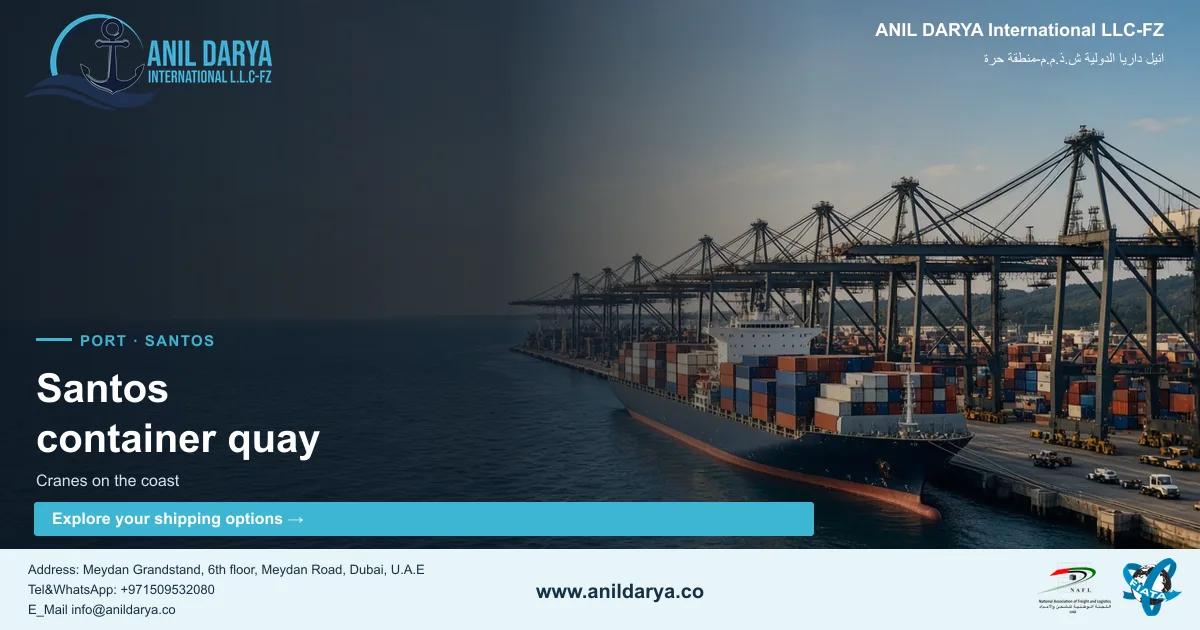
Port of Santos shipping covers a large share of Brazil's foreign trade: containers, breakbulk, liquid and dry bulk, vehicles and dangerous goods, on both banks of the Santos estuary in Sao Paulo state. The port is run by the Autoridade Portuaria de Santos (APS), and cargo is cleared by the Receita Federal through the Duimp in the Portal Unico. This guide covers the terminals, cargo types, customs and how we ship your cargo from Dubai to Santos. We ship both from Dubai to Santos and from Santos to Dubai.
Port of Santos guide: key facts at a glance
| Item | Detail |
|---|---|
| Port authority | Autoridade Portuaria de Santos (APS), formerly Codesp |
| Owner | Brazilian federal government |
| Location | Santos estuary, Sao Paulo state, about 70 km from Sao Paulo city |
| Layout | Right bank on Santos island; left bank in Guaruja and on the mainland side of the estuary |
| Quay length | About 15 km across both banks |
| Cargo in 2025 (whole port complex) | 186.4 million tonnes, a record |
| Cargo in 2025 (public port, Antaq basis) | 142.8 million tonnes, up 2.98% on 2024 |
| Containers, first half of 2025 | 2.8 million TEU, up 7.8% on the same period of 2024 |
| Share of Brazil's trade | 29.9% in June 2025 |
| Main export cargo | Soybeans and soymeal, sugar, pulp |
| Port area | Public port area enlarged by 17.2 million m2 in February 2026 |
| Rail | Rumo (southern network) and MRS (northern network); about 27% of cargo moves by rail |
| Road | Anchieta and Imigrantes highways to Sao Paulo, Rio-Santos highway (BR-101) |
| Customs authority | Receita Federal do Brasil |
| Import declaration | Duimp in the Portal Unico Siscomex |
| Santos to Dubai | Exporter files the DU-E in the Portal Unico; UAE duty 5% of CIF for most goods plus 5% import VAT |
Where is the Port of Santos and how does cargo reach it?
The port lines both sides of the Santos estuary, which separates Santos from Guaruja and the mainland, on the coast of Sao Paulo state. The right bank sits on Santos island. The left bank covers Guaruja on Santo Amaro island and the mainland side of the estuary. The channel between Santos and Guaruja is only about 400 m wide, and today people and cars cross it by ferry in around 7 minutes. A road tunnel between the two cities is planned as a public-private partnership.
For cargo, the link that matters is inland. Sao Paulo city is about 70 km away by the Anchieta and Imigrantes highway system. Two rail networks reach the port, Rumo from the south and MRS from the north, and rail carries about 27% of the port's cargo. Inside the port, a 100 km internal rail network is run by Portofer.
A simple rule: the bank of your terminal decides your truck route and your consignee's pickup plan. Ask which terminal your carrier uses before the vessel arrives, not after.
Which terminals does the Port of Santos have?
Santos is a mix of public port areas leased to operators and private-use terminals. The table groups the main ones by bank, as listed for the port.
| Bank | Terminal areas | Main cargo |
|---|---|---|
| Right bank (Santos) | Alemoa | Liquid bulk |
| Right bank (Santos) | BTP (Brasil Terminal Portuario) | Containers |
| Right bank (Santos) | Saboo, Valongo, Paqueta, Outeirinhos, Macuco, Ponta da Praia | General cargo, sugar, bulk and mixed terminals |
| Left bank (Guaruja) | Tecon Santos (Santos Brasil) | Containers |
| Left bank (Guaruja) | Vehicle terminal (TEV) | Vehicles |
| Left bank | Barnabe island | Liquid bulk |
| Left bank | Conceicaozinha | Solid bulk |
| Private-use terminals | DP World Santos, Tiplam, Cutrale, Dow and others | Containers, breakbulk, bulk, juice, chemicals |
Container terminals in Santos
Three terminals handle most container calls. The figures below come from the operators where we could open their pages.
| Terminal | Bank | Quay | What the operator lists |
|---|---|---|---|
| BTP | Right bank, Alemoa | 1,108 m | Up to three New Panamax ships at once; capacity of 1.5 million TEU a year; reefer area, scanner, warehouse |
| DP World Santos | Left bank, Barnabe island | 1,100 m | Quay sized for two 366 m ships, current maximum ship length 340 m; 1,000 reefer connections; containers, breakbulk, pulp, IMDG cargo, out-of-gauge cargo, on-dock CFS |
| Tecon Santos (Santos Brasil) | Left bank, Guaruja | See operator | Container terminal; operator site did not open for us, so no figures are given here |
Your carrier's service decides the terminal. Check it on the arrival notice, because the free time, storage tariff and truck booking all follow the terminal.
What DP World Santos offers on site
| Area | What DP World lists |
|---|---|
| Rail | 20,000 m2 rail yard |
| Warehousing | 7,000 m2 general warehouse, plus 35,000 m2 for pulp |
| Cross-docking | 30,000 m2 cross-docking and general warehouse |
| Empty containers | 40,000 m2 empty depot |
| Back-up area | 207,000 m2, with 131,000 m2 for expansion |
| Access | Conego Domenico Rangoni highway |
What cargo can you ship through the Port of Santos?
| Cargo type | How it usually moves | What to plan |
|---|---|---|
| General goods in containers | FCL or LCL through BTP, Tecon Santos or DP World Santos | Terminal on the booking, free time, the importer's Duimp |
| Chilled and frozen goods | Reefer containers on plug-in points | Set temperature, agricultural or health permits in Brazil |
| Vehicles | Ro-Ro to the vehicle terminal, or in containers | Brazilian vehicle import rules, checked by the importer first |
| Steel, machinery, equipment | Breakbulk or flat racks | Lifting points, lashing, trailer type |
| Oversized pieces | Out-of-gauge on flat racks or breakbulk vessels | Drawings, lift plan, road permits from the port |
| Chemicals and other DG | IMDG containers | Carrier and terminal acceptance, agency consent in Brazil |
| Liquid and dry bulk | Alemoa, Barnabe island, Conceicaozinha and private terminals | Receiving facility, surveys, discharge plan |
How much cargo moves through the port each year?
Santos is Brazil's largest port complex, and the federal Ministry of Ports and Airports publishes its results every month. The figures below are the most recent official ones we could open.
| Period | Total cargo | Containers | What stood out |
|---|---|---|---|
| Full year 2025 | 186.4 million tonnes (whole complex), a record | Not in the ministry release | Public port alone: 142.8 million tonnes, up 2.98% |
| First half of 2025 | 88.3 million tonnes | 2.8 million TEU, up 7.8% | Soybeans and soymeal 29.61 million tonnes, sugar 8.83 million, pulp 4.71 million |
| June 2025 | 16.04 million tonnes | 511,200 TEU, a monthly record | 29.9% of Brazil's trade, the highest share in four years |
| January 2026 | 12.7 million tonnes, a January record | 467,000 TEU | Sugar up 36.8% on January 2025 |
What this means for an importer from the UAE: Santos is mainly an export port for bulk. In the first half of 2025, loadings were 65.49 million tonnes against 22.84 million tonnes unloaded. Inbound containers compete for terminal space and truck slots with a very large export flow, so book the pickup before the vessel arrives.
FCL and LCL shipping to Santos
Most cargo from the UAE reaches Santos in containers. You have two main options.
- FCL (full container load). You book a whole 20ft or 40ft box. It suits larger shipments and goods you want sealed from origin to the consignee.
- LCL (less than container load). Your cargo shares a box with other shippers and is unpacked in a bonded warehouse after discharge. Your release depends on the whole consolidated box being handled, so it can take longer.
In Brazil, terminal storage costs more than just the storage bill. The state ICMS tax is calculated on a base that includes customs expenses such as storage and terminal handling, so slow clearance raises the tax as well. Our guide to FCL vs LCL costs shows where the crossover sits, and our sea freight service covers booking and trucking in the UAE.
Breakbulk, project cargo and dangerous goods at Santos
DP World Santos lists breakbulk and out-of-gauge project cargo next to containers, and Santos has several public and private terminals for general and bulk cargo on both banks. Cargo that fits a 40ft flat rack by size and weight usually gets more sailings on a container service. Cargo that does not fit needs breakbulk or heavy-lift tonnage, and the sailing date then drives the whole plan.
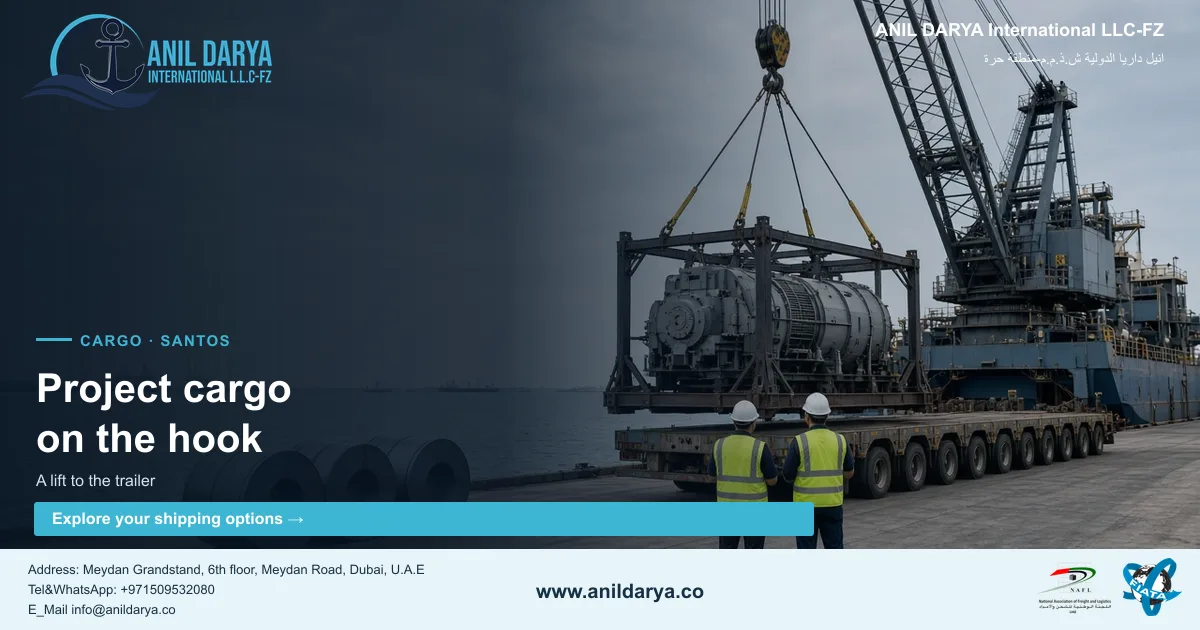
When you ship project cargo to Santos with us, we plan it in this order:
- Collect drawings, dimensions, weights and centre of gravity for each piece.
- Choose flat rack on a container service, or breakbulk or heavy-lift tonnage.
- Get acceptance from the carrier and confirm the discharge terminal in Santos.
- Agree lifting and lashing in Dubai, and share the piece list with the consignee's broker.
- Make sure the Brazilian importer has its Duimp and any permits ready, so the cargo leaves the quay quickly.
Our break bulk and project cargo service covers the UAE side, and our article on flat rack, open top and breakbulk options explains which equipment fits which piece.
For dangerous goods, DP World Santos lists IMDG cargo among the cargo it handles. You need the UN number, proper shipping name, class and packing group, a Safety Data Sheet, a signed DG declaration, UN packaging, labels and placards, and carrier acceptance. Many chemicals also need agency consent in Brazil, which the importer requests in the Portal Unico. Our dangerous goods shipping team checks the documents before you commit to a sailing.
Customs clearance at the Port of Santos: Duimp, documents and taxes
Imports through Santos are cleared by the Receita Federal under the same national process as any Brazilian port. Brazil is moving every import onto the Duimp (Declaracao Unica de Importacao) in the Portal Unico de Comercio Exterior, which replaces the old Siscomex LI and DI. Migration began on 1 October 2024, and the old DI is being switched off in phases.
Who can file the import declaration?
The declaration is made by the importer or its legal representative, usually a customs broker. The importer must first be habilitated with the Receita Federal, the registration traders still call RADAR. Habilitation is requested in the Habilita system in the Portal Unico. In the limitada modality, the importer can bring in up to US$50,000 or US$150,000 in each six-month period, measured on customs value plus freight and insurance. The expressa and ilimitada modalities have no such limit.
How clearance works at Santos
- The cargo is discharged and manifested in the Portal Unico's cargo and transit control module (CCT Importacao).
- The broker registers the Duimp, which can be done once the cargo is manifested.
- Documents are attached in the Anexacao system.
- Taxes are paid and the declaration is risk-assessed. It is released or selected for a document check or a physical inspection.
- After release, the terminal delivers the cargo and the empty container goes back to the line's depot.
Which documents do you need?
The government lists the documents common to every import declaration: bill of lading, commercial invoice, packing list, proof of origin, cargo manifest and documents that prove the commercial transaction.
| Cargo type | Core documents | Usually also needed |
|---|---|---|
| General cargo (FCL or LCL) | Invoice, packing list, certificate of origin, bill of lading | Nothing more if the goods need no licence |
| Food and reefer cargo | Core set | Agricultural or health licensing and certificates from origin |
| Products under Inmetro control | Core set | Inmetro consent through an LPCO in the Portal Unico |
| Dangerous goods | Core set | DG declaration, SDS, agency consent for the product |
| Breakbulk and project cargo | Core set, with a piece-by-piece packing list | Drawings and weights for the terminal |
Get the NCM code right before the cargo sails
Brazil classifies goods with the NCM, the Mercosur version of the HS code. The NCM decides the import duty rate, the IPI rate and whether a licence is needed. The importer and its broker file the code on the Duimp, so agree it with them before you print the invoice.
- Send the broker a full description: material, use, model numbers and a photo or data sheet.
- Get the NCM code back in writing for each line.
- Put the same code and description on the invoice and packing list.
- Ask whether that code needs an LPCO, and wait for it to be granted before loading.
Which taxes are paid on imports through Santos?
The charges on imports are import duty (II), IPI, PIS and COFINS, AFRMM, CIDE-Combustiveis on fuels, the state ICMS and the Siscomex fee. PIS-Importacao is 2.10% and COFINS-Importacao 9.65% of the customs value for almost all imports. AFRMM is 8% of the ocean freight on international shipping. Customs value is usually the FOB value plus international freight and insurance. ICMS is set by each state, and its base includes customs value, the other taxes and customs expenses such as storage and AFRMM.
How to ship from Dubai to Santos: step by step
This is how we handle a typical shipment from the UAE to the Port of Santos. We book space, prepare documents and arrange UAE trucking and export clearance. The consignee's broker clears the goods in Brazil.
- Tell us about the cargo. Commodity, NCM code, weight, volume or dimensions, Incoterm and the consignee's city.
- Confirm the buyer is ready. The Brazilian importer should confirm its habilitation, its broker and any licence the goods need.
- Get a quote. We compare carrier services from Jebel Ali Port to Santos and confirm which Santos terminal each uses.
- Book space. For DG, reefer or out-of-gauge cargo we get carrier acceptance first.
- Check documents before loading. Invoice, packing list, certificate of origin and the draft bill of lading must show the same weights, pieces, consignee and CNPJ.
- Pack and load. ISPM 15 wood packaging, DG labels where needed, container stuffing and seal.
- File the UAE export declaration and gate in before the cut-off.
- Release the bill of lading and send the full document set to the Brazilian broker before the vessel arrives.
[AMIR-FACT: Our real port-to-port transit Jebel Ali to Santos (days) and the carriers or services we actually book to Santos]
How to ship from the Port of Santos to Dubai
We also handle the other direction: shipping from Santos to Dubai, with arrival at Jebel Ali, Khalifa Port or Sharjah port. We book the space with the carrier and run the UAE side. The Brazilian export side stays with the shipper or its Brazil agent, because we have no office in Brazil.
The Brazil export side
- DU-E. The exporter prepares the export declaration, the DU-E, in the Portal Unico Siscomex. The Receita Federal manual sets out each step.
- Cargo reception. The terminal receives the cargo against the Brazilian electronic invoice (NF-e) and presents it for clearance.
- Clearance. The Receita Federal distributes the DU-E for review and clears it, after which the terminal delivers the cargo for loading.
- Loading. The carrier reports the loading data, the system records the cargo as fully exported, and the export is registered (averbacao).
The UAE import side
The import declaration goes to Dubai Customs. A company with a Dubai Customs business code can file it, or a licensed clearing agent with the owner's authorisation. Dubai Customs asks for the commercial invoice, packing list, certificate of origin and any permit from the authority that controls restricted goods, and the carrier's agent needs the bill of lading before it issues the delivery order. Customs duty in Dubai is 5% of the CIF value for most goods, with 50% on alcohol and 100% on cigarettes. Import VAT is 5% of the customs value, and a VAT-registered importer accounts for it on its VAT return through the reverse charge.
- Send us the shipper's details in Brazil, the cargo, the HS code, the Incoterm and the UAE delivery address.
- We book space from Santos to Jebel Ali, Khalifa Port or Sharjah and send the booking and cut-offs to the shipper.
- The shipper or its trucker collects the empty, stuffs it and delivers the box to the Santos terminal on the booking before the cut-off.
- The shipper or its Brazilian customs broker prepares the DU-E, and the Receita Federal clears it before loading.
- We check the draft bill of lading against the invoice and packing list before the carrier issues it.
- We file the UAE import declaration before the ship arrives.
- We arrange payment of the duty and VAT.
- We collect the delivery order from the carrier's agent in the UAE.
- We truck the cargo to your site and return the empty container inside free time.
[AMIR-FACT: the carriers we actually use from Santos to Jebel Ali/Khalifa/Sharjah and our real transit days in this direction]
Free time, storage and demurrage at Santos
Shipping lines give a number of free days for their container. After that, demurrage runs while the full container stays in the port, and detention while the consignee keeps it outside. In Santos you also pay terminal storage, and those customs expenses go into the ICMS base. Free days and daily rates differ by carrier and terminal, so read them on the quote and the arrival notice.
Three things keep these costs down: an importer with habilitation and licences ready before arrival, documents that match, and a broker who receives the documents before the vessel berths. Our article on demurrage and detention shows how the charges are worked out.
Recent developments at the Port of Santos
| Project | Status in official releases | Why it matters to you |
|---|---|---|
| Tecon Santos 10 (STS10), a new container terminal | Expected to raise the port's installed container capacity by about 50% | More berth and yard space for container calls |
| Deeper navigation channel | Deepening works named by the ministry in July 2025; a concession of the access channel is planned | Larger ships and more loading flexibility |
| Larger public port area | 17.2 million m2 added to the organised port in February 2026 | Room for new terminals and storage |
| Santos-Guaruja tunnel | Public-private partnership in the federal Novo PAC programme | A fixed road link between the two banks, which today rely on a ferry |
None of these changes the paperwork today. They do mean terminal choices and free time terms may change over the next few years, so check them on each booking.
Santos or another Brazilian port: which fits your cargo?
| Your situation | Port to compare | Why |
|---|---|---|
| Consignee in Sao Paulo state or the centre-west | Santos | Closest gateway, two rail networks and the Anchieta and Imigrantes highways |
| Consignee in Parana or Santa Catarina | Paranagua, Itajai, Navegantes or Itapoa | Shorter truck leg to the south |
| Consignee in Rio de Janeiro or Espirito Santo | Rio de Janeiro or Vitoria | Avoids a long road leg from Santos |
| Consignee in the northeast | Suape, Salvador or Pecem | Much closer than any southeast port |
| Goods for the Manaus free zone | Manaus | Its own tax regime and river port |
The cheapest ocean rate is not always the cheapest landed cost. ICMS is set by the state of the importer, and a long truck leg can cost more than the freight you saved. We can price more than one Brazilian port so you can compare the cost to the door.
Checklist before you ship to the Port of Santos
- Brazilian importer habilitated, with enough limit for the full customs value.
- NCM code agreed for every item.
- Licences or LPCO granted for controlled goods before loading.
- Invoice, packing list and bill of lading match on weights, pieces, consignee and CNPJ.
- Certificate of origin issued in the UAE.
- Wood packaging treated and marked to ISPM 15.
- Santos terminal confirmed on the booking.
- For DG: SDS, DG declaration, packaging, labels and carrier acceptance.
- For project cargo: drawings, lifting points and a lashing plan.
- Free time agreed and cargo insurance arranged.
Common mistakes when shipping to Santos
- Shipping before the buyer is habilitated or licensed. The box sits in the terminal and storage runs up.
- Forgetting that freight and insurance count against the importer's limitada ceiling.
- Vague goods descriptions that the broker cannot classify.
- Untreated wooden pallets or crates.
- Wrong terminal on the pickup plan. The two banks are on opposite sides of the channel.
- Undeclared or misdeclared dangerous goods.
Frequently asked questions
Who manages the port in Santos?
The Autoridade Portuaria de Santos (APS), formerly Codesp, manages the port, which is owned by the Brazilian federal government. Terminals are run by private operators such as BTP, Santos Brasil and DP World.
Is Santos the largest port in Brazil?
Yes. The Ministry of Ports and Airports calls Santos the country's largest port complex. In June 2025 it handled 29.9% of Brazil's trade.
How much cargo does Santos handle?
The whole port complex handled a record 186.4 million tonnes in 2025. On the Antaq basis, which counts the public port only, the figure was 142.8 million tonnes. In the first half of 2025 it handled 2.8 million TEU of containers.
Which container terminals operate in Santos?
The main ones are BTP on the right bank at Alemoa, and Tecon Santos and DP World Santos on the left bank. Your carrier's service decides which one your container uses.
How do I clear goods at the Port of Santos?
A habilitated Brazilian importer or its broker registers a Duimp in the Portal Unico once the cargo is manifested, pays taxes and attaches the documents. The Receita Federal then releases the goods or selects them for inspection.
Can I ship dangerous goods to Santos?
Yes. DP World Santos lists IMDG dangerous goods among its cargo types. You need carrier acceptance, the SDS, a DG declaration and UN packaging, and the importer must get any agency consent the product needs.
How far is the Port of Santos from Sao Paulo?
About 70 km. Trucks use the Anchieta and Imigrantes highways, and two rail networks, Rumo and MRS, also serve the port.
How do I ship from Dubai to Santos?
Send us the cargo details and the consignee's city. We book space from Jebel Ali, clear the UAE export and send the documents to the Brazilian broker, who registers the Duimp once the cargo is manifested.
Can you ship from Santos to Dubai?
Yes. We book space from Santos to Jebel Ali, Khalifa Port or Sharjah, the shipper or its Brazilian broker files the DU-E, and we clear the cargo through UAE customs and deliver it. Most goods pay 5% customs duty on the CIF value plus 5% import VAT.
Get a quote for Port of Santos shipping
Send us your cargo details and the consignee's city, and we will come back with a routing and a price to Santos. Use our freight rate inquiry form, or contact our team to talk through a breakbulk, project or DG shipment first. You can also read more about our Dubai freight forwarding team.
Sources
- Ministry of Ports and Airports: Santos handles 186.4 million tonnes in 2025 (January 2026)
- Ministry of Ports and Airports: Southeast ports in 2025, Antaq data (March 2026)
- Ministry of Ports and Airports: Santos container record, first half of 2025 (July 2025)
- Ministry of Ports and Airports: Santos January 2026 results and area expansion (February 2026)
- Wikipedia (Portuguese): Porto de Santos (authority, quay, banks, terminals, rail and road access)
- Wikipedia: Port of Santos (federal ownership)
- DP World: Santos terminal (quay, ship size, reefer connections, cargo types, areas)
- BTP: Brasil Terminal Portuario (quay, capacity)
- Ministry of Ports and Airports: Santos-Guaruja tunnel (channel width, ferry crossing)
- Ministry of Finance: Duimp enters operation (October 2024)
- Receita Federal: Preparing the Duimp
- Receita Federal: Habilitation via the Habilita system
- Receita Federal: IN RFB 1,984/2020 text (habilitation limits)
- Gov.br: Declare imported goods (documents)
- Invest and Export Brasil: Tax treatment on imports
- Receita Federal import simulator glossary (tax bases and rates)
- Ministry of Ports and Airports: AFRMM
- Inmetro: Import consent in the Portal Unico
- IPPC: ISPM 15
- Receita Federal: Export manual, DU-E in the Portal Unico (steps from DU-E to averbacao)
- Dubai Customs: Submit customs declaration (invoice, packing list, certificate of origin, permits)
- Dubai Customs: FAQ (customs business code, clearing agents with owner authorisation)
- UAE Government portal: Customs duty (5% of CIF, alcohol 50%, cigarettes 100%)
- Federal Tax Authority: VAT guide (5% import VAT on the customs value, reverse charge)
Reviewed: 10 November 2026