
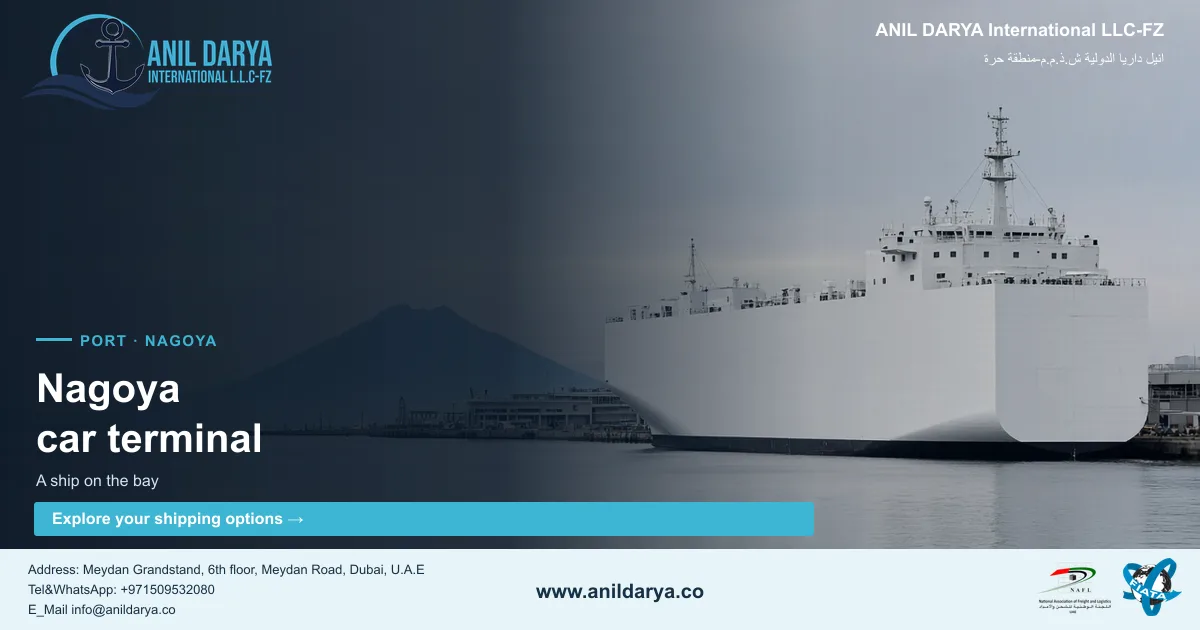
Port of Nagoya shipping is the sea route into Japan's car-making heartland. Nagoya handled 159.4 million tonnes of cargo in 2025, the most of any Japanese port, and about 2.76 million TEU of containers in 2024 across five container terminals. This guide covers the terminals, the car and breakbulk side of the port, what is specific about clearing cargo there, and how we ship your cargo from Dubai to Nagoya. We ship both ways: from Dubai to Nagoya and from Nagoya to Dubai.
Port of Nagoya guide: key facts at a glance
| Item | Detail |
|---|---|
| Port administrator | Nagoya Port Authority, a joint body of Aichi Prefecture and Nagoya City |
| UN/LOCODE | JPNGO |
| Location | Innermost part of Ise Bay, Aichi Prefecture, central Honshu |
| Opened to international trade | 10 November 1907 |
| Total cargo | 159.4 million tonnes in 2025 (156.71 million in 2024), the largest in Japan |
| Containers handled in 2024 | 2,755,491 TEU, MLIT figure (port authority: 2.76 million TEU) |
| Foreign trade containers | 2,588,364 TEU in 2024 (1,343,035 out, 1,245,329 in); 2.64 million TEU in 2025, up 1.9% |
| Container terminals | Five: Tobishima Pier North, NCB, Tobishima Pier South, Tobishima Pier South Side, Nabeta Pier |
| Container berths | 13 berths, 3,955 m of quay, 29 gantry cranes |
| Deepest container berths | 16 m at Tobishima Pier South Side |
| All berths (4.5 m depth and over) | 277 berths, 33,700 m in total, as of 1 July 2026 |
| Completed car exports | About 1.46 million vehicles a year, Japan's No. 1 car export port |
| Vessel arrivals | 27,466 in 2024 |
| Top export markets | China, USA, Australia, UAE, Thailand |
| Customs authority | Japan Customs |
| Consumption tax on imports | 10% standard, 8% reduced rate |
| Nagoya to Dubai | Japanese export permit before loading; 5% UAE duty on CIF for most goods plus 5% VAT |
Where is the Port of Nagoya, and which consignees does it suit?
Nagoya sits at the innermost edge of Ise Bay on Japan's Pacific coast, roughly midway between Tokyo and Osaka. Its piers spread across Nagoya, Tokai, Chita, Yatomi and Tobishima in Aichi Prefecture. The port authority describes the hinterland as home to Japan's automobile industry, and the port is the main export base for Toyota.
The port links to the Tomei and Meishin expressways, and the wider region is ringed by the Isewangan, Tokai Ring and Higashi-Meihan expressways. That makes Nagoya the natural port for factories and warehouses in Aichi, Gifu, Mie and parts of Shizuoka.
| Your consignee is in | Port to price first |
|---|---|
| Aichi, Gifu or Mie (Chubu manufacturing belt) | Nagoya |
| Western Shizuoka | Price Nagoya and the Tokyo Bay ports side by side |
| Greater Tokyo or Kanagawa | Yokohama or Tokyo |
| Osaka, Kyoto, Hyogo or western Japan | Kobe or Osaka |
| Small port on Ise Bay such as Yokkaichi | Ask whether a direct call exists, or use Nagoya plus a truck |
Which container terminals does the Port of Nagoya have?
The port authority lists five container terminals with 13 berths in total. Four sit on Tobishima Pier and NCB on the west side of the port, and the largest, Nabeta Pier, is on its own. Your carrier's service decides the terminal, and the arrival notice names it.
| Terminal | Berths | Quay | Depth | Gantry cranes | Reefer outlets | 2024 TEU | Main routes |
|---|---|---|---|---|---|---|---|
| Tobishima Pier North | W90 to W92 | 620 m | 10 to 12 m | 3 | 110 | 122,750 | North America West Coast, Indonesia, Singapore, Indochina |
| NCB | R1 to R3 | 900 m | 12 to 15 m | 6 | 189 | 631,709 | North America West Coast, Indonesia, Singapore, Bangkok, Indochina, Korea |
| Tobishima Pier South | W93, W94 | 700 m | 15 m | 6 | 135 | 269,316 | North America West Coast, Bay of Bengal, Indonesia, Singapore, Bangkok, China |
| Tobishima Pier South Side | TS1, TS2 | 750 m | 16 m | 6 | 240 | 602,025 | North America West Coast, North America and Europe, Singapore, Bangkok, Philippines |
| Nabeta Pier | T1 to T3 | 985 m | 12 to 14 m | 8 | 288 | 1,127,617 | China, Korea, Taiwan |
The port authority notes that NCB's figures may differ during quay reconstruction work. Routes are the terminals' main lines, not a full list.
Nabeta Pier: the busiest box terminal
Nabeta Pier handled 1,127,617 TEU in 2024, about 41% of the port's containers. It is run by Nagoya United Container Terminal Co. (NUCT), a joint company of nine harbour transport firms. T1 opened in 1997, T2 in 2001 and T3 in 2012. It has 24 inbound and 12 outbound gate lanes and 16 truck scales, so it is built for heavy truck traffic. Its main routes are short-sea services to China, Korea and Taiwan.
Tobishima Pier South Side: Japan's first automated terminal
Tobishima Pier South Side is the deep-water terminal, with two 16 m berths that opened in 2005 and 2008. The port authority calls it Japan's first automated terminal: it runs 34 automated guided vehicles (AGVs) and 25 RTGs, 24 of them automated. It is leased by Tobishima Container Berth Co., whose investors include K Line, Mitsui O.S.K. Lines and NYK. Its routes include the long-haul North America and Europe services.
The older terminals: Tobishima North, Tobishima South and NCB
Tobishima Pier North (opened 1984) is one of two public container terminals and the shallowest at 10 to 12 m. Tobishima Pier South (1991) has two 15 m berths for over-Panamax ships. NCB began in 1972 as a joint venture of the port authority and Japanese lines. Its R1 and R2 berths are leased to K Line, MOL and NYK, and its R3 berth to NUCT.
What is changing at the container terminals?
The port plan adds a third 16 m berth at Tobishima Pier South Side, for 1,200 m of quay in all. It also creates a Tobishima Pier East Side terminal: one NCB berth is being deepened to 15 m so that four berths in a row, including the two at Tobishima South, form a 1,400 m quay. For you, this means berth assignments can shift during the works, so check the terminal on each arrival notice.
What cargo moves through the Port of Nagoya?
Nagoya is an export port built around cars. In 2025, completed cars and car parts made up over 60% of its exports by weight. The port authority lists its main exports as completed cars, car parts, industrial machinery, steel and chemical products, and its main imports as LNG, iron ore, crude oil, coal and clothing.
The UAE is one of Nagoya's top five export markets, alongside China, the USA, Australia and Thailand. In containers, the port is close to balanced: 1,343,035 TEU went out and 1,245,329 TEU came in on foreign trade in 2024. Domestic containers are small, at 167,127 TEU, so Nagoya is mostly a deep-sea and Asia port rather than a coastal feeder hub.
| Cargo type | How it usually moves into Nagoya | What to plan |
|---|---|---|
| General goods, parts, resins | FCL or LCL through the five container terminals | Terminal on the arrival notice, free time, trucking slot |
| Chilled and frozen food | Reefer containers, 962 outlets across the terminals | Set temperature, food import notification |
| Machinery and steel | Flat racks, or breakbulk at general cargo berths | Lifting points, berth depth, trailer type |
| Vehicles | Ro-Ro, or cars stuffed in containers | Vehicle documents, inspection, storage time |
| Chemicals and other DG | IMDG containers on services that accept the class | Japanese approvals before import |
| Bulk (coal, ore, grain, oil) | Dedicated bulk and liquid berths | Receiving facility and discharge plan |
Port of Nagoya shipping by container: FCL, LCL and reefer
- FCL (full container load). You book a whole 20ft or 40ft box. It is discharged at your carrier's terminal and trucked to the consignee once customs releases it.
- LCL (less than container load). Your cargo shares a box and is unpacked at a container freight station. Every shipper's papers in the box affect the release, so send clean documents early.
- Reefer. The five terminals list 962 reefer outlets in total, from 110 at Tobishima North to 288 at Nabeta.
Cargo from the UAE usually reaches Nagoya with a transhipment at an Asian hub. A tracker of container lanes lists Jebel Ali among the origins of Nagoya's import lanes. The same tracker showed Ocean Network Express with about 56% of tracked capacity at Nagoya in March 2026. Once your cargo fills a good part of a 20ft box, price FCL as well. Our guide to FCL vs LCL costs shows where the break-even usually sits, and our sea freight service lists the container types we book.
Cars, Ro-Ro and the Kinjo Pier vehicle base
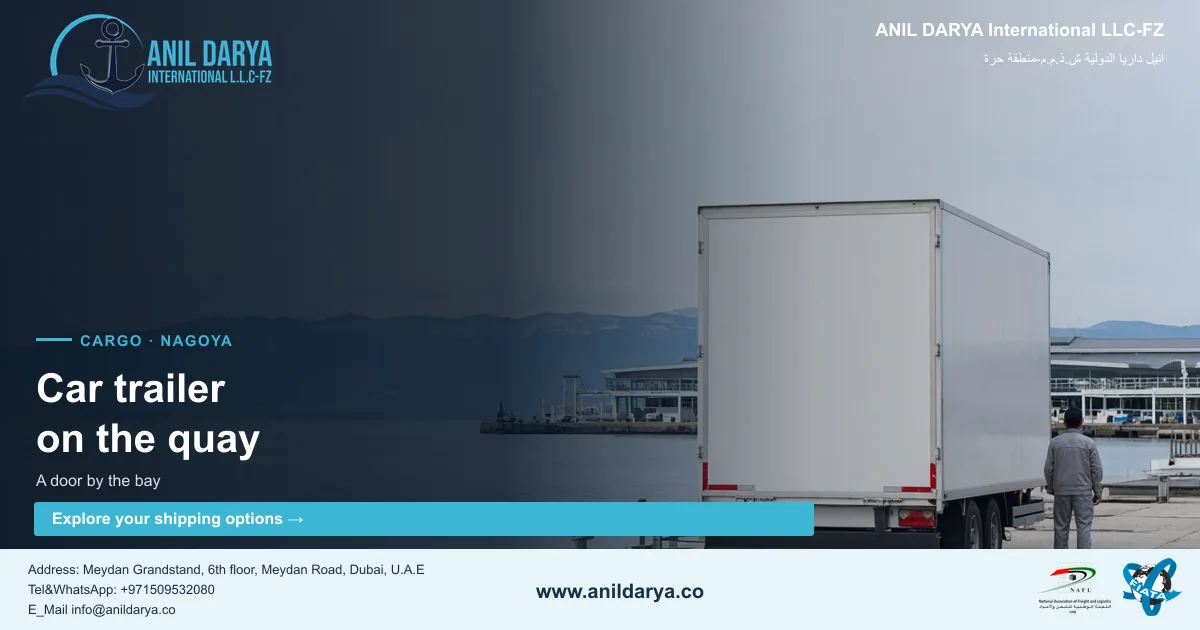
Nagoya ships about 1.46 million completed cars a year, more than any other Japanese port. Most of this flow is outbound, from the Chubu car plants to markets that include the Gulf. If you are shipping vehicles or rolling machinery from the UAE into Nagoya, ask the carrier whether a Ro-Ro service takes cargo inbound on your dates.
The port plan builds a Kinjo Pier automobile handling base with 12 m water depth, two berths totalling 520 m plus a 260 m berth, and 18.6 ha of reclaimed land. Ro-Ro needs rolling or towable cargo. Anything that cannot roll goes in a container, on a flat rack or as breakbulk.
A decision rule: for one or two vehicles, a container is often simpler. For self-propelled machinery that is too big for a box, ask the carrier whether a Ro-Ro service calls Nagoya on your dates.
Breakbulk, project and out-of-gauge cargo into Nagoya
The region's machinery and steel industry keeps a large general cargo side at the port. The port authority lists 1.69 million m² of cargo handling yards, 469,715 m² of sheds, 3.19 million m² of warehouses and 1.4 million m² of timber yards. Its East Channel is 15 to 16 m deep and its West Channel 12 to 16 m, but individual berths are shallower, so the ship's draught still has to match the berth.
- Send drawings, dimensions, weights and centre of gravity for each piece.
- Choose between a flat rack on a container service and a conventional or heavy-lift ship.
- Confirm the discharge berth and its depth with the carrier, since general cargo berths vary.
- Plan the road move with the consignee's trucker, including permits for wide or heavy loads.
- Line up customs before arrival so the cargo leaves the quay quickly.
A rule of thumb: if a piece fits a 40ft flat rack by size and weight, a container service gives you more sailings into Nagoya. If not, the breakbulk ship's sailing date drives the plan. See our guide to flat racks, open tops and breakbulk and our break bulk and project cargo service.
Dangerous goods to the Port of Nagoya
You can ship IMDG dangerous goods to Nagoya on container services that accept the class. Before loading in Dubai you need the UN number, proper shipping name, class and packing group, a Safety Data Sheet, a signed Dangerous Goods Declaration, UN-approved packaging with labels and placards, and written carrier acceptance for every leg, including the transhipment.
Japan Customs checks 30 other laws at import. For the chemicals and gases that Chubu factories buy, the ones that usually apply are the High Pressure Gas Safety Act, the Poisonous and Deleterious Substance Control Act, the chemical substances law and the Industrial Safety and Health Act. The importer must hold any approval before the declaration. Our dangerous goods shipping team checks classification and acceptance before you commit to a sailing.
Customs at the Port of Nagoya: the short version
Nagoya follows the same Japan Customs rules as every Japanese port. Our Yokohama guide covers them in full, so here is the summary.
- Advance filing. The carrier or NVOCC files container cargo data through NACCS, in principle 24 hours before the ship leaves the port of loading. Give a precise cargo description at booking.
- Pre-arrival examination. Once the bill of lading is issued, the importer can file with the customs office for the bonded area where the box will land and learn early whether it faces an inspection.
- Import declaration. The importer files Customs Form C-5020, usually through a customs broker, normally after the goods enter a bonded (Hozei) area.
- Documents. Invoice, bill of lading, and where needed a certificate of origin, packing list, freight and insurance documents, and licences under other laws.
- Tax. Consumption tax is 10%, or 8% at the reduced rate, on the customs value plus duty plus any excise tax.
One Nagoya point: many imports here are parts for production lines, so a hold costs the consignee more than storage. Use the pre-arrival examination to learn early whether the box will be inspected. The UAE and Japan concluded CEPA negotiations in March 2026, but we found no confirmation that the agreement is in force, so plan on standard duty rates.
How to ship from Dubai to the Port of Nagoya, step by step
- Send us the cargo details: commodity, HS code, weight, volume or dimensions, the consignee's address and the Incoterm.
- Confirm Japanese controls. The importer checks food, chemical or gas approvals and starts them early.
- Pick the port and service. We check that Nagoya is the right port for the consignee and which terminal each carrier uses.
- Book space. For DG, reefer or out-of-gauge cargo we get carrier acceptance first, for every leg.
- Prepare documents. We check that names, weights, marks and HS codes match across invoice, packing list and bill of lading.
- Export from Dubai. We truck the cargo to Jebel Ali Port, file the export declaration with Dubai Customs and gate in before the cut-off.
- The carrier files the advance data with Japan Customs before the ship sails.
- Clear and deliver in Nagoya. The importer's broker files the declaration and pays duty and tax, and the trucker collects the box from the named terminal.
Published transit indications vary. Fluent Cargo, a route tool, shows about 27 days from Khor Fakkan to Nagoya and about 35 days from Jebel Ali, both with one transhipment and sailings every two to four weeks on those routings. Shipa Freight lists 27 days from Jebel Ali. Treat these as indications only.
[AMIR-FACT: the carriers or services we actually book from Jebel Ali to Nagoya, the transhipment hub, which Nagoya terminal they use, and our typical port-to-port days]
When does air cargo make more sense?
Chubu Centrair International Airport has been the Nagoya region's main airport since 2005. Fluent Cargo shows routings from Dubai International to Centrair of about 17 hours with one transfer, with flights every one to two days. For urgent parts that stop a production line, compare that with the sea time. See our air cargo service.
How to ship from the Port of Nagoya to Dubai
We also handle the other direction: cargo from Nabeta, Tobishima or another Nagoya terminal to Jebel Ali, Khalifa Port or Sharjah port. Nagoya's own figures list the UAE among the port's top five export markets. We book the space with the carrier, check the papers and run the UAE side. The Japanese export clearance stays with the shipper or its Japanese customs broker.
The Japan export side
- Export declaration. The exporter, or a customs broker acting as its proxy, lodges an export declaration (Customs form C-5010) describing the nature, quantity and value of the goods. It goes with the invoice and any permit or approval required by other laws.
- Export permit. Customs checks the declaration against the invoice and supporting papers, may examine the goods, and then issues the export permit. Cargo cannot be loaded without it.
- Controlled goods. Some goods need approval from another ministry before the declaration. Strategically sensitive items, for example, need authorization from the Ministry of Economy, Trade and Industry (METI).
- Used vehicles. A registered vehicle needs a Certificate of Registration Deletion from the Ministry of Land, Infrastructure, Transport and Tourism; a vehicle already deregistered needs a Certificate of Notice of Planned Export. Either one is valid for 6 months and is shown to customs at the export inspection.
The UAE import side
For car parts, industrial machinery, steel or used vehicles loaded at Nagoya, we lodge the import declaration with Dubai Customs before the ship reaches the UAE. It carries the Nagoya shipper's commercial invoice and packing list, the certificate of origin and a permit from the controlling authority if the goods are restricted. The carrier issues the delivery order once it holds the original or released bill of lading from Nagoya. Dubai charges customs duty of 5% of the CIF value on most goods; alcohol pays 50% and cigarettes 100%. Import VAT is 5% of the import value, meaning the customs value, freight, insurance and the duty paid. A VAT-registered UAE importer accounts for it on its VAT return under the reverse charge; an importer that is not registered settles it at import.
- Send us the shipper's details in Japan, the cargo, the HS code and the UAE delivery address.
- We book space from Nagoya and send the booking and cut-offs to the shipper.
- The shipper or its trucker delivers the loaded box to the terminal before the cut-off, with a gate reservation where the terminal needs one.
- The shipper or its customs broker lodges the export declaration and gets the export permit.
- We check the draft bill of lading against the invoice and packing list.
- We file the Dubai Customs import declaration before the ship arrives.
- We arrange payment of the duty and VAT and collect the delivery order from the carrier's UAE agent.
- We truck the box to your site and return the empty to the carrier's depot inside free time.
[AMIR-FACT: the carriers we actually use from Nagoya to Jebel Ali, Khalifa Port or Sharjah, and our real port-to-port transit days in this direction]
Free time, demurrage and detention at Nagoya
Each carrier sets free days for its containers. After that, demurrage runs while the full box stays in the terminal, and detention runs while you keep it outside. A container tracker reported average import dwell times at Nagoya of about 5.5 to 11.6 days a month between September 2025 and February 2026, so plan clearance before arrival rather than after. Our article on demurrage and detention explains how the charges add up.

Checklist before you ship to the Port of Nagoya
- HS code checked against Japan's current tariff.
- Importer and customs broker in Japan confirmed.
- Nagoya chosen because the consignee is in the Chubu region, not by habit.
- Food, chemical or gas approvals started before sailing.
- Precise cargo description given at booking for the advance filing.
- Invoice, packing list and bill of lading show the same consignee, weights and marks.
- Terminal confirmed on the arrival notice, especially during the Tobishima works.
- For DG: SDS, DG declaration, packaging, labels and acceptance for every leg.
- For machinery: drawings, lifting points and berth depth confirmed.
- Free time agreed with the carrier if clearance may be slow.
Common mistakes on Nagoya shipments
- Booking to Tokyo or Kobe for a consignee in Aichi, then paying for a long truck move.
- Sending the truck to the wrong terminal. Nagoya has five, and Nabeta Pier is a separate pier from Tobishima.
- Vague cargo descriptions at booking, which can cause problems with the advance filing.
- Starting chemical or gas approvals after the ship sails.
- Assuming the transhipment carrier accepts the DG class because the first carrier did.
- Treating a production-line shipment like stock. A short delay here can stop a plant, so build in buffer time or use air for urgent parts.
Frequently asked questions
Who manages and runs the port of Nagoya?
The Nagoya Port Authority, a local public body run jointly by Aichi Prefecture and Nagoya City. Terminal companies such as NUCT and Tobishima Container Berth Co. lease and run the container terminals.
What is the port code for Nagoya?
The UN/LOCODE for the Port of Nagoya is JPNGO. You will see it on bookings, bills of lading and tracking systems.
How many containers does the Port of Nagoya handle?
About 2.76 million TEU in 2024, of which 2,588,364 TEU were foreign trade containers. Foreign trade containers rose 1.9% to 2.64 million TEU in 2025.
Which is the deepest container terminal at Nagoya?
Tobishima Pier South Side, with two 16 m berths and 750 m of quay. It is also Japan's first automated container terminal, using AGVs and automated RTGs.
Is Nagoya the busiest port in Japan?
By total cargo, yes. Nagoya handled 156.71 million tonnes in 2024 and 159.4 million tonnes in 2025, the largest in Japan. By containers, Tokyo, Yokohama and Kobe handle more.
How long does sea freight from Dubai to Nagoya take?
Published indications range from about 27 days from Khor Fakkan to about 35 days from Jebel Ali, with one transhipment. Ask for the carrier's own schedule for your sailing.
Can I ship dangerous goods to the Port of Nagoya?
Yes, on container services into Nagoya that accept the class, with full IMDG documents, packaging and written acceptance for every leg, including the transhipment. High-pressure gases, poisonous substances and some chemicals also need approvals under Japanese law, which the importer must hold before the declaration.
How much consumption tax is charged on imports at Nagoya?
Consumption tax is 10%, or 8% at the reduced rate, on the customs value plus duty plus any excise tax. Customs duty depends on the HS code.
Can you ship cargo from Nagoya to Dubai?
Yes. The shipper or its Japanese customs broker lodges export form C-5010 and gets the export permit, with the MLIT certificate for a used vehicle. We book the space from Nabeta or Tobishima, clear the cargo through Dubai Customs and deliver it in the UAE. Most goods pay 5% UAE duty on the CIF value plus 5% import VAT.
Get a quote for Port of Nagoya shipping
Send us your cargo details and the consignee's address, and we will come back with a routing and a price to Nagoya. Use our freight rate inquiry form, or contact our team to talk through a breakbulk, DG or machinery shipment first. You can also read more about our Dubai freight forwarding team.
Sources
- Nagoya Port Authority: Port profile (2024 cargo, TEU, vessel arrivals, car exports, trade partners)
- Nagoya Port Authority: Statistics 2025
- Nagoya Port Authority: Facility outline (277 berths, yards and sheds, as of July 2026)
- Nagoya Port Authority: Container terminals (berths, quay, depth, cranes, 2024 TEU)
- Nagoya Port Authority: Nabeta Pier container terminal
- Nagoya Port Authority: Tobishima Pier South Side container terminal
- Nagoya Port Authority: Tobishima Pier South container terminal
- Nagoya Port Authority: Tobishima Pier North container terminal
- Nagoya Port Authority: NCB container terminal
- Nagoya Port Authority: Other facilities (channels, warehouses, yards)
- Nagoya Port Authority: Port development (Tobishima, Kinjo Pier)
- MLIT: Container cargo volume at Japanese ports in 2024, corrected (port-by-port TEU)
- Wikipedia: Port of Nagoya (piers, administration, Toyota exports)
- Wikipedia: Transport in Greater Nagoya (expressways, Centrair)
- iContainers: Port of Nagoya (UN/LOCODE, expressways, regions served)
- Cogoport: Nagoya port statistics (dwell times, operator capacity, lanes)
- Japan Customs: Import procedures
- Japan Customs: Advance Filing Rules on maritime container cargo
- Japan Customs: Pre-arrival examination system
- Japan Customs: Tariff rates and consumption tax
- Japan Customs: Other laws checked at import
- Gulf Business: UAE concludes CEPA negotiations with Japan (March 2026)
- Fluent Cargo: Dubai to Nagoya routes (transit indications)
- Shipa Freight: Shipping to Japan (Jebel Ali to Nagoya transit)
- Japan Customs: Export procedures (exporter or customs broker, form C-5010, invoice, permits under other laws, METI)
- Japan Customs: Customs procedures for exporting used vehicles (MLIT certificates, 6-month validity)
- Dubai Customs: Submit customs declaration (documents)
- UAE Government portal: Customs duty (5% of CIF, alcohol 50%, cigarettes 100%)
- Federal Tax Authority: VAT Decree-Law No. 8 of 2017 as amended (5% rate, import value, reverse charge, unregistered importers)
Reviewed: 10 November 2026