
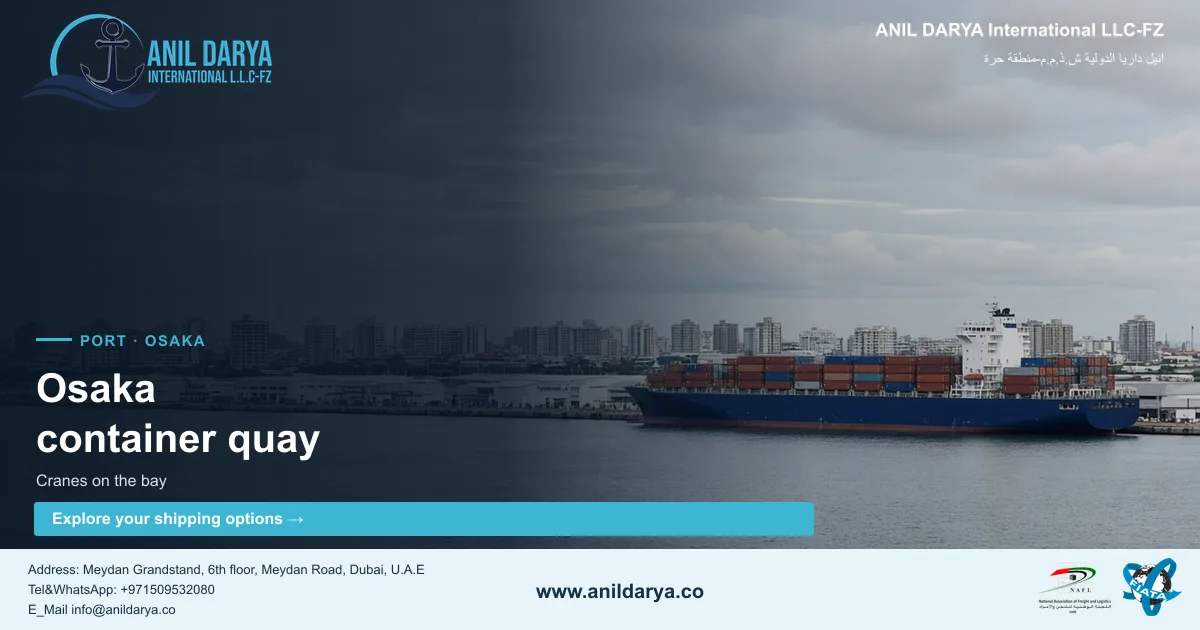
Port of Osaka shipping is how most containers reach the Osaka city area and eastern Kansai. Osaka handled 2,315,878 TEU in 2024, and unlike Kobe across the bay it takes in more containers than it sends out. This guide covers the Yumeshima and Sakishima terminals, the steel and ferry side of the port, what is specific about clearing cargo there, and how we ship your cargo from Dubai to Osaka. We ship both ways: from Dubai to Osaka and from Osaka to Dubai.
Port of Osaka guide: key facts at a glance
| Item | Detail |
|---|---|
| Port administrator | City of Osaka (Osaka Port and Harbor Bureau) |
| Container terminal company | Kobe-Osaka International Port Corporation (HPC), for Hanshin Port (Kobe and Osaka) |
| UN/LOCODE | JPOSA |
| Location | Osaka Bay, on the delta of the Yodo River |
| Container areas | Sakishima (C-1 to C-4, C-8, C-9) and Yumeshima (C-10 to C-12) |
| Deepest container berth | 16 m at C-12, Yumeshima (650 m of quay) |
| Containers handled in 2024 | 2,315,878 TEU, MLIT corrected figure (2023: 2,238,365 TEU) |
| Foreign trade containers in 2024 | 2,024,908 TEU: 914,405 out, 1,110,503 in |
| Domestic containers in 2024 | 290,970 TEU |
| Liner (conventional) berths | L-1 to L-7 at Sakishima, 200 to 250 m each, 10 m depth, mainly steel |
| Ferry berths | R-4, R-5, F-1, F-3, F-4 and the international ferry terminal at Sakishima |
| Gate reservation system | CONPAS at the Yumeshima container terminal |
| Nearest cargo airport | Kansai International Airport (KIX) |
| Customs authority | Japan Customs |
| Consumption tax on imports | 10% standard, 8% reduced rate |
| Osaka to Dubai | Japanese export permit before loading; 5% UAE duty on CIF for most goods plus 5% VAT |
Where is the Port of Osaka, and is it the right port for your cargo?
The port sits on Osaka Bay at the mouth of the Yodo River, with the city right behind it. It serves Osaka, Kyoto, Nara, Hyogo, Wakayama and Shiga, and has road links into the Kansai region and western Honshu. Osaka and Kobe together make up Hanshin Port, and HPC develops and leases the container terminals at both.
They are still two ports for your booking, with separate terminals and separate port codes, so the port on your bill of lading matters. Our Kobe guide compares the two in detail. The short version for Osaka:
| Your situation | What to do |
|---|---|
| Consignee in Osaka city, eastern Osaka Prefecture, Nara or Kyoto | Price Osaka first |
| Consignee in Hyogo or western Kansai | Price Kobe first |
| Imported consumer goods for Kansai distribution centres | Osaka, which takes in more boxes than it ships out |
| Long-haul service on a very large ship | Yumeshima at Osaka, or Kobe's 16 m berths |
| Consignee in the Chubu region around Aichi | Nagoya instead |
Which container terminals does the Port of Osaka have?
Osaka's container berths are in two places. Sakishima, in the Nanko district, is the older area with six berths mostly on Asian routes. Yumeshima, an island further out in the bay, is the newer, deeper terminal. HPC's table for Osaka is dated September 2026.
| Berth | Area | Lessee / operator | Quay | Depth | Reefer outlets | Main routes |
|---|---|---|---|---|---|---|
| C-1 | Sakishima | Tatsumi Shokai | 350 m | 13.5 m | 378 | Southeast Asia, China, Korea |
| C-2 | Sakishima | Mitsui O.S.K. Lines / Shosen Koun | 350 m | 13.5 m | 324 | Southeast Asia, China, Korea, India |
| C-3 | Sakishima | Tatsumi Shokai | 350 m | 13.5 m | 192 | Southeast Asia, China |
| C-4 | Sakishima | Tatsumi Shokai | 350 m | 13.5 m | 120 | Korea, Southeast Asia, China |
| C-8 | Sakishima | Kawasaki Kisen / Nitto Total Logistics | 350 m | 14 m | 312 | China, Southeast Asia |
| C-9 | Sakishima | Wan Hai Lines / Mitsubishi Logistics | 350 m | 13.5 m | 288 | Korea, Southeast Asia, China |
| C-10 | Yumeshima | Dream Island Container Terminal (DICT) group | 350 m | 15 m | 342 | Southeast Asia, China, Oceania, Korea |
| C-11 | Yumeshima | Evergreen joint service / Tatsumi Shokai | 350 m | 15 m | 420 | North America, Southeast Asia, China |
| C-12 | Yumeshima | DICT group | 650 m | 16 m | 642 | Southeast Asia, China, Oceania, Korea |
Lessees and routes change when carriers move, so treat this as a snapshot and check the terminal on the arrival notice.
Yumeshima: the deep-water terminal
Yumeshima's three berths, C-10 to C-12, form one continuous 1,350 m quay at 15 to 16 m depth. Dream Island Container Terminal Co. (DICT) operates the terminal. HPC's carrier list for the Yumeshima group names lines such as Maersk, MSC, CMA CGM, COSCO, OOCL and Wan Hai, and C-11 is used by Evergreen for North America, Southeast Asia and China. Yumeshima also has the most reefer outlets in the port, 642 at C-12 alone.
HPC is redeveloping C-10 to C-12 with a larger yard, more gates, bigger gantry cranes, a new common gate and 16 m quay depth. The national government's port office also lists a Yumeshima tunnel under construction to link Yumeshima with Sakishima and make container trucking between them easier.
Sakishima: Asian services and the older berths
Sakishima's six container berths are 350 m each at 13.5 to 14 m. They mostly carry Asian services to Korea, China and Southeast Asia, and C-2 also lists India. Korean lines are strong here: C-4 alone lists eleven carriers, most of them Korean. For cargo from the UAE, this matters because your box may come on an Asian feeder after transhipment, and that feeder is likely to land at Sakishima rather than Yumeshima.
What cargo moves through the Port of Osaka?
Osaka is an import port. In 2024 its foreign trade boxes were 1,110,503 TEU inbound against 914,405 TEU outbound. That fits its role as the entry point for goods consumed in the Osaka metropolitan area. DP World describes the Osaka and Kobe gateway as a major import hub for Kansai's consumer and industrial markets.
| Cargo type | How it usually moves into Osaka | What to plan |
|---|---|---|
| Consumer goods, food and beverage, machinery parts | FCL or LCL to Sakishima or Yumeshima | Terminal on the arrival notice, CONPAS slot at Yumeshima |
| Chilled and frozen food | Reefer containers, 3,018 outlets across the nine berths | Set temperature, food import notification |
| Steel and steel products | Conventional ships at liner berths L-1 to L-7 | 10 m berth depth, lifting gear, sheds |
| Machinery and project cargo | Flat racks on container services, or breakbulk ships | Drawings, lift plan, road permits |
| Trucks and trailers to other Japanese regions | Domestic Ro-Ro ferries from Osaka Bay | Ferry booking, unaccompanied trailer rules |
| Chemicals and other DG | IMDG containers on services that accept the class | Japanese approvals before import |
Port of Osaka shipping by container: FCL, LCL and reefer
- FCL (full container load). You book a whole 20ft or 40ft box. It is discharged at the carrier's berth and trucked to the consignee once customs releases it.
- LCL (less than container load). Your cargo shares a box and is unpacked at a container freight station. Every shipper's papers in the box affect the release, so send clean documents early.
- Reefer. Osaka's nine container berths list 3,018 reefer outlets in total, from 120 at C-4 to 642 at C-12.
Once your cargo fills a good part of a 20ft box, price FCL as well. Our guide to FCL vs LCL costs shows where the break-even usually sits, and our sea freight service lists the container types we book.
Gates, CONPAS and trucking out of Yumeshima
CONPAS (Container Fast Pass) is a system developed by Japan's transport ministry to cut queues at terminal gates. In Osaka it runs at the Yumeshima container terminal. It covers reservations for collecting and delivering boxes, advance checks of collection data, and PS card entry for trucks. The PS card is an ID card issued by the ministry for entry to international terminals.
In February 2025 DICT also started a new gate system at Yumeshima. It replaces paper and visual container checks with 5G handheld terminals and an AI camera system at the gate, and links truck data to CONPAS. For you, the practical point is simple: the consignee's trucker should book a slot and carry the right card before going to Yumeshima. Ask whether your Sakishima berth needs the same.
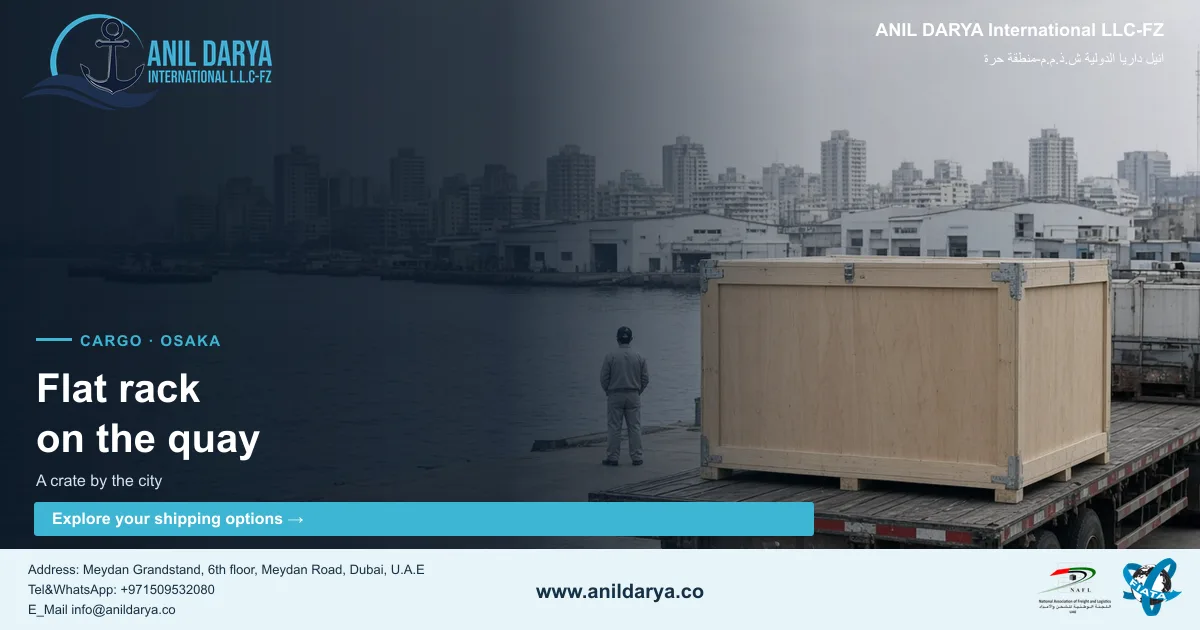
Steel, breakbulk and project cargo at Osaka's liner berths
Sakishima keeps seven conventional (liner) berths, L-1 to L-7. Each is 200 to 250 m long at 10 m depth, with yards of about 18,000 to 19,000 m² and sheds of about 5,600 to 7,000 m². HPC lists steel materials as their main cargo. Lessees include Konoike Transport, Nissin, Kamigumi, Tatsumi Shokai, Sankyu, Shibusawa Logistics and Nippon Express. L-1 and L-5 have operational depths below 10 m, at 9 m and 8.8 m.
- Send drawings, dimensions, weights and centre of gravity for each piece.
- Choose between a flat rack on a container service and a conventional or heavy-lift ship.
- Check the ship's draught against the berth. A 10 m liner berth, or 8.8 m operational at L-5, can rule out a larger ship.
- Plan the road move with the consignee's trucker, including permits for wide or heavy loads in the city.
- Line up customs before arrival so the cargo leaves the quay quickly.
A rule of thumb: if a piece fits a 40ft flat rack by size and weight, a container service gives you more sailings into Osaka. If not, the breakbulk ship's sailing date drives the plan, and Kobe's liner berths are worth pricing too. See our guide to flat racks, open tops and breakbulk and our break bulk and project cargo service.
Ferries and feeders: moving on from Osaka
Osaka Bay is a hub for Japan's domestic ferries. HPC counts 49 ferry sailings a week from Hanshin Port to Kyushu and 41 to Shikoku, and Sakishima has its own ferry berths and an international ferry terminal. Hanshin Port also has coastal container feeders to Kyushu, Shikoku, Chugoku, Tokai, Kanto and the Sea of Japan coast.
A decision rule: if your consignee is in Kyushu or Shikoku and no deep-sea carrier calls a nearby port, ask the carrier for a through bill of lading via Osaka or Kobe. Agree with the importer before sailing where the box will be cleared.
Dangerous goods to the Port of Osaka
You can ship IMDG dangerous goods to Osaka on container services that accept the class. Before loading in Dubai you need the UN number, proper shipping name, class and packing group, a Safety Data Sheet, a signed Dangerous Goods Declaration, UN-approved packaging with labels and placards, and written carrier acceptance for every leg.
Japan Customs checks 30 other laws at import. For DG cargo, the usual ones are the High Pressure Gas Safety Act, the Poisonous and Deleterious Substance Control Act, the Explosives Control Act and the chemical substances law. The importer must hold any approval before the declaration. If your box arrives on an Asian feeder after transhipment, confirm that the feeder also accepts the class. Our dangerous goods shipping team checks classification and acceptance before you commit to a sailing.
Customs at the Port of Osaka: the short version
Osaka follows the same Japan Customs rules as every Japanese port. Our Yokohama guide covers them in full, so here is the summary.
- Advance filing. The carrier or NVOCC files container cargo data through NACCS, in principle 24 hours before the ship leaves the port of loading.
- Pre-arrival examination. Once the bill of lading is issued, the importer can file with the customs office for the bonded area where the box will land and learn early whether it faces an inspection.
- Import declaration. The importer files Customs Form C-5020, usually through a customs broker, normally after the goods enter a bonded (Hozei) area.
- Documents. Invoice, bill of lading, and where needed a certificate of origin, packing list, freight and insurance documents, and licences under other laws.
- Tax. Consumption tax is 10%, or 8% at the reduced rate, on the customs value plus duty plus any excise tax.
One Osaka point: if your cargo is food or a consumer product for the Kansai market, check whether the Food Sanitation Law or another product law applies, and start those filings before sailing. The UAE and Japan concluded CEPA negotiations in March 2026, but we found no confirmation that the agreement is in force, so plan on standard duty rates.
How to ship from Dubai to the Port of Osaka, step by step
- Send us the cargo details: commodity, HS code, weight, volume or dimensions, the consignee's address and the Incoterm.
- Confirm Japanese controls. The importer checks food, plant, chemical or gas approvals and starts them early.
- Pick the port and service. We compare Osaka with Kobe for your consignee, and check which Osaka berth each carrier uses.
- Book space. For DG, reefer or out-of-gauge cargo we get carrier acceptance first, including any feeder leg.
- Prepare documents. We check that names, weights, marks and HS codes match across invoice, packing list and bill of lading.
- Export from Dubai. We truck the cargo to Jebel Ali Port, file the export declaration with Dubai Customs and gate in before the cut-off.
- The carrier files the advance data with Japan Customs before the ship sails.
- Clear and deliver in Osaka. The importer's broker files the declaration and pays duty and tax, and the trucker books a CONPAS slot at Yumeshima where needed.
Published transit indications vary. Fluent Cargo, a route tool, shows about 26 days from Khor Fakkan to Osaka with one transhipment, with sailings two to four times a week on that routing. For the neighbouring port, it shows about 34 days from Jebel Ali to Kobe. Treat these as indications only.
[AMIR-FACT: the carriers or services we actually book from Jebel Ali to Osaka, the transhipment hub, whether they land at Yumeshima or Sakishima, and our typical port-to-port days]
For urgent cargo, Kansai International Airport serves Osaka. Fluent Cargo lists direct flights from Dubai International to Kansai of about 9 hours 10 minutes, and a freighter from Al Maktoum International. See our air cargo service.

How to ship from the Port of Osaka to Dubai
We also handle the other direction: cargo from Yumeshima or Sakishima to Jebel Ali, Khalifa Port or Sharjah port. We book the space with the carrier, check the papers and run the UAE side. The Japanese export clearance stays with the shipper or its Japanese customs broker.
The Japan export side
- Export declaration. The exporter, or a customs broker acting as its proxy, lodges an export declaration (Customs form C-5010) describing the nature, quantity and value of the goods. It goes with the invoice and any permit or approval required by other laws.
- Export permit. Customs checks the declaration against the invoice and supporting papers, may examine the goods, and then issues the export permit. Cargo cannot be loaded without it.
- Controlled goods. Some goods need approval from another ministry before the declaration. Strategically sensitive items, for example, need authorization from the Ministry of Economy, Trade and Industry (METI).
- Used vehicles. A registered vehicle needs a Certificate of Registration Deletion from the Ministry of Land, Infrastructure, Transport and Tourism; a vehicle already deregistered needs a Certificate of Notice of Planned Export. Either one is valid for 6 months and is shown to customs at the export inspection.
The UAE import side
For a box loaded at Yumeshima or Sakishima, we lodge the import declaration with Dubai Customs before the ship reaches the UAE. It carries the Osaka shipper's commercial invoice and packing list, the certificate of origin and a permit from the controlling authority if the goods are restricted. The carrier issues the delivery order once it holds the original or released bill of lading from Osaka. Dubai charges customs duty of 5% of the CIF value on most goods; alcohol pays 50% and cigarettes 100%. Import VAT is 5% of the import value, meaning the customs value, freight, insurance and the duty paid. A VAT-registered UAE importer accounts for it on its VAT return under the reverse charge; an importer that is not registered settles it at import.
- Send us the shipper's details in Japan, the cargo, the HS code and the UAE delivery address.
- We book space from Osaka and send the booking and cut-offs to the shipper.
- The shipper or its trucker delivers the loaded box to the terminal before the cut-off, with a gate reservation where the terminal needs one.
- The shipper or its customs broker lodges the export declaration and gets the export permit.
- We check the draft bill of lading against the invoice and packing list.
- We file the Dubai Customs import declaration before the ship arrives.
- We arrange payment of the duty and VAT and collect the delivery order from the carrier's UAE agent.
- We truck the box to your site and return the empty to the carrier's depot inside free time.
[AMIR-FACT: the carriers we actually use from Osaka to Jebel Ali, Khalifa Port or Sharjah, and our real port-to-port transit days in this direction]
Free time, demurrage and detention at Osaka
Each carrier sets free days for its containers. After that, demurrage runs while the full box stays in the terminal, and detention runs while you keep it outside. File for pre-arrival examination and line up approvals before the ship arrives, so the free days cover clearance and the truck run. Our article on demurrage and detention explains how the charges add up.
Checklist before you ship to the Port of Osaka
- HS code checked against Japan's current tariff.
- Importer and customs broker in Japan confirmed.
- Osaka or Kobe chosen by the consignee's location, not by habit.
- Food, plant, chemical or gas approvals started before sailing.
- Precise cargo description given at booking for the advance filing.
- Invoice, packing list and bill of lading show the same consignee, weights and marks.
- Berth confirmed on the arrival notice: Sakishima or Yumeshima.
- CONPAS slot and PS card arranged for Yumeshima pick-ups.
- For DG: SDS, DG declaration, packaging, labels and acceptance for every leg.
- For breakbulk: ship draught checked against the liner berth depth.
Common mistakes on Osaka shipments
- Treating Osaka and Kobe as one port on the bill of lading. They share Hanshin Port, but the terminals differ.
- Sending the truck to Yumeshima when the box landed at Sakishima, or the other way round.
- Arriving at Yumeshima without a CONPAS reservation where one is needed.
- Starting food or chemical approvals after the ship sails.
- Booking a breakbulk ship that is too deep for a 10 m liner berth.
- Assuming the Asian feeder accepts your DG class because the first carrier did.
Frequently asked questions
Who manages the port of Osaka?
The City of Osaka manages the port through its Osaka Port and Harbor Bureau. The container terminals are developed and leased by the Kobe-Osaka International Port Corporation (HPC), which also covers Kobe.
What is the port code for Osaka?
The UN/LOCODE for the Port of Osaka is JPOSA. Kobe has its own code, JPUKB, so check which one is on your booking.
How many containers does the Port of Osaka handle?
Osaka handled 2,315,878 TEU in 2024, up from 2,238,365 TEU in 2023. Of the 2024 total, 2,024,908 TEU were foreign trade containers, with more coming in than going out.
What are the main container terminals in Osaka?
Yumeshima (berths C-10 to C-12, 15 to 16 m deep, 1,350 m of quay) and Sakishima in the Nanko district (berths C-1 to C-4, C-8 and C-9, 13.5 to 14 m deep). Yumeshima handles the larger ships.
Is the Port of Osaka the same as the Port of Kobe?
No. Both are part of Hanshin Port and one company develops their container terminals, but they are separate ports with their own terminals and codes. Osaka's terminals are at Sakishima and Yumeshima.
How long does sea freight from Dubai to Osaka take?
A published route tool shows about 26 days from Khor Fakkan to Osaka with one transhipment. The same tool shows longer times from Jebel Ali on nearby routings. Ask for the carrier's own schedule for your sailing.
Can I ship dangerous goods to the Port of Osaka?
Yes, on container services into Osaka that accept the class, with full IMDG documents and packaging. If the box arrives on an Asian feeder after transhipment, the feeder must accept the class too. High-pressure gases, poisonous substances and some chemicals also need approvals under Japanese law, which the importer must hold before the declaration.
Do trucks need a reservation at Osaka's container terminal?
At Yumeshima, the CONPAS system handles reservations for collecting and delivering boxes, along with PS card entry for trucks. Ask the trucker to check the rule for your berth before sending a truck.
Can you ship cargo from Osaka to Dubai?
Yes. The shipper or its Japanese customs broker lodges export form C-5010 and gets the export permit before the box gates in at Yumeshima or Sakishima. We book the space, clear the cargo through Dubai Customs and deliver it in the UAE. Most goods pay 5% UAE duty on the CIF value plus 5% import VAT.
Get a quote for Port of Osaka shipping
Send us your cargo details and the consignee's address, and we will come back with a routing and a price to Osaka. Use our freight rate inquiry form, or contact our team to talk through a steel, DG or project shipment first. You can also read more about our Dubai freight forwarding team.
Sources
- Kobe-Osaka International Port Corporation: Container terminals of Kobe and Osaka (Osaka table as of September 2026)
- Kobe-Osaka International Port Corporation: Facilities (Sakishima and Yumeshima areas, ferry berths)
- Kobe-Osaka International Port Corporation: Liner berths L-1 to L-7
- Kobe-Osaka International Port Corporation: Yumeshima C-10 to C-12 redevelopment
- Kobe-Osaka International Port Corporation: CONPAS at Hanshin Port
- Kobe-Osaka International Port Corporation: Route network, coastal feeders and ferries (June 2026)
- Kobe-Osaka International Port Corporation: Business introduction
- MLIT Kinki Regional Development Bureau, Osaka Port and Airport Office (Yumeshima tunnel, terminal projects)
- Hellenic Shipping News: New gate system at Osaka Yumeshima container terminal (April 2025)
- MLIT: Container cargo volume at Japanese ports in 2024, corrected (Osaka figures)
- iContainers: Port of Osaka (UN/LOCODE, administrator, regions served)
- Shipa Freight: Shipping to Japan (Osaka location on the Yodo River delta)
- DP World: Shipping to Japan (Osaka and Kobe as Kansai import hub)
- Japan Customs: Import procedures
- Japan Customs: Advance Filing Rules on maritime container cargo
- Japan Customs: Pre-arrival examination system
- Japan Customs: Tariff rates and consumption tax
- Japan Customs: Other laws checked at import
- Gulf Business: UAE concludes CEPA negotiations with Japan (March 2026)
- Fluent Cargo: Dubai to Osaka routes (transit and air indications)
- Japan Customs: Export procedures (exporter or customs broker, form C-5010, invoice, permits under other laws, METI)
- Japan Customs: Customs procedures for exporting used vehicles (MLIT certificates, 6-month validity)
- Dubai Customs: Submit customs declaration (documents)
- UAE Government portal: Customs duty (5% of CIF, alcohol 50%, cigarettes 100%)
- Federal Tax Authority: VAT Decree-Law No. 8 of 2017 as amended (5% rate, import value, reverse charge, unregistered importers)
Reviewed: 10 November 2026