
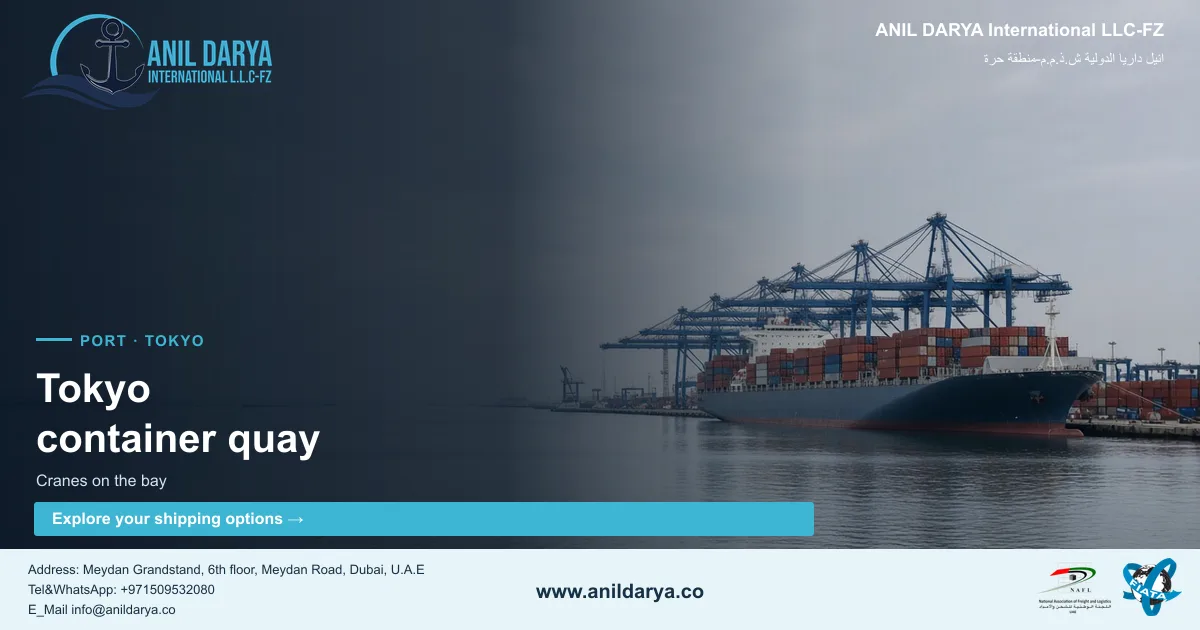
Port of Tokyo shipping is mostly about imports: containers of food, clothing, furniture and consumer goods for a hinterland of about 40 million people. The port is run by the Tokyo Metropolitan Government, its main container terminals are Oi, Aomi, Shinagawa and the Outer Central Breakwater, and it handled 4.7 million TEU in 2024, more than any other port in Japan. This guide covers the terminals, the cargo each one takes, what is specific about clearing and trucking cargo in Tokyo, and how we ship your cargo there from Dubai. We ship both ways: from Dubai to Tokyo, and from Tokyo to Dubai.
Port of Tokyo guide: key facts at a glance
| Item | Detail |
|---|---|
| Port manager | Tokyo Metropolitan Government, Bureau of Port and Harbor |
| Container terminal manager | Tokyo Port Terminal Corporation (central management of foreign trade container terminals since April 2009) |
| UN/LOCODE | JPTYO |
| Location | Head of Tokyo Bay, between the mouths of the Arakawa and Tamagawa rivers |
| Opened to international trade | 20 May 1941 |
| Port area | 5,166 ha of water, 1,028.1 ha of land |
| Wharves and piers | 24,714 m, 215 berths, of which 4,479 m and 15 berths are container berths (1 January 2022) |
| Foreign trade container terminals | Oi, Aomi, Shinagawa, Outer Central Breakwater |
| Deepest container berths | 16 m at the Outer Central Breakwater; 15 m at Oi and Aomi A2 to A4 |
| Containers handled in 2024 | 4,700,678 TEU (4,169,322 TEU foreign trade), MLIT preliminary figure |
| Containers handled January to June 2025 | About 2.42 million TEU, up 6.5% (preliminary) |
| Cargo mix | Imports are about two-thirds of all cargo handled |
| Main imports | Clothing and footwear, electrical equipment, processed food, furniture, fruit and vegetables, meat and seafood |
| Customs authority | Japan Customs (Tokyo Customs) |
| Consumption tax on imports | 10% standard, 8% reduced rate |
| Tokyo to Dubai | Export declaration by the shipper or its Japanese customs broker; Dubai duty 5% of CIF for most goods, plus 5% import VAT |
Where is the Port of Tokyo, and which consignees does it suit?
The Port of Tokyo sits at the head of Tokyo Bay, on reclaimed land between the Arakawa and Tamagawa rivers. The city describes its catchment as all of metropolitan Tokyo and some neighbouring areas, a region of about 40 million people. Warehouses and distribution centres sit on the reclaimed land right behind the terminals, so many boxes travel only a short distance after release.
Tokyo and Yokohama are separate ports with separate terminals, gates and free time. Kawasaki and Chiba are also on the same bay. The right port is usually the one your carrier calls that is closest to the consignee's warehouse.
| Your situation | Port to price first |
|---|---|
| Consignee in central or eastern Tokyo, Saitama or Chiba | Tokyo |
| Consignee in Kanagawa or southern Tokyo | Price Tokyo and Yokohama side by side |
| Frozen seafood, meat, fruit or grain for the Tokyo market | Tokyo, with its food and cold storage terminals at Oi |
| Very large ship on a deep-sea service | Whichever port the service calls; check the berth depth |
| Consignee in Kansai, central Japan or Kyushu | Kobe, Osaka, Nagoya or Hakata instead |
Which container terminals does the Port of Tokyo have?
The city's 2022 port guide lists 17 container berths and 39 container cranes across four foreign trade container terminals. Shinagawa opened in 1967 as Japan's first container terminal, and Oi followed between 1971 and 1975. Your carrier's service decides the terminal, and the arrival notice names it.
| Terminal | Berths | Quay length | Depth | Cranes | Area | Use |
|---|---|---|---|---|---|---|
| Oi | 7 | 2,354 m | 15 m | 20 | 945,700 m² | Dedicated berths |
| Aomi (public berths) | 3 | 870 m | 13 to 15 m | 6 | 239,956 m² | Public |
| Aomi (dedicated berths) | 2 | 700 m | 15 m | 3 | 239,123 m² | Dedicated berths |
| Shinagawa | 3 | 555 m | 10 m | 4 | 96,741 m² | Public |
| Outer Central Breakwater | 2 | 630 m | 11 to 16 m | 6 | 332,545 m² | Public |
Figures are as of 1 January 2022, from the Tokyo Metropolitan Government. At that date one dedicated berth at Aomi was out of service ahead of redevelopment, so check current berth status with the carrier.
Oi container terminal: the main deep-sea terminal
Oi is the largest terminal and the one most deep-sea services use. Its original eight berths were rebuilt into seven larger ones in 2003 to take bigger ships. All seven sit at 15 m depth.
| Berth | O1 | O2 | O3 | O4 | O5 | O6 | O7 |
|---|---|---|---|---|---|---|---|
| Length | 330 m | 330 m | 354 m | 330 m | 330 m | 330 m | 350 m |
| Depth | 15 m | 15 m | 15 m | 15 m | 15 m | 15 m | 15 m |
Behind the quay, five transit sheds and about 40 companies' distribution centres on 33 ha handle container cargo. The yard holds 61,292 TEU of dry boxes and 3,472 reefer containers.
Aomi container terminal
Aomi has five berths over 1,570 m. A0 and A1 are 260 m at 13 m depth, and A2, A3 and A4 are 350 m at 15 m. Berths opened between 1992 and 2001. The Aomi Cargo Distribution Center and the larger World Cargo Distribution Center sit behind the terminal for container cargo handling and storage. The port plan aims to rebuild A2 to A4 as three berths of 1,050 m at 15 to 16 m depth for larger ships.
Shinagawa and the Outer Central Breakwater terminal
Shinagawa is the oldest container terminal in Japan, with 555 m of quay at 10 m depth and four gantry cranes. The city says it serves routes to China, Korea, Southeast Asia and Japanese coastal ports, so it suits smaller intra-Asia ships rather than mainline services.
The Outer Central Breakwater terminal is the newest. Berth 1 opened in December 2017, and Berth 2 opened in April 2020 to take 150,000 DWT container ships. It is also the only Tokyo terminal with a dedicated empty container yard in the city's table, with space for 8,995 empty TEU.
Who runs the terminals?
Tokyo Port Terminal Corporation manages the foreign trade container terminals and the Odaiba Liner Terminal, while carriers and stevedoring companies work the berths. Kamigumi also runs a private container berth.
Food, reefer and other specialised terminals at Tokyo
Tokyo's real speciality is food for the capital. In 2020 the port took a third of Japan's meat imports and more than half of its imports of prawns and shrimps and of salmon and trout, according to Tokyo Customs figures in the city's port guide. Several terminals exist only for this trade.
| Terminal | What it handles | Key facility facts |
|---|---|---|
| Oi Marine Products Terminal | Frozen seafood | 2 berths for 30,000-ton ships; cold storage behind for up to 359,000 tons |
| Oi Foodstuffs Terminal | Wheat, fresh fruit and vegetables, imported food | 3 berths, opened February 1999; wheat mill and silos; sheds where produce is handled and fumigated |
| Tsukishima Terminal | Marine products | Large cold stores; stockyard for the Toyosu Central Wholesale Market |
| Odaiba Liner Terminal | Steel, machinery, lumber, paper | 9 berths over 1.8 km, ships up to 15,000 tons |
| Bulk Cargo Terminal, Inner Central Breakwater | Coal, silica sand, other bulk imports | 240 m, 12 m depth, 30,000-ton ships, opened May 2000 |
| No. 15 Lumber Terminal | Lumber, mainly from Canada and the USA | Open storage for up to 200,000 m³ |
For food from the UAE, such as dates, processed food and spices, the box normally lands at a container terminal. If it needs plant checks or fumigation, ask the importer early where that will happen.
What cargo moves through the Port of Tokyo?
Of the 80.87 million tons the port handled in 2020, inbound cargo made up 67.6%. Imports have been larger than exports since 1987. In foreign trade, the biggest import groups were clothing, personal belongings and footwear (13.5%) and electrical equipment (10.3%), followed by processed food, other chemical products and furniture. Exports were smaller and led by reusable material, chemical products, industrial machines and auto parts.
In 2024 the port handled 4,700,678 TEU. Of the foreign trade boxes, 2,280,514 TEU came in and 1,888,808 TEU went out. Domestic containers added 531,356 TEU.
Port of Tokyo shipping by container: FCL, LCL and reefer
- FCL (full container load). You book a whole 20ft or 40ft box. It is discharged at your carrier's terminal and trucked to the consignee once cleared.
- LCL (less than container load). Your cargo shares a box and is unpacked at a container freight station near the terminals. It suits small orders, but every shipper's papers in that box affect the release.
- Reefer. Chilled and frozen food moves in reefer containers. Oi alone has space for 3,472 reefer boxes, and Aomi and the Outer Central Breakwater add more.
Once your cargo fills a good part of a 20ft box, price FCL too. Our guide to FCL vs LCL costs shows where the break-even usually sits, and our sea freight service lists the container types we book.
Breakbulk, project and out-of-gauge cargo into Tokyo
Tokyo is a container and consumer port first. Conventional ships use the Odaiba Liner Terminal, where the nine berths take ships up to 15,000 tons. For anything larger, we check the discharge berth with the carrier before quoting.
- Send drawings, dimensions, weights and centre of gravity for each piece.
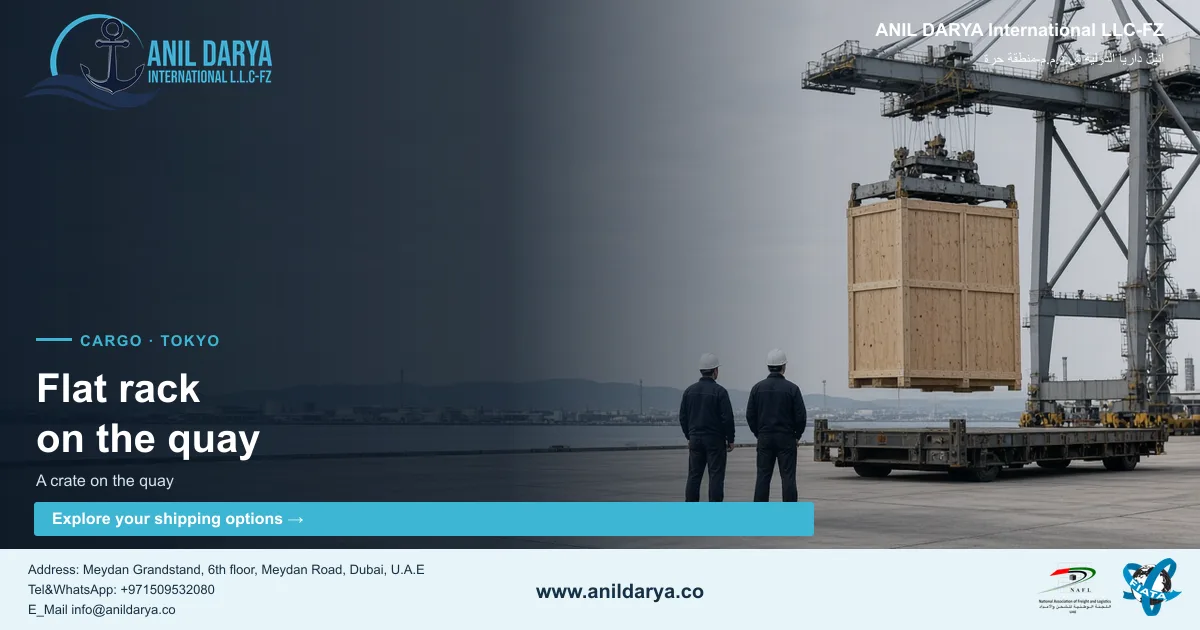
- Choose between a flat rack or open top on a container service and a conventional breakbulk ship.
- Confirm the discharge berth and the lifting gear with the carrier.
- Check the road move from the quay with the consignee's trucker, including permits for wide or heavy loads.
- Line up customs before arrival so the cargo does not wait on the quay.
One Tokyo detail: ships heading for the inner terminals pass under the Rainbow Bridge, which the city lists with a passage limit height of A.P. +54.4 m. If a tall heavy-lift ship with its own cranes has to reach an inner berth, the carrier must check this clearance. Read our guide to flat racks, open tops and breakbulk and see our break bulk and project cargo service.
Dangerous goods to the Port of Tokyo
You can ship IMDG dangerous goods to Tokyo on container services that accept the class. Before loading in Dubai you need the UN number, proper shipping name, class and packing group, a Safety Data Sheet, a signed Dangerous Goods Declaration, UN-approved packaging with labels and placards, and written carrier acceptance.
On the Japanese side, Japan Customs checks a list of 30 other laws at import. For DG, the ones that come up most are the High Pressure Gas Safety Act, the Poisonous and Deleterious Substance Control Act, the Explosives Control Act and the Act on the Regulation of Manufacture and Evaluation of Chemical Substances. The importer must hold any approval before the import declaration.
If your product needs a Japanese approval, do not book until the importer confirms it is in hand. Our dangerous goods shipping team checks classification and carrier acceptance before you commit to a sailing.
Trucking out of Tokyo's terminals: congestion and gate reservations
Truck congestion around the container terminals is a long-standing Tokyo issue. Its port plan builds on a package of congestion measures set in February 2014. The North-South Access Road, about 3.7 km with 4 to 6 lanes, opened on 20 June 2020 to link the Outer Central Breakwater terminal with the rest of the port.
The port also uses CONPAS, a container carry-in and carry-out reservation system. In its seventh phase in early 2025, reservations ran at Oi berths 1 and 2, 3 and 4, and 6 and 7, and at Aomi berth 4, with time-slot quotas for trucks. The scheme is planned to continue as results are reviewed.
Ask your trucker whether the terminal needs a CONPAS slot, and remember that congestion days still count against the carrier's free time. Our article on demurrage and detention explains how the charges add up.
Customs at the Port of Tokyo: what to know
Tokyo follows the same Japan Customs rules as every Japanese port. The short version:
- Advance filing. Since March 2014, the carrier or NVOCC must file container cargo data with Japan Customs, in principle 24 hours before the ship leaves the port of loading. Give a precise description and full consignee details at booking.
- Pre-arrival examination. Once the bill of lading is issued, the importer can submit documents to the customs office that controls the bonded area where the box will land. Customs then says whether the cargo faces a physical inspection, a document check or a simplified check.
- Import declaration. The importer files it (Customs Form C-5020), usually through a customs broker, normally after the goods enter a bonded (Hozei) area.
- Documents. Invoice, bill of lading, and where needed a certificate of origin, packing list, freight and insurance documents, and licences under other laws.
- Tax. Consumption tax is 10%, or 8% at the reduced rate, charged on the customs value plus duty plus any excise tax.
For a food or reefer box at Oi, the pre-arrival route is the simplest way to cut time in the terminal. The UAE and Japan concluded CEPA negotiations in March 2026, but we found no confirmation that the agreement is in force, so plan on standard duty rates for now. Our Yokohama guide covers Japanese customs, valuation and documents in more detail.
How to ship from Dubai to the Port of Tokyo, step by step
- Send us the cargo details: commodity, HS code, weight, volume or dimensions, the consignee's address and the Incoterm.
- Confirm Japanese controls. The importer checks food, plant, chemical or gas approvals and starts them early.
- Pick the service. We compare carriers into Tokyo and confirm which terminal each one uses.
- Book space. For DG, reefer or out-of-gauge cargo we get carrier acceptance first.
- Prepare documents. We check that names, weights, marks and HS codes match across invoice, packing list and bill of lading.
- Export from Dubai. We truck the cargo to Jebel Ali Port, file the export declaration with Dubai Customs and gate in before the cut-off.
- Carrier files the advance data with Japan Customs before the ship sails.
- Clear and deliver in Tokyo. The importer's broker files the declaration, pays duty and consumption tax, and books the truck, with a CONPAS slot if the terminal needs one.
Published transit times on this lane vary a lot. Fluent Cargo, a route tool, shows about 30 days from Khor Fakkan with one transhipment and about 41 days from Jebel Ali with two, while Shipa Freight lists 31 days from Jebel Ali to Tokyo. Treat these as indications only.
[AMIR-FACT: the carriers or services we actually book from Jebel Ali to Tokyo, which Tokyo terminal each uses, and our typical port-to-port days]
How to ship from the Port of Tokyo to Dubai
We also handle the other direction: shipping from Tokyo to Dubai, with arrival at Jebel Ali, Khalifa Port or Sharjah port. We book the space with the carrier and run the UAE side. The Japanese export papers stay with the shipper or its Japanese customs broker.
The Japan export side
- Export declaration. The exporter, or a customs broker acting for it, files the export declaration (Customs Form C-5010) with the invoice. It states the nature, quantity and value of the goods.
- Where the goods sit. Export cargo must be brought into a customs area or a specially permitted storage place before Japan Customs checks it and grants the export permit.
- Permits under other laws. Some goods need a prior permit or approval, for example from the Ministry of Economy, Trade and Industry for strategically sensitive items. Japan Customs will not permit the export until these are proved.
- Pickup. The shipper or its trucker delivers the box to the terminal the carrier names, inside the receiving window and before the cut-off.
The UAE import side
On arrival, the declaration goes to Dubai Customs with the commercial invoice, packing list, bill of lading, certificate of origin and any permit for restricted goods. Customs duty in Dubai is 5% of the CIF value for most goods, with 50% on alcohol and 100% on cigarettes. Import VAT is 5%. A VAT-registered importer that meets the Federal Tax Authority's conditions can account for it on its VAT return instead of paying at the border.
- Send us the shipper's details in Tokyo, the cargo, the HS code and the UAE delivery address.
- We book space ex Tokyo and send the booking, terminal and cut-offs to the shipper.
- The shipper or its trucker picks up the empty, loads it and delivers it to the terminal.
- The shipper or its customs broker files the export declaration and gets the export permit.
- We check the draft bill of lading against the invoice and packing list.
- We file the UAE declaration before arrival and arrange payment of the duty and VAT.
- We collect the delivery order, truck the box to your site and return the empty inside free time.
[AMIR-FACT: the carriers we actually use from Tokyo to Jebel Ali, Khalifa Port or Sharjah, and our real transit days in this direction]
When does air cargo make more sense?
For urgent or high-value goods, air is the alternative. Fluent Cargo lists direct passenger flights from Dubai International to Tokyo Haneda of about 9 hours 30 minutes, and freighter flights from Al Maktoum to Narita. If a delay at sea would cost more than the air freight, see our air cargo service.
Checklist before you ship to the Port of Tokyo
- HS code checked against Japan's current tariff.
- Importer and customs broker in Japan confirmed.
- Food, plant, chemical or gas approvals started before sailing.
- Precise cargo description given at booking for the advance filing.
- Invoice, packing list and bill of lading show the same consignee, weights and marks.
- Freight and insurance costs passed to the broker for the customs value.
- Terminal confirmed on the arrival notice, and CONPAS slot booked if needed.
- For DG: SDS, DG declaration, packaging, labels and carrier acceptance.
- Free time agreed and cargo insurance in place.
Common mistakes on Tokyo shipments
- Assuming Tokyo and Yokohama are one port. They have different terminals, gates and free time.
- Sending the truck to the wrong terminal. Oi, Aomi, Shinagawa and the Outer Central Breakwater are separate gates.
- Starting the food notification after arrival, which leaves a reefer box running up plug-in and storage charges.
- Vague cargo descriptions that trigger questions under the advance filing rules before loading.
- Pricing duty on the invoice value alone. Freight and insurance are part of the customs value.
- Declaring batteries, aerosols, perfumes or paints as general cargo.
Frequently asked questions
Who manages the port of Tokyo?
The Tokyo Metropolitan Government's Bureau of Port and Harbor manages the port. Tokyo Port Terminal Corporation has managed the foreign trade container terminals centrally since April 2009.
What is the port code for Tokyo?
The UN/LOCODE for the Port of Tokyo is JPTYO. You will see it on bookings, bills of lading and tracking systems.
How many containers does the Port of Tokyo handle?
MLIT's preliminary figure for 2024 is 4,700,678 TEU, the highest of any Japanese port. Preliminary figures for January to June 2025 show about 2.42 million TEU, up 6.5%.
Is the Port of Tokyo the same as the Port of Yokohama?
No. Both are on Tokyo Bay, but they are separate ports with their own terminals and managers. Tokyo's container terminals are at Oi, Aomi, Shinagawa and the Outer Central Breakwater, while Yokohama's are at Minami Honmoku, Honmoku and Daikoku.
Can I ship frozen or chilled food to the Port of Tokyo?
Yes. Tokyo has dedicated food and marine products terminals at Oi and large cold stores behind them. Reefer containers land at the container terminals, and the importer must complete the food import notification before release.
How long does sea freight from Dubai to Tokyo take?
Published indications vary widely, from about 30 to 41 days on one route tool depending on the origin port and transhipments. Ask for the routing and the carrier's own schedule for your sailing.
How much consumption tax is charged on imports at Tokyo?
Consumption tax is 10%, or 8% at the reduced rate. It is charged on the customs value, which includes freight and insurance, plus duty and any excise tax.
How do I ship from Tokyo to Dubai?
We book the space from Tokyo and run the UAE side. The shipper or its Japanese customs broker files the export declaration and delivers the box to the terminal. We then file the Dubai Customs declaration, arrange payment of the 5% duty and 5% VAT, and deliver the cargo.
Can I ship dangerous goods to the Port of Tokyo?
Yes, on container services that accept the class, with full IMDG documents and packaging. Products such as high-pressure gases or poisonous substances also need approvals under Japanese law before import.
Get a quote for Port of Tokyo shipping
Send us your cargo details and the consignee's address, and we will come back with a routing and a price to Tokyo. Use our freight rate inquiry form, or contact our team to talk through a reefer, DG or out-of-gauge shipment first. You can also read more about our Dubai freight forwarding team.
Sources
- Tokyo Metropolitan Government, Port of Tokyo 2022: Outline of the Port (area, facilities, 2020 statistics)
- Tokyo Metropolitan Government, Port of Tokyo 2022: Cargo handling and role of the port (2020 cargo mix, import shares)
- Tokyo Metropolitan Government, Port of Tokyo 2022: Foreign trade container terminals and Oi berths
- Tokyo Metropolitan Government, Port of Tokyo 2022: Aomi, Shinagawa and Outer Central Breakwater terminals
- Tokyo Metropolitan Government, Port of Tokyo 2022: Foodstuffs and marine products terminals
- Tokyo Metropolitan Government, Port of Tokyo 2022: General cargo, construction material and lumber terminals
- Tokyo Metropolitan Government, Port of Tokyo 2022: 8th Revised Port Plan and congestion measures
- Tokyo Metropolitan Government, Port of Tokyo 2022: Transportation (Rainbow Bridge, North-South Access Road)
- MLIT: Container cargo volume at Japanese ports in 2024, preliminary (port-by-port TEU)
- Maritime Gateway: Tokyo Port container traffic up 6.5% in first half of 2025
- Cyber Port / CONPAS portal: Port of Tokyo container reservation scheme, 7th phase
- Tokyo Port Terminal Corporation: terminals managed
- Japan Customs: Import procedures
- Japan Customs: Advance Filing Rules on maritime container cargo
- Japan Customs: Pre-arrival examination system
- Japan Customs: Tariff rates and consumption tax
- Japan Customs: Other laws checked at import
- Japan Customs: Export procedures (C-5010, customs area, permits under other laws)
- Dubai Customs: Submit customs declaration (documents)
- Dubai Customs: FAQ (5% of CIF, alcohol 50%, cigarettes 100%)
- UAE Government portal: Customs duty
- Federal Tax Authority: VAT guide (import VAT at 5%, deferral to the VAT return)
- Gulf Business: UAE concludes CEPA negotiations with Japan (March 2026)
- Fluent Cargo: Dubai to Tokyo routes (transit indications)
- Shipa Freight: Shipping to Japan (Jebel Ali to Tokyo transit indication)
- Wikipedia: Port of Tokyo (Kamigumi private berth)
Reviewed: 10 November 2026