
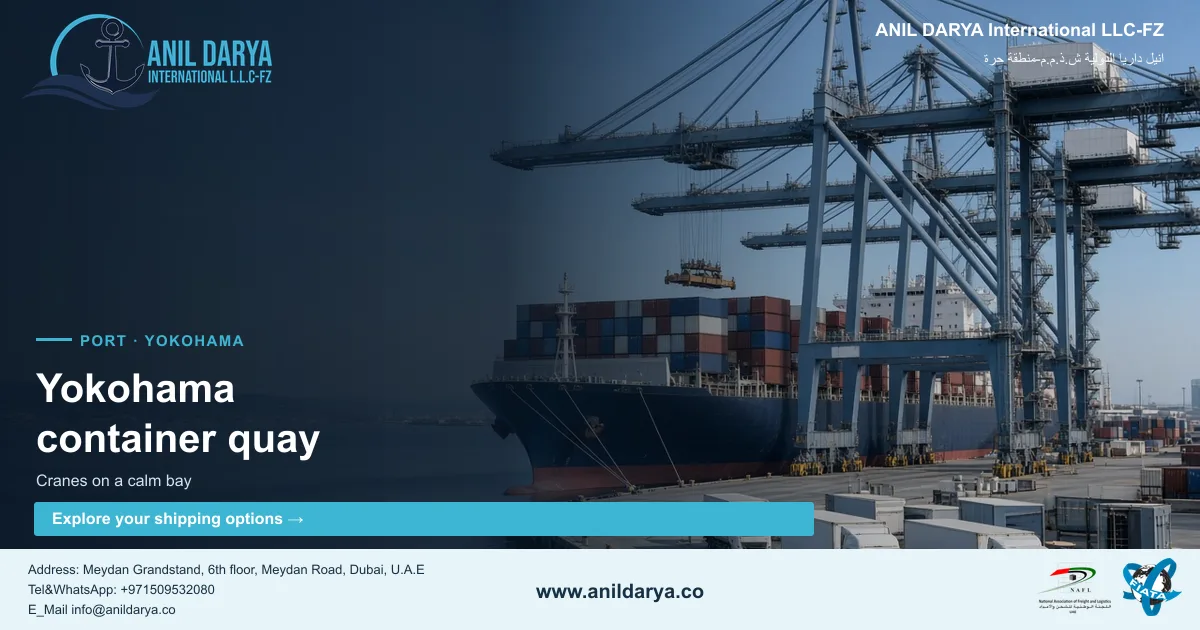
Port of Yokohama shipping covers containers, vehicles, breakbulk and general cargo for Greater Tokyo and the wider Kanto region. The port is run by the City of Yokohama's Port and Harbor Bureau, its main container terminals are at Minami Honmoku and Honmoku, and cargo is cleared by Japan Customs through the NACCS system. This guide covers the terminals, the cargo each one handles, customs and tax, and how we ship your cargo from Dubai to Yokohama. We ship both from Dubai to Yokohama and from Yokohama to Dubai.
Port of Yokohama guide: key facts at a glance
| Item | Detail |
|---|---|
| Port manager | Port and Harbor Bureau, City of Yokohama |
| Container terminal company | Yokohama Kawasaki International Port Corporation (YKIP) |
| UN/LOCODE | JPYOK |
| Location | Tokyo Bay, Kanagawa Prefecture, south of the Port of Tokyo |
| Opened to foreign trade | 2 June 1859 |
| Port area | 7,218.3 ha (March 2023) |
| Main container piers | Minami Honmoku (MC-1 to MC-4), Honmoku (BC, C, D berths), Daikoku (C-3, C-4, T-9) |
| Deepest container quay | 18 m at MC-3 and MC-4, Minami Honmoku |
| Containers handled in 2024 | 3,075,370 TEU (2,755,211 TEU foreign trade) |
| Containers handled in 2025 | 3,182,607 TEU, up 3.5% on 2024 (December 2025 monthly report) |
| Containers handled January to June 2026 | 1,607,838 TEU, up 4.8% on the same period of 2025 |
| Regular international container routes | Over 90 (Yokohama Port Corporation) |
| Ocean-going ship calls in 2025 | 8,536, of which 4,493 full container ships |
| Total cargo in 2025 | 103.46 million freight tons |
| Cargo types | Containers (dry and reefer), finished cars and Ro-Ro, breakbulk and conventional cargo, energy such as oil, grains, fresh produce, building materials |
| Customs authority | Japan Customs (Yokohama Customs) |
| Consumption tax on imports | 10% standard, 8% reduced for food and drink other than alcohol |
| Yokohama to Dubai | Exporter or its broker files the export declaration with Japan Customs; UAE duty 5% of CIF for most goods plus 5% import VAT |
Where is the Port of Yokohama, and how does it compare with Tokyo?
The Port of Yokohama sits on Tokyo Bay, south of the Port of Tokyo. YKIP describes the area as the mouth of Tokyo Bay, where wind and tidal currents rarely affect cargo handling. Expressways link the port to the Tomei and Tohoku expressways and on to the Kanto and Koshinetsu regions.
Tokyo and Yokohama are separate ports with separate terminals. The Port of Tokyo's container terminals are at Oi, Aomi and Shinagawa. Both serve Greater Tokyo, so the right choice usually comes down to two things: which port your carrier's service calls, and where your consignee is. A warehouse in Kanagawa or southern Tokyo is often closer to Yokohama. A site in eastern Tokyo or Chiba may be closer to the Tokyo terminals.
| Your situation | Port to price first |
|---|---|
| Consignee in Kanagawa, western or southern Tokyo | Yokohama |
| Consignee in eastern Tokyo, Chiba or Saitama | Price Tokyo and Yokohama side by side |
| Large ship on a deep-sea service | Yokohama Minami Honmoku (18 m quay) |
| Cars and Ro-Ro cargo | Yokohama Daikoku |
| Consignee in Kansai or central Japan | Osaka, Kobe or Nagoya instead |
Which terminals does the Port of Yokohama have?
The city lists 11 piers and marinas. Four matter most for cargo from Dubai: Minami Honmoku and Honmoku for containers, Daikoku for vehicles, Ro-Ro and some containers, and Yamashita for conventional cargo. Your carrier's service decides the terminal, and the arrival notice names it.
Minami Honmoku: the deep-water container terminal
Minami Honmoku has four container berths that have run as one integrated terminal since April 2021. MC-3 and MC-4 form a 900 m quay at 18 m depth, which the city calls Japan's largest and only 18 m quay. YKIP says the gantry cranes there reach 24 container rows across.
| Berth | Length | Depth | Gantry cranes | Yard area |
|---|---|---|---|---|
| MC-1 | 350 m | 16 m | 3 | 175,000 m² |
| MC-2 | 350 m | 16 m | 2 | 229,000 m² |
| MC-3 | 400 m | 18 m | 4 | 225,000 m² |
| MC-4 | 500 m | 18 m | 1 | 225,000 m² |
| Total | 1,600 m | - | 10 | 854,000 m² |
MC-1 and MC-2 started in April 2001, MC-3 in April 2015 and MC-4 in August 2020. Extra gates were added at Minami Honmoku in June 2016.
Honmoku: about half the port's containers
Honmoku covers 287.7 ha and handles about 50% of the port's container throughput. It also has berths for conventional ships and building materials.
| Berths | Length | Depth | Use |
|---|---|---|---|
| BC-1 and BC-2 | 470 m | 16 m | Container terminal, the main one at Honmoku |
| C-5 to C-9 | 200 m each | 13 m | Container terminal |
| D-1 | 482.5 m | 13 to 14 m | Container terminal |
| D-4 | 400 m | 16 m | Container terminal |
| D-5 | 300 m | 16 m | Container terminal (YKIP lists it as under construction) |
| A-1 to A-7, B-1 to B-4 | 200 to 300 m | 10 to 12 m | Conventional ships |
| Building material berths 1 and 2 | 185 m and 145 m | 10 m and 9 m | Building materials only |
Daikoku: vehicles, Ro-Ro and multipurpose berths
Daikoku is a 322 ha man-made island with 25 berths and 5,250 m of quay. Container berths C-3 and C-4 are 350 m at 15 m depth, and T-9 is a 240 m container berth at 12 m. The city describes converting part of the pier from container berths to Ro-Ro berths for finished cars, trucks and large construction equipment. The Yokohama Cargo Center (Y-CC), opened in 1996, is one of Japan's largest logistics facilities.
Yamashita, Detamachi and the other piers
Yamashita Pier has 10 public berths for conventional ships at 10 to 12 m depth and eight warehouses, though the city says it is being redeveloped. Detamachi is the pier for fresh fruit and vegetables. Osanbashi is the passenger and cruise pier, so it does not handle freight.
What cargo can you ship through the Port of Yokohama?
| Cargo type | Where it usually goes | What to plan |
|---|---|---|
| General goods in containers | Minami Honmoku, Honmoku or Daikoku, by carrier | Terminal on the arrival notice, free time, delivery truck |
| Chilled and frozen food | Reefer containers at the container terminals | Set temperature, food import notification |
| Fresh produce | Detamachi Pier | Plant and food checks before release |
| Cars, trucks, construction plant | Ro-Ro berths at Daikoku | Vehicle documents, inspection |
| Steel, machinery, project pieces | Conventional berths at Honmoku or Daikoku, or flat racks | Lifting points, lashing, road permits |
| Building materials | Dedicated berths at Honmoku | Discharge plan, consignee's receiving site |
| Grain and oil | Specialised berths; we confirm which one with the carrier | Discharge plan, surveys, receiving facility |
| Dangerous goods | IMDG containers on container services | Carrier acceptance, approvals under Japanese law |
Yokohama Port Corporation says the port has ranked first in Japan for incoming foreign ships every year since 1964, and lists over 90 regular international container routes. For cold chain cargo, YKIP notes that Kanagawa Prefecture has had Japan's largest cold storage network since 2014, with many logistics facilities near the port.
FCL and LCL shipping to the port of Yokohama
- FCL (full container load). You book a whole 20ft or 40ft box. The container is discharged at your carrier's terminal and trucked to the consignee once cleared.
- LCL (less than container load). Your cargo shares a box and is unpacked at a container freight station before release. It suits small orders but adds handling and depends on every shipper's papers in the box.
With LCL to Yokohama, make sure carton marks match the packing list exactly, because one mismatch can hold the unpacking. Once your cargo fills a good part of a 20ft box, price FCL too. Our guide on FCL vs LCL costs walks through the maths, and our sea freight service page lists the container types we book.
YKIP also notes coastal feeder and barge services linking Yokohama with other Japanese ports. If your consignee is far from Tokyo Bay, ask whether a domestic feeder from Yokohama or a direct call at another port works out cheaper.
Breakbulk, project and out-of-gauge cargo at Yokohama
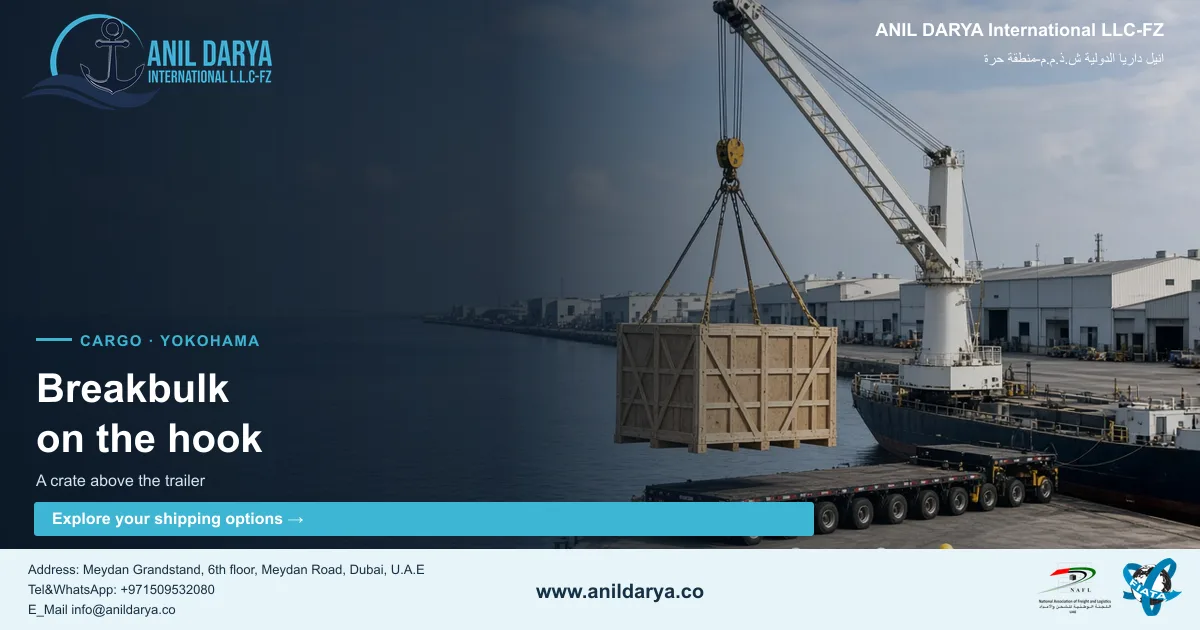
Yokohama still has many conventional berths at Honmoku, Daikoku and Yamashita, so breakbulk is possible. The plan depends on the piece.
- Collect drawings, dimensions, weights and centre of gravity for each piece.
- Choose between a flat rack on a container service and conventional breakbulk or heavy-lift tonnage.
- Confirm the discharge berth and the lifting equipment with the carrier.
- Check road permits for the move from the quay with the consignee's trucker.
- Line up customs before arrival so the cargo leaves the quay quickly.
A decision rule: if a piece fits a 40ft flat rack by size and weight, a container service gives you more sailings into Minami Honmoku or Honmoku. If not, the sailing date of breakbulk tonnage drives the whole plan. See our guide to flat racks, open tops and breakbulk and our break bulk and project cargo service.
Dangerous goods to Yokohama
You can ship IMDG dangerous goods to Yokohama on container services that accept the class. Before loading in Dubai you need the UN number, proper shipping name, class and packing group, a Safety Data Sheet, a signed Dangerous Goods Declaration, UN packaging with labels and placards, and carrier acceptance.
On the Japanese side, some products need approvals under laws Japan Customs checks at import. These include the High Pressure Gas Safety Act (gases), the Poisonous and Deleterious Substance Control Act, the Explosives Control Act and the Chemical Substances Control Act. The importer must hold any approval before the declaration. One port detail: when YKIP describes the 2015 change to compulsory pilotage in Yokohama, it notes the change does not apply to vessels carrying hazardous materials.
Our dangerous goods shipping team checks classification and carrier acceptance before you commit to a sailing.
Customs clearance at the Port of Yokohama
Cargo landed at Yokohama is cleared by Japan Customs. The import declaration (Customs Form C-5020) is made, in principle, by the importer, and a customs broker usually files it for them. It is normally lodged after the goods enter a bonded (Hozei) area, and the import permit follows any examination and the payment of duty and tax. The procedures run through NACCS, Japan's electronic system for port and customs work.
Advance filing before the ship leaves Dubai
Under Japan's Advance Filing Rules, in force since March 2014, shipping companies and NVOCCs must file container cargo data with Japan Customs through NACCS, in principle 24 hours before the vessel leaves the port of loading. For cargo to Yokohama, that means before the ship sails from Jebel Ali or the transshipment port. Give a precise description and full consignee details at booking.
Can customs check the documents before the ship arrives?
Yes. Under Japan's pre-arrival examination system, the importer can submit the declaration documents once the bill of lading is issued, to the customs office that controls the bonded area where the cargo will land. Customs examines them in advance and tells the importer whether the cargo faces a physical inspection, a document check or a simplified check. For a box landing at Minami Honmoku or Honmoku, this is the simplest way to cut time in the terminal.
If you sell on DDP terms and act as importer yourself, Japan Customs requires you to appoint a Customs Procedure Agent in Japan, and a licensed customs broker must do the clearance unless that agent holds a brokerage licence.
Which documents does Japan Customs need?
| Document | Who provides it |
|---|---|
| Commercial invoice | Seller in the UAE |
| Bill of lading | Carrier, through us |
| Packing list | Seller |
| Freight and insurance documents | Seller or us, for the customs value |
| Certificate of origin | UAE chamber or authority, where a rate depends on origin |
| Licences or certificates under other laws | Importer, for food, plants, chemicals, medicines and similar goods |
| Valuation declaration | Importer, through its broker |
Food and drink fall under the Food Sanitation Law, and plants under the Plant Protection Act. Japan Customs lists 30 such laws it checks at import, so ask the importer to confirm early whether any applies.
How much duty and consumption tax will the importer pay?
Japan's customs value is the transaction value plus transport costs to the Japanese port and insurance. Duty depends on the HS code and the rate type: general, temporary, WTO, GSP or EPA. Consumption tax is 10%, or 8% for food and drink other than alcohol, charged on the customs value plus duty plus any excise tax.
| Customs value per declaration | Treatment |
|---|---|
| 10,000 yen or less | No duty or consumption tax, with exclusions such as leather bags, gloves and knitted clothing |
| 200,000 yen or less (commercial) | Simplified tariff rates can apply; consumption tax still charged |
| Above 200,000 yen | Normal tariff rate for the HS code |
The UAE and Japan concluded CEPA negotiations in 2026, but we found no confirmation that the agreement is in force. Plan on standard rates until it is.
How to ship from Dubai to the Port of Yokohama, step by step
- Send us the cargo details. Commodity, HS code, weight, volume or dimensions, the consignee's address and the Incoterm.
- Confirm Japanese controls. The importer checks food, plant, chemical or other approvals and starts them early.
- Pick the service. We compare carriers into Yokohama and confirm which terminal each one uses.
- Book space. For DG, reefer or out-of-gauge cargo we get carrier acceptance first.
- Prepare documents. We check that names, weights, marks and HS codes match across invoice, packing list and bill of lading.
- Export from Dubai. We truck the cargo to Jebel Ali Port, file the export declaration with Dubai Customs and gate in before the cut-off.
- Carrier files the advance data. Your description goes to Japan Customs through NACCS before the ship sails.
- Clear and deliver in Yokohama. The importer's broker files the import declaration, pays duty and consumption tax, and arranges the truck from the terminal.
[AMIR-FACT: the carriers or services we actually book from Jebel Ali to Yokohama, which Yokohama terminal each uses, and our typical port-to-port days]
How to ship from the Port of Yokohama to Dubai
We also handle the other direction: shipping from Yokohama to Dubai, with arrival at Jebel Ali, Khalifa Port or Sharjah port. We book the space with the carrier and run the UAE side. The Japanese export side stays with the shipper or its Japan agent, because we have no office in Japan.
The Japan export side
- Export declaration. The exporter, or a customs broker it appoints, files the export declaration (Customs form C-5010) with the invoice and supporting documents.
- Where the goods must be. The goods go into a customs (hozei) area or a specially permitted storage place first. Japan Customs checks the declaration, may examine the goods, and then issues the export permit.
- Licences under other laws. Where another law needs a permit or approval, such as METI approval for strategically sensitive goods, customs will not permit the export until the exporter proves it has one.
The UAE import side
The import declaration goes to Dubai Customs. A company with a Dubai Customs business code can file it, or a licensed clearing agent with the owner's authorisation. Dubai Customs asks for the commercial invoice, packing list, certificate of origin and any permit from the authority that controls restricted goods, and the carrier's agent needs the bill of lading before it issues the delivery order. Customs duty in Dubai is 5% of the CIF value for most goods, with 50% on alcohol and 100% on cigarettes. Import VAT is 5% of the customs value, and a VAT-registered importer accounts for it on its VAT return through the reverse charge.
- Send us the shipper's details in Japan, the cargo, the HS code, the Incoterm and the UAE delivery address.
- We book space from Yokohama to Jebel Ali, Khalifa Port or Sharjah and send the booking and cut-offs to the shipper.
- The shipper or its trucker collects the empty, stuffs it and delivers the box to the Yokohama terminal on the booking before the cut-off.
- The shipper or its Japanese customs broker files the export declaration, and Japan Customs issues the export permit before loading.
- We check the draft bill of lading against the invoice and packing list before the carrier issues it.
- We file the UAE import declaration before the ship arrives.
- We arrange payment of the duty and VAT.
- We collect the delivery order from the carrier's agent in the UAE.
- We truck the cargo to your site and return the empty container inside free time.
[AMIR-FACT: the carriers we actually use from Yokohama to Jebel Ali/Khalifa/Sharjah and our real transit days in this direction]
Free time, demurrage and detention at Yokohama
On the marine side, YKIP notes that since August 2015 compulsory pilotage in the Yokohama section starts at 10,000 GT instead of 3,000 GT, except for ships carrying hazardous materials. This matters mostly for smaller feeder and breakbulk ships.
Each carrier sets the free days for its containers. After that, demurrage runs while the full box stays in the terminal, and detention while you keep it outside. Late food notifications and missing approvals are the usual reasons boxes overstay. The city also publishes a marine terminal tariff for its own facilities. Read our article on demurrage and detention to see how the charges add up.
Checklist before you ship to Yokohama
- HS code checked against Japan's current tariff schedule.
- Importer and customs broker in Japan confirmed.
- Food, plant, chemical or gas approvals started before sailing.
- Precise cargo description given at booking for the advance filing.
- Invoice, packing list and bill of lading show the same consignee, weights and marks.
- Freight and insurance costs passed to the broker.
- Terminal confirmed on the arrival notice before booking the truck.
- For DG: SDS, DG declaration, packaging, labels and carrier acceptance.
- Free time agreed and cargo insurance in place.
Common mistakes
- Choosing Yokohama for a consignee who is closer to another port. Inland trucking can wipe out a cheaper sea rate.
- Vague cargo descriptions that trigger questions under the advance filing rules before loading.
- Starting the food notification after arrival, which leaves the box in the terminal.
- Pricing duty on the invoice value alone. Freight and insurance are part of the customs value.
- Sending the truck to the wrong pier. Minami Honmoku, Honmoku and Daikoku are different gates.
- Declaring batteries, aerosols or paints as general cargo.
Frequently asked questions
Who manages and operates the port of Yokohama?
The Port and Harbor Bureau of the City of Yokohama manages the port. The Yokohama Kawasaki International Port Corporation runs and develops the main container terminals.
What is the port code for Yokohama?
The UN/LOCODE for the Port of Yokohama is JPYOK. It appears on bookings, bills of lading and tracking systems.
How many containers does the Port of Yokohama handle?
The city reported 3,075,370 TEU in 2024. Its December 2025 monthly report shows 3,182,607 TEU for 2025, up 3.5% on 2024.
How do I ship from Dubai to Yokohama?
Send us the cargo details and the consignee's address. We book space from Jebel Ali, clear the UAE export and send the documents, and the importer's broker files the import declaration with Japan Customs.
Which regions does the port of Yokohama serve best?
Yokohama is the natural gateway for Kanagawa and western and southern Tokyo, and competes with the Port of Tokyo for the rest of Greater Tokyo. For central Japan, Kansai or Kyushu, Nagoya, Osaka, Kobe or Hakata are usually closer.
Is the Port of Yokohama the same as the Port of Tokyo?
No. They are separate ports in Tokyo Bay with separate terminals. Yokohama is south of Tokyo, and the Port of Tokyo's container terminals are at Oi, Aomi and Shinagawa.
What documents are needed to clear cargo at Yokohama?
Japan Customs asks for the invoice, the bill of lading, and where needed a certificate of origin, packing list, freight and insurance documents, and licences under other laws. The importer also files a valuation declaration.
How much consumption tax is charged on imports at Yokohama?
Consumption tax is 10%, or 8% for food and drink other than alcohol. It is charged on the customs value, which includes freight and insurance, plus duty and any excise tax.
Can I ship dangerous goods to Yokohama?
Yes, on container services that accept the class, with full IMDG documents and packaging. Some products, such as high-pressure gases or poisonous substances, also need approvals under Japanese law before import.
Can you ship from Yokohama to Dubai?
Yes. We book space from Yokohama to Jebel Ali, Khalifa Port or Sharjah, the shipper or its Japanese broker gets the export permit, and we clear the cargo through UAE customs and deliver it. Most goods pay 5% customs duty on the CIF value plus 5% import VAT.
Get a quote for Port of Yokohama shipping
Send us your cargo details and the consignee's address, and we will come back with a routing and a price to Yokohama. Use our freight rate inquiry form, or contact our team to talk through a breakbulk, DG or reefer shipment first. You can also read more about our Dubai freight forwarding team.
Sources
- City of Yokohama: Port of Yokohama overview (area, piers, opening date, 2022 activity)
- City of Yokohama: Minami-Honmoku Pier
- City of Yokohama: Honmoku Pier
- City of Yokohama: Daikoku Pier
- City of Yokohama: Yamashita Pier
- City of Yokohama: Port statistics (container throughput 2015-2024, December 2025 monthly report)
- City of Yokohama: Port of Yokohama English pages (marine terminal tariff)
- Yokohama Port Corporation: About Port of Yokohama (routes, ship arrivals ranking)
- City of Yokohama: Port statistics June 2026 (January to June 2026 TEU)
- Yokohama Kawasaki International Port Corporation: Facilities and advantages of the Keihin ports
- Japan Customs: Import procedures
- Japan Customs: Advance Filing Rules on maritime container cargo
- Japan Customs: Pre-arrival examination system
- Japan Customs: Customs Procedure Agent for non-residents
- Japan Customs: Tariff rates and consumption tax
- Japan Customs: Customs valuation details
- Japan Customs: 10,000 yen exemption
- Japan Customs: Other laws checked at import
- National Tax Agency: Consumption tax rates
- Gulf Business: UAE concludes CEPA negotiations with Japan (2026)
- DP World: Shipping routes to Japan (Yokohama, JPYOK)
- Shipa Freight: Japanese ports of arrival (Yokohama location, Detamachi)
- Wikipedia: Port of Yokohama (port manager, Detamachi, Osanbashi)
- Wikipedia: Port of Tokyo (container terminals)
- Japan Customs: Export clearance procedures (form C-5010, export permit, other laws)
- Dubai Customs: Submit customs declaration (invoice, packing list, certificate of origin, permits)
- Dubai Customs: FAQ (customs business code, clearing agents with owner authorisation)
- UAE Government portal: Customs duty (5% of CIF, alcohol 50%, cigarettes 100%)
- Federal Tax Authority: VAT guide (5% import VAT on the customs value, reverse charge)
Reviewed: 10 November 2026