
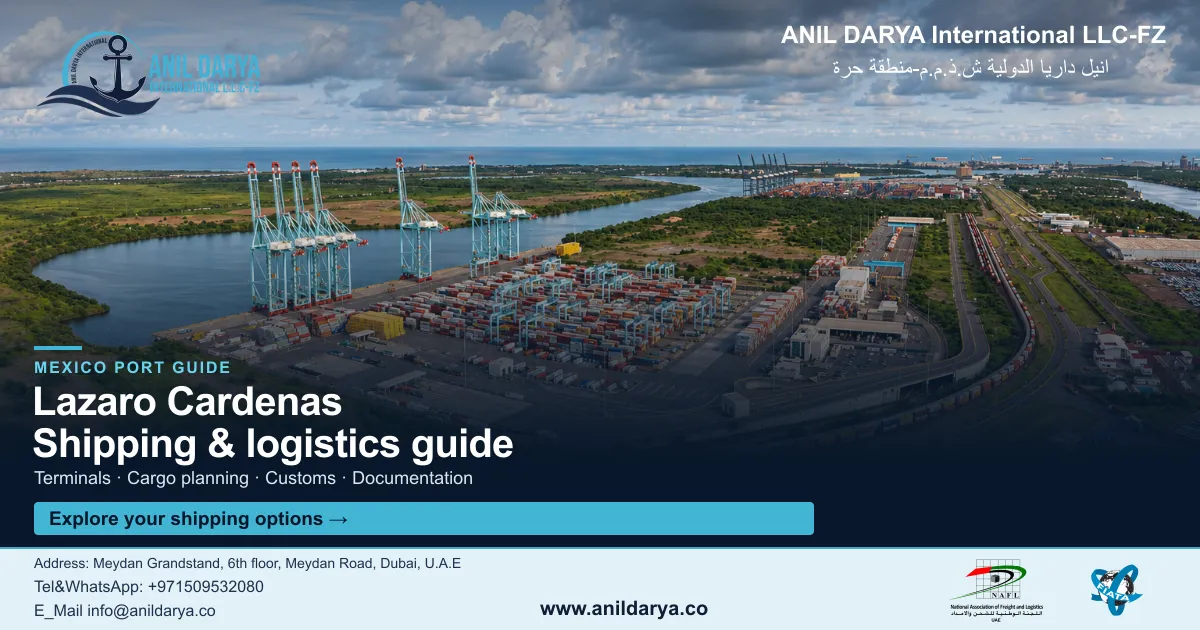
Port of Lazaro Cardenas shipping is about depth and rail: the port in Michoacan state has a 19 m deep access channel, two container terminals with on-dock rail, and it handled 2,616,770 TEU in 2025, close to half of it transshipment. It is also a major car port, with 804,955 vehicles in 2025, and has dedicated berths for steel, minerals, grain and fertilizer. This guide covers the terminals, cargo rules, free storage, customs at the port and how we ship your cargo there from Dubai. We ship both ways: from Dubai to Lazaro Cardenas and from Lazaro Cardenas to Dubai.
Port of Lazaro Cardenas guide: key facts at a glance
| Item | Detail |
|---|---|
| Location | Lazaro Cardenas, Michoacan state, Pacific coast of Mexico |
| Port code (UN/LOCODE) | MXLZC |
| Port authority | ASIPONA Lazaro Cardenas (Administracion del Sistema Portuario Nacional Lazaro Cardenas) |
| Customs office | Aduana de Lazaro Cardenas (ANAM), Isla del Cayacal |
| Access channel | 1,785 m long, 19.00 m deep, ships up to 62 m beam |
| Turning basins | 16.50 m to 17.00 m deep, ships up to 400 m long |
| Berthing positions listed by the port | 20 positions, 6,138 m of quay |
| Container terminals | Two: Hutchison Ports LCT (TEC I) and APM Terminals (TEC II) |
| Containers handled in 2025 | 2,616,770 TEU, up 9% on 2024 |
| Total cargo in 2025 | 27.3 million tonnes |
| Container flow in 2025 | 44% transshipment, 29% import, 27% export |
| Inland split in 2025 | 74% road, 26% rail |
| Vehicles in 2025 | 804,955 units, up 19% |
| Free storage on containers (by law) | 7 days import, 15 days export |
| Import taxes | IGI duty by tariff code, DTA fee, 16% IVA |
| Lazaro Cardenas to Dubai | Pedimento de exportacion through an agente aduanal; 5% UAE duty on CIF for most goods plus 5% VAT |
Where is Lazaro Cardenas port and what does it serve?
The port sits at the mouth of the Balsas river in Michoacan, on islands such as Isla del Cayacal and Isla de Enmedio. The container terminals, the car terminal and the import customs area are on Cayacal. Steel, minerals, coal, fertilizer and grain berths line the channels around them.
Three types of cargo dominate. First, containers, many of them transshipped to other ports or railed inland. Second, finished vehicles, mostly imports. Third, raw materials and steel for the industrial zone next to the port. Shippers from the UAE mainly use it for containers railed to central Mexico, and for steel, machinery and project cargo.
The rail line into the port is run by CPKC, the former Kansas City Southern de Mexico network, with service to Mexico City, Monterrey and on to the US Midwest. In 2025, 26% of the port's land movements went by rail. That share is high for a Mexican port, and it is the main reason to choose Lazaro Cardenas over a port closer to your consignee.
Which terminals does the Port of Lazaro Cardenas have?
ASIPONA lists the berths below. The operator on your booking decides where your cargo lands and which yard you collect from.
| Terminal | Operator | Berths | Quay | Max draft |
|---|---|---|---|---|
| Container terminal I (TEC I) | LC Terminal Portuaria de Contenedores (Hutchison Ports LCT) | 2 | 930 m | 16.00 m |
| Container terminal II (TEC II) | APM Terminals Lazaro Cardenas | 2 | 750 m | 16.50 m |
| Car terminal (TEA) | SSA Lazaro Cardenas | 2 | 600 m | 14.00 m |
| Multipurpose TUM I | ArcelorMittal Portuarios | 1 | 253 m | 12.00 m |
| Multipurpose TUM II and energy fluids | Promotora Inmobiliaria del Balsas | 1 | 253 m | 12.00 m |
| Multipurpose TUM III | LC Multipurpose Terminal | 1 | 286 m | 13.70 m |
| Metals and minerals | Corporacion del Balsas | 2 | 650 m | 16.00 m |
| Public bulk mineral and steel products | Terminales Portuarias del Pacifico | 1 | 180 m | 15.50 m |
| Grain (T pier and marginal quay) | Infraestructura Portuaria del Golfo | 3 | 528 m and 150 m | 8.00 m to 13.11 m |
| Fertilizer | Fertinal | 2 | 497 m | 14.00 m |
| Petroleum fluids | Pemex | 2 | 2 x 325 m | 14.00 m |
| Coal | CFE | 1 | 411 m | 16.50 m |
Container terminals compared
Both container terminals publish their own specifications. Use them to understand reefer space, rail capacity and crane reach, and let the carrier's service decide which one you get.
| Item | Hutchison Ports LCT (TEC I) | APM Terminals (TEC II) |
|---|---|---|
| Quay | 930 m, 3 berthing positions (operator figure) | 750 m now, 1,200 m planned in Phase III |
| Depth | 17 m natural draft (operator figure) | Up to 16.5 m |
| Quay cranes | 9 super post-Panamax | 8 STS cranes, 72 m reach |
| Yard equipment and area | 21 RTGs, 76 ha of yards and warehouses | 65 ha |
| Capacity | 1,650,000 TEU a year | Up to 2 million TEU a year |
| Reefer plugs | 648 | 342 |
| Rail | 4 spurs, 2.4 km of track | 5 rail tracks on dock |
| Other | 5,000 m2 CFS warehouse, 2,200 m2 plant and animal health inspection point | Over 60 customs positions, 100 t lift for general cargo |
The two sets of figures differ slightly from the port authority's table, because each source counts berths and depth in its own way. For booking purposes, the carrier's arrival notice and the terminal's vessel schedule are what count.
Car terminal and storage areas
SSA Marine runs the specialised car terminal: 600 m of quay with two berths, 48.82 ha, static space for 18,300 vehicles and a dynamic capacity of over 830,000 units a year. It has six rail spurs for car-carrying wagons and also handles high and heavy machinery that rolls on and off. ASIPONA runs a separate truck logistics area (ASLA) of 139,859 m2 and a public vehicle yard of 81,626 m2.
What cargo can you ship through Lazaro Cardenas?
| Cargo type | Where it goes | What to plan |
|---|---|---|
| General goods in containers | FCL or LCL at TEC I or TEC II | Terminal on the arrival notice, rail or truck plan, free days |
| Chilled and frozen goods | Reefer plugs at both terminals, inspection point at LCT | Set temperature, health certificates, early permits |
| Steel, coils, plates and machinery | Multipurpose terminals TUM I to III, or flat racks at the container terminals | Lifting points, piece list, trailer type |
| Vehicles and rolling machinery | SSA car terminal, Ro-Ro | Vehicle documents, rail or road delivery |
| Minerals, coal, fertilizer, grain | Dedicated bulk berths with silos and yards | Receiving facility, surveys, discharge rate |
| Dangerous goods | Containers under the IMDG Code and port rules | 48-hour vessel notice, short storage limits |
The grain terminal has silos for 80,000 tonnes and machinery rated to discharge 350 tonnes an hour, which matters if you sell bulk agricultural cargo and need to know the receiving rate at destination.
FCL, LCL and rail: moving containers through Lazaro Cardenas
Most UAE cargo for this port moves in containers, and the real decision is how the box leaves the port.
- FCL by truck. The simplest choice for consignees in Michoacan, Guerrero or western Mexico.
- FCL by rail. Both terminals load trains on the dock. APM says this saves up to 5 days compared with other ports for some inland points, and it mentions an inland depot linked to the terminal. Ask your carrier for a through bill of lading to the inland rail ramp if that is where your consignee is.
- LCL. Your cargo shares a container and is unpacked at a CFS. LCT has a 5,000 m2 CFS on the terminal. Release depends on the consolidator's paperwork, so make sure carton marks match the packing list.
The port's rules say internal rail tracks are for loading and unloading only and wagons may not stay more than 24 hours, so rail moves need a firm plan before the vessel arrives. Our guide to FCL vs LCL shipping shows where the cost break-even usually falls. For the ocean leg, see our sea freight service.
Breakbulk, project cargo and dangerous goods at Lazaro Cardenas
Breakbulk and project cargo
Lazaro Cardenas was built around a steel industry, so steel products, slabs and heavy equipment are routine. Three multipurpose terminals and a public bulk and steel terminal take conventional vessels, and the main basins allow ships up to 400 m long. APM's general cargo lift is rated at 100 tonnes.
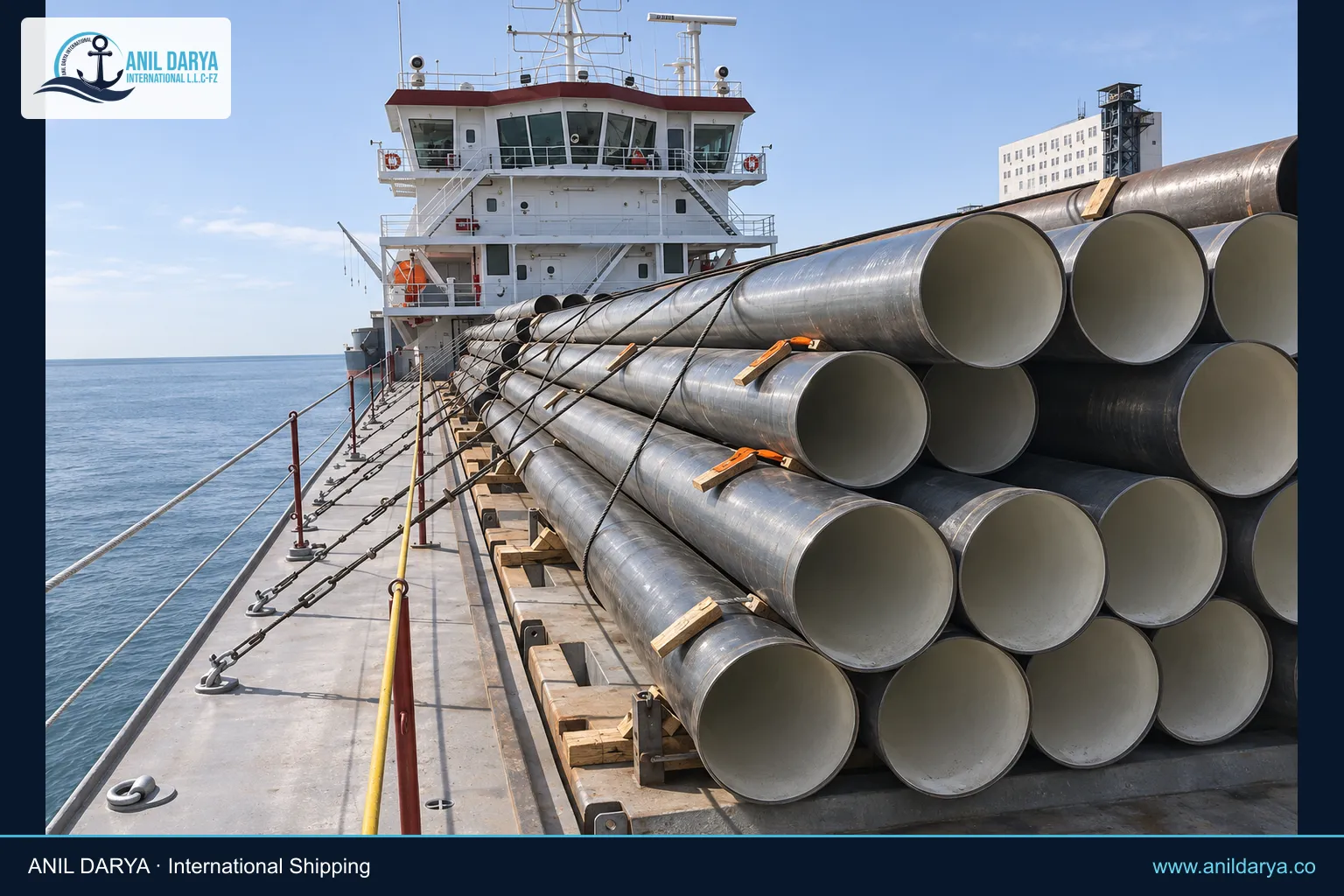
When we plan a project shipment from the UAE to Lazaro Cardenas we work in this order:
- Collect drawings, weights, dimensions and centre of gravity for each piece.
- Decide between flat racks on a container service and a breakbulk or heavy-lift vessel.
- Check the receiving terminal's berth depth and lift limits against the vessel and the heaviest piece.
- Agree lashing and discharge with the carrier and the terminal.
- Line up the consignee's customs broker and the road or rail move from the quay.
If a piece fits a 40ft flat rack by size and weight, a container service usually gives you more sailings. If not, the breakbulk sailing date drives the whole plan. Our notes on flat rack, open top and out-of-gauge cargo and our break bulk and project cargo service explain the options.
Dangerous goods
The port's Rules of Operation and their dangerous goods annex set these points. They date from 2011, so the carrier and terminal confirm current practice for each booking.
| Rule | What it means for you |
|---|---|
| Vessel notice at least 48 hours before arrival, with UN number, class, packing group, weight, flash point and stowage | Your DG declaration must be correct before the ship sails, not on arrival |
| DG ships berth where the port authority and harbour master decide | Expect a set berth and work schedule for DG discharge |
| Explosives and radioactive goods are discharged directly, not stored in the port | The consignee must collect at the ship's side |
| DG arriving by land for export needs 24 hours' notice to the authority, port and operator | Book the gate-in with the DG details a day ahead |
| DG containers go in a separate, segregated yard area | Storage space is limited, so collect quickly |
| Hazardous goods are treated as abandoned 3 days after receipt | Clearance must be ready before discharge |
The 3-day limit comes from article 29 of Mexico's Customs Law, which applies the same short period to explosive, flammable, polluting, radioactive and corrosive goods and to perishables. It can be extended to up to 45 days where suitable storage exists. Our dangerous goods shipping team checks the SDS, the DG declaration and carrier acceptance before you commit to a sailing.
Customs at Lazaro Cardenas: what is specific to this port
Mexico's import rules are the same at every port: the importer needs an active RFC tax ID, registration in the SAT importers' register, a licensed customs broker (agente aduanal) and the correct tariff code. The broker files the pedimento, and taxes are IGI duty by tariff code, a DTA processing fee of 8 per thousand on most imports, and 16% IVA. Our guide to the Port of Manzanillo covers these steps in full.
What changes here is local:
- The Aduana de Lazaro Cardenas sits inside Isla del Cayacal. ANAM lists import and export hours of Monday to Friday 9:00 to 19:00 and Saturday 10:00 to 14:00. Plan releases and gate-ins around those hours.
- There are separate import and export customs areas, with the import area reached through the Torre 8 (Cayacal 2) access.
- APM advertises same-day customs clearance and over 60 customs positions at its terminal. LCT has its own plant and animal health inspection point, which shortens moves for food and agricultural cargo.
- Rail containers can be cleared at the port or moved in bond to an inland customs point, depending on the broker's plan. Decide this at booking.

| Document or data | Who provides it |
|---|---|
| Commercial invoice and packing list, with full descriptions and serial numbers where items are identifiable | Shipper in the UAE |
| Bill of lading (through bill for rail moves) | Carrier, from our shipping instructions |
| Certificate of origin | Shipper, when an origin rule applies |
| Permits and proof of Mexican standards (NOMs) | Importer, before arrival |
| Value declaration and broker authorisation | Importer in Mexico |
| DG declaration and SDS | Shipper, for dangerous goods |
How to ship to the Port of Lazaro Cardenas from Dubai: step by step
We book space and prepare everything on the UAE side. In Mexico, the consignee's customs broker clears the cargo.
- Send us the cargo details: commodity, HS code, weight, volume or dimensions, Incoterm and the final delivery point in Mexico.
- We confirm the importer side: the consignee's RFC, importers' register, any sector register and the broker who will file.
- We compare carrier services from Jebel Ali and other UAE ports and check whether the delivery is by truck, by rail from the port, or on a through bill to an inland ramp.
- We book space. DG, reefer and out-of-gauge cargo get carrier acceptance first.
- We arrange origin trucking in the UAE, container stuffing, UAE export declaration and gate-in through Jebel Ali port or the port the service calls.
- We check that invoice, packing list and bill of lading match on names, weights and descriptions, then release the documents to the consignee and broker.
- The broker files the pedimento before arrival so the box can leave inside the free days.
- The consignee or broker collects the container, or the rail operator moves it inland, and the empty goes back to the depot the line names.
Published schedules show this is a long lane with transshipment. Fluent Cargo lists Jebel Ali to Lazaro Cardenas at 58 days 4 hours with two transfers, sailing every 2 to 4 weeks.
[AMIR-FACT: our real port-to-port days from Jebel Ali or Khor Fakkan to Lazaro Cardenas in 2026 and the carrier and transshipment hub we use]
Our Dubai freight forwarding team handles the UAE side from pickup to sailing.
How to ship from Lazaro Cardenas to Dubai
We also handle the other direction: cargo from Lazaro Cardenas to Jebel Ali, Khalifa Port or Sharjah port. We book the space with the carrier, check the papers and run the UAE side. The Mexican export clearance stays with the shipper and its agente aduanal.
The Mexico export side
- Pedimento de exportacion. Exporters must present a pedimento at the customs office through a licensed agente aduanal or an apoderado aduanal (Article 36 of the Customs Law). It carries the electronic signature that shows the goods meet any non-tariff rules.
- Documents to the broker. The commercial invoice, any permits or certificates the goods need, and a letter of instruction (carta de encomienda) naming the exporter, the broker, the goods, their value and quantity, the regime and the customs office. The broker can also ask for the RFC, shipping instructions and the carrier booking.
- Exporters' register. Most exporters do not need to register; only some sectors must join the sector exporters' register (Padron de Exportadores Sectorial).
- Proof of export. The pedimento is the evidence the exporter uses with the tax authorities, mainly to recover VAT.
- Port free time. Export containers get 15 free storage days at Lazaro Cardenas, against 7 for imports.
The UAE import side
Before the ship reaches the UAE, the import declaration goes to Dubai Customs. Dubai Customs lists the documents as the commercial invoice, the packing list, the certificate of origin and a permit from the controlling authority for restricted goods. The original or released bill of lading is what the carrier needs before it issues the delivery order. Customs duty in Dubai is 5% of the CIF value for most goods, with 50% on alcohol and 100% on cigarettes. Import VAT is 5% of the import value, which includes the customs value, freight, insurance and the duty paid. A VAT-registered importer accounts for it on its VAT return under the reverse charge; an importer that is not registered settles it at import.
- Send us the shipper's details in Mexico, the cargo, the HS code and the UAE delivery address.
- We book space from Lazaro Cardenas through a hub and send the booking and cut-offs to the shipper.
- The shipper or its trucker delivers the loaded box to the terminal, or it comes in by rail, inside the free days and before the cut-off.
- The shipper's agente aduanal files the pedimento de exportacion and clears the cargo.
- We check the draft bill of lading against the invoice and packing list.
- We file the Dubai Customs import declaration before the ship arrives.
- We arrange payment of the duty and VAT and collect the delivery order from the carrier's UAE agent.
- We truck the box to your site and return the empty to the carrier's depot inside free time.
[AMIR-FACT: the carriers and hub we actually use from Lazaro Cardenas to Jebel Ali, Khalifa Port or Sharjah, and our real port-to-port transit days in this direction]
Free days, storage and abandonment at Lazaro Cardenas
Hutchison Ports LCT states the free storage set by law: 7 days for imports and 15 days for exports. After that, terminal storage charges start. The shipping line sets separate free days for its container, and detention runs once you take the box out.
Under the Customs Law, ordinary imports left in customs storage are treated as abandoned after two months, exports after three months, and hazardous or perishable goods after three days. Once ANAM notifies the owner, there are 15 calendar days to collect. Costs start long before that, which is why we push for pre-filed pedimentos. Our note on demurrage and detention shows how the charges build up.
Lazaro Cardenas or another Mexican port?
| Your situation | Port to consider | Why |
|---|---|---|
| Consignee near a CPKC rail ramp in central or northern Mexico | Lazaro Cardenas | On-dock rail at both container terminals, 26% rail share |
| Steel, slabs, minerals, coal or fertilizer | Lazaro Cardenas | Dedicated deep berths up to 16.5 m |
| Imported vehicles for the Pacific side | Lazaro Cardenas | Specialised car terminal, 531,182 vehicles from January to September 2026 |
| Consignee in Guadalajara or the Bajio by truck | Manzanillo | More container sailings and shorter road legs |
| Consignee in Veracruz, Puebla or the east | Veracruz | Gulf coast port closer to the east |
Compare the full door-to-door cost and days. A cheaper ocean rate to one port can be wiped out by a longer truck leg.
Air cargo instead of sea
For urgent parts or samples, sea freight to Lazaro Cardenas is too slow. Air cargo usually goes to Mexico City and then by road. Our air cargo team books it from Dubai.
Checklist before you ship to Lazaro Cardenas
- Consignee has an active RFC and is in the importers' register, plus any sector register for steel, chemicals, textiles or other listed goods.
- Customs broker named and authorised before sailing.
- Tariff code checked and NOM or permit requirements known.
- Delivery mode chosen: truck from port, rail from port, or through bill to an inland ramp.
- Invoice, packing list and bill of lading match, with serial numbers where needed.
- For DG: SDS, DG declaration, carrier acceptance and a plan to clear within 3 days.
- For breakbulk: drawings, weights, lifting points and the receiving terminal's draft.
- Free days on the container agreed with the carrier.
- Cargo insurance arranged.
Common mistakes
- Booking to Lazaro Cardenas for a truck delivery that would be shorter from Manzanillo.
- No rail plan. Wagons cannot wait on port tracks for more than 24 hours.
- Late broker appointment. Without a pre-filed pedimento, the 7 free days go quickly.
- Treating DG like general cargo. Hazardous goods face a 3-day abandonment limit and segregated storage.
- Missing serial numbers on machinery and electronics, which holds the pedimento.
- Ignoring customs hours. Saturday hours end at 14:00 and there are none on Sunday.
Frequently asked questions
Where is Lazaro Cardenas port located?
It is on the Pacific coast of Mexico in Michoacan state, at the mouth of the Balsas river. The container terminals and the import customs area are on Isla del Cayacal inside the port.
Who operates the container terminals at Lazaro Cardenas?
Hutchison Ports LCT runs container terminal I and APM Terminals runs container terminal II. Both have on-dock rail. The port authority is ASIPONA Lazaro Cardenas.
How deep is Lazaro Cardenas port?
The access channel is 19.00 m deep and the main basins 16.50 m to 17.00 m. Container berths are listed at 16.00 m and 16.50 m by the port authority, and LCT gives 17 m for its own quay.
How many containers does Lazaro Cardenas handle?
It handled 2,616,770 TEU in 2025, up 9% on 2024. About 44% of that was transshipment, with the rest split between imports and exports.
Does Lazaro Cardenas have rail to central Mexico?
Yes. Both container terminals load trains on the dock, and CPKC runs the line inland to Mexico City, Monterrey and the US. In 2025, 26% of the port's land movements went by rail.
How many free storage days do containers get at Lazaro Cardenas?
The free storage set by law is 7 days for import containers and 15 days for export containers. The shipping line's free time on the container itself is separate and set by the carrier.
Can I ship dangerous goods to Lazaro Cardenas?
Yes, under the IMDG Code and the port rules. The vessel must give 48 hours' notice, explosives and radioactive goods are delivered directly from the ship, and hazardous goods are treated as abandoned after 3 days if not cleared.
How long does shipping from Dubai to Lazaro Cardenas take?
Fluent Cargo lists Jebel Ali to Lazaro Cardenas at 58 days 4 hours with two transfers. Real times depend on the carrier, the hub and connections, so ask us for the current schedule.
Do I need a customs broker at Lazaro Cardenas?
Yes. Imports into Mexico are cleared on a pedimento filed by a licensed agente aduanal, unless a company clears through its own accredited legal representative.
Can you ship cargo from Lazaro Cardenas to Dubai?
Yes. The shipper's agente aduanal files the pedimento de exportacion, and we book the space, clear the cargo through Dubai Customs and deliver it in the UAE. Most goods pay 5% UAE duty on the CIF value plus 5% import VAT.
Get a quote for Port of Lazaro Cardenas shipping
Send us the cargo details and the final delivery point in Mexico, and we will compare routings and carriers from the UAE. Use our freight rate inquiry or contact us by email at info@anildarya.co or on +971 50 953 2080.
Sources
- ASIPONA Lazaro Cardenas: Infraestructura del recinto portuario (channels, basins, berths, storage)
- ASIPONA Lazaro Cardenas: Rules for Operations of the Port, March 2011 (rules 36, 66, rail, annex VI dangerous goods)
- Hutchison Ports LCT: Infrastructure
- Hutchison Ports LCT: Frequently asked questions (free storage days)
- APM Terminals Lazaro Cardenas: Our terminal
- SSA Marine Mexico: Lazaro Cardenas car terminal
- Mexico Industry: Lazaro Cardenas closed 2025 with 27.3 million tonnes (port figures for 2025)
- Cluster Industrial: Ports moved 1.56 million vehicles by sea to September 2026
- Latin American Cargo: Port of Lazaro Cardenas (CPKC rail)
- Wikipedia: Port of Lazaro Cardenas (rail by CPKC)
- ANAM: Aduana de Lazaro Cardenas
- ANAM: Frequently asked questions (requirements to import, abandoned goods)
- Ley Aduanera, article 29 (Orden Juridico Nacional)
- Ley del Impuesto al Valor Agregado, article 1 (Orden Juridico Nacional)
- Ley Federal de Derechos, article 49 (Orden Juridico Nacional)
- Fluent Cargo: Dubai to Mexico City (Jebel Ali to Lazaro Cardenas schedule)
- Government of Mexico: Guia basica del exportador (pedimento via agente aduanal, documents, carta de encomienda, sector register)
- Dubai Customs: Submit customs declaration (documents)
- UAE Government portal: Customs duty (5% of CIF, alcohol 50%, cigarettes 100%)
- Federal Tax Authority: VAT Decree-Law No. 8 of 2017 as amended (5% rate, import value, reverse charge, unregistered importers)
Reviewed: 10 November 2026