
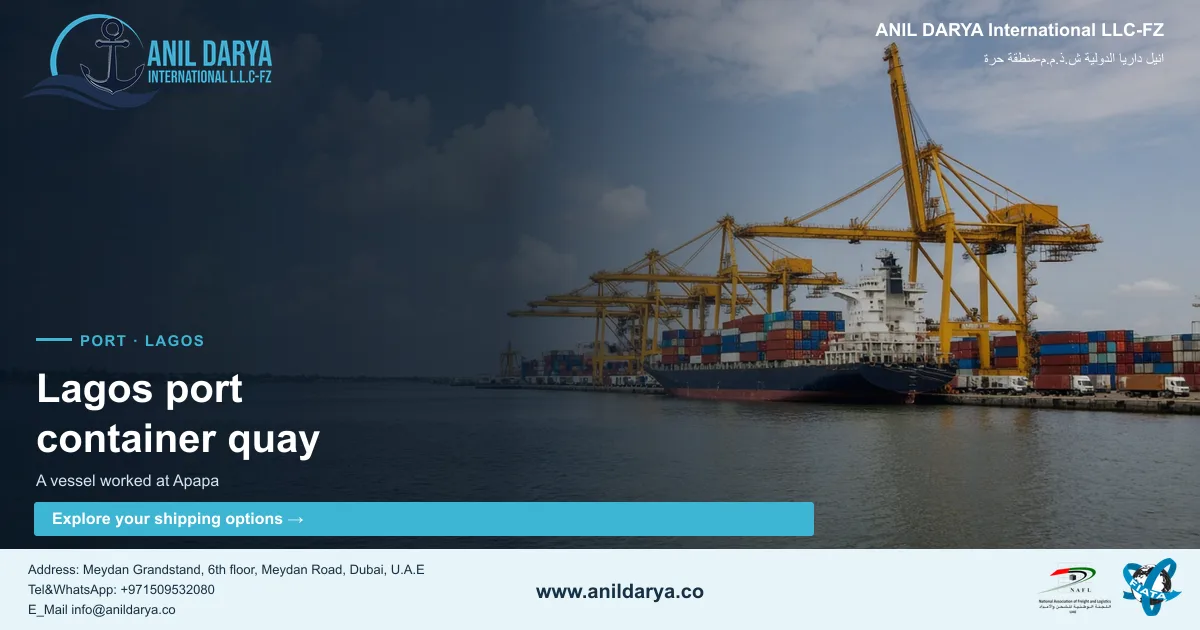
Lagos port shipping usually means the Lagos Port Complex at Apapa, the oldest and largest port in Nigeria, plus Tin Can Island Port next door and the newer Lekki Deep Sea Port to the east. The Nigerian Ports Authority (NPA) owns the ports and private companies run the terminals. This guide covers the terminals, what cargo goes where, customs at Lagos, and how we ship your cargo there from Dubai. We ship both ways: from Dubai to Lagos and from Lagos to Dubai.
Lagos port shipping at a glance
| Item | Detail |
|---|---|
| Official name | Lagos Port Complex, also called Apapa Quays or Premiere Port |
| Landlord and regulator | Nigerian Ports Authority (NPA) |
| Established | 1913; first four deep water berths started in 1921 |
| Terminal model | Five private terminals, concessioned in 2006 |
| Terminal operators | APM Terminals, ENL Consortium, Apapa Bulk Terminal, Greenview Development, Lilypond container terminal |
| Other facilities | Two logistics bases (Eko Support Services, LADOL) and eight jetties |
| Berth depths (NPA pilotage list) | About 9.6 m to 14.4 m alongside, depending on the berth |
| Oversize gate | Wheel gate of about 8 m for oversized cargo |
| Transport links | Road, rail and water |
| Hours | 24-hour operation |
| Port codes | NGAPP (Apapa), NGLOS (Lagos) |
| Customs authority | Nigeria Customs Service, Apapa Area Command, on the B'Odogwu platform |
| Nearby ports | Tin Can Island Port (next door), Lekki Deep Sea Port (about 65 km east) |
| Shipping from Lagos to Dubai | Also handled: arrival at Jebel Ali, Khalifa Port or Sharjah, cleared by UAE customs with 5% duty on most goods and 5% VAT |
Where is Lagos port and how does it fit with Tin Can and Lekki?
The Lagos Port Complex sits in Apapa, Lagos State, the commercial centre of Nigeria. Tin Can Island Port lies just northwest of it, and the two are often treated as one Lagos gateway in carrier schedules. Lekki Deep Sea Port sits about 65 km east of Lagos inside the Lagos Free Zone.
Which one your cargo uses depends on the carrier's service, the cargo type and where the consignee is. The NPA reports that Nigerian ports handled 602,392 TEU of containers in the second quarter of 2026, and it has announced a $1 billion overhaul of the Lagos Port Complex and Tin Can Island Port.
| Port | Main cargo | Good fit for |
|---|---|---|
| Lagos Port Complex (Apapa) | Containers, breakbulk, general cargo, dry bulk, oversized cargo | Most containers and project cargo for Lagos |
| Tin Can Island Port | Containers, general cargo, bulk, vehicles (Ro-Ro) | Vehicles and containers on services calling there |
| Lekki Deep Sea Port | Containers, dry bulk, liquid bulk | Services using larger vessels, consignees east of Lagos |
Which terminals does Lagos Port Complex have?
Since 2006 the NPA has acted as landlord and the terminals have been run by private operators. Your bill of lading and arrival notice show which terminal your cargo discharges at, and that decides where your clearing agent and truck go.
| Terminal | Operator | Cargo | Berths | Area |
|---|---|---|---|---|
| Terminal A and B | Apapa Bulk Terminal Ltd | Bulk | 1 to 5, sheds and warehouse | 5.913 ha and 5.752 ha |
| Terminal C and D | ENL Consortium | Breakbulk, general cargo, containers | 6 to 14, sheds 6 to 13 | 11.211 ha and 10.549 ha |
| Container Terminal | APM Terminals | Containers | 15 to 18A | 59.41 ha |
| Terminal E | Greenview Development Nigeria Ltd | Bulk | 19 to 20 | 19.091 ha |
| Lilypond (Ijora) | APM Terminals | Containers | Inland container terminal | 13.60 ha |
Berth depths at Lagos Port Complex
The NPA's Lagos Pilotage Direction lists the depth at each berth. Deeper berths take larger vessels, so carriers plan their calls around them.
| Berths | Operator | Depth range |
|---|---|---|
| 1 to 5 | Apapa Bulk Terminal | 10.2 m to 14.4 m |
| 6 to 14 | ENL Consortium | 9.6 m to 11.5 m |
| 15 to 18 | APM Terminals | 12.7 m to 13.5 m |
| 19 to 20 | Greenview (GDNL) | 10.3 m to 11.3 m |
Pilotage is compulsory in the Lagos district for vessels of 500 GT and above, and every vessel carrying IMDG dangerous goods must have a pilot on board. These are carrier matters, but they explain why berth windows can shift.
Tin Can Island and Lekki: the other Lagos ports
Tin Can Island Port
Tin Can Island Port was commissioned on 14 October 1977 to ease congestion at Apapa. Today it combines the old Ro-Ro port and Tin Can Island, and handles vessels from 100 m to 260 m with 24-hour pilotage.
| Terminal | Operator | Cargo | Quay length |
|---|---|---|---|
| Terminal A (berths 1, 1A, 2) | Josepdam Port Services | Bulk | 484 m |
| Terminal B (berths 3 to 5) | Tin Can Island Container Terminal | Containers | 776.90 m |
| Terminal C (berths 6 to 8) | Port and Cargo Handling Services | Containers, general cargo | 759.54 m |
| Terminal D (berths 9 to 10) | Five Star Logistics | Containers, general cargo | 437.53 m |
| Ro-Ro terminal (berths 11 to 12) | Ports and Terminal Multiservices (PTML) | Vehicles, containers | 490 m |
If you ship vehicles from Dubai, the Ro-Ro service you book usually discharges at Tin Can.
Lekki Deep Sea Port, the deep-water option
Lekki Deep Sea Port is run by Lekki Port LFTZ Enterprise under a 45-year concession signed in 2018. The NPA describes it as the deepest seaport in sub-Saharan Africa. The operator says the port has been fully operational since 1 April 2023, with container, dry bulk and liquid bulk terminals, 5 ship-to-shore cranes and 15 rubber-tyred gantry cranes.
Containers, vehicles and breakbulk through Lagos port
Here is how each main cargo type usually moves through the Lagos ports.
| Cargo | Where it usually goes | What to plan |
|---|---|---|
| FCL containers | APM Terminals Apapa, ENL, Tin Can container terminals, Lekki | Terminal on the arrival notice, free time, truck booking |
| LCL cargo | Container terminal, then unstuffed at a freight station | Each consignee still needs its own Form M and PAAR |
| Cars and trucks | Ro-Ro terminal at Tin Can | Vehicle age limit, duty and levy |
| Steel, machinery, generators | ENL breakbulk berths at Apapa, or flat racks on container services | Lifting points, lashing, trailer type |
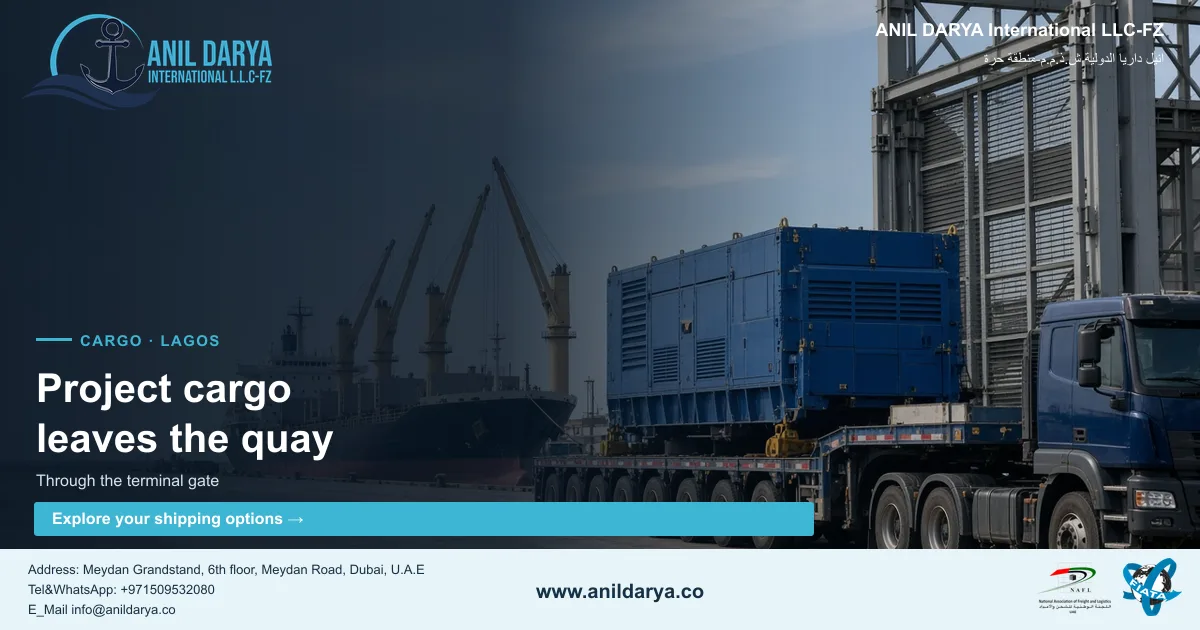
| Oversized project cargo | Apapa, using the 8 m wheel gate | Drawings, lift plan, road permits, escort |
| Grain, cement, other dry bulk | Apapa Bulk Terminal, Greenview, Josepdam, Lekki | Discharge rate, receiver's silo or warehouse |
| Dangerous goods | Container terminals, declared under IMDG | SDS, DG declaration, NAFDAC permits for chemicals |
A simple rule for heavy pieces: if the piece fits a 40ft flat rack by size and weight, a container service to Apapa or Tin Can gives you more sailings. If not, you need breakbulk tonnage, and the sailing date drives the plan. Our guide to flat rack, open top and breakbulk cargo explains the choice, and our break bulk and project cargo service covers how we plan it.
Customs clearance at Lagos port: documents and steps
Customs at Apapa and Tin Can is run by the Nigeria Customs Service. Declarations are now processed on B'Odogwu, the NCS's own platform. It started as a pilot at the PTML command at Tin Can in October 2024 and went live at the Apapa command in May 2025, replacing the older NICIS system.
Nigeria uses destination inspection, so goods are checked on arrival. The NCS uses scanners at Apapa to reduce manual examinations, and duties are paid in naira.
Documents you need for Lagos
| Document | Who handles it | When |
|---|---|---|
| Company registration, TIN, Authorised Dealer Bank | Nigerian importer | Before any import |
| Product Certificate (SONCAP), if goods are regulated | Importer, through an accredited inspection firm | Before Form M |
| Form M with proforma invoice and insurance certificate | Importer, through its bank on the Single Window | Before shipment |
| Final invoice, packing list, bill of lading | Shipper and carrier | At shipment |
| SONCAP Certificate | Issued by SON per shipment | Before arrival |
| NAFDAC registration | Importer or local agent | Before import of food, drugs, cosmetics, chemicals, medical devices |
| PAAR | Issued by NCS on the Single Window | Before clearance starts |
Duty follows the ECOWAS Common External Tariff, with five bands from 0% to 35%, and VAT is 7.5%. Vehicles pay 20% duty plus a National Automotive Council levy. Check the HS code against the current Nigerian prohibition lists before the Form M is opened, because the trade list was revised from 1 April 2026.
What happens at the terminal
- The shipping line submits the manifest to Customs, NPA and the terminal operator.
- The terminal discharges the cargo, records tally sheets and stacks or stores it.
- The clearing agent files the declaration against the PAAR on B'Odogwu and pays duty.
- Customs scans or examines the cargo if it is selected.
- Customs releases the cargo, the line issues the delivery order, and the terminal bills handling and storage.
- The truck collects the cargo, and the empty container goes back to the line's depot.
A consignee can also ask for its containers to be moved to a bonded terminal or warehouse. The terminal operator requests this from Customs, and the move needs an NCS transit approval.
How to ship from Dubai to Lagos port step by step
We handle the UAE side and work with your consignee's licensed clearing agent in Lagos. We do not clear cargo in Nigeria.
- Send the cargo details. Commodity, HS code, weight, volume or dimensions, pickup address and the Lagos port or terminal the consignee prefers.
- Confirm the Nigerian approvals. The consignee opens the Form M, with a Product Certificate if the goods are regulated.
- Book space. We compare services from Jebel Ali to Apapa, Tin Can and Lekki and get carrier acceptance for DG, vehicles or out-of-gauge cargo.
- Prepare the cargo. We arrange pickup, stuffing or lashing, and UAE export clearance. Our Jebel Ali port guide covers the UAE side.
- Issue documents. Final invoice, packing list and bill of lading carry the Form M number and match each other.
- Hand over to Lagos. We send drafts to the consignee and its clearing agent before arrival so the SONCAP Certificate and PAAR are ready.
- Track to discharge. We follow the vessel and share the arrival notice so the agent can file early.
[AMIR-FACT: a real shipment we sent from Jebel Ali to Apapa, Tin Can or Lekki: cargo, terminal used and our actual port-to-port transit time]
See our sea freight service for FCL and LCL bookings, and our dangerous goods team if the cargo is classed under IMDG.
How to ship from Lagos port to Dubai
We also handle the other direction: shipping from Lagos to Dubai, with arrival at Jebel Ali, Khalifa Port or Sharjah port. We book the space with the carrier and run the UAE side. The Nigerian export papers stay with the shipper or its Nigerian agent.
The Nigerian export side
- Exporter registration. The Nigerian Export Promotion Council (NEPC) lists registration as an exporter with NEPC as the first step.
- NXP form. The shipper's commercial bank issues the Nigeria Export Proceeds (NXP) form, which records the value of the export.
- Inspection and certificates. A government-appointed pre-shipment inspection agency issues a Clean Certificate of Inspection. Farm produce needs a phytosanitary certificate from NAQS, and NACCIMA issues certificates of origin.
- Export clearance. The shipper or its Nigerian agent clears the goods for export with the Nigeria Customs Service.
The UAE import side
For cargo cleared in Dubai, the import declaration goes to Dubai Customs with the commercial invoice, packing list, certificate of origin and any permit from the authority that controls restricted goods. The bill of lading is what releases the cargo from the shipping line. Customs duty in Dubai is 5% of the CIF value for most goods, with 50% on alcohol and 100% on cigarettes. Import VAT is 5%, charged on the customs value including freight and insurance. A VAT-registered importer that has registered its customs number with the Federal Tax Authority pays no VAT at the border and accounts for it on its next VAT return.
- Send us the shipper's details in Lagos, the cargo, the HS code and the UAE delivery address.
- We book space with the carrier from Lagos to Jebel Ali, Khalifa Port or Sharjah and send the booking and cut-offs to the shipper.
- The shipper or its trucker picks up the cargo and delivers the container to the Apapa, Tin Can or Lekki terminal named in the booking before the cut-off.
- The shipper or its Nigerian agent completes the NXP form, inspection and export clearance with the Nigeria Customs Service.
- We check the draft bill of lading against the invoice and packing list before the line issues it.
- We file the UAE import declaration before the vessel arrives.
- We arrange payment of the duty and VAT and collect the delivery order from the shipping line.
- We truck the container to your site in the UAE.
- We return the empty container to the line's depot within free time.
[AMIR-FACT: the carriers we actually use from Apapa, Tin Can or Lekki to Jebel Ali, Khalifa Port or Sharjah and our real port-to-port transit days in this direction]
Free time, storage and demurrage at Lagos
Every day a container waits at the terminal after free time adds terminal storage and shipping line demurrage, and every day you keep it outside adds detention. Free days and daily rates vary by line and terminal, so read them on the quote and arrival notice. The NPA says terminal timelines and charges are set by each terminal operator.
Three habits keep these costs down: get the PAAR before the vessel arrives, name the clearing agent before sailing, and plan delivery and empty return in advance. Our article on demurrage and detention shows how the charges build up.
Checklist before you ship to Lagos
- HS code checked against the current Nigerian prohibition lists.
- Form M approved and its number on the invoice and bill of lading.
- SONCAP route agreed for regulated goods.
- NAFDAC registration in place for food, drugs, cosmetics, chemicals or medical devices.
- Discharge port and terminal confirmed: Apapa, Tin Can or Lekki.
- Clearing agent in Lagos named and given draft documents.
- For vehicles: age within the limit and Ro-Ro service to Tin Can confirmed.
- For heavy lifts: drawings, weights and the road route from the port.
- Free time agreed with the line.
Common mistakes at Lagos port
- Sailing before the Form M is approved. The PAAR cannot be issued and the cargo waits at the terminal.
- Wrong terminal on the paperwork. The agent files with the wrong command and loses days.
- No SONCAP Certificate for regulated goods. Customs will not release them.
- Mismatched values or weights between Form M, invoice and bill of lading.
- Undeclared dangerous goods. These can be rejected or fined.
- Late agent appointment. Free time runs out before filing starts.
Frequently asked questions
What is the main port in Lagos?
The Lagos Port Complex at Apapa is the main and oldest port in Lagos and Nigeria. Tin Can Island Port sits next to it, and Lekki Deep Sea Port lies about 65 km east of Lagos.
Who operates the terminals at Apapa?
The NPA is the landlord. Terminals are run by APM Terminals (Container Terminal and Lilypond), ENL Consortium (Terminals C and D), Apapa Bulk Terminal (A and B) and Greenview Development (Terminal E).
What is the difference between Apapa and Tin Can Island port?
Both are NPA ports in Lagos with private terminals. Apapa is larger and handles containers, breakbulk and bulk, while Tin Can also has the Ro-Ro terminal used for most vehicle imports.
Can large container ships call at Lagos?
Berth depths at Apapa range from about 9.6 m to 14.4 m in the NPA pilotage list. Lekki Deep Sea Port, described by the NPA as the deepest seaport in sub-Saharan Africa, was built for larger vessels.
Which customs system is used at Lagos port?
The Nigeria Customs Service uses B'Odogwu. It went live at the Apapa command in May 2025 after a pilot at the PTML command in Tin Can from October 2024, replacing the older NICIS system.
What documents do I need to clear cargo at Lagos port?
The importer needs an approved Form M, a PAAR, the invoice, packing list and bill of lading. Regulated goods also need SONCAP certificates, and food, drugs, cosmetics and chemicals need NAFDAC registration.
How do I ship cargo from Dubai to Lagos port?
Your consignee opens the Form M first. We then book space from Jebel Ali to Apapa, Tin Can or Lekki, arrange UAE export clearance and documents, and hand over to the consignee's clearing agent in Lagos.
How do I ship from Lagos port to Dubai?
The Nigerian shipper registers with NEPC, gets the NXP form from its bank, completes inspection and clears the goods for export. We book the space to Jebel Ali, Khalifa Port or Sharjah, file the UAE import declaration and arrange payment of the 5% duty (on the CIF value of most goods) and the 5% import VAT.
Get a quote for Lagos port shipping
Send us your cargo details and the Lagos terminal you prefer, and we will come back with a routing and a price. Use our freight rate inquiry form, or contact our team to discuss a vehicle, breakbulk or DG shipment. You can also read more about our Dubai freight forwarding team.
Sources
- Nigerian Ports Authority: Lagos Port Complex
- Nigerian Ports Authority: Terminals and operators
- Nigerian Ports Authority: Lagos Port Complex berth characteristics (terminal areas)
- Nigerian Ports Authority: Lagos Pilotage Direction (berth depths, pilotage rules)
- Nigerian Ports Authority: Tin Can Island Port Complex
- Nigerian Ports Authority: Tin Can berth characteristics (quay lengths)
- Nigerian Ports Authority: Lekki Deep Sea Port
- Lekki Port: Port facts and equipment
- Nigerian Ports Authority: Import and export guidelines
- Nigerian Ports Authority: Cargo handling (transfers, timelines, charges)
- Nigerian Ports Authority: Q2 2026 operational performance
- Nigerian Ports Authority: Q1 2026 performance and port modernisation
- Standards Organisation of Nigeria: SONCAP services
- ECOWAS: Common External Tariff bands
- PwC Worldwide Tax Summaries: Nigeria VAT rate
- US International Trade Administration: Nigeria import tariffs (vehicles)
- US International Trade Administration: Nigeria import requirements (destination inspection, scanners)
- US International Trade Administration: Nigeria customs regulations (naira payment)
- SCP Law: Nigeria's 2026 import restrictions
- Legal 500: Registration of imported products with NAFDAC
- Nairametrics: B'Odogwu pilot and rollout (March 2025)
- Legit.ng: B'Odogwu goes live at Apapa (May 2025)
- Cogoport: Apapa (NGAPP) port information
- Seabay: Lagos (NGLOS) port code
- Nigerian Export Promotion Council: Export documents and procedures (registration, NXP, CCI, certificates)
- Dubai Customs: Submit customs declaration (invoice, packing list, certificate of origin, permits)
- UAE Government portal: Clearing customs and paying customs duty (5% of CIF, alcohol 50%, cigarettes 100%)
- Federal Tax Authority: VAT (5% rate)
- Federal Tax Authority: VAT guide, section 3.5 on VAT on imports (5%, deferral for VAT-registered importers)
Reviewed: 10 November 2026