
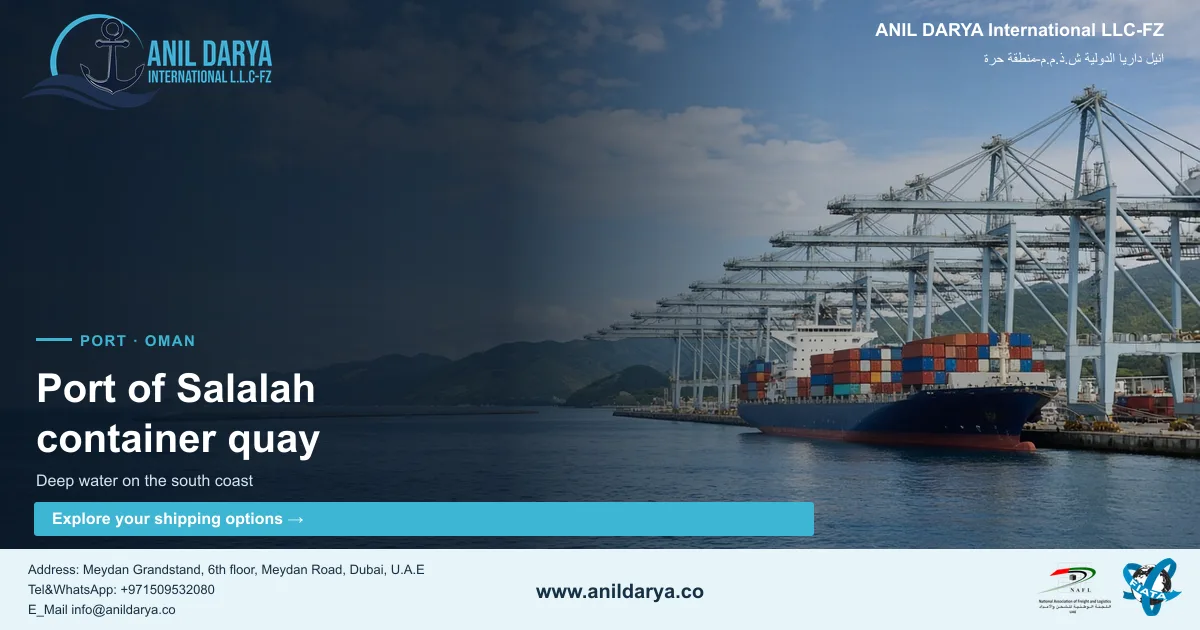
Salalah port shipping means using Oman's largest port, a deep-water hub in the south of the country that handles more than 4 million TEU a year plus bulk, breakbulk and liquid cargo. The Port of Salalah is run by Salalah Port Services, whose main shareholders are Asyad and APM Terminals, and it clears cargo through Oman Customs' Bayan system. This guide covers the terminals, the monsoon season, the free zone, customs and how we move your cargo from the UAE to Salalah. We ship both ways: from Dubai to Salalah, and from Salalah to Dubai.
Port of Salalah guide: key facts at a glance
| Item | Detail |
|---|---|
| Operator | Salalah Port Services Company (SPS), listed in Muscat; main shareholders Asyad and APM Terminals |
| Location | Raysut, Salalah, Dhofar Governorate, southern Oman |
| UN/LOCODE | OMSLL |
| Operating since | 1998 |
| Container terminal | 6 berths, 2,197 m quay, draft up to 18 m, 6 million TEU a year |
| Reefer plugs | More than 1,500 |
| General cargo terminal | 13 berths, about 3,000 m quay, draft 6.8 to 18 m, 35 million tonnes a year |
| Liquid bulk terminal | 2 berths, 666 m, 18 m draft, 6 million tonnes a year |
| Containers handled in 2025 | 4,324,549 TEU |
| General cargo terminal volume in 2025 | 26.3 million freight tonnes |
| Neighbours | Salalah Free Zone, Al Mazunah Free Zone, Salalah Airport |
| Monsoon season | June to August, waves up to 4 m; monsoon controls apply |
| Customs | Directorate General of Customs, Royal Oman Police, through Bayan |
| Customs duty | GCC common external tariff of 5% on most foreign goods |
| VAT | 5% standard rate |
| Shipping Salalah to Dubai | Export declaration in Bayan by the shipper or its agent; import declaration with Dubai Customs, 5% duty on non-GCC goods and 5% VAT |
What is the Port of Salalah and where is it?
The Port of Salalah sits at Raysut, outside Salalah city in Dhofar, the southern governorate of Oman. It opened in 1998 and has since handled more than 50 million TEU and more than 100 million tonnes of bulk, liquid and general cargo. Salalah Port Services Company (SPS) runs it. SPS is a public company whose main shareholders are Asyad, Oman's ports and logistics group, and APM Terminals.
Salalah is mainly a transshipment hub. In 2025 the port handled 4.32 million TEU, of which 3.87 million TEU were transshipment. Imports into Oman were 149,822 TEU and exports 193,668 TEU. That split matters for you: most container services at Salalah are mainline or hub services, and the port says it is a core hub in the Gemini network. The port names Maersk, MSC and CMA among its key customers.
The port also ranks high on efficiency. The World Bank's Container Port Performance Index ranked Salalah the second most efficient container port in the world for three years in a row, 2021 to 2023.
Which terminals does the Port of Salalah have?
The port has three main operating areas. Your cargo type decides which one you use.
| Terminal | Cargo | Key specs |
|---|---|---|
| Container terminal | FCL, transshipment, reefers | 6 berths, 2,197 m quay, draft up to 18 m, 6 million TEU capacity, 1,500+ reefer plugs |
| General cargo terminal (GCT) | Dry bulk, breakbulk, project cargo, Ro-Ro, dhows, a small container operation | 13 berths, about 3,000 m quay, draft 6.8 to 18 m, 35 million tonnes capacity, about 15,000 containers a year |
| Liquid bulk terminal | Fuel, methanol, LPG, MEG, vegetable oil | 2 berths, 666 m, 18 m draft, 6 million tonnes capacity, 120,000 tonne tank farm |
Container terminal
The container terminal has 6 berths along 2,197 m of quay, with a draft of up to 18 m. In 2025 SPS completed a $300 million upgrade of all six berths and the yard, which raised capacity from 4.5 million to 6 million TEU. In 2020 it received the MSC Isabella, a Gulsun-class ship and at the time the largest vessel the port had handled. The terminal has more than 1,500 reefer plugs and offers container maintenance and repair.
Volumes are rising. The container terminal handled 2.33 million TEU in the first half of 2026, compared with 2.03 million TEU in the first half of 2025.
General cargo terminal
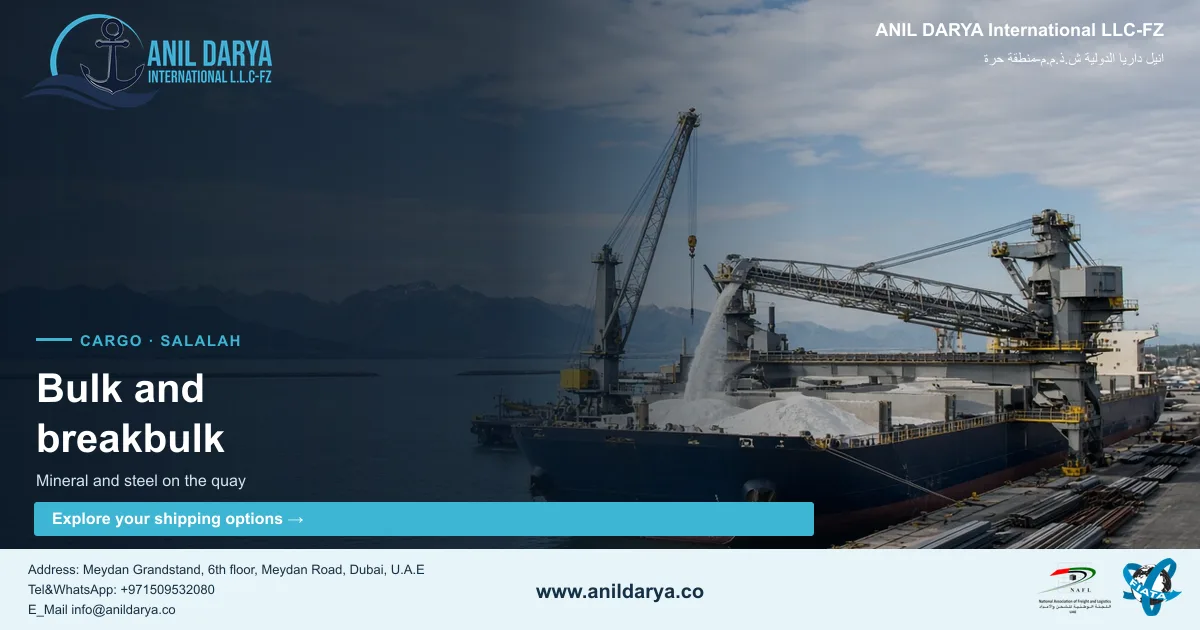
The GCT has 13 berths along about 3,000 m of quay, with drafts from 6.8 m to 18 m. It can handle 35 million tonnes a year and its equipment can work dry bulk vessels of 200,000 tonnes and more. Dry bulk drives its growth: the GCT moved 21.3 million tonnes of dry bulk, 1.57 million tonnes of breakbulk and 3.43 million tonnes of liquid bulk in 2025, a total of 26.3 million tonnes. Asyad describes Salalah as the world's largest exporter of gypsum.
The GCT also handles dhow operations and a small container activity of about 15,000 containers a year.
Liquid bulk terminal
The liquid terminal has two dedicated 18 m berths spanning 666 m and a capacity of 6 million tonnes a year. It handles fuel, methanol, LPG, MEG and vegetable oil. A 4.5 km pipe corridor links it with customers in Salalah Free Zone, and a new jetty serves LPG exports.
Port services
SPS lists trucking, warehousing, real estate leasing, sea-air cargo, a container freight station (CFS), Ro-Ro, cruise, customs clearance, bulk and breakbulk handling, and dhow operations. Marine services include pilotage. Asyad adds stevedoring, tug services, bunkering and a wave-dampening system that reduces ship movement at the berth.
What cargo can you ship through Salalah?
| Cargo type | How it moves at Salalah | What to plan |
|---|---|---|
| General goods in containers | FCL at the container terminal | Carrier service that discharges for Salalah import, free time, inland truck |
| Small shipments | LCL through the port's CFS | Consolidator's sailing, carton marks |
| Chilled and frozen food | Reefers on 1,500+ plugs | Set temperature, Ministry of Agriculture permits, halal certificate for meat |
| Steel, machinery, project cargo | Breakbulk at the GCT | Lift plan, mobile crane, abnormal load permit |
| Vehicles and rolling equipment | Ro-Ro at the GCT | Vehicle documents, Ro-Ro sailing |
| Minerals and dry bulk | Dry bulk berths at the GCT | Discharge or loading plan, storage |
| Fuels and chemicals | Liquid terminal, or IMDG containers | Environment Authority permit, DG approvals |
| Urgent cargo | Sea-air through the bonded corridor to Salalah Airport | Sea-air booking, airline acceptance |
FCL and LCL shipping to Salalah port
Container cargo for Dhofar and southern Oman normally arrives at Salalah. Because most of the port's traffic is transshipment, not every service that calls at Salalah discharges import cargo there on a route from the UAE. We check that the carrier offers Salalah as a final port of discharge, not only as a hub, before we book.
LCL goes through the port's CFS. Your cargo is unpacked from the shared container before release, so make sure the carton marks and packing list match. Our guide to FCL vs LCL costs helps you decide, and our sea freight team can price both.
[AMIR-FACT: the carrier services we actually book from Jebel Ali to Salalah for import cargo, and our real port-to-port and door-to-door transit time]
Breakbulk, bulk and project cargo at Salalah
The GCT is one of the busiest breakbulk and bulk terminals in the region. It handled 1.57 million tonnes of breakbulk and 21.3 million tonnes of dry bulk in 2025. For project cargo, we plan it in this order:
- Collect drawings, weights and centre of gravity for each piece.
- Choose the vessel: flat rack on a container ship, or a breakbulk or heavy-lift vessel to the GCT.
- Confirm berth, draft and crane with the port. GCT drafts range from 6.8 m to 18 m, so the berth must suit the vessel.
- Arrange the abnormal load permit for the road leg. Oman's transport ministry issues permits for exceptional heavy loads.
- File the Bayan declaration before arrival, so the cargo leaves the quay without storage days.
Our break bulk and project cargo service covers the lift and route planning, and our bulk cargo team handles dry and liquid bulk.
Monsoon season at Salalah: what changes from June to August
Salalah has a monsoon season (khareef) from June to August, when waves can reach 4 m. The average tidal range is 1 m to 2 m. The port applies monsoon control guidelines when sea conditions require them. In 2025, for example, monsoon controls took effect on 5 June at 00:01.
What this means for your cargo:
- Expect monsoon controls to affect vessel operations in some weeks, so keep buffer time in the schedule.
- Plan breakbulk and project lifts outside the monsoon where you can, or allow extra time.
- Ask your carrier whether its service schedule changes in summer.
Dangerous goods at Salalah: port advisories
The Port of Salalah has issued two recent DG advisories that affect bookings.
| Advisory | Date | What it says |
|---|---|---|
| 05/26, mandatory DG pre-approvals | 26 March 2026 | Vessel operators need prior approval from the Ministry of Transport, Communications and Information Technology before calling any Omani port with Class 1, 2.1, 3, 4.3, 5.1 or 5.2 goods, including cargo on board for transshipment. The port accepts calls only on that approval. |
| 2/26, DG on dhows | 4 February 2026 | Carrying IMDG dangerous goods on traditional vessels (dhows) to or from Salalah is prohibited unless the port approves in advance and the vessel has a Document of Compliance, the current IMDG Code, emergency procedures and a DG first aid guide. A DG manifest is required. Breaches lead to denial of entry. |
On top of the port rules, chemicals need an Environment Authority permit and explosives need a Royal Oman Police permit. For any DG booking, you provide the UN number, proper shipping name, class, packing group, SDS, a signed DG declaration and UN-approved packaging. Our dangerous goods shipping team checks these before you book.
Salalah Free Zone and sea-air cargo
Salalah Free Zone sits next to the port, and Al Mazunah Free Zone is also nearby. SPS lists these free zone terms:
- Zero import or re-export duties, and 30 years free of corporate tax.
- 100% foreign ownership.
- A 2.5% cargo inspection rate, with shipment customs clearance within 21 minutes.
- A dedicated sea-air customs bonded corridor, which connects a sea-air box within 2 hours of discharge.
Deliver into the free zone if the consignee holds a free zone licence and will store, process or re-export the goods. Deliver to the Omani mainland if the goods will be sold or used in Oman, where duty and VAT apply. For urgent onward cargo, the sea-air link to Salalah Airport can save days; our air cargo team can price the air leg.
Customs clearance at the Port of Salalah
Oman Customs, the Directorate General of Customs of the Royal Oman Police, clears cargo at Salalah through Bayan. Since 27 May 2024, the port's systems are linked to Bayan:
- You must complete the Bayan declaration before you book a container inspection.
- Inspection requests are processed digitally, and customs tells the terminal which containers it wants to inspect.
- After inspection and customs requirements are complete, customs sends an electronic release to the port, which allows gate-out.
- The port no longer accepts paperwork for these steps, and it asks that bill of lading details are correct from origin.
A Bayan declaration costs OMR 15 for companies and OMR 5 for individuals. For new products, the importer can ask customs through Bayan to confirm value, HS code and origin before shipping.
Which documents does Oman Customs need?
Oman Customs lists commercial invoices, a certificate of origin from the manufacturer's country and a declaration issued by the exporting country, plus permits for restricted goods.
| Cargo type | Core documents | Usually also needed |
|---|---|---|
| General cargo (FCL or LCL) | Invoice, packing list, certificate of origin, bill of lading, UAE export declaration | Nothing more if goods are not restricted |
| Food and reefer cargo | Core set | Ministry of Agriculture permit, health certificate, halal certificate for meat |
| Dangerous goods | Core set | DG declaration, SDS, Environment Authority or ROP permit, carrier MTCIT approval |
| Breakbulk and project cargo | Core set with a piece-by-piece packing list | Drawings and weights, abnormal load permit |
| Telecom and electronic goods | Core set | Telecom Regulatory Authority release |
| Standards-controlled goods (toys, tyres, paints, electrical goods, cosmetics) | Core set | Ministry of Commerce standards approval |
Customs duty and VAT
Oman applies the GCC common external tariff: 5% on foreign goods from outside the GCC, in force since 1 January 2003, with 417 goods exempt. Goods produced in a GCC state are exempt with a purchase invoice and an indication of origin, and loose or liquid materials also need a Gulf origin certificate. VAT is 5% on most goods, including imports. A UAE supplier shipping directly to Oman with an export declaration can zero-rate the sale.
Trucks and gates at Salalah
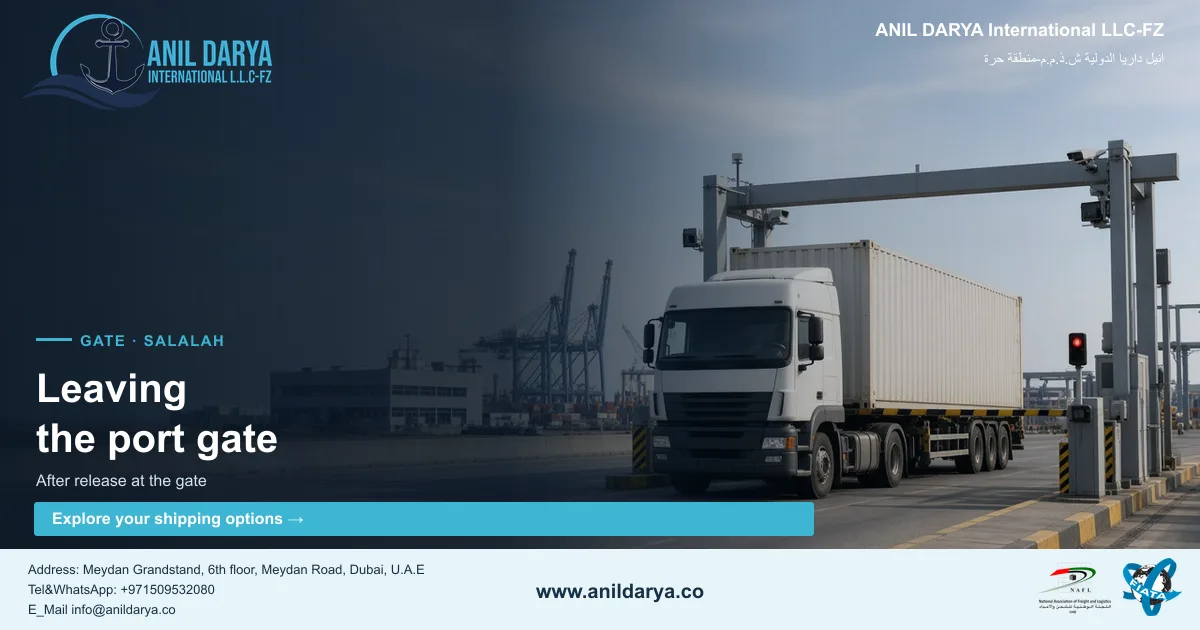
The port has moved its truck gates to automated systems. Trucks and drivers must be registered for the gate automation system (PASS), and a truck inspection system has been active at the terminal gates since February 2025. Since January 2026, late gate charges apply to containers gated in outside gate timings or after the vessel cut-off. The port has also banned small trailers for 45ft containers. Book export gate-in early and use the right trailer.
How to ship to the Port of Salalah from Dubai: step by step
We book space with carriers, prepare documents, arrange trucking and export clearance in the UAE, and work with your consignee's clearing agent or a destination clearing agent in Oman.
- Tell us about the cargo. Commodity, HS code, weight, dimensions, pickup address in the UAE and the Incoterm.
- Pick the service. We find a carrier that discharges import cargo at Salalah and compare it with other routings.
- Check Omani permits. The consignee applies for any permit the goods need.
- Book space. For DG, reefer or out-of-gauge cargo we get carrier acceptance first, including any MTCIT approval for DG.
- Prepare documents. Invoice, packing list, certificate of origin and the draft bill of lading, with matching data.
- File the UAE export declaration through Dubai Customs and deliver to the loading port before the cut-off.
- Pre-file the Bayan declaration in Oman so it is ready when the vessel berths.
- Clear and release. After duty, VAT and any inspection, customs sends the release to the port electronically.
- Deliver and return the empty within free time.
If you load at Jebel Ali, see our Jebel Ali port shipping guide for the UAE side.
How to ship from the Port of Salalah to Dubai
We also run the lane the other way: shipping from Salalah to Dubai, with arrival at Jebel Ali, Khalifa Port or Sharjah port. We book the space and handle the UAE side, while the Omani export filing stays with the shipper or its Oman agent.
The Oman export side
- Export declaration. The shipper or its Omani agent creates it in Bayan, the system of the Directorate General of Customs, which handles import, export and transit declarations. The steps are sign in, create the declaration, choose the coordinator code, attach the documents, submit and pay. The fee is OMR 15 for a company and OMR 5 for an individual.
- Documents. Oman Customs lists the trade invoices and a certificate showing where the goods were made, plus a permit file if the goods need one.
- Certificate of origin for Omani goods. Dubai Customs Notice 14/2020 accepts electronic certificates of origin issued by the Oman Chamber of Commerce and Industry. Ask the shipper for one if the goods are made in Oman.
- Pickup. The shipper or its trucker delivers the box to the Salalah container terminal before the carrier's cut-off.
The UAE import side
For a container loaded at the Salalah container terminal, we file the import declaration with Dubai Customs before the ship reaches the UAE. The document set is the Omani shipper's commercial invoice, the packing list, the certificate of origin (the electronic Oman Chamber of Commerce and Industry certificate if the goods are made in Oman) and a permit from the relevant authority for restricted goods. The carrier releases the box against the bill of lading. Dubai charges customs duty of 5% of the CIF value on most goods, 50% on alcohol and 100% on cigarettes, and import VAT of 5%. A VAT-registered importer accounts for the VAT on its return under the reverse charge; any other importer pays it before release.
Goods made in Oman and shipped from Salalah are treated differently. The GCC Customs Union treats goods produced in any member state as national goods across all member states, so they pay no 5% duty in Dubai when the certificate of origin proves they were made in Oman. The UAE government portal, in its section on Sharjah customs, sets the test at no less than 40% of the raw materials coming from the GCC. Foreign goods that paid duty when they first entered the GCC, for example cargo first cleared into Oman at Salalah, are not charged again if you can prove the payment. The 5% import VAT applies in both cases.
- Send us the shipper's details in Salalah, the cargo, the HS code and the UAE delivery address.
- We book space from Salalah and send the booking and cut-offs to the shipper.
- The shipper or its trucker stuffs the container and delivers it to the Salalah container terminal.
- The shipper or its Oman agent files the export declaration in Bayan.
- We check the draft bill of lading against the invoice, packing list and certificate of origin.
- We file the UAE declaration with Dubai Customs before the vessel arrives.
- We arrange payment of the duty and VAT and collect the delivery order from the carrier.
- We truck the container to your site and return the empty to the depot the line names within free time.
[AMIR-FACT: the carriers we actually use from Salalah to Jebel Ali/Khalifa/Sharjah and our real transit days in this direction]
Free time and demurrage at Salalah
Carriers set free days for their containers. Demurrage runs after that while the box stays in the port, and detention while you keep it outside. Rates differ by carrier, so check your quote and arrival notice. Since 1 January 2026, the port also charges a tariff for empty container handling. A Bayan declaration filed before arrival and permits ready before berthing are the best protection. Our article on demurrage and detention shows how the charges build up.
Checklist before you ship to Salalah
- Carrier confirmed to discharge import cargo at Salalah.
- HS code confirmed for every item.
- Invoice, packing list and bill of lading match, and B/L details are correct from origin.
- Certificate of origin issued, with GCC origin proof if you claim the exemption.
- UAE export declaration filed.
- Omani importer registered in Bayan, or a broker authorised.
- Import permits issued for restricted goods.
- Delivery point agreed: mainland, Salalah Free Zone or sea-air.
- DG approvals in place for the vessel and the product.
- Monsoon timing checked for June to August arrivals.
- Trucks registered for the port's gate system.
- Free time agreed and cargo insurance arranged.
Common mistakes when shipping to Salalah
- Booking a service that only transships at Salalah. Your cargo needs a carrier that discharges it there for import.
- Ignoring the monsoon. Arrivals from June to August need buffer time, because the port applies monsoon controls when sea conditions require them.
- Wrong bill of lading data. Errors from origin delay Bayan processing now that the port and customs systems are linked.
- DG on dhows without approval. The port refuses entry and refers violators to the authorities.
- Late gate-in. Containers gated in after the cut-off pay late gate charges.
- Late permits. A missing Omani permit leaves the container in the yard while charges run.
- Clearing free zone goods for the local market. You pay duty and VAT you may not owe.
Salalah or Sohar: which Omani port fits your cargo?
| Your situation | Port to choose | Why |
|---|---|---|
| Consignee in Salalah or Dhofar | Salalah | Next to the city, free zones and airport |
| Consignee in Muscat or the Batinah coast | Sohar | Muscat's commercial cargo moved to Sohar in 2014 |
| Free zone processing or re-export from southern Oman | Salalah | Salalah Free Zone and Al Mazunah Free Zone are nearby |
| Bulk minerals or liquid bulk | Salalah | Large dry bulk and liquid terminals with 18 m draft |
| Small or urgent cargo from Dubai to northern Oman | Road via the land border | Door to door without port handling |
Frequently asked questions
Who operates the port in Salalah?
Salalah Port Services Company (SPS), a public company listed in Muscat, operates the port. Its main shareholders are Asyad and APM Terminals.
How do I ship from Dubai to Salalah?
We book space on a carrier that discharges import cargo at Salalah, file the UAE export declaration and deliver to the loading port before the cut-off. The consignee's agent pre-files the Bayan declaration so customs can release the cargo after duty, VAT and any inspection.
How big is the Salalah container terminal?
The container terminal has 6 berths on 2,197 m of quay, a draft of up to 18 m and a capacity of 6 million TEU a year after a $300 million upgrade. It handled 4.32 million TEU in 2025.
Is Salalah a transshipment port?
Mostly, yes. In 2025, 3.87 million of the 4.32 million TEU handled were transshipment. Import and export containers for Oman were about 343,000 TEU combined.
Does the monsoon affect shipping to Salalah?
It can. From June to August waves can reach 4 m, and the port applies monsoon control guidelines when sea conditions require them. Allow extra time for breakbulk, project and dhow cargo in those months.
What documents do I need to clear cargo at Salalah?
Oman Customs asks for the commercial invoice, a certificate of origin and the export declaration from the exporting country, filed through Bayan. Restricted goods also need a permit, and bill of lading data must be correct from origin.
Can I ship dangerous goods to Salalah?
Yes, with approvals. Vessels with Class 1, 2.1, 3, 4.3, 5.1 or 5.2 goods need prior ministry approval before calling Oman, and DG on dhows is banned unless the port approves and strict conditions are met.
What does Salalah Free Zone offer?
The port lists zero import and re-export duties, 30 years free of corporate tax, 100% foreign ownership and a 2.5% inspection rate. A bonded sea-air customs corridor connects a sea-air box within 2 hours of discharge.
What is the customs duty on goods imported through Salalah?
Most foreign goods pay the GCC common external tariff of 5%, with 417 goods exempt. GCC-made goods are exempt with an invoice and proof of origin. VAT of 5% also applies on import.
Can you ship from Salalah to Dubai?
Yes. The shipper or its Omani agent files the export declaration in Bayan (OMR 15 for a company) and delivers the box to the Salalah container terminal. We book the space, file the Dubai Customs declaration, arrange payment of the duty and VAT, and deliver from Jebel Ali, Khalifa Port or Sharjah. Goods made in Oman with a certificate of origin skip the 5% duty, but the 5% import VAT still applies.
Get a quote for Salalah port shipping
Send us your cargo details and we will come back with a routing and a price for shipping to Salalah. Use our freight rate inquiry form, or contact our team to talk through a bulk, project or DG shipment first. You can also read more about our Dubai freight forwarding team.
Sources
- Port of Salalah: Container terminal
- Port of Salalah: General cargo terminal
- Port of Salalah: Liquid infrastructure
- Port of Salalah: Port statistics 2022 to 2026
- Port of Salalah: Our story (history, upgrade, CPPI ranking)
- Port of Salalah: Value added services
- Port of Salalah: Marine services (monsoon, tides)
- Port of Salalah: Salalah ecosystem (free zone terms, sea-air corridor)
- Port of Salalah: Customer advisories list (gate, tariff, trailer advisories)
- Port of Salalah: Customer advisory 05/26, DG pre-approvals (March 2026)
- Port of Salalah: Customer advisory 2/26, DG on dhows (February 2026)
- Port of Salalah: Customer advisory 04/24, Bayan integration (May 2024)
- Port of Salalah: Customer advisory 05/25, monsoon control (June 2025)
- Asyad: Salalah Port (shareholders, neighbours, services)
- Wikipedia: Port of Salalah (location, listing)
- iContainers: Port of Salalah (UN/LOCODE)
- Oman Customs: Request to apply a customs declaration
- Oman Customs: Before imports
- Oman Customs: Customs exemptions
- Oman Customs: Permits by issuing authority
- UAE ICP: GCC customs union
- Oman Tax Authority: VAT FAQs
- Gulf News: Oman Tax Authority clarifies VAT on imports from the UAE (October 2025)
- US International Trade Administration: Oman import requirements
- MarineLink: Sultan Qaboos Port cargo moves to Sohar (October 2013)
- Dubai Customs: Submit customs declaration (invoice, packing list, certificate of origin, permits)
- UAE Government portal: Customs duty (5% of CIF in Dubai, alcohol 50%, cigarettes 100%; GCC-origin goods and the 40% test)
- Federal Tax Authority: VAT Taxable Person Guide, chapter 9 Import of goods (5% rate, reverse charge, payment before release)
- Dubai Customs Notice 14/2020: electronic certificates of origin from the Oman Chamber of Commerce and Industry
Reviewed: 10 November 2026