
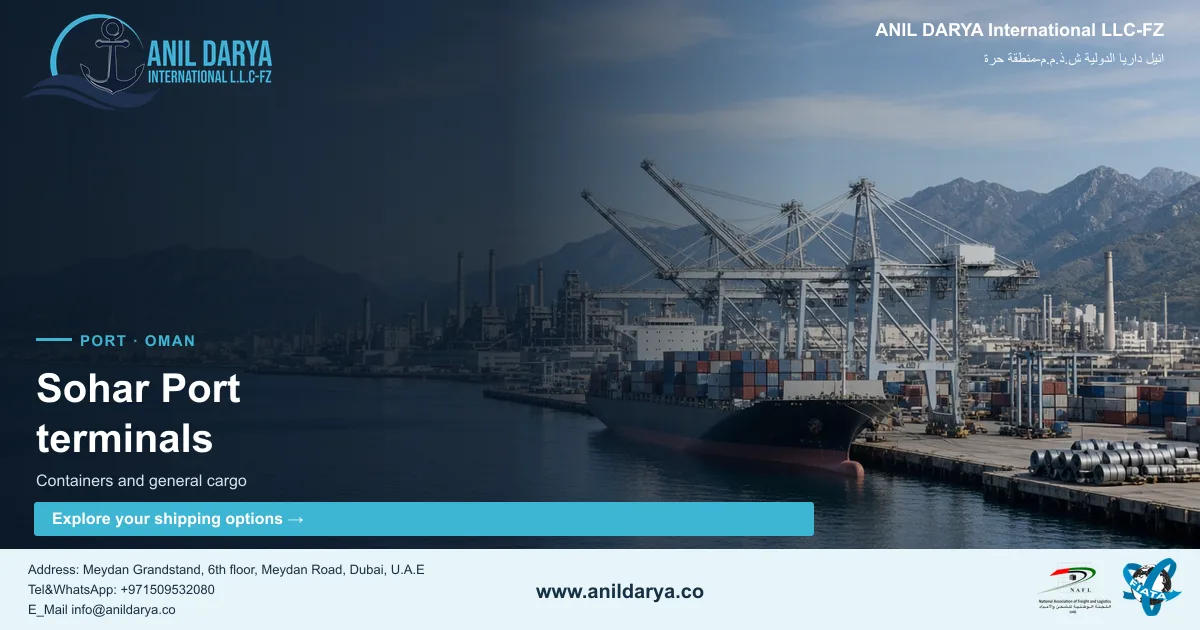
Sohar port shipping covers most of the container, breakbulk and bulk cargo that enters northern Oman by sea. SOHAR Port and Freezone is run by Sohar Industrial Port Company, a 50:50 joint venture between Asyad and the Port of Rotterdam, and it took over Muscat's commercial cargo in 2014. This guide covers the terminals, the freezone, Oman customs at Sohar, dangerous goods rules and how we move your cargo from the UAE to Sohar. We ship both ways: from Dubai to Sohar, and from Sohar to Dubai.
Sohar port guide: key facts at a glance
| Item | Detail |
|---|---|
| Port manager | Sohar Industrial Port Company (SIPC), 50:50 Asyad and Port of Rotterdam |
| Location | Liwa, Al Batinah North Governorate, northern Oman |
| UN/LOCODE | OMSOH |
| Operating since | 2004 |
| Port area | 21 million sq m deep-sea hub |
| Container terminal | Hutchison Ports Sohar: 2 million TEU a year, 18 m draft, 13 cranes |
| General cargo terminal | C. Steinweg Oman: 4 berths, 16 m water depth, 72+ hectares |
| Liquid bulk terminal | Advario Terminals |
| Cargo throughput 2025 | 72 million metric tonnes |
| Vessel calls 2025 | 3,427 |
| First half of 2026 | 52 million tonnes in total, 545,000 TEU, 1.24 million tonnes of breakbulk |
| Free zone | SOHAR Freezone, next to the port (4,500 ha concession) |
| Road access | Muscat, Dubai and Abu Dhabi within four hours by road (terminal operator) |
| Customs | Directorate General of Customs, Royal Oman Police, through Bayan |
| Customs duty | GCC common external tariff of 5% on most foreign goods |
| VAT | 5% standard rate |
| Shipping Sohar to Dubai | Export declaration in Bayan by the shipper or its agent; import declaration with Dubai Customs, 5% duty on non-GCC goods and 5% VAT |
What is Sohar Port and where is it?
SOHAR Port and Freezone is a deep-sea port and free zone in the wilayat of Liwa, Al Batinah North Governorate, on Oman's northern coast. It has been operating since 2004 and covers 21 million square metres. Asyad, Oman's ports and logistics group, lists more than 3,000 vessel calls a year, and the port reported 3,427 calls in 2025.
The port is built around clusters. The three established clusters are logistics, petrochemicals and metals. A newer food cluster includes Oman's first terminal dedicated to agricultural bulk, plus a flour mill, a sugar refinery and a grain silo complex. Grain is handled at 600 tonnes per hour.
For shippers in the UAE, Sohar's position matters most by road. Hutchison Ports Sohar says Muscat, Dubai and Abu Dhabi are within four hours by road. That makes Sohar a practical gateway for cargo going to Muscat and the Al Batinah coast, and a road link back to the UAE.
Sohar also became Muscat's cargo port. Oman's government converted Port Sultan Qaboos in Muscat into a tourism port, and commercial vessels, including container ships, vehicle carriers and project cargo ships, stopped calling there by 31 August 2014. Their business moved to Sohar.
Which terminals does Sohar Port have?
Sohar is a landlord-style port. SIPC manages the port and the freezone, and specialist operators run the terminals. The operator on your booking decides which gate your truck uses and whose tariff applies.
| Terminal | Operator | Cargo | Key specs |
|---|---|---|---|
| Container terminal (Terminal C) | Hutchison Ports Sohar | FCL containers, transshipment, reefers | 2 million TEU a year, 18 m draft, 13 cranes including remote-controlled super-post-panamax quay cranes |
| General cargo terminal | C. Steinweg Oman | Breakbulk, project cargo, steel, non-ferrous metals, dry bulk, forest products, Ro-Ro, container stuffing and stripping | 4 berths, 16 m water depth, 72+ hectares, CFS and warehousing |
| Liquid bulk terminal | Advario Terminals | Liquid bulk | Next to the port's petrochemicals cluster |
| Agricultural bulk terminal | Food cluster | Grain and other agri bulk | Oman's first dedicated agri bulk terminal |
| Dry bulk jetties | Port and industrial users | Dry bulk | Jetties able to handle Valemax-class bulk carriers |
Hutchison Ports Sohar container terminal
Hutchison Ports Sohar is a joint venture between Hutchison Ports, Asyad and other shareholders. It has an annual capacity of 2 million TEU, an 18 m draft and 13 cranes in operation. The terminal describes itself as a 100% on-dock facility with storage available, guaranteed berth windows for carriers and real-time EDI transmission. In July 2026 the 24,346 TEU MSC Loreto berthed at the terminal, the largest container ship by capacity to call at Sohar, on a service that links Sohar with ports in Asia and the UAE.
Container volumes grew fast in 2026. Sohar handled 545,000 TEU in the first half of 2026, up 40% on the same period of 2025.
C. Steinweg Oman general cargo terminal
C. Steinweg Oman (CSO) has operated at Sohar since early 2004 and holds the concession for dry bulk, breakbulk, Ro-Ro and container stuffing and stripping. The terminal has 4 berths with 16 m of water depth and more than 72 hectares of space. It lists project cargo, steel, non-ferrous metals, forest products, dry bulk, Ro-Ro and general cargo, with warehousing and a container freight station.
CSO works 24 hours a day, 365 days a year. Cargo delivery and collection runs daily from 7:30 to 17:30, which matters when you book trucks. CSO also holds GCC Authorized Economic Operator status.
Port services
Asyad lists bunkering, marine supply, ship supply, fresh water, and ship-to-ship transfer at Sohar. The port runs a vessel notification system and offers Routescanner, a platform that shows hinterland connections and a network of 550 ports.
What cargo can you ship through Sohar Port?
| Cargo type | How it moves at Sohar | What to plan |
|---|---|---|
| General goods in containers | FCL through Hutchison Ports Sohar | Carrier service, free time, truck to Muscat or the Batinah coast |
| Small shipments | LCL, unpacked at a CFS (CSO runs one) | Consolidator's sailing, carton marks matching the packing list |
| Chilled and frozen food | Reefer containers | Set temperature, food permits from the Omani ministry |
| Steel, machinery, equipment | Breakbulk at the CSO berths, or flat racks on container ships | Lifting points, lashing, trailer type |
| Oversized and heavy-lift project cargo | CSO general cargo berths | Drawings, lift plan, abnormal load permit for the road leg |
| Vehicles and rolling equipment | Ro-Ro at CSO | Vehicle documents, Ro-Ro sailing |
| Dry bulk and grain | Dry bulk jetties and the agri bulk terminal | Discharge plan, receiver's storage |
| Chemicals and fuels | Liquid bulk at Advario, or IMDG containers | Environment Authority permit, DG approvals before arrival |
Breakbulk at Sohar is growing. The port handled 1.24 million tonnes of breakbulk in the first half of 2026, more than double the year before.
FCL and LCL shipping to the port of Sohar
Most general cargo for northern Oman arrives at Sohar in containers. FCL suits larger shipments and goods you do not want handled with other cargo. LCL suits small volumes, but the shared container is unpacked at a container freight station before your part is released, so release also depends on the consolidator's paperwork.
When you choose, compare the cost of the box with the extra handling and waiting time of LCL. Our guide to FCL vs LCL costs shows where the break-even point usually sits, and our sea freight team can price both.
A practical point for UAE shippers: if your cargo sits in Dubai or the northern emirates and is going to the Sohar or Muscat area, a truck across the land border may be faster than a container. If the cargo is already in a container at a UAE port, or you ship full boxes every week, compare a sea service into Sohar.
[AMIR-FACT: the carrier or feeder services we actually use from Jebel Ali to Sohar, and our real port-to-port and door-to-door transit time]
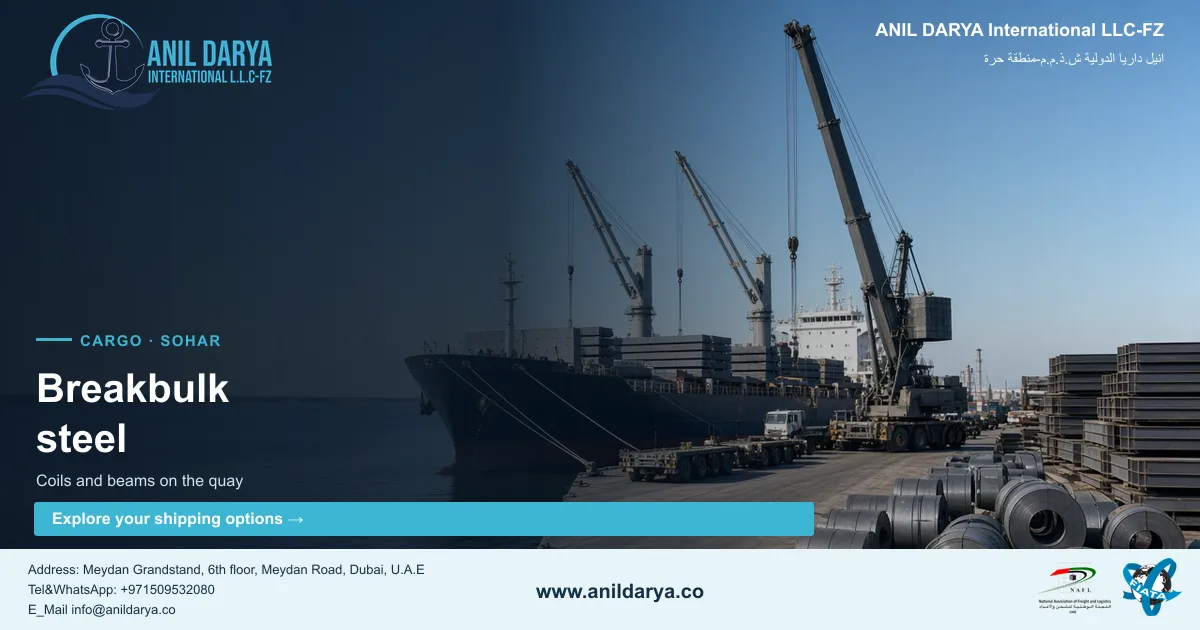
Breakbulk, heavy-lift and project cargo at Sohar
Sohar's metals and petrochemical clusters bring in a steady flow of steel, equipment and plant modules. CSO handles this cargo on 4 berths with 16 m of water depth and holds the port's concession for breakbulk and Ro-Ro.
When you ship project cargo to Sohar with us, we plan it in this order:
- Collect drawings, dimensions, weights and centre of gravity for each piece.
- Choose the vessel: flat rack on a container ship, or a breakbulk or heavy-lift vessel to the CSO berths.
- Agree lifting, lashing and discharge with the carrier and the terminal.
- Arrange the abnormal load permit for the road leg. Oman's transport ministry issues permits for exceptional heavy loads.
- File the Bayan declaration before arrival, so the cargo leaves the quay without storage days.
A simple decision rule: if a piece fits a 40ft flat rack by size and weight, container services usually give you more sailings. If it does not, the breakbulk sailing date drives the whole plan. Our guide to flat racks, open tops and breakbulk explains the choice, and our break bulk and project cargo service covers the planning.
Dry and liquid bulk at Sohar
Bulk is a large part of Sohar's business. The port has jetties able to handle Valemax-class dry bulk carriers, an agricultural bulk terminal and a liquid bulk terminal run by Advario. Total throughput reached 72 million tonnes in 2025, up from 62 million tonnes in 2019, and 52 million tonnes in the first half of 2026 alone. If you are moving grain, minerals, fuels or chemicals in bulk, the receiver's storage and discharge plan matter as much as the sea leg. See our dry and liquid bulk cargo service.
Dangerous goods at Sohar: approvals and permits
Dangerous goods follow the IMDG Code at sea and Omani permits on land. Two layers of approval apply:
- Vessel approval. In March 2026 the Port of Salalah advised that the Ministry of Transport, Communications and Information Technology requires prior approval before any vessel calls an Omani port with Class 1, 2.1, 3, 4.3, 5.1 or 5.2 goods on board, including transit cargo. The carrier arranges this, but it can affect which sailings accept your cargo.
- Product permits. Chemicals, radioactive materials and ozone-depleting substances need Environment Authority permits. Explosives, fireworks and ammonium nitrate need a Royal Oman Police Special Task Force permit, with a separate permit for transit.
What you need to provide for any DG booking to Sohar:
- UN number, proper shipping name, class and packing group.
- A Safety Data Sheet (SDS) for each product.
- A Dangerous Goods Declaration signed by a trained person.
- UN-approved packaging, marks, labels and container placards.
- The Omani import permit, where your product needs one.
Our dangerous goods shipping team checks carrier acceptance and the permits before you commit to a sailing.
SOHAR Freezone: when to deliver into the free zone
SOHAR Freezone sits next to the port and is managed by SIPC. Its concession, signed in 2007, covers 4,500 hectares, and the freezone was set up in 2010. Asyad describes it as hosting supply chains from production to delivery in one connected area.
Investment is still growing. In 2025 SOHAR signed $968 million of new commitments across eight agreements and leased 76 hectares of land in the port and freezone. In the first half of 2026, leased warehouse space in the freezone rose 19% to about 37,000 square metres.
A simple rule for your delivery:
- Deliver to the Omani mainland if the goods will be sold or used in Oman. Duty and VAT apply at import.
- Deliver into the freezone if the consignee holds a freezone licence and will store, process or re-export the goods.
- Check the declaration type with the consignee before the vessel arrives, because Oman Customs has separate procedures for transfers between free zones, warehouses and the local market.
Customs clearance at Sohar Port
Customs at Sohar is handled by the Directorate General of Customs of the Royal Oman Police. Every import, export and transit declaration is created in Bayan, the customs system. The declarant signs in, creates the declaration, attaches the documents, submits and pays. The fee is OMR 15 for companies and OMR 5 for individuals.
For new products, the importer can ask customs, through Bayan, to confirm the value, HS code and origin before the goods ship. Customs may ask for a sample, a catalogue or photos.
Which documents does Oman Customs need?
For a Bayan declaration, Oman Customs lists commercial invoices, a certificate of origin from the manufacturer's country and a declaration issued by the exporting country, plus permits for restricted goods.
| Cargo type | Core documents | Usually also needed |
|---|---|---|
| General cargo (FCL or LCL) | Invoice, packing list, certificate of origin, bill of lading, export declaration from the UAE | Nothing more if goods are not restricted |
| Food and reefer cargo | Core set | Ministry of Agriculture permit, health certificate, halal certificate for meat |
| Dangerous goods | Core set | DG declaration, SDS, Environment Authority or ROP permit |
| Breakbulk and project cargo | Core set with a piece-by-piece packing list | Drawings and weights for the terminal, abnormal load permit |
| Telecom and electronic goods | Core set | Telecom Regulatory Authority release |
| Consumer goods under standards control (toys, tyres, paints, electrical goods, cosmetics) | Core set | Ministry of Commerce standards approval |
How much is customs duty and VAT at Sohar?
Oman applies the GCC common external tariff, which has been 5% on foreign goods from outside the GCC since 1 January 2003, with 417 goods exempt. Goods produced in a GCC state are national goods: Oman Customs exempts them with a purchase invoice and an indication of origin, and loose or liquid materials also need a Gulf origin certificate.
VAT in Oman is 5% on most goods, including imports. A UAE supplier who ships directly to Oman with an export declaration can zero-rate the sale. Use the Oman Customs duty calculator to estimate duty by HS code before you price the deal.
How to ship to Sohar Port from Dubai: step by step
This is how we handle a typical shipment from the UAE to Sohar. We book space, prepare documents, arrange trucking and export clearance in the UAE, and work with your consignee's clearing agent or a destination clearing agent in Oman.
- Tell us about the cargo. Commodity, HS code, weight, dimensions, pickup address and the Incoterm.
- Choose sea or road. We compare a container or breakbulk sailing to Sohar with a truck across the land border.
- Check permits in Oman. The Omani importer applies for any permit the goods need.
- Book space. For DG, reefer or out-of-gauge cargo we get carrier acceptance first.
- Prepare documents. Invoice, packing list, certificate of origin and the draft bill of lading, all matching.
- File the UAE export declaration through Dubai Customs and deliver the cargo to the loading port before the cut-off.
- Pre-file the Bayan declaration in Oman before the vessel arrives.
- Clear, release and deliver. After duty, VAT and any inspection, the container or cargo is released at Sohar and trucked to the consignee.
- Return the empty within free time and close the file.
If you load at Jebel Ali, our Jebel Ali port shipping guide covers the UAE side.
How to ship from Sohar Port to Dubai
We also handle the other direction: shipping from Sohar to Dubai, with arrival at Jebel Ali, Khalifa Port or Sharjah port. We book the space with the carrier and run the UAE side. The Omani export papers stay with the shipper or its Oman agent.
The Oman export side
- Export declaration. The shipper or its Omani agent creates it in Bayan, the system of the Directorate General of Customs, which handles import, export and transit declarations. The steps are sign in, create the declaration, choose the coordinator code, attach the documents, submit and pay. The fee is OMR 15 for a company and OMR 5 for an individual.
- Documents. Oman Customs lists the trade invoices and a certificate showing where the goods were made, plus a permit file if the goods need one.
- Certificate of origin for Omani goods. Dubai Customs Notice 14/2020 accepts electronic certificates of origin issued by the Oman Chamber of Commerce and Industry. Ask the shipper for one if the goods are made in Oman.
- Pickup. The shipper or its trucker delivers the box to the Hutchison Ports Sohar container terminal before the carrier's cut-off.
The UAE import side
Once the box from Hutchison Ports Sohar is on its way, we file the import declaration with Dubai Customs so it is ready before the vessel arrives. Dubai Customs asks for the commercial invoice, the packing list, the certificate of origin (for Omani-made goods, the electronic certificate from the Oman Chamber of Commerce and Industry that Notice 14/2020 accepts) and a permit from the relevant authority for restricted goods. The carrier releases the cargo against the bill of lading. Duty in Dubai is 5% of the CIF value for most goods, 50% on alcohol and 100% on cigarettes. Import VAT is 5%: a VAT-registered importer accounts for it under the reverse charge on its VAT return, and anyone else pays it before the goods are released.
Goods made in Oman get GCC treatment. The GCC Customs Union counts goods produced in any member state as national goods in every member state, so they enter Dubai without the 5% duty once the certificate of origin proves where they were made. On the UAE government portal's Sharjah customs section, the test is at least 40% of the raw materials coming from the GCC. Foreign goods that already paid duty when they first entered the GCC are not charged a second time if the payment is proven. Neither case removes the 5% import VAT.
- Send us the shipper's details in Sohar, the cargo, the HS code and the UAE delivery address.
- We book space from Sohar and send the booking and cut-offs to the shipper.
- The shipper or its trucker stuffs the container and delivers it to the Hutchison Ports Sohar container terminal.
- The shipper or its Oman agent files the export declaration in Bayan.
- We check the draft bill of lading against the invoice, packing list and certificate of origin.
- We file the UAE declaration with Dubai Customs before the vessel arrives.
- We arrange payment of the duty and VAT and collect the delivery order from the carrier.
- We truck the container to your site and return the empty to the depot the line names within free time.
[AMIR-FACT: the carriers we actually use from Sohar to Jebel Ali/Khalifa/Sharjah and our real transit days in this direction]
Free time and demurrage at Sohar
Shipping lines give a set number of free days for their containers. After that, demurrage runs while the full container stays in the port and detention runs while you keep it outside. Free days and daily rates differ by carrier, so read them on your quote and arrival notice. The best protection is a Bayan declaration filed before arrival and permits ready before the vessel berths. Our article on demurrage and detention shows how the charges build up.
Checklist before you ship to Sohar
- HS code confirmed for every item.
- Invoice, packing list and bill of lading show the same consignee, weights and piece counts.
- Certificate of origin issued, with GCC origin proof if you claim the exemption.
- UAE export declaration filed.
- Omani importer registered in Bayan, or a customs broker authorised.
- Import permits issued for restricted goods.
- Terminal confirmed: Hutchison for containers, CSO for breakbulk and Ro-Ro.
- Delivery point agreed: Omani mainland or SOHAR Freezone.
- For DG: SDS, DG declaration, packaging, permits and carrier acceptance.
- For project cargo: drawings, lift plan and abnormal load permit.
- Free time agreed and cargo insurance arranged.
Common mistakes when shipping to Sohar
- Booking sea freight to Muscat. Commercial cargo for Muscat now arrives at Sohar.
- Late permits. A missing Omani permit leaves the container in the yard while charges run.
- Wrong delivery point. Clearing goods for the local market when they belong in the freezone means duty you may not owe.
- Mismatched documents. Different weights on the invoice and the bill of lading stop the Bayan declaration.
- Trucks outside working hours. CSO releases cargo between 7:30 and 17:30, so plan collection inside that window.
- Treating DG like general cargo. Some classes need ministry approval before the vessel calls.
- Assuming GCC trade is always duty-free. Only GCC national products are exempt by origin.
Sohar or another port: which fits your cargo?
| Your situation | Port to compare | Why |
|---|---|---|
| Cargo for Muscat, Sohar or the Batinah coast | Sohar | Muscat's cargo moved here; within four hours of Muscat by road |
| Cargo for Salalah or Dhofar | Port of Salalah | 6 million TEU container terminal in the south, next to Salalah Free Zone |
| Cargo for central Oman | Duqm | Asyad port on the central coast |
| Small or urgent cargo from Dubai to northern Oman | Road across the land border | No port handling; door to door by truck |
Frequently asked questions
Who operates the port of Sohar?
Sohar Industrial Port Company (SIPC), a 50:50 joint venture between Asyad and the Port of Rotterdam, manages the port and the freezone. Hutchison Ports Sohar runs the container terminal, C. Steinweg Oman the general cargo terminal and Advario Terminals the liquid bulk terminal.
Can you ship from Sohar to Dubai?
Yes. The shipper or its Omani agent creates the export declaration in Bayan and trucks the box to Hutchison Ports Sohar before the cut-off. We book the space, file the Dubai Customs declaration, arrange payment of the duty and VAT, and deliver from Jebel Ali, Khalifa Port or Sharjah. With a certificate of origin, Omani-made goods are free of the 5% duty; the 5% import VAT still applies.
How big is the Sohar container terminal?
Hutchison Ports Sohar has an annual capacity of 2 million TEU, an 18 m draft and 13 cranes. It handled 545,000 TEU in the first half of 2026.
Can Sohar Port handle breakbulk and project cargo?
Yes. C. Steinweg Oman holds the concession for breakbulk, dry bulk and Ro-Ro at Sohar, with 4 berths and 16 m of water depth. It lists project cargo, steel and non-ferrous metals among its cargo types.
Should I ship from Dubai to Sohar by sea or by road?
Both work, and we price both. Hutchison Ports Sohar says Dubai, Muscat and Abu Dhabi are all within four hours of the terminal by road, so trucks often suit part loads and urgent cargo, while full containers and heavy cargo suit a sailing. Actual truck time also depends on the border crossing and customs clearance.
What documents do I need to clear cargo at Sohar?
Oman Customs asks for the commercial invoice, a certificate of origin and the export declaration from the exporting country, filed through Bayan. Restricted goods also need a permit from the competent ministry.
What is the customs duty on goods imported through Sohar?
Most foreign goods pay the GCC common external tariff of 5%, with 417 goods exempt. Goods of GCC national origin are exempt with an invoice and proof of origin. VAT of 5% also applies on import.
Is Sohar Port the same as SOHAR Freezone?
No. The port is the deep-sea harbour with its terminals, and the freezone is a separate 4,500-hectare zone next to it. Both are managed by SIPC, but goods entering the freezone use a different customs procedure.
Can I ship dangerous goods to Sohar?
Yes, with approvals. Vessels carrying Class 1, 2.1, 3, 4.3, 5.1 or 5.2 goods need prior approval from Oman's transport ministry before calling, and chemicals or explosives need Environment Authority or Royal Oman Police permits.
Did Sohar replace Port Sultan Qaboos for cargo?
Yes. Commercial vessels stopped calling at Port Sultan Qaboos in Muscat by 31 August 2014, when it became a tourism port, and its cargo business moved to Sohar.
Get a quote for Sohar port shipping
Send us your cargo details and we will come back with a routing and a price for shipping to Sohar, by sea or by road. Use our freight rate inquiry form, or contact our team to talk through a breakbulk, project or DG shipment first. You can also read more about our Dubai freight forwarding team.
Sources
- Asyad: Sohar Port (management, area, terminals, clusters, services)
- Asyad: Hutchison Ports Sohar (capacity, draft, cranes, road access)
- C. Steinweg Oman: Sohar terminal
- Wikipedia: SOHAR Port and Freezone (location, freezone concession, bulk jetties, food cluster)
- Oman Observer: SOHAR results to end-2025 (January 2026)
- Oman Observer: SOHAR first half 2026 cargo (August 2026)
- Oman Observer: MSC Loreto maiden call at Sohar (July 2026)
- MarineLink: Sultan Qaboos Port to stop cargo trade (October 2013)
- iContainers: Port of Sohar (UN/LOCODE)
- Oman Customs: Request to apply a customs declaration (Bayan, documents, fees)
- Oman Customs: Before imports (advance value, HS code, origin)
- Oman Customs: Customs exemptions (GCC products)
- Oman Customs: Permits by issuing authority
- Oman Customs: Procedural services (free zone and warehouse transfers)
- UAE ICP: GCC customs union and common external tariff
- Oman Tax Authority: VAT FAQs
- Gulf News: Oman Tax Authority clarifies VAT on imports from the UAE (October 2025)
- US International Trade Administration: Oman import requirements (halal, food permits)
- Port of Salalah: Customer advisory 05/26, DG pre-approvals for vessels calling Omani ports (March 2026)
- Port of Salalah: Container terminal capacity
- Dubai Customs: Submit customs declaration (invoice, packing list, certificate of origin, permits)
- UAE Government portal: Customs duty (5% of CIF in Dubai, alcohol 50%, cigarettes 100%; GCC-origin goods and the 40% test)
- Federal Tax Authority: VAT Taxable Person Guide, chapter 9 Import of goods (5% rate, reverse charge, payment before release)
- Dubai Customs Notice 14/2020: electronic certificates of origin from the Oman Chamber of Commerce and Industry
Reviewed: 10 November 2026