
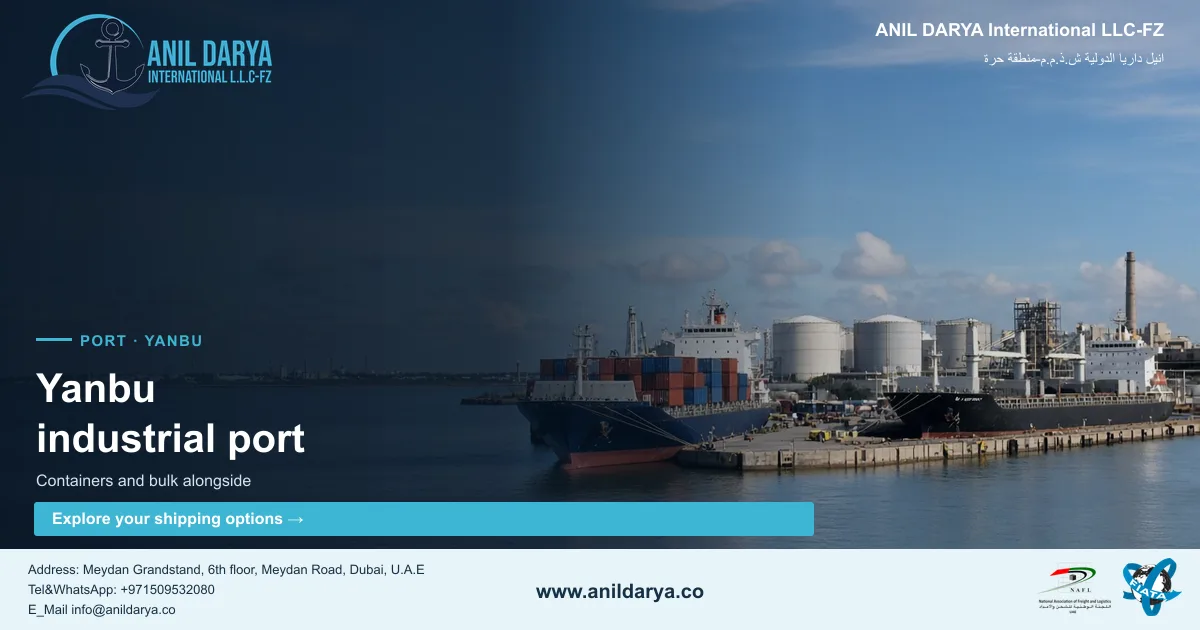
Yanbu port shipping means using one of two separate Saudi ports in Yanbu, about 300 km north of Jeddah: Yanbu Commercial Port for general cargo, bulk, Ro-Ro and pilgrims, and King Fahd Industrial Port for petrochemicals, bulk, oil and a general cargo and container terminal. The two have different UN/LOCODEs, different berths and different depths, so the right one depends on your cargo. This guide explains both, gives a short summary of Saudi customs, and shows how we ship your cargo to Yanbu from Dubai. We ship both ways: from Dubai to Yanbu, and from Yanbu to Dubai.
Yanbu port shipping: key facts at a glance
| Item | Yanbu Commercial Port | King Fahd Industrial Port, Yanbu |
|---|---|---|
| UN/LOCODE | SAYNB | SAYBI |
| Port authority | Saudi Ports Authority (Mawani) | Saudi Ports Authority (Mawani) |
| Main role | General cargo, breakbulk, dry bulk, Ro-Ro, containers, pilgrims | Petrochemicals, refined products, crude oil, bulk, general cargo and containers |
| Berths | 12 | 34 |
| Terminals | Passenger, general cargo, grain silos | 10 |
| Annual handling capacity | Over 13.5 million tonnes | 210 million tonnes |
| Maximum depth or draft | 11.1 m for breakbulk, containers and bulk | 16.6 m draft for container ships, 300 m LOA |
| Opened | 1965 | Established 1980 |
| Distance from Jeddah | About 310 km north-northwest | About 326 km north of Jeddah Islamic Port |
| Nearest airport | Yanbu (YNB), about 15 km | Yanbu (YNB), about 28 km |
| Distance between the two ports | About 12 nautical miles | |
| Customs | ZATCA, declaration on Fasah at least 48 hours before arrival | |
| Import duty and VAT | Mostly 5% duty on CIF value, plus 15% import VAT | |
| Yanbu to Dubai | Saudi export declaration through Fasah; Saudi-made goods treated as GCC national goods in the UAE; 5% UAE VAT | |
Yanbu port shipping: two ports, two jobs
Most port guides talk about "Yanbu port" as if it were one place. It is not. Yanbu has two ports, about 12 nautical miles apart, and both are under the Saudi Ports Authority (Mawani).
Yanbu Commercial Port is the older town port, opened in 1965. Findaport describes it as a sheltered port that mainly handles breakbulk and dry bulk, plus passengers, Ro-Ro and containers. It is also the Kingdom's second sea gateway for pilgrims after Jeddah, with road links to Madinah and Makkah.
King Fahd Industrial Port, established in 1980, is the large industrial port south-east of the town. It was built for the refineries and petrochemical plants of Yanbu Industrial City, and Arab News describes it as the largest facility on the Red Sea coast for loading crude oil and petrochemical products. It also has a general cargo and container terminal.
The practical rule is simple:
- Bagged or bulk food, steel, building materials and vehicles for Yanbu town or Madinah usually go to the commercial port.
- Containers on a liner service, petrochemical exports, plant equipment and chemicals usually go to King Fahd Industrial Port.
- Always check the LOCODE on the booking. SAYNB and SAYBI are different ports, and a box landed at the wrong one needs a truck move between them.
Yanbu Commercial Port: berths, cargo and pilgrims
Mawani gives Yanbu Commercial Port 12 berths and a handling capacity of over 13.5 million tonnes a year. Its facilities include a passenger terminal for 2,000 travellers, a general cargo terminal and two grain silos of 20,000 tonnes each. Wikipedia, citing port data, records 3.33 million tonnes handled in 2018, so the port runs well below its stated capacity.
Depth limits the ships it takes. Findaport lists a maximum depth of 11.1 m for breakbulk, container and bulk vessels, and 8.5 m for passenger ships. That suits feeder and conventional general cargo ships, not large container vessels.
In December 2025 Mawani signed a contract with Q Saudi to build and run an integrated logistics centre at the port, on 120,490 m² with investment of over SAR 29 million. Once open, it adds storage and distribution space next to the berths. Ask your consignee whether it is operating before you plan storage there.
| Cargo | Fit at Yanbu Commercial Port |
|---|---|
| Grain and dry bulk | Good: two 20,000 t silos and bulk berths |
| Steel, timber, building materials | Good: conventional breakbulk berths |
| Vehicles | Possible: Ro-Ro listed among cargo types |
| Containers | Limited: feeder-size ships only, 11.1 m maximum depth |
| Passengers and pilgrims | Main passenger gateway for the region |
King Fahd Industrial Port: terminals and vessel limits
Saudipedia gives King Fahd Industrial Port 34 berths, 10 terminals, an area of about 6.8 km² and a handling capacity of 210 million tonnes a year, with ships of up to 500,000 tonnes. Most of the tonnage is oil, refined products and petrochemicals loaded at terminals linked to the plants behind the port.
Findaport names the terminals and the plants they serve:
| Terminal | Main cargo |
|---|---|
| General cargo and container terminal | Containers, general cargo, project cargo |
| Bulk terminal (SAMREF) | Dry bulk |
| Chemical terminal (YANPET) | Liquid chemicals |
| Export refinery terminal (SAMREF) | Refined products |
| Crude oil terminal (Saudi Aramco) | Crude oil |
| Sulphur, oil and petroleum coke terminal (YASREF) | Sulphur, petroleum coke, products |
| NGL terminal | Natural gas liquids |
| Yanbu refinery terminal (Saudi Aramco) | Refined products |
| Yanbu South terminal (Saudi Aramco) | Oil products |
For dry cargo shippers, the vessel limits matter more than the oil numbers:
| Ship type | Maximum LOA | Maximum draft | Size limit |
|---|---|---|---|
| Container ships | 300 m | 16.6 m | Not stated |
| Ro-Ro | 250 m | 14.6 m | Not stated |
| Bulk carriers | 260 m | 23.0 m | 100,000 dwt |
| Chemical tankers | 260 m | 14.2 m | 80,000 dwt |
A 300 m, 16.6 m draft limit is enough for regional and mid-size liner ships. It is the reason container services to Yanbu use the industrial port rather than the town port.
Container services at Yanbu: what to expect
Yanbu is a small container port next to Jeddah and King Abdullah Port. Fluent Cargo ranks it fourth in Saudi Arabia for liner connectivity and, in late 2026, listed one carrier with direct calls, Folk Maritime, sailing every one to two weeks. TimeToCargo lists more lines for the port code, which usually means transshipped bookings through a bigger hub.
In May 2026 Mawani added the Red Sea Express service with Folk Maritime and SABIC. It links King Fahd Industrial Port in Yanbu with Ain Sokhna in Egypt and Aqaba in Jordan, with ships of up to 1,100 TEU. This is a regional loop for petrochemical exports and imports, not a direct link from the UAE.
What this means for a container from Dubai:
- Expect a transshipment, usually at a larger Saudi or regional hub, unless a carrier confirms a direct call.
- Ask which Yanbu port the final feeder calls, and get SAYBI or SAYNB written on the booking.
- Allow for less frequent sailings than to Jeddah. A missed feeder can add a week or more.
- For a single urgent box, compare the sea option with road freight from the UAE.
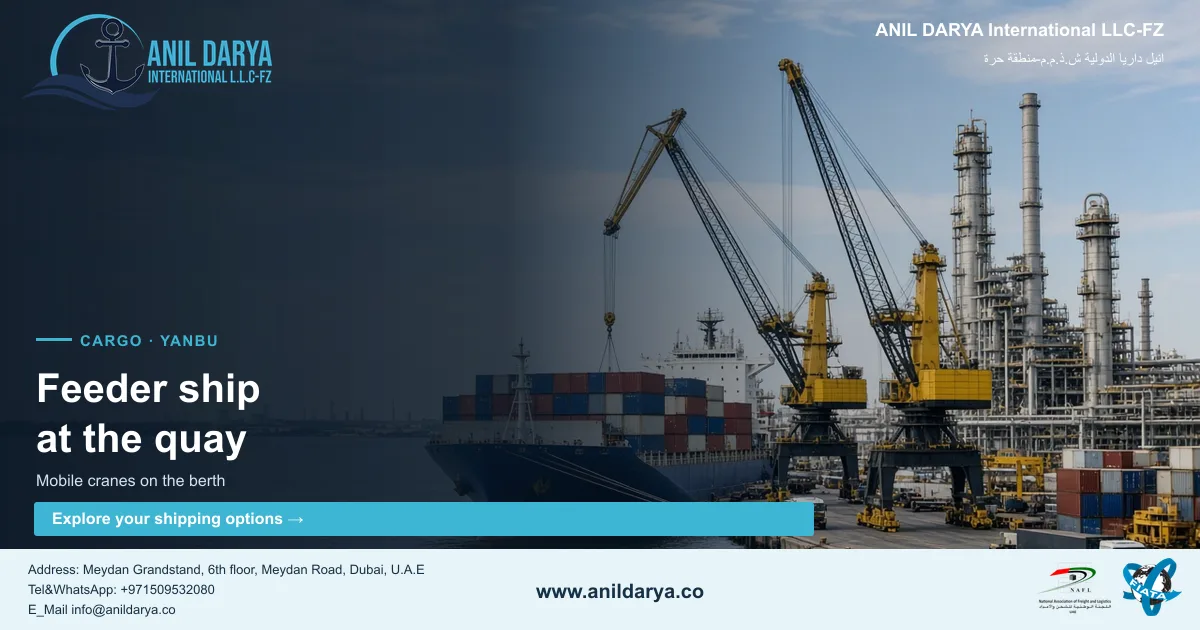
Who ships through Yanbu, and what cargo comes from the UAE?
Yanbu's trade follows its two hinterlands. The industrial port serves the refineries and petrochemical plants of Yanbu Industrial City, such as SAMREF, YANPET and YASREF. The commercial port serves Yanbu town, Madinah and the pilgrim traffic.
| Cargo from the UAE | Usual Yanbu port | What to plan |
|---|---|---|
| Spare parts, valves, pumps for plants | King Fahd Industrial Port | Plant delivery rules, end user on the invoice |
| Plant equipment and project pieces | King Fahd Industrial Port | Lifting plan, road permits inside the industrial city |
| Chemicals and lubricants | King Fahd Industrial Port | DG paperwork, carrier acceptance |
| Food, consumer goods for Madinah region | Either; check where the feeder calls | Food permits, SABER where needed |
| Steel and building materials | Yanbu Commercial Port | Breakbulk sailing, discharge plan |
| Vehicles and machinery | Either, by Ro-Ro or flat rack | Vehicle import rules, Ro-Ro sailing dates |
Breakbulk, bulk and project cargo at Yanbu
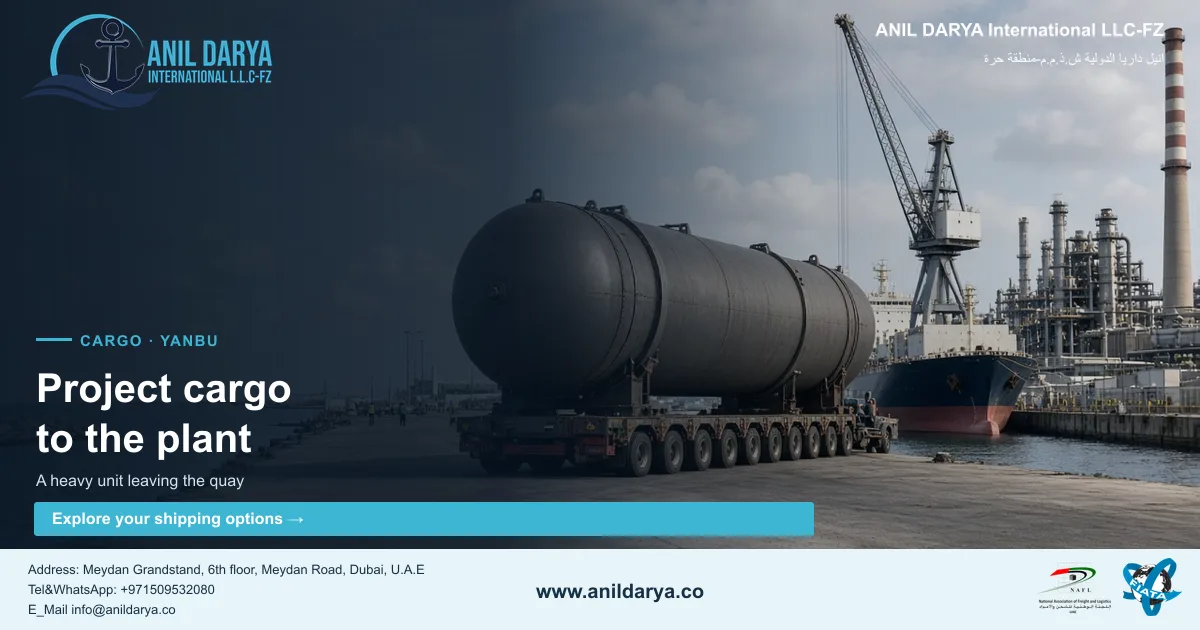
Yanbu takes a lot of non-container cargo. The commercial port's berths are geared to breakbulk and dry bulk, and the industrial port has a bulk terminal plus a general cargo terminal that takes Ro-Ro ships up to 250 m. For a project shipment to Yanbu Industrial City, we plan it in this order:
- Collect drawings, weights, dimensions and centre of gravity for each piece.
- Choose between flat racks on a container service, Ro-Ro for wheeled units, or a breakbulk ship.
- Confirm which Yanbu port the vessel will call and that the ship fits its draft and length limits.
- Agree lifting, lashing and discharge with the carrier and the terminal.
- Line up the Saudi broker, permits and the road move from quay to plant.
Read how we handle flat rack, open top and out-of-gauge cargo, or see our break bulk and project cargo service. For bulk parcels, our dry and liquid bulk team can check vessel options.
Dangerous goods and chemicals at Yanbu
King Fahd Industrial Port has a dedicated chemical terminal and terminals for refined products and gas liquids, so hazardous liquids in bulk are routine there. Packaged dangerous goods in containers are a different matter: they go through the general cargo and container terminal under the carrier's and the port's acceptance rules. We could not open Mawani's own port pages for Yanbu, so we confirm class limits and storage rules with the carrier and terminal for every booking. You need:
- UN number, proper shipping name, class and packing group.
- A Safety Data Sheet for each product.
- A signed dangerous goods declaration.
- UN-approved packaging, labels and placards.
- Any Saudi permit for the product, approved before sailing.
Our dangerous goods shipping team checks acceptance before you commit to a sailing.
Customs at Yanbu port: a short summary
Both Yanbu ports use the same Saudi customs rules as Jeddah and Dammam, which our Jeddah port guide covers in full. In short:
- ZATCA clears the cargo. The importer or its broker files on Fasah at least 48 hours before arrival.
- Core documents are the commercial invoice, bill of lading and certificate of origin, plus product documents such as an IECEE certificate or product registration.
- Regulated products need SABER certificates. SABER lists SAR 500 for a product certificate and SAR 350 per shipment certificate, before VAT, with shipment certificates valid for 90 days.
- Most goods from outside the GCC pay at least 5% duty on CIF value. Import VAT is 15%.
What is specific to Yanbu: much of the import cargo is for industrial plants, so the end user, purchase order and plant delivery address should appear clearly on the invoice and packing list. Check which port's customs office will clear the cargo, since the declaration must name the right port.
How to ship from Dubai to Yanbu: step by step
From the UAE you can move cargo to Yanbu by sea from Jebel Ali, usually with a transshipment, or by road across Saudi Arabia.
| Option | How it works | When it fits |
|---|---|---|
| Sea FCL via a hub | Container from Jebel Ali to a hub, then a feeder to Yanbu | Regular volumes, heavy cargo |
| Sea FCL to Jeddah or KAP, then truck | Container discharged at a bigger west coast port and trucked north | When the feeder to Yanbu is slow or infrequent |
| Road, UAE to Yanbu | Truck loaded at your site, cleared at the Ghuwaifat and Al Batha border | Door-to-door control, part loads, urgent cargo |
| Breakbulk or Ro-Ro | Conventional or Ro-Ro ship to the right Yanbu port | Project cargo, vehicles, steel |
[AMIR-FACT: the carriers and routings we actually use from Jebel Ali to Yanbu (direct or via which hub, which Yanbu port) and our typical port-to-port and door-to-door transit days]
This is how we handle a typical shipment from Dubai to Yanbu. We book the space, prepare the UAE side and work with your Saudi consignee or their clearing agent.
- Send the cargo details: commodity, HS code, weight, volume or dimensions, UAE pickup point, Incoterm and delivery address in Yanbu.
- We check Saudi product rules: SABER, permits and product registration.
- We compare sea services from Jebel Ali port to Yanbu, and the sea-plus-truck and road options. We confirm the Yanbu port and the transshipment hub.
- For DG, reefer or out-of-gauge cargo we get carrier acceptance first.
- We arrange the container, stuffing and seal, and file the UAE export or re-export declaration.
- The container gates in at Jebel Ali before the cut-off.
- We send the bill of lading, invoice, packing list and certificate of origin to the consignee's broker to file on Fasah at least 48 hours before arrival.
- ZATCA assesses duty and VAT, inspects if selected and releases the cargo. The consignee's agent trucks it to the plant or warehouse.
- The empty goes back to the depot the line names, within free time.
Our sea freight service from Dubai covers FCL and LCL. Our guide to demurrage and detention explains what happens when a box overstays at the port.
How to ship from Yanbu to Dubai
We also handle the other direction: shipping from Yanbu to Dubai, by sea with arrival at Jebel Ali, Khalifa Port or Sharjah port, or by road across Saudi Arabia. We book the space and run the UAE side. The Saudi export papers stay with the shipper or its Saudi customs broker.
The Saudi export side
- The exporter registers on Fasah, ZATCA's trade platform, with its commercial registration and ID number, before it can export.
- The exporter can authorise a licensed customs broker at a specific customs port, for export only if it wishes.
- ZATCA asks for the bill of lading, the invoice and the manifest to complete the export declaration.
- The shipper or its trucker delivers the box to the right Yanbu port, SAYBI or SAYNB, inside the carrier's cut-off.
The UAE import side
On arrival in Dubai, the declaration goes to Dubai Customs with the commercial invoice, packing list, bill of lading, certificate of origin and any permit for restricted goods. Goods produced in a GCC member state are treated as national goods in all member states, so the 5% duty on goods from outside the GCC does not apply to Saudi-made goods with a certificate of origin showing Saudi origin. Goods that only passed through Saudi Arabia from a third country are different: under the GCC customs union, duty is collected at the first point of entry, so keep proof that it was paid there. For goods of non-GCC origin, Dubai duty is 5% of the CIF value for most goods. Import VAT of 5% applies either way.
- Send us the shipper's details in Yanbu, the cargo, the HS code, the origin of the goods and the UAE delivery address.
- We compare sea services from Yanbu, via a hub or Jeddah, with the road option, and book the space.
- The shipper or its trucker picks up the cargo and delivers it to the port or loads our truck.
- The shipper or its broker files the Saudi export declaration on Fasah.
- We check the draft bill of lading and the certificate of origin against the invoice.
- We file the Dubai Customs declaration before arrival, and we arrange payment of any duty and the VAT.
- We collect the delivery order, truck the cargo to your site and return the empty inside free time.
[AMIR-FACT: the carriers and hubs we actually use from Yanbu (SAYBI or SAYNB) to Jebel Ali, Khalifa Port or Sharjah, our road option, and our real transit days in this direction]
Yanbu, King Abdullah Port or Jeddah: which fits your cargo?
| Your situation | Usually better | Why |
|---|---|---|
| Delivery to a plant in Yanbu Industrial City | King Fahd Industrial Port | Quay next to the plants, short truck leg |
| Bulk grain or breakbulk for Yanbu town or Madinah | Yanbu Commercial Port | Silos and breakbulk berths |
| Containers on a large deep-sea service | Jeddah or King Abdullah Port, then truck | More direct calls and deeper berths |
| Consignee in Jeddah, Makkah or KAEC | Jeddah or King Abdullah Port | About 300 km closer than Yanbu |
| Riyadh or Eastern Province | Dammam or road | East coast is far closer |
Checklist before you ship to Yanbu
- Right Yanbu port on the booking: SAYBI for the industrial port, SAYNB for the commercial port.
- Transshipment hub and feeder frequency confirmed.
- HS code confirmed for every item, SABER status checked.
- Permits and product registrations approved before sailing.
- Invoice, packing list and bill of lading match on weights, pieces and consignee.
- End user and plant delivery address shown for industrial cargo.
- Saudi broker ready to file on Fasah at least 48 hours before arrival.
- Vessel fits the port's draft and length limits for breakbulk or Ro-Ro.
- For DG: SDS, DG declaration, packaging, labels and carrier acceptance.
Common mistakes when shipping to Yanbu
- Booking "Yanbu" without the LOCODE. The two ports are separate and 12 nautical miles apart by sea.
- Assuming a direct sailing from Jebel Ali. Most container bookings move via a hub, so plan for the feeder.
- Sending a deep-draft ship to the commercial port. Its maximum depth is 11.1 m.
- Leaving the plant end user off the invoice. Industrial deliveries need it to clear and to enter the site.
- Comparing only sea freight. For a single urgent box, sea to Jeddah plus truck, or road from the UAE, can arrive sooner.
- Starting SABER after sailing. The certificate must be ready before the declaration is filed.
Frequently asked questions
How many ports are there in Yanbu?
Yanbu has two main ports under the Saudi Ports Authority: Yanbu Commercial Port (SAYNB), the older town port for general cargo, bulk and pilgrims, and King Fahd Industrial Port (SAYBI), the large industrial port for petrochemicals, oil, bulk and containers.
What is the port code for Yanbu?
Yanbu Commercial Port is SAYNB and King Fahd Industrial Port is SAYBI. Put the right code on the booking and bill of lading so the cargo lands at the port nearest your consignee.
How many berths does King Fahd Industrial Port have?
King Fahd Industrial Port has 34 berths and 10 terminals, with a handling capacity of 210 million tonnes a year, according to Saudipedia. Yanbu Commercial Port has 12 berths.
Can Yanbu handle container ships?
Yes. King Fahd Industrial Port has a general cargo and container terminal that takes container ships up to 300 m long with a 16.6 m draft. Yanbu Commercial Port also handles some containers, but its maximum depth is 11.1 m.
Is there a direct shipping service from Dubai to Yanbu?
Schedule trackers in late 2026 showed few direct container calls at Yanbu, so most bookings from Jebel Ali move via a transshipment hub. We confirm the current routing for each shipment and compare it with sea to Jeddah plus truck, or road.
Do Saudi goods shipped from Yanbu to Dubai pay UAE customs duty?
Goods produced in Saudi Arabia are treated as GCC national goods, so the 5% duty on non-GCC goods does not apply when the certificate of origin shows Saudi origin. Third-country goods that only transit Saudi Arabia follow the first point of entry rule. Import VAT of 5% still applies.
How far is Yanbu from Jeddah?
Yanbu Commercial Port is about 310 km north-northwest of Jeddah, and King Fahd Industrial Port is about 326 km north of Jeddah Islamic Port. The two Yanbu ports are about 12 nautical miles apart.
What documents do I need to import through Yanbu?
ZATCA requires a commercial invoice, bill of lading and certificate of origin, with a packing list in practice. Regulated products need SABER certificates, and restricted goods need permits. The declaration is filed on Fasah at least 48 hours before arrival.
Can I ship chemicals to Yanbu?
Yes. King Fahd Industrial Port has a chemical terminal for bulk liquids, and packaged dangerous goods move in containers through the general cargo terminal. You need correct classification, packaging, a DG declaration, carrier acceptance and any Saudi permit.
Get a quote for Yanbu port shipping
Send us your cargo details and we will come back with a routing and a price for shipping to Yanbu. Use our freight rate inquiry form, or contact our team to talk through a project, bulk or DG shipment first. You can also read more about our Dubai freight forwarding team.
Sources
- Riyadh Daily: Mawani contract for an integrated logistics centre at Yanbu Commercial Port (berths, capacity, silos, passenger terminal; December 2025)
- Arab News: Saudi Ports (Yanbu Commercial Port opened 1965, pilgrim gateway; King Fahd Industrial Port capacity; March 2026)
- Arab News: Mawani adds Red Sea Express service linking Yanbu to Egypt and Jordan (May 2026)
- Saudipedia: Handling capacity of King Fahd Industrial Port in Yanbu (berths, terminals, area, distance, year)
- Findaport: Yanbu Commercial Port (depth, cargo, airport, distance from Jeddah)
- Findaport: Yanbu Industrial Port (terminals, vessel limits, distances)
- Wikipedia: Yanbu Commercial Port (LOCODE, 2018 tonnage)
- Wikipedia: King Fahd Industrial Port (LOCODE SAYBI, owner)
- Fluent Cargo: Yanbu SAYNB (carriers, connectivity rank)
- TimeToCargo: Port of Yanbu (lines listed)
- ZATCA: Import instructions (documents, Fasah, 48-hour rule)
- SABER platform (SASO): certificate fees and validity
- ZATCA: export instructions (bill of lading, invoice, manifest)
- ZATCA: customs journey (Fasah registration, authorising a customs broker for export)
- UAE ICP: GCC customs union (national goods, first point of entry, 5% on goods from outside the GCC)
- Dubai Customs: import declaration documents
- Dubai Customs: FAQ (5% of CIF, 50% alcohol, 100% cigarettes)
- UAE Federal Tax Authority: VAT (5%)
- US International Trade Administration: Saudi Arabia import tariffs (5% CET, CIF basis, 15% VAT)
Reviewed: 10 November 2026