
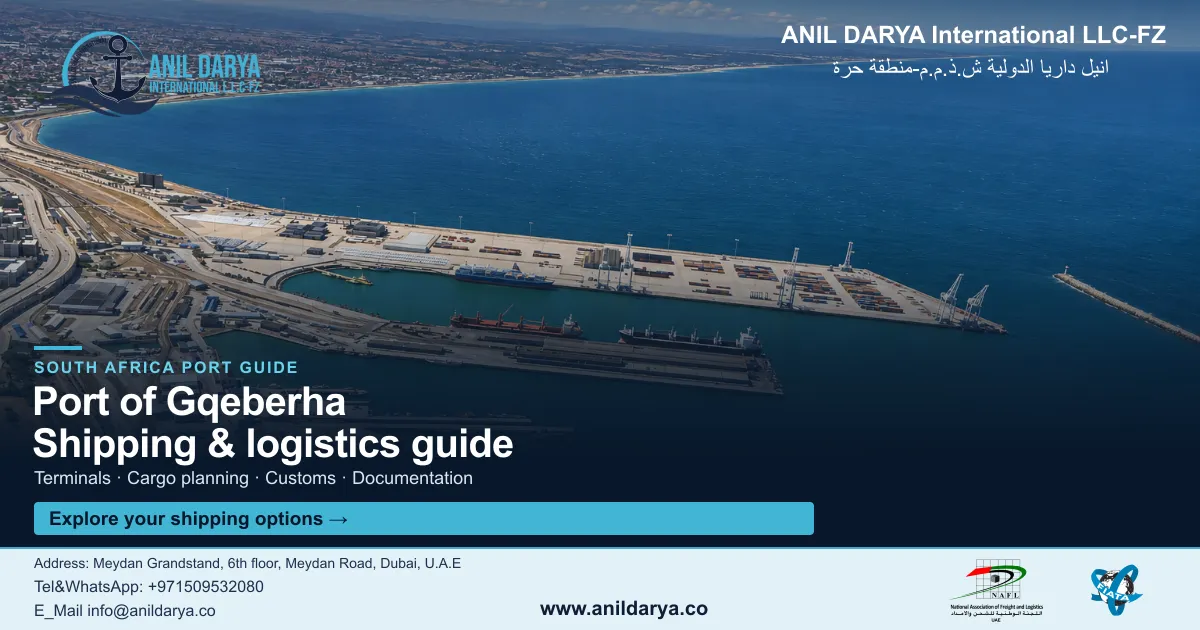
Port of Gqeberha shipping means using the older multi-cargo harbour in the city still widely called Port Elizabeth, on Algoa Bay in South Africa's Eastern Cape. In 2025 it handled 130,715 TEU of containers, 153,637 vehicles and about 12 million tonnes of bulk and breakbulk, most of it manganese exports. This guide covers the terminals, how the port differs from Ngqura 20 km away, and both directions of trade: shipping from Dubai to Port Elizabeth and shipping from Port Elizabeth to Dubai.
Port of Gqeberha at a glance
| Item | Detail |
|---|---|
| Other names | Port Elizabeth, PE |
| Port authority | Transnet National Ports Authority (TNPA) |
| Main terminal operator | Transnet Port Terminals (TPT): container terminal (PECT), Ro-Ro car terminal, manganese bulk |
| UN/LOCODE | ZAPLZ |
| Opened as a port | 1825 |
| Location | Western edge of Algoa Bay; 384 nautical miles south-west of Durban, 423 nautical miles east of Cape Town |
| Berths | 15 (TNPA); 10 terminal operators |
| Entrance channel | 14.5 m chart datum, 310 m wide |
| Published profile draughts; reconfirm before booking | Container ships 11.2 m; dry cargo and passenger 11 m; ore carriers 12.1 m; tankers 9.6 m |
| Containers, 2025 | 130,715 TEU |
| Vehicles, 2025 | 153,637 units (125,173 exported, 27,539 imported and 925 transshipped) |
| Dry bulk, 2025 | 10,852,632 tonnes, of which 10,663,893 tonnes exported |
| Liquid bulk, 2025 | 850,736 tonnes |
| Breakbulk, 2025 | 338,658 tonnes |
| Ocean-going arrivals, 2025 | 731: 271 bulk, 155 in the container/reefer category, 125 tankers, 94 car carriers, 44 passenger, 40 general cargo and 2 other |
| World Bank port performance index | 314th in the 2025 index |
| Customs | South African Revenue Service (SARS) |
| Import VAT (South Africa) | 15% of the added tax value |
Where is the Port of Gqeberha and what does it serve?
The port sits on the western edge of Algoa Bay, right next to the city centre of Gqeberha in the Nelson Mandela Bay metro. The city was officially renamed in 2021, but carriers, bills of lading and the port code still use "Port Elizabeth". It is one of South Africa's oldest ports, with port status since 1825.
Transnet Port Terminals describes the port as the automotive hub of the Eastern Cape. The main cargoes listed for the port include motor vehicles and components, steel, machinery, wool, agricultural products, manganese ore railed from the Northern Cape, petroleum products, citrus and deciduous fruit, and wheat imports.
A simple rule: the port suits consignees and shippers in Gqeberha, the Eastern Cape automotive belt and the surrounding farming areas. Cargo for Johannesburg and Gauteng usually goes through Durban.
Port Elizabeth or Ngqura: which port is your cargo going to?
Gqeberha (Port Elizabeth) and Ngqura are two separate TNPA ports on the same bay, about 20 km apart. Quotes often say "Port Elizabeth" or "Gqeberha" for both, so the port code on the booking is what counts. This table shows which port each type of cargo usually uses, based on TNPA's 2025 figures.
| Cargo | Port of Gqeberha (ZAPLZ), 2025 | Port of Ngqura (ZANGQ), 2025 | What it means for you |
|---|---|---|---|
| Containers | 130,715 TEU | 747,847 TEU | Most mainline boxes go to Ngqura; some services call PECT |
| Transshipment containers | 22,211 TEU (about 17%) | 384,071 TEU (about 51%) | PE boxes are mostly local cargo |
| Vehicles | 153,637 units | None reported | Cars and Ro-Ro go to Port Elizabeth |
| Breakbulk | 338,658 t | 64,284 t | Steel and general cargo usually discharge at PE |
| Liquid bulk landed | 318,665 t | 57,156 t | Fuel imports go mainly to PE |
| Dry bulk exports | 10,663,893 t | 7,452,830 t | Manganese is still split between the two |
Carriers can switch a call between the two at short notice. In May 2024, for example, Maersk moved one vessel call from the Ngqura Container Terminal to the Port Elizabeth Container Terminal. Check the port of discharge on every booking confirmation and tell your clearing agent and haulier which port it is.
Which terminals does the Port of Gqeberha have?
TNPA lists 15 berths and 10 terminal operators. Transnet Port Terminals runs the container terminal, a Ro-Ro facility rated under South Africa's NOSCAR safety system, and a manganese bulk operation. The dimensions below are published port-profile figures; confirm current operational limits and equipment availability before booking.
| Terminal or berth | Size | Main cargo |
|---|---|---|
| Port Elizabeth Container Terminal (PECT) | 3 berths, 925 m; 22 ha stack; 5,400 ground slots | Containers, including reefers |
| Car terminal | Open-area terminal on the Charl Malan Quay | New vehicles, mainly exports |
| Breakbulk berths | 6 berths, 1,170 m | Steel, machinery, project cargo, general cargo |
| Dry bulk berths | 2 berths, 360 m; manganese storage for 350,000 t | Manganese ore exports |
| Tanker berth | 242 m | Petroleum products |
| Fruit terminal | Berths also used by passenger ships | Fruit exports, cruise calls |
At PECT, trains can be loaded directly under the gantry cranes. The terminal handled 130,715 TEU in 2025. Published equipment and nominal-capacity figures vary between profiles; confirm working cranes, berth and stack availability for the selected sailing with the terminal. Pilotage and tug assistance are compulsory for ships entering the port.
Performance in recent years
The World Bank’s 2025 Container Port Performance Index placed Port Elizabeth 314th. The index measures container-vessel time in port; it does not predict the clearance or delivery time of an individual shipment. Confirm current terminal conditions and allow contingency in delivery dates.
What cargo can you ship through the Port of Gqeberha?
TNPA lists containers, liquid bulk, dry bulk, automotive and breakbulk. Here is how that looks for trade with the UAE, in both directions.
| Cargo | Direction | Where it is handled | What to plan |
|---|---|---|---|
| General goods (FCL) | Dubai to PE | PECT, or Ngqura if the carrier calls there | Port of discharge, road weight limit, SARS documents |
| Small shipments (LCL) | Dubai to PE | Unpacked at a depot after discharge | Allow for depot unpacking and any holds on the consolidated container |
| Machinery and steel | Dubai to PE | Breakbulk berths or flat racks via PECT | Lifting plan, laydown space, abnormal load permits |
| Vehicles and auto parts | PE to Dubai | Car terminal, or containers via PECT | Ro-Ro or container, vehicle documents for UAE entry |
| Citrus and deciduous fruit | PE to Dubai | Reefer containers or the fruit terminal | Set temperature, export certificates, UAE food rules |
| Wool and farm products | PE to Dubai | Containers via PECT | Packing, fumigation if required, UAE permits |
| Dangerous goods | Both | Containers under carrier and TNPA rules | Carrier acceptance on every leg |
Container shipping at PECT: FCL, LCL and road limits
PECT is mostly a gateway for local cargo. Of the 130,715 TEU it handled in 2025, 50,286 TEU were landed from deep-sea ships and 51,640 TEU shipped on deep-sea ships, with only 22,211 TEU transshipped. Empty boxes made up 45,882 TEU of the total.
- FCL suits larger volumes. The box leaves PECT once SARS releases it and the line issues the delivery order.
- LCL suits small volumes. The consolidator's box is unpacked at a depot, so delays affecting the consolidated container can postpone unpacking and availability.
Our guide to FCL vs LCL costs explains where a full box starts to pay off. Road weight is the other limit to plan for. Maersk publishes these maximum gross weights for road haulage in South Africa, including container tare and any reefer genset:
| Container | Maersk maximum gross for road haulage |
|---|---|
| 20ft dry or reefer | 30 tonnes |
| 40ft dry or reefer | 31.5 tonnes |
| 45ft | Not accepted under Maersk’s published South Africa policy |
A 20ft box of tiles or steel loaded to its maximum at Jebel Ali can be over the road limit at Port Elizabeth. Agree the payload with the consignee before you load.
Breakbulk and project cargo at Port Elizabeth
With 338,658 tonnes of breakbulk in 2025, against 64,284 tonnes at Ngqura, Port Elizabeth is the bay's main general cargo port. Of that, 187,802 tonnes were landed and 150,683 tonnes shipped. Confirm the equipment available for the booked vessel and cargo with the terminal.
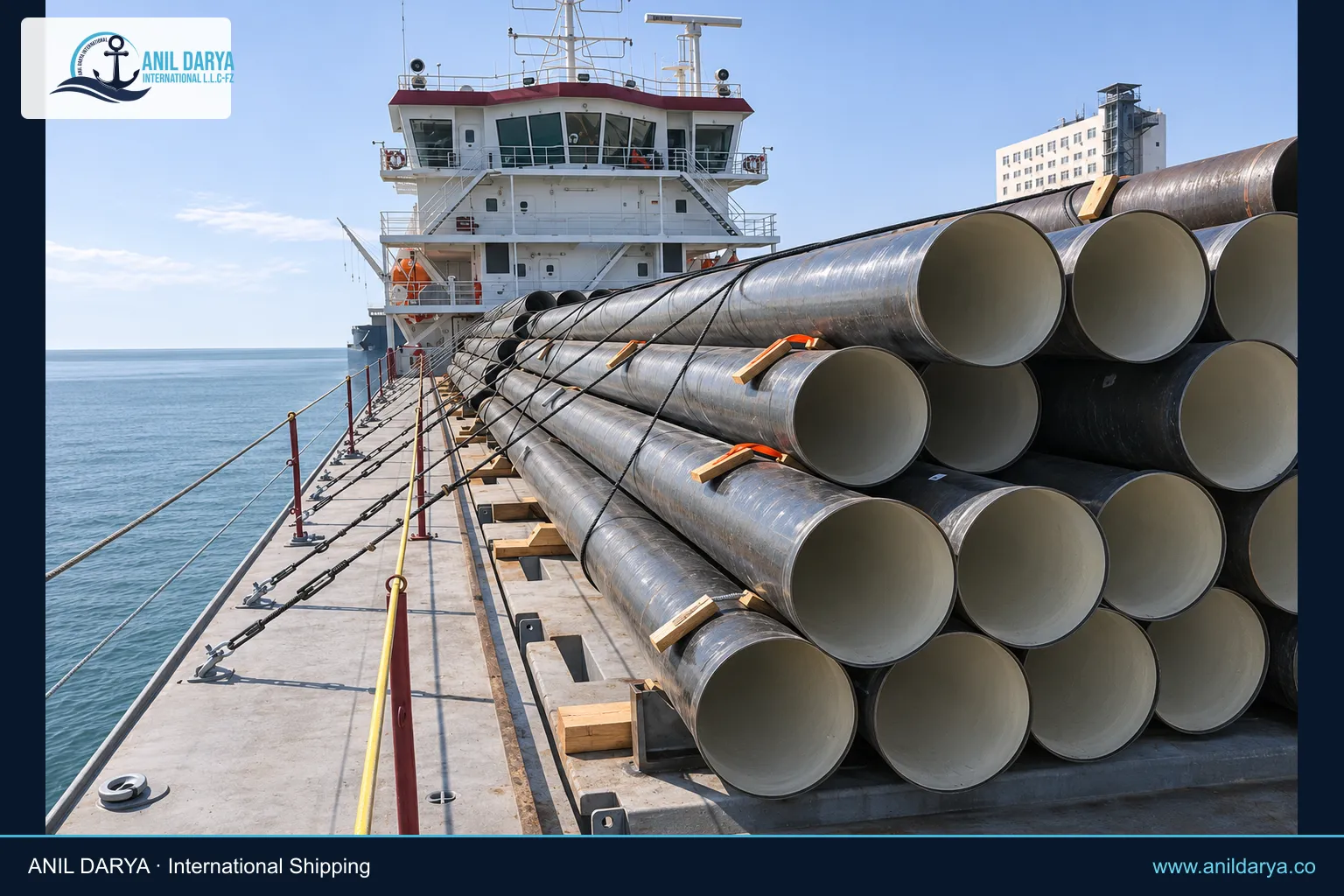
When we plan a breakbulk or project shipment from the UAE into Port Elizabeth, we work in this order:
- Collect drawings, weights, dimensions and centre of gravity for every piece.
- Choose between flat racks on a container service and a general cargo vessel calling at the breakbulk berths.
- Confirm with the carrier that the ship discharges at Port Elizabeth, not Ngqura.
- Agree lifting gear: ship's cranes or a mobile crane hired at the quay.
- Plan the road move with the consignee's haulier, including abnormal load permits.
- Line up the SARS declaration so the pieces leave the quay quickly. SARS allows 14 days to declare loose or breakbulk cargo landed by sea.
See our break bulk and project cargo service for what we cover.
Manganese and the planned move to Ngqura
Manganese ore is the port's biggest cargo by weight, which explains the 10.66 million tonnes of dry bulk exports in 2025. TPT identifies manganese handling as a core terminal activity. Transnet now plans to consolidate manganese exports at Ngqura through a new terminal within an integrated rail-and-port partnership. The September 2026 RFQ gives an indicative 25-year term and R30–44 billion total corridor investment. It distinguishes an initial corridor throughput of about 12 million tonnes a year, potentially growing towards 16 million, from the proposed terminal’s approximately 14.7-million-tonne annual capacity. These are planning assumptions subject to the next procurement stage.
Confirm the latest commissioning timetable with Transnet before relying on the planned transfer. For now, manganese still moves through both ports. For general cargo shippers, the practical effects are berth occupancy by ore ships and dust near the bulk area, so keep open cargo and clean goods away from it. For a manganese enquiry, confirm service availability and specialist handling requirements before booking.
Dangerous goods through the Port of Gqeberha
DG cargo moves in IMDG containers on the container services, in both directions. Carrier acceptance is the first gate. Maersk's South African cargo rules say hazardous Classes 1 and 7 need approval before acceptance and that DG charcoal is not accepted. Other lines have their own lists, and any transshipment hub on the way may add limits.
For any DG booking you need the UN number, class and packing group where applicable, an SDS for each product, a signed DG declaration and container packing certificate, packaging, marks and labels meeting the applicable IMDG requirements, and acceptance on every leg. Plan a fast release so the box does not sit in the terminal. Our dangerous goods shipping team checks the documents and acceptances before you commit to a sailing.
Customs clearance at Port Elizabeth: the short version
SARS clears cargo at Port Elizabeth under the same national rules as every South African port.
- The importer registers with SARS, and the importer or its agent declares the goods.
- SARS checks the declaration against the invoice, bill of lading, certificate of origin and any permits.
- Restricted goods need an ITAC import permit, produced at clearance. Maersk names used tyres and used clothing among them.
- For taxable imports from outside SACU, import VAT is generally 15% × (customs value + 10% of customs value + any non-rebated duties). SARS excludes the uplift for goods originating in Botswana, Lesotho, Namibia or Eswatini; confirm any product-specific exemption.
| Cargo situation | Time to declare after landing |
|---|---|
| Most goods | 7 days |
| Loose or breakbulk cargo by sea | 14 days |
| Goods in a container depot | 28 days |
Goods not declared in time can be moved to the State Warehouse.

How to ship from Dubai to Port Elizabeth: step by step
Containers from the UAE load at Jebel Ali. Our Jebel Ali port shipping guide covers the UAE export side in detail.
Before booking, request a dated carrier itinerary showing the actual loading and discharge ports, any transshipment hub, scheduled transit time and cut-offs. Confirm whether the destination is PECT (ZAPLZ) or Ngqura (ZANGQ); availability and transit times depend on the selected sailing.
- Send us the cargo details: commodity, tariff code, weight, volume or dimensions, and the Incoterm agreed with your buyer.
- Confirm the South African side. The consignee is registered with SARS, has a clearing agent and has any ITAC permit.
- Check the payload against the road weight limit for the container size.
- We compare services and confirm the port of discharge: Port Elizabeth (ZAPLZ) or Ngqura (ZANGQ).
- Book space. For DG, reefer or out-of-gauge cargo we get carrier acceptance first.
- We arrange UAE trucking, export clearance and gate-in at Jebel Ali before the cut-off.
- After sailing, we send the bill of lading, invoice, packing list and certificate of origin to the consignee's clearing agent.
- The agent declares the goods within the SARS deadline and pays duty and VAT. The haulier collects the box from PECT after release.
How to ship from Port Elizabeth to Dubai
Shipping from Port Elizabeth to Dubai is common for Eastern Cape exports: vehicles and parts, fruit, wool and other farm products. We book the space with the carriers serving the port and arrange the UAE services agreed in the quotation. The shipper or its South African clearing agent handles the export declaration with SARS and the documents at origin.
- Send us the cargo details, the pickup address and the Incoterm agreed with your supplier.
- We book space and confirm the loading port (PECT, the car terminal or Ngqura), the vessel and the cut-offs.
- The shipper or its agent arranges packing, export clearance and delivery to the terminal before the cut-off. For fruit and food, the shipper also arranges the export certificates.
- For a vehicle, decide between Ro-Ro and a container. Ro-Ro needs a car carrier with a UAE call; containers give more sailings.
- The shipper sends us the invoice, packing list, certificate of origin and any permit. We check them against the draft bill of lading.
- We file the UAE declaration before arrival. Dubai Customs asks for an invoice, packing list, certificate of origin and a permit for restricted goods. Duty in Dubai is 5% of the CIF value for most goods, and import VAT also applies.
- After release we collect the delivery order, book the truck and deliver to your site, a free zone or a re-export warehouse. Khalifa Port or Sharjah can be the better landing point if your site is nearer to them.
The UAE importer needs a Dubai Customs business code, or a licensed clearing agent with its own code and your authorisation can file for you.
Checklist before you ship
- Port code on the booking is Port Elizabeth (ZAPLZ), not Ngqura (ZANGQ), unless Ngqura is what you want.
- South African consignee or shipper registered with SARS, with a clearing agent named.
- Tariff code checked for duty and VAT at the destination.
- ITAC permit in hand for restricted imports into South Africa.
- Gross weight agreed with the carrier and haulier; Maersk publishes 30 t for a 20ft and 31.5 t for a 40ft.
- Certificate of origin arranged where required by customs, preferential origin rules or the buyer.
- For reefers: set temperature and any health or export certificates.
- For DG: SDS, DG declaration and acceptance on every leg.
- UAE importer has a customs business code or an authorised clearing agent.
Common mistakes when shipping to or from Port Elizabeth
- Treating "Port Elizabeth", "Gqeberha" and "Ngqura" as one port. The agent and the haulier go to the wrong terminal.
- Routing Johannesburg cargo through Port Elizabeth. Durban is usually the shorter inland leg.
- Loading a 20ft box over 30 tonnes gross for a South African road delivery.
- Declaring late. Most goods must be declared within 7 days of landing.
- Shipping restricted goods such as used tyres without an ITAC permit.
- Sending fruit or food to Dubai without checking UAE import permits first.
Port of Gqeberha or another South African port?
| Your situation | Port to compare | Why |
|---|---|---|
| Eastern Cape vehicles, breakbulk or fuel | Port of Gqeberha | Car terminal, breakbulk berths, tanker berth |
| Eastern Cape containers on mainline services | Ngqura | Deepwater container hub on the same bay |
| Johannesburg and Gauteng | Durban | Major container gateway with an established inland corridor |
| Western Cape and fruit from that region | Cape Town | Closest port to the Western Cape |
Frequently asked questions
Is Gqeberha the same as Port Elizabeth?
Yes. The city was renamed Gqeberha in 2021, but the port is still widely called Port Elizabeth and its UN/LOCODE is ZAPLZ. It is a different port from Ngqura (ZANGQ), 20 km away on the same bay.
Who operates the port at Gqeberha?
Transnet National Ports Authority owns and manages the port. Transnet Port Terminals runs the container terminal, the Ro-Ro car terminal and the manganese bulk operation, and TNPA lists 10 terminal operators in total.
How many containers does the Port of Gqeberha handle?
It handled 130,715 TEU in 2025, according to TNPA. Ngqura, the nearby deepwater hub, handled 747,847 TEU in the same year.
How deep is the port?
The entrance channel is 14.5 m at chart datum. Published profile draughts vary by berth: 11.2 m for container ships, 12.1 m for ore carriers and 9.6 m for tankers. Obtain current limits and acceptance from the harbour master and terminal before fixing a vessel.
How do I ship from Dubai to Port Elizabeth?
We load your container at Jebel Ali on a service that discharges at Port Elizabeth or Ngqura, and send the documents to your consignee's clearing agent. The agent confirms the applicable SARS clearance deadline, declares the goods, pays applicable duty and VAT, and arranges release and collection.
How do I ship from Port Elizabeth to Dubai?
The South African shipper packs the cargo, clears it for export with SARS and delivers it to the terminal. We book the space, file the UAE declaration before arrival, and deliver the cargo in the UAE after Dubai Customs releases it.
Can I ship cars from Port Elizabeth to Dubai?
Port Elizabeth handled 125,173 vehicle exports in 2025, so it is a natural loading port for cars. You can ship by Ro-Ro, if a car carrier calls the UAE, or in containers through PECT.
Can I ship dangerous goods through Port Elizabeth?
Yes, in IMDG containers on the container services. Each carrier has its own acceptance rules; Maersk, for example, needs prior approval for Classes 1 and 7 and does not accept DG charcoal.
Get a quote for Port of Gqeberha shipping
Send us your cargo details and we will come back with a routing and a price, from Dubai to Port Elizabeth or from Port Elizabeth to Dubai. Use our freight rate inquiry form, or contact our team to talk through a breakbulk, vehicle or DG shipment first. You can also read about our Dubai freight forwarding team and our sea freight service.
Sources
World Bank: CPPI 2025 and official data annex
Transnet: September 2026 manganese corridor RFQ, indicative scope and capacity
- Transnet National Ports Authority: Our ports, Port of Port Elizabeth (berths, operators, commodities)
- Transnet Port Terminals: Port Elizabeth Terminal
- TNPA: Summary of cargo handled at South African ports, 2025
- TNPA: Container statistics, 2025
- TNPA: Vessel arrivals at South African ports, 2025
- Africa Ports: Port Elizabeth (location, terminals, channel, draughts, commodities)
- Wikipedia: Port of Gqeberha (opening year, UN/LOCODE, CPPI rankings)
- Business Day: Manganese export revamp at Ngqura could cost R44bn (September 2026)
- Maersk: South Africa import information (road weights, cargo restrictions)
- Maersk: Celsius Boston/419N terminal change (May 2024)
- SARS: Imports
- SARS: Duties and taxes for importers
- Dubai Customs: Frequently asked questions (duty rate, business code, clearing agents)
- Dubai Customs: Submit Customs Declaration (documents)
Reviewed: 15 November 2026