
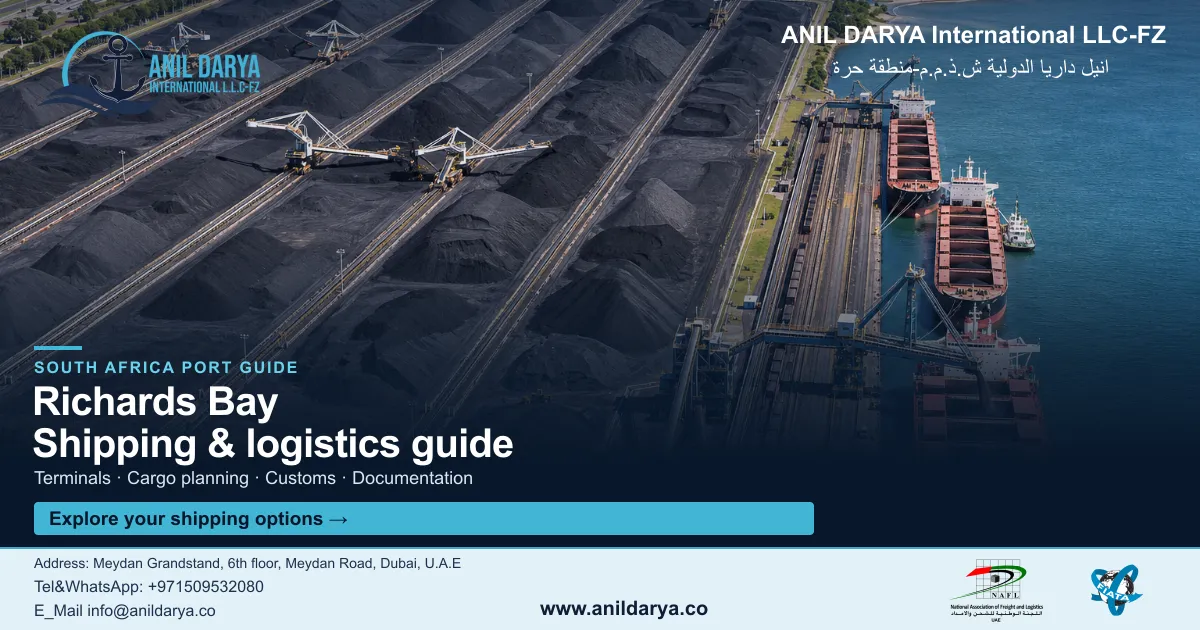
Port of Richards Bay shipping is mostly bulk shipping. The port in northern KwaZulu-Natal handled 87.8 million tonnes of cargo in 2025, about 40% of all cargo through South African ports, and almost all of it was dry bulk such as coal, chrome, magnetite and ferrochrome. This guide covers the coal, dry bulk and multipurpose terminals, berth depths, breakbulk and liquid bulk, why containers usually go through Durban instead, SARS clearance, and how to move bulk or breakbulk between Richards Bay and the UAE. We ship both from Dubai to Richards Bay and from Richards Bay to Dubai.
Port of Richards Bay at a glance
| Item | Detail |
|---|---|
| Port authority | Transnet National Ports Authority (TNPA) |
| Main terminal operators | Transnet Port Terminals (Dry Bulk and Multipurpose terminals); Richards Bay Coal Terminal (RBCT, privately operated) |
| UN/LOCODE | ZARCB |
| Location | About 160 km north-east of Durban and 465 km south of Maputo |
| Opened | April 1976, for coal exports |
| Port area | 2,157 ha of land and 1,495 ha of water |
| Berths (TNPA) | 22: 6 coal, 7 dry bulk, 7 breakbulk, 2 liquid bulk |
| Entrance channel | -19.5 m, permissible draught 17.5 m |
| Deepest berths | 19 m (coal berths and several dry bulk berths) |
| Total cargo, 2025 | 87,812,281 tonnes |
| Dry bulk, 2025 | 83,438,546 tonnes, of which 80,184,680 tonnes exported |
| Ocean-going vessel arrivals, 2025 | 1,427, of which 1,146 dry bulk carriers |
| Containers, 2025 | 338 TEU |
| Hours | 24 hours a day, 365 days a year; pilotage and tugs compulsory |
| Customs | South African Revenue Service (SARS) |
| Import VAT | 15% of the added tax value |
| Shipping from Richards Bay to Dubai | SARS export declaration by the seller or its agent, ITAC permit if restricted; UAE duty 5% of CIF for most goods, import VAT 5% |
Where is the Port of Richards Bay and what does it serve?
Richards Bay sits on the Zululand coast of northern KwaZulu-Natal, on what was a natural lagoon at the Mhlathuze estuary until the mid-1970s. It is a man-made deepwater port. The first commercial ship docked in 1976 to export coal, and the port has grown around bulk exports ever since.
TNPA lists its hinterland as northern KwaZulu-Natal, Gauteng, Mpumalanga and Limpopo. A dedicated railway links the port to the coalfields of Mpumalanga and to Gauteng, with other lines south to Durban and north to Eswatini. A 2012 provincial freight study found that rail carried about 88% of the port's cargo by weight, with road traffic mainly at the Multipurpose and Dry Bulk terminals at the northern end of the port.
The port is split into three precincts, South Dunes, Bayview and Newark, each focused on different services. Several large industries next to the port receive or send bulk cargo straight over conveyors, so a lot of the tonnage never touches a truck.
Which terminals does the Port of Richards Bay have?
Richards Bay has four main cargo areas. The terminal decides the berth, the loading or discharge method and who you deal with.
| Terminal | Operator | Cargo | Key figures |
|---|---|---|---|
| Richards Bay Coal Terminal (RBCT) | Private | Export coal | 6 berths (301 to 306), 350 m each, 19 m deep; capacity 91 million tonnes a year; up to 6 million tonnes stockpiled |
| Dry Bulk Terminal (DBT) | Transnet Port Terminals | Ores, minerals, fertilisers, woodchips, alumina, sulphur, coking coal and more | Over 13 million tonnes a year; conveyor network of over 40 km |
| Multipurpose Terminal (MPT) | Transnet Port Terminals | Breakbulk, neo-bulk and a small number of containers | 6 berths; capacity 5.6 million tonnes a year |
| Liquid bulk | Various | Chemicals, phosphoric acid, fuel oil | 2 liquid bulk berths; chemical berth 209 is 300 m long with 12.5 m permissible draught |
Transnet Port Terminals describes its Richards Bay operation as having 13 berths with a draft that takes Capesize and Panamax vessels. Berth counts differ between sources because some include RBCT and some do not. For your vessel, the berth plan from the terminal is what counts.
Dry Bulk Terminal berth depths
If you are fixing a bulk carrier, the berth limits matter more than the port headline. These are the DBT berths as published by Africa Ports:
| Berth | Length | Depth | Permissible draught |
|---|---|---|---|
| 609 | 300 m | 14.5 m | 14.0 m |
| 701 | 240 m | 14.5 m | 14.0 m |
| 702 | 300 m | 19 m | 17.5 m |
| 703 | 240 m | 19 m | 17.5 m |
| 704 | 240 m | 19 m | 17.5 m |
| 705 | 280 m | 19 m | 17.5 m |
| 801 | 260 m | 19 m | 17.5 m |
| 804 | 260 m | 19 m | 17.5 m |
A decision rule: a vessel arriving at no more than 14.0 m draught fits any of these berths. A deeper-loaded ship needs one of the 19 m berths with 17.5 m permissible draught, so confirm the berth allocation before you fix the vessel.
What cargo moves through the Port of Richards Bay?
TNPA's 2025 figures show how one-sided the port is. Exports far outweigh imports, and dry bulk dwarfs everything else.
| Cargo type, 2025 | Imports | Exports | Total handled |
|---|---|---|---|
| Dry bulk (tonnes) | 3,183,271 | 80,184,680 | 83,438,546 |
| Liquid bulk (tonnes) | 2,159,449 | 998,821 | 3,506,261 |
| Breakbulk (tonnes) | 42,442 | 825,032 | 867,474 |
| Containers (TEU) | 190 landed | 148 shipped | 338 |
TNPA lists coal, ferrochrome, magnetite, chrome ore, woodchips, alumina, sulphur and aluminium as the port's commodities. Transnet Port Terminals says over 30 commodities are exported, including magnetite, ferrochrome, woodchips, aluminium and steel, to markets that include the Middle East. Over 15 commodities are imported each year, including sulphur, coking coal and alumina.
Dry bulk shipping at Richards Bay: imports and exports
Dry bulk is why most shippers deal with Richards Bay. The Dry Bulk Terminal lists a long range of products: andalusite, chrome, magnetite, ferro fines, fertiliser products, rock phosphate, rutile, titanium and vanadium slag, vermiculite, woodchips, zircon, alumina, coking coal, anthracite, manganese, export coal, metallurgical coke, petcoke, salt and sulphur.
Two DBT rules affect your cargo directly:
- Maximum parcel size is 65 mm. Lumpy material above that size may not suit the conveyor system, so check the size grading before you book.
- Equipment is washed between parcels to avoid contamination. If your product is sensitive to contamination, say so at booking and ask how the terminal sequences cargoes.
Most dry bulk is moved by conveyor between the quay and the industries behind the port. That is fast for those plants, but a smaller importer without a conveyor link needs storage and road or rail transport planned from the start.
Importing bulk into Richards Bay from the UAE
For a bulk import, the questions come in a fixed order. We work through them with you like this:
- Confirm the receiver can take the parcel: conveyor link, storage, or trucks.
- Check the product against the DBT commodity list and the 65 mm size limit.
- Choose the vessel size from the parcel and the berth draught, 14.0 m or 17.5 m.
- Agree laytime, discharge rate and surveys with the receiver and the terminal.
- Prepare the bill of lading, invoice, certificate of origin and any cargo certificates for SARS.
- Check the cargo declaration for solid bulk cargo, including any hazard group under the IMSBC Code.
Exporting bulk from Richards Bay to the UAE
If you are a buyer in the UAE of chrome, ferrochrome, magnetite or similar products, Richards Bay is likely to be the load port. Plan the loading window with the seller's terminal slot, confirm the discharge port in the UAE and its berth draught, and agree who arranges the survey at loading. Our guide to bulk shipping between Dubai and Africa covers the commercial side, and our dry and liquid bulk shipping service explains what we arrange.
Breakbulk and project cargo at the Multipurpose Terminal
The Multipurpose Terminal was formed by merging the old bulk metal and combi terminals. It handles breakbulk, neo-bulk and containers over six berths, with a capacity of 5.6 million tonnes a year. Breakbulk at Richards Bay is mostly exports: aluminium ingots, ferrochrome, granite, pig iron and steel. Imports are small, 42,442 tonnes in 2025.
| MPT storage | Size |
|---|---|
| Warehouses | Two of 10,000 m² each |
| Covered canopy | 8,000 m² |
| Shed | 4,500 m² |
| Open storage | 330,000 m² |
| Ferro handling facility | 75,000 m² |
| Leased log terminal | 55,000 m² |
Transnet Port Terminals says breakbulk is handled by skip-loading and relies mainly on road transport. For heavy pieces bound for mines and smelters in northern KwaZulu-Natal or Mpumalanga, a landing at Richards Bay can shorten the road move compared with Durban.
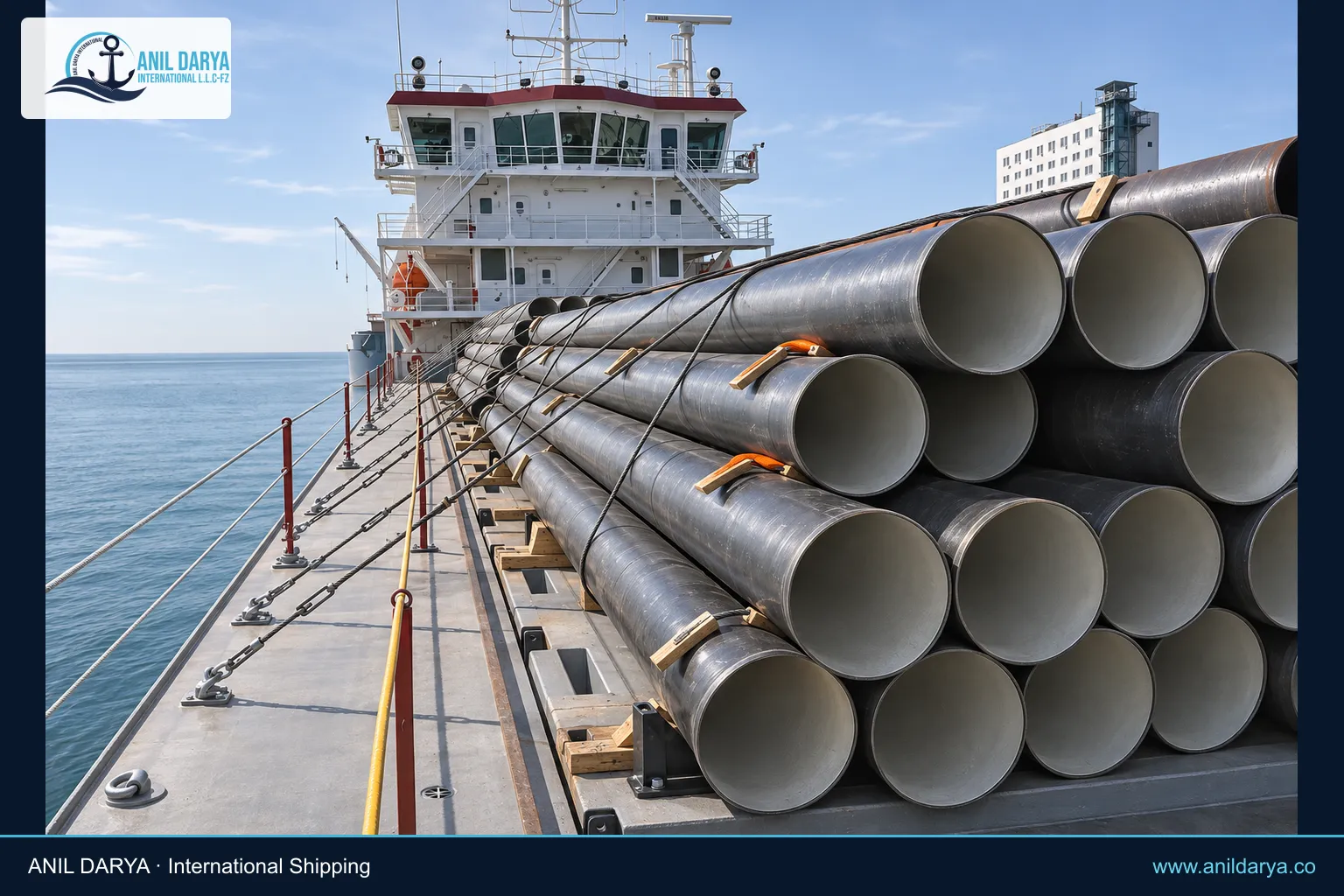
When we plan a breakbulk or project shipment from the UAE to Richards Bay, we work in this order:
- Collect drawings, weights and centre of gravity for every piece.
- Find a breakbulk or heavy-lift vessel that will call at Richards Bay, or compare a Durban discharge plus road.
- Confirm lifting gear: ship's cranes or a hired mobile crane at the MPT.
- Agree open storage or warehouse space at the MPT if the site cannot receive at once.
- Plan the road move, including abnormal load permits and escorts.
- Line up the SARS declaration so the cargo leaves the quay quickly.
See our break bulk and project cargo service and our guide to breakbulk documents and the UAE port process.
Liquid bulk and chemicals at Richards Bay
Richards Bay handled 3,506,261 tonnes of liquid bulk in 2025, mostly imports. Older port data lists bulk liquids, phosphoric acid and fuel oil among the liquid cargoes. Chemical tankers made 147 of the port's ocean-going calls in 2025. Liquid bulk moves through two dedicated berths, including chemical berth 209 with 12.5 m permissible draught. For a parcel tanker shipment, the receiving tank terminal and its berth window come first, then the vessel.
Containers at Richards Bay: why most go through Durban
Richards Bay is not a container port today. It handled only 338 TEU in 2025, and only two container ships were among its ocean-going arrivals. A general container from Jebel Ali for northern KwaZulu-Natal will normally discharge at Durban and travel about 160 km by road. Our Durban port guide covers that route.
That may change. In May 2025 Transnet signed a 25-year concession with the Grindrod Eyamakhosi joint venture for a container handling facility in the Bayvue precinct. It is meant to raise annual container capacity from 50,000 TEU to 200,000 TEU, with an investment of R285 million, and is expected to open in 2028. Until then, plan containers through Durban.
Dangerous goods at the Port of Richards Bay
Dangerous goods at Richards Bay are mostly bulk chemicals on tankers and solid bulk cargoes with hazard properties, such as sulphur. They follow the IMDG or IMSBC rules for the cargo type, plus port and terminal approvals. Packaged DG in containers would normally route through Durban, where carriers apply their own acceptance rules. Maersk's South African rules, for example, say Classes 1 and 7 need approval before acceptance.
For any DG cargo to Richards Bay, have the safety data sheet, the correct UN number or bulk cargo name, and the shipper's declaration ready before you fix the vessel. Our dangerous goods shipping team checks acceptance and paperwork first.
Customs clearance at the Port of Richards Bay
SARS clears cargo at Richards Bay under the national rules used at every South African port.
- The importer must be registered with SARS. The importer or its agent declares the goods.
- SARS checks the declaration against the invoice, bill of lading, certificate of origin and any permits.
- Restricted goods need an ITAC import permit, produced at clearance.
- SARS may examine goods, take samples, or hold them for another government department.
| Cargo situation | Time to declare after landing |
|---|---|
| Most goods | 7 days |
| Loose or break bulk cargo by sea | 14 days |
| Goods in a container depot | 28 days |
Bulk and breakbulk landed at Richards Bay usually fall in the 14-day group. Goods not declared in time can be moved to the State Warehouse. Import VAT is 15% of the added tax value: the customs value plus 10%, plus any non-rebated duty. Duty depends on the tariff heading.

Shipping from the UAE to Richards Bay: what we arrange
Most UAE to Richards Bay business is bulk or breakbulk on chartered or tramp tonnage, not scheduled container services. Our role is to book space or find tonnage, prepare the documents, arrange UAE trucking and export clearance, plan DG and breakbulk handling, and work with the consignee's clearing agent in South Africa. For bulk, the UAE load port depends on the cargo and the berth. Our Fujairah port guide covers one east coast option.
[AMIR-FACT: a real bulk or breakbulk shipment we handled between the UAE and Richards Bay (cargo, tonnage, vessel type, load port), or the usual routing we offer for this lane]
How to ship to the Port of Richards Bay: step by step
- Tell us the cargo: product, tonnage or pieces, size grading for bulk, dimensions for breakbulk, and the Incoterm.
- Decide the port. Bulk and breakbulk for northern KwaZulu-Natal suit Richards Bay; general containers go via Durban.
- Confirm the South African side: SARS-registered importer, clearing agent, any ITAC permit, and receiving capacity.
- Choose the vessel. For bulk, match the parcel to the berth draught. For breakbulk, find a vessel calling at the MPT.
- Agree terminal handling, storage and surveys with the terminal and the receiver.
- We arrange UAE trucking, export clearance and loading at the UAE port.
- After loading, we send the bill of lading, invoice, certificate of origin and cargo certificates to the clearing agent.
- The agent declares within the SARS deadline, usually 14 days for bulk and breakbulk, and pays duty and VAT.
- The cargo is discharged, released and delivered by conveyor, rail or road.
How to ship from Richards Bay to Dubai
We also handle the other direction: shipping from Richards Bay to Dubai, with arrival at Jebel Ali, Khalifa Port or Sharjah port. We book the space with the carrier and run the UAE side. The export papers at origin stay with the shipper or its agent there.
The South African export side
- Registration. SARS says importers, exporters and their clearing or registered agents must be registered or licensed before they submit a declaration. It can be submitted electronically or manually.
- Export permits. Some goods need an export permit, presented at clearance. Permits for restricted goods come from the International Trade Administration Commission (ITAC). The seller should check this early for metals and minerals.
- Proof of export. Proof of export for acquittal comes from the port of exit on the required forms, so the seller's agent needs the final loading details.
The UAE import side
For cargo discharged at Jebel Ali, the import declaration goes to Dubai Customs. It asks for the commercial invoice, the packing list, a certificate of origin and, for restricted goods, the approval of the authority that controls them. The carrier's agent releases the cargo against the bill of lading with a delivery order. Customs duty in Dubai is 5% of the CIF value for most goods, with 50% on alcohol and 100% on cigarettes. Import VAT is 5% of the customs value, which takes in insurance and freight, plus customs fees and any excise tax. A VAT-registered importer whose customs number is registered with the Federal Tax Authority can account for that VAT on its VAT return instead of paying it at clearance.
- Send us the shipper's details in Richards Bay, the cargo, the HS code and the delivery address in the UAE.
- We book space from Richards Bay with the carrier and send the booking and cut-off dates to the shipper.
- The shipper or its trucker delivers the cargo to the Richards Bay terminal named in the booking inside the receiving window.
- The shipper or its South African clearing agent files the SARS export declaration.
- We check the draft bill of lading against the invoice and packing list before the carrier issues it.
- We file the UAE import declaration before the ship arrives.
- We arrange payment of the duty and VAT and collect the delivery order from the carrier's agent.
- We truck the cargo to your site in the UAE.
- We return the empty container to the carrier's depot inside free time.
[AMIR-FACT: the vessels or carriers we actually use from Richards Bay (or Durban for containers) to Jebel Ali, Khalifa or Sharjah, and our real transit days in this direction]
Checklist before you ship to Richards Bay
- Right port chosen: Richards Bay for bulk and breakbulk, Durban for general containers.
- Product on the DBT commodity list and within the 65 mm size limit.
- Vessel draught matched to the berth: 14.0 m or 17.5 m.
- Receiver ready: conveyor, storage, trucks or rail.
- Consignee registered with SARS and a clearing agent named.
- Tariff code checked for duty and VAT.
- ITAC permit in hand for restricted goods.
- For bulk DG: SDS, bulk cargo declaration and any approvals.
- For project cargo: drawings, lifting plan, laydown space and road permits.
- Survey arrangements agreed at load and discharge.
Common mistakes at the Port of Richards Bay
- Booking a general container to Richards Bay. Very few container ships call; Durban is the normal route.
- Fixing a vessel loaded deeper than 14.0 m without confirming a 19 m berth.
- Shipping lumpy material over 65 mm without checking the conveyor limit.
- Arriving with no plan for storage or inland transport for a bulk parcel.
- Missing the 14-day declaration window for break bulk cargo.
- Assuming contamination-sensitive cargo will be handled separately without asking.
Richards Bay or another South African port?
| Port | Total cargo, 2025 | Containers, 2025 | When to choose it |
|---|---|---|---|
| Richards Bay | 87,812,281 t | 338 TEU | Dry bulk, liquid bulk, breakbulk for northern KwaZulu-Natal and the coal and minerals hinterland |
| Durban | 40,662,134 t | 2,732,190 TEU | Containers, vehicles and general cargo for Gauteng and KwaZulu-Natal |
| Ngqura | 8,162,061 t | 747,847 TEU | Eastern Cape containers and manganese |
| Cape Town | 5,275,876 t | 843,599 TEU | Western Cape containers and reefer cargo |
For the Eastern Cape, see our Ngqura port guide. For the Western Cape, see our Cape Town port guide.
Frequently asked questions
What is the Port of Richards Bay mainly used for?
Bulk exports. In 2025 it handled 83,438,546 tonnes of dry bulk, most of it exported, including coal, chrome, magnetite and ferrochrome. It also handles liquid bulk and breakbulk.
What is the port code for Richards Bay?
The UN/LOCODE for the Port of Richards Bay is ZARCB. You will see it on bills of lading and charter documents.
How deep is the water at the Port of Richards Bay?
The entrance channel is -19.5 m with a permissible draught of 17.5 m. The coal berths and the deeper dry bulk berths are 19 m; two dry bulk berths are 14.5 m with 14.0 m permissible draught.
How many berths does the Port of Richards Bay have?
TNPA lists 22 berths: 6 coal, 7 dry bulk, 7 breakbulk and 2 liquid bulk. Other sources give different totals depending on whether they count the coal terminal.
Can I ship containers to Richards Bay?
Very few containers go there today: 338 TEU in 2025. A new container facility in the Bayvue precinct is planned for 2028. Until then, ship general containers to Durban and truck them about 160 km.
What is the capacity of the Richards Bay Coal Terminal?
RBCT has a capacity of 91 million tonnes a year after its upgrade, with six berths of 350 m and room to stockpile up to 6 million tonnes.
Which products does the Dry Bulk Terminal handle?
Products include chrome, magnetite, ferro fines, fertilisers, rock phosphate, rutile, zircon, woodchips, alumina, coking coal, manganese, petcoke, salt and sulphur. Maximum parcel size is 65 mm.
How long do I have to clear bulk cargo at Richards Bay?
SARS gives 14 days after landing for loose or break bulk cargo arriving by sea, against 7 days for most goods. After that, goods can be moved to the State Warehouse.
Can you ship from Richards Bay to Dubai?
Yes. We book the space or find tonnage out of Richards Bay, the seller or its South African clearing agent files the SARS export declaration and any ITAC permit, and we clear and deliver the cargo in the UAE. Duty in Dubai is 5% of CIF value for most goods, and import VAT is 5%.
Get a quote for Port of Richards Bay shipping
Send us the product, tonnage or piece list and the receiver's location, and we will come back with a routing and a price for Richards Bay. Use our freight rate inquiry form, or contact our team to talk through a bulk, breakbulk or project shipment first. You can also read more about our Dubai freight forwarding team.
Sources
- Transnet National Ports Authority: Our Ports (Port of Richards Bay location, hinterland, precincts, berths, commodities)
- Transnet National Ports Authority: Summary of cargo handled at South African ports, 2025 (tonnes by cargo type and port)
- Transnet National Ports Authority: Containers handled by port, 2025 calendar year
- Transnet National Ports Authority: Vessel arrivals at South African ports, 2025
- Transnet Port Terminals: Richards Bay Terminal (berths, commodities, conveyors, history)
- Africa Ports: Port of Richards Bay (area, channel and berth depths, MPT, DBT, RBCT, rail)
- Wikipedia: Port of Richards Bay (history, LOCODE)
- Wikipedia: Richards Bay Coal Terminal
- WorldCargo News: Transnet inks deal for container handling facility at Richards Bay (May 2025)
- Limpopo Freight Databank: Maritime port of Richards Bay (rail share, roads, breakbulk and liquid commodities)
- MarineLink: Port of Richards Bay description
- Nautical Flock: Port of Richards Bay
- Bus-Ex: Port of Richards Bay
- Maersk: South Africa imports (DG acceptance rules)
- SARS: Imports (clearance, documents, declaration deadlines)
- SARS: Duties and taxes for importers (VAT and added tax value)
- SARS: Exports (export permits, ITAC, proof of export)
- SARS: Clearance declaration (registration of exporters and agents, electronic or manual submission)
- Dubai Customs: Submit customs declaration (import documents)
- UAE Government portal: Customs duty (5% of CIF, alcohol 50%, cigarettes 100%, GCC-origin goods)
- Federal Tax Authority: VAT (5% rate)
- Federal Tax Authority: VAT guide, section 3.5 (import VAT at 5%, accounting on the VAT return)
Reviewed: 10 November 2026