
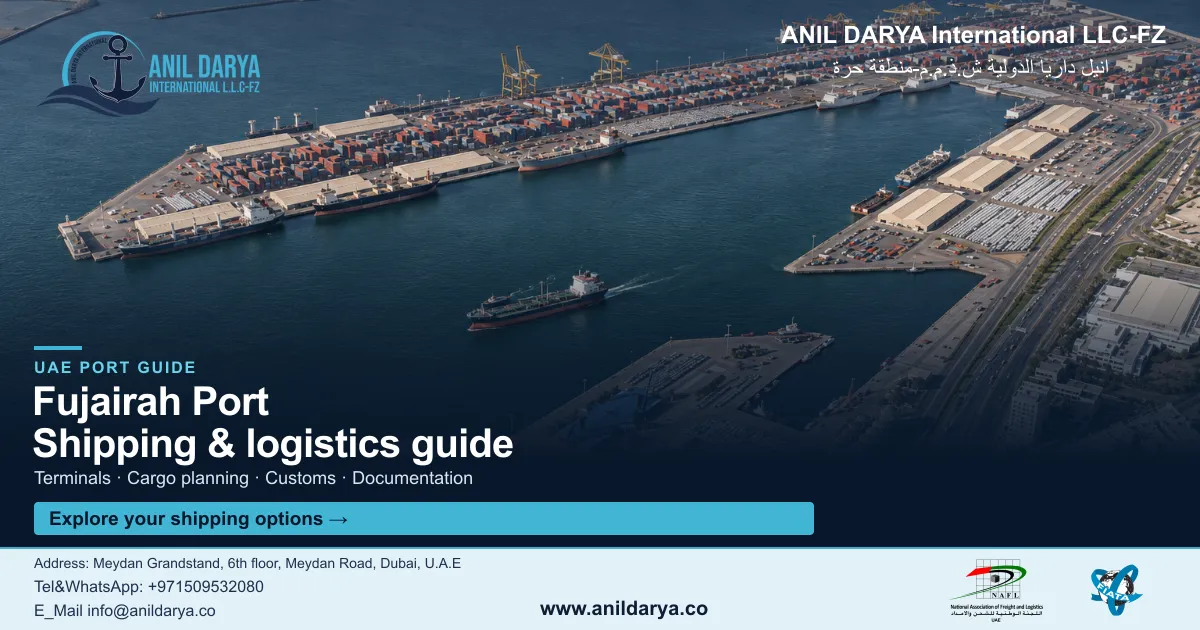
Fujairah port shipping means using the UAE's deep-water port on the east coast, on the Gulf of Oman. The port handles containers, general and project cargo, dry bulk and oil, with a container and general cargo terminal run by Fujairah Terminals, part of AD Ports Group. We book your space, prepare the documents, arrange customs clearance and trucking, and plan breakbulk and dangerous goods moves through the port.
Port of Fujairah at a glance
| Item | Detail |
|---|---|
| Location | On the UAE's east coast, on the Gulf of Oman |
| Construction started / full operations | 1978 / 1983 |
| Total quay length (2024) | More than 9.5 km |
| Port authority | Fujairah Ports Authority |
| Container and general cargo operator | Fujairah Terminals (AD Ports Group), 35-year concession signed June 2017 |
| Container terminal quay | 1,000 m quay wall, 4 berths, 2 ship-to-shore cranes |
| Depth at container berths | 15 m (CD); max arrival draught 13 m, max sailing draught 13.5 m |
| Max vessel length at main quay | 330 m |
| Container capacity | 720,000 TEU per year |
| General cargo capacity | 1.3 million tons per year |
| Heavy lift | Mobile harbour cranes of 100 and 150 tons; heavy packages up to 1,000 tons on berth and yard |
| Oil storage connected to the port | Almost 18 million cbm |
| Anchorage | Up to 174 anchor positions; around 12,000 vessel calls a year |
Which Fujairah terminal will your cargo use?
Fujairah is not one terminal. It is a group of facilities with different operators and berths. Before you book, find your cargo type in the table below.
| Facility | Cargo | Key facts |
|---|---|---|
| Fujairah Terminals (AD Ports Group) | Containers, general and project cargo, RoRo, cruise, livestock, rail handling, land lease | 1,000 m quay, 4 berths, 15 m depth, 720,000 TEU and 1.3 million tons general cargo capacity |
| Dry bulk and multipurpose berths | Aggregates, grain, clinker, general cargo | 5 berths dredged to 15 m, 3 with bulk loaders; aggregate loading up to 4,000 tons an hour for ships up to 150,000 DWT |
| Oil berths (Fujairah Oil Tanker Terminals) and VLCC jetty | Crude oil, refined products, bunkers | 9 main berths; VLCC jetty takes ships up to 330,000 DWT at 26 m depth, in full operation since 2016 |
| Dibba Port | Limestone, aggregate, clinker exports | 2 dry bulk berths dredged to 17 m; commercial operations started 1 March 2024 |
| Service harbour | Supply and utility vessels | More than 100 privately owned supply vessels work from it around the clock |
For most general shippers, the relevant facility is Fujairah Terminals. Bulk and oil cargoes use their own berths and their own commercial contacts.
Container shipping at Fujairah port: FCL and LCL
The container terminal has two ship-to-shore cranes on a 1,000 m quay. All four main berths have 15 m depth (CD), with a maximum arrival draught of 13 m and a maximum sailing draught of 13.5 m. The operator lists a truck turnaround time of 15 minutes, which helps when you are collecting or delivering boxes on a tight schedule.
For a full container (FCL), we book space with a line that serves Fujairah, release the empty, arrange stuffing and trucking, and file the export declaration. For smaller loads (LCL), we check whether a consolidation service runs through Fujairah for your lane. If it does not, we tell you, and we look at moving the cargo through another UAE port instead. We do not quote transit times or rates until a carrier has confirmed the service. Our sea freight service covers both FCL and LCL.
Ask us early about special equipment such as flat racks, open tops or reefers. We confirm availability with the line before you commit to a ship date. Reefer cargo also has to appear on the ship's refrigerated cargo list, which the vessel agent files with the port.
One tariff detail matters for mixed or bulky cargo. Unless stated otherwise, the port charges per freight tonne, which is 1,000 kg or one cubic metre, whichever is greater. Light, bulky cargo is charged on volume, not weight.
Breakbulk, heavy lift and project cargo at Fujairah
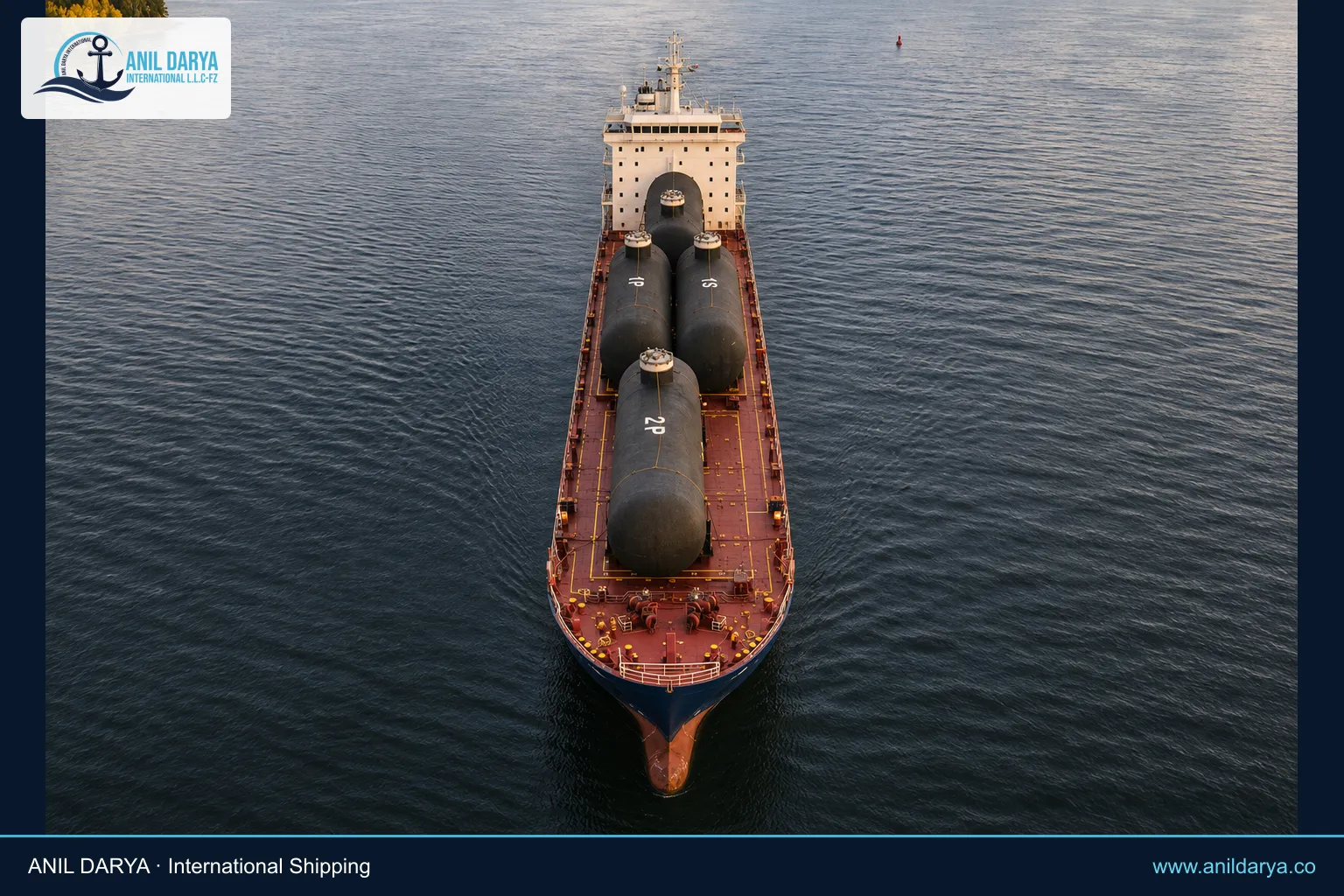
Heavy cargo is where Fujairah earns its place. The port lists mobile harbour cranes of 100 and 150 tons and a heavy package capacity of up to 1,000 tons on the berth and yard. Berth loading capacity is above 20 tons per square metre. Bonded warehousing and covered storage are also listed.
The port tariff sets three rules you should plan around:
- Heavy lift cargo that needs special handling from the ship's side, or special storage, is quoted separately. Do not assume a standard rate for a heavy piece.
- Ships must file a heavy lift list for any piece over 5 tons, so your weights must be right before arrival.
- Direct delivery, from ship's tackle straight onto a truck or the reverse, needs prior approval from the port and works only when no terminal equipment or storage is used.
Here is how we plan a heavy or out-of-gauge move:
- We collect the drawings, weights, centre of gravity and lifting points for each piece.
- We check which crane and berth fit the lift, and whether ship's gear is needed.
- We get the heavy lift handling quoted before the ship is fixed.
- We decide between direct delivery and yard storage, and apply for approval if direct delivery fits.
- We plan the road move from the quay, including permits and escorts where the size requires them.
Our breakbulk and project cargo service covers the full plan, from booking to final delivery.
Dry bulk cargo
Fujairah has five dry bulk and general cargo berths. Berths 5 and 6 have aggregate loaders, and the grain loader at SBB 2 discharges 1,200 tons an hour and loads 600 tons an hour for ships up to 90,000 DWT. Dibba Port adds two bulk berths with a 4,000 tons an hour loader for ships up to 120,000 DWT. For bulk shipments, see our dry and liquid bulk service.
RoRo, vehicles and livestock
Fujairah Terminals offers RoRo and cruise services, and the port tariff has a separate vessel category for car carriers, RoRo and livestock ships. Fujairah Terminals also has a livestock service under its concession. If you are shipping vehicles or self-propelled machinery, we confirm the RoRo call and the documents with the line first.
Oil and bunkering
The port is one of the world's top three bunkering hubs. Oil storage connected to the port has grown from 550,000 cbm in 1994 to almost 18 million cbm, and 15 storage terminal companies connect directly to the port. Oil cargo is handled through the oil berths and the VLCC jetty, not the container terminal.
Can you ship dangerous goods through Fujairah port?
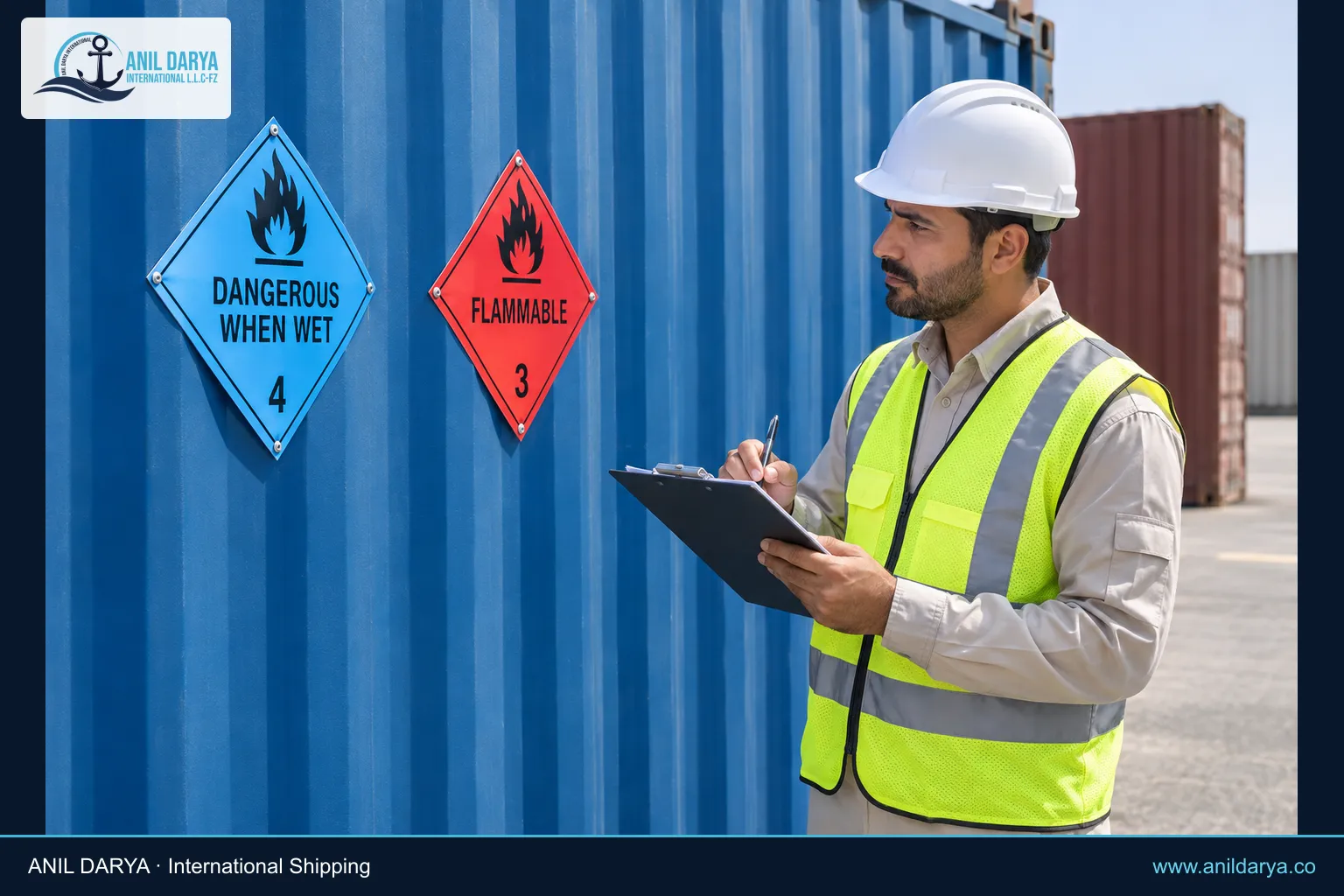
Yes, with planning. The port tariff is clear on two points. First, dangerous, hazardous or obnoxious cargo is received only by advance arrangement with the port authority. Second, handling follows the IMDG Code. Ships must also submit a Dangerous Cargo List for port operations, and the port can move cargo it judges likely to damage other cargo, at the owner's risk and cost.
So you cannot simply deliver a DG container to the gate and expect it to load. The tariff lists the nine IMDG classes. This is how we prepare each one:
| IMDG class (as listed in the port tariff) | What we check before booking |
|---|---|
| 1. Explosives | Carrier acceptance on that service and every approval needed before the box moves. Allow the most lead time. |
| 2. Gases, compressed, liquefied or dissolved under pressure | Cylinder or tank certification, and segregation from other DG in the same stow. |
| 3. Inflammable liquids | Flash point and packing group from the SDS, and correct packaging marks. |
| 4. Inflammable solids | Sub-class and any temperature or moisture limits in the SDS. |
| 5. Oxidising substances and organic peroxides | Temperature control needs and segregation from flammables. |
| 6. Poisonous and infectious substances | Packaging approvals and any import permit at destination. |
| 7. Radioactive substances | Carrier acceptance and the competent authority approvals for the shipment. |
| 8. Corrosives | Packaging compatibility and segregation from other classes. |
| 9. Miscellaneous dangerous substances | Exact UN number, as many lithium battery and environmental cargoes fall here. |
Then we work in this order:
- Check the UN number, class, packing group and any limits with you, using the SDS.
- Confirm the carrier accepts the cargo on that service.
- Prepare the DG declaration and make sure the container is packed, marked and placarded to IMDG rules.
- Arrange the advance approval with the port before the box moves.
See our dangerous goods shipping service for the classes we handle by sea and air, and our guide to dangerous goods classes for what each class means.
Customs and documents for Fujairah port shipping
The port tariff says the port operates as a duty free zone, and every cargo movement, whether transhipment or to the hinterland, is subject to customs rules. Customs duty is payable on all imported goods under the published tariff and regulations (Customs Ordinance 1983). In practice, cargo inside the port is not yet cleared. Duty and clearance apply when it leaves for the UAE market.
The documents you need depend on the cargo. Use this table as a starting point:
| Document | Container (FCL/LCL) | Breakbulk / project | Dangerous goods | Dry bulk |
|---|---|---|---|---|
| Commercial invoice and packing list | Yes | Yes | Yes | Yes |
| Bill of lading or sea waybill | Yes | Yes | Yes | Yes |
| Certificate of origin | When required | When required | When required | When required |
| Delivery order (imports) | Yes | Yes | Yes | Yes |
| Customs declaration (import or export) | Yes | Yes | Yes | Yes |
| Drawings, weights and lifting plan | Only for out-of-gauge | Yes | No | No |
| DG declaration and SDS | No | If the cargo is DG | Yes | If the cargo is DG |
| Import permit or product approval | For controlled goods | For controlled goods | Often | For controlled goods |
Documents the vessel agent files
You will not file these yourself, but they explain why your data must be right. On arrival, the ship or its agent gives the port the cargo manifests, stow plans, the dangerous cargo list, the transhipment cargo list, the heavy lift list for pieces over 5 tons and the refrigerated cargo list. A wrong weight or a missing DG entry on your booking ends up on these lists.
Insurance and uncollected cargo
The tariff states the port's charges do not include insurance for cargo, containers or ships. Arrange marine cargo insurance yourself, or agree who covers it under your Incoterm. The port can also sell cargo by public auction to recover unpaid dues after 6 months in port storage, so do not leave a shipment unclaimed while a dispute runs.
Warehousing and free zone links near the port
The port lists bonded warehousing and covered storage at Fujairah Terminals, and land lease is among the terminal's services. In June 2025, Fujairah Terminals signed an MoU with the Fujairah Free Zone Authority to share data and forecasts on container movement by road and sea. In May 2026, it signed three land lease agreements covering 130,000 sqm with Fujairah International Airport, the Fujairah Free Zone Authority and Al Dahra Agriculture Trading, to expand its logistics capacity. If you need storage near the quay, we check what is available for your cargo and dates.
Fujairah port working hours and vessel rules
Normal cargo working hours at the port, per the tariff:
| Day | Hours |
|---|---|
| Monday to Saturday (except Friday) | 07:00 to 12:00 and 13:00 to 16:00 |
| Friday | 07:00 to 12:30 and 14:00 to 16:30 |
| Sundays and public holidays | Not normal working hours |
Work outside these hours must be arranged in advance and overtime applies. Labour for work outside normal routines has to be ordered by 12:00 on the previous working day. Hours can change during Ramadan. If your truck or lift is planned for a Friday afternoon or a Sunday, we book it ahead.
For the ship side, owners must give the port 72 hours notice of arrival with draft, length and cargo details, and reconfirm the day before. Ships contact Fujairah Port Control on VHF channel 16. Pilotage is compulsory for all ships other than exempted vessels. These rules sit with the carrier, but they affect when your cargo is worked.
Fujairah port shipping step by step
Exports through Fujairah
- Send us the details. Commodity, HS code, weight, dimensions, origin, destination and ready date.
- We check the route. We confirm which lines and services call Fujairah for your lane, and whether another UAE port fits better.
- We book space. Container, breakbulk or DG, with any special approvals arranged first.
- We prepare the documents. Invoice checks, the export declaration and any DG or heavy lift paperwork.
- We arrange trucking and gate-in, inside working hours or with overtime booked.
- We confirm loading and send you the bill of lading.
Imports through Fujairah
- You share the bill of lading, invoice and packing list before the ship arrives.
- We check the HS codes and any permits for controlled goods.
- We collect the delivery order from the line once freight and charges are settled.
- We file the import declaration and handle any inspection.
- We arrange trucking from the quay to your door, or direct delivery where approved.
- We return empty containers on time to avoid detention.
Inland transport from Fujairah
Most cargo leaves Fujairah by road. The operator lists a 15-minute truck turnaround at the container terminal, and rail handling is among the services in its concession. For oversize cargo, road permits and escorts come before the cargo leaves the quay, so we start that work when the booking is made. We do not give fixed road transit times; they depend on the route, cargo size and permits.
Checklist before you ship
- HS code confirmed for every line on the invoice
- Weights and dimensions measured, not estimated
- Consignee details and import requirements checked at destination
- DG cargo: SDS ready and classification confirmed
- Heavy pieces: lifting points marked and drawings shared
- Incoterm agreed, so you know who pays port and clearance costs
- Cargo insurance in place
- Delivery or pickup planned inside port working hours
Common mistakes to avoid
- Assuming every line calls Fujairah. Check the service first. Many lanes run through other UAE ports.
- Delivering DG cargo without approval. The port needs advance arrangement. Without it, the box waits.
- Using a standard rate for heavy lifts. Heavy lift handling is quoted separately by the port.
- Late documents. A missing certificate or wrong HS code delays clearance and adds storage costs.
- Not planning the road leg. Oversize cargo needs permits before it leaves the quay.
- Booking trucks for a Sunday or late Friday without arranging overtime.
- Skipping insurance because the port handles the cargo. The port's charges do not cover it.
Fujairah or another UAE port: which should you use?
| Your cargo or need | Start with |
|---|---|
| Cargo for the east coast emirates | Fujairah |
| Heavy lift or project pieces that suit a multipurpose quay | Fujairah, then compare with the other ports for your lane |
| Aggregates, clinker or grain | Fujairah or Dibba bulk berths |
| Oil, products and bunkers | Fujairah oil berths |
| Widest choice of container lines and sailings | Jebel Ali port shipping guide |
| Cargo for Abu Dhabi | Khalifa Port in Abu Dhabi |
| Cargo for Sharjah and nearby emirates | Sharjah port options |
| Cargo for Ras Al Khaimah | Saqr Port in Ras Al Khaimah |
If you are not sure, our Dubai freight forwarding team will compare the ports for your lane and cargo.
How the Port of Fujairah developed
| Year | Milestone |
|---|---|
| 1978 | Construction started, with a first quay of 370 m |
| 1983 | Full operations began |
| 1994 | Oil storage capacity of 550,000 cbm |
| 2016 | VLCC jetty in full operation |
| 2017 | 35-year concession with AD Ports; Fujairah Terminals established |
| 2024 | Dibba Port starts commercial operations; total quay length passes 9.5 km |
Frequently asked questions
Where is the Port of Fujairah?
The Port of Fujairah is on the UAE's east coast, on the Gulf of Oman. It has operated fully since 1983.
Who operates the container terminal at Fujairah?
Fujairah Terminals, part of AD Ports Group, runs the container and general cargo terminal under a 35-year concession signed in June 2017.
How deep are the container berths at Fujairah?
The container and general cargo berths have 15 m depth (CD). The port lists a maximum arrival draught of 13 m and a maximum sailing draught of 13.5 m.
Is Fujairah port a free zone?
The port tariff says the port operates as a duty free zone. All cargo movements, transhipment or to the hinterland, are still subject to customs, and duty applies to goods imported into the UAE.
Can Fujairah port handle heavy lift and project cargo?
Yes. The port lists mobile harbour cranes of 100 and 150 tons and heavy package capacity of up to 1,000 tons on berth and yard. Heavy lift handling is quoted separately.
Can I ship dangerous goods through Fujairah?
Yes, but only by advance arrangement with the port authority, and handling follows the IMDG Code. We prepare the declaration and arrange the approval before the cargo moves.
What are the working hours at Fujairah port?
Normal cargo hours are 07:00 to 12:00 and 13:00 to 16:00 Monday to Saturday, with different Friday hours. Sundays and public holidays need overtime arranged in advance.
What documents do I need to import through Fujairah port?
You need a commercial invoice, packing list, bill of lading, delivery order and an import declaration. DG, heavy lift and controlled goods need extra documents.
Do you work as a freight forwarder for Fujairah shipments?
Yes. As a freight forwarder for Fujairah cargo, we book space, prepare documents, clear customs and arrange trucking. We do not operate a facility at the port.
Is Fujairah a good option for LCL cargo?
It depends on your lane. We check whether a consolidation service runs through Fujairah, and if not, we suggest a better UAE port for your shipment.
Get a quote for Fujairah port shipping
Send us your cargo details through our freight rate inquiry form and we will check the route, equipment and port approvals for you. For heavy lift or DG questions, contact our team directly at info@anildarya.co or +971 50 953 2080.
Sources
- Port of Fujairah: Our Story
- Fujairah Ports Authority: Infrastructure Overview
- Fujairah Ports Authority: Container, General Cargo, Cruise, Ro-Ro and Livestock
- AD Ports Group: Fujairah Terminals
- AD Ports Group: Fujairah Terminals and Fujairah Free Zone Authority sign MoU (June 2025)
- AD Ports Group: Fujairah Terminals signs land lease agreements (May 2026)
- Port of Fujairah Tariff, 1 February 2026
Reviewed: 9 November 2026