
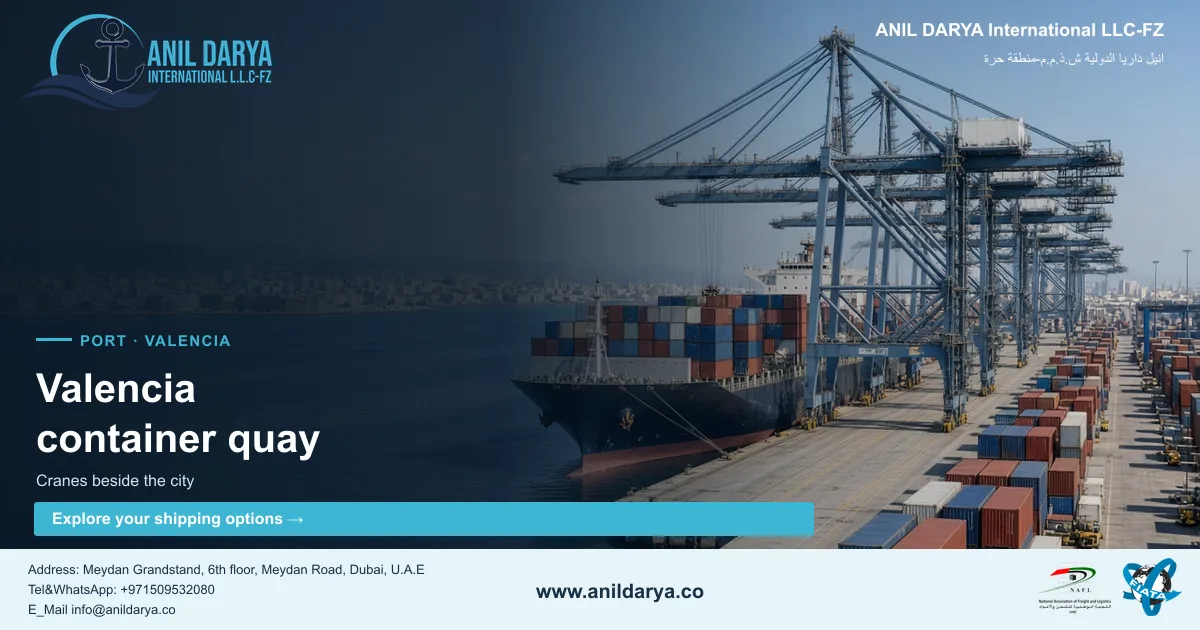
Port of Valencia shipping covers the busiest container gateway in Spain: Valenciaport handled a record 5.66 million TEU in 2025 and says it carries around 40% of Spain's containerised sea trade. The port is run by the Port Authority of Valencia together with the ports of Sagunto and Gandia, and cargo is cleared by the Spanish Tax Agency under EU customs law. This guide covers the terminals, cargo types, dangerous goods rules, customs and how we move your cargo from Dubai to Valencia. We ship both from Dubai to Valencia and from Valencia to Dubai.
Port of Valencia guide: key facts at a glance
| Item | Detail |
|---|---|
| Port authority | Port Authority of Valencia (PAV), trading as Valenciaport |
| Ports in the group | Valencia, Sagunto and Gandia, along 80 km of the Mediterranean coast |
| UN/LOCODE | ESVLC |
| Customs authority | Spanish Tax Agency (AEAT), Customs and Excise Department |
| Container terminals in Valencia | CSP Iberian Valencia Terminal, MSC Terminal Valencia, APM Terminals Valencia |
| Containers handled in 2025 | 5,662,661 TEU, up 3.41% on 2024 |
| Full import containers, 2025 | 1,051,784 TEU, the first year above one million |
| Full export containers, 2025 | 919,570 TEU, up 5.56% |
| Total cargo, 2025 | 80,061,993 tonnes |
| Shipping network | Over 100 regular lines to over 1,000 ports |
| Share of Spain's container trade | Around 40% |
| Rail traffic, January to July 2026 | 172,328 TEU, up 17.97% |
| Logistics zone | ZAL of 68 hectares next to the port |
| Import VAT in Spain | 21% general rate, 10% and 4% for listed goods |
| Valencia to Dubai | Exporter or its representative files the export DUA with AEAT; UAE duty 5% of CIF for most goods plus 5% import VAT |
Where is the Port of Valencia and who runs it?
The Port of Valencia is on Spain's east coast, next to the city of Valencia. It is a state-owned port managed by the Port Authority of Valencia, which also runs Sagunto to the north and Gandia to the south. Valenciaport describes the three as one system: Valencia for containers, vehicles and cruises, Sagunto for steel, vehicles and bulk, and Gandia for general cargo.
For shippers, the location matters most for inland reach. Valenciaport lists a toll-free motorway to Madrid, and its container terminals connect by rail to the dry ports of Madrid, Zaragoza and Bilbao. The CSP Iberian terminal release describes a hinterland within a 350 km radius that generates 55% of Spanish GDP. If your consignee is in the Valencia region, Madrid or central Spain, Valencia is often the closest sea gateway.
Which terminals does the Port of Valencia have?
Over 70% of the goods handled at Valenciaport travel in containers. The container terminal on your booking decides where your truck or train goes, so check it on the arrival notice.
Container terminals in Valencia
| Terminal | Operator | What the operator or port publishes |
|---|---|---|
| CSP Iberian Valencia Terminal | Public container terminal on the Principe Felipe quay | 2.3 km of quay, 145 hectares, own rail terminal linked to Madrid, Zaragoza and Bilbao dry ports, automatic gate |
| MSC Terminal Valencia | MSC, part of the Terminal Investment Limited (TIL) group | One of MSC's main hubs in the Western Mediterranean |
| APM Terminals Valencia | APM Terminals, part of A.P. Moller-Maersk | Levante quay 1,230 m (566 m at 17 m depth, 350 m at 12 m, 314 m at 9.5 m); Llovera quay 430 m at 16 m |
| North Terminal | Being developed by the Port Authority | New container terminal focused on electrification |
Your carrier's service decides the terminal. Each terminal handles import, export and transshipment boxes, both full and empty.
Sagunto and Gandia
Sagunto has traditionally been the steel port of the group, and Valenciaport calls it the main iron and steel cluster in Spain. It now also handles vehicles, with about 50 hectares used for vehicle logistics, plus natural gas, solid bulk and short sea containers. Two container-capable terminals operate there: Intersagunto Terminals and Noatum Terminal Sagunto, which also handles ro-ro cargo.
Gandia is a general cargo port. It specialises in paper reels and pulp, imported timber and local agricultural products.
Ro-ro, ferries and the rail motorway
Valenciaport says it handles more than a fifth of Spain's ro-ro road traffic. Grimaldi runs ro-ro services from Valencia and Sagunto to Italy and other Mediterranean ports, and Balearia and GNV run ferries with freight to the Balearic Islands. A rail motorway terminal on the eastern quay loads lorry semi-trailers onto trains of up to about 750 m, with four Valencia to Madrid services a week and capacity for over 10,000 lorries a year.
Port services
| Service area | What Valenciaport lists |
|---|---|
| Technical-nautical | Pilotage, towage, mooring and unmooring |
| Cargo handling | Loading, unloading, stevedoring, transit and transshipment |
| Commercial | Shipping agents, bunkering including LNG, provisions, road transport |
| Logistics | ZAL logistics zone of 68 hectares for containerised cargo |
| Digital | ValenciaportPCS platform for port calls and schedules |
| Security | Container Security Initiative risk analysis, radiation detectors at the gates |
When should you choose Valencia over another Spanish port?
Valencia is not always the right discharge port. Pick the port by where the cargo ends up and what it is, then compare the freight.
| Your situation | Port to consider | Why |
|---|---|---|
| Consignee in the Valencia region, Madrid or central Spain | Valencia | Short road leg, rail links to Madrid and Zaragoza dry ports |
| Steel coils, plates or long products | Sagunto | The group's steel port, with vehicle and bulk handling |
| Paper reels, pulp or timber | Gandia | General cargo port built around these goods |
| Consignee in Catalonia or the north-east | Barcelona | Usually a shorter truck leg than from Valencia |
| Consignee in Andalusia | Algeciras | Southern gateway |
| Consignee in the Canary Islands | Las Palmas | Different tax rules apply there, not mainland VAT |
If two ports are close on freight, choose the one with the cheaper and faster inland leg. A few days saved at sea are easily lost on a long truck move or a missed rail slot.
What cargo can you ship through the Port of Valencia?
Here is how each main cargo type usually moves through the Valencia port system.
| Cargo type | Where it moves | What to plan |
|---|---|---|
| General goods in containers | FCL or LCL through the three Valencia container terminals | Terminal on the booking, free time, truck or rail slot |
| Chilled and frozen food | Reefer containers | Set temperature, health certificates, CHED pre-notification |
| Vehicles | Ro-ro in Valencia and Sagunto, or cars in containers | Vehicle documents, registration rules in Spain |
| Steel and metal products | Sagunto, breakbulk or flat racks | CBAM status of the importer, lifting points, lashing |
| Paper, pulp, timber | Gandia general cargo berths | Bundle sizes, weather protection |
| Oversized and heavy-lift pieces | Breakbulk or flat racks | Drawings, lift plan, road permits |
| Chemicals and other DG | IMDG containers under Spanish port admission rules | Admission request 48 hours before arrival |
Port of Valencia traffic: who trades through it?
In 2025 Valenciaport handled 5,662,661 TEU, a record. Full import containers passed one million TEU for the first time, and China supplied 50.73% of them. The United States took 14.66% of full export containers. China, Italy and the United States were the top three trade partners for the year.
In the first half of 2025, Valenciaport's top partners by TEU were China (386,562), the United States (195,534), Algeria (160,993), Turkey (127,292) and India (81,795). Valencia is a busy import and export port as well as a transshipment hub, which is why so many deep-sea services call there.
| Measure | 2025 figure |
|---|---|
| Total containers | 5,662,661 TEU (+3.41%) |
| Full import containers | 1,051,784 TEU |
| Full export containers | 919,570 TEU (+5.56%) |
| Total cargo | 80,061,993 tonnes (-0.75%) |
| Regular ferry passengers | 861,748 |
| Cruise passengers | 799,050 |
FCL and LCL container shipping to Valencia
Most cargo through Valencia moves in containers. You have two main options.
- FCL (full container load). You book a whole 20ft, 40ft or 40ft high cube. It suits larger shipments and cargo you do not want handled with other goods.
- LCL (less than container load). Your cargo shares a container and is unpacked at a container freight station in Valencia. It suits small volumes but adds handling, and your release also depends on the other cargo in the box being cleared.
With LCL imports, send documents early and make sure carton marks match the packing list. The break-even between the two is often lower than people think. Our guide to FCL vs LCL costs walks through the maths, and our sea freight service page explains what we book. If you are unsure, ask us to price both.
Breakbulk, vehicles and project cargo through Valencia
Steel, machinery and oversized pieces often move through Sagunto or on flat racks through the Valencia container terminals. Cargo that fits a container but is too tall or wide goes on flat racks or open tops. Cargo that does not fit a container at all moves as breakbulk on a general cargo or heavy-lift vessel. Our guide to flat rack, open top and out-of-gauge cargo explains the choice.
When you ship project cargo to Valencia with us, we plan it in this order:
- Collect drawings, dimensions, weights and centre of gravity for each piece.
- Choose the vessel type: flat rack on a container ship, or breakbulk or heavy-lift tonnage.
- Agree lifting, lashing and securing with the carrier.
- Send the piece list to the consignee's agent so the discharge berth and road permits in Spain can be planned.
- Line up customs before arrival so the cargo leaves the quay quickly.
A useful decision rule: if a piece fits a 40ft flat rack by size and weight, a container service usually gives you more sailings. If it does not, the breakbulk sailing date drives the whole plan. See our break bulk and project cargo service.
Dangerous goods at the Port of Valencia
Valencia handles IMDG dangerous goods, but Spanish ports add their own admission step on top of the IMDG Code. Valenciaport lists Royal Decree 145/1989, the national rules for admission, handling and storage of dangerous goods in ports, among its regulations.
| Rule under Royal Decree 145/1989 | What it means for you |
|---|---|
| Admission request (Art. 13) | The shipper or consignee asks the port director for admission 48 hours before the goods arrive |
| Short voyages (Art. 13.2) | If the ship leaves its last port less than 48 hours before arrival, the request is made as soon as the voyage is known |
| Documents (Art. 14) | DG declaration, emergency instructions, number and type of packages, vessel details |
| Special authorisation (Art. 15) | Certain goods, such as explosives of divisions 1.1 to 1.3 and radioactive material, need separate written approval |
| Containers (Art. 16) | Maximum gross weight shown, a CSC plate for containers built after 1 January 1984, and a stowage certificate |
The decree dates from 1989, so treat the table as a planning guide and confirm current practice with the terminal and the consignee's agent. What you need to provide for any DG booking:
- A correct UN number, proper shipping name, class and packing group.
- A Safety Data Sheet for each product.
- A Dangerous Goods Declaration signed by a trained person.
- UN-approved packaging, marks and labels, and placards on the container.
Our dangerous goods shipping team checks the paperwork and the carrier's acceptance before you commit to a sailing, and sends the DG data to Spain early so the admission request is on time.
Customs clearance at the Port of Valencia
Customs in Valencia is run by the Spanish Tax Agency (AEAT) under EU law. Declarations are filed electronically by the importer or its customs representative, and each one gets a control channel: green (release once duty is paid or guaranteed), orange (document check) or red (document check and physical inspection).
What happens when your container arrives in Valencia?
- The vessel berths at the terminal on your booking and the container is discharged into the yard.
- The goods are in temporary storage under customs control until a customs procedure is chosen, usually release for free circulation and home use.
- The customs representative files the declaration with the AEAT and the system gives it a green, orange or red channel.
- For food, plant or animal products, the border control post checks run in parallel, based on the CHED sent before arrival.
- Duty and VAT are paid or deferred, customs releases the goods, and the carrier's release lets the box leave the terminal.
- The container leaves by truck, by train from the terminal's rail siding, or goes to the ZAL for unpacking.
Every day between discharge and gate-out counts against the terminal's free time, so have the declaration ready before the ship berths.
What does the importer need before the ship arrives?
- An EORI number. The European Commission says it is mandatory for clearing all customs operations. Spanish companies whose tax number does not start with N, M, X or Y get one automatically with their first declaration. Others apply through the AEAT.
- A customs representative, unless the importer files its own declarations.
- An Entry Summary Declaration in the EU's ICS2 system, filed by the carrier and, where needed, by the forwarder holding house-level data, before arrival.
Which documents does Spanish customs need?
| Cargo type | Core documents | Usually also needed |
|---|---|---|
| General cargo (FCL or LCL) | Commercial invoice, packing list, bill of lading, certificate of origin | Importer's EORI and VAT number |
| Food, plants, products of animal origin | Core set | Health or phytosanitary certificates and a CHED sent in advance to the border control post |
| Steel, aluminium, cement, fertilisers | Core set | Authorised CBAM declarant status if imports exceed 50 tonnes a year |
| Dangerous goods | Core set | DG declaration, SDS, port admission request |
| Vehicles | Core set | Ownership and technical documents |
How much is customs duty and import VAT?
Duty is the EU's common rate for the goods code, found in the TARIC database by code and origin. TARIC also shows anti-dumping duties, quotas and other measures. The EU has no trade agreement in force with the UAE (talks were launched on 28 May 2025), so UAE-origin goods pay the normal third-country rate.
Import VAT in mainland Spain is 21% for most goods, 10% for most food and 4% for goods such as bread, milk, fresh fruit and vegetables, books and medicines for human use. A VAT-registered importer can opt, with a census declaration filed in November, to defer import VAT to its Modelo 303 return instead of paying it at clearance.
CBAM for metal cargo
From 1 January 2026, an importer bringing more than 50 tonnes a year of CBAM goods (iron and steel, aluminium, cement, fertilisers, hydrogen, electricity) into the EU must be an authorised CBAM declarant. Customs checks this before release, so a steel or aluminium shipment to Valencia or Sagunto can be held if the importer is not authorised.
Getting cargo out of the port: rail and road
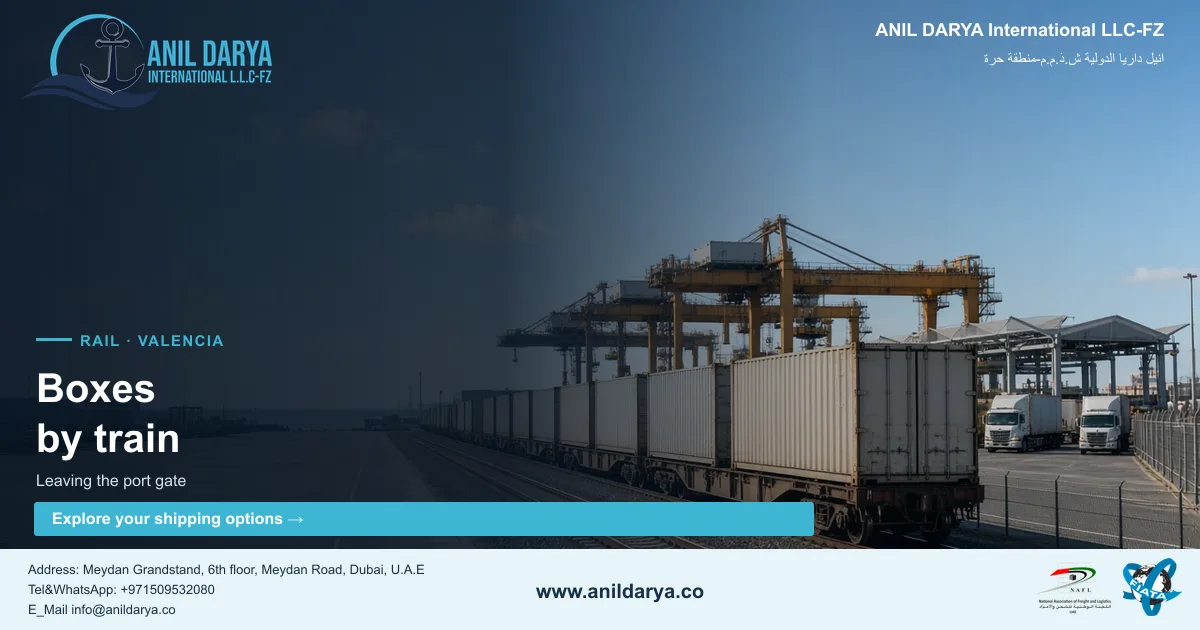
Valencia has strong inland links, which is a big part of why it suits importers in Madrid and central Spain. The Port Authority manages the port's railway infrastructure under an agreement with Spain's rail network administrator, ADIF.
| Option | What is published | Best for |
|---|---|---|
| Container rail | 172,328 TEU moved by rail from January to July 2026, up 17.97%; CSP Iberian links to Madrid, Zaragoza and Bilbao dry ports | Full containers to inland Spain |
| Rail motorway | Four Valencia to Madrid trains a week, over 10,000 lorries a year | Trailers and ro-ro cargo |
| Road | Toll-free motorway to Madrid | Short distances and urgent deliveries |
| ZAL logistics zone | 68 hectares next to the port | Unpacking, storage and distribution near the quay |
A simple rule: for a full container going to Madrid or Zaragoza, ask the consignee's agent to price rail against road. For anything going within the Valencia region, road is usually simpler.
How to ship from Dubai to the Port of Valencia: step by step
Shipping from Dubai to Valencia usually loads at Jebel Ali. Our Jebel Ali port shipping guide covers the export side there. Fluent Cargo's schedule data lists a quickest Jebel Ali to Valencia option of 30 days 19 hours with one transfer, sailing every 2 to 4 weeks, and Khor Fakkan to Valencia services every 1 to 2 weeks. Check the actual schedule and arrival date on your booking.
[AMIR-FACT: the carriers or services we actually book from Jebel Ali to Valencia, which Valencia terminal each uses, and our typical port-to-port days]
- Agree the Incoterm with your buyer, so both sides know who books the freight and who clears in Valencia.
- Check the goods code in TARIC for duty and any measure such as CBAM, anti-dumping or a health check.
- Confirm the importer's EORI number and its customs representative in Spain.
- Send us the cargo details: goods, HS codes, weight, volume, packing and the delivery address in Spain.
- We book space with the carrier and send precise goods data for the ICS2 filing.
- We arrange UAE trucking, the export declaration and loading at Jebel Ali.
- For DG, we send the data to the consignee's agent so the port admission request goes in 48 hours before arrival.
- We share the bill of lading, invoice, packing list and certificate of origin with the agent before the vessel arrives.
- The agent files the declaration, duty and VAT are paid or deferred, and the box leaves Valencia by road or rail.
How to ship from the Port of Valencia to Dubai
We also handle the other direction: shipping from Valencia to Dubai, with arrival at Jebel Ali, Khalifa Port or Sharjah port. We book the space with the carrier and run the UAE side. The Spanish export papers stay with the shipper or its Spain agent, because we have no office in Spain.
The Spain export side
- Export declaration. The exporter, or a customs representative acting for it, files the export declaration with the Spanish Tax Agency (AEAT) on the DUA model, usually electronically. AEAT checks it through its risk-analysis system and then releases the goods.
- EU exit. Under EU rules the declaration goes to the customs office where the exporter is established or where the goods are packed or loaded, and the office of exit supervises the departure from the EU.
- Delivery to the terminal. The shipper or its trucker, or a rail operator from inland Spain, brings the box to the Valencia terminal named on the booking.
The UAE import side
The import declaration goes to Dubai Customs. A company with a Dubai Customs business code can file it, or a licensed clearing agent with the owner's authorisation. Dubai Customs asks for the commercial invoice, packing list, certificate of origin and any permit from the authority that controls restricted goods, and the carrier's agent needs the bill of lading before it issues the delivery order. Customs duty in Dubai is 5% of the CIF value for most goods, with 50% on alcohol and 100% on cigarettes. Import VAT is 5% of the customs value, and a VAT-registered importer accounts for it on its VAT return through the reverse charge.
- Send us the shipper's details in Spain, the cargo, the HS code, the Incoterm and the UAE delivery address.
- We book space from Valencia to Jebel Ali, Khalifa Port or Sharjah and send the booking and cut-offs to the shipper.
- The shipper or its trucker collects the empty, stuffs it and delivers the box to the Valencia terminal on the booking before the cut-off.
- The shipper or its Spanish customs representative files the export declaration with AEAT, and customs releases the goods.
- We check the draft bill of lading against the invoice and packing list before the carrier issues it.
- We file the UAE import declaration before the ship arrives.
- We arrange payment of the duty and VAT.
- We collect the delivery order from the carrier's agent in the UAE.
- We truck the cargo to your site and return the empty container inside free time.
[AMIR-FACT: the carriers we actually use from Valencia to Jebel Ali/Khalifa/Sharjah and our real transit days in this direction]
Checklist for Port of Valencia shipping
- Importer's EORI number confirmed and on the documents.
- HS code and origin checked in TARIC.
- VAT rate known and deferral option checked with the importer.
- CBAM status checked for steel, aluminium or fertiliser cargo.
- Health certificates and CHED arranged for food, plant or animal products.
- DG admission data sent to Spain at least 48 hours before arrival.
- Terminal on the booking known, and rail or road delivery booked.
- Free time at the terminal known, with clearance planned before it ends.
- Cargo insurance arranged if the Incoterm puts the risk on you.
Common mistakes at the Port of Valencia
| Mistake | What happens | How to avoid it |
|---|---|---|
| Importer has no EORI | The declaration cannot be filed and storage starts | Confirm the EORI before the cargo sails |
| Vague goods descriptions | ICS2 queries and holds | Use precise descriptions and HS codes at booking |
| Late DG admission request | Container not admitted on time | Send DG data with the booking |
| Missing CHED for food | Cargo held at the border control post | Pre-notify before arrival |
| Ignoring CBAM on steel or aluminium | Release blocked until the importer is authorised | Check the 50-tonne rule early |
| Booking road when rail fits better | Higher inland cost to Madrid or Zaragoza | Compare both for full containers |
Clearance delays turn into storage and container charges fast. Our note on demurrage and detention shows how they build up.
Frequently asked questions
Who operates the Valencia port?
The Port Authority of Valencia, which trades as Valenciaport, runs the Port of Valencia together with the ports of Sagunto and Gandia. Container terminals inside the port are run by CSP Iberian, MSC (through TIL) and APM Terminals.
How long does shipping from Dubai to Valencia take?
Fluent Cargo's schedule data lists a quickest Jebel Ali to Valencia option of 30 days 19 hours with one transfer. Check the actual sailing and arrival date on your booking.
How many containers does the Port of Valencia handle?
Valenciaport handled 5,662,661 TEU in 2025, a record and 3.41% more than in 2024. Full import containers passed one million TEU for the first time.
How many container terminals does Valencia have?
Three are working today: CSP Iberian Valencia Terminal, MSC Terminal Valencia and APM Terminals Valencia. A new North Terminal is being developed by the Port Authority.
What documents do I need to clear cargo at Valencia?
You need a commercial invoice, packing list, bill of lading and certificate of origin, plus the importer's EORI number. Food, DG and CBAM goods need extra certificates or approvals.
What is the import VAT rate at the Port of Valencia?
Import VAT in Spain is 21% for most goods, 10% for most food and 4% for basics such as bread, milk, fresh fruit and medicines for human use. Customs duty depends on the goods code in TARIC.
Can I ship dangerous goods to Valencia?
Yes. Under Royal Decree 145/1989, the shipper or consignee must request admission of the goods from the port director 48 hours before arrival, with the DG declaration and emergency instructions.
Does the EU have a trade agreement with the UAE?
Not yet. The EU and the UAE launched free trade talks on 28 May 2025 and held a first round on 24 June 2025, but no agreement is in force. Until one is, UAE-origin goods entering at Valencia pay the normal EU third-country duty.
Can containers leave Valencia by rail?
Yes. Valenciaport moved 172,328 TEU by rail from January to July 2026, and the CSP Iberian terminal has rail links to the dry ports of Madrid, Zaragoza and Bilbao.
Can you ship from Valencia to Dubai?
Yes. We book space from Valencia to Jebel Ali, Khalifa Port or Sharjah, the shipper or its Spanish representative files the export declaration with AEAT, and we clear the cargo through UAE customs and deliver it. Most goods pay 5% customs duty on the CIF value plus 5% import VAT.
Get a quote for Port of Valencia shipping
Send us your cargo details and we will come back with a routing and a price for shipping to the Port of Valencia. Use our freight rate inquiry form, or contact our team if you want to talk through a breakbulk, DG or steel shipment first. You can also read more about our Dubai freight forwarding team.
Sources
- Valenciaport: Container traffic grew 3.4% in 2025 (23 January 2026)
- Valenciaport: 2025 economic results and traffic figures (9 February 2026)
- Valenciaport: First-half 2025 traffic and trade partners
- Valenciaport: Containers (terminals, share of Spanish trade)
- Valenciaport: APM Terminals Valencia (quays and depths)
- Valenciaport: CSP Iberian Valencia Terminal
- Valenciaport: Port of Sagunto
- Valenciaport: Port of Gandia
- Valenciaport: Ro-ro and motorways of the sea
- Valenciaport: Maritime and land connections
- Valenciaport: Port and commercial services
- Valenciaport: Logistic services (ZAL)
- Valenciaport: Rail services
- Valenciaport: Rail traffic to July 2026
- Valenciaport: Safety and security
- Valenciaport: Regulations
- BOE: Royal Decree 145/1989 on dangerous goods in ports
- Wikipedia: Port of Valencia (UN/LOCODE)
- AEAT: Customs declaration and control channels
- AEAT: EORI registration
- European Commission: EORI number
- AEAT: VAT rates 2026
- AEAT: Deferring import VAT
- European Commission: TARIC
- European Commission: EU-UAE agreement negotiations
- European Commission: ICS2 for maritime transport
- European Commission: CBAM definitive regime
- EUR-Lex: Regulation (EU) 2017/625 (border control posts, CHED)
- Fluent Cargo: Dubai to Valencia schedules
- Agencia Tributaria: Export procedure (export customs declarations, DUA model, risk analysis)
- European Commission: What is exportation (export declaration, office of export, office of exit)
- Dubai Customs: Submit customs declaration (invoice, packing list, certificate of origin, permits)
- Dubai Customs: FAQ (customs business code, clearing agents with owner authorisation)
- UAE Government portal: Customs duty (5% of CIF, alcohol 50%, cigarettes 100%)
- Federal Tax Authority: VAT guide (5% import VAT on the customs value, reverse charge)
Reviewed: 10 November 2026