
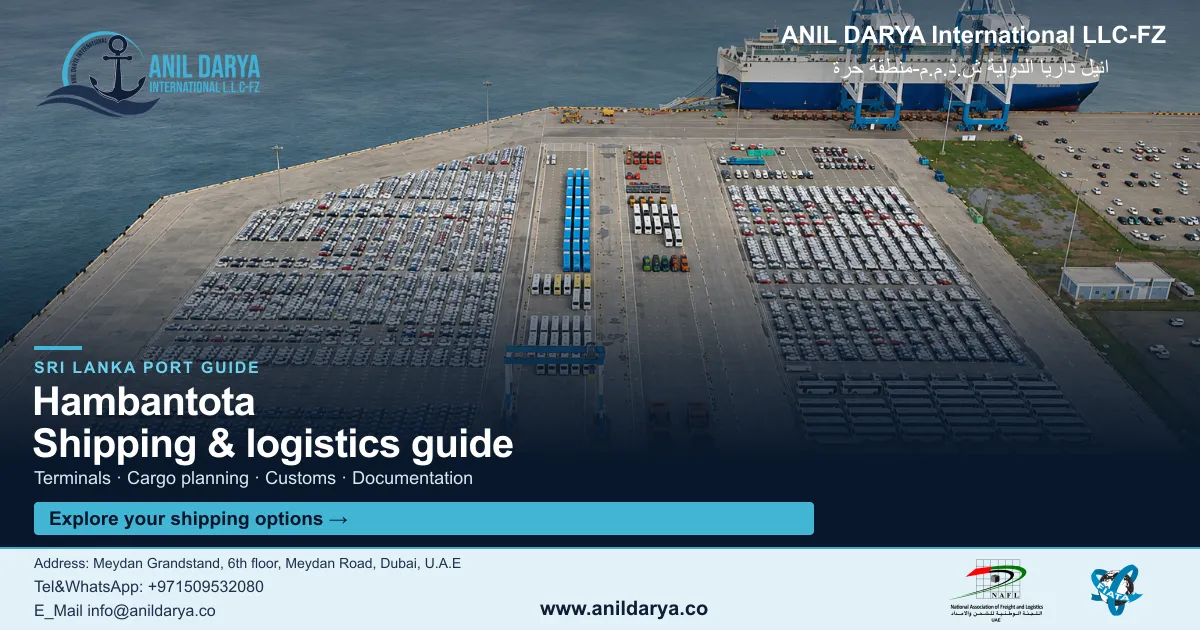
Hambantota port shipping is mostly about vehicles, transshipment containers, bulk and breakbulk, handled at a deep-water port on Sri Lanka's south coast. The port is run by Hambantota International Port Group (HIPG), all berths but three have 17 m alongside, and Sri Lanka Customs clears cargo through its own office inside the port. This guide covers the berths, the Ro-Ro and container rules, port free time, customs at Hambantota and how we ship your cargo there from Dubai. We ship in both directions: from Dubai to Hambantota, and from Hambantota to Dubai with clearance in the UAE.
Hambantota port shipping: key facts at a glance
| Item | Detail |
|---|---|
| Port operator | Hambantota International Port Group (HIPG), with marine services by Hambantota International Port Services (HIPS) |
| Ownership model | Public-private partnership between Sri Lanka Ports Authority (SLPA) and China Merchants Port Holdings |
| Customs | Sri Lanka Customs, Hambantota International Port (HIP) office |
| Hambantota to Dubai | CusDec lodged in Sri Lanka by the exporter or its CHA; Dubai Customs declaration on arrival at Jebel Ali, Khalifa Port or Sharjah |
| UN/LOCODE | LKHBA |
| Location | South coast, 164 km southeast of Colombo, about 10 nautical miles from the East-West shipping lanes |
| Berths and quay | 14 berths, 3,660 m of quay |
| Depth alongside | 17 m at 11 berths, 12.8 m at the two feeder berths, 5 m at the small craft berth |
| Approach channel | 1,386 m long, 210 m wide, 17.5 m deep, single lane |
| Port area | 11.92 sq km of land and water |
| Containers handled | 428,036 TEU in 2025, up from 53,169 TEU in 2024 |
| Total cargo in 2025 | 8.24 million tonnes, up 175% |
| Vehicles handled in 2025 | 726,153 |
| Monthly records (June 2026) | 90,219 vehicles and 80,325 TEU |
| Cargo types | Containers, Ro-Ro vehicles, dry bulk, breakbulk and project cargo, LPG, bunker fuel, cruise |
| Terminal hours | 24 hours, every day |
Where is Hambantota port and who runs it?
The port sits at the southern tip of Sri Lanka, 164 km southeast of Colombo and 270 km south of Trincomalee. Port data lists Hambantota airport (HRI) at 40 km and Colombo airport (CMB) at 235 km, which matters if you plan to split a shipment between sea and air.
HIPG runs the terminals: berth planning, stevedoring, yards, gates and billing. HIPS runs port control, mooring, security and the pass office. Sri Lanka Customs has its own HIP office in the port, so vessel reports, sufferance and cargo release are handled there rather than in Colombo.
A simple rule for your consignee: Hambantota suits sites in the south of the island. If the cargo is going to Colombo, the Western Province or the north, compare the truck leg against discharge at Colombo before you book.
Berths, depth and marine access at Hambantota
HIPG publishes a full berth list. This is the table to check before you fix a vessel or ask a carrier which berth your cargo will use.
| Berth | Length | Depth (chart datum) |
|---|---|---|
| Small craft berth | 105 m | 5 m |
| General purpose berths 1 and 2 | 300 m each | 17 m |
| Service berth 3 | 208 m | 17 m |
| Multipurpose berths 4, 5 and 6 | 279.5 m each | 17 m |
| Feeder berths 7 and 8 | 230 m each | 12.8 m |
| Container berths 9, 10 and 11 | 279.5 m each | 17 m |
| Oil berths North and South | 310 m and 300 m | 17 m |
Ships enter through a 1,386 m single-lane channel, 210 m wide and 17.5 m deep, and turn in a 600 m turning circle. HIPS runs four tugs of 65 tonnes bollard pull each and a pilot boat. Port data gives 100,000 dwt and 17 m draft as the limits for product and gas tankers.
What this means for you: depth is rarely the problem at Hambantota. Berth allocation is. HIPG allocates berths first come, first served, with set priorities for ships in distress, cruise and naval ships, and with containers and pure car carriers ahead of other cargo ships. A breakbulk or bulk ship can wait for a berth when car carriers are busy.
What cargo can you ship through Hambantota?
HIPG lists container, Ro-Ro, dry bulk, breakbulk and project cargo, LPG, petrochemicals, bunkering and cruise services. Here is how each one usually moves and what to plan.
| Cargo type | How it moves | What to plan |
|---|---|---|
| New and used vehicles | Ro-Ro on car carriers, or cars in containers | Vehicle documents, CHA appointment, 10 free days |
| Machinery and high and heavy units | Ro-Ro on MAFI trailers, or breakbulk | Weights, dimensions, separate report to the port |
| General goods in containers | FCL on carrier services that call Hambantota | Carrier routing, 3 clear free days on import |
| Steel, equipment, project cargo | Breakbulk at the general and multipurpose berths | Lift plan, crane capacity, 7 free days on import |
| Bagged and dry bulk (cement, fertiliser, grain) | Bulk or bagged cargo at the general berths | Discharge rate, irritant cargo rules, trucks |
| Chemicals and other DG | IMDG containers with port approval | Prior approval before loading, 48-hour free window |
| LPG and fuel | Oil berths and the tank farm | Receiver's terminal arrangements |
Ro-Ro and vehicle shipping at Hambantota
Vehicles are the cargo Hambantota is best known for. The port handled 726,153 vehicles in 2025, and set a monthly record of 90,219 in June 2026. A six-hectare Ro-Ro yard opened in March 2026 as part of Phase II, raising parking to 4,500 units per terminal space. HIPG's published Ro-Ro capacity of 600,000 units a year is older than these volumes, so treat yard space as something to confirm when volumes peak.
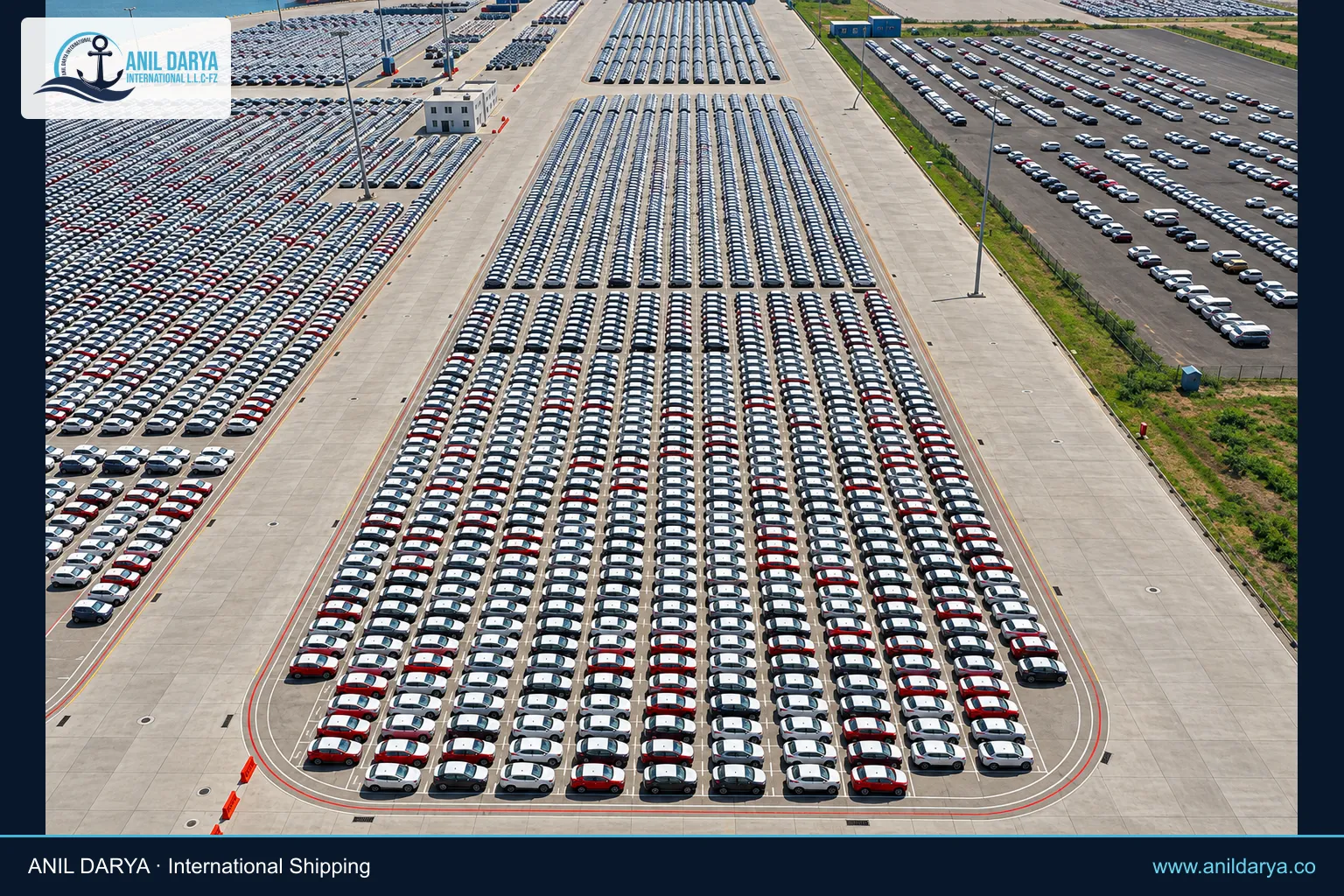
How a vehicle import is released
- The ship discharges and HIPG carries out a 360-degree survey of every import and transshipment vehicle. The survey does not cover accessories, the roof or the undercarriage.
- A tally report is issued for import vehicles only, and only if the load port tally is available.
- Your Customs House Agent (CHA) submits valid documents with the CHA's NIC to the HIP Documentation Centre to book a delivery appointment.
- The vehicle moves to the customs inspection bay. HIPG says it can move there before port payments are finished, with payment settled in parallel.
- Customs releases the vehicle by an ASYCUDA e-release message, and HIPG checks the CHA's identity at the inspection bay.
HIPG says vehicles can be cleared within 24 hours of submitting complete documents, subject to customs formalities. The Documentation Centre works until 20:30 on weekdays and 13:00 on Saturdays.
Free days, bonded storage and uncleared vehicles
| Vehicle status | Free period in the 2026 tariff | After the free period |
|---|---|---|
| Import, discharged from a Ro-Ro ship | 10 calendar days from discharge | Daily charge per tonne, rising after day 20 and day 30 |
| Transshipment, loaded on a Ro-Ro ship | 21 calendar days from discharge | Daily charge per tonne from day 22 |
Transshipped vehicles can also stay in bonded storage for six months while a buyer and final destination are found. Work on them, such as restoration, upgrades or certification, runs through an HIP-approved provider under the TIEP inward processing scheme.
Do not let an import vehicle sit. In July 2026 Sri Lanka Customs said about 1,025 imported vehicles were still uncleared at Hambantota, around 625 of them for more than six months, and that it would sell them by auction or tender. Customs expects importers to clear goods within one month of paying duties and taxes.
Container shipping to Hambantota: FCL, LCL and gate rules
Container volumes jumped from 53,169 TEU in 2024 to 428,036 TEU in 2025, and the port handled 13,260 TEU on a single vessel, MSC Marie Leslie, in April 2026. Most of this is transshipment. Cogoport's March 2026 snapshot lists MSC as the only operator it tracks at the port, so check with your carrier whether it calls Hambantota at all before you name it as the discharge port.
HIPG lists 7 quay cranes (four at 65 t, two at 50 t, one at 41 t), 16 RTGs and 3 reach stackers. It has committed USD 108 million to new container equipment and targets 2 million TEU a year of capacity.
FCL is the realistic option for most cargo. We did not find a published LCL consolidation service into Hambantota, so small loose shipments usually make more sense into Colombo. Our guide to FCL vs LCL costs shows where the break-even point sits.
Import gate process for containers
- The CHA submits valid documents with the CHA's NIC to the HIP Documentation Centre for a delivery appointment.
- Trucks enter through Gate 03 with the Delivery Advice and a port pass.
- The gate officer checks truck, driver and Delivery Advice and issues a Gate In Slip.
- The truck collects the box, goes to the weighing station and leaves by the gate-out lane on the weigh ticket.
- Sri Lanka Customs issues an Exit Note at the out gate, and security and customs check it at Gate 03.
Export gate process for containers
- Container number and cargo details are pre-advised in the CM E-Port system.
- The driver carries the Cargo Dispatch Note, the landing and delivery payment confirmation and a gate pass.
- Export gates open seven calendar days before the vessel berths and close 24 hours before it berths.
Port free time and storage at Hambantota
Port storage is separate from the shipping line's demurrage and detention. Both can run at the same time. These are the free periods in HIPG's 2026 tariff.
| Cargo | Free period |
|---|---|
| Laden import container, normal cargo | 3 clear days from the day after discharge |
| Laden import container, DG cargo | 48 hours |
| Laden export container | 7 days from receipt |
| Empty import or export container | 5 clear days |
| Transshipment container (empty, laden or OOG) | 14 days |
| Transshipment DG container | 10 days |
| Breakbulk and general cargo, import | 7 calendar days from discharge or de-stuffing |
| DG conventional cargo, import | 48 hours |
| Breakbulk and high and heavy cargo, export | 7 calendar days |
| Transshipment breakbulk and high and heavy cargo | 21 days |
Two rules stand out. Three clear days on an import container is short, so file the CusDec and book the appointment before the ship arrives. And DG export cargo pays 100% extra on normal storage rates, so deliver DG close to the cut-off. Our article on demurrage and detention explains the carrier side.
Breakbulk, heavy-lift and project cargo at Hambantota
Breakbulk and project cargo work from the 300 m general purpose berths and the multipurpose berths, all at 17 m. HIPG lists the equipment below. Ship's gear is still needed for most heavy lifts, because the port's own mobile cranes top out at 80 tonnes.
| Equipment | Capacity |
|---|---|
| Portal cranes | 2 x 40 t |
| Mobile cranes | 1 x 80 t, 1 x 50 t |
| Forklifts | 3 t up to 25 t |
| Lowbed trailers | 4 x 120 t, plus a 120 t gooseneck |
| Tractor for heavy units | 1 x 165 t Terberg with SafeNeck |
| Wheel loaders | 2 x 13.3 t |
The tariff treats any piece over 20 tonnes or over 50 cbm as overweight or oversized cargo. The vessel agent must report high and heavy, static and breakbulk cargo separately, and send the stowage plan, cargo manifest, unit weights and gear certificates 24 hours before arrival.
When we plan project cargo for Hambantota, we work in this order:
- Collect drawings, weights and centre of gravity for each piece.
- Choose flat rack on a container service or a breakbulk ship with its own cranes.
- Confirm the berth and the port equipment with HIPG's breakbulk desk.
- Plan the road move from the port, including lowbeds and any permits.
- Line up the CusDec so the cargo leaves inside the 7 free days.
A rule of thumb: if the piece fits a 40ft flat rack, a container service gives you more sailing options. Our guide to flat racks, open tops and OOG cargo covers the choice, and our break bulk and project cargo service covers what we arrange.
Dangerous goods at Hambantota: approvals and time limits
DG cargo needs approval on two levels at Hambantota. The vessel agent must send all IMDG cargo information to the SLPA Safety Office in Colombo at least 24 hours before arrival and pass the approved copy to the HIPS HSE department. Any DG handling also needs prior approval from HIPG, obtained before the cargo is loaded at the port of loading.
- Get HIPG approval before the box is loaded in the UAE, not after sailing.
- Have the CusDec ready, because import DG has only 48 hours free in the port.
- Expect a higher landing and delivery charge class for DG, reefer and liquor.
- Ships carrying explosive cargo need prior approval from HIPG management to berth.
From your side we need the UN number, proper shipping name, class and packing group, an SDS for each product, a signed DG declaration and UN-approved packaging and labels. Our dangerous goods shipping team confirms carrier and port acceptance before you commit to a sailing.
Customs clearance at Hambantota: a short summary
Sri Lanka's customs rules are the same at every port. Our Colombo port guide covers them in full, including duty bands, levies and SLSI checks. What changes at Hambantota is where things happen.
- The cargo manifest must reach Customs no later than 72 hours before arrival at the first Sri Lankan port. Only licensed shipping agents, freight forwarders or NVOCCs may file it.
- The vessel agent reports the ship to the HIP Customs office by email at least 24 hours before arrival and applies for sufferance before cargo work starts.
- Your CHA lodges the CusDec online after the goods arrive and after the shipping agent issues the delivery order.
- Duty is set per HS code in the Customs tariff guide. If the code is unclear, you can ask the Commodity Classification Branch for an advance ruling.
- Customs charges Rs. 250 per declaration, Rs. 100 seal charge per container and Rs. 1,600 overtime on FCL cargo. Payment is made at Bank of Ceylon or People's Bank.
- For motor vehicles, the Customs Valuation Committee sets the value.

How to ship from Dubai to Hambantota, step by step
HIPG gives a sailing time of 6.6 days from Dubai at 16 knots. That is a distance figure, not a schedule. Your real transit depends on whether the carrier calls Hambantota directly or relays through another hub.
[AMIR-FACT: our real Jebel Ali to Hambantota transit time and the carriers or feeders we book, direct or via Colombo, for containers and for Ro-Ro]
- Send us the cargo details: commodity, HS code, weight and dimensions, units for vehicles, and the Incoterm.
- We check which carriers accept Hambantota as the discharge port, and whether Colombo with a truck leg is cheaper to the door.
- We book space. For DG we get HIPG approval before loading. For vehicles we confirm the Ro-Ro service and any MAFI or high and heavy units.
- We arrange trucking to Jebel Ali or Khalifa Port, stuffing, and UAE export clearance.
- We check the invoice, packing list, certificate of origin and draft bill of lading match on weights, units and HS codes.
- We send the documents to your CHA in Sri Lanka so the CusDec and appointment are ready on arrival.
- Your CHA clears the cargo at the HIP Customs office and collects it inside the port's free days.
If your cargo leaves the UAE through Jebel Ali, our Jebel Ali port guide covers the export steps there.
How to ship from Hambantota to Dubai
We also handle the other direction: cargo from Hambantota to Dubai, with arrival at Jebel Ali, Khalifa Port or Sharjah port. Containers, breakbulk and project pieces that load at Hambantota all fit this lane. We book the space with the carrier and run the UAE side. The Sri Lankan export papers stay with the shipper or its Sri Lankan agent.
The Sri Lanka export side
- Declarant. The exporter or a Customs House Agent (CHA) can act as declarant, and lodges the Customs Declaration (CusDec) online once the shipment is ready.
- Permits first. Any permit listed in the National Export Tariff Guide must come from the relevant agency before the CusDec is lodged. Some goods, such as tea, coconut and rubber products, also carry export cesses.
- 30-day window. The export must take place within 30 days of the CusDec registration date.
- Examination. Customs selects goods on risk: some are exempted, some go to a panel examination and some to a full examination.
- Gate-in at Hambantota. The box is pre-advised in the CM E-Port system and the driver carries the Cargo Dispatch Note. Export gates open seven days before the ship berths and close 24 hours before.
- Proof of export. On written request with the export documents, Customs issues an export (shipment effected) certificate.
The UAE import side
On arrival, the declaration goes to Dubai Customs with the commercial invoice, packing list, bill of lading, certificate of origin and any permit for restricted goods. A company with a Dubai Customs business code can file it, or a licensed clearing agent with the owner's authorisation. Customs duty is 5% of the CIF value for most goods, with 50% on alcohol and 100% on cigarettes. Import VAT is 5%, and a VAT-registered importer whose customs number is linked to its tax registration accounts for it on the VAT return instead of paying at the border.
- Send us the shipper's details in Sri Lanka, the cargo, the HS code, the weight or volume and the UAE delivery address.
- We book space with a carrier that loads at Hambantota and send the booking and cut-offs to the shipper.
- The shipper gets any export permit and its CHA lodges the CusDec.
- The shipper's trucker delivers the box inside the export gate window.
- We check the draft bill of lading against the invoice and packing list.
- We file the UAE declaration before the ship arrives.
- We arrange payment of the duty and VAT, and collect the delivery order.
- We truck the cargo to your site and return the empty container inside free time.
[AMIR-FACT: the carriers we actually use from Hambantota (direct or via Colombo) to Jebel Ali, Khalifa Port or Sharjah, and our real transit days in this direction]
Hambantota or Colombo: which port fits your cargo?
| Your situation | Better fit | Why |
|---|---|---|
| Vehicles for the Sri Lankan market | Hambantota | Ro-Ro yard, vehicle survey and fast clearance process |
| Vehicles stored before resale to another country | Hambantota | 21 free days and six months of bonded storage |
| Small LCL shipments | Colombo | No published LCL service into Hambantota |
| Containers for Colombo or the Western Province | Colombo | Shorter truck leg to the consignee |
| Bulk or bagged cargo for the south | Hambantota | 17 m general berths close to the consignee |
| Project cargo for a southern site | Hambantota | Deep berths, lowbeds and a short inland move |
Checklist before you ship to Hambantota
- Carrier confirmed to discharge at Hambantota, not only at Colombo.
- HS code checked against the Sri Lanka Customs tariff, with an advance ruling if unclear.
- Invoice, packing list and bill of lading match on weights, units and consignee.
- Consignee's CHA named and holding the documents before arrival.
- For vehicles: all clearance documents and the duty funds ready inside 10 free days.
- For DG: HIPG approval before loading, SDS, DG declaration and a plan to clear within 48 hours.
- For breakbulk: weights, dimensions and lifting points sent 24 hours before arrival.
- Carrier free time on the container agreed at booking.
- Cargo insurance in place, especially for vehicles and heavy lifts.
Common mistakes when shipping to Hambantota
- Assuming every Sri Lanka service calls Hambantota. Many do not, and a relay adds days.
- Waiting until arrival to start the CusDec. Import containers have 3 clear free days.
- Asking for DG approval after the box has sailed. HIPG needs it before loading.
- Leaving vehicles uncleared. Storage builds up and Customs can sell long-stay vehicles.
- Sending LCL to Hambantota without checking for a consolidator at destination.
- Reporting a heavy piece as general cargo. High and heavy cargo must be reported separately.
Frequently asked questions
Who operates Hambantota port?
Hambantota International Port Group (HIPG) operates the terminals, and Hambantota International Port Services (HIPS) runs port control, mooring and security. HIPG is a public-private partnership between Sri Lanka Ports Authority and China Merchants Port Holdings.
What is the port code for Hambantota?
The UN/LOCODE for Hambantota is LKHBA. You will see it on bookings, bills of lading and tracking systems.
How deep is Hambantota port?
Eleven of the 14 berths have 17 m depth at chart datum. The two feeder berths have 12.8 m and the small craft berth 5 m. The approach channel is 17.5 m deep.
How many containers does Hambantota handle?
Hambantota handled 428,036 TEU in 2025, up from 53,169 TEU in 2024, and set a monthly record of 80,325 TEU in June 2026. Most of the volume is transshipment.
How long can an imported car stay at Hambantota port for free?
HIPG's 2026 tariff gives import vehicles 10 calendar days free from discharge. Charges start on day 11 and rise after day 20 and day 30.
How fast can vehicles be cleared at Hambantota?
HIPG says vehicles can be cleared within 24 hours of submitting complete documents, subject to customs formalities. Release is by an ASYCUDA e-release message from the HIP Customs office.
Can I ship dangerous goods to Hambantota?
Yes, with approvals. IMDG details go to the SLPA Safety Office 24 hours before arrival, HIPG must approve DG handling before the cargo is loaded at origin, and import DG has only 48 hours free in the port.
Can I ship LCL cargo to Hambantota?
We found no published LCL consolidation service into Hambantota. For small shipments, LCL into Colombo with a truck leg south is usually the practical route.
Can you ship cargo from Hambantota to Dubai?
Yes. The exporter or its CHA lodges the CusDec in Sri Lanka and gets any export permit. We book the space, file the Dubai Customs declaration before arrival, arrange payment of the 5% duty and 5% VAT, and deliver to your site.
Get a quote for Hambantota port shipping
Send us your cargo details and we will come back with a routing and a price to Hambantota, or to Colombo if that works out cheaper to the door. Use our freight rate inquiry form, or contact our team to talk through vehicles, project cargo or DG first. You can also read about our sea freight service and our Dubai freight forwarding team.
Sources
- HIPG: home page (17 m depth, 10 nautical miles from shipping lanes, services, SLPA and CMPort partnership)
- HIPG: Port infrastructure (berths, channel, turning circle, area, equipment, tugs, capacity table)
- HIPG: Connectivity (sailing days at 16 knots)
- HIPG: Ro-Ro services (bonded storage, TIEP scheme, e-release)
- HIPG: Bulk, project and breakbulk cargo
- HIPG: Operational guideline for external customers 2026 (berth priority, sufferance, IMDG approvals, vehicle survey, gate procedures)
- HIPG: Port tariff 2026 (free periods and storage rules)
- HIPG: New monthly records for Ro-Ro and containers (July 2026)
- Daily FT: HIP expands Ro-Ro capacity with new yard (March 2026)
- Maritime Gateway: HIPG vehicle clearance process (May 2025)
- Daily FT: Customs to auction uncleared vehicles at Hambantota (July 2026)
- Sri Lanka Customs: Import procedures (CusDec, charges, payment, manifest rule)
- Findaport: Port of Hambantota (location, airports, maximum sizes, UN/LOCODE)
- Cogoport: Hambantota port statistics (operator snapshot, March 2026)
- Wikipedia: Hambantota International Port (UN/LOCODE, opening, equipment order)
- Sri Lanka Customs: Exporting goods (declarant, CusDec, permits, cesses, 30-day rule, examination, shipment effected certificate)
- Dubai Customs: Submit customs declaration (required documents)
- Dubai Customs: FAQ (5% of CIF, alcohol and cigarettes, business code, clearing agents)
- UAE Government portal: Clearing the customs and paying customs duty
- Federal Tax Authority: Taxable person guide for VAT (5% import VAT, reverse charge for registered importers)
Reviewed: 10 November 2026