
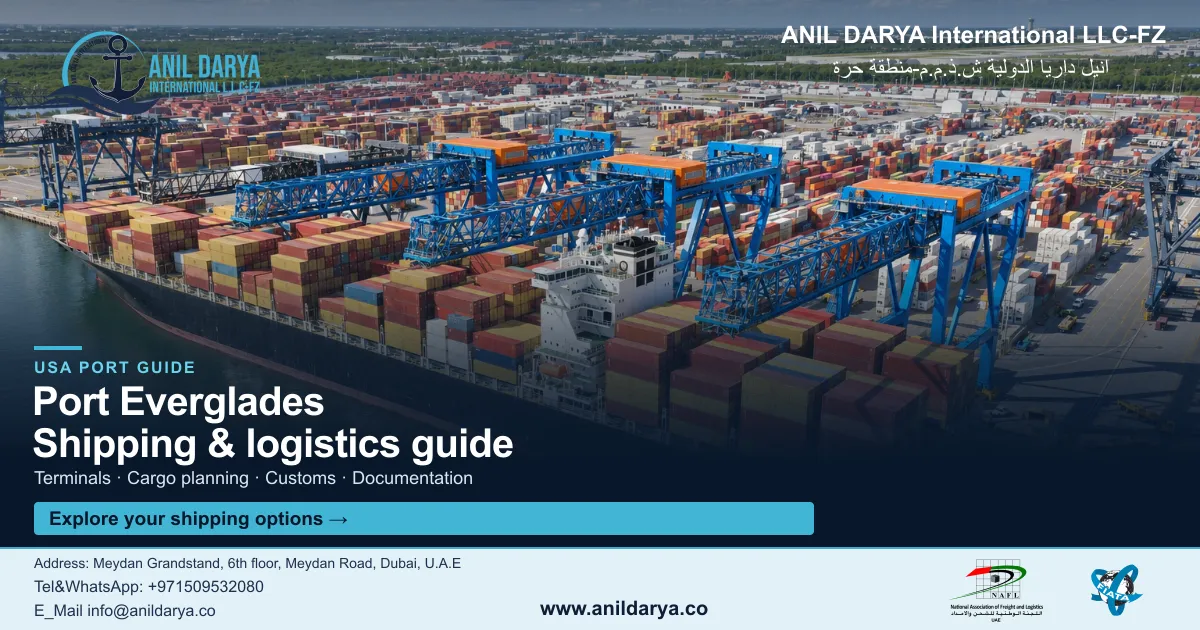
Port Everglades shipping means containers, reefer cargo, petroleum, breakbulk and vehicles through Broward County's seaport in Fort Lauderdale, Florida. The port moved a record 1,167,552 TEU in fiscal year 2025, but its 42-foot inner channel still limits how loaded the biggest ships can arrive. This guide covers the terminals, depth limits, free time, reefer and breakbulk, and US customs, in both directions: shipping from Dubai to Port Everglades, and shipping from Port Everglades to Dubai.
Port Everglades at a glance
| Item | Detail |
|---|---|
| Owner and operator | Broward County, through its Port Everglades Department (a self-supporting enterprise fund) |
| Location | 1850 Eller Drive, Fort Lauderdale, Florida, less than one mile from the Atlantic shipping lane |
| UN/LOCODE | USPEF |
| CBP port code (Schedule D) | 5203 |
| Containers, fiscal year 2025 (October 2024 to September 2025) | 1,167,552 TEU, a port record |
| US ranking | 15th busiest container port in the country (port figure) |
| Cargo areas | Northport, Midport and Southport |
| Cranes | 14 gantry cranes and 1 mobile harbor crane |
| Channel depth today | Outer entrance channel 45 ft; inner entrance channel and main turning basin 42 ft |
| Planned depth | 48 ft plus overdepth (50 ft total) inside; 55 ft outer channel |
| Reefer outlets | More than 2,000 |
| Rail | 43-acre near-dock Intermodal Container Transfer Facility, run by Florida East Coast Railway |
| Foreign-Trade Zone | FTZ 25, Florida's first, 20.25 activated acres |
| Petroleum, fiscal year 2025 | 131,855,261 barrels |
| Port tariff free time (non-lease yard areas) | Inbound containers 12 days, outbound containers 15 days |
| Customs authority | U.S. Customs and Border Protection (CBP) |
What is Port Everglades and who runs it?
Port Everglades sits on land shared by Fort Lauderdale, Hollywood and Dania Beach in Broward County. The county owns it and runs it through the Port Everglades Department, which pays its own way from port revenue rather than local property taxes.
The county runs the port, but private terminal operators work the cargo. The port lists 10 terminal operators. Two of them handle most of the deep-sea container lines:
| Terminal operator | Lines it serves (port list) | Address |
|---|---|---|
| Florida International Terminal (FIT) | CMA CGM, Great White Fleet, Hapag-Lloyd, Maersk, ONE | 4100 McIntosh Rd |
| Port Everglades Terminal (PET) | MSC, ZIM | 4200 McIntosh Rd |
| Crowley Liner Services | Crowley | 4300 McIntosh Rd |
| Sun Terminals | King Ocean Services | 3501 SE 18th Ave |
| Hyde Shipping | Hybur, Seaboard Marine | 1801 SE 28th St |
| Hirsch Stevedoring and Hirsch Maritime | Several smaller general cargo lines | 2051 SE 35th St |
Your carrier decides the terminal: Maersk or Hapag-Lloyd usually means FIT, MSC means PET.
Where is the port and how does cargo leave it?
The port is less than a mile from the Atlantic shipping lane and two miles from Fort Lauderdale-Hollywood International Airport. That airport link matters if you split an urgent part of an order to air cargo while the rest goes by sea.
More than 6 million people live within 100 miles of the port, so most cargo has a short truck leg.
For inland cargo, the 43-acre near-dock rail yard, run by Florida East Coast Railway, sits next to the docks. The Florida Ports Council reports that rail cargo from it reaches Atlanta and Charlotte in two days, Memphis and Nashville in three, and 70% of the US population in four. Road access runs through I-595, I-95, I-75 and the Florida Turnpike.
Southport, Midport and Northport: which area handles what?
The port groups its cargo berths into three areas. Southport is the main container area. Midport mixes containers, neobulk and the cold store. Northport is closest to the petroleum and cruise berths.
| Area | Open yard (port figures) | Main use |
|---|---|---|
| Southport | Southport terminal 256 acres, Phase V 38 acres, Phase VI 45 acres, plus 271 acres for future development | Containers and trailers; the six newest cranes |
| Midport | Container yards 51 acres, Mini Basin 15 acres, Berth 29 18 acres | Containers, neobulk at Berth 29, refrigerated warehouse |
| Northport | Small yard plots of 1 to 4 acres | Containers and neobulk at Pier 2 |
The Southport Turning Notch and the newer cranes
The $471 million Southport Turning Notch Extension stretched the turning area from 900 feet to 2,400 feet, about 1,500 feet to the west, to create new cargo berths. It came with six Super Post-Panamax gantry cranes along Berths 30, 31 and 32. The port also reports that its older cranes are being upgraded to 65 long tons of lifting capacity.
How deep is Port Everglades, and why does it matter?
This is the point most guides skip. Today the outer entrance channel is 45 feet deep and 500 feet wide. The inner entrance channel and the main turning basin are 42 feet.
In August 2026 the 13,050 TEU MSC Vandya became the largest container ship to call at the port. The port said at the time that water depth limits ships to about 8,000 TEU, so bigger ships arrive lightly loaded or skip the call. Port Director Joseph Morris put it simply: "Until we deepen and widen our navigational channel, ships will arrive lightly loaded."
The fix is the Port Everglades Navigation Improvements Project, led by the US Army Corps of Engineers. Congress authorized it in 2016. The plan takes the inner channel and turning basin to 48 feet plus 2 feet of overdepth, and the outer channel to 55 feet and 800 feet wide. The port projects completion in 2034.
What this means for you:
- Big Asia and Mediterranean services can still call, but the line may cap the load. Late roll-overs are more likely in busy weeks.
- Ask the carrier for the final discharge port, not only the destination on the quote.
- If your sailing date is tight, compare a direct call at Port Everglades with a call at Miami or another East Coast port.
Shipping from Dubai to Port Everglades: lines, hubs and transit
Port Everglades is mainly a north-south port. The port lists 26 container services, mostly to the Caribbean and Latin America, reaching more than 150 ports in 70 countries. It is the leading US port for Caribbean trade by its own count.
The port's Direct Shipline Services Guide for November 2026 lists no direct service from any Gulf or Indian Subcontinent port. The east-west services it does list are useful hubs for cargo from the UAE:
| Service in the port guide | Terminal | Foreign port | Import transit to Port Everglades (days) |
|---|---|---|---|
| Hapag-Lloyd, Maersk and ZIM, Turkey East Coast Express (TEX), weekly | FIT | Ambarli, Türkiye | 35 |
| TEX | FIT | Aliaga, Türkiye | 32 |
| TEX | FIT | Salerno, Italy | 28 |
| TEX | FIT | Tanger, Morocco | 20 |
| MSC and ZIM, EMPIRE service, weekly | PET | Shanghai, China | 41 |
| EMPIRE | PET | Busan, South Korea | 36 |
The guide itself says to confirm with your carrier before booking, and so do we. In practice a box from Jebel Ali reaches Port Everglades by transshipment at a hub, which adds the first leg to the days above.
[AMIR-FACT: the carrier services and transshipment hub we actually book from Jebel Ali or Khalifa Port to Port Everglades, which terminal (FIT or PET) they discharge at, and our real port-to-port transit days]
For nearby Miami, Shipa Freight publishes 38 days FCL from Jebel Ali as an indication only.
Free time and storage under the port tariff
Port Everglades Tariff No. 12, Item 600, sets free time on the port's non-lease, non-grid yard areas. Free time includes Saturdays, Sundays and legal holidays.
| Cargo | Inbound free time | Outbound free time |
|---|---|---|
| Containers, trailers and chassis, empty or loaded | 12 days | 15 days |
| Steel products, up to 2,500 tons | 14 days | 12 days (all other cargo) |
| Steel products, 2,501 to 5,000 tons | 20 days | 12 days |
| Steel products, 5,001 to 7,500 tons | 27 days | 12 days |
| Steel products, over 7,500 tons | 34 days | 12 days |
| Bundled lumber, up to 1,200 tons / 1,201 tons and over | 12 days / 16 days | 12 days |
| All other cargo | 12 days | 12 days |
Item 605 says inbound free time starts at 8:00 a.m. on the day after the vessel finishes discharging the cargo. After that, wharf demurrage applies at the tariff rates.
One warning. Most container yards are leased to terminal operators, and the carrier's own free time and demurrage on the box are separate from the port tariff. The days on your arrival notice are the ones that count. Our guide to demurrage and detention charges explains how the two add up.
Reefer and perishables at Port Everglades
Port Everglades calls itself Florida's leading perishables gateway. It handled more than 147,000 TEU of refrigerated cargo in fiscal year 2025, by the port's figures. The facilities page lists more than 2,000 reefer outlets, mostly 3-phase, 480-volt plugs.
In Midport, the Quirch Foods cold store holds more than 1.6 million cubic feet of variable-temperature storage. For plant and produce imports, USDA APHIS-authorized fumigation and restacking services work inside the port.
For food from the UAE, the US importer must have FDA prior notice and any USDA permit ready before arrival.
Breakbulk, bulk and project cargo
Port Everglades still handles breakbulk and bulk. The port names steel rebar, aggregate and lumber, and Berth 29 in Midport and Pier 2 in Northport are listed for neobulk. The steel bands in the free time table show how much steel moves here.
Dry bulk such as cement moves through pneumatic unloaders into silos. Petroleum is the biggest business by volume: about 200 storage tanks, and one third of Florida's petroleum passes through the port.
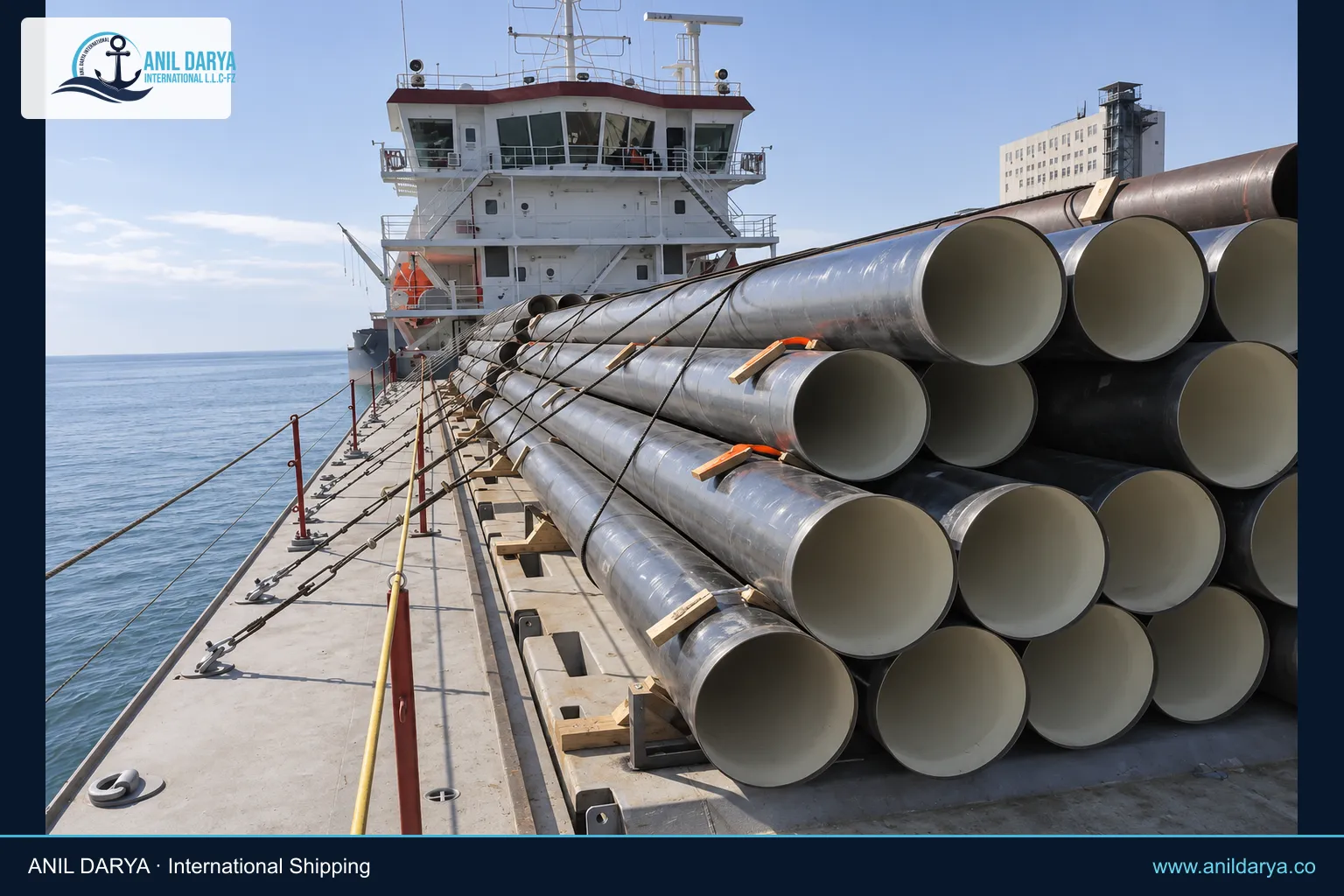
For project cargo from Dubai, the plan depends on size:
- If the piece fits a flat rack or open top, it can move on a container service into FIT or PET. Check lashing, height and weight with the line.
- If it is too big for a flat rack, you need a breakbulk or heavy-lift sailing. Check what sails on your dates, and compare discharge at Port Everglades with a US Gulf port that has breakbulk terminals.
- Ask the port's general cargo stevedores (Hirsch, Logistec and others on the port list) about crane capacity at your berth before you fix the vessel.
Our break bulk and project cargo team handles the UAE side: drawings, lifting plan, lashing survey and the export declaration. For large heavy-lift pieces our guide to flat racks, open tops and breakbulk helps you pick the right unit.
Dangerous goods through Port Everglades
Port Everglades handles hazardous cargo under its tariff. Tariff Item 1006 covers the reporting of hazardous materials and hazardous waste shipments, and Item 1072 covers the petroleum and LPG terminal facilities. On the ocean leg, the IMDG Code applies, and the carrier and the terminal (FIT or PET) must both accept the booking.
What you send us for a DG booking to Port Everglades:
- UN number, proper shipping name, class and packing group for each product.
- A Safety Data Sheet for every product.
- A signed dangerous goods declaration and IMDG-compliant packaging, marks, labels and placards.
- Carrier approval before you commit to a vessel, plus any hub port acceptance on the transshipment leg.
Our dangerous goods shipping team checks the papers on the UAE side.
Foreign-Trade Zone 25
FTZ 25 was the first foreign-trade zone in Florida and sits inside the port. It has 20.25 activated acres plus 10 usage-driven sites around Broward County.
In a zone you can defer, reduce or remove US customs duty on goods you store, process or re-export. That suits UAE exporters selling into the Caribbean and Latin America through a South Florida distributor. One thing does not go away: the harbor maintenance fee of 0.125% still applies to cargo unloaded at the port and admitted to a zone. The zone operator, not you, files the zone admission, so talk to the US importer before the cargo ships.
US customs at Port Everglades: the short version
CBP rules are the same at every US seaport, and our Port of Houston guide covers them in full. At Port Everglades the CBP port code on the entry is 5203. The essentials:
- ISF 10+2. Most data elements are due no later than 24 hours before the cargo is loaded on the vessel bound for the US. With transshipment, that is the hub port, not Jebel Ali. Container stuffing location and consolidator are due no later than 24 hours before US arrival.
- Entry. Entry documents are due within 15 calendar days of arrival. The entry summary and estimated duty follow within 10 working days.
- Harbor maintenance fee. 0.125% of cargo value on imports.
- Duty. Set by the HTS code and origin of each product. Check the current US tariff for your code.

How to ship from Dubai to Port Everglades: step by step
- Send us the cargo details. Commodity, HS code, weight, volume or dimensions, the UAE pickup point, the consignee's city and your Incoterm.
- We choose the routing. We compare carrier services and hubs to Port Everglades, and to Miami where it helps, and tell you which terminal each one uses.
- Book space. For reefer, DG or out-of-gauge cargo we get carrier acceptance first.
- Prepare the ISF data. The US importer or broker files the ISF before the box loads at the hub, using the data you give.
- Pick up and clear export. We arrange trucking in the UAE, stuffing, the export declaration and gate-in at Jebel Ali or Khalifa Port before the cut-off.
- Check the bill of lading. We match it against the invoice and ISF data, then release it after sailing.
- Hand over to the US side. The consignee's customs broker files the entry, and their trucker collects the box from FIT or PET inside free time.
We work with the consignee's customs broker or a destination clearing agent. We do not have our own office in the US. See our sea freight service for FCL and LCL options from the UAE.
How to ship from Port Everglades to Dubai
We also handle shipping from Port Everglades to Dubai, with arrival at Jebel Ali, Khalifa Port or Sharjah port. We book the space with the carrier and run the UAE side. The US export papers stay with the shipper or its US agent.
The US export side
- Electronic Export Information (EEI). The US Principal Party in Interest (USPPI) or its authorized agent files it in the AES. For vessel cargo the filing citation must reach the carrier 24 hours before loading at the US port.
- Exemptions. EEI is generally not needed for goods under a Schedule B number valued at $2,500 or less, subject to the conditions in the rules.
- Pickup. The shipper's trucker delivers the box to FIT or PET, whichever the carrier uses, inside the port tariff's 15 days of outbound free time or the terminal's own window.
The UAE import side
Dubai Customs needs an invoice, a packing list, a certificate of origin and any permit for restricted goods. Duty in Dubai is 5% of the CIF value for most goods, 50% on alcohol and 100% on cigarettes. Import VAT is 5%, and a VAT-registered importer can account for it on its VAT return.
- Send us the shipper's details in Florida, the cargo, the HS code and the UAE delivery address.
- We book space from Port Everglades and send the booking and cut-offs to the shipper.
- The shipper or its US agent files the EEI and gates the box in.
- We check the draft bill of lading and track the hub connection.
- We file the UAE declaration before arrival and collect the delivery order.
- We truck the box to your site and return the empty inside free time.
[AMIR-FACT: the carriers and hub we actually use from Port Everglades to Jebel Ali, Khalifa Port or Sharjah, and our real port-to-port transit days in this direction]
Checklist before you ship to Port Everglades
- HTS code checked for every line on the invoice.
- ISF data sent to the US importer before the cargo leaves Dubai.
- Terminal confirmed (FIT, PET or another operator) from the carrier service.
- Final discharge port confirmed, in case a large ship skips or lightens the call.
- Carrier free time and the port tariff free time both known.
- Reefer settings, FDA prior notice and any USDA permit ready for food cargo.
- DG papers complete and carrier approval in writing.
- Wood packaging treated and marked to ISPM 15.
- Cargo insurance arranged.
Common mistakes on cargo to Port Everglades
- Filing the ISF too late. With transshipment, the 24-hour rule runs from loading at the hub, which can be days after the box leaves Jebel Ali.
- Assuming the port tariff free time applies. Your carrier's free time on a leased terminal is usually what limits you.
- Ignoring the depth limit. A heavy box on a large ship can be rolled or discharged elsewhere.
Port Everglades or Miami: which suits your shipment?
| Your situation | Port to look at | Why |
|---|---|---|
| Consignee in Broward or Palm Beach | Port Everglades | Shortest truck leg |
| Steel, lumber or other breakbulk for South Florida | Port Everglades | Neobulk berths and steel free time bands in the tariff |
| Re-export to the Caribbean or Latin America | Port Everglades or Miami | Both have FTZs and many north-south services |
| Consignee in Miami-Dade, or a better sailing on your dates | Miami | Different carriers and hubs, short truck to Broward |
| Heavy project cargo or a Texas consignee | Houston | Breakbulk terminals and Gulf location |
On the UAE side, the box usually starts at Jebel Ali port or Khalifa Port. We can price both US ports so you compare the total cost to the consignee's door.
Frequently asked questions
Who owns and runs Port Everglades?
Broward County owns Port Everglades and runs it through the Port Everglades Department. Private terminal operators such as Florida International Terminal and Port Everglades Terminal work the container ships.
What is the port code for Port Everglades?
The UN/LOCODE is USPEF, which you see on bookings and bills of lading. On US customs entries the CBP port code is 5203.
How deep is the Port Everglades channel?
The outer entrance channel is 45 feet and the inner channel and main turning basin are 42 feet. A US Army Corps of Engineers project will take the inner channel to 48 feet plus overdepth, with completion projected for 2034.
How many TEU does Port Everglades handle?
The port handled a record 1,167,552 TEU in fiscal year 2025, which ran from October 2024 to September 2025. It ranks itself the 15th busiest container port in the US.
Is there a direct service for shipping from Dubai to Port Everglades?
The port's November 2026 shipline guide lists no direct service from the Gulf. Cargo from Dubai moves by transshipment through a hub, then on a service such as TEX or EMPIRE into the port.
Can you handle shipping from Port Everglades to Dubai?
Yes. We book carrier space from Port Everglades, the shipper or its US agent files the export information, and we clear the cargo through UAE customs and deliver it. Most goods pay 5% duty on the CIF value plus 5% import VAT.
How much free time do containers get at Port Everglades?
The port tariff gives 12 days for inbound containers and 15 days for outbound containers on non-lease yard areas. On leased terminals, the carrier's free time on your arrival notice is what applies.
Does Port Everglades handle breakbulk and reefer cargo?
Yes. The port handles steel rebar, aggregate and lumber as breakbulk and bulk, and has more than 2,000 reefer outlets. It moved more than 147,000 TEU of refrigerated cargo in fiscal year 2025.
Get a quote for Port Everglades shipping
Send us the cargo, the UAE pickup point and the consignee's city, and we will come back with a routing and a price to Port Everglades. Use our freight rate inquiry form, or contact our team to talk through reefer, DG or breakbulk cargo first. You can also read about our Dubai freight forwarding team.
Sources
- Port Everglades: Cargo (FY2025 TEU record, ranking, 26 services, 150 ports, ICTF, location)
- Port Everglades: Facilities and services (yard acres, 14 gantry cranes, Ro-Ro berths, reefer outlets, cold store, petroleum tanks)
- Port Everglades: Terminal operators and lines served
- Port Everglades: Cargo types
- Port Everglades: Harbor deepening and widening (current and planned depths)
- Port Everglades: Southport Turning Notch Extension and cranes
- Port Everglades: FY2025 records (TEU, petroleum barrels), December 2025
- Port Everglades: Foreign-Trade Zone 25
- Port Everglades: Tariff No. 12 (items 600, 605, 1006, 1072)
- Port Everglades Tariff No. 12, Item 600: Free time allowances
- Port Everglades Tariff No. 12, Item 605: Computation of free time
- Port Everglades: Direct Shipline Services Guide, November 2026
- Maritime Executive: MSC Vandya visit and channel limits (August 2026)
- Maritime Executive (Port Everglades sponsored feature, March 2026): reefer TEU, Southport cost, 2034 deepening projection
- Florida Ports Council: Port Everglades (rail reach, hinterland)
- Wikipedia: Port Everglades (UN/LOCODE, location)
- iContainers: Port Everglades (road access)
- Airlift: USPEF port code and CBP Schedule D code 5203
- Shipa Freight: UAE to US transit indications
- 19 CFR 149.2: ISF time of transmission
- CBP: Entry and entry summary
- 15 CFR 30.4: EEI filing timeframes
- 15 CFR 30.37: EEI exemptions ($2,500 per Schedule B number)
- Dubai Customs: Submit customs declaration (documents)
- UAE Government portal: Customs duty (5% of CIF, alcohol 50%, cigarettes 100%)
- Federal Tax Authority: VAT guide (5% rate, import VAT)
- 19 CFR 24.24: Harbor maintenance fee (including FTZ admissions)
Reviewed: 10 November 2026