
Shipping from Argentina to Dubai almost always starts at Buenos Aires or Dock Sud, sails with at least one transshipment and ends at Jebel Ali, with air cargo from Ezeiza for urgent goods. In Argentina, a customs broker files the export permit in ARCA's SIM system. In the UAE, the importer clears the goods with Dubai Customs and pays 5% duty on the CIF value plus 5% import VAT. This guide explains ports, modes, transit indications, documents and the steps in order.
Argentina to Dubai shipping at a glance
| Item | Detail |
|---|---|
| Main Argentine load ports | Buenos Aires (Puerto Nuevo) and Dock Sud; also Zarate, Rosario and Bahia Blanca |
| Main UAE discharge port | Jebel Ali, Dubai; some services discharge at Fujairah |
| Routing | Transshipment services; schedule data shows 2 transfers on the main Buenos Aires to UAE routings |
| Published sea indication | Buenos Aires to Jebel Ali about 67 days; Buenos Aires to Fujairah about 51 to 60 days (Fluent Cargo) |
| Published air indication | Ezeiza (EZE) to Dubai (DXB) about 19 hours; Emirates freighters EZE to Al Maktoum (DWC) about 1 day 2 hours |
| Modes | FCL, LCL, reefer, breakbulk and project cargo, dangerous goods, air cargo |
| Argentine export filing | Export permit (form OM-1993-A SIM) in ARCA's SIM, filed by a despachante de aduana |
| Export permit validity | 31 calendar days from registration |
| UAE customs authority (Dubai) | Dubai Customs; importer needs a customs business code |
| Customs duty in Dubai | 5% of CIF for most goods; alcohol 50%, cigarettes 100% |
| Import VAT | 5%; deferred to the VAT return for registered importers linked with the FTA |
| Free zone | Jafza, next to Jebel Ali Port |
How shipping from Argentina to Dubai works
There is no shortcut on this lane. It is one of the longest container routes into the UAE, and every shipment passes through the same three stages.
- Export in Argentina. The supplier prepares the goods, its despachante files the export permit in the SIM, and the cargo is delivered to the terminal before the cut-off.
- The sea or air leg. We book space with the carrier, check the bill of lading draft and follow the box through each transshipment port.
- Import in the UAE. The consignee or a licensed clearing agent files the Dubai Customs declaration, pays duty and VAT, takes the delivery order and receives the goods.
The Incoterm decides where your responsibility starts. FOB Buenos Aires is the usual choice for a Dubai buyer: the supplier and its broker handle the Argentine export, and you control the freight and the UAE end. CFR or CIF moves the freight booking to the supplier, but the Dubai charges stay with you. Our guide to Incoterms 2020 for sea freight shows where cost and risk pass under each term.
Avoid EXW unless you have a trusted party in Argentina. Only a registered despachante can file the export permit, so a Dubai buyer buying ex works still needs someone local to clear the goods out.
Which Argentine port should you ship from?
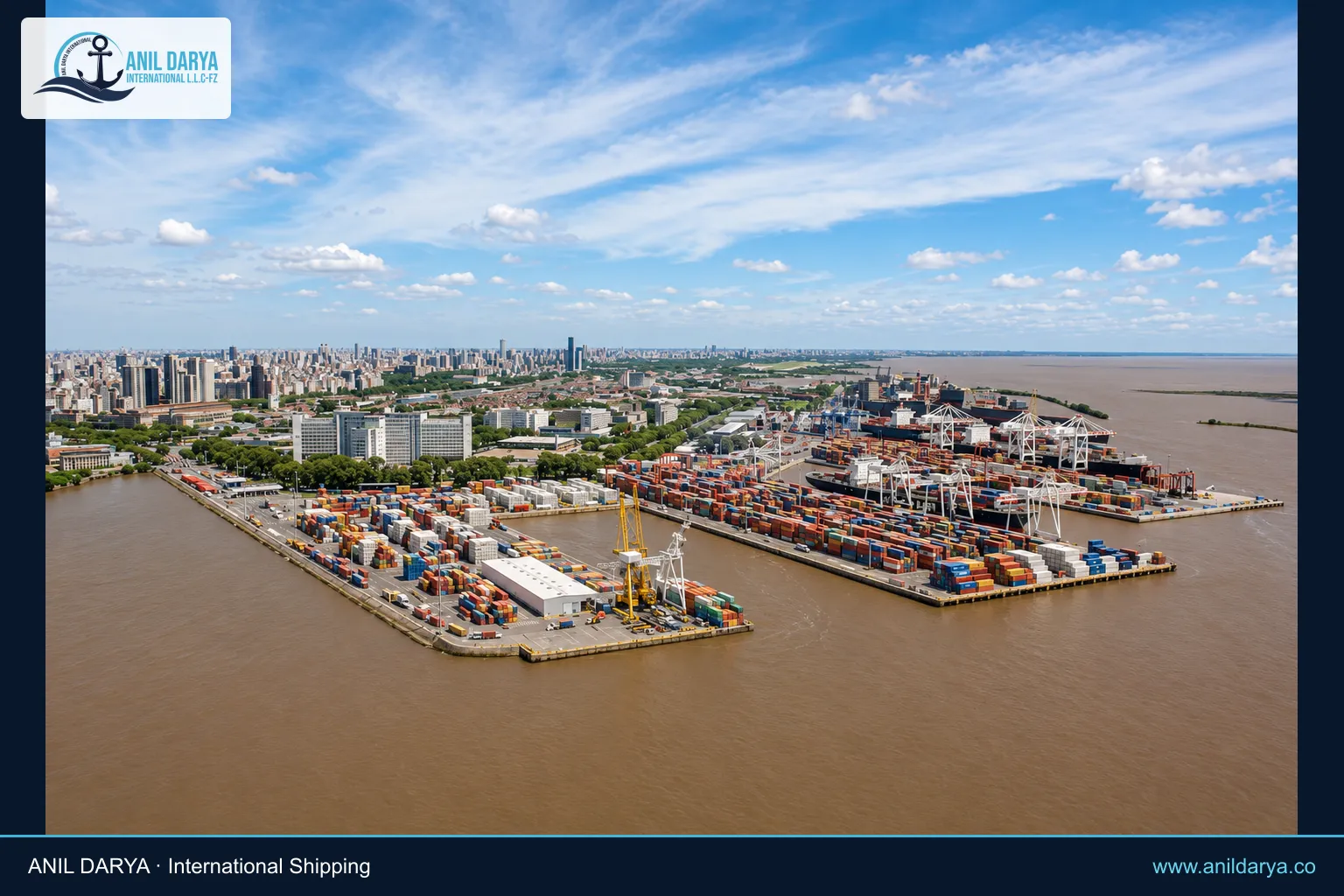
Most of Argentina's containers move through the Buenos Aires port complex on the Rio de la Plata. Container figures for 2024 show how concentrated the trade is.
| Port | Containers in 2024 | What it is used for |
|---|---|---|
| Buenos Aires (Puerto Nuevo) | 675,232 TEU, January to November | Main container gateway; terminals run by DP World TRP (Terminals 1 to 3), APM Terminals (Terminal 4) and BACTSSA (Terminal 5) |
| Dock Sud | 434,196 TEU, January to November | Second terminal of the complex, Exolgan, in Avellaneda |
| Zarate | 79,787 TEU, January to September | Main vehicle and ro-ro gateway up the Parana river, plus containers |
| Rosario | About 35,000 TEU (preliminary) | Santa Fe and Cordoba shippers close to the river ports |
| Bahia Blanca | 7,555 TEU, January to October | Energy and project cargo in the south of Buenos Aires province |
Puerto Nuevo has a maximum depth of about 10.1 m for containers, breakbulk and ro-ro, which limits the size of ships that call. That is one reason services to the Gulf feed through larger transshipment hubs. For most shippers the decision is simple: use Buenos Aires or Dock Sud, whichever terminal your chosen service calls at, and keep the truck leg from the factory short.
Which UAE port should your cargo arrive at?
Jebel Ali is the main destination for containers from South America. DP World lists over 80 weekly services at the port, linked to more than 150 ports, with handling for containers, breakbulk, ro-ro, reefers, IMDG dangerous goods and out-of-gauge project cargo. Read our Jebel Ali port guide for terminals and port rules.
- Dubai and Jafza consignees: Jebel Ali.
- Abu Dhabi sites: compare Khalifa Port in Abu Dhabi if your carrier calls there.
- Fujairah: some Buenos Aires services discharge there and schedule data shows shorter transits on that port pair. Add the truck leg across the country before you compare.
Sea freight from Argentina to Dubai: containers and transit
Containers carry most cargo on this lane: food and agricultural products, wine, leather, machinery parts and industrial goods.
| Option | Use it when | Watch out for |
|---|---|---|
| FCL dry 20ft or 40ft | One supplier, enough cargo to fill most of a box | Long transit ties up stock; plan free time at Jebel Ali |
| Reefer | Chilled or frozen meat, fruit, dairy | Health certificates and UAE food approval before arrival; reefer plugs at each transshipment |
| LCL | A trial order or samples by sea | More handling over a long route; consolidator cut-offs in Buenos Aires |
| Flat rack or open top | Machinery slightly out of gauge | Acceptance by every carrier on a transshipment routing |
On a route this long, consolidating several suppliers into one FCL usually pays. You clear one shipment in Dubai instead of several LCL lots. For booking options see our sea freight service.
How long does sea freight from Argentina to Dubai take?
Schedule data published by Fluent Cargo shows only transshipment routings between Buenos Aires and the UAE. The figures vary widely with the routing, so treat them as indications.
| Port pair | Published transit | Transfers | Carriers named | Frequency |
|---|---|---|---|---|
| Buenos Aires to Jebel Ali | 67 days 12 hours | 2 | CMA CGM | Every 1-2 weeks |
| Buenos Aires to Fujairah | 59 days 19 hours | 2 | CMA CGM | Every 1-2 weeks |
| Buenos Aires to Fujairah | 50 days 15 hours | 2 | COSCO, OOCL | Every 1-2 weeks |
The spread between routings is more than two weeks. Ask for the full rotation on every quote: the transshipment ports, the connection at each one and the final discharge port. A routing with fewer stops can beat a faster first leg that waits at a hub.
[AMIR-FACT: our real port-to-port and door-to-door transit days Buenos Aires to Jebel Ali, the transshipment hubs used, and the carriers we actually book on this lane]
A long transit also means a long gap between paying for goods and selling them. If your cash cycle matters, compare air for part of the order, or plan stock in a Jafza warehouse so the next shipment is already at sea when the last one sells.
Food, wine and other controlled cargo from Argentina
Food and drink shipments need permits at both ends. On the UAE side, the US Commercial Service's guide lists an original health certificate from the exporting country's government agency for food products, and an original halal slaughter certificate for meat and poultry. Dubai Customs releases goods that need an approval only once the competent authority has given it.
| Cargo | What the UAE end needs | Plan before sailing |
|---|---|---|
| Beef and other meat | Health certificate, halal slaughter certificate, food import approval | Certificates issued and checked against the invoice and cartons |
| Fruit, nuts, grains | Health or plant certificate from the Argentine authority, food approval | Shelf life against a long transit; reefer setting |
| Wine and spirits | Alcohol pays 50% duty in Dubai | Confirm with your clearing agent that the consignee can import alcohol before you buy |
| Medicines and cosmetics | Approval from the competent UAE authority | Confirm the approval route with your clearing agent before you buy |
Over a two-month voyage, the paperwork has plenty of time to be ready. Use it. A permit that is still missing when the box lands costs storage and reefer charges every day.
Breakbulk, project cargo and dangerous goods
Machinery, energy equipment and steel pieces that do not fit a container can move on flat racks if every carrier on the routing accepts them, or as breakbulk. Bahia Blanca is the port Argentine sources name for energy project cargo, and Zarate handles ro-ro and vehicles. For pieces that ship as breakbulk:
- Collect drawings, weights, dimensions and lifting points from the supplier.
- Agree vessel type and load port with the carrier, and confirm whether the cargo can stay on one vessel to the UAE.
- Prepare a piece-by-piece packing list that matches the invoice.
- Plan discharge at Jebel Ali or Khalifa Port, the trailer, road permits and any escort.
Our break bulk and project cargo service covers the UAE side of these moves.
Dangerous goods such as chemicals, agrochemicals, paints and batteries need the UN number, class, Safety Data Sheet, UN packaging and a signed DG declaration from the Argentine shipper. On a transshipment route, every carrier and hub has to accept the DG booking, so allow more time for acceptance. At Jebel Ali, Trakhees requires imported Class 8 corrosives to be cleared within 3 working days. Our dangerous goods team checks the documents and acceptance before you commit.
Air cargo from Ezeiza
When two months at sea is too long, air cargo from Ministro Pistarini (Ezeiza) is the alternative. Fluent Cargo's schedule data shows a transit of about 19 hours from EZE to Dubai International (DXB), with Emirates and several other airlines every one to two days, and Emirates freighters from EZE to Al Maktoum International (DWC) in about 1 day 2 hours.
- Fly samples, spares, medicines, documents-heavy orders and high-value goods.
- Split an order: send the first cartons by air and the rest by sea.
- Check volumetric weight: light, bulky cargo is charged on volume.
Customs in Dubai is the same as for sea cargo, with the air waybill in place of the bill of lading. As an IATA-approved agent we book this space directly through our air cargo service.
The Argentine export permit: what your supplier must do
Argentine exports are declared in the Sistema Informatico MALVINA (SIM) of ARCA, the tax and customs agency. The government's guide says a despachante de aduana, registered in the brokers' register, files the declaration in the exporter's name. Filing produces form OM-1993-A SIM, the export permit, known as the permiso de embarque.
- Once the permit is made official, the SIM gives it a registration number. That number is used to follow the operation, pay any export duties that apply and claim refunds.
- The permit is valid for 31 calendar days from registration, or 45 days for land transit. Goods must ship within that window.
- The exporter needs an active importer or exporter profile with ARCA, created under General Resolution 5472/2023.
We do not file in Argentina. We need the permit number and confirmation that the cargo has been delivered to the terminal, so the box makes its vessel. Ask the supplier's broker early whether any export duty applies to your product, because it changes the supplier's price.
Make sure the goods description and value on the export permit match the commercial invoice you will hand to Dubai Customs.
Clearing Argentine goods through Dubai Customs
To file a declaration in Dubai, a business needs a customs business code, registered online through Dubai Trade. Dubai Customs also lets a clearing agent with a clearing and forwarding licence file with its own code and the goods owner's authorisation. If you do not have a code, we arrange clearance through a licensed agent or work with yours.
Documents for the Dubai declaration
Dubai Customs asks for an invoice, a packing list, a certificate of origin and, for restricted goods, a permit from the competent authority. For sea cargo you also need the bill of lading and the delivery order from the shipping line.
| Document | Issued by | Check |
|---|---|---|
| Commercial invoice | Argentine supplier | Description, HS code, prices, total, currency, Incoterm, consignee |
| Packing list | Argentine supplier | Weights, packages and marks match the invoice |
| Certificate of origin | Chamber of commerce in Argentina | Names Argentina as origin and matches the invoice |
| Bill of lading or air waybill | Carrier | Consignee, notify party, weights, container numbers |
| Delivery order | Shipping line in the UAE | Released after local charges are paid |
| Health and halal certificates | Argentine authority and certifier | Food, meat and poultry |
| Permit | Competent UAE authority | Restricted goods only |
Invoices and shipping documents can be attested through the UAE Ministry of Foreign Affairs, according to the US Commercial Service. Ask your clearing agent whether your goods need it before the originals are couriered from Buenos Aires.

Choosing the right declaration
| Plan for the goods | Dubai declaration | Duty and VAT |
|---|---|---|
| Sale or use in the UAE mainland | Import | Paid at import, VAT deferred if eligible |
| Storage and resale from Jafza | Transfer into the free zone | Only when the goods enter the mainland |
| Onward shipment to another country | Transit | Not imported |
| Exhibition, testing or repair, then return | Temporary admission | Deposit equal to the duty, refunded on re-export; none under an ATA carnet |
Duty and VAT on imports from Argentina to Dubai
Dubai Customs charges 5% of the CIF value on most goods, 50% on alcohol and 100% on cigarettes. Freight from Argentina is part of CIF, so a long and expensive routing raises the duty a little. The UAE government portal says tariffs range from 0 to 5%, so check your HS code for exemptions.
Import VAT is 5% on the customs value plus duty. A VAT-registered importer whose customs number is registered with the Federal Tax Authority declares it in the VAT return instead of paying at the border. An unregistered importer pays it before release.
| Charge | Rate | Base |
|---|---|---|
| Customs duty, most goods | 5% | CIF value |
| Customs duty, alcohol (for example Argentine wine) | 50% | CIF value |
| Customs duty, cigarettes | 100% | CIF value |
| Import VAT | 5% | Customs value plus duty |
We arrange payment of the duty and VAT through the clearing agent and pass you the receipts for your records.
Storing and re-exporting Argentine goods from Jafza
A two-month supply chain makes stock planning matter. Many buyers land Argentine goods in Jafza, next to Jebel Ali Port, and sell them on to the UAE mainland, the GCC or other markets. Jafza has operated since 1985 and hosts over 11,000 businesses. Goods transferred into the free zone pay Dubai duty only if they later enter the mainland.
When you sell on, Dubai Chambers issues certificates of origin for exported and re-exported goods for AED 100, approved within two hours when the documents are complete. For transhipment cargo it asks for the transit bill from Dubai Customs. Our guide to Jafza re-export for bulk and breakbulk explains the free zone route.
Restricted and prohibited goods
Dubai Customs says some goods need approval from a competent authority and will not be released without it. Printed and recorded media are inspected by the information authority, and goods against the country's values are banned. Check these groups before your supplier ships:
- Meat, dairy, fruit and other food.
- Seeds, plants and agricultural inputs.
- Alcoholic drinks.
- Medicines, cosmetics and supplements.
- Pesticides and many industrial chemicals.
What affects the cost of shipping from Argentina to Dubai?
We quote each shipment rather than publish rates. These are the parts that make up the total and what moves them.
| Cost part | What moves it |
|---|---|
| Argentine origin costs | Trucking to the terminal, terminal charges, broker fee, any export duty (on the supplier under FOB) |
| Ocean or air freight | Routing and number of transshipments, container type, season, surcharges |
| Special cargo | Reefer, DG, flat rack or breakbulk premiums |
| UAE terminal and line charges | Terminal handling, delivery order, reefer plug-in, LCL unpacking |
| Duty and VAT | CIF value and HS code |
| Delivery | Distance, truck type, unloading |
| Delays | Demurrage and detention after free time |
Our article on demurrage and detention charges explains how free time works and how to avoid paying for it.
How to ship from Argentina to Dubai: step by step
- Agree FOB Buenos Aires or another Incoterm with your supplier.
- Send us the commodity, HS code, weight, volume, supplier city, ready date and any reefer or DG details.
- We quote routings with their transshipment ports and discharge port, so you can weigh time against cost.
- Line up UAE permits, and for food the health and halal certificates.
- Book space, with carrier acceptance first for reefer, DG or out-of-gauge cargo.
- The supplier's despachante files the export permit in the SIM and the cargo goes to the terminal within its validity.
- We check invoice, packing list, certificate of origin and the draft bill of lading against each other.
- We follow the box through each transshipment and update you on the arrival date.
- The Dubai declaration is filed before arrival; duty, VAT and local charges are paid and the delivery order is collected.
- Delivery to your site or Jafza unit, and the empty goes back within free time.
[AMIR-FACT: one real Argentina to UAE shipment we handled (cargo, Argentine port, routing, UAE port, total days, what we solved), cleared for publication]
Our Dubai freight forwarding team handles the UAE end of each step.
Checklist before the box leaves Buenos Aires
- Incoterm agreed, with the Argentine exporter of record named.
- Supplier's despachante confirmed and export duty question answered.
- Export permit filed and the cargo shipped within its 31 days.
- HS code and Dubai duty rate checked.
- Invoice, packing list, certificate of origin and bill of lading consistent.
- Food: health certificate, halal certificate for meat and poultry, UAE approval.
- Alcohol: consignee able to import it, 50% duty budgeted.
- DG: SDS, DG declaration and acceptance by every carrier on the routing.
- Dubai Customs business code or authorised clearing agent ready.
- Cargo insurance covering the full transshipment route.
Common mistakes on this long-haul lane
- Comparing quotes on first-leg days instead of the full routing to the UAE port.
- Letting the export permit expire before the cargo is shipped.
- Buying EXW with nobody in Argentina to act as exporter.
- Shipping wine to a consignee that cannot import alcohol.
- Reefers sent without checked health and halal papers.
- Insurance that stops at a transshipment port.
- Different values on the Argentine permit and the invoice given in Dubai.
Frequently asked questions
How long does shipping from Argentina to Dubai take?
By sea, published schedule data shows about 67 days from Buenos Aires to Jebel Ali and 51 to 60 days to Fujairah, all with two transshipments. By air, Ezeiza to Dubai takes about 19 hours.
Which port in Argentina do containers to Dubai leave from?
Mostly Buenos Aires (Puerto Nuevo) or Dock Sud, which together handled over 1.1 million TEU in the first eleven months of 2024. Zarate handles vehicles and ro-ro cargo.
Who files the export declaration in Argentina?
A registered despachante de aduana files the export permit in ARCA's SIM system in the exporter's name. The permit is valid for 31 calendar days from registration.
What is the import duty on goods from Argentina in Dubai?
5% of the CIF value for most goods, 50% for alcohol such as wine and 100% for cigarettes. Import VAT of 5% also applies, deferred for VAT-registered importers linked with the FTA.
Can I ship Argentine beef to Dubai?
Yes, with an original health certificate from the Argentine authority, a halal slaughter certificate and the UAE food import approval in place before the reefer arrives.
Is air cargo from Argentina to Dubai a good option?
For samples, spares and urgent goods, yes. The sea leg takes around two months, while Ezeiza to Dubai International is about 19 hours.
Can goods from Argentina go into a Dubai free zone?
Yes. Goods transferred into Jafza pay Dubai duty only if they later enter the UAE mainland, which suits buyers who hold stock and re-export.
Get a quote for shipping from Argentina to Dubai
Tell us what you are buying, where the supplier is in Argentina and where it should be delivered in the UAE. We will come back with routings, transit and price. Use our freight rate inquiry form, or contact our team to discuss a reefer, DG or project shipment.
Sources
- Fluent Cargo: Buenos Aires to Dubai (air and ocean schedules)
- Fluent Cargo: Argentina to United Arab Emirates (Buenos Aires to Fujairah, EZE to DXB and DWC)
- Argentina.gob.ar: Generate and file an export declaration (SIM, despachante, validity)
- Aduana News: RG 5472/2023 importer and exporter profiles
- US Commercial Service: Argentina customs regulations (ARCA)
- DatamarNews: Buenos Aires, Dock Sud and Zarate container volumes 2024
- Find a Port: Port of Buenos Aires (depth)
- DP World: Terminales Rio de la Plata, Buenos Aires
- Interworld Freight: Argentine ports (Zarate, Bahia Blanca)
- DP World: Jebel Ali Port
- Dubai Customs: Submit customs declaration
- Dubai Customs: FAQ
- UAE Government portal: Customs duty
- Federal Tax Authority: VAT taxable person guide (VAT on imports)
- US Commercial Service: UAE import requirements and documentation
- Trakhees circular EHS/PM/04/12: Class 8 cargo at port
- Jafza: About Jebel Ali Free Zone
- Dubai Chambers: Issuing a certificate of origin
Reviewed: 10 November 2026