
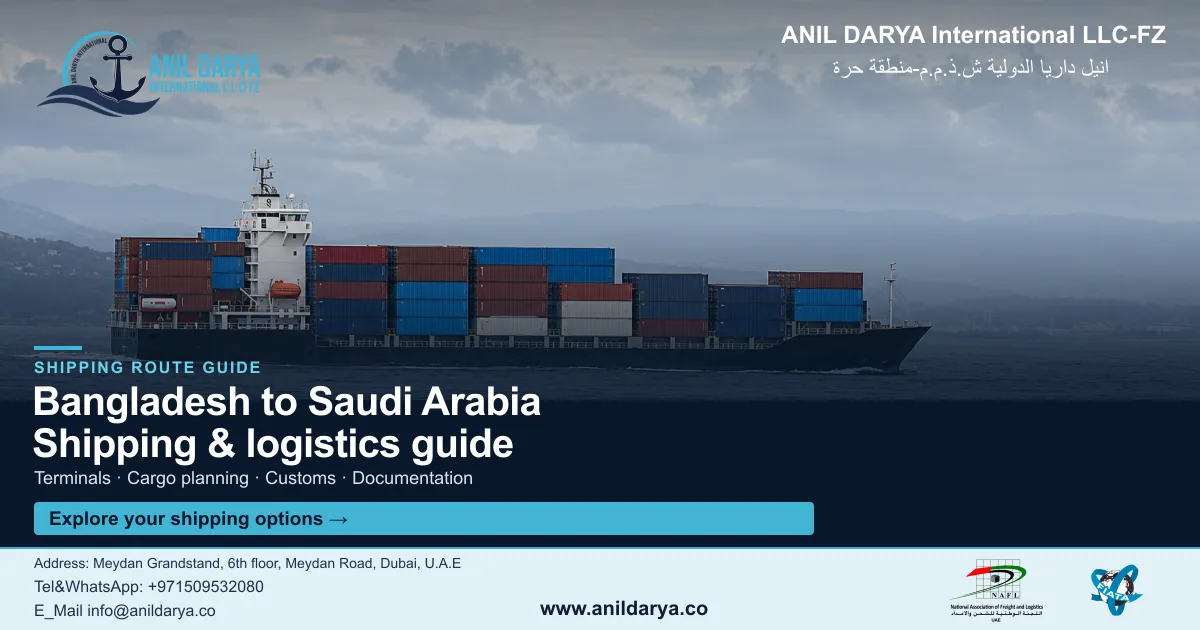
Shipping from Bangladesh to Saudi Arabia is a sea lane built around garments: most boxes load at Chattogram, change ship at a hub, and discharge at Jeddah on the west coast or Dammam on the Gulf coast. The Bangladeshi exporter clears the goods out with Bangladesh Customs and its bank, while the Saudi buyer or its broker files on Fasah, pays duty and 15% VAT and holds the SABER certificates that clothing needs. We book the ocean freight from Dubai and coordinate both ends.
Bangladesh to Saudi Arabia shipping at a glance
| Item | Detail |
|---|---|
| Main mode | Sea: 40ft and 40ft high cube FCL for garments, 20ft for dense cargo, LCL for small lots, reefers from Chattogram only |
| Bangladeshi load points | Chattogram port (BDCGP), Mongla, Dhaka ICD (Kamalapur), Pangaon, export processing zones and factory door |
| Saudi discharge ports | Jeddah Islamic Port and King Abdullah Port (west), Dammam and Jubail (east) |
| Routing | Usually via a hub, because Chattogram takes only feeder-size ships; no carrier schedule page we opened shows a direct Chattogram to Saudi loop |
| What Saudi Arabia buys | SAR 1.7 billion of Bangladeshi goods in 2025, about three quarters of it clothing (DataSaudi) |
| Export side in Bangladesh | Export declaration on ASYCUDA World, EXP form through the bank, B/L normally consigned to a local bank |
| Import side in Saudi Arabia | Fasah declaration at least 48 hours before arrival, by the importer or its broker |
| Duty and VAT | GCC tariff of at least 5% of CIF for most goods; 15% import VAT |
| Garment conformity | SASO textile regulation, product and shipment certificates in SABER |
| Bill of lading | The shipping line's own B/L, issued and released to you through us |
How a Bangladesh to Saudi Arabia cross-trade booking is split
The cargo never has to touch the UAE: it sails from Bangladesh to Saudi Arabia and we arrange the sea leg from Dubai. Four parties each have a job, settled before stuffing.
| Job | Who does it | Our part |
|---|---|---|
| Factory pickup, stuffing, Bangladeshi export clearance | The exporter or its C&F agent in Bangladesh | We pass on the booking number, cut-off and B/L instructions and check they are followed |
| Ocean freight to Jeddah, Dammam or another Saudi port | The shipping line | We book the space from Dubai and track the box through any hub |
| Bill of lading | The shipping line issues it | As agent for many shipping lines, we have the carrier's B/L issued and released to you through our office |
| Saudi clearance, duty, VAT, delivery | The consignee's licensed customs broker in Saudi Arabia | We get the broker's name and document list before we confirm the space |
We do not sell customs clearance in Saudi Arabia. Duty and taxes at destination are paid by the consignee or its broker. A garment box with no broker, or no SABER shipment certificate, waits in the Saudi yard while storage and detention add up, so the broker check comes before we confirm the booking.
The Incoterm on the buyer's order sets who pays what. Many Bangladeshi garment orders are sold FOB Chattogram, so the Saudi buyer pays the sea freight and picks the forwarder. Under CFR or CIF Jeddah the exporter pays the freight, but the Saudi side still pays port charges, duty and VAT. Our Incoterms 2020 guide for sea freight shows where cost and risk change hands.
Where to load in Bangladesh
Almost all of Bangladesh's container trade passes through Chattogram. The Chittagong Port Authority's handling report, signed in July 2026, puts the port at 3,531,118 TEU and 138.07 million tonnes of cargo in the 2025-26 financial year, up from 3,296,067 TEU the year before. Exports were 8.47 million tonnes of that, against 121.88 million tonnes of imports, so outbound boxes are much lighter than inbound ones. That suits garments, which fill a box by volume long before weight.
| Load point | What to know | Fits |
|---|---|---|
| Chattogram port | Main gateway, with several container terminals and general cargo berths; the Patenga Container Terminal has been run by Jeddah's Red Sea Gateway Terminal under a 22-year concession since June 2024 | Every cargo type; with Mongla, the only place where Maersk takes all reefer and out-of-gauge boxes |
| Dhaka ICD (Kamalapur) | Rail-linked inland depot; 30,241 TEU of exports in 2025-26 | Dry garment boxes from Dhaka and Gazipur factories; no reefers, OOG or 45ft |
| Pangaon inland terminal | River terminal near Dhaka; 4,549 TEU of exports in 2025-26 | Dry boxes moved by barge |
| Mongla | Second seaport, in the south-west, much smaller than Chattogram | Cargo from Khulna and the Mongla EPZ |
Chattogram is a river port. The Port Authority's draught notice caps ships at its jetties at about 10 metres draught and 200 metres length, so only feeder-size ships call. Large Asia to Middle East services cannot come in, which is the main reason Saudi-bound boxes change ship along the way.
Maersk's Bangladesh export page caps cargo at 21,700 kg in a 20ft dry and 26,480 kg in a 40ft or 40ft high cube. Garment cartons at Chattogram have a cut-off one day after the ship's ETA, other dry cargo one day before it, and the line runs a strict "No SI, No Load" and "No VGM, No Load" rule, with the VGM due six hours before departure.
Which Saudi port: Jeddah, King Abdullah, Dammam or Jubail?
Saudi Arabia has container ports on two coasts, a long truck ride apart. Choose the port by where the goods will be sold, then compare freight. A cheap rate to the wrong coast is soon lost on trucking.
| Saudi port | Coast | Facts from the operator | Good for |
|---|---|---|---|
| Jeddah Islamic Port | West | RSGT handled about 39% of Saudi container throughput in 2024 and has 6.2 million TEU of capacity | Garment wholesalers in Jeddah, Makkah and Madinah |
| King Abdullah Port | West | Privately owned port north of Jeddah, built for large ships | West coast distribution centres |
| Dammam (King Abdulaziz Port) | East | 43 berths, 105 million tonnes capacity, rail link to the Riyadh dry port | Riyadh and the Eastern Province |
| Jubail Commercial Port | East | Next to Jubail industrial city | Industrial buyers in Jubail |
Riyadh buyers usually take Dammam for the rail link to the Riyadh dry port; west coast warehouses book Jeddah. Split an order between coasts only if each half fills its own containers.
Hubs and transit times from Chattogram
We did not find a carrier schedule page in 2026 that shows a direct weekly Chattogram to Jeddah or Chattogram to Dammam loop. CMA CGM launched a direct Chattogram to Jebel Ali service, BIGEX, in 2023, but Maritime Gateway reported in October 2023 that it was dropping the Chattogram call, citing port constraints and low cargo. Treat any "direct" claim on this lane with care and ask for the full routing in writing.
Carrier service sheets show how Chattogram cargo usually reaches the Gulf. Milaha's Southeast Asia - Gulf (SAG) sheet, dated February 2023, notes that its service to and from Chittagong is via Colombo, with the mainline ship then calling Jebel Ali and onward cargo for other Gulf ports going via Jebel Ali. Other lines relay at their own hubs. The hub and the wait for the second ship decide the real transit, so a quote with only a port-to-port figure is incomplete.
[AMIR-FACT: the carriers we actually book from Chattogram to Jeddah, King Abdullah Port and Dammam in 2026, the hub each one uses, and our real door-to-door and port-to-port days for FCL and LCL]
Using Dubai on this lane: Jebel Ali, consolidation and Jafza
Jebel Ali is one of the hubs that can link a Bangladeshi feeder with a Saudi call. DP World lists more than 80 weekly services from the port, connecting more than 150 ports, so space onward to Dammam, Jubail or Jeddah is rarely the problem. There are three ways the port can help a Bangladesh to Saudi Arabia order.
| Option | How it works | When it is worth it |
|---|---|---|
| Relay at Jebel Ali | The box changes ship at Jebel Ali on the carrier's through B/L to the Saudi port | When the carrier's own network links Chattogram and Saudi Arabia through Jebel Ali |
| Buyer's consolidation in Dubai | Small lots from several Bangladeshi factories arrive in Dubai, are combined, then shipped on | When a Saudi retailer buys a few hundred cartons from each of several suppliers |
| Stock in Jafza | Garments are held in the free zone and called off to Saudi Arabia and other GCC markets | When the buyer sells across the Gulf and wants short reorder times |
Our Jebel Ali port guide covers the terminals, and our article on re-exporting through Jafza explains how free zone stock leaves again. If the goods are cleared, stored or re-exported in Dubai, the Dubai customs clearance is our service, for a fee. A box that simply changes ship on the carrier's through bill stays with the carrier, and Dubai Customs lists separate declaration types for transit and transfer.
[AMIR-FACT: whether we currently route Bangladesh to Saudi Arabia cargo through Jebel Ali (relay, Dubai consolidation of garment lots, or Jafza stock), with which carrier or feeder, how many days it adds, and what Dubai customs filing we make]
Sea freight from Bangladesh to Saudi Arabia: FCL, LCL, reefer and project cargo
Pick the box by the cargo, then compare rates. On this lane, volume runs out before weight for most shipments.
| Option | Typical cargo | Decision rule |
|---|---|---|
| 40ft high cube FCL | Knitwear, woven garments, home textiles in cartons | Default for garment orders; the extra height adds cartons at little cost |
| 20ft FCL | Tea, jute yarn, ceramics, leather goods | Dense cargo that reaches the weight limit first |
| LCL | Samples, first orders, a few cubic metres of garments | Cheaper for small lots, more handling, later release at the Saudi end |
| Reefer | Frozen fish and shrimp, chilled vegetables | Load at Chattogram only; no LCL reefer in Bangladesh |
| Flat rack or breakbulk | Machinery returning for repair, steel structures | Rare on this lane; check that the feeder and hub accept OOG |
For shared versus full boxes, see our guide to FCL vs LCL. Our sea freight service page lists the equipment we book.
Palletised loading at Saudi ports
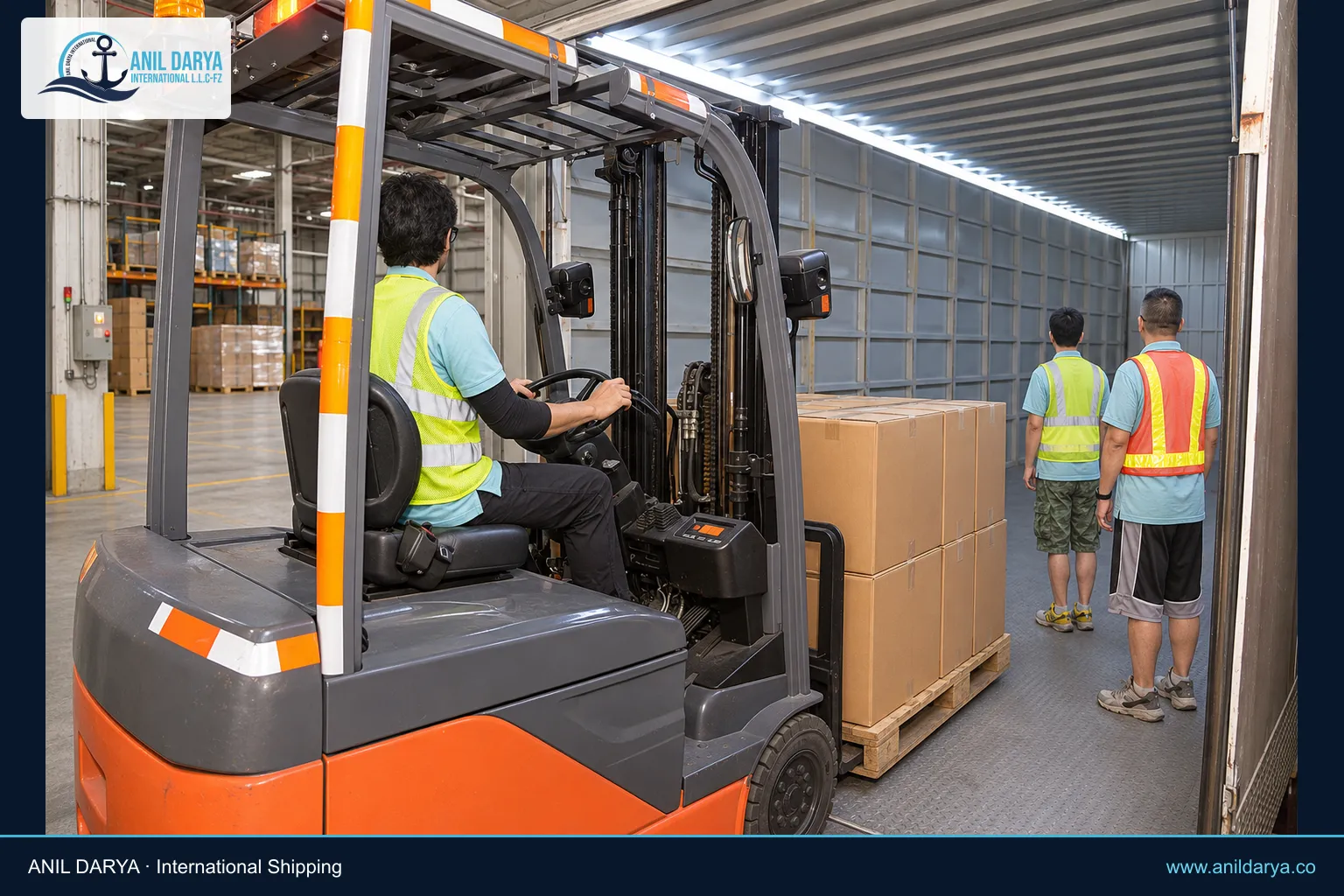
Bangladeshi garment cartons are often floor-loaded to fit more into each box. Saudi Arabia started a rule from 8 May 2025 that containerised imports at its ports must be palletised, with a 12-month phase-in and exemptions only for goods that cannot go on pallets, heavy machinery and oversized items, subject to approval. (trade.gov, last published 11 May 2026). Pallets cost carton space, so agree the loading method with the buyer before booking.
[AMIR-FACT: confirm how Saudi ports enforce the palletisation rule in late 2026 for floor-loaded garment cartons from Bangladesh, and whether any exemption or fee applies]
Dangerous goods
Few Bangladeshi exports to Saudi Arabia are dangerous goods, but dyes, chemicals and some batteries in electronics are. Check carrier policy first: Maersk's Bangladesh export page says it has a strict no-acceptance policy for IMO cargo booked from Bangladesh. Other lines may accept it, and every hub on the route must accept it too. Our dangerous goods team checks the papers and the carrier's acceptance before stuffing.
What Saudi buyers order from Bangladesh
The Saudi government's DataSaudi portal shows imports from Bangladesh of SAR 1.7 billion in 2025, up 3.3% on the year before. The main groups were:
| Product group | 2025, SAR million | What it means for the shipment |
|---|---|---|
| Knitted or crocheted apparel | 721.2 | 40ft high cube; SABER textile certificates; Arabic labels |
| Apparel, not knitted | 565.8 | Same as above |
| Coffee, tea, mate and spices | 99.3 | SFDA food clearance, health certificate, product registration on Ghad |
Clothing led again in August 2026, so for most shippers the SASO textile rules, not the sailing, decide when the box is released.
The Bangladeshi export side: ERC, EXP and the bank B/L
Bangladesh Customs, under the National Board of Revenue, processes export declarations on ASYCUDA World, which links customs with the banks and the port's terminal system. The exporter or its C&F agent files. Pickup and the export declaration are done by the shipper or its origin agent, and we coordinate with them on cut-offs, the booking and the draft B/L.
Bangladesh Customs lists these general documents for export:
- Export Registration Certificate (ERC), under the Export Policy 2024-2027, and the VAT registration (BIN) certificate.
- Export letter of credit, export contract, sales contract or guarantee, or an export permit if none of these exist.
- EXP form under the Foreign Exchange Regulation Act, 1947.
- Commercial invoice, packing lists, the bill of lading and a certificate of origin.
- Any permit from a regulatory agency the product needs.
Two bank rules shape the bill of lading. Maersk notes that, under Bangladesh Bank rules, bills of lading from Bangladesh must be consigned to a local bank, with exceptions only for fully foreign-owned factories and shipments without a letter of credit. And for prepaid freight, the shipper must show an Export Certificate to collect the B/L. So the "consignee" field on a Bangladesh to Saudi Arabia B/L is often the exporter's bank, with the Saudi buyer as notify party. Make sure the Saudi broker knows this, because the delivery order follows the endorsed original B/L.
For the certificate of origin, the Export Promotion Bureau (EPB) issues preferential certificates such as GSP and SAARC forms. For a plain non-preferential certificate, which is what Saudi customs normally sees from Bangladesh, the EPB has said that authorised chambers of commerce issue them, along with the two main garment associations for their members.
Is there a trade agreement on this lane?
We found no free trade agreement in force between Bangladesh and Saudi Arabia, or between Bangladesh and the GCC. Bangladeshi business groups have called for one, but that is not a tariff cut you can use. Both countries take part in the OIC trade preferential system talks (TPS-OIC); the October 2025 committee report lists both delegations but does not say that Saudi customs gives TPS-OIC rates to Bangladeshi goods. Plan on the normal GCC tariff, and ask the Saudi broker before you price.
If a preference ever applies, origin rules usually require direct shipment and an unbroken document trail. Splitting or storing the cargo in Dubai could then cost the preference, so check with the broker before you choose the Jafza route.
Saudi import customs for Bangladeshi cargo
Saudi customs is run by the Zakat, Tax and Customs Authority (ZATCA). The importer, or a broker acting for it, files the customs declaration on Fasah at least 48 hours before the ship reaches the port of entry. ZATCA asks for the commercial invoice, the bill of lading and the certificate of origin, plus product-specific documents. Since January 2025, GCC states use a 12-digit tariff code, so the Bangladeshi invoice should carry a code that the broker can map.
Document set for Saudi clearance
| Document | Issued by | Check before sailing |
|---|---|---|
| Commercial invoice | Bangladeshi exporter | HS code, fibre content, quantity, value, Incoterm; for food, expiry dates and batch numbers |
| Packing list | Bangladeshi exporter | Carton count, sizes and weights match the B/L |
| Bill of lading | Shipping line, released through us | Bank as consignee where required; Saudi buyer as notify party |
| Certificate of origin | Authorised Bangladeshi chamber or association | Exporter and goods match the invoice |
| SABER shipment certificate | Through the Saudi importer's SABER account | Issued for this consignment before the declaration |
SABER and the SASO textile regulation
SABER is the online conformity platform of the Saudi Standards, Metrology and Quality Organization (SASO). Importers register products there and obtain a product certificate, then a shipment certificate for each consignment. Since 1 October 2025, the shipment certificate must be issued before any customs declaration on the goods can be filed.
The SASO Technical Regulation for Textile Products covers products with at least 80% textile fibres by weight. The English version on SASO's site is Version 1, published in the Official Gazette on 24 August 2018; seller guides mention a newer edition, so the importer should check the edition in SABER. In the version we opened:
- Underwear and children's products need a certificate under conformity Type 3, from a SASO-approved body.
- Other textile products follow Type 1a.
- Labels must be in Arabic, or Arabic and English, and must not wash off.
- Labels must show the fibre types with their mass percentages, the country of origin, and care instructions.
Labels are sewn in at the factory and cannot be fixed at Jeddah, so get the label artwork with the order.
SFDA rules for tea, spices and seafood
The Saudi Food and Drug Authority's 2025 guide on food clearance says the importer must register its establishment and the products on the Ghad platform, apply for clearance through Fasah and have a licensed warehouse. Importers with no more than 5 shipments a year and 2,000 kg in total are exempt from the warehouse rule. Fish and aquatic products need an SFDA import permit, and food must come from establishments on SFDA's list for the exporting country. Invoices must show expiry dates and batch numbers.

Duty and 15% VAT on Bangladeshi goods
As a GCC member, Saudi Arabia applies the common external tariff of at least 5% to most goods from outside the GCC, worked out on the CIF value. Coffee and tea are among the goods that enter duty-free. Some food products that compete with local production carry rates up to 40%. Import VAT is 15%, charged on the customs value plus duty and other charges, and it applies even when no duty is due.
| Cargo from Bangladesh | Customs duty | Import VAT |
|---|---|---|
| Garments and home textiles | GCC tariff, at least 5% of CIF; check the 12-digit code | 15% on value plus duty |
| Tea and coffee | Duty-free | 15% |
| Spices, processed food | Check the code; some food lines are higher | 15% on value plus duty |
Duty and taxes at destination are paid by the consignee or its broker. The ocean freight from Chattogram forms part of the CIF value, so the broker needs the real freight figure from the invoice or our freight note.
Restricted and prohibited goods
ZATCA says restricted goods need the permits and documents of the competent authority, and goods prohibited locally or internationally cannot enter. The checks that matter for Bangladeshi cargo are:
- Garments, textiles and footwear: SABER certificates and correct labels.
- Food, tea, spices and seafood: SFDA registration, health certificates and, for fish, an import permit.
- Chemicals and dyes: permit from the competent Saudi authority.
- Medicines need SFDA approval, and counterfeit brands are not allowed in.
Bangladesh has its own export prohibited list in the Export Policy. Check both lists before quoting a new product.
How to arrange shipping from Bangladesh to Saudi Arabia, step by step
- Buyer and seller agree the Incoterm, the Saudi port and whether cartons go on pallets.
- The Saudi buyer names its customs broker and checks the SABER or SFDA needs for each HS code.
- Send us the details: product, HS code, cartons, weight and volume, load point (Chattogram, Dhaka ICD, EPZ), ready date and Saudi port.
- We quote the carrier, the hub, the transit and the free time at the Saudi port.
- We confirm with the consignee's broker that clearance is agreed and the document list is clear. Only then do we confirm the booking.
- The exporter or its C&F agent stuffs the cargo, files the export declaration, arranges the EXP with its bank and sends shipping instructions and VGM before the cut-off.
- We check the draft B/L, including the bank consignee and notify party, against the invoice and packing list.
- The carrier's B/L is issued and released through us, as an original or a release the bank allows.
- The buyer's SABER shipment certificate is issued, and the broker files on Fasah at least 48 hours before arrival.
- The broker arranges duty and VAT, the consignee takes delivery and returns the empty in free time.
Our Dubai freight forwarding team runs steps 3 to 8 and keeps the factory and the buyer updated.
What drives the cost of shipping from Bangladesh to Saudi Arabia
We do not publish prices, because they change with every sailing. These are the parts of the total and what moves each one.
| Cost part | What moves it |
|---|---|
| Origin in Bangladesh | Trucking or rail from the factory, ICD or EPZ, port charges, C&F agent fees |
| Ocean freight | Box type, season, hub and number of ship changes, surcharges |
| Detention | Days the empty box is out; Maersk's Bangladesh export tariff from 6 April 2026 allows 10 free days before charges start |
| Saudi port charges | Terminal handling, delivery order, inspection, LCL unpacking |
| Compliance | SABER certificates, SFDA testing, pallets |
| Duty and VAT | HS code and CIF value |
Our article on demurrage and detention explains how free time is counted at each end.
Checklist before the box leaves Chattogram
- Incoterm, Saudi port and loading method in the purchase order.
- Saudi customs broker named and clearance agreed.
- 12-digit HS code checked for duty, SABER and SFDA rules.
- SABER product certificate in place and the shipment certificate planned.
- Arabic or Arabic-English labels with fibre content and origin sewn in.
- ERC, BIN, EXP and export LC or contract ready at the exporter's bank.
- B/L consignee set as the bank requires, buyer as notify party.
- Free time at the Saudi port confirmed and cargo insured.
Common mistakes on this lane
- Shipping before destination clearance is agreed. Without a broker, the box sits at Jeddah or Dammam and charges grow every day.
- No SABER shipment certificate. Since October 2025 the declaration cannot be filed without it.
- English-only garment labels. They break the SASO textile rule and cannot be fixed at the port.
- Floor-loading cartons without checking the Saudi pallet rule.
- Wrong consignee on the B/L. A buyer named as consignee when the LC needs a bank consignee causes rework in Bangladesh.
- Believing a "direct" quote. Ask where the box changes ship and how long it waits.
Frequently asked questions
How long does shipping from Bangladesh to Saudi Arabia take?
It depends on the hub and the connection. We found no carrier schedule page in 2026 with a direct Chattogram to Saudi loop, so most boxes change ship at a hub such as Colombo or Jebel Ali. Ask for the full routing and add export clearance, the Fasah filing and inland delivery.
Which Saudi port is best for garments from Bangladesh?
Use Jeddah or King Abdullah Port for buyers in the west, including Makkah and Madinah. Use Dammam for Riyadh and the Eastern Province, because the rail link runs from Dammam to the Riyadh dry port.
Do Bangladeshi garments need SABER certificates in Saudi Arabia?
Yes, where the product falls under the SASO textile regulation, which covers products with at least 80% textile fibres. The importer needs a product certificate and a shipment certificate in SABER, and since 1 October 2025 the shipment certificate must exist before the customs declaration.
What customs duty does Saudi Arabia charge on clothing from Bangladesh?
Saudi Arabia applies the GCC common external tariff, at least 5% of the CIF value for most goods, plus 15% import VAT. Check the exact 12-digit code with the broker. We found no trade agreement in force that lowers this for Bangladeshi goods.
Why is the bill of lading consigned to a bank?
Bangladesh Bank rules require bills of lading from Bangladesh to be consigned to a local bank, with limited exceptions. The bank endorses the original B/L when the buyer pays or accepts the documents, and the Saudi side then takes delivery.
Who clears the cargo in Saudi Arabia?
The consignee or its licensed customs broker files on Fasah and pays duty and VAT. We do not sell clearance in Saudi Arabia, so we confirm the broker before we confirm the booking.
Do you issue your own bill of lading on this lane?
No. You get the carrier's own bill of lading. Because we are agent for many shipping lines, that B/L is issued and released through us, with the consignee and notify party your Bangladeshi bank and Saudi buyer need.
Get a quote for shipping from Bangladesh to Saudi Arabia
Send us the load point, product and HS code, carton count, weight and volume, ready date, Saudi port and the name of the buyer's broker. We will come back with the carrier, the hub and a price. Use our freight rate inquiry form, or contact our team to talk through a reefer or palletised garment shipment first.
[AMIR-FACT: one real Bangladesh to Saudi Arabia cross-trade shipment we handled (cargo, load point, Saudi port, carrier and hub, how the bank B/L and the Saudi broker were handled, days from booking to delivery), cleared for publication]
Sources
- Chittagong Port Authority: Handling Report 2025-26 (signed 13 July 2026)
- Chittagong Port Authority: draught and length limits at the jetties
- Red Sea Gateway Terminal: about us (Jeddah share, capacity, Patenga Container Terminal)
- Arab News: Saudi-run terminal at Bangladesh's largest port (21 June 2026)
- Maersk: Bangladesh exports (cut-offs, weight limits, DG, bank B/L rule, detention from 6 April 2026)
- Milaha: Southeast Asia - Gulf Service (SAG), February 2023
- Maritime Gateway: CMA CGM drops Chittagong call on its Gulf service
- DP World: Jebel Ali Port
- Dubai Customs: customs declaration types
- Bangladesh Customs (NBR): general documents for import and export
- ASYCUDA: Bangladesh compendium (ASYCUDA World links with banks and terminals)
- Export Promotion Bureau: Policy and Planning Division (preferential certificates of origin)
- The Financial Express: EPB on chambers issuing non-preferential certificates of origin
- DataSaudi: Saudi Arabia and Bangladesh trade (2025 and August 2026)
- COMCEC: TPS-OIC Trade Negotiating Committee report (Ankara, October 2025)
- ZATCA: import instructions
- ZATCA: restricted and prohibited imports
- ZATCA: guideline on imports and exports under VAT
- International Trade Administration: Saudi Arabia import tariffs (last published 11 May 2026)
- International Trade Administration: Saudi Arabia import requirements and palletisation (last published 11 May 2026)
- SABER: Saudi product conformity platform
- SASO: Technical Regulation for Textile Products (Version 1, Official Gazette 24 August 2018)
- TradeArabia: SASO shipment certificate before declaration from 1 October 2025 (27 August 2025)
- SFDA: conditions and requirements for food clearance (2025)
- Saudipedia: King Abdulaziz Port in Dammam
- King Abdullah Port: official site
Reviewed: 11 November 2026