
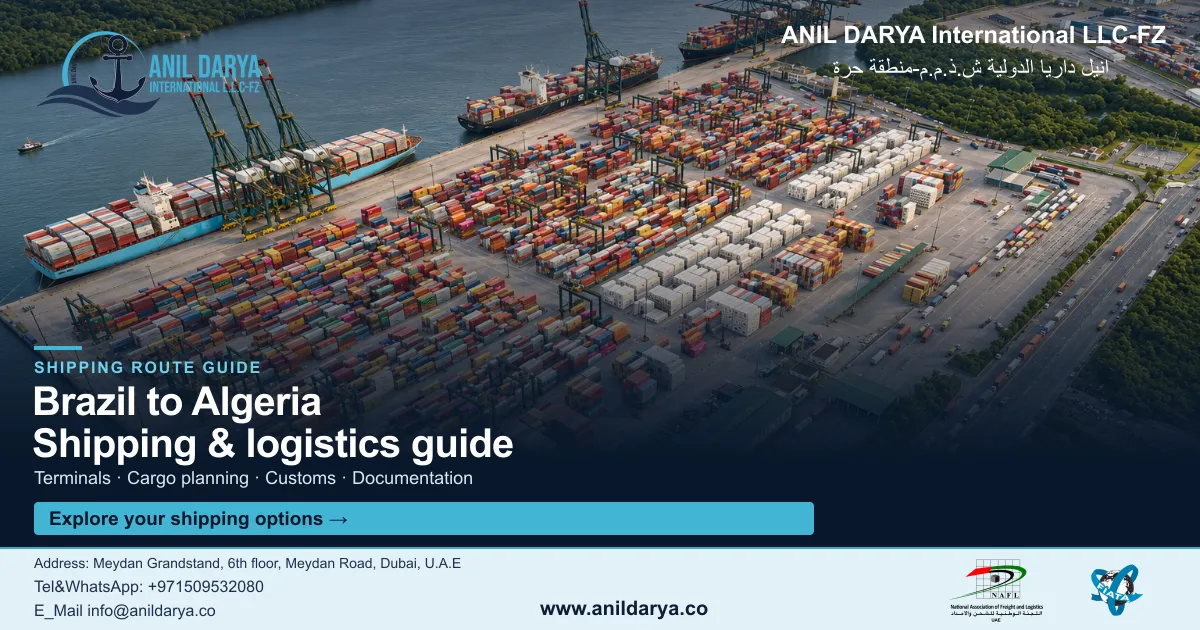
Shipping from Brazil to Algeria is a food and raw materials lane: soybeans, sugar, corn, iron ore and chilled beef top the list, according to Brazilian trade data for 2026. No regular container line runs straight between the two countries, so boxes change ship at a hub on the way, and that matters for chilled meat with a short shelf life. The other trap sits on the Algerian side: the buyer's bank must domicile the import, and some permits must be dated, before the cargo is loaded in Brazil. We book the ocean freight from Dubai, release the carrier's bill of lading to you and line up the Brazilian exporter, the Algerian importer and its customs broker before the box sails.
Brazil to Algeria shipping at a glance
| Item | Detail |
|---|---|
| Type of lane | Sea cross-trade, Brazil to Algeria, booked and coordinated by Anil Darya from Dubai |
| Main cargo | Soybeans, sugar, iron ore, corn, chilled beef, soybean oil, peanuts and engines |
| Brazilian load ports | Santos, Paranagua, Itajai and Navegantes, Rio Grande; Salvador, Suape and Pecem in the northeast |
| Algerian discharge ports | Algiers, Djen Djen (Jijel), Bejaia and Oran, with Annaba, Skikda and Mostaganem on some services |
| Routing | Transhipment at a hub; Brazil's Ministry of Agriculture reports no direct sea line |
| Brazilian export filing | DU-E in the Portal Unico Siscomex, by the exporter or its customs broker |
| Before loading in Brazil | Bank domiciliation of the import; for meat a veterinary derogation; for feed corn and soybean meal a phytosanitary authorisation dated before the B/L |
| Algerian customs | Direction Generale des Douanes (DGD); detailed declaration within 21 clear days of unloading |
| Trade agreement | None between Brazil or Mercosur and Algeria; the general tariff applies |
| Bill of lading | The shipping line's own B/L, released to you through us as agent for the line |
| Who clears in Algeria | The importer or its commissionnaire en douane, agreed before we confirm the booking |
How a cross-trade booking from Brazil to Algeria works
The box is stuffed in Brazil and cleared in Algeria, and touches the UAE only if you choose. Our Dubai desk holds the booking and checks the Brazilian papers against what the Algerian bank and customs will ask for.
| Party | What it does on a Brazil to Algeria shipment |
|---|---|
| Brazilian exporter or its broker | Packs or stuffs the cargo, files the DU-E, obtains the sanitary or phytosanitary certificate, the certificate of origin and any halal certificate, trucks the box to the terminal |
| Anil Darya, Dubai | Books space, checks the domiciliation and permit dates against the planned loading date, follows the transhipment, releases the carrier's B/L |
| Shipping line | Carries the box via its hub and lodges the manifest at the Algerian port |
| Algerian importer | Holds the trade register entry, domiciles the import at its bank, gets the veterinary or plant health authorisation, pays duty and taxes |
| Importer's commissionnaire | Files the detailed declaration, attends the border inspections and takes release |
The bill of lading is the carrier's own. Anil Darya acts as agent for many shipping lines, so the line's bill for, say, a 40ft reefer of beef from Paranagua to Algiers is released to you from our Dubai office. On this lane the date printed on that bill is checked by the Algerian bank, so we confirm the loading date only after the importer sends us its domiciliation date.
Clearance in Algeria is not something we sell. Duty and taxes at destination are paid by the consignee or its broker. Before we confirm a sailing out of Santos or Paranagua, the buyer names its commissionnaire, tells us which port that broker works at and confirms that the bank file and any permit are in place. Until then the booking stays provisional.
FOB Brazil keeps the carrier choice, the hub and the B/L date in the buyer's hands, which helps with the Algerian date rules. Under CFR or CIF the Brazilian seller books the ship, so the buyer must make sure the seller knows the domiciliation date. Our Incoterms 2020 guide for sea freight sets out where cost and risk pass under each term.
Load ports in Brazil
Choose by where the plant or mill sits and, for meat, by reefer capacity at the terminal.
| Port | Hinterland | What the official or operator pages say |
|---|---|---|
| Santos | Sao Paulo, Minas Gerais, Goias, Mato Grosso | Brazil's largest port complex, 186.4 million tonnes in 2025 and 2.8 million TEU in the first half of 2025; DP World Santos has a 1,100 m quay and 1,000 reefer connections |
| Paranagua | Parana, Mato Grosso do Sul | 1.662 million TEU in 2025 and the largest Brazilian corridor for frozen animal protein, with 34% of that market |
| Itajai and Navegantes | Santa Catarina | Portonave at Navegantes handled 1,108,029 TEU in 2025, with frozen meat among its top exports |
| Rio Grande | Rio Grande do Sul | Southern outlet for grain, meat and tobacco |
| Salvador, Suape, Pecem | Bahia and the northeast | Closer to North Africa on the map; check each week whether the carrier's connection from there suits Algeria |
Discharge ports in Algeria
Book the port closest to the buyer's cold store, mill or plant, and where its commissionnaire is registered.
| Port | Facts from the operator | Best for |
|---|---|---|
| Algiers | DP World Djazair: two 300 m berths, depths up to 11 m, a 30-hectare terminal with direct truck access | Meat and food importers in the capital and the centre |
| Djen Djen (Jijel) | DP World: 1,590 m of quay at 17 m draft, 12 super post-Panamax cranes, 36 reefer plugs; about 350 km from Algiers per the port authority | The east, and larger ships if the line calls there |
| Bejaia | Container terminal run by Bejaia Mediterranean Terminal, a joint venture set up in 2004 | Kabylie and the food industry around it |
| Oran | Main container gateway for the west | Western buyers who want to avoid a long truck haul from Algiers |
For beef, check reefer plugs: Djen Djen lists 36, so confirm capacity before booking a large Ramadan programme.
Transhipment and transit time from Brazil to Algeria
The Ministry of Agriculture's attache office in Algiers wrote in February 2026 that there are no direct sea or air lines between Brazil and Algeria, so cargo is transhipped in European ports. Route listings we opened for Santos to Algiers and Salvador to Algiers also show only transhipment services, with one or two changes of ship. Each quote from us names the vessel on both legs and the hub.
The same ministry note warns that boxes pile up at the hub and that delays there can push chilled beef past its use-by date before customs release in Algeria. Brazilian officials and exporters got Algeria to accept a longer shelf life, and in 2025 a temporary approval to freeze chilled cargo held in port. Plan the connection, not just the first sailing.
How many days does sea freight from Brazil to Algeria take?
We do not print a figure. We could not open a carrier schedule page for this lane, and the estimates on route sites differ from one listing to the next. We send the carrier's own schedule for both legs with each quote.
[AMIR-FACT: the carriers and services we actually book from Santos, Paranagua, Itajai and Pecem to Algiers, Oran, Bejaia and Djen Djen, the hub each one uses, and real port-to-port days for chilled reefer, frozen reefer and dry boxes]
Sea freight from Brazil to Algeria: reefer, dry box and bulk
| Option | Typical cargo | Point to check for Algeria |
|---|---|---|
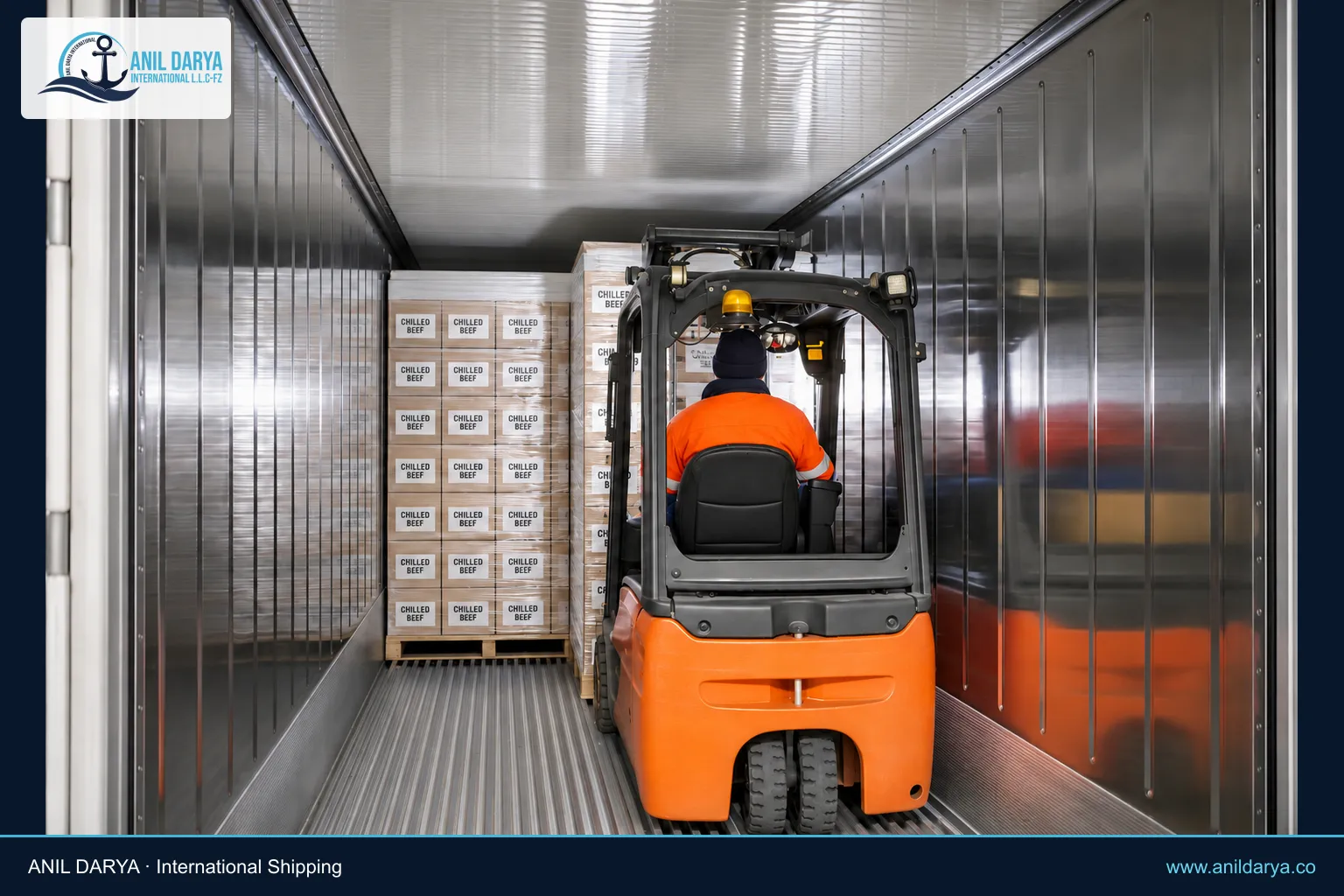
| 40ft reefer, chilled | Boneless chilled beef | Shelf life left after the hub; veterinary derogation; plug at the Algerian terminal |
| 40ft reefer, frozen | Frozen beef, offal | Set point on the booking; the same sanitary papers as chilled |
| 20ft dry | Bagged sugar, peanuts, coffee | Weight limit before volume; phytosanitary certificate; fumigation with an approved product |
| 40ft dry or high cube | Engines, auto parts, machinery parts | Invoice value equal to the domiciled amount; new goods only |
| Flexitank or ISO tank | Soybean oil | Food-grade tank history and the conformity file |
| Bulk carrier | Soybeans, corn, raw sugar, iron ore | Charter terms, and for feed grain the phytosanitary authorisation dated before the B/L |
Soybeans, corn, iron ore and raw sugar usually move as whole ship cargoes, which our bulk cargo team handles. For mixed or smaller lots, our FCL vs LCL comparison shows when a full box pays, and our sea freight service books the container.
Chilled beef: plan for the shelf life
Count the days from slaughter to expected release in Algeria, including the hub wait and the border inspection. If the margin is thin, ship frozen or pick another hub. The MAPA note puts the cost of holding a container in an Algerian port at up to USD 15,000 a month, and it reports importers abandoning boxes that ended up auctioned.
Fumigation and dangerous goods
The USDA's February 2026 certificate report says that since October 2022 only aluminium phosphide and magnesium phosphide are allowed for fumigation in Algeria, so check the fumigation certificate for bagged sugar or peanuts. Engines with fuel residue, resins and agrochemicals travel under the IMDG Code 2024 edition, Amendment 42-24, mandatory since 1 January 2026; every line on the route must accept the booking, which our dangerous goods team arranges first.
What the exporter files in Brazil
Exports leave Brazil on the DU-E (Declaracao Unica de Exportacao) in the Portal Unico Siscomex. The government service page says the exporter, the declarant or their legal representatives register it, usually from the electronic invoice (NF-e), and recommends checking the NCM code first. Under the Receita Federal export manual, the terminal then receives the cargo, customs clears it and the carrier reports the loading.
We do not collect cargo or file in Brazil. Before the cut-off we need the cleared DU-E and these papers for Algeria:
- A sanitary veterinary certificate for meat and other animal products, on the model Algeria has agreed with Brazil, from Brazil's Ministry of Agriculture (MAPA).
- A phytosanitary certificate for grain, sugar, peanuts and other plant products, plus a fumigation certificate where used.
- A certificate of origin; the USDA report lists it, with a certificate of conformity and quality, among the papers Algeria wants for all imports.
- A halal certificate for meat.
- A certificate of free sale for finished goods sold on as they are.
The USDA report notes that Algeria's veterinary services agree certificate models country by country, so ask the exporter to confirm it will issue the current Algeria model.
Rules the Algerian buyer must settle before loading
Treat these as booking conditions, not arrival tasks.
Registered importer and import programme
Customs wants a trade register entry whose activity matches the product, and a tax number. Since the end of 2021, importers of goods for resale as they are need an electronic trade register entry for each product sub-group, per the USDA report. The Ministry of Foreign Trade also asks importers to file a forecast import programme (PPI) on its platform each half-year; the window for the second half of 2026 ran from 23 June to 31 July 2026. The MAPA note confirms that beef importers file this programme to obtain import authorisations.
Bank domiciliation before shipment
Bank of Algeria note 01/DGC/2026 of 14 May 2026 requires every import of goods to be domiciled at an approved bank before the foreign supplier ships. Banks must check that the transport document, the B/L included, is dated after the domiciliation, and must refuse a file where the goods shipped first, except in duly justified and expressly authorised cases. For a Brazilian seller this means: no gate-in until the buyer sends the domiciliation date.
Veterinary derogation and plant health authorisation
The USDA certificate report of 10 February 2026 says animal products need a sanitary authorisation from the Ministry of Agriculture's veterinary services, the derogation sanitaire, before import. The MAPA note adds that beef also gets a veterinary sanitary inspection on arrival and needs an admission authorisation for release. For corn and soybean meal for feed, the importer must hold a phytosanitary authorisation from the plant protection directorate (DPVCT), and the USDA report says it must bear a date earlier than the bill of lading or the product is rejected.
The same report cites a 2000 Ministry of Agriculture decree that bans genetically engineered plant material except for research, and says a non-GE certificate goes with plants and plant products. Brazilian soybeans and corn still sell in Algeria, so ask the importer which attestation the DPVCT wants for your grain.
[AMIR-FACT: confirm with an Algerian importer or broker, before we publish, which plant health attestation the DPVCT currently asks for on Brazilian soybeans and corn, and whether the beef derogation and admission steps above are still the ones in force in November 2026]
Halal and Arabic labels
A 2014 order sets Algeria's technical rules for halal food, covering slaughter, processing, packing, labelling, storage and transport, according to the USDA country report of January 2022. That report also says labels must be in Arabic, and the label must be applied before export. Agree the halal certifier and the Arabic label text with the importer before production starts.
Conformity control at the port
All imports go through conformity control at the port by a joint team from four ministries, and the original documents must travel with the shipment. The USDA report still lists a deposit of 120% of the transaction value 30 days before shipment for finished goods for resale; confirm with the importer's bank whether that applies to your product.
Algerian customs clearance and the 21-day limit
The DGD requires a detailed declaration for every import, even when no duty is due. It is lodged at the competent customs office by the owner of the goods, a commissionnaire en douane or the carrier, and the deadline is 21 clear days from unloading into a temporary storage area or dry port. After that the goods go under the deposit regime with penalties. An early declaration before arrival is allowed only for perishable, dangerous and heavy goods, which includes much of what comes from Brazil.
| Document | What customs uses it for |
|---|---|
| Trade register extract and tax number | Confirms the importer may import this product |
| Final invoice, domiciled at an approved bank | Customs value and the link to the bank file |
| Bill of lading | Transport title; its date is checked against the domiciliation |
| Packing list | Needed when a shipment holds goods under several tariff codes |
| Veterinary, phytosanitary or conformity documents | Proof the border inspection was passed |
| Authorisations | Derogation sanitaire for meat, DPVCT authorisation for feed grain |
| Certificate of origin | Origin check on the declaration |
| Broker's mandate | When a commissionnaire files for the owner |
A registered declaration cannot be amended. The system routes it to the green channel for release after payment, the orange channel for a document check of tariff code, value, origin and quantity, or the red channel, which adds a physical examination with the declarant present.
Duty, VAT and other taxes at the Algerian border
Duty is set by the 10-digit Algerian tariff code: six HS digits and four national ones. The DGD's worked example taxes a good at 30% duty and then 19% VAT on the value plus duty, giving DZD 5,470 of tax on a DZD 10,000 customs value. The US trade.gov guide also notes a temporary additional safeguard duty (DAPS) on a list of products since January 2019.
Beef shows how far the general rule can move. The MAPA note of February 2026 lists, for boneless fresh or chilled beef under code 0201301100:
| Charge | Rate under the general tariff |
|---|---|
| Customs duty | 30% |
| VAT | 0% (exempt) |
| Sanitary tax on meat | DZD 10 per kg |
| PRCT and TCS | 2% and 3% |
| DAPS | 0% for this line |
The same note says the finance laws for 2024, 2025 and 2026 granted temporary duty exemptions on certain essential foods, so the rate actually charged can be lower than the table. The commissionnaire should confirm the line in the DGD tariff database, or request a binding tariff ruling (RTC), before the price is agreed.
[AMIR-FACT: confirm with the importer's commissionnaire the duty and tax actually charged in November 2026 on chilled and frozen Brazilian beef, sugar and soybeans, after the 2026 finance law exemptions]
Is there a trade agreement between Brazil and Algeria?
No. The DGD lists Algeria's preferential agreements as the association agreement with the EU, the Greater Arab Free Trade Area (GZALE), the African Continental Free Trade Area, applied by Algeria from 1 November 2024, and bilateral agreements with Jordan and Tunisia. Brazil and Mercosur are not on the list, so Brazilian goods pay the general rate for their code.
Routing through Dubai does not change that. The UAE is a GZALE member, but GZALE covers only goods of Arab origin under its own rules, proven by an Arabic certificate of origin, with direct transport between Arab states. Brazilian sugar repacked or stored in Jafza keeps its Brazilian origin. Algerian customs also separates origin, where goods were made, from provenance, where they were shipped from, so a box from Jebel Ali still declares Brazil as origin.
Banned and restricted goods in Algeria
The DGD's non-exhaustive list of banned or suspended imports includes several items Brazilian sellers ask about:
- Used goods in general, used spare parts for trade, and used or retreaded tyres.
- Used vehicles, apart from narrow exceptions.
- Counterfeit goods and goods with marks suggesting Algerian origin.
- Fireworks and other explosives; arms; drugs and poisonous substances.
- Ozone-depleting substances and products that contain them.
- Second-hand clothing.
Goods that need an authorisation count as prohibited if they arrive without it. On this lane that mostly means meat without a veterinary derogation and feed grain without the DPVCT authorisation.
Typical cargo on this lane
Brazilian exports to Algeria reached USD 1.8 billion from January to September 2026, up 6.9% on the same period of 2025, according to ministry data compiled by the Arab-Brazilian Chamber of Commerce and reported by ANBA on 30 October 2026. The main products were soybeans, sugar, iron ore, corn, chilled beef, soybean oil, peanuts and engines. The MAPA office in Algiers puts Brazil's 2025 sales of fresh and chilled beef to Algeria at more than USD 282 million, plus about USD 30 million of live cattle.
The note says meat demand roughly doubles in Ramadan, and in 2025 import authorisations ran ahead of demand, so thousands of tonnes waited in ports. For a Ramadan beef programme, fix the arrival window in the contract and allow for hub delays.
Routing through Dubai: when it helps
Dubai is off the direct path, and for chilled beef a stop there only eats shelf life. It can still fit a few cases:
- A Dubai trader buys from Brazil and sells to Algeria while the cargo ships straight from Brazil.
- Non-food Brazilian goods such as engines or parts held in a Dubai free zone and shipped to Algeria per order. Our article on JAFZA re-export explains the free zone route.
- Brazilian goods combined with Gulf or Asian goods in one box for an Algerian buyer. Our Jebel Ali port guide covers the terminal.
Where the cargo is landed, stored or re-exported in Dubai, we clear it through UAE customs for a fee with our Dubai freight forwarding team. The Algerian rules do not go away: the import must be domiciled before the goods ship, and the onward B/L is checked against that date.
[AMIR-FACT: whether we have moved Brazilian cargo for Algerian buyers through Jebel Ali (trader invoicing, consolidation or Jafza stock), for which cargo, the carrier from Jebel Ali to Algeria and the real extra days compared with a direct transhipment]
What drives the cost of shipping from Brazil to Algeria?
Rates change every sailing, so we publish none. On FOB terms the bill splits like this.
| Cost part | What moves it | Usually paid by (FOB) |
|---|---|---|
| Origin charges in Brazil | Trucking, DU-E, terminal handling, reefer power before loading | Exporter |
| Certificates | Veterinary, phytosanitary, fumigation, halal, origin, free sale | Exporter, unless agreed otherwise |
| Ocean freight | Reefer or dry, load port, hub, season, surcharges | Importer |
| Algerian port and line charges | Terminal handling, delivery order, reefer power, storage, container deposit | Importer |
| Border inspections | Veterinary, phytosanitary and conformity checks | Importer |
| Duty and taxes | Tariff code, finance law exemptions, DAPS, VAT, sanitary tax | Consignee or its broker |
| Delay charges | Late domiciliation, missing derogation, expired shelf life | Whoever caused the delay, by contract |
Port storage and container detention are where this lane loses money. See our article on demurrage and detention.
Step by step with Anil Darya
- Agree the product, HS code and Incoterm with the Brazilian seller, and the payment method; MAPA advises Brazilian exporters to prefer a letter of credit over cash against documents.
- Send us the plant city, cargo, weights, ready date, reefer set point if any and the Algerian port.
- Name the commissionnaire. We confirm with the buyer that its trade register, PPI and any permit cover the goods, and that the broker works at that port. Only then do we confirm the booking.
- The importer domiciles the import at its bank and, for meat or feed grain, obtains the derogation or the DPVCT authorisation. It sends us the dates.
- We book the space, compare load ports and hubs, and get reefer or DG acceptance on both legs.
- The exporter applies Arabic labels, prepares the certificates, files the DU-E and gates in before cut-off, not before the domiciliation date.
- We check the draft B/L against the invoice, the domiciled amount and the permit dates, then release the carrier's B/L once freight is settled.
- The ship discharges in Algeria. The broker files the detailed declaration well inside 21 days, attends the inspections, and the consignee or its broker pays duty and taxes.
[AMIR-FACT: one real Brazil to Algeria cross-trade shipment we handled (cargo, Brazilian load port, Algerian port, carrier and hub, how the domiciliation and permit dates were matched to the B/L, door-to-door days), cleared for publication]

Checklist before the cargo leaves Brazil
- Importer's trade register matches the product; PPI covers the goods.
- Import domiciled at the bank, with the date sent to us.
- Veterinary derogation for meat, or DPVCT authorisation for feed corn and soybean meal, dated before loading.
- Certificate on the agreed Algeria model, plus origin, halal and free sale certificates where needed.
- Arabic labels on the product before export.
- Shelf life checked against the full route, hub included.
- Duty, exemptions and DAPS checked with the commissionnaire.
- Broker named and clearance agreed before the booking is confirmed.
Mistakes that cost money on this lane
- Shipping before destination clearance is agreed. A reefer at Algiers with no commissionnaire burns plug and storage days while the 21-day clock runs.
- Loading before the bank domiciliation, which leaves a B/L dated too early.
- A DPVCT authorisation dated after the B/L, which the USDA report says leads to rejection.
- Booking chilled beef on a long hub connection without counting the shelf life.
- Selling on cash against documents to a new buyer; MAPA reports payment delays and cargo left in port.
- Expecting a lower duty because the goods passed through Dubai.
Frequently asked questions
Is there a direct ship from Brazil to Algeria?
Brazil's Ministry of Agriculture reported in February 2026 that there is no direct sea line, and the route listings we opened show transhipment services only. Your box changes ship at a hub, and we name the hub and both vessels on each quote.
Do Brazilian goods get a lower duty in Algeria?
No trade agreement covers Brazil, so the general tariff applies. Some foods, beef among them, have had temporary exemptions under Algeria's finance laws for 2024 to 2026, so the broker should confirm the current rate for your tariff code.
When must the Algerian buyer domicile the import?
Before the Brazilian seller ships. Bank of Algeria note 01/DGC/2026 says the transport document must be dated after the domiciliation, so we wait for that date before loading.
What does Algeria need for beef from Brazil?
A sanitary veterinary certificate on the agreed model, a veterinary derogation held by the importer, a halal certificate, Arabic labels, inspection on arrival and an admission authorisation, according to USDA and MAPA reports. Chilled beef also needs enough shelf life to survive the hub.
What does Algeria need for soybeans and corn?
A phytosanitary certificate and, for feed corn and soybean meal, an import authorisation from the DPVCT dated before the bill of lading. Ask the importer which other attestations the plant health service wants for your grain.
How long does the importer have to declare the goods?
Twenty-one clear days from unloading, after which the goods go under the deposit regime with penalties.
Does Anil Darya clear the cargo in Algeria?
No. The importer or its commissionnaire clears the goods, and duty and taxes at destination are paid by the consignee or its broker. We agree the plan with that broker before confirming the booking.
Get a quote for sea freight from Brazil to Algeria
Send us the plant city, the cargo and HS code, the ready date, the reefer set point if any, the Algerian port, the broker's name and the domiciliation status, and we will reply with routing options and a price. Use our freight rate inquiry form, or contact our team to plan a reefer programme or a bulk cargo first.
Sources
- ANBA: Brazil's exports to Algeria rise in 2026 (30 October 2026)
- MAPA, agricultural attache in Algiers: Agroinsight 2/26, beef and live animals in Algeria (1 February 2026)
- USDA FAS Algiers: FAIRS Export Certificate Report AG2025-0007 (10 February 2026)
- USDA FAS Algiers: FAIRS Country Report AG2021-0016 (25 January 2022)
- Bank of Algeria: Note 01/DGC/2026 (14 May 2026)
- Algerian Customs: Detailed declaration and documents
- Algerian Customs: Control channels
- Algerian Customs: Estimating duties and taxes
- Algerian Customs: Banned and suspended goods
- Algerian Customs: Preferential agreements
- Algerian Customs: GZALE rules
- trade.gov: Algeria customs regulations
- Algerie Eco: PPI window, second half of 2026
- DP World Djazair: Algiers terminal
- DP World Djen Djen: Terminal data
- Djen Djen Port: The port
- Bejaia Mediterranean Terminal: Partnership
- Government of Brazil: Declare an export (DU-E)
- Receita Federal: Portal Unico export manual
- Ministry of Ports and Airports: Santos tonnage 2025
- Ministry of Ports and Airports: Santos containers, first half of 2025
- DP World: Santos terminal
- Parana State Government: Ports of Parana container exports
- Portonave: 2025 throughput
- Fluent Cargo: Santos to Algiers services (routing type only)
- IMO: IMDG Code 2024 edition
- Jafza: About
Reviewed: 11 November 2026