
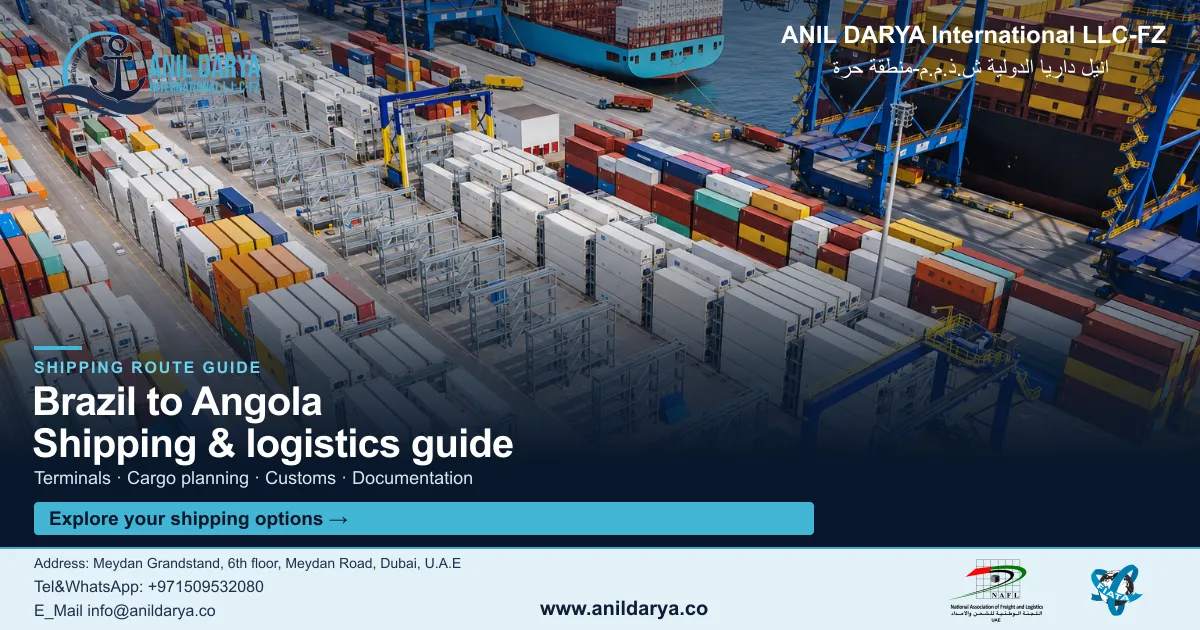
Shipping from Brazil to Angola is mostly a reefer and food lane: frozen chicken, pork and beef, raw and white sugar, then steel products, machinery and vehicles, loaded at Santos, Paranagua or Itajai and discharged at Luanda, with Lobito and Namibe for the south. Each sea shipment needs an Angolan loading certificate before it sails, and most food needs an import licence that the Angolan buyer must hold first. Anil Darya books the ocean freight from Dubai, gets the shipping line's bill of lading released to you, and lines up the Brazilian exporter and the Angolan customs agent before any space is confirmed.
Shipping from Brazil to Angola at a glance
| Item | Detail |
|---|---|
| Size of the trade | Brazil exported USD 592 million of goods to Angola in 2025 (UN Comtrade data) |
| Main cargo | Meat and offal, sugar, articles of iron or steel, machinery, vehicles, prepared meat and fish |
| Brazilian load ports | Santos, Paranagua, Itajai and Navegantes; Salvador, Suape and Pecem in the north-east |
| Angolan discharge ports | Luanda for most cargo; Lobito for Benguela and the rail corridor; Namibe for the far south |
| Liner routing | Usually a loop that crosses to Durban before Luanda, or a change of ship at a hub; ask for the routing on every quote |
| Brazil export filing | DU-E in Portal Unico Siscomex, filed by the exporter or its customs broker |
| Before sailing | Angolan loading certificate, with its number on the bill of lading and manifest |
| Angola import filing | Documento Unico with the AGT, by the importer or an approved customs agent |
| Import VAT | 14% general rate, 5% reduced rate for some goods |
| Trade agreement | No tariff agreement between Brazil or Mercosur and Angola; full tariff rates apply |
| Bill of lading | The shipping line's own B/L, released to you through us as agent for the line |
Who does what on a Brazil to Angola cross-trade
The cargo goes from a Brazilian terminal to an Angolan one and never touches the UAE unless you ask for that. Our part sits in Dubai: we pick the sailing, hold the space, check the papers and follow the container.
| Step | Who handles it |
|---|---|
| Carrier choice, space, reefer or special equipment | Anil Darya, booked with the line from Dubai |
| Collection at the plant or cold store, stuffing, VGM, trucking to the terminal | The Brazilian exporter or its despachante (customs broker), to the cut-offs we send |
| DU-E and any Brazilian export certificate | The exporter or its broker |
| Loading certificate application | Made with the booking data through an authorised agent before the ship leaves |
| Import licence, Documento Unico, inspections, release | The Angolan importer and its customs agent |
| Duty, VAT and port charges in Angola | The consignee or its broker |
The title document is the carrier's bill of lading, issued from the Brazilian load port to Luanda, Lobito or Namibe. Because we work as agent for many shipping lines, the line issues that B/L and we hand it to you from Dubai, as originals or as a release the line accepts. There is no house bill of ours between you and the carrier.
Customs clearance in Angola is not something we sell. We treat it as a gate in the booking instead. Before we confirm space from Santos or Paranagua, the Angolan buyer names its customs agent, and that agent confirms three things: the importer holds a licence for this product, the HS codes on the Brazilian invoice are the ones it will declare, and it is ready to file when the reefer lands. If any answer is missing, we hold the booking.
Load ports in Brazil for this lane
Pick the port by the plant location and by the loop the line runs to Africa. Meat packers in the south often load at Paranagua or Itajai; sugar and goods from Sao Paulo state go through Santos.
| Port | Figure we found | Typical Angola cargo |
|---|---|---|
| Santos (Sao Paulo) | 186.4 million tonnes handled in 2025, a record; DP World's Santos terminal alone moved 1.3 million TEU | Sugar, beef, steel, machinery, vehicles, consumer goods |
| Paranagua (Parana) | 1.662 million TEU in 2025 | Frozen chicken and pork from Parana packers, food ingredients |
| Itajai and Navegantes (Santa Catarina) | Portonave handled 1,108,029 TEU in 2025 | Frozen chicken and pork from Santa Catarina, ceramics, machinery parts |
| Salvador, Suape, Pecem | Route listings show Luanda reached from these ports with one or two transfers | Goods from factories in Bahia, Pernambuco and Ceara |
Angolan discharge ports: Luanda, Lobito or Namibe
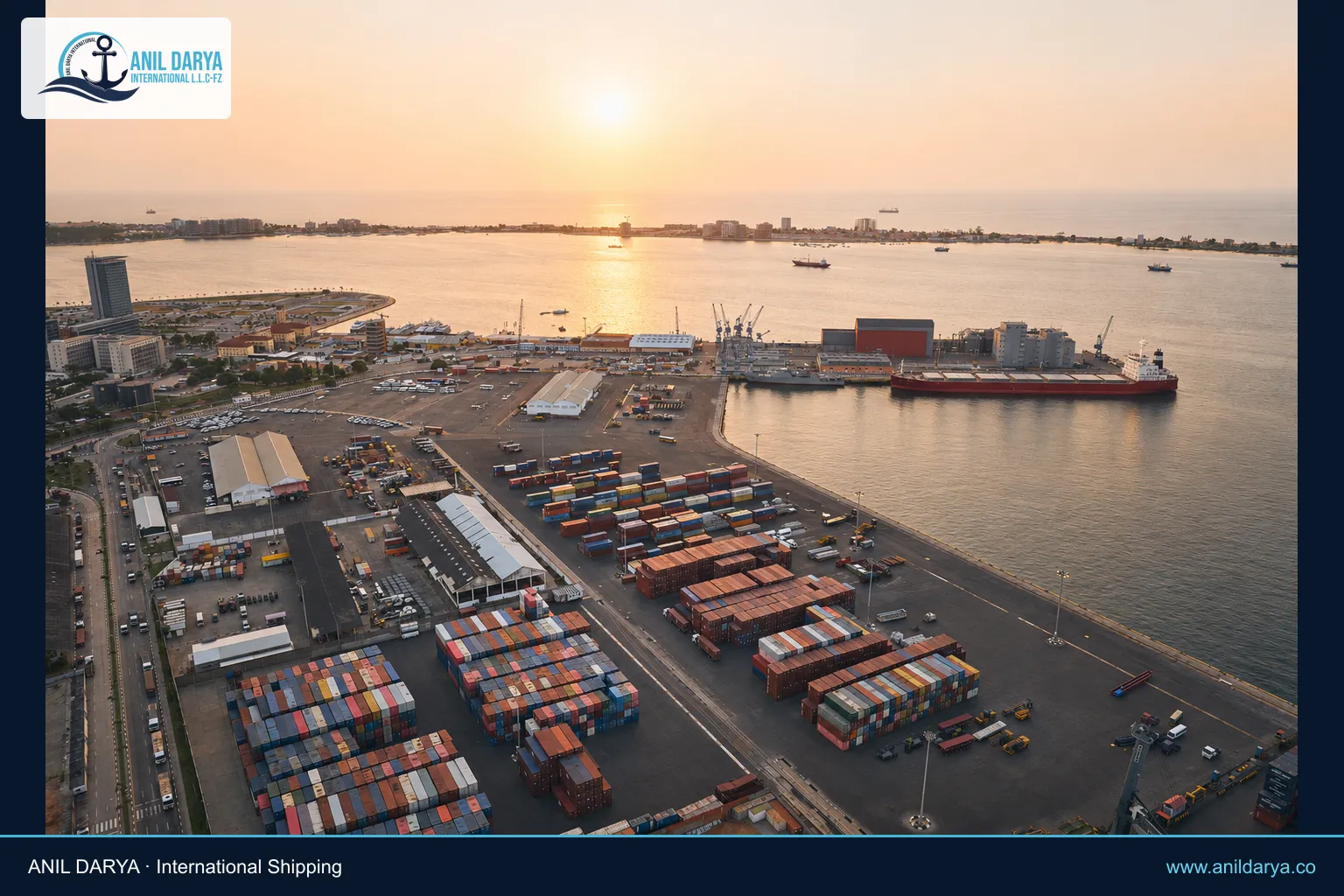
Most Brazilian food ends up in Luanda's cold stores and wholesale markets, so Luanda is the default. Lobito makes sense for Benguela, Huambo and towns along the railway. Namibe serves the far south.
| Port | What the operators and lines publish | Point for Brazilian cargo |
|---|---|---|
| Luanda | Container terminals run by Sogester, DP World and AD Ports Group, plus Multiterminais with a 900 m general cargo quay; channel 15 to 30 m; pilotage compulsory over 500 gross tonnes. Maersk lists a 35 t gross limit per container. | Reefers accepted; the terminal starts charging storage from day 4 after discharge, per Maersk's Angola import page |
| Lobito | AGL runs the multipurpose and container terminal with a 1,200 m quay. Maersk lists a 31 t gross limit per container. | Storage is charged from day 1, so clearance has to be ready on arrival |
| Namibe | Maersk lists a 40 t gross limit per container and a twice-monthly breakbulk call on its SAFWAF service | Fewer container calls; ask for the relay port in writing |
These limits are gross, cargo plus container, so check a 20ft box of bagged sugar before it is stuffed.
Sea freight from Brazil to Angola: routings and transit
There is no short straight line on most liner services. Lines have long run this trade as a triangle between Brazil, South Africa and Angola, which means a box loaded in Brazil may sail east to Durban first and then north to Luanda.
- Maersk's advisory of 13 June 2024 on its 09D/WAFEX offer gave the rotation Luanda, Paranagua, Santos, Navegantes, Durban, Luanda, with weekly departures from Durban after changes by the service operator. Reading that rotation, a box loaded in Brazil would reach Luanda after the Durban call; confirm with the line that it stays on the same vessel.
- Trade reports from late 2025 said Santos would drop out of this South America to Africa loop from November 2025, leaving Paranagua and Itajai as the Brazilian calls. We could not open the carrier's own notice, so we confirm the live rotation on each booking.
- In April 2026 DP World launched its Brazil-Africa Link, a logistics corridor from the Port of Santos to its operations in Angola and Mozambique. The Italian Trade Agency reported in September 2026 that DP World also runs a direct sea corridor from Santos for containerised animal protein and farm commodities to Angola, Mozambique and South Africa.
We do not print a transit figure for this lane. The aggregator numbers we saw for Santos to Luanda differ from each other by more than a week, and none comes from a carrier timetable we could check against a port rotation. Every quote we send carries the line's own dates for that vessel and voyage.
[AMIR-FACT: the carriers and services we actually book from Santos, Paranagua and Itajai to Luanda and Lobito in 2026, whether the loop calls Durban or uses another hub, and real port-to-port days for reefer and dry boxes]
Frozen chicken, pork and beef: the reefer side of the lane
Meat is the largest line in Brazil's sales to Angola, at USD 191 million in 2025. Brazil's agricultural attache in Luanda has published several reports on this trade since 2025, and they matter to anyone booking a reefer.
Chicken
- Angola imported 223,000 tonnes of chicken meat in 2025, after more than 306,000 tonnes in 2022 (AGT data, in the May 2026 report).
- Brazil became the largest supplier by volume in 2025, with 43% of the market and more than 96,000 tonnes.
- Leg quarters made up 61.7% of import volume in 2025; whole frozen griller chicken came second with 27,000 tonnes.
- The report says import licences have become harder to obtain, and that the rules for granting them change often.
Pork
- Brazil is Angola's main pork supplier, with 70% of chilled and frozen pork imports in 2024.
- An import licence is required, and licences for offal, heads, head meat and feet have been restricted since 2024.
- The September 2025 report lists import duty of 20% for pork and pork cuts, 10% for frozen liver and 50% for other offal, heads, tails and feet.
What changed for 2026
Angola's 2026 State Budget Law, Law 14/25 of 30 December 2025, amended the customs tariff again. According to the attache's January 2026 report, chicken, turkey, goose and guinea fowl feet are now prohibited imports. New tariff lines at 10% were added for bovine feet and hearts and for pig tails and feet, and two chicken offal codes (0207.13.90 and 0207.14.90) fell from 50% to 30%. Brazil supplied 40% of Angola's frozen chicken feet in January to October 2025, so this change hits Brazilian packers directly.
Booking a reefer to Luanda
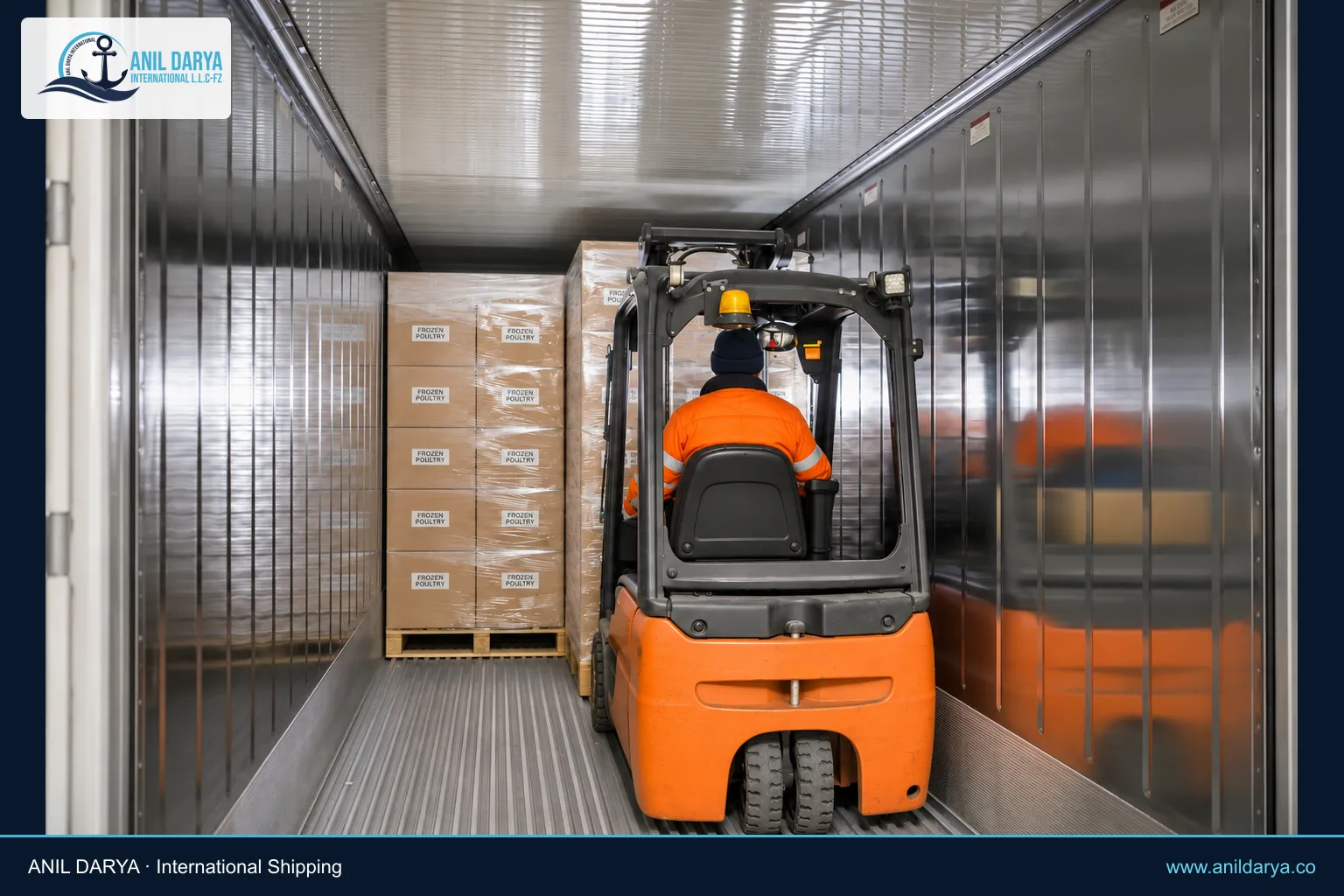
Ask the buyer for the licence number and its validity before the packer books production. Set the temperature on the booking itself. Food is laboratory tested in Angola during clearance under Decree 140/16, so plan extra days for the release.
Sugar, steel, machinery and project cargo
Sugar was the second-largest export to Angola in 2025 at USD 126 million, ahead of articles of iron or steel at USD 84 million, machinery at USD 34 million and vehicles at USD 27 million.
| Cargo | Usual equipment | Plan for |
|---|---|---|
| Bagged sugar | 20ft FCL | Gross weight against the Luanda and Lobito limits; food licence and testing in Angola |
| Steel bars, pipes, wire, structures | 20ft FCL, flat rack, breakbulk | Lashing, rust protection, crane capacity at the discharge berth |
| Farm machinery and spare parts | 40ft, open top, flat rack | Dimensions, lifting points, written line acceptance for each transfer |
| Vehicles and trucks | Container or ro-ro through a hub | Duty line for the vehicle category; ask the agent before you buy |
For a first trial order, LCL can work, but release in Angola waits until every lot in the shared box is cleared. Our FCL vs LCL guide helps you decide when a full container pays, and our sea freight service covers what we book on the line. For a sugar mill part, a crusher or a steel structure that will not fit a flat rack, our break bulk and project cargo team looks for breakbulk space and plans the stowage.
Dangerous goods on this route
Agrochemicals, paints, resins, lubricants and batteries all travel as dangerous goods. The IMDG Code 2024 edition (Amendment 42-24) has been mandatory since 1 January 2026, and the Brazilian shipper must supply the UN number, class, packing group, safety data sheet and a signed DG declaration.
- Maersk's Angola page says Luanda handles class 1 and class 7 only by direct delivery, and class 5.1 can stay in the yard for no more than 48 hours.
- At Lobito and Namibe, the same page says all IMO cargo must go by direct delivery, with written confirmation from the port.
- On a loop that calls Durban before Luanda, the class must also be accepted for that call.
Direct delivery means the agent and the haulier must be ready the day the ship berths. Our dangerous goods desk checks acceptance for the whole routing before we hold space.
The Brazilian export side: DU-E and certificates
Brazilian export formalities stay with the exporter or its despachante. We share the booking number, cut-offs and the draft B/L with them; we do not file in Brazil.
- The DU-E (Declaracao Unica de Exportacao) is registered in Portal Unico Siscomex by the exporter, the declarant or their legal representatives, normally built from the NF-e electronic invoice.
- The gov.br service page, updated 29 July 2026, sets the order: check the NCM code and its administrative and tax treatment, register the DU-E, then present documents if the customs channel is not green.
- Animal products need the veterinary certificate that Angola asks for, issued by Brazil's official veterinary service, and the description must match the Angolan import licence.
Most Angolan buyers purchase FOB or CFR Santos or Paranagua, which keeps the Brazilian export with the seller. Our Incoterms 2020 guide shows where cost and risk pass under each term.
The Angolan loading certificate before the ship sails
Every sea shipment to an Angolan port needs a loading certificate, the Certificado de Embarque. The US Commercial Service lists it among the standard import documents under the names ARC, waiver or CNCA certificate, and says it is issued by an authorised agent in the country of origin. Germany's trade agency GTAI adds that its number must appear on the bill of lading and the cargo manifest. The agency now in charge is ARCCLA, whose statute (Presidential Decree 326/20) gives it the task of issuing pre-shipment cargo certificates.
On a Brazil booking, the order is simple. We confirm the space and the B/L number, the application goes in with shipper, consignee, HS codes, weights, freight and vessel, and the certificate number is printed on the draft B/L before the final is issued. A reefer that leaves Paranagua without it is costly to put right.
[AMIR-FACT: which authorised agent issues the Angolan loading certificate for our Brazil to Angola bookings, the data it needs from the exporter and the usual lead time before sailing]
Angola import customs for Brazilian goods
What the Angolan importer must hold
- A registration with the Ministry of Industry and Trade for the product category (the REI, valid five years according to GTAI).
- An import licence for sensitive goods such as food, medical devices, pharmaceuticals and agricultural inputs, per the US Commercial Service. For Brazilian meat this is the step that most often blocks a sale.
- A customs agent approved by the AGT, unless the importer files itself. Agent fees are regulated and cannot exceed 2% of the CIF value.
The declaration and the system
The import declaration is the Documento Unico, filed electronically with the AGT, Angola's tax and customs authority, together with the declaration of customs value. The AGT launched ASY5, its new ASYCUDA generation, at Lobito on 5 January 2026, with modules for the sea cargo manifest, the declaration and payment. GTAI reports legal filing deadlines from arrival of 60 days for sea cargo and 13 days for perishables, but terminal storage and reefer power run from the first days, so the agent should file as soon as the ship berths.
Documents for a Brazilian consignment
| Document | Comes from | Check before sailing |
|---|---|---|
| Commercial invoice and packing list | Brazilian exporter | HS codes, net and gross weights, Incoterm, same consignee as the B/L |
| Carrier bill of lading | Shipping line, released to you through us | Loading certificate number, correct port and consignee |
| Loading certificate | Authorised agent | Issued before the vessel sails |
| Import licence | Angolan importer | Covers this product, quantity and period |
| Veterinary or phytosanitary certificate | Brazil's official services | Matches the licence and the labels |
| Certificate of origin | Brazilian issuing body | Same origin and description as the invoice |
Pre-shipment inspection has not been mandatory since Presidential Decree 63/13 of 11 June 2013, according to the US Commercial Service.
Duty, VAT and trade agreements when shipping from Brazil to Angola
The customs tariff
Angola's Pauta Aduaneira follows the 2022 Harmonized System. Presidential Legislative Decree 1/24 approved it in January 2024, and the AGT says it took effect on 3 April 2024. Since then, each year's State Budget Law has amended it: Law 18/24 for 2025 and Law 14/25 for 2026. Duty depends on the HS code of each line, so ask the Angolan agent to run every code through the AGT tariff before the price is fixed.
| Charge | Rate or basis |
|---|---|
| Import duty | Rate for the HS code in the current Pauta; for example 20% on pork cuts, 30% on the two chicken offal codes cut in 2026 |
| VAT | 14% general rate, 5% reduced rate for certain goods, charged on a base that includes duty and other taxes |
| General customs fee | 2%, as listed by the US Commercial Service |
| Stamp duty | 1%, as listed by the US Commercial Service |
| Customs agent fee | Regulated, no more than 2% of CIF value |
Duty and taxes at destination are paid by the consignee or its broker. We do not pay them for you.
Is there a trade agreement?
No tariff preference covers this lane. The only Brazil-Angola agreement on Brazil's Siscomex agreements pages is an Investment Cooperation and Facilitation Agreement (ACFI), which is in force but deals with investment, not customs duty. Mercosur has no preferential trade agreement with Angola. African preferences under the AfCFTA or SADC need African origin, so Brazilian goods pay the full Angolan rate. Since there is no preference to protect, holding or splitting Brazilian goods in Dubai does not change their duty in Angola, but the certificate of origin must still state Brazil.
Banned and restricted goods at the Angolan border
- Chicken, turkey, goose and guinea fowl feet: prohibited from 2026 under Law 14/25.
- Poultry wing tips, heads, combs and tails: still prohibited for chicken; the 2026 law took frozen turkey and duck versions off the list.
- Restricted, with extra scrutiny of licences: bovine tongue and edible skins, pig feet, skins and heads, poultry edible skins. Some restricted goods are licensed only for processing.
- Refined vegetable oils: since Executive Decree 393/25 (April 2025), vegetable oils may be imported only crude and in bulk, and the trade ministry suspended licences for refined sunflower, palm and soy oil. Bottled Brazilian soy oil cannot be sold into Angola; crude oil for local refiners can.
- Food, medicines, medical devices and farm inputs: import licence and laboratory testing at entry.
- Counterfeit branded goods: seized at the border.
[AMIR-FACT: whether our Angolan meat buyers obtained import licences for Brazilian chicken and pork in 2026, the usual time to get one, and any product we had to turn down]
Does a Dubai routing make sense on this lane?
For a straight order from a Brazilian packer or mill, no. Dubai is far off the South Atlantic, and a detour adds a second long sea leg and a second reefer plug-in period. Two narrower cases can still justify it.
| Option | How it works | What to watch |
|---|---|---|
| Direct from Brazil | The box sails from Santos, Paranagua or Itajai to Luanda on the line's B/L | The default for meat, sugar and steel |
| Brazilian goods held in JAFZA | Dry goods such as footwear, machinery parts or plastics wait in the Jebel Ali Free Zone and ship to Angola with Gulf or Asian stock | The loading certificate and Angolan licence still apply to each shipment |
When goods are held, consolidated or re-exported in Dubai, we handle the UAE customs clearance for a fee. Our Jebel Ali port guide covers the terminal side, and our note on re-exporting through JAFZA explains the free zone set-up.
[AMIR-FACT: whether any client has routed Brazilian cargo for Angola through Jebel Ali or JAFZA, for which goods, and the extra days compared with a direct sailing]
Shipping from Brazil to Angola step by step
- Agree the Incoterm with the Brazilian seller. FOB or CFR keeps the DU-E with the exporter.
- The Angolan buyer checks its product registration and obtains the import licence for the goods and quantity.
- The buyer names its AGT-approved customs agent, who confirms the HS codes and any testing.
- Send us the load port, discharge port, cargo, HS codes, weight, temperature or DG details and the ready date. We quote the line, the routing and the vessel.
- We check with the agent that clearance is agreed, and only then confirm the booking.
- The loading certificate is applied for with the booking data, and its number goes on the draft B/L.
- The exporter stuffs the box, files the DU-E and gets the veterinary or phytosanitary certificate where needed.
- We check the draft B/L against the invoice, packing list and licence, then release the carrier's B/L to you from Dubai.
- We follow the vessel through any hub and send the arrival notice to the agent.
- The agent files the Documento Unico, the consignee pays duty and VAT, the cargo is tested if it is food, released and delivered.
[AMIR-FACT: one real Brazil to Angola shipment we booked (cargo, Brazilian load port, Angolan port, carrier and routing, how the loading certificate and the Angolan agent were coordinated, total days), cleared for publication]
What drives the cost of shipping from Brazil to Angola?
We quote each sailing on its own, because the routing, the box type and the season change the price. These are the parts of a landed cost.
| Cost part | What moves it | Usually paid by |
|---|---|---|
| Brazilian inland and terminal charges | Distance from the plant, reefer pre-trip, DU-E and broker fees | Seller on FOB, buyer on EXW |
| Ocean freight | Dry or reefer, routing via Durban or a hub, season, surcharges | Set by the Incoterm |
| Loading certificate | Agent's fee per shipment | As agreed in the sale |
| Angolan terminal charges | Terminal, box size, reefer power, storage after free days | Consignee |
| Clearance and testing | Agent fee, customs fee, stamp duty, laboratory tests | Consignee |
| Duty and VAT | HS code, CIF value, 14% or 5% VAT | Consignee or its broker |
| Delay costs | Missing licence, late filing, slow empty return | Whoever caused the delay |
Our article on demurrage and detention shows how those daily charges build up.
Checklist before cargo leaves Brazil
- Import licence held by the Angolan buyer for this product and quantity.
- HS code checked against the 2026 prohibited and restricted lists.
- Angolan customs agent named, briefed and in agreement before booking.
- Loading certificate number on the draft B/L.
- Veterinary or phytosanitary certificate matching the licence and labels.
- Reefer temperature on the booking; DG papers to the 2024 IMDG edition.
Mistakes to avoid on this lane
| Mistake | What happens | How to avoid it |
|---|---|---|
| Shipping before destination clearance is agreed | A reefer sits at Luanda on power while storage and detention run | Name and brief the Angolan agent before we confirm space |
| Selling meat to a buyer without a licence | The Documento Unico cannot be filed | See the licence before the packer schedules production |
| Quoting chicken feet or banned cuts | The goods are refused at entry | Check the 2026 list for every code |
| No loading certificate number on the B/L | Extra cost and delay at the Angolan port | Apply as soon as the booking is confirmed |
| Overweight 20ft box for Lobito | The line refuses or re-stuffs the container | Check the 31 t gross limit at booking |
Frequently asked questions
How long does sea freight from Brazil to Angola take?
It depends on the loop: some services call Durban before Luanda, others change ship at a hub. We quote the line's own dates for each sailing.
Is there a direct ship from Santos to Luanda?
Some loops carry Brazilian cargo to Luanda on the same vessel, but via Durban. DP World also announced a direct corridor from Santos to Angola in 2026.
Can I export Brazilian chicken to Angola?
Yes, if the Angolan importer holds a licence. Chicken feet have been prohibited since 2026, and some offal and parts remain banned or restricted.
What is the Angolan loading certificate?
It is a certificate every sea shipment to Angola needs before sailing, issued through an authorised agent under ARCCLA. Its number must be printed on the bill of lading and the manifest.
Is there a trade agreement between Brazil and Angola?
Not one that cuts duty. The two countries have an investment agreement, but Brazilian goods pay the full Angolan tariff rate plus VAT of 14%, or 5% on certain goods.
Who clears the cargo in Angola?
The importer or an AGT-approved customs agent hired by the consignee files the Documento Unico. We agree the plan with that agent before booking, but we do not clear goods in Angola.
Who issues the bill of lading on a Brazil to Angola booking with you?
The shipping line issues its own B/L. As agent for many lines, we release it to you from our Dubai office. We do not issue a house bill on cross-trade bookings.
Get a quote for this lane
Send us the Brazilian plant city or load port, the Angolan port, the goods with HS codes, the weight and volume, and the reefer temperature or DG class. Use our freight rate inquiry form or contact our Dubai office, and our Dubai freight forwarding team will reply with a routing and a booking plan.
Sources
- Trading Economics (UN Comtrade): Brazil exports to Angola, 2025
- Brazil Ministry of Agriculture, attache in Luanda: The chicken market in Angola 2022 to 2025 (13 May 2026)
- Brazil Ministry of Agriculture, attache in Luanda: The pork market in Angola (15 September 2025)
- Brazil Ministry of Agriculture, attache in Luanda: Recent changes to Angola's customs tariff for animal products (13 January 2026)
- Brazil Ministry of Agriculture, attache in Luanda: Angola suspends imports of refined vegetable oils (15 May 2025)
- Siscomex: Investment Cooperation and Facilitation Agreements, Brazil and Angola
- Government of Brazil: Declare export, DU-E in Portal Unico Siscomex (updated 29 July 2026)
- Ministry of Ports and Airports: Santos handles 186.4 million tonnes in 2025
- Government of Parana: Ports of Parana pass 1.6 million TEU
- Portonave: 2025 throughput
- DP World: Brazil-Africa logistics corridor launched (24 April 2026)
- Italian Trade Agency (ICE): DP World direct sea corridor from Santos to Africa (21 September 2026)
- Maersk: Service changes 09D/WAFEX (13 June 2024)
- Maersk: Angola export information, weight limits and IMO handling
- Maersk: Angola import information, terminal storage
- Fluent Cargo: Sao Paulo to Luanda route listing (routing type only)
- Porto de Luanda: terminals, channel depth and pilotage
- AD Ports Group: operations start at Luanda
- AGL: Lobito multipurpose and container terminal concession
- US Commercial Service: Angola import requirements and documentation (1 February 2024)
- US Commercial Service: Angola import tariffs
- GTAI: Angola customs declaration, importer registration and loading certificate
- Presidential Decree 326/20: statute of ARCCLA
- AGT Folha Tributaria no. 70 (April 2024): revised Pauta Aduaneira
- AGT Folha Tributaria no. 89 (January 2026): launch of ASY5
- IMO: IMDG Code 2024 edition
- JAFZA: About the Jebel Ali Free Zone
Reviewed: 11 November 2026