
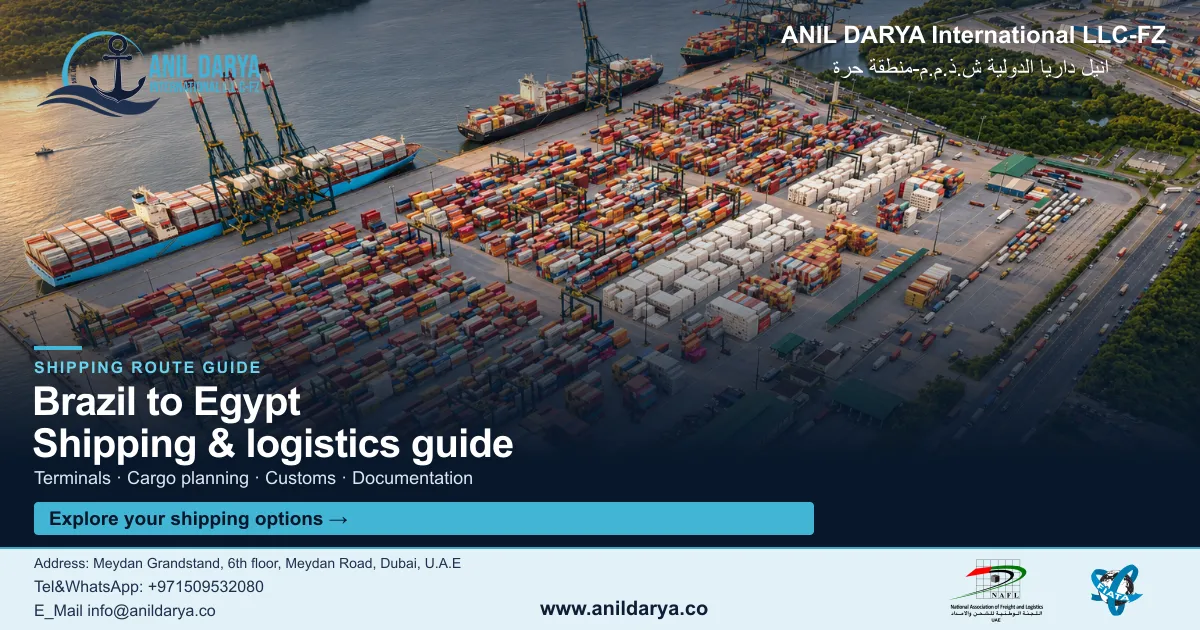
Shipping from Brazil to Egypt is mostly a food lane: frozen beef in reefers, sugar, and corn that makes Egypt one of Brazil's biggest grain buyers. Three things decide whether a box clears smoothly. The Egyptian importer needs an ACID from Nafeza before loading, meat needs a GOVS permit and a halal certificate, and the Brazilian exporter must get a Mercosur-Egypt certificate of origin before export so the buyer pays the agreement rate. We book the ocean freight from Dubai, release the carrier's bill of lading to you, and line up both sides before we confirm the booking.
Brazil to Egypt shipping at a glance
| Item | Detail |
|---|---|
| Type of lane | Cross-trade by sea, Brazil to Egypt, booked and coordinated by Anil Darya from Dubai |
| Main Brazilian load ports | Santos, Paranagua, Itajai and Navegantes, Rio Grande; Salvador, Suape and Pecem in the northeast |
| Main Egyptian discharge ports | Alexandria and Dekheila, Port Said (East and West), Damietta, Sokhna |
| Routing | Container services listed for Santos to Alexandria are transhipment services; we name the hub on each quote |
| Typical cargo | Corn, raw cane sugar, frozen beef and offal, soybeans, unprocessed tobacco |
| Brazilian export filing | DU-E in the Portal Unico Siscomex, by the exporter or its customs broker |
| Trade agreement | Mercosur-Egypt FTA, in force since 1 September 2017; scheduled tariff cuts ran to 1 September 2026 |
| Proof of origin | Mercosur-Egypt certificate of origin in English, issued before export, valid 180 days |
| Egypt pre-shipment rule | ACID requested on Nafeza at least 48 hours before loading |
| Egypt import VAT | 14% standard, as the broker confirms per product |
| Bill of lading | The shipping line's own B/L, released to you through us as agent for the line |
| Destination clearance | The consignee's licensed customs broker in Egypt, agreed before we confirm the booking |
How shipping from Brazil to Egypt works as a cross-trade
The cargo is loaded in Brazil and cleared in Egypt; it touches the UAE only if you choose. Our Dubai desk holds the booking and checks that the Brazilian papers match what the Egyptian broker will file.
| Party | Role on a Brazil to Egypt box |
|---|---|
| Brazilian exporter or its broker | Stuffs the reefer or dry box, files the DU-E, gets the veterinary or phytosanitary certificate, the halal certificate and the Mercosur-Egypt certificate of origin, uploads the ACI documents on CargoX |
| Anil Darya, Dubai | Books space, checks the ACID and the GOVS permit dates before gate-in, follows the transhipment, releases the carrier's B/L |
| Shipping line | Loads only with a valid ACID, carries the box via its hub, lodges the manifest in Egypt |
| Egyptian importer | Holds the import registration and NFSA food licence, requests the ACID and the GOVS permit, pays duty and VAT |
| Importer's broker in Egypt | Files the declaration with the certificate of origin, attends sampling and inspection, takes release |
The B/L is the carrier's own document. Anil Darya is agent for many shipping lines, so for a reefer of frozen beef from Paranagua to Port Said the line's bill is released from our Dubai office. Before release we compare it with the invoice: consignee, Egyptian tax number, ACID, container and seal numbers must all agree.
We do not clear goods in Egypt. Duty and taxes at destination are paid by the consignee or its broker. Before we confirm a booking out of Santos or Paranagua, the buyer names its broker, tells us at which port that broker works, and confirms that the ACID request and, for meat, the GOVS permit are filed. If those answers are missing, the booking stays on hold.
On FOB Santos the buyer pays the ocean freight; on CFR or CIF Alexandria the seller books the ship, but Egyptian charges, duty and VAT stay with the buyer. Our Incoterms 2020 guide for sea freight shows where cost and risk pass.
Which Brazilian ports to ship from
Pick the load port by plant location and reefer capacity, since so much of this lane is frozen protein.
| Brazilian port | Hinterland | Facts that matter for Egypt cargo |
|---|---|---|
| Santos | Sao Paulo state, Minas Gerais, Goias, Mato Grosso | Brazil's largest port complex; 186.4 million tonnes in 2025; 2.8 million TEU in the first half of 2025; sugar is one of its main exports. DP World Santos has a 1,100 m quay and 1,000 reefer connections. |
| Paranagua | Parana, Mato Grosso do Sul, Paraguay | 1.662 million TEU in 2025; the largest Brazilian corridor for frozen animal protein, with 34% of that market |
| Itajai and Navegantes | Santa Catarina meat and poultry belt | Portonave at Navegantes handled 1,108,029 TEU in 2025; frozen meat is among its top three exports |
| Rio Grande | Rio Grande do Sul | Southern gateway for the state's meat, tobacco and grain |
| Salvador, Suape, Pecem | Bahia and the northeast | Calls on some Europe and Mediterranean loops; check the transhipment option per quote |
Which Egyptian port to arrive at
The USDA Cairo office lists five main entry ports for food imports: Damietta, Alexandria, Port Said East, Port Said West and Sokhna. Pick the one closest to the buyer's cold store or mill, where its broker works.
| Egyptian port | What the official or operator pages say | Usually suits |
|---|---|---|
| Alexandria and Dekheila | Alexandria Port Authority runs both; about 60% of Egypt's export and import volume; Dekheila has dry bulk and liquid bulk terminals as well as containers | Alexandria, the western Delta, Cairo importers, grain mills |
| Port Said (SCCT in East Port Said) | APM Terminals lists a 3,355 m quay, 17 m draft and 6,400 reefer plugs | Frozen meat importers in the canal cities, the eastern Delta and the 10th of Ramadan area |
| Damietta | Container terminals plus grain berths; NFSA has a laboratory at the port | Mansoura, Damietta and the eastern Delta, grain buyers |
| Sokhna | DP World operates the container berths; dry bulk berths handle sugar | Suez and eastern Cairo |
Transhipment and transit time from Brazil to Egypt
No carrier page we could open shows a regular container loop that calls Brazil and Egypt on the same ship. The services that route aggregators list from Santos to Alexandria are all transhipment services: a South America to Mediterranean loop joined to a second loop into Egypt. The changeover happens at a Mediterranean hub, and which hub depends on the carrier and the week.
The hub adds dwell time, a beef reefer must hold its set point through the changeover, and the GOVS permit must still be valid on arrival. Each quote from us names the vessel on both legs and the hub.
How long does sea freight from Brazil to Egypt take?
We print no figure: the carrier schedule pages for this lane could not be opened and aggregator estimates disagree. Ask us for the current sailing and its days per leg.
[AMIR-FACT: the carriers we actually book from Santos, Paranagua and Itajai to Alexandria, Port Said and Damietta, the transhipment hub each uses, and the real port-to-port days for reefer and dry boxes]
Sea freight from Brazil to Egypt: reefer, dry box and bulk
| Option | Typical Brazilian cargo for Egypt | Point to check |
|---|---|---|
| 40ft reefer | Frozen boneless beef, offal, poultry | Set point on the booking, GOVS permit valid on arrival, shelf life left at the Egyptian port |
| 20ft dry | Bagged sugar, coffee, tobacco, seeds | Weight limit before volume; fumigation or phytosanitary papers where needed |
| 40ft dry / high cube | Auto parts, machinery parts, paper, packaged foods | Same piece counts and weights on invoice, packing list and Nafeza |
| LCL | Spare parts, samples | Each consignee in the box needs its own ACID |
| Bulk carrier | Corn, soybeans, raw sugar | Charter terms, CAPQ and GOEIC rules on the Egyptian side |
| Flat rack or breakbulk | Farm machinery, plant equipment | Dimensions, weight and lifting points; an ACID is still needed |
Corn, soybeans and raw sugar usually sail in bulk ships. For a full grain cargo, our bulk cargo team handles the charter side. For mixed lots of dry goods, our FCL vs LCL comparison shows where a full box pays off, and our sea freight service books the container.
Frozen beef in reefers
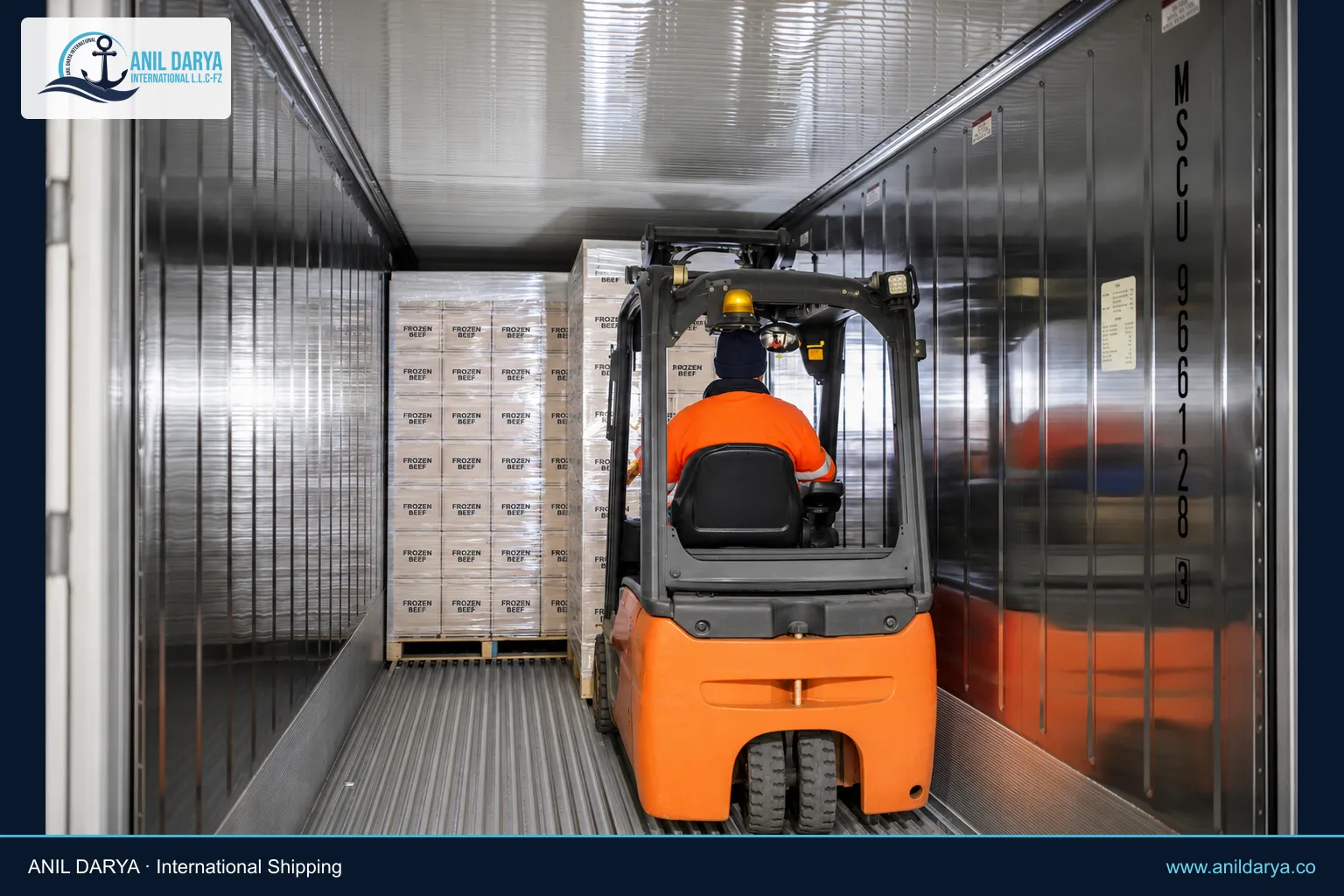
The USDA Cairo report says Egypt tests 100% of meat and offal imports for drug residues. It also says frozen beef must be packed in sealed bags with an Arabic label inside each bag: the producer, slaughterhouse, slaughter date, importer and the body that supervised halal slaughter. Frozen boneless beef has a 12-month shelf life from production. A product with six months or more of shelf life must reach the port with at least three months left. With a long transhipment route, check the production date before you book.
Chemicals and dangerous goods
Resins, agrochemicals and some fuel additives move under the IMDG Code 2024 edition, Amendment 42-24, mandatory since 1 January 2026. The Brazilian shipper gives the UN number, class, packing group, safety data sheet and DG declaration, and each line on the route, including the second leg, must accept the booking. Our dangerous goods team gets that acceptance first.
What the Brazilian exporter files before the ship sails
Brazilian exports are declared on the DU-E (Declaracao Unica de Exportacao) in the Portal Unico Siscomex. The government service page says the exporter, the declarant or their legal representatives register it, normally from the electronic invoice (NF-e), and advises checking the NCM code first. Receita Federal's export manual then has the terminal receive the cargo, customs clear it and the carrier report the loading.
We do not file the DU-E or collect cargo in Brazil. What we need is the cleared DU-E before cut-off, plus these Egypt papers:
- The Mercosur-Egypt certificate of origin, issued before the goods are exported.
- A veterinary health certificate for meat, or a phytosanitary certificate for plant products, from the Brazilian competent authority.
- A halal certificate for meat and poultry, from a body Egypt accepts.
- The ACID, the importer's tax number and the exporter's ID on every document.
The Mercosur-Egypt FTA and the certificate of origin
This is the paper most Brazil to Egypt guides skip. Brazil's Siscomex portal says the Mercosur-Egypt free trade agreement entered into force on 1 September 2017 and that its tariff cuts run until 1 September 2026, so the scheduled phase-out is now complete. Egypt granted Mercosur a 100% margin on 5,259 tariff codes, a 30% margin on seven and quotas on two. A product outside Egypt's list still pays the normal rate.
The preference is not automatic. The goods must meet the agreement's origin rules, and the Egyptian broker must present the original certificate with the import declaration.
| Rule | What it says |
|---|---|
| Who issues | Entities authorised by the Brazilian government (entidades habilitadas), on the exporter's declaration and invoice |
| Form and language | The model in Annex II.1, completed in English, on guilloche-printed paper |
| Timing | Issued before export; issued afterwards only in special cases, marked "ISSUED RETROSPECTIVELY" |
| Validity | 180 days from issue, for one import operation |
| Origin criteria | A for wholly obtained goods such as Brazilian beef or corn; B for a change of 4-digit heading; C for non-originating materials within the percentage limit (45% of the ex-works price for Brazil when the heading rule cannot be met); D for product-specific rules in Annex II.4 |
| Third-party invoicing | Allowed if the certificate shows the third operator's invoice number, date, name and address, or the invoice carries a declaration linking it to the certificate |
The third-operator rule matters for Dubai traders. A UAE company can buy from a Brazilian packer and invoice the Egyptian buyer, and the Brazilian goods can still get the preference, if the certificate or invoice carries the right details. Box 11 of the certificate is where a third operator is noted.
Direct transport: why routing matters for the duty rate
Article 14 of the origin chapter says the goods must be transported directly. Transit through a third country, with transhipment or temporary storage, is allowed only under that country's customs control, for geographic or transport reasons, with no trade or use there and no handling beyond unloading, reloading and keeping the goods in good condition. A normal transhipment in a Mediterranean hub fits. Selling the goods out of a free zone stock usually does not. Ask the broker before you plan any stop.
Egypt import customs: ACI, ACID and Nafeza
Since 1 October 2021, Advance Cargo Information has been mandatory for shipments to Egypt. The Misr Technology Services guide for shipping lines sets the ACI request deadline at 48 hours before loading, allows customs up to 48 hours to issue the ACID, and tells carriers never to load cargo with an invalid ACID. On a long transhipment route the timing is easy; the trap is starting late and missing the Santos cut-off.
| Step | Who | What happens |
|---|---|---|
| 1 | Egyptian importer or broker | Registers the shipment on Nafeza and requests the ACID |
| 2 | Egyptian Customs | Issues the 19-digit ACID within 48 hours |
| 3 | Brazilian exporter | Uploads invoice, packing list, certificate of origin and B/L copy on CargoX under that ACID |
| 4 | Importer | Approves the exporter's data on Nafeza |
| 5 | Shipping line | Checks the ACID, loads in Brazil, lodges the manifest before berthing in Egypt |
| 6 | Importer and broker | Present the originals, pay duty and VAT, attend sampling and inspection, take release |
Only verified exporters can file on CargoX, and a sent filing cannot be recalled. The US Commerce guide says shipments without an ACID are re-exported at the shipper's cost.
Documents Egypt expects for goods from Brazil
| Document | Issued by | What Egypt checks |
|---|---|---|
| Commercial invoice | Brazilian exporter or third operator | ACID, tax number, exporter ID, HS code, value |
| Mercosur-Egypt certificate of origin | Authorised entity in Brazil | Brazilian origin, so the agreement rate applies |
| Packing list | Exporter | Same weights, cartons and batch numbers as the invoice |
| Bill of lading | Shipping line, released through us | Carries the ACID; matches the import permit |
| Veterinary health certificate | Brazilian competent authority | For meat and offal; must match the GOVS permit |
| Halal certificate | Approved halal body | Required for meat and poultry |
| Phytosanitary certificate | Brazilian plant protection authority | For grain, seeds and plant products; must cite the Egyptian import permit |
| Import permit | Issued to the Egyptian importer | GOVS for meat; GOEIC for corn for feed and soybeans for crushing |
The USDA report says Egypt dropped embassy authentication of certificates of origin but, in the US case, still wants veterinary certificates legalised. Ask the broker what applies to Brazilian papers.

Egypt's food rules for meat, grain and sugar
Food on this lane goes through three Egyptian bodies as well as customs, according to the USDA Cairo report of December 2025: NFSA for food safety, GOVS for animal products and CAPQ for plant health.
| Cargo | Egyptian rule to plan for |
|---|---|
| Frozen beef and offal | GOVS import permit, valid one month and renewable; halal certificate; 100% residue testing; Arabic label inside each bag; products shipped directly from the country of origin |
| Corn for feed, soybeans for crushing | GOEIC import permit; third-party pre-shipment inspection; phytosanitary certificate citing the permit; corn aflatoxin limit 10 micrograms per kg total, 5 for B1 |
| Packaged foods | NFSA food importer licence; Arabic labels; shelf-life rules; GOEIC registration of the factory if the product is on the Decree 43 list |
| Sugar products | On NFSA's list of goods that can use a certificate of conformity for faster release |
The meat rule needs care. The USDA report quotes Agriculture Decree 465 of 1997: meat and poultry must be shipped directly from the country of origin. Any discrepancy between the GOVS permit and the shipping documents leads to rejection, so the port, quantity and arrival date on the permit should match your booking.
Egypt's approved halal body has changed in recent years, so confirm the certifier with the importer before slaughter.
Duty, VAT and other charges
For goods outside the agreement, PwC reports Egyptian customs duty of 0% to 60% of CIF value, up to 135% on passenger cars, luxury goods and alcohol. VAT is 14% on CIF plus duty and other taxes. The USDA report puts Egypt's average applied rate on farm products at 65.1%, which shows how much a valid certificate of origin can save on goods inside Egypt's offer. Some basic foods have their own VAT treatment, so the broker should confirm the rate per HS code on the Egyptian Customs tariff portal.
The consignee or its broker pays duty, VAT and the inspection, testing and single window fees in Egypt.
Restricted goods and approvals in Egypt
The official sources we opened give no single banned list. The main controls are:
- Meat, offal and poultry: GOVS permit, halal certificate and plant approval. The USDA report says frozen poultry parts face extra limits under Decree 766 of 2006.
- Grain, seeds and plant products: CAPQ phytosanitary rules and the import permit.
- Products on the Decree 43 list: factory or brand registration with GOEIC before shipment.
- Chemicals and agrochemicals: SDS, IMDG papers and, for pesticides, Egyptian registration.
The importer must also be on the GOEIC importers register, whose rules Decree 271 of 2026 updated from 22 July 2026.
Typical cargo on this lane
Brazilian agribusiness exports to Egypt reached 3.3 billion dollars in 2024, up 91.4%, according to Ministry of Agriculture data reported by ANBA. Corn alone was 1.103 billion dollars, up 174.2%, making Egypt the top buyer of Brazilian corn that year. Sugar and beef were among the other top lines, raw cane sugar, soybeans and unprocessed tobacco grew fast, and agribusiness made up 82.9% of all Brazilian exports to Egypt.
The Dubai option: when Jebel Ali helps and when it hurts
Dubai is not on the direct path from Brazil to Egypt, but it can still fit some deals:
- A Dubai trading company buys from Brazil and sells to Egypt as a third operator, with the goods shipped straight from Brazil to Egypt.
- Non-food Brazilian goods held in a Dubai free zone and called off in smaller lots. See our article on JAFZA re-export.
- Combined shipments, where Brazilian goods join Gulf or Asian goods in one box for Egypt. Our Jebel Ali port guide covers the terminal.
Two warnings. Storing or selling goods in Dubai may break the direct transport rule and cost the Mercosur preference. And Egyptian rules require meat to ship directly from its country of origin, so frozen beef should not be held in Dubai. Where cargo does stop in Dubai, customs clearance there is a service we provide for a fee through our Dubai freight forwarding team, and the Dubai to Egypt leg needs its own ACID.
[AMIR-FACT: whether we route Brazilian cargo for Egyptian buyers through Jebel Ali today (third-operator invoicing, consolidation or JAFZA re-export), for which cargo, on which carriers, and the real extra days compared with a direct transhipment via the Mediterranean]
What drives the cost of shipping from Brazil to Egypt?
We price each sailing on the day, so there are no fixed rates here. These are the parts of the bill on FOB terms.
| Cost part | What moves it | Usually paid by (FOB) |
|---|---|---|
| Origin charges in Brazil | Trucking, stuffing, DU-E, terminal handling, reefer plug-in before loading | Exporter |
| Documents | Certificate of origin fee, veterinary and halal certificates, CargoX fee per ACID | Exporter, unless agreed otherwise |
| Ocean freight | Reefer or dry, load port, transhipment hub, season, surcharges | Importer |
| Egyptian port charges | Terminal handling, delivery order, reefer power at the terminal, storage | Importer |
| Inspection and testing | NFSA, GOVS or CAPQ sampling and laboratory fees | Importer |
| Duty and taxes | FTA eligibility, HS code, CIF value, VAT | Consignee or its broker |
| Delay charges | Missing ACID, expired GOVS permit, late originals, failed test | Whoever caused the delay, by contract |
The costliest avoidable item is a reefer waiting at an Egyptian port while papers are fixed. Our article on demurrage and detention shows how fast they add up.
How to arrange shipping from Brazil to Egypt, step by step
- Agree the Incoterm and the HS code with the Brazilian seller, and check the code against Egypt's list under the Mercosur agreement.
- Send us the product, weight, volume, plant city, ready date, reefer set point if any, and the Egyptian port.
- Name the Egyptian broker. We confirm that the importer is registered, holds any NFSA or GOVS permit needed, and that the broker works at the chosen port. Only then do we confirm the booking.
- Get the ACID on Nafeza at least 48 hours before loading and share it with the seller and with us.
- Book the space. We compare load ports and transhipment options and get reefer or DG acceptance on both legs.
- Prepare the papers in Brazil: certificate of origin before export, veterinary or phytosanitary certificate, halal certificate, and the ACID on every document.
- File the DU-E and the CargoX upload, then gate in before cut-off.
- We check the draft B/L against the invoice, ACID and permit and release the carrier's B/L once freight is settled.
- The consignee's broker presents the originals, attends sampling, pays duty and VAT and takes delivery.
[AMIR-FACT: one real Brazil to Egypt cross-trade shipment we handled (cargo, Brazilian load port, Egyptian port, carrier and hub, how the ACID, certificate of origin and broker were lined up, door-to-door days), cleared for publication]
Checklist before the box leaves Brazil
- Incoterm and HS code agreed; product checked against Egypt's tariff offer.
- Importer registered, holding a valid ACID, and for meat a GOVS permit that covers the arrival date.
- Broker named and working at the discharge port.
- Certificate of origin issued before export, in English, with third-operator details if a Dubai company invoices.
- Veterinary or phytosanitary certificate and halal certificate ready.
- Arabic labels inside meat bags; enough shelf life left on arrival.
- DU-E cleared; CargoX filing done by a verified exporter.
- Reefer set point, DG acceptance or bulk charter terms confirmed.
Common mistakes on this lane
- Shipping before destination clearance is agreed. A reefer at Port Said with no broker in place burns power, storage and detention.
- Gating in without an ACID. The line will not load it.
- Getting the certificate of origin after the ship sails. The rule is before export, and a retrospective one is only for special cases.
- Routing through a free zone stock. That can break the direct transport rule and, for meat, Egypt's direct shipment rule.
- A GOVS permit that does not match the B/L or expires during a long transhipment.
- Corn shipped without the third-party pre-shipment inspection the permit requires.
Frequently asked questions
How long does shipping from Brazil to Egypt take by sea?
The services listed for Santos to Alexandria are transhipment services, so the time depends on the hub and the connection. We quote the published days for each leg of the actual sailing rather than a general figure.
Do Brazilian goods pay customs duty in Egypt?
Products in Egypt's offer under the Mercosur-Egypt agreement have had their duty phased out on the schedule that ended on 1 September 2026, if they meet the origin rules and travel with a valid certificate of origin. Other goods pay the normal Egyptian rate.
Who issues the certificate of origin for Brazil to Egypt?
An entity authorised by the Brazilian government, based on the exporter's declaration and invoice. It must be in English, issued before export, and is valid for 180 days.
Is VAT charged on Brazilian goods in Egypt?
Yes. The agreement covers customs duty, not VAT. The standard rate is 14% on CIF value plus duty and other taxes, and the broker confirms the rate for each food product.
What does Egypt need for frozen beef from Brazil?
A GOVS import permit held by the importer, a veterinary health certificate, a halal certificate from an approved body, Arabic labels inside each bag and enough shelf life left on arrival. The meat must ship directly from Brazil.
Does Anil Darya clear the cargo in Egypt?
No. We book the ocean freight, coordinate with the Brazilian shipper and release the carrier's bill of lading. The consignee's licensed broker clears the goods in Egypt, and we agree that before confirming the booking.
Can a Dubai company invoice a Brazil to Egypt shipment?
Yes. The agreement allows third-operator invoicing if the certificate of origin or the invoice carries the third operator's details. The goods should still ship from Brazil to Egypt without being stored for sale in Dubai.
Get a quote for shipping from Brazil to Egypt
Send us the plant city, the cargo and HS code, the ready date, the reefer set point if any, the Egyptian port and the name of the buyer's broker, and we will come back with sailing options and a price. Use our freight rate inquiry form, or contact our team to talk through a reefer, DG or bulk shipment first.
Sources
- Siscomex (Government of Brazil): Mercosur-Egypt agreement, entry into force, tariff offers, origin regime
- Siscomex: Mercosur-Egypt origin technical sheet (updated 7 August 2025)
- MDIC / SECEX: Instruction 1/2018 to authorised entities on the Mercosur-Egypt certificate of origin
- Mercosur-Egypt free trade agreement text, Chapter II rules of origin (Articles 14, 15, 19 to 22)
- Government of Brazil: Declare, amend and consult an export (DU-E)
- Receita Federal: Portal Unico export manual
- USDA FAS Cairo: Egypt FAIRS Country Report Annual, EG2025-0025 (19 December 2025)
- Misr Technology Services via SCZONE: ACI Shipping Lines/Agents Guide v1.5
- CargoX: Advance Cargo Information Egypt
- US International Trade Administration: Egypt import requirements and documentation
- PwC Worldwide Tax Summaries: Egypt, other taxes
- AHK Egypt: Registration of manufacturers with GOEIC (Decree 43 of 2016)
- Baker McKenzie: Egypt importers register, Decree 271 of 2026
- Ministry of Ports and Airports: Santos handled 186.4 million tonnes in 2025
- Ministry of Ports and Airports: Santos container record, first half of 2025
- DP World: Santos terminal
- Parana State Government: Ports of Parana pass 1.6 million TEU
- Portonave: 2025 throughput and main exports
- Alexandria Port Authority
- APM Terminals: Suez Canal Container Terminal, East Port Said
- DP World: Sokhna infrastructure facts
- ANBA: Brazil's corn exports to Egypt up 174% (Agrostat and ComexStat data)
- ANBA: Brazil's agribusiness exports to Egypt rise 91.4%
- IMO: IMDG Code 2024 edition (Amendment 42-24)
- Fluent Cargo: Sao Paulo to Alexandria services (routing type only)
Reviewed: 11 November 2026