
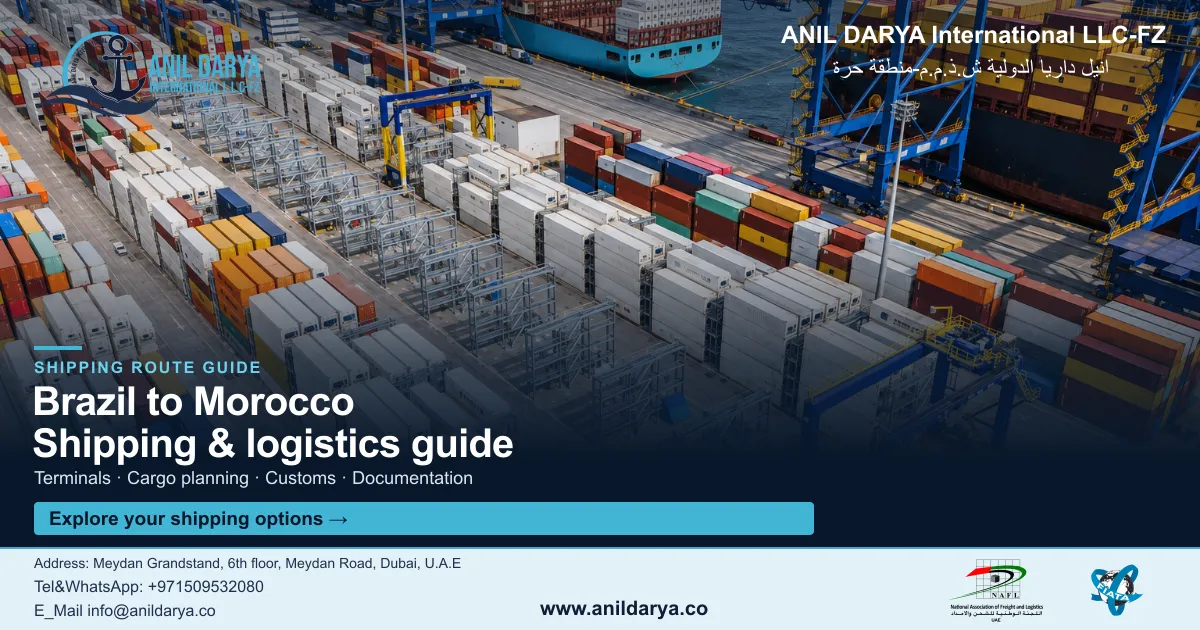
Shipping from Brazil to Morocco is mostly food and farm cargo: sugar, corn, live cattle, pepper and frozen beef led Brazilian sales to Morocco in 2025. Containers have a direct weekly loop from Santos, Paranagua, Itajai and Itapoa to Tanger Med, and Maersk publishes 15 to 20 days port to port on it. Sugar and corn go on chartered bulk ships, and Casablanca takes most of Morocco's grain. Before any of it loads, the Moroccan buyer must have a bank-stamped import commitment. We book the ocean freight from Dubai, release the carrier's bill of lading to you and agree the plan with the buyer's Moroccan broker before the box sails.
Shipping from Brazil to Morocco at a glance
| Item | Detail |
|---|---|
| Type of lane | Sea cross-trade, Brazil to Morocco, booked and coordinated by Anil Darya from Dubai |
| Main cargo (2025) | Sugar, corn, live cattle, pepper and bell pepper, frozen beef |
| Brazilian load ports for containers | Santos, Paranagua, Itajai and Itapoa on the direct loop; other ports through a feeder or transhipment |
| Moroccan discharge ports | Tanger Med for containers; Casablanca for containers, grain and feed; Jorf Lasfar has received Brazilian cattle ships |
| Published carrier transit | Santos to Tanger Med 15 days, Paranagua 17, Itajai 19, Itapoa 20 (Maersk advisory of 6 May 2026) |
| Brazilian export filing | DU-E in the Portal Unico Siscomex, by the exporter or its customs broker |
| Before the order | Engagement d'importation domiciled at an approved Moroccan bank, valid six months |
| Moroccan customs | ADII, BADR system; DUM within 45 days of the summary declaration |
| Trade agreement | No free trade agreement in force; a Mercosur-Morocco framework agreement only sets up future talks |
| Bill of lading | The shipping line's own B/L, released to you through us as agent for the line |
| Who clears in Morocco | The importer or its approved transitaire, agreed before we confirm the booking |
Who does what on a cross-trade booking
The cargo is packed in Brazil and cleared in Morocco; it touches the UAE only if you choose that.
| Party | Role on a Brazil to Morocco shipment |
|---|---|
| Brazilian exporter or its broker | Stuffs the box or loads the bulk ship, files the DU-E, obtains the sanitary or phytosanitary certificate and the certificate of origin, trucks the box to the terminal |
| Anil Darya, Dubai | Books space with the line, checks the import commitment and the invoice against each other, follows the sailing, releases the carrier's B/L |
| Shipping line | Carries the box and, through its agent, lodges the summary declaration in Morocco before arrival |
| Moroccan importer | Holds a commercial register number, domiciles the import commitment, arranges any sanitary or conformity control, pays duty and taxes |
| Importer's transitaire | Enters and lodges the DUM in BADR with the documents and takes the release |
The bill of lading is the carrier's own document. Anil Darya acts as agent for many shipping lines, so the line's B/L for a 40ft reefer of frozen beef from Paranagua or a 20ft of bagged pepper from Santos is released to you from our Dubai office. We do not issue a house bill on this lane.
Clearance in Morocco is not a service we sell there. Duty and taxes at destination are paid by the consignee or its broker. Before we confirm a sailing out of Santos, the buyer tells us which transitaire will lodge the DUM, at which port, and that the import commitment already carries the bank's stamp. Until we hear that, the space stays on hold, not confirmed.
The Incoterm decides who controls the booking. On FOB Santos the Moroccan buyer chooses the line and can route to Tanger Med or Casablanca as it likes. On CFR Casablanca the Brazilian seller books the ship, and Moroccan port charges, duty and VAT stay with the buyer. Our guide to Incoterms 2020 in sea freight shows where cost and risk pass under each term.
Which Brazilian port should the cargo leave from?
For containers, start with the four ports on the direct loop to Tanger Med, then weigh the truck or rail haul from the plant. For bulk, the port depends on the grain corridor or the sugar terminal the seller already uses.
| Port | Hinterland | What the official or operator sources say |
|---|---|---|
| Santos | Sao Paulo, Minas Gerais, Goias, Mato Grosso | Brazil's largest port complex: 186.4 million tonnes in 2025 per the Ministry of Ports and Airports; on the direct Tanger Med loop |
| Paranagua | Parana, Mato Grosso do Sul, Paraguay transit | 1.662 million TEU in 2025 and the largest Brazilian corridor for frozen animal protein, with 34% of that market (Parana state government); on the direct loop |
| Itajai and Navegantes | Santa Catarina | Portonave at Navegantes handled 1,108,029 TEU in 2025, frozen meat among its main exports; Itajai joined the direct loop in June 2026 |
| Itapoa | Northern Santa Catarina, Parana | On the direct loop; 20 days to Tanger Med in the Maersk table |
| Rio Grande | Rio Grande do Sul | Reaches Morocco through a connection |
| Salvador, Suape, Pecem | Bahia and the northeast | Closer to Morocco on the map; Salvador is a southbound-only call on the direct loop, so northbound boxes need another service |
Tanger Med, Casablanca or Jorf Lasfar: where to discharge
Pick the port by cargo type first and by the buyer's warehouse second.
| Port | Facts from the operator or port agency | Best for |
|---|---|---|
| Tanger Med | 10,241,392 TEU in 2024, up 18.8%; four container terminals with 9 million TEU capacity and 18 m depth; a rail terminal of 400,000 TEU a year linked to the main cities | Containers from the direct Brazil loop, then truck or rail inland |
| Casablanca | About 35% of Morocco's port traffic and 17 million tonnes in the first half of 2026 (Maersk, citing the National Ports Agency); 60% of national cereal supply and 70% of animal feed pass here, per the ANP in June 2026 | Bulk corn and feed, and boxes for buyers in the Casablanca region |
| Jorf Lasfar | Received the first Brazilian live cattle shipment in March 2023, according to ANBA | Livestock carriers and some bulk |
Plan for weather and congestion at Casablanca: the ANP reported 38 days of suspended operations from December 2025 to June 2026 because of heavy swell and rain. Maersk runs a rail service from Tanger Med to Casablanca, so a box can land at Tanger Med and still reach a Casablanca warehouse.
Sea freight from Brazil to Morocco: the direct loop and transit days
Maersk's service advisory of 6 May 2026 for its Europe to East Coast Latin America loop, NEOBOSSANOVA, gives this weekly rotation: Tanger Med 2, Salvador, Santos, Itapoa, Itajai, Paranagua, Santos, Tanger Med, Algeciras. On the northbound leg the ship sails from the Brazilian ports straight to Tanger Med, with no stop in between. The first vessel on the new windows was the Santa Ines, voyage 622S, at Salvador on 8 June 2026.
| From | To Tanger Med (Maersk table, days) | Departure day in Brazil |
|---|---|---|
| Santos (northbound call) | 15 | Sunday |
| Paranagua | 17 | Friday |
| Itajai | 19 | Wednesday |
| Itapoa | 20 | Tuesday |
We checked these figures against the order of calls and the weekday windows in the same advisory, and they agree: every port lands on the Monday Tanger Med arrival. Salvador appears only on the southbound leg, so it is not a Morocco load port on this loop. Carriers change rotations often, so treat the table as the published plan of May 2026 and ask us for the current schedule.
Reaching Casablanca and other ports
The route listings we opened for Santos to Casablanca show only transhipment services, with one change of ship; we name no hub because we could not open a carrier page for it. Either discharge at Tanger Med and move the box by truck or rail, or book a through service with a relay. Each quote names the vessels on every leg.
[AMIR-FACT: the carriers and services we actually book from Santos, Paranagua, Itajai and Itapoa to Tanger Med and to Casablanca, whether Casablanca boxes go by relay or by rail from Tanger Med, and the real door-to-door days we see for reefer and dry boxes]
Containers, reefers, bulk and dangerous goods
| Option | Typical Brazilian cargo for Morocco | Point to check |
|---|---|---|
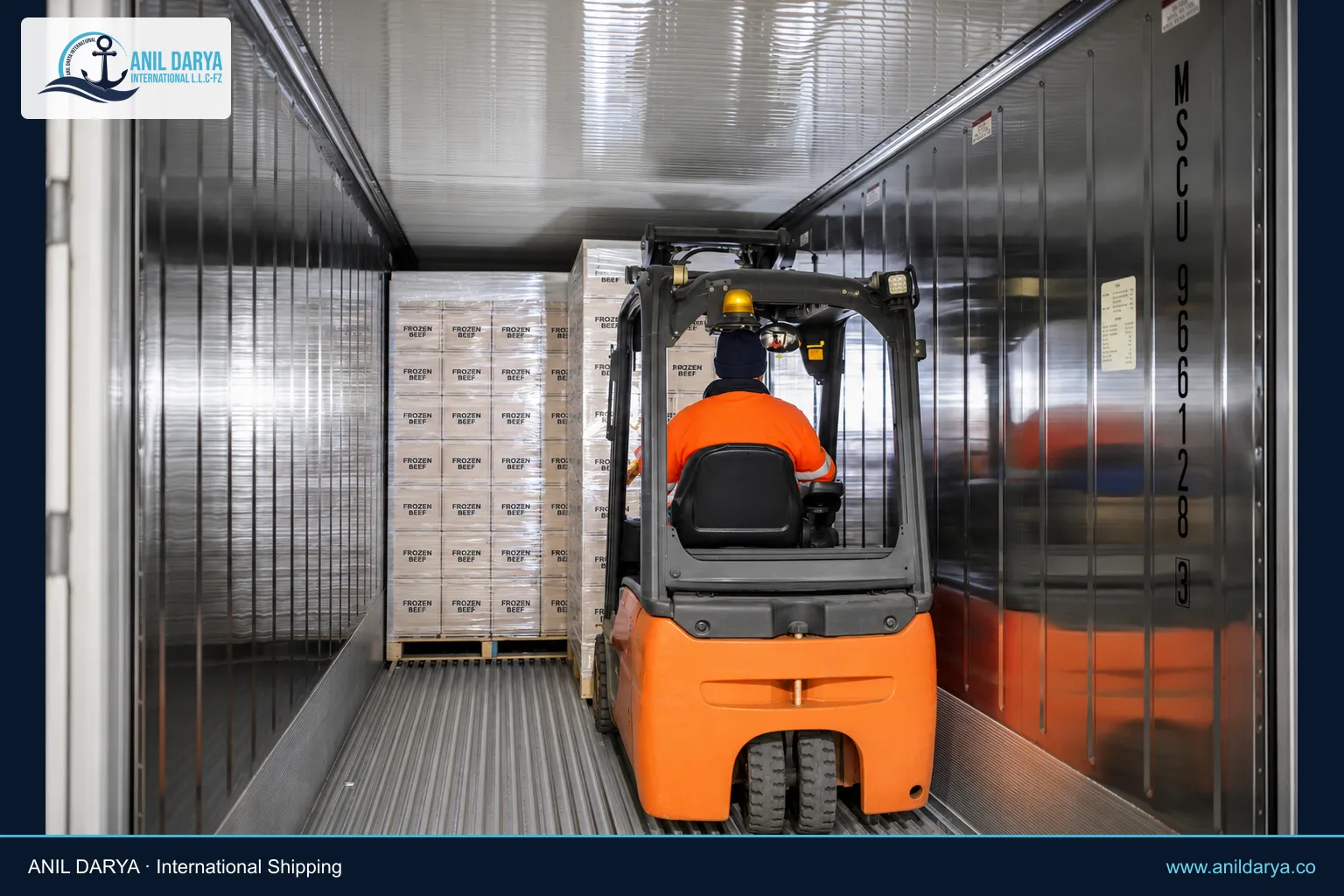
| 40ft reefer, frozen | Frozen beef, offal | Set point on the booking, the agreed sanitary certificate, the 2026 duty status of the tariff line |
| 20ft dry | Bagged sugar, pepper, coffee, peanuts | Weight limit before volume; phytosanitary certificate for plant products |
| 40ft dry or high cube | Machinery parts, wood products, packaged food | Invoice value and quantity match the import commitment; any conformity check |
| Flexitank or ISO tank | Vegetable oils | Food-grade tank history and the sanitary file |
| Bulk carrier | Raw sugar, corn | Charter terms, discharge port draft and storage, phytosanitary certificate |
| Livestock carrier | Live cattle | Veterinary certificate model agreed between the two countries; duty-free quota status |
Frozen beef in reefers
Frozen beef is a top-five Brazilian sale to Morocco. Paranagua and Itajai sit on the direct loop, so a reefer goes from the frozen protein ports to Tanger Med on one ship. Ask the exporter to confirm that its plant is listed for Morocco and that it will issue the certificate model Morocco accepts.
Bulk sugar and corn
Sugar and corn, the two biggest products on this lane, move mostly as whole ship cargoes. Casablanca takes most of Morocco's cereal and feed, so plan the berth and the silo with the buyer before fixing the ship. Our bulk cargo team handles charter enquiries; smaller lots go in boxes, and our FCL vs LCL guide shows when a full container pays.
Live cattle
Morocco was the second largest buyer of Brazilian live cattle in 2025, per ANBA. The first shipment, 2,800 head from Para, reached Jorf Lasfar in March 2023 after the veterinary certificate was approved. Cattle sail on livestock carriers, outside our container and bulk booking.
Dangerous goods
Agrochemicals, resins, aerosols or machinery with fuel residue travel under the IMDG Code 2024 edition, Amendment 42-24, mandatory since 1 January 2026. The line must accept the booking before the box is stuffed. Our dangerous goods team gets that acceptance first, and our sea freight service books the space.
What the exporter files in Brazil
Every export leaves Brazil on a DU-E (Declaracao Unica de Exportacao) in the Portal Unico Siscomex. The government service page says the exporter, the declarant or their legal representative registers it, usually from the electronic invoice (NF-e), and it advises checking the NCM tariff code first. Under the Receita Federal export manual, the terminal receives the cargo, customs clears it and the carrier then reports the loading.
We do not collect cargo or file anything in Brazil. Before the cut-off we need the cleared DU-E and these papers for Morocco:
- A commercial invoice describing the goods in French, with the HS code and a value per line; trade.gov advises French and dates written day, month, year.
- A packing list showing weight, number and type of goods per package.
- An international sanitary certificate from Brazil's Ministry of Agriculture (MAPA) for beef, offal and other animal products.
- A phytosanitary certificate from MAPA for sugar, corn, pepper and other plant products, plus a fumigation certificate if the cargo was treated.
- A certificate of origin; Moroccan customs asks for one to apply a preferential rate, and buyers often want it anyway.
Is there a trade agreement between Brazil and Morocco?
Not a free trade agreement. The OAS trade information system (SICE) records that the Mercosur countries, Brazil included, signed a framework trade agreement with Morocco on 26 November 2004, in force since 29 April 2010. Its stated aim is to set the conditions for negotiating a free trade agreement. SICE lists one negotiating round, in Rabat on 11 April 2008, and no concluded deal. So Brazilian goods pay Morocco's general (MFN) rate for their tariff code.
Both countries also take part in the Global System of Trade Preferences (GSTP), in force since April 1989. Its newer Sao Paulo Round is not yet in force, according to UNCTAD, because it is still one ratification short. If your transitaire finds an old GSTP concession on your code in ADIL, it will need GSTP proof of origin and goods shipped direct, so ask before you plan a stop anywhere.
Routing through Dubai does not open a better rate. The UAE-Morocco free trade agreement, in force since 9 July 2003, covers goods of Arab origin. Brazilian sugar stored or repacked in Jafza keeps its Brazilian origin, and the Moroccan declaration shows Brazil as origin and the UAE only as the place the goods came from.
What the Moroccan buyer needs before you load
ADII, Morocco's customs and indirect tax administration, tells importers not to order goods abroad before they hold an import title. Its question-and-answer pages carry no version date; we read them again on 14 November 2026.
Commercial register and import commitment
In principle only persons on the commercial register (RC) may sign import commitments. For goods that are free to import, the title is the engagement d'importation (EI): five copies with a pro forma invoice, presented for domiciliation at an approved bank of the buyer's choice. Without the bank's domiciliation stamp, customs will not process the clearance. Licence-list goods need an import licence instead.
The six-month window and the shipped-on-board B/L
An EI is valid for six months from domiciliation. If the six months run out while the goods are on the water, customs still accepts the EI when the goods were shipped direct to Morocco before it expired. For sea cargo the proof is a direct shipped-on-board bill of lading naming the vessel. That is one more reason to load in Santos well inside the window and to have the B/L dated correctly.
Special formalities: sanitary, plant health and conformity
ADII lists the controls it applies with other agencies: veterinary health control of live animals and animal products, plant health control of plants and plant products, fraud control on goods, and standards control on some industrial products. For beef, cattle, sugar, corn and pepper, the buyer should ask ONSSA, Morocco's food safety office, what it wants before the seller produces. For regulated industrial products, Morocco's verification of conformity has applied since 1 February 2020 under Law 24-09, with the check made before shipment or on arrival, and the certificate handled on PortNet.
Customs clearance at Tanger Med and Casablanca
The ship's master or its agent lodges an electronic summary declaration in BADR at least 24 hours before the vessel arrives. A declarant then enters the detailed declaration (DUM) in BADR and lodges it within 45 days of the summary declaration for sea cargo; Saturdays count, public holidays do not. Goods not yet cleared cannot be sold on to another customer.
The declarant can be the owner or its agent, an approved transitaire, the carrier, or another person customs has authorised for named goods. Customs staff do not fill in the DUM; the declarant does all of it.
| Document attached to the DUM | What it is for |
|---|---|
| Commercial invoice and value detail per item | Customs value and duty |
| Bank certificate | Names the domiciling bank, the amount invoiced in foreign currency, the exchange rate and the import title |
| Import title | The engagement d'importation, an import licence or a prior import declaration |
| Control certificate | Sanitary, veterinary, plant health, fraud control or industrial standard |
| Bill of lading | Transport title |
| Packing list | Weight, number and type of goods per package |
| Commercial register proof | Confirms the importer may import |
| Certificate of origin | Only needed for a preferential rate |
ADII moved from inspecting every file to risk-based selection in 1998, so the DUM is either released on the papers or picked for a physical check. Customs authorises removal once duty and taxes are paid or guaranteed.

Duty, TPI and VAT on Brazilian goods
ADII charges duty either ad valorem, as a percentage of the customs value, or as a specific amount by weight, number or volume, at the rate in force on the day the DUM is registered. The customs value adds costs incurred before import, such as packing and containers, to the price paid. ADIL, the ADII online tool, shows the duty, taxes and required documents for each code.
| Charge | Rate or basis | Note |
|---|---|---|
| Customs duty | General (MFN) rate for the tariff code | No FTA rate for Brazilian origin; check ADIL |
| Parafiscal import tax (TPI) | 0.25% of the value (PwC, reviewed 30 April 2026) | Confirm in ADIL for your code |
| Import VAT | 20% standard, 10% on designated goods | The transitaire confirms the rate for your code |
Meat and cattle have their own 2026 rules. Moroccan press reported in July 2026 that decree 2.26.584 suspends import duty on meat of cattle, sheep, goats and camelids, and that the 2026 finance law keeps duty and VAT exemption for imported cattle within a quota of 300,000 head. We could not open the official texts, so have the transitaire confirm the treatment of your tariff line in ADIL before you price the deal.
[AMIR-FACT: confirm with a Moroccan transitaire the duty, TPI and VAT actually charged in November 2026 on Brazilian frozen beef, live cattle, raw sugar and corn, and whether the 2026 meat and cattle suspensions are still open]
Duty and taxes at destination are paid by the consignee or its broker, normally before removal. ADII also offers a removal credit of up to 180 days and a deposit of the amount due, which the transitaire can ask for if the importer qualifies.
Restricted and prohibited goods in Morocco
ADII names weapons, weapon parts and munitions of war; printed matter, recordings and objects contrary to public morals or order; and some plants and plant products that may carry harmful organisms. That last item matters for Brazilian seeds, fruit and plants: get the plant health conditions in writing before you ship.
Goods under special formalities are not banned, but they are held without the right certificate: veterinary for meat, phytosanitary for plant products, conformity for regulated industrial goods.
Typical cargo on this lane
Brazilian exports to Morocco were USD 1.359 billion in 2025, down 2.6% on 2024, according to ministry data compiled by the Arab-Brazilian Chamber of Commerce and reported by ANBA on 31 March 2026. Sugar, corn, live cattle, pepper and bell pepper, and frozen beef led the list.
Most of it is food and feed, so sanitary and plant health papers decide how fast it clears.
Routing through Dubai: when it helps
Dubai sits far off the direct path, and the direct loop to Tanger Med is the quicker plan for most Brazilian cargo. A Dubai link can still fit a few cases:
- A Dubai trader buys from Brazil and sells to Morocco while the goods sail straight from Santos to Tanger Med.
- Non-food goods kept in a Dubai free zone and called off per Moroccan order. Our article on JAFZA re-export explains that route.
- Brazilian goods combined with Gulf or Asian goods in one box for a Moroccan buyer. Our Jebel Ali port guide covers the terminal.
When goods are landed, stored or re-exported in Dubai, we clear them through UAE customs for a fee with our Dubai freight forwarding team. The Moroccan side does not change: the import commitment must be domiciled first, the origin stays Brazilian, and any GSTP preference may be lost if the cargo is stored or split in Dubai. Confirm with the transitaire before you plan the stop.
[AMIR-FACT: whether we have moved Brazilian cargo for Moroccan buyers through Jebel Ali (trader invoicing, consolidation or Jafza stock), for which cargo, the carrier from Jebel Ali to Tanger Med or Casablanca and the real extra days compared with the direct loop]
What drives the cost of shipping from Brazil to Morocco?
Rates change every sailing, so we publish none. On FOB terms:
| Cost part | What moves it | Usually paid by (FOB) |
|---|---|---|
| Origin charges in Brazil | Trucking, DU-E, terminal handling, reefer power before loading | Exporter |
| Certificates | Sanitary, phytosanitary, fumigation, origin, conformity | Exporter, unless agreed otherwise |
| Ocean freight | Reefer or dry, load port, direct loop or relay, season, surcharges | Importer |
| Moroccan port and line charges | Terminal handling, delivery order, reefer power, storage | Importer |
| Duty and taxes | Tariff code, 2026 suspensions, TPI, VAT | Consignee or its broker |
| Delay charges | Missing bank stamp, wrong certificate, late DUM, port weather days | Whoever caused the delay, under the contract |
Free time at the Moroccan terminal and port tariffs change often, so confirm the current terms with the line and the port before the box arrives. Our article on demurrage and detention explains how those charges build up.
Step by step with Anil Darya
- Agree the product, the HS code, the Incoterm and the Moroccan port with the Brazilian seller.
- Send us the plant city, cargo, weights, ready date, reefer set point if any, and whether the box goes to Tanger Med or Casablanca.
- Name the transitaire. We check with the buyer that its RC and import title cover the goods and that the broker works at the discharge port. Only then do we confirm the booking.
- The importer domiciles the engagement d'importation at its bank and sends us the date and the amount.
- We book the space on the direct loop or a relay service and get reefer or DG acceptance from the line.
- The exporter prepares the French invoice and the certificates, files the DU-E and gates in before the cut-off.
- We check the draft B/L against the invoice and the import commitment, then release the carrier's B/L once freight is settled.
- The ship's agent lodges the summary declaration. The transitaire lodges the DUM, the consignee or its broker pays duty and taxes, and the box is released.
[AMIR-FACT: one real Brazil to Morocco cross-trade shipment we handled (cargo, Brazilian load port, Tanger Med or Casablanca, carrier, how the import commitment and certificates were matched to the B/L, door-to-door days), cleared for publication]
Checklist before the cargo leaves Brazil
- Importer on the commercial register, with an import title for the goods.
- Engagement d'importation domiciled, with the value matching the pro forma.
- EI validity checked; French invoice with HS codes.
- Sanitary or phytosanitary certificate on the model Morocco accepts.
- Conformity certificate if the product is on the Law 24-09 list.
- Duty, TPI and VAT checked in ADIL by the transitaire.
- Transitaire named and clearance agreed before the booking is confirmed.
Mistakes that hold Brazilian cargo in Morocco
- Shipping before destination clearance is agreed. A reefer at Tanger Med with no transitaire uses power and storage days while the 45-day clock runs.
- Ordering or loading before the import commitment carries the bank stamp.
- Letting the EI run out without a direct shipped-on-board B/L to prove the goods left in time.
- Assuming a Mercosur preference. The framework agreement gives no duty cut.
- Expecting a lower rate via Dubai.
Frequently asked questions
Is there a direct ship from Brazil to Morocco?
Yes, for containers. Maersk's May 2026 advisory shows a weekly loop that sails from Santos, Paranagua, Itajai and Itapoa straight to Tanger Med. Casablanca boxes usually go by relay or by rail from Tanger Med.
How long does sea freight from Brazil to Morocco take?
Maersk publishes 15 days from Santos to Tanger Med, 17 from Paranagua, 19 from Itajai and 20 from Itapoa. Add the inland legs, the cut-off and clearance for the door-to-door time.
Do Brazilian goods pay a lower duty in Morocco?
No free trade agreement covers Brazil, so the general rate applies. Some meat and cattle lines had duty suspended in 2026, so the transitaire should confirm the current rate for your code in ADIL.
What is the engagement d'importation?
It is the import title for goods free to import. The buyer files it with a pro forma at an approved bank, which stamps it. It is valid for six months, and customs will not clear goods without the bank stamp.
How long does the importer have to lodge the DUM?
Forty-five days from the summary declaration for sea cargo. The ship's agent lodges that summary at least 24 hours before arrival.
Does Anil Darya clear the cargo in Morocco?
No. The importer or its transitaire clears the goods, and duty and taxes at destination are paid by the consignee or its broker. We agree the plan with that broker before confirming the booking.
Get a quote for sea freight from Brazil to Morocco
Send us the plant city, the cargo and HS code, the ready date, the reefer set point if any, the Moroccan port, the transitaire's name and the status of the import commitment. We will reply with the sailing options and a price. Use our freight rate inquiry form, or contact our team to plan a reefer programme or a bulk cargo first.
Sources
- Maersk: Service update NEOBOSSANOVA, rotation and transit times (6 May 2026)
- Maersk: Tangier to Casablanca rail service and Casablanca traffic (14 August 2026)
- Tanger Med: Port facilities and 2024 traffic
- ANP communique on the port of Casablanca, via Liberation and AllAfrica (27 June 2026)
- ANBA: Brazil's 2025 exports to Morocco and main products (31 March 2026)
- ANBA: Morocco receives first live cattle shipment from Brazil (30 March 2023)
- OAS SICE: Mercosur-Morocco framework agreement
- UNCTAD: About the GSTP (participants, Sao Paulo Round status)
- WIPO Lex: UAE-Morocco free trade agreement, in force 9 July 2003
- ADII: Import title needed before ordering
- ADII: Filing an import commitment
- ADII: Bank domiciliation of the import commitment
- ADII: Prohibited imports
- ADII: Goods subject to special import formalities
- ADII: Customs value
- ADII: Summary declaration deadline for sea cargo
- ADII: Who may lodge the detailed declaration
- ADII: 45-day deadline for the detailed declaration
- ADII: Documents attached to the declaration
- ADII: Risk-based selection for inspection
- ADII: How import duties and taxes are calculated
- ADII: Removal credit and deposit of duties
- ADII: ADIL import tariff tool
- trade.gov: Morocco import requirements, VoC and invoice language
- SGS: Morocco product conformity assessment (Law 24-09, PortNet)
- PwC: Morocco import VAT and TPI (reviewed 30 April 2026)
- Yabiladi: Morocco suspends meat import duties, decree 2.26.584 (23 July 2026)
- Government of Brazil: Declare an export (DU-E)
- Receita Federal: Portal Unico export manual
- Ministry of Ports and Airports: Santos tonnage 2025
- Parana State Government: Ports of Parana container exports
- Portonave: 2025 throughput
- Fluent Cargo: Santos to Casablanca services (routing type only)
- IMO: IMDG Code 2024 edition (Amendment 42-24)
Reviewed: 14 November 2026