
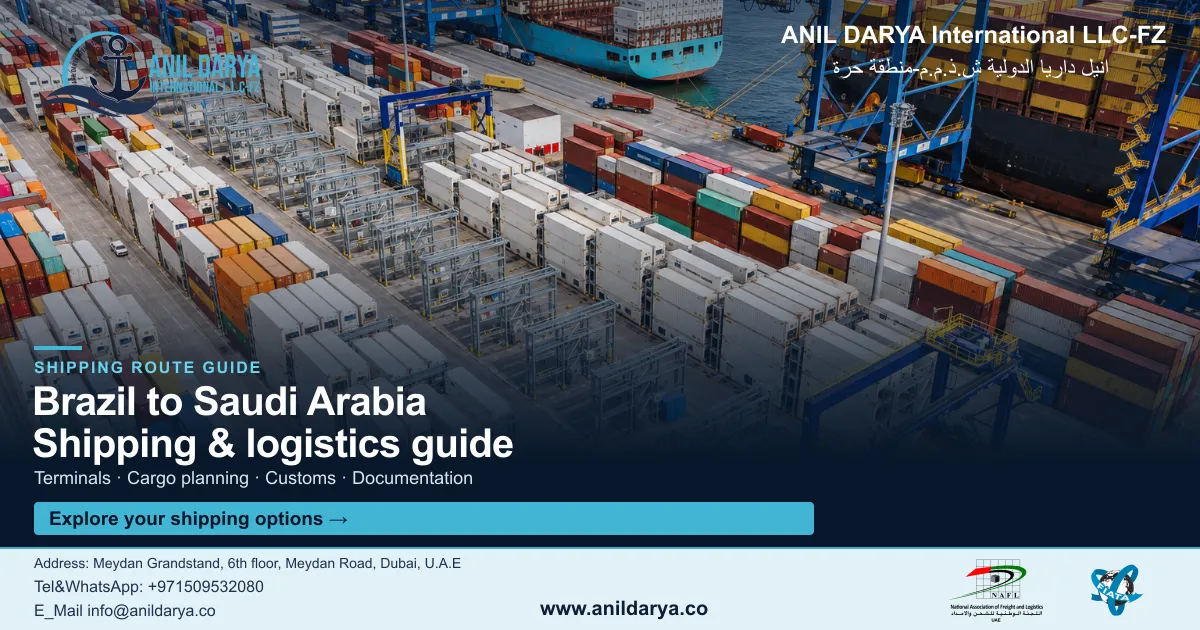
Shipping from Brazil to Saudi Arabia is dominated by food: frozen chicken and beef in reefer containers from Paranagua, Itajai, Navegantes and Santos, plus sugar and grain that often move as bulk. Most boxes go to Jeddah on the west coast or Dammam on the east coast. We book the ocean freight with the shipping line from Dubai and coordinate the Brazilian exporter and the Saudi consignee, while the consignee's broker clears the cargo on Fasah with the SFDA food papers, a SABER shipment certificate, any duty and 15% VAT.
Brazil to Saudi Arabia shipping at a glance
| Item | Detail |
|---|---|
| Trade type | Cross-trade: the cargo sails Brazil to Saudi Arabia and does not have to enter the UAE; the booking and follow-up run from our Dubai desk |
| Main Brazilian load ports | Santos, Paranagua, Itajai and Navegantes, Rio Grande, Rio de Janeiro; Suape, Salvador and Pecem in the northeast |
| Main Saudi discharge ports | Jeddah Islamic Port and King Abdullah Port on the west coast; King Abdulaziz Port Dammam and Jubail on the east coast |
| What Saudi Arabia buys most from Brazil | Meat and offal, sugar, cereals (DataSaudi, 2025) |
| Usual equipment | 40ft reefer for frozen protein; dry 20ft or 40ft for packed goods; bulk carriers for sugar and grain |
| Bill of lading | The carrier's own B/L, issued and released to you through us as the line's agent |
| Brazilian export filing | DU-E in the Portal Unico Siscomex, by the exporter or its declarant |
| Saudi customs | ZATCA, declaration on Fasah at least 48 hours before arrival |
| Food regulator | Saudi Food and Drug Authority (SFDA): approved plants, halal slaughter certificate, poultry import permit |
| Brazilian poultry | SFDA certificate of conformity required per shipment since 1 April 2026 |
| Duty | GCC common external tariff, at least 5% for most goods on the CIF value; some food lines are duty-free |
| Import VAT | 15% |
Who does what on a Brazil to Saudi cross-trade booking
The cargo never passes through our hands. What we hold is the booking with the line and the document flow, which is where most shipments on this lane go wrong.
| Party | Their part of the job |
|---|---|
| Brazilian exporter or its origin agent | Stuffs the reefer or dry box at the plant or warehouse, trucks it to the terminal, files the DU-E and gets the health and halal papers issued |
| Anil Darya, Dubai | Books space and equipment with the line, checks the reefer set point and cargo data, follows the box, checks the draft B/L and arranges its release |
| Saudi consignee and its customs broker | Holds the SFDA registrations and permits, files on Fasah, handles SABER, pays duty and VAT, takes the cargo to a licensed store |
The B/L you receive is the shipping line's document, not ours. We act as agent for many lines, so the carrier issues its bill and we hand it over once the release conditions are met. On a reefer of chicken sold on documentary terms, that keeps the bank, seller and buyer working from one desk.
Saudi customs clearance is not something we sell. Before we confirm a Brazil to Saudi booking, we ask who the consignee's broker is and check with them that the importer's SFDA registration, the poultry import permit and the Fasah filing are ready for this exact cargo. If any of those is missing, the right move is to hold the reefer in Brazil, not to let it sail.
Which ports to use for shipping from Brazil to Saudi Arabia
The Brazilian port follows the cargo. Frozen protein starts in the south, close to the plants. Dry goods and machinery start at Santos, which has the widest choice of sailings. On the Saudi side, pick the coast where the cold store or site is.
Load ports in Brazil
| Port | Published facts | Typical cargo for Saudi buyers |
|---|---|---|
| Santos | DP World's Santos terminal has a 1,100 m quay and 1,000 reefer connections, and handles containers, breakbulk, project cargo and IMDG goods | Machinery, auto parts, pulp, coffee, frozen beef, mixed dry cargo |
| Paranagua | Ports of Parana handled about 1.66 million TEU in 2025 and describe Paranagua as Brazil's largest corridor for frozen animal protein | Frozen chicken, beef, grain and sugar |
| Itajai and Navegantes | Portonave at Navegantes handled 1,108,029 TEU in 2025, with frozen meat among its top three exports | Frozen chicken and pork from Santa Catarina, wood, ceramics |
| Rio Grande | Container port for Rio Grande do Sul | Frozen meat, tobacco, resins, agricultural goods |
| Rio de Janeiro | Container and general cargo port | Industrial goods from Rio state |
| Suape, Salvador, Pecem | Northeast container and industrial ports | Fruit, steel, chemicals from the northeast |
Discharge ports in Saudi Arabia
| Saudi port | Coast | What the operator publishes | Fits Brazilian cargo for |
|---|---|---|---|
| Jeddah Islamic Port | West | RSGT's container terminal: 6.2 million TEU a year on a 3,300 m quay, dry and reefer units; a multipurpose terminal with 12 berths for containers, bulk and breakbulk | Food importers and cold stores in Jeddah, Makkah and Madinah |
| King Abdullah Port | West, north of Jeddah | 5.5 million TEU current container capacity, 4 million tonnes of agri bulk capacity, a bonded and re-export zone | Containers for the western region, grain and other agri bulk |
| King Abdulaziz Port, Dammam | East | 43 berths, a container terminal and two general cargo terminals, 105 million tonnes capacity, rail link to the Riyadh dry port | Eastern Province, Riyadh and central region buyers |
| Jubail | East, north of Dammam | Commercial and industrial ports for Jubail Industrial City | Industrial inputs and project cargo |
Riyadh importers have a real choice: Dammam with rail or a reefer truck, or Jeddah with a long road haul. Price both.
Direct sailings or transhipment on the South Atlantic lane
Few container loops sail straight from Brazil to a Saudi port. Schedule aggregators that list Santos to Jeddah services show mostly transhipment routings run by the large lines, with the Brazilian leg on one service and the Saudi leg on another. That means your reefer is lifted off one ship and onto another at a hub on the way.
For frozen cargo, count the handlings: every lift and every hour unplugged is a cold chain risk. Compare arrival dates, not sailing dates.
[AMIR-FACT: the shipping lines we actually book from Santos, Paranagua and Itajai to Jeddah and Dammam, the transhipment hub each one uses, and our real port-to-port days for reefer and dry boxes]
How long does shipping from Brazil to Saudi Arabia take?
We found no carrier schedule page for this lane that we can quote with confidence, and forwarder and aggregator figures disagree widely, so we print no number here. Every quote we send states the routing and the estimated arrival.
The sea leg is only part of the total:
| Stage | What sets the time |
|---|---|
| Health and halal papers | Inspection at the plant, halal slaughter certificate, SFDA certificate of conformity for poultry |
| Export clearance and gate-in | DU-E registration and clearance, reefer delivery before cut-off |
| Sea leg and hub connection | Sailing day, transhipment wait, feeder schedule |
| Saudi clearance | Fasah filing 48 hours ahead, SFDA checks and sampling if selected |
Frozen meat has a fixed shelf life from the production date, so time lost at a hub or in clearance is time lost for selling.
Sea freight from Brazil to Saudi Arabia: reefer, FCL and LCL
40ft reefer for frozen chicken and beef
Most Brazilian protein for Saudi buyers moves in 40ft reefers set to the frozen temperature in the buyer's contract. Give us the set point, weight, plant and container count early, because empty reefers must be positioned at the plant before loading. Our sea freight service books reefer and dry equipment with the lines.
Dry FCL for packed goods and machinery
A 20ft dry box suits dense cargo such as steel parts, bagged sugar or paper. A 40ft or high cube suits auto parts and mixed goods.
LCL for samples and small first orders
LCL works for a few pallets of dry goods or samples, never for frozen food, and the shared box is released only when every shipper's papers are clean. See our guide to FCL vs LCL costs for where a full container starts to pay off.
Frozen chicken and meat: SFDA rules for Brazilian protein
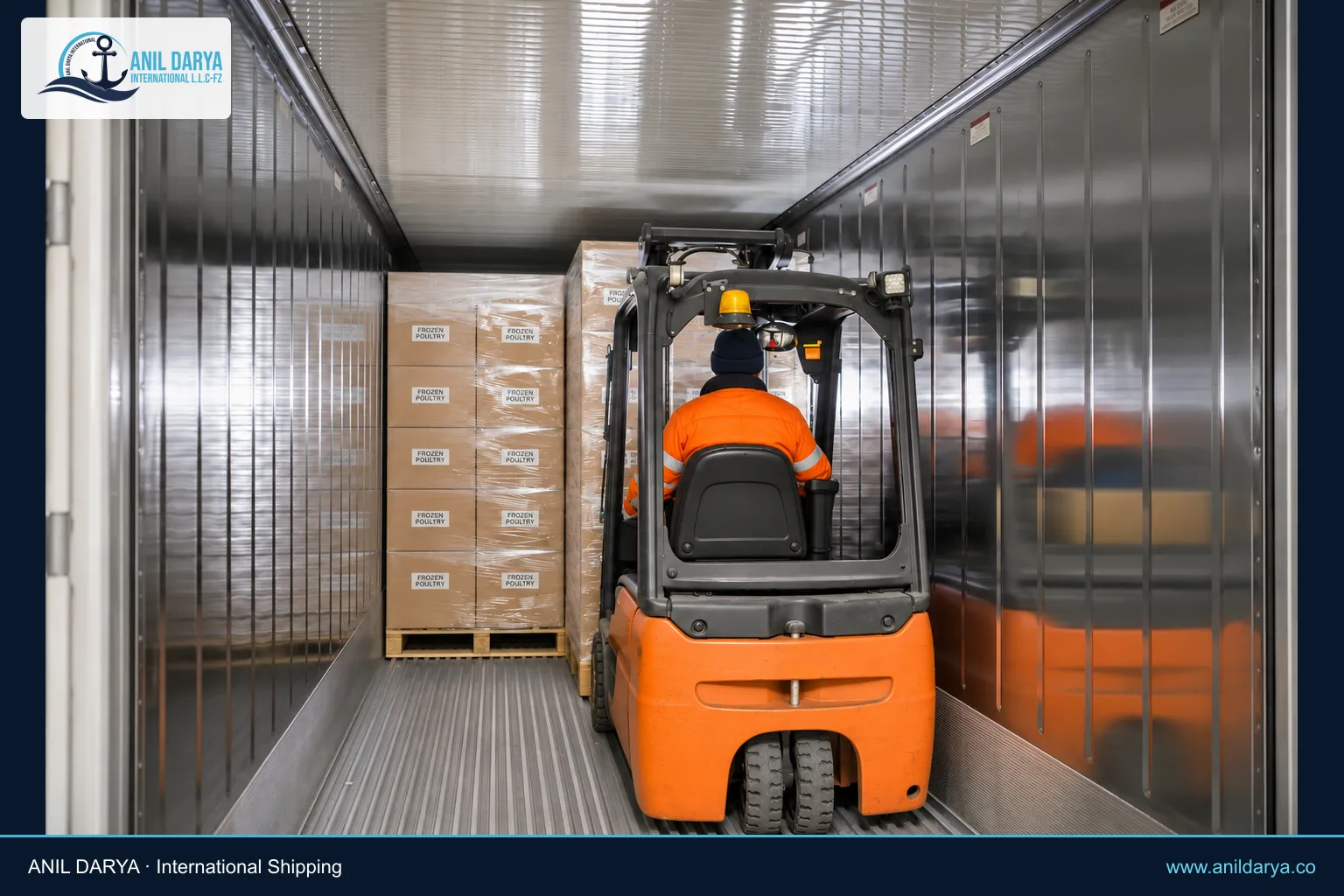
Saudi Arabia is a large buyer of Brazilian chicken. SGS reports that Saudi Arabia imported about 397,200 tonnes of Brazilian chicken meat in 2025, 7.1% more than in 2024, making it Brazil's third-largest export market for chicken. That volume comes with strict import rules, and most of them sit with the SFDA, not with customs.
What the importer must have before the cargo ships
The SFDA's guide to food clearance says that before importing food, the importer must register its establishment on the SFDA's Ghad platform, register the food products it plans to import, and have a licensed warehouse that meets SFDA requirements. Clearance requests go through Fasah. Small importers and factories importing raw materials have limited exemptions on the warehouse rule.
Documents for meat and poultry
| Document | Issued by | Note for Brazilian cargo |
|---|---|---|
| Health certificate | Competent authority in Brazil | Confirms the food is safe and meets the technical rules; may carry the plant's registration number |
| Halal slaughter certificate | Halal body accredited by the Saudi Halal Center | Required for meat and poultry; carries slaughter and expiry details |
| Import permit | SFDA, requested by the importer | Needed for poultry meat and products, fish, and eggs |
| Certificate of conformity | SFDA-designated conformity body | Mandatory for Brazilian poultry from SFDA-approved plants since 1 April 2026 |
| Commercial invoice | Exporter | Products, quantities, expiry dates and batch numbers |
| Certificate of origin and B/L | Brazilian issuer and the shipping line | Copies uploaded on Fasah |
The plant itself must be on the SFDA's list of establishments approved to export to the Kingdom. SGS notes that the poultry certificate of conformity is separate from that approval. It covers food safety, labelling, halal and slaughter requirements, so start it early.
Labels, shelf life and sampling
SFDA applies Gulf technical regulations at clearance, including GSO 9 on labelling of prepacked food, which calls for Arabic labels, and the GSO 150-1 rules on expiry dates. The SFDA may take samples from a shipment for lab testing, and the importer pays for the analysis. A carton without proper Arabic labelling, or a production date that leaves too little shelf life, can turn a routine reefer into a refused one.
We do not produce these papers, but we check before booking that the exporter and the consignee's broker have each one in hand.
Bulk sugar, grain, breakbulk and dangerous goods
Sugar and cereals are Brazil's other big sales to Saudi Arabia. Large lots of raw sugar, corn and soybeans normally move as dry bulk on chartered ships, not in containers. On the Saudi side, King Abdullah Port publishes 4 million tonnes of current agri bulk capacity, and Dammam and Jeddah also handle bulk. Bagged sugar and smaller grain lots can go in 20ft boxes. Our bulk cargo team handles chartering questions for these parcels.
Brazilian machinery and steel structures that fit a flat rack can stay on container services. Larger pieces go breakbulk to a multipurpose berth such as Jeddah's or Dammam's general cargo terminals, with dimensions, lifting points and lashing agreed with the carrier first. Our break bulk and project cargo service plans these moves with the line.
Brazilian chemicals, resins, paints and some agricultural inputs are dangerous goods at sea. They move under the IMDG Code, whose 2024 edition (Amendment 42-24) became mandatory on 1 January 2026. The exporter provides the UN number, class, packing group and Safety Data Sheet, packs in approved packaging and signs the DG declaration. On a transhipment routing, both the first carrier and the connecting service must accept the class. Our dangerous goods desk checks acceptance before you commit to a sailing.
Where Dubai fits on a Brazil to Saudi shipment
Most Brazilian cargo for Saudi buyers never needs Dubai. Three cases where it can help:
| Option | What happens | When a buyer chooses it |
|---|---|---|
| Transhipment at Jebel Ali | The Brazilian service discharges at Jebel Ali and a feeder carries the box to the Saudi port | When the line's network connects that way and the dates suit |
| Frozen stock held in Dubai | Reefers land in Dubai, go into cold storage in the Jebel Ali Free Zone and move on to Saudi Arabia in smaller lots | A regional distributor serving Saudi Arabia and other Gulf markets from one stock |
| Consolidation in Dubai | Dry goods from several Brazilian suppliers are combined in Dubai and shipped on together | Mixed small orders and spare parts |
DP World says Jebel Ali has over 80 weekly services to more than 150 ports and handles reefers, breakbulk and IMDG cargo. Our Jebel Ali port guide covers the port, and our article on re-exporting through JAFZA explains how stock held there moves on. When goods are held or consolidated in Dubai, UAE customs clearance is a service we provide for a fee. SFDA rules still apply to food re-exported from Dubai.
[AMIR-FACT: whether we have moved Brazilian cargo for Saudi consignees through Jebel Ali (transhipment or JAFZA cold storage and re-export), and the extra days and Dubai steps it really added]
Export side in Brazil: the DU-E and who files it
Brazilian exports are declared on the DU-E (Declaracao Unica de Exportacao) in the Portal Unico Siscomex. The government's service page says the DU-E is registered by the exporter or declarant, or their legal representatives, and is normally built from the electronic invoice (NF-e). It also advises checking the NCM code and simulating the tax and administrative treatment before registering.
The Receita Federal's export manual sets out the flow: the exporter prepares the DU-E, the terminal receives the cargo, Receita Federal clears it, and the carrier reports the loading.
The exporter or its broker does all of that; we do not file the DU-E or collect cargo in Brazil. We need the DU-E cleared before cut-off so the box makes its ship.
- FOB Paranagua or FOB Santos: the exporter clears and loads, and the Saudi buyer controls the freight through us.
- CFR or CIF: the exporter books the freight, and can still book it through us.
- EXW: a Saudi buyer cannot file a Brazilian export declaration, so someone in Brazil must still act as exporter.
The values and product descriptions on the DU-E should match the invoice the Saudi broker files. Our Incoterms 2020 guide for sea freight shows where cost and risk pass under each term.
Saudi import customs: Fasah, documents and SABER
The Zakat, Tax and Customs Authority (ZATCA) runs Saudi customs. The importer files on Fasah directly or through a customs broker. Duty and taxes at destination are paid by the consignee or its broker.
Customs documents for Brazilian cargo
| Document | Source | What to check |
|---|---|---|
| Commercial invoice | Brazilian exporter | Importer name, HS code, value, currency and Incoterm, matching the DU-E |
| Bill of lading | Shipping line, released through us | Consignee and notify party exactly as registered in Saudi Arabia |
| Certificate of origin | Brazilian issuing body | ZATCA lists it as a core document unless origin is clearly established |
| SABER shipment certificate | Issued in SABER for the consignment | Needed before the customs declaration on non-food goods |
| IECEE certificate or product registration | Certification body or regulator | Only where the product requires it |
| SFDA documents | See the food section above | Health, halal, import permit, certificate of conformity |
SABER for non-food products
SABER is the conformity platform of the Saudi Standards, Metrology and Quality Organization (SASO). From 1 October 2025, SASO said a shipment certificate must be issued in SABER before any customs declaration on imported products, whether or not the product falls under a technical regulation. For Brazilian machinery or auto parts, the product certificate or self-declaration comes first. For food, the SFDA route applies; the broker confirms which steps fit each invoice line.
The 48-hour Fasah rule
ZATCA asks for the customs declaration and documents at least 48 hours before the shipment reaches the port of entry. On a long sailing that is easy, if the broker has the papers while the ship is at sea. We send the draft and final B/L to the broker as soon as the line issues them.

Saudi duty and VAT on this cargo
Saudi Arabia applies the GCC common external tariff. According to the US International Trade Administration, most goods from outside the GCC pay at least 5% ad valorem on the CIF value, so the ocean freight from Brazil is part of the base. Some food is duty-free, including rice, bulk animal feed, livestock, fresh red meat, coffee and tea, and some processed foods can reach 40%. Frozen meat, poultry, sugar and grain each sit on their own tariff line under the 12-digit code used since January 2025, so check the exact rate in the ZATCA tariff for your HS code before you agree a price.
Import VAT is 15%. ZATCA's VAT guideline puts the import value at the customs value plus duty, excise and other charges at import.
| Brazilian cargo | Duty | VAT |
|---|---|---|
| Frozen chicken and beef | Rate for the HS code in the ZATCA tariff | 15% |
| Sugar and cereals | Rate for the HS code; check before contracting | 15% |
| Machinery, parts, other manufactured goods | GCC tariff rate, at least 5% on CIF for most lines | 15% |
Typical cargo on this lane
DataSaudi puts Saudi imports from Brazil at about SAR 14.6 billion in 2025. The largest groups were meat and edible offal (about SAR 5.3 billion), sugar and sugar confectionery (about SAR 4.3 billion) and cereals (about SAR 1.9 billion).
| Cargo | Usual way to ship | Check before shipping |
|---|---|---|
| Frozen chicken, cuts and whole birds | 40ft reefer | Plant on the SFDA list, halal slaughter certificate, poultry import permit, certificate of conformity, Arabic labels |
| Frozen beef and offal | 40ft reefer | Plant approval, health and halal papers, shelf life left on arrival |
| Raw and refined sugar | Bulk vessel, or bagged in 20ft boxes | Tariff line, discharge port with bulk capacity, SFDA food rules for packed sugar |
| Corn, soybeans, grain | Bulk vessel | Phytosanitary certificate, port capacity, vessel size |
| Machinery, auto parts, steel | Dry FCL, flat rack or breakbulk | SABER certificates, dimensions, tariff rate |
Restricted and prohibited goods in Saudi Arabia
ZATCA's import page says restricted goods need permits and documents from the competent authorities, goods banned internationally or locally cannot be imported, and counterfeit, adulterated or IP-infringing goods are refused. For Brazilian exporters, the groups that need the most care are:
- All meat and poultry, which need SFDA plant approval, halal papers and, for poultry, an import permit.
- Pork and pork products, and anything containing them or their derivatives.
- Alcoholic drinks, including wine and spirits.
- Medicines, cosmetics, pesticides and many chemicals, which need approval from the relevant Saudi regulator.
- Copies of branded goods, which are seized as counterfeit.
Any permit the broker asks for must be issued before the cargo sails.
Step by step: shipping from Brazil to Saudi Arabia with us
- You send the cargo details: product, HS code, reefer or dry, weight, container count, Brazilian plant or city, Saudi delivery city, ready date and Incoterm.
- We check the routing: load port, Saudi port, the hub on the way, and reefer equipment availability.
- The consignee names its Saudi customs broker. We confirm with the broker that the SFDA registration, import permit, SABER steps and Fasah filing are ready before we confirm the booking.
- The exporter arranges the health certificate, halal slaughter certificate and, for poultry, the certificate of conformity.
- We book the ocean freight with the shipping line from Dubai and send the booking and reefer instructions to the exporter.
- The exporter stuffs the container, sets the temperature, files the DU-E and delivers the box before cut-off.
- We check the draft B/L against the invoice, the line issues its B/L and we release it on the agreed terms.
- The broker files on Fasah at least 48 hours before arrival with all the food or SABER papers.
- The ship arrives, SFDA and customs checks are done, and the consignee or its broker pays duty and VAT.
- The cargo goes to the consignee's licensed store and the empty container is returned within free time.
[AMIR-FACT: one real Brazil to Saudi Arabia cross-trade shipment we booked from Dubai (cargo, Brazilian load port, Saudi discharge port, routing, days taken, any problem we solved)]
What drives the cost of this lane
We quote each booking on its own details. These are the parts of the total.
| Cost part | Who usually pays | What moves it |
|---|---|---|
| Origin charges in Brazil | Exporter under FOB | Trucking from the plant, terminal handling, broker fees for the DU-E, reefer pre-trip |
| Ocean freight | Buyer under FOB, exporter under CFR or CIF | Reefer or dry, season, carrier, number of transhipments, surcharges |
| Certificates | Exporter or importer, as agreed | Halal body, conformity body and SABER fees, lab tests |
| Saudi port charges | Consignee | Terminal handling, delivery order, reefer plug-in and monitoring |
| Duty and VAT | Consignee or its broker | CIF value, HS code |
| Inland delivery | Consignee | Reefer truck or rail, distance to the cold store |
Our article on demurrage and detention explains how free time is counted and what happens when it runs out.
Checklist before the cargo leaves Brazil
- Incoterm agreed and written in the contract.
- HS code fixed and the Saudi duty rate checked.
- Consignee's Saudi broker named and the clearance plan agreed before the booking is confirmed.
- Importer and products registered on Ghad, licensed store ready.
- Brazilian plant on the SFDA approved list.
- Health certificate, halal slaughter certificate and poultry import permit in hand.
- SFDA certificate of conformity for poultry, or SABER certificates for non-food goods.
- Arabic labels and enough shelf life left on arrival.
- Invoice with batch numbers and expiry dates, packing list and draft B/L all matching.
- DU-E cleared before cut-off, reefer set point confirmed.
Mistakes to avoid on the Brazil to Saudi Arabia lane
- Shipping before destination clearance is agreed. A reefer of chicken with no broker, no import permit or no Ghad registration sits at the Saudi port on power and storage charges.
- Using a plant that is not on the SFDA list. The certificate of conformity does not cover an unapproved plant.
- Leaving the poultry certificate of conformity until after loading. It has been mandatory since 1 April 2026 and needs time.
- Halal papers from a body the Saudi Halal Center does not recognise.
- Labels without Arabic, or a production date that leaves too little shelf life.
- Choosing the wrong coast. Eastern Province or Riyadh cargo sent to Jeddah adds a long reefer haul.
- A B/L consignee that differs from the registered Saudi importer.
Frequently asked questions
Which Saudi port should cargo from Brazil go to?
Use Jeddah or King Abdullah Port for buyers in the western region, and Dammam for the Eastern Province. For Riyadh, Dammam is usually priced first because it has a rail link to the Riyadh dry port, but compare it with Jeddah plus a truck.
Are there direct container ships from Brazil to Saudi Arabia?
Few. Most container services on this lane tranship at a hub on the way. Ask for the full routing and the hub on every quote, especially for reefers.
What does Saudi Arabia require for frozen chicken from Brazil?
The plant must be approved by the SFDA, and each shipment needs a health certificate, a halal slaughter certificate from a body recognised by the Saudi Halal Center, an import permit and, since 1 April 2026, an SFDA certificate of conformity. The importer must be registered on Ghad and have a licensed store.
Can you ship from Brazil to Saudi Arabia from Dubai?
Yes. We book the ocean freight with the shipping line from Dubai and coordinate the Brazilian exporter and the Saudi consignee's broker. The cargo does not need to pass through the UAE.
Who issues the bill of lading?
The shipping line issues its own B/L. As agent for many lines, we arrange for that B/L to be issued and released to you through us.
Do you clear customs in Saudi Arabia?
No. The consignee or its customs broker clears the goods on Fasah and deals with the SFDA. We agree the plan with the broker before we confirm the booking.
What duty and VAT apply to Brazilian goods in Saudi Arabia?
Most goods pay the GCC common external tariff, at least 5% on CIF, and some food lines are duty-free. Import VAT is 15%, paid with any duty by the consignee or its broker.
Get a quote for shipping from Brazil to Saudi Arabia
Send the product, the Brazilian plant or city, the Saudi delivery city, the container count and the ready date, and we will come back with routings and a price. Use our freight rate inquiry form, or contact our team to plan a reefer programme, a bulk parcel or a project shipment.
Sources
- ZATCA: Import instructions (documents, Fasah, 48-hour rule, broker filing)
- ZATCA: Import of goods (restricted, prohibited and counterfeit goods)
- ZATCA: Guideline on imports and exports under VAT provisions
- SFDA: Conditions and requirements for food clearance (Ghad, licensed warehouse, health and halal certificates, poultry import permit, GSO 9)
- SGS: Saudi Arabia introduces mandatory certificate of conformity for Brazilian poultry (September 2026)
- US International Trade Administration: Saudi Arabia import tariffs
- TradeArabia: SASO makes shipment certificates mandatory from 1 October
- DataSaudi: Saudi Arabia and Brazil trade (2025 imports by product)
- Government of Brazil: Declare export (DU-E in the Portal Unico Siscomex)
- Receita Federal: Export manual, Portal Unico
- DP World: Santos terminal
- Government of Parana: Ports of Parana pass 1.6 million TEU
- Portonave: 2025 throughput
- RSGT: Jeddah Islamic Port terminals and services
- King Abdullah Port: capacity, agri bulk, re-export zone
- Saudipedia: King Abdulaziz Port in Dammam
- DP World: Jebel Ali Port
- IMO: IMDG Code 2024 edition
- Fluent Cargo: Sao Paulo to Jeddah service listing (routing type only)
Reviewed: 11 November 2026