
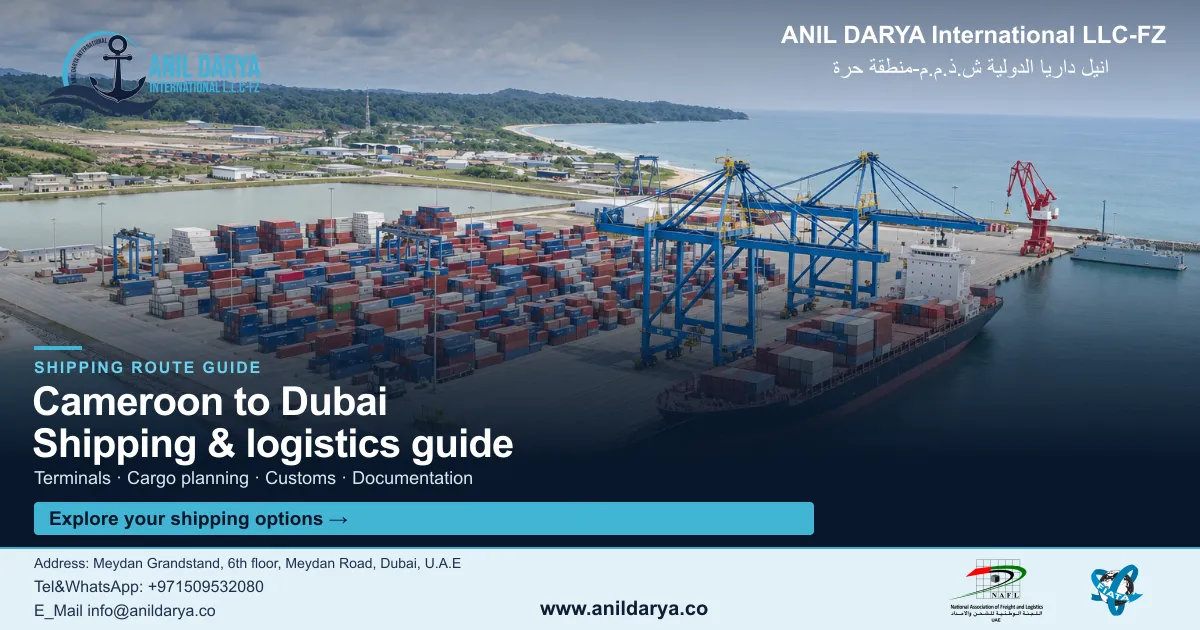
Shipping from Cameroon to Dubai usually means a container from Kribi or Douala to the UAE with at least one stop on the way, or air cargo from Douala or Yaounde for urgent and high-value goods. In Cameroon, the exporter runs the export through the GUCE single window and gets an export BESC from the shippers' council. In Dubai, the importer needs a customs business code, a Dubai Customs declaration, 5% duty on the CIF value and 5% import VAT.
Cameroon to Dubai shipping at a glance
| Item | Detail |
|---|---|
| Cameroon load ports | Kribi deep-sea port (CMKBI) and Douala-Bonaberi (CMDLA) |
| UAE arrival ports | Jebel Ali for Dubai; Khor Fakkan appears on the published routings |
| Published sea transit | Kribi to Khor Fakkan about 34 days 23 hours; Douala to Khor Fakkan about 55 days 8 hours with 1 transfer (Fluent Cargo) |
| Published air transit | Douala to Abu Dhabi about 14 h 21 m, 1 transfer; Yaounde Nsimalen to Dubai about 15 hours, 1 transfer (Fluent Cargo) |
| Modes | FCL, LCL, breakbulk (timber, metals), dangerous goods, air cargo |
| Export single window | GUCE, with the e-FORCE export tool |
| Cargo tracking note | Export BESC from the Conseil National des Chargeurs du Cameroun (CNCC) |
| Main Cameroon exports | Crude oil, gold, aluminium, cocoa, bananas, cotton, palm oil, rubber, coffee, timber |
| UAE customs authority (Dubai) | Dubai Customs; importer needs a customs business code |
| UAE customs duty | 5% of CIF value for most goods; alcohol 50%, cigarettes 100% |
| UAE import VAT | 5%, deferred to the VAT return for registered importers who link their customs number with the FTA |
| Free zone next to the port | Jafza, over 11,000 businesses |
How the lane works: export, voyage, UAE clearance
The US Commercial Service lists the UAE among the top destinations for Cameroon's exports in 2023, next to the Netherlands, France, India and China. The lane carries farm goods such as cocoa and coffee, timber, metals and other raw materials, and goods that Dubai traders sell on to other markets.
Every shipment has three parts:
- Origin. The Cameroonian exporter, or its clearing agent, gets the export approvals, files the export in GUCE, gets the export BESC and has the goods loaded.
- Main carriage. A shipping line or airline carries the cargo. We book that space with carriers when you buy on FOB or EXW terms.
- Destination. The consignee in the UAE, or a licensed clearing agent with its authorisation, files the Dubai Customs declaration. We arrange payment of the duty and VAT, collect the delivery order and deliver.
Under FOB, the exporter clears export and loads at Kribi or Douala. Under EXW, the buyer's side needs someone in Cameroon to run the export formalities, which is hard without a local agent. Under CIF or CFR, the exporter books the sea freight and we take over in the UAE. Agree the term in writing before anything is booked.
Kribi or Douala: which port should you ship from?
Both ports are run by public port authorities. Douala is the older commercial port on the Wouri river. Kribi is the deep-water port on the coast to the south.
| Point | Douala-Bonaberi | Kribi |
|---|---|---|
| Port authority | Port Autonome de Douala (PAD) | Port Autonome de Kribi (PAK) |
| Water | River channel kept at -7 m chart datum, drafts of about 9 m on a favourable tide | 16 m at the 715 m Phase II container quay |
| Berths | 17 berths over 3,100 m of quay | Container terminal (KCT) and multipurpose terminal (KMT) |
| Export traffic | 2,360,149 t loaded and 97,533 full export TEU in 2024 | 17,976 full export TEU in 2025, plus 348,289 TEU of transshipment |
| Export cargo it is set up for | Timber terminal, fruit terminal, mineral terminal for alumina and aluminium | Multipurpose terminal for ores, forest products, cereals, fishery products, coffee and cocoa |
| Best for | Shippers in Douala, the west and north, and cargo from Chad and CAR | Shippers in the south and Yaounde area, and bigger ships |
The port authority of Douala says two thirds of the trade of the inland countries passes through Douala, mainly Chad and the Central African Republic. Kribi takes ships that cannot use the Douala channel, and its quickest published routing to the UAE is shorter. Ask the carrier which port your booking really loads at, as some services load at Kribi and move Douala cargo by feeder.
Which UAE port should your cargo arrive at?
Jebel Ali is the default for Dubai and Jafza. DP World runs four container terminals there and handles break bulk, project cargo and IMDG dangerous goods. Our Jebel Ali port guide covers the terminals and port rules.
The published routings from Cameroon end at Khor Fakkan on the UAE east coast, where carriers connect to services into the Gulf ports. If your bill of lading names Jebel Ali as the place of delivery, the carrier moves the box on. If it names Khor Fakkan, you need a truck or feeder from there. For a consignee in Sharjah or the northern emirates, compare the Sharjah ports.
Sea freight from Cameroon to Dubai: transit times and sailings
There is no short route on this lane. Cargo sails around Africa or connects through a hub, and the schedule changes with the carrier. The data below comes from Fluent Cargo route pages, port to port, quickest option listed.
| Route | Quickest published transit | Routing | Frequency | Carriers named |
|---|---|---|---|---|
| Kribi to Khor Fakkan | 34 days 23 hours | Direct MSC service listed, plus transshipment options | Every 1 to 2 weeks | MSC, Maersk |
| Douala to Khor Fakkan | 55 days 8 hours | 1 transfer, Cameroon feeder service into an MSC line | Every 1 to 2 weeks | MSC |
The gap between the two is mostly the feeder leg and the waiting time at the hub. If your goods are near Douala, compare the Douala sailing with trucking to Kribi. Add time at both ends for export formalities in Cameroon and clearance in Dubai.
[AMIR-FACT: our real port-to-port transit from Kribi and Douala to Jebel Ali, and the carriers and transshipment hubs we actually book on this lane]
FCL or LCL from Cameroon?
Most cargo on this lane moves in full containers, because the main exports are heavy or bulky. FCL is sealed at origin and released as one unit in Dubai. LCL suits samples and small lots, but consolidation services from Cameroon to the UAE are less frequent, so a missed cut-off can cost weeks. Price both if your volume is close to a 20ft. Our guide to FCL vs LCL costs explains the break-even, and our sea freight service page shows how we book containers.
Timber, metals and breakbulk
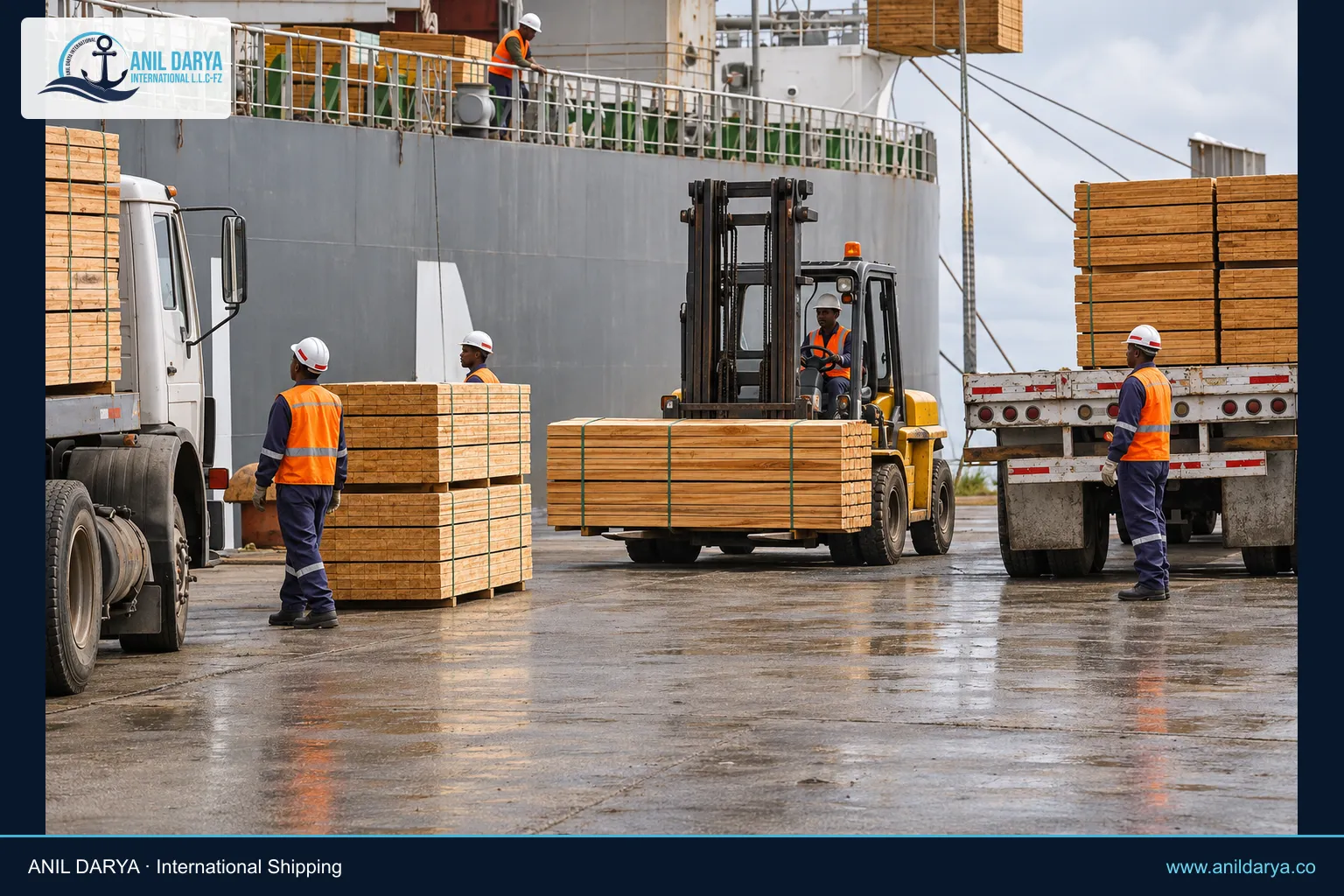
Sawn timber and logs, aluminium and other metals often move in containers or on breakbulk ships. Douala has a dedicated timber terminal, and Kribi's multipurpose terminal handles forest products and ores. For bundles and pieces that do not fit a box, the breakbulk sailing date drives the plan. At the UAE end we plan the discharge, storage and trucking. See our break bulk and project cargo service, and for bulk trades with the region our note on Dubai to Africa bulk shipping.
Dangerous goods
Chemicals, oils, paints and batteries need a safety data sheet, a DG declaration, UN packaging and labels, and carrier acceptance for every leg, including the transshipment hub. Feeder services do not accept every class. At the UAE end, have the Dubai declaration and delivery ready for the day the vessel berths. Our dangerous goods shipping team checks acceptance route by route.
When air cargo is worth it on this lane
Air suits samples, documents, spare parts and high-value goods. Fluent Cargo lists Douala to Abu Dhabi at about 14 hours 21 minutes with one transfer, 2 to 4 times a week, and Yaounde Nsimalen to Dubai at about 15 hours with one transfer, 1 to 2 times a day, with Ethiopian Airlines among the carriers. The CNCC says a BESC is also issued for air waybills at Douala and Yaounde Nsimalen airports, for exports as well as imports. In Dubai, the customs process is the same as for sea cargo. Our air cargo service covers what we book.
What the Cameroonian exporter must do
The export side is your supplier's job, but you depend on it. The US Commercial Service describes the export process like this:
- The exporter registers with the Ministry of Trade, holds a taxpayer card and keeps it updated in the customs system.
- It gets the authorisations required for regulated goods.
- It prepares the purchase order, the invoice and a certificate of origin.
- For some products, such as cocoa, timber and medicinal plants, it submits a declaration through the inspection company SGS.
- Exports in containers need a stuffing certificate, and some shipments need sanitary or phytosanitary certificates.
GUCE and e-FORCE export
GUCE, Cameroon's single window for foreign trade, links banks, customs, the Treasury, SGS, the port authorities and agencies such as the National Office of Cocoa and Coffee and the phytosanitary service. The US Commercial Service says it aims to process exports in two days. GUCE's e-FORCE export tool lets the exporter or its representative run the export online in five stages:
| Stage | What happens |
|---|---|
| Prior approvals | Permits or approvals from the technical ministries for the goods |
| Pre-clearance | Commercial, financial and customs formalities before the goods move |
| Taking charge | Administrative and customs formalities and cargo preparation before loading |
| Clearance | Assessment and payment of any duties and taxes |
| Loading | The formalities for putting the cargo on board |
For plant products such as cocoa, bananas, pineapples and timber, the phytosanitary certificate is now applied for on the GUCE platform. The plant health service checks the cargo, then issues and signs the certificate electronically, and it is sent to the importing country through the international ePhyto hub.
The export BESC
Cameroon's shippers' council, the CNCC, issues an export BESC as well as the import one. The shipper opens an account on export.cncc.cm, which the CNCC activates, then fills in the form from the export declaration and submits it for validation. Ask your supplier to show you the validated export BESC with the other documents.
| Cameroon export document | Who provides it | When it is needed |
|---|---|---|
| Commercial invoice and packing list | Exporter | Every shipment |
| Export file in GUCE (e-FORCE) | Exporter or clearing agent | Every shipment |
| Export BESC | Exporter, validated by the CNCC | Sea and air exports |
| Certificate of origin | Exporter, through the issuing body | Needed by Dubai Customs |
| SGS declaration | Exporter | Cocoa, timber, medicinal plants and other listed goods |
| Phytosanitary or sanitary certificate | Plant or animal health service, through GUCE | Plant and food goods |
| Stuffing certificate | Issued at stuffing | Containerised exports |
| Bill of lading or air waybill | Carrier or forwarder | Every shipment |
Clearing Cameroonian cargo through Dubai Customs
Cocoa, coffee, timber or metal from Kribi or Douala that reaches Jebel Ali is cleared by Dubai Customs. Because much of this cargo is traded on rather than used in the UAE, pick the regime before the ship arrives: local import, free zone transfer, transit or temporary admission.
Do you need a customs code to import into Dubai?
Yes. The UAE buyer of Cameroonian goods needs a customs business code, and the Dubai declaration is filed under it. If you have none, a clearing agent with a Dubai Economic Department clearing and forwarding licence and its own code can file with your written authorisation. On a five-week voyage from Kribi there is time to set this up, so we arrange it through a licensed agent before the box lands.
Which documents does Dubai Customs need?
For a Cameroonian consignment, Dubai Customs wants the exporter's invoice, packing list and certificate of origin, plus a UAE permit for restricted goods, and the line's delivery order once the box lands. Many Cameroonian documents are in French, so check that names, weights and HS codes match across every page.
| Document | Who provides it | Why Dubai needs it |
|---|---|---|
| Commercial invoice | Cameroonian exporter | Customs value and HS code |
| Packing list | Cameroonian exporter | Inspection and release |
| Certificate of origin | Issuing body in Cameroon | Origin of the goods |
| Bill of lading or air waybill | Carrier or forwarder | Title to the goods |
| Delivery order | Shipping line in the UAE | Releasing the container |
| Permit | UAE authority for the product | Restricted goods only |
| Phytosanitary certificate | Cameroon plant health service | Cocoa, coffee, fruit and other plant goods |

Which declaration should you use?
| What happens to the goods | Declaration | Duty and VAT |
|---|---|---|
| Sold or used in the UAE mainland | Import for local use | Duty and VAT at import |
| Delivered into Jafza | Transfer into the free zone | Due only if the goods later enter the mainland |
| Brought in for a time, then sent back | Temporary admission | Deposit equal to the duty, refunded on re-export in time; no deposit under an ATA carnet |
| Passing through to another country | Transit | Not imported into the UAE |
How much is duty and VAT on goods from Cameroon to Dubai?
The UAE Government portal sets the Dubai tariff at 5% of the CIF value, except alcohol at 50% and cigarettes at 100%. The duty varies for some goods according to the tariff, so check your HS code before you price the deal. CIF means the value of the goods plus freight and insurance up to the place of import. On a long lane like this one, freight is a bigger share of CIF than on short routes, so the duty grows with it.
The Federal Tax Authority charges import VAT at 5% on the customs value, including insurance, freight and any customs fees and excise tax paid on import.
- VAT-registered importer whose customs registration number is registered with the FTA: no VAT is charged at the border. It is pre-filled in your VAT return and you can recover it as input tax if eligible.
- Importer not registered for VAT: VAT is paid to the FTA before customs releases the goods.
| Charge | Rate | Base |
|---|---|---|
| Customs duty, most goods | 5% | CIF value |
| Customs duty, alcohol | 50% | CIF value |
| Customs duty, cigarettes | 100% | CIF value |
| Import VAT | 5% | Customs value plus customs fees and excise tax |
| Rough diamonds | Duty exempt | Kimberley Process certificate required, or the shipment is impounded |
Restricted goods for import into the UAE
Dubai Customs says some goods need approval from the competent authority before release, and that approval goes in with the other clearance documents. On this lane, plan ahead for:
- Cocoa, coffee, fruit, spices and other food: UAE food safety approvals, plus the Cameroonian phytosanitary certificate.
- Timber and wood products: plant health papers from Cameroon and any UAE approval for the product.
- Medicinal plants, medicines and cosmetics: health authority approval or product registration.
- Chemicals and dangerous goods: permits for some products and port approvals for some classes.
- Rough diamonds and precious stones: a Kimberley Process certificate for rough diamonds.
Apply for UAE permits as soon as the booking is made. A permit that arrives after the vessel means storage and demurrage at the port.
Re-exporting Cameroonian goods through Jafza
Some cargo on this lane is bought by a Dubai or Jafza trader and sold on to other markets. Jafza, next to Jebel Ali Port, has grown from 19 companies in 1985 to over 11,000. Deliver into Jafza under a free zone transfer, and duty applies only if the goods later enter the UAE mainland. The goods keep their Cameroonian origin. For the next buyer, Dubai Chambers issues certificates of origin for exported and re-exported goods for AED 100, with a two-hour processing time. Our guide to Jafza re-export covers bulk and breakbulk cargo.
Shipping from Cameroon to Dubai step by step
- Send us the cargo details: goods, HS codes, weight, volume, packing, the pickup point in Cameroon and the delivery address in the UAE.
- Agree the Incoterm with the exporter. Under FOB we book the sea or air freight. Under CIF or CFR the exporter books it and we take over in the UAE.
- Get your UAE side ready: customs business code, VAT number linked with your customs registration, and permits for restricted goods.
- The exporter gets the prior approvals, the SGS declaration where needed and the phytosanitary certificate through GUCE.
- Book space. We compare Kribi and Douala sailings, confirm the transshipment port and the place of delivery in the UAE. DG and breakbulk get carrier approval first.
- The exporter files the export in GUCE e-FORCE, gets the export BESC validated and has the container stuffed and loaded.
- Check documents before arrival. Invoice, packing list, bill of lading, certificate of origin and phytosanitary certificate must match.
- The Dubai declaration is filed through a licensed agent before the vessel berths.
- We arrange payment of the duty and VAT if due and the line's charges, collect the delivery order, deliver to your site or Jafza warehouse and return the empty within free time.
[AMIR-FACT: one real Cameroon to Dubai shipment we handled, with cargo type, Kribi or Douala, mode, total days and how clearance went in the UAE, cleared for publication]
What decides the cost on this lane?
Rates change every week, so we quote each shipment. These are the parts of the total:
| Cost factor | Effect |
|---|---|
| Load port | Kribi has the shorter published routing; Douala often adds a feeder leg |
| Inland transport in Cameroon | Truck or rail from the producer to the port |
| Cameroon origin charges | Terminal handling, GUCE and BESC fees, inspection, certificates |
| Container type | Open top, flat rack and breakbulk cost more than dry boxes |
| UAE arrival port | A Khor Fakkan discharge may need a truck or feeder to Dubai |
| UAE destination charges | Terminal handling, delivery order, clearance, trucking |
| Duty and VAT | 5% duty on CIF and 5% VAT unless deferred |
| Free time | Demurrage and detention once free days run out |
The biggest avoidable cost is waiting at the UAE port. Our article on demurrage and detention explains how it adds up.
Checklist before cargo leaves Cameroon
- Customs business code active, and VAT registration linked with your customs number.
- HS code agreed with the exporter and checked for UAE duty and restrictions.
- UAE permits applied for on food, plant and other restricted goods.
- Exporter's prior approvals, SGS declaration and phytosanitary certificate in hand.
- Export filed in GUCE and the export BESC validated.
- Load port confirmed: Kribi, or Douala with a feeder.
- Place of delivery in the UAE confirmed: Jebel Ali or Khor Fakkan.
- Declaration type chosen: local import, free zone, temporary admission or transit.
- DG documents and carrier approval for every leg.
- Cargo insurance arranged for a voyage of five weeks or more.
Common mistakes when shipping from Cameroon to Dubai
| Mistake | What happens | How to avoid it |
|---|---|---|
| No customs code in the UAE | Goods wait at the port until someone authorised files | Get the business code before the goods ship |
| VAT not linked to the customs number | Import VAT paid in cash before release | Register the customs number with the FTA |
| Phytosanitary certificate missing or late | Food and plant goods held at the UAE port | Make it part of the exporter's GUCE file |
| Assuming Jebel Ali when the box ends at Khor Fakkan | Extra truck or feeder cost and delay | Read the place of delivery on the booking |
| Quoting a Douala sailing time for a feeder routing | Arrival weeks later than planned | Compare Kribi and Douala schedules before you sell |
| French and English documents that do not match | Clearance held over a weight or description | Check every document line by line before arrival |
Frequently asked questions
How long does shipping from Cameroon to Dubai take by sea?
Fluent Cargo's schedule data lists about 34 days 23 hours from Kribi to Khor Fakkan, and about 55 days 8 hours from Douala to Khor Fakkan with one transfer. Add time for export formalities in Cameroon and clearance in Dubai.
Should I ship from Kribi or Douala?
Kribi has 16 m of water at its container quay and the shorter published routing to the UAE. Douala has the timber, fruit and mineral terminals and most of the clearing agents. Choose by where the goods are and which port the carrier really loads at.
What is the customs duty on goods from Cameroon to Dubai?
Dubai charges 5% of the CIF value for most goods, 50% on alcohol and 100% on cigarettes. Some HS codes carry other rates, so check yours before you price the deal.
Do I pay VAT on imports from Cameroon into the UAE?
Yes. Cocoa, coffee, timber and other goods from Cameroon pay 5% UAE import VAT on top of the duty. A VAT-registered importer whose customs number is registered with the FTA reports it in the VAT return rather than paying before release.
Is a BESC needed for exports from Cameroon?
Yes. The CNCC issues an export BESC. The shipper opens an account on export.cncc.cm and fills in the form from the export declaration. A BESC is also issued for air waybills at Douala and Yaounde Nsimalen airports.
What documents does a Cameroonian exporter of cocoa or timber need?
Besides the invoice, packing list, certificate of origin and bill of lading, cocoa and timber exports need a declaration through SGS, and plant goods need a phytosanitary certificate, applied for on the GUCE platform.
Can goods from Cameroon go into a Dubai free zone without paying duty?
Yes. Goods delivered into Jafza under a free zone declaration pay duty only if they later enter the UAE mainland.
Can I send air cargo from Cameroon to Dubai?
Yes. Schedule data lists Yaounde Nsimalen to Dubai at about 15 hours with one transfer, 1 to 2 times a day, and Douala to Abu Dhabi at about 14 hours with one transfer.
Can you collect cargo from my supplier in Cameroon?
We book the sea or air freight with carriers. Pickup and the export formalities in Cameroon are done by your supplier or its clearing agent, and we take over the documents and the UAE side.
Get a quote for shipping from Cameroon to Dubai
Send us the cargo, the pickup point in Cameroon and your delivery address in the UAE, and we will come back with a routing and a price, including clearance at the Dubai end. Use our freight rate inquiry form or contact our team. You can also read more about our Dubai freight forwarding team.
Sources
- US International Trade Administration: Cameroon market overview (exports and destinations)
- US International Trade Administration: Cameroon customs regulations (export procedures, GUCE)
- GUCE: e-FORCE export stages
- GUCE: e-PHYTO electronic phytosanitary certificate
- CNCC: BESC, including export and air BESC
- Port Autonome de Douala: port overview and hinterland
- Port Autonome de Douala: infrastructure overview
- Port Autonome de Douala: channel depth
- Port Autonome de Douala: specialised terminals
- Port Autonome de Douala: statistics
- Port Autonome de Kribi: key figures 2025
- Port Autonome de Kribi: Phase II
- Port Autonome de Kribi: cargo services
- Fluent Cargo: Cameroon to United Arab Emirates
- Fluent Cargo: Douala to Dubai
- DP World: Jebel Ali Port
- Dubai Customs: Submit customs declaration (documents)
- Dubai Customs: Frequently asked questions (business code, agents, duty, temporary admission, diamonds)
- UAE Government portal: Customs duty and tariff
- Federal Tax Authority: VAT guide (import VAT)
- Jafza: About Jebel Ali Free Zone
- Dubai Chambers: Issuing a certificate of origin
Reviewed: 10 November 2026