
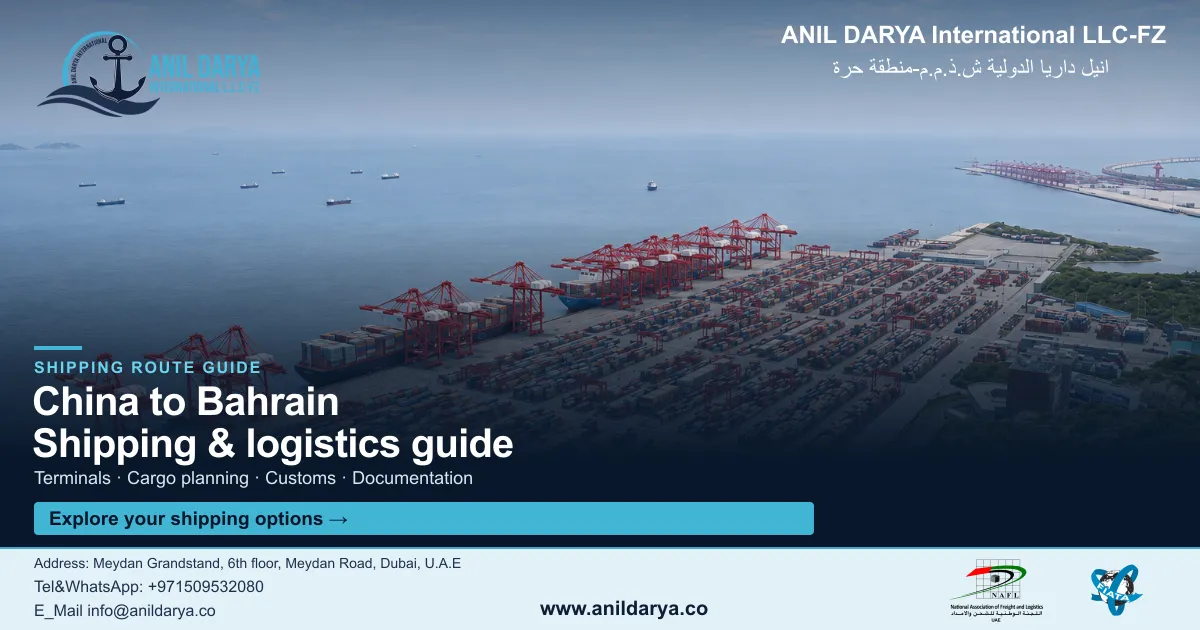
Shipping from China to Bahrain is almost always a sea container from Shanghai, Ningbo, Shenzhen or another Chinese port into Khalifa Bin Salman Port, the only general commercial port in Bahrain. Many services reach Bahrain by transhipment at Jebel Ali in Dubai, which is why a Dubai team can book and follow this lane closely. The supplier files the Chinese export declaration, and the consignee's clearing agent files the Bahrain import declaration on OFOQ, where 5% duty and 10% VAT apply to most goods.
China to Bahrain shipping at a glance
| Item | Detail |
|---|---|
| Lane type | Cross-trade: China to Bahrain, booked and coordinated by Anil Darya from Dubai |
| Main mode | Sea freight: FCL, LCL, reefer, flat rack, breakbulk, dangerous goods |
| Common Chinese load ports | Shanghai, Ningbo, Shenzhen (Shekou, Yantian), Guangzhou (Nansha), Qingdao, Tianjin, Xiamen |
| Bahrain discharge port | Khalifa Bin Salman Port (KBSP), run by APM Terminals Bahrain |
| Usual routing | Transhipment at Jebel Ali onto a Gulf feeder; some carriers offer other routings |
| Published example transit | Milaha MGX via Jebel Ali: Shanghai 25, Ningbo 24, Shekou 21 days to Bahrain (February 2026 proforma) |
| Export filing in China | Consignor (usually the supplier) or its customs broker, 24 hours before loading |
| Import filing in Bahrain | OFOQ system, Customs Affairs (Ministry of Interior), through a licensed clearing agent |
| Bahrain customs duty | 5% on most goods from outside the GCC; alcohol 125%, tobacco 100% |
| Bahrain VAT | 10% standard rate since 1 January 2022 |
| Bill of lading | The shipping line's own B/L, issued and released through Anil Darya as the carrier's agent |
How shipping from China to Bahrain works when it is booked in Dubai
The booking is made in Dubai, but the cargo does not need to be cleared in the UAE. Three parties share the work: the Chinese supplier, the Bahrain consignee and us.
| Task | Who handles it |
|---|---|
| Factory pickup, container stuffing, trucking to the Chinese port | The supplier or its origin agent |
| Chinese export declaration | The supplier as consignor, or a Chinese customs broker it appoints |
| Ocean freight booking with the shipping line | Anil Darya, from Dubai |
| Bill of lading | Issued by the shipping line and released to you through us as its agent |
| Tracking, cut-offs, transhipment follow-up | Anil Darya |
| Bahrain import declaration, duty and VAT | The consignee's customs broker in Bahrain |
| Delivery from KBSP to the consignee's site | The consignee or its broker's transport |
We act as agent for many shipping lines, so the bill of lading you receive is the carrier's own document, not a house bill. It names the shipper in China and the consignee in Bahrain, and the original or telex release comes through our office. We do not have an office, yard or agent in China or in Bahrain. We coordinate with the people who are already there: your supplier at origin and your customs broker at destination.
The Incoterm decides where the supplier's job ends. FOB is the cleanest choice for this lane. The supplier clears export and loads the box at the Chinese port, and the freight is booked by the buyer through us. Under EXW the buyer would need someone in China to act as exporter of record, which most Bahrain buyers do not have. Our Incoterms 2020 guide for sea freight shows where cost and risk pass under each term.
Load ports and the discharge port
Pick the Chinese port nearest the factory. A truck across several provinces to reach a different port costs more than most freight savings it might win.
| Supplier region | Usual load port | Typical goods for Bahrain buyers |
|---|---|---|
| Shanghai, Jiangsu, Zhejiang | Shanghai, Ningbo | Machinery, electrical goods, steel products, furniture |
| Guangdong (Shenzhen, Dongguan, Foshan) | Shekou, Yantian, Nansha | Electronics, lighting, building fittings, furniture |
| Shandong, Hebei, Beijing, Tianjin | Qingdao, Tianjin | Tyres, chemicals, steel, heavy equipment |
| Fujian | Xiamen | Stone, ceramics, footwear, textiles |
At the Bahrain end there is one answer for containers. APM Terminals Bahrain describes Khalifa Bin Salman Port as the only general commercial port facility in the country, and has run it under an exclusive government concession since 2009. The operator lists a 1,800 m quay, 15 m maximum depth at the quayside, four post-Panamax ship-to-shore cranes, 840 reefer plugs and a maximum vessel size of 14,000 TEU.
Terminal rules at KBSP matter for planning. Gates open Saturday to Thursday from 04:00 to 22:00 and on Friday from 08:00 to 16:00. Every empty container goes through the customs scanner on return, and loads over 5 metres high need a traffic escort when they leave the port.
Direct call or transhipment at Jebel Ali?
The big Asia to Gulf mainline services are built around Jebel Ali. A Bahrain box often rides the mainline from China to Jebel Ali, is lifted off, and continues on a smaller feeder vessel to KBSP. On a through bill of lading to Bahrain, the transhipment is the carrier's own operation. You do not book the feeder leg yourself.
One published example is Milaha's Gulf Express (MGX). Its February 2026 proforma shows a weekly rotation of Shanghai, Ningbo, Shekou and Jebel Ali, and lists Bahrain among the Upper Gulf ports served via Jebel Ali. The table below copies its China to Gulf transit days for this lane.
| Load port (MGX) | To Jebel Ali | To Bahrain via Jebel Ali |
|---|---|---|
| Shanghai | 23 days | 25 days |
| Ningbo | 22 days | 24 days |
| Shekou | 19 days | 21 days |
These are one carrier's published proforma figures, not a promise for every sailing. Other carriers use different hubs and rotations, and schedules change each season. On every quote, ask for three things: the mainline vessel, the transhipment port and the feeder connection to KBSP.
| Routing | When it suits you | What to check |
|---|---|---|
| Mainline to Jebel Ali, feeder to KBSP | Most FCL and LCL from the main Chinese ports | Feeder frequency and the waiting time at Jebel Ali |
| Other routings a carrier offers | When a carrier quotes a better total time or rate | Every port on the routing and the total days, not only the first leg |
| Consolidation or stock in Dubai, then on to Bahrain | Several suppliers, or stock held for several Gulf buyers | UAE customs status of the goods and the second shipment to Bahrain |
[AMIR-FACT: the carriers Anil Darya actually books from China to Khalifa Bin Salman Port, whether each routes via Jebel Ali or another hub, and our real port-to-port days from Shanghai, Ningbo and Shenzhen]
How long does shipping from China to Bahrain take?
The sailing is only part of the total. Door to door, the time adds factory pickup, Chinese export clearance, waiting for the vessel cut-off, the mainline voyage, the transhipment wait, the feeder leg, Bahrain clearance and delivery.
| Stage | What sets the time |
|---|---|
| Cargo ready and collected | Production, packing and truck booking at the factory |
| Chinese export clearance | Declaration filed 24 hours before loading, inspection if selected |
| Mainline voyage to the hub | Weekly sailing day and port rotation; MGX shows 19 to 23 days to Jebel Ali |
| Transhipment and feeder | Feeder schedule from Jebel Ali to KBSP; MGX adds 2 days on its published figures |
| Bahrain clearance | OFOQ declaration filed before arrival, approvals ready, duty and VAT paid |
| Delivery | Gate hours at KBSP, truck availability and unloading at site |
Rely on the carrier's schedule for your booking, and allow a margin for the transhipment connection.
Sea freight options: FCL, LCL and special equipment
Most buyers on this lane start with one question: is the order big enough for its own container?
| Option | Best for | Watch out for |
|---|---|---|
| 20ft FCL | Dense goods: tiles, steel parts, tyres, cable drums | Weight limits for the truck in China and in Bahrain |
| 40ft or 40ft high cube FCL | Furniture, lighting, appliances, mixed stock from one factory | Free time at KBSP and a delivery slot |
| LCL | Small and first orders | Extra handling and the shared box; KBSP needs the LCL delivery order and payment receipt by 15:30 the day before collection |
| Reefer | Food, some chemicals and medicines | Set point, Bahrain food or health approvals before arrival |
| Flat rack or open top | Machinery slightly over container size | Carrier acceptance at the hub and on the feeder |
For a flat rack or open top, both the mainline ship and the feeder must accept the unit. Ask for that confirmation before the supplier crates the machine. Our FCL vs LCL guide explains where the break-even point usually falls, and our sea freight service lists the container types we book.
Buying from several Chinese suppliers
Several small LCL lots each pay their own handling and clearance in Bahrain. Two options cut that. The suppliers can deliver to one consolidation warehouse in China, so one FCL sails to KBSP. Or each lot can come to Dubai, be combined with other stock and move to Bahrain as one shipment. The second option is covered in the Dubai section below.
Dangerous goods and reefer cargo
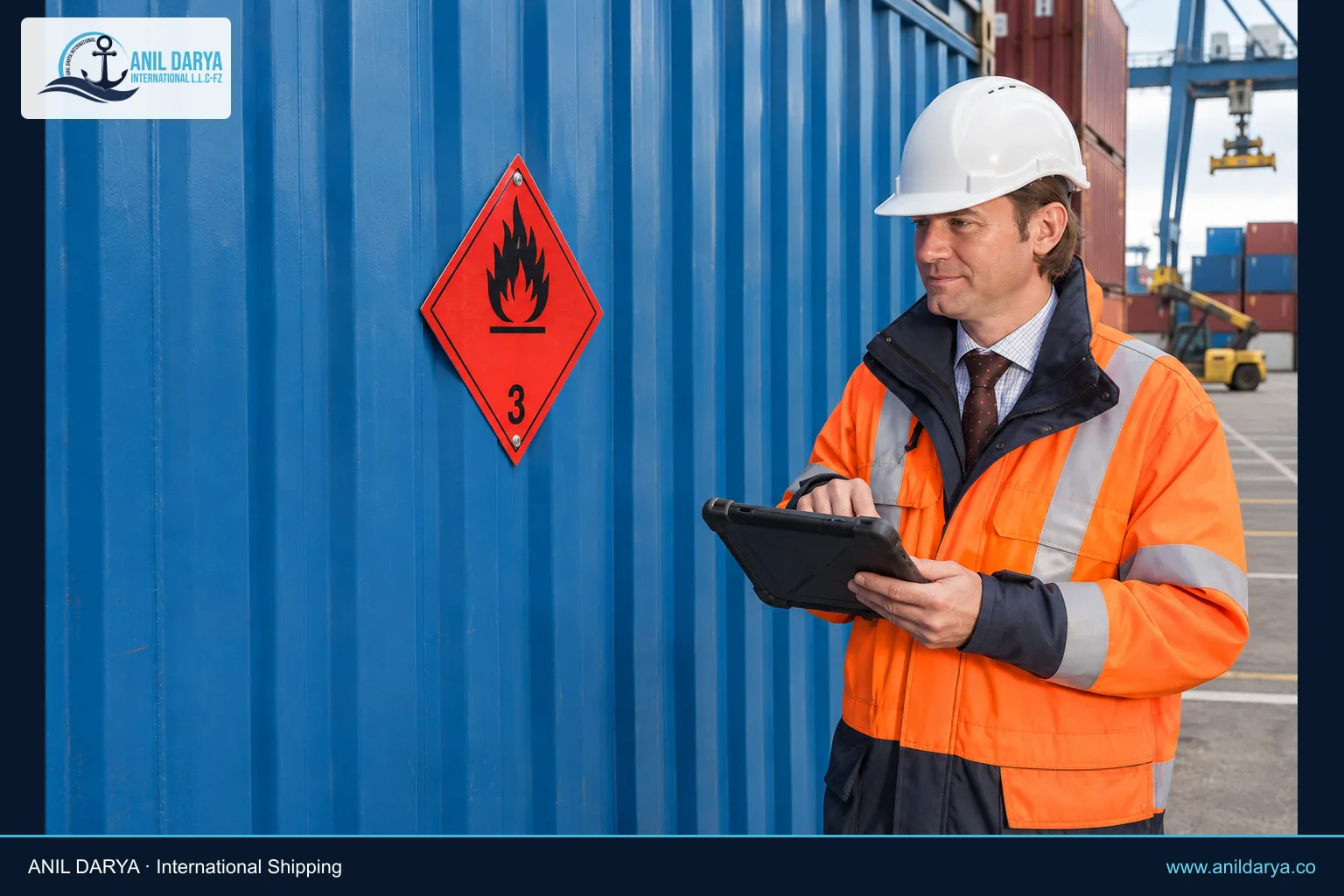
A lot of everyday cargo from China is dangerous goods: lithium batteries in tools and electronics, paints, adhesives, aerosols, solvents and pool chemicals. On a transhipped routing the cargo must be accepted three times: at the Chinese load port, at the hub and at KBSP.
Before the cargo leaves China
China Customs inspects packaging used for exported dangerous goods. Performance appraisal confirms the packaging type meets the standard, and use identification checks how the real goods were packed. The supplier needs these packaging certificates before a DG booking can be made. Sea DG moves under the IMDG Code, and the 2024 edition (Amendment 42-24) has been mandatory since 1 January 2026, so the Safety Data Sheet and DG declaration should follow it.
At the Bahrain terminal
APM Terminals Bahrain handles all hazardous classes but asks a lot in advance. Approvals go to its planning team 72 hours before the vessel arrives, and the agent must send the MSDS and manifest at least 72 hours before arrival. IMO Class 1 and Class 7 need government approval first. Several classes, including Class 1 and 7, carry a 100% handling surcharge, and hazardous containers pay BHD 88 a day in storage with no free days. A DG box that waits for a missing permit gets expensive quickly.
Reefers need the set point and ventilation on the booking, and any food or health approval must be in progress before the feeder reaches Bahrain. Our dangerous goods team checks the UN number, packing group and carrier acceptance before we confirm a sailing.
Breakbulk and project cargo
Bahrain's industrial and construction projects buy transformers, steel structures, generators, pumps and production lines from China. Pieces that fit a flat rack can travel on container services. Larger or heavier pieces need breakbulk or heavy-lift tonnage, and the Bahrain Ministry of Transportation and Telecommunications lists general cargo and Ro-Ro among the services at KBSP.
- Collect drawings, weights, dimensions and lifting points for every piece from the supplier.
- Decide flat rack or breakbulk. If any piece is too big for a flat rack, the vessel date drives the plan.
- Confirm the carrier accepts the cargo for the whole routing, including any transhipment.
- Write one master packing list that matches the invoice and bill of lading piece by piece.
- Agree with the consignee's broker how the declaration will be filed and which approvals the goods need.
- Plan the road move from KBSP, including the escort for loads over 5 metres high.
Our break bulk and project cargo service covers the booking and stowage side.
Export customs in China: what the supplier files
China Customs (GACC) controls the export side. According to the Shanghai government's trade guidance, the consignor files the export declaration once the goods arrive in the customs supervision area and 24 hours before loading. It can file itself or appoint a customs broker, on paper at the window or electronically.
- The exporter needs market entity status and the Registration of Foreign Trade Operators, and must be recorded with customs. Recordation can be done online through the China International Trade Single Window.
- Goods under statutory inspection, such as DG packaging, need the inspection result before export.
- The value, description and HS code on the Chinese declaration should match the commercial invoice the Bahrain broker will file.
We do not file Chinese export declarations. We send the supplier the booking, the cut-off times and the shipping instructions, and we check its draft B/L details against the invoice before the box loads.
Bahrain import customs for goods from China
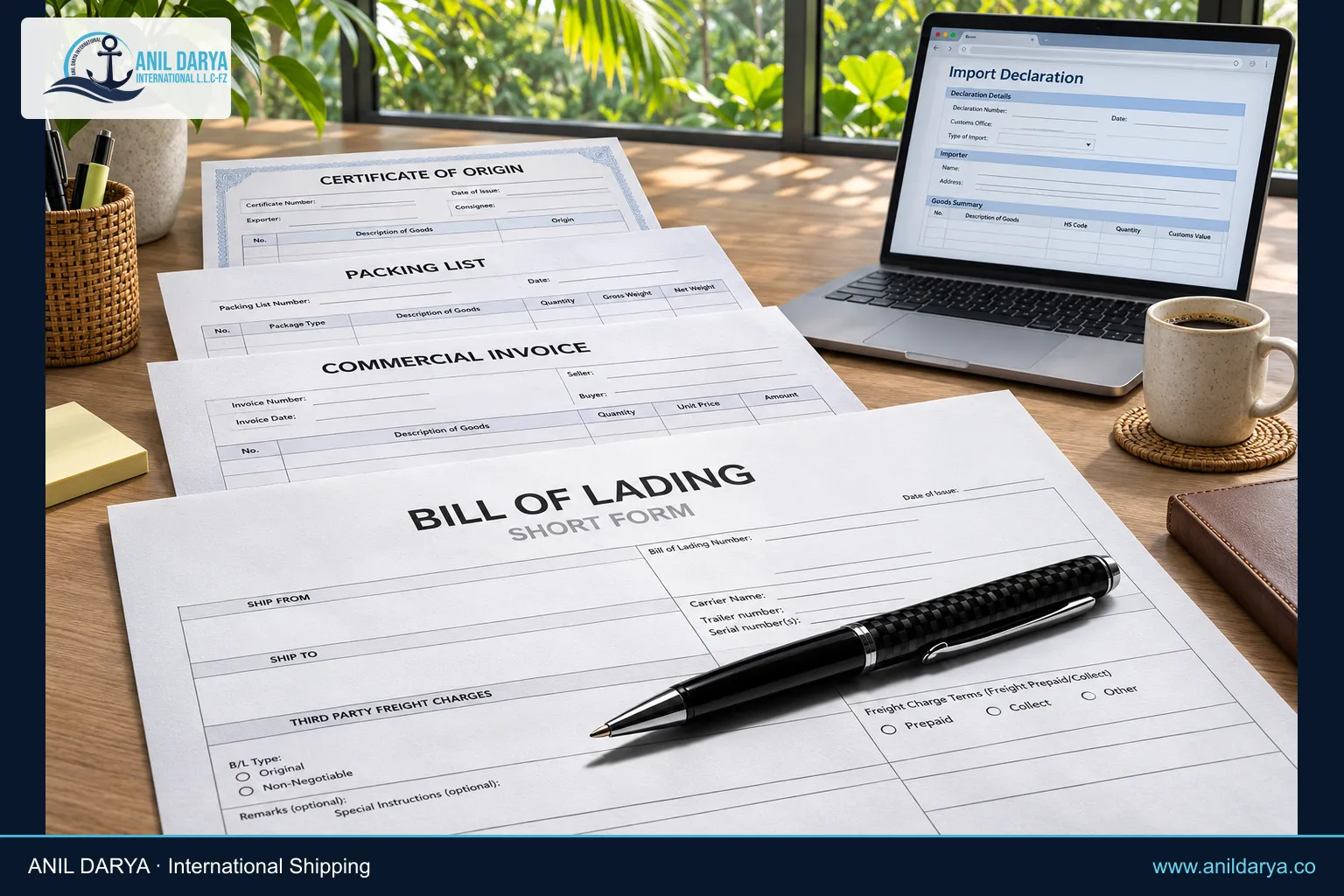
Bahrain customs sits under Customs Affairs at the Ministry of Interior, and declarations run on the OFOQ system. The bahrain.bh service page lists the bill of lading and the invoices, with a certificate of origin or other documents where required. It shows a fee of BD 3 for a declaration lodged before the goods arrive and BD 5 for the statement fee. The US trade guide for Bahrain advises importers to use a registered, licensed clearing agent and notes that the importer or its agent completes a customs bill of entry.
Documents the broker will ask for
| Document | Issued by | What to check |
|---|---|---|
| Commercial invoice | Chinese supplier | Full description, HS code, unit and total value, currency, Incoterm, Bahrain consignee |
| Packing list | Chinese supplier | Pieces, gross and net weights, volume; the GCC customs guide asks for HS codes and DG codes on it |
| Certificate of origin | Issuing body in China | Goods and consignee match the invoice |
| Bill of lading | Shipping line, released through Anil Darya | Consignee and notify party, port of discharge KBSP, weights and piece count |
| Delivery order | Carrier's agent in Bahrain | Released once local charges are paid |
| Proof of conformity or approval | Supplier, test lab or Bahrain ministry | Needed for regulated products before release |
The GCC unified customs guide also notes that customs may ask for an Arabic translation of documents. Ask the broker early whether it wants one for your goods.
Regulated products and conformity
Many Chinese goods fall under the Testing and Metrology Directorate of the Ministry of Industry and Commerce (MOIC). The clearing agent raises a request on OFOQ, sends the invoices, packing list and proof of conformity for the product, and the directorate's port controller decides on OFOQ. The service page gives one working day for online requests. The proof differs by product, so ask the supplier for its test reports and certificates while the order is still in production, not after the box sails.
Duty and VAT in Bahrain on Chinese goods
Bahrain applies the GCC common external tariff. The US trade guide states 5% import duty on most goods from outside the GCC, with alcohol at 125% and tobacco at 100%. Some goods are exempt, so the broker should confirm the rate for each HS code before you place the order. VAT is separate: Bahrain's standard rate has been 10% since 1 January 2022, administered by the National Bureau for Revenue. Some goods are zero-rated or exempt.
Duty and taxes at destination are paid by the consignee or its broker. They are not part of our freight invoice.
| Situation | Duty in Bahrain | Note |
|---|---|---|
| Goods shipped straight from China to KBSP | 5% on most goods, paid at clearance in Bahrain | 10% VAT also applies unless the goods are zero-rated or exempt |
| Goods first cleared and duty paid in the UAE, then sent on to Bahrain | GCC first-point-of-entry rule may allow duty-free entry with the right certificates | The broker must see proof that GCC duty was paid at the first entry point |
| Goods held in a Dubai free zone, then re-exported to Bahrain | Duty is paid in Bahrain, as for a direct shipment | The goods were never cleared into the UAE market |
| Alcohol or tobacco | 125% or 100% | Special approvals; check before ordering |
A low invoice value does not save money. It draws a hold, a reassessment and storage charges at KBSP while the case is reviewed.
Where Dubai helps on this lane
Most China to Bahrain cargo does not need to be cleared in the UAE. Dubai still adds value in three cases.
- Transhipment at Jebel Ali. Many mainline services from China run to Jebel Ali and feed Bahrain from there, as the MGX proforma shows. Our Jebel Ali port guide explains the terminals.
- Consolidation. Lots from several Chinese suppliers, or Chinese goods combined with stock bought in the UAE, can be joined in Dubai and sent to Bahrain as one shipment.
- Free zone stock. A trader can hold Chinese goods in Jebel Ali Free Zone and re-export them to Bahrain and other Gulf buyers as orders arrive. Our article on re-export through JAFZA covers how this works.
When the cargo is landed in Dubai for consolidation or re-export, Dubai customs clearance is a service we provide for a fee. Dubai Customs runs one declaration service that covers import, export, transit, transfer and temporary admission, so the right declaration type depends on whether the goods enter the UAE market or only pass through.
[AMIR-FACT: whether Anil Darya has consolidated Chinese supplier lots in Dubai or Jebel Ali Free Zone for a Bahrain buyer, and how the onward leg to Bahrain was moved]
Typical cargo on this lane
The goods on this lane follow Bahrain's building, retail and industrial demand. Common shipments include:
- Building materials: tiles, sanitary ware, aluminium profiles, steel products, cable and lighting.
- Furniture and home goods for retail and hotel fit-outs.
- Electrical and electronic goods, many of them under MOIC conformity rules or containing lithium batteries.
- Machinery, generators, pumps and spare parts for factories and contractors.
- Tyres, auto parts and accessories.
- Textiles, clothing and footwear.
Electrical goods need proof of conformity, batteries are DG, and bulky furniture usually fills a 40ft high cube better than several LCL lots.
Restricted and prohibited goods in Bahrain
The US trade guide lists goods Bahrain prohibits outright. Several of them come from Chinese factories, so check the order before it ships:
- Radio or remote controlled model aircraft.
- Children's toy guns that fire projectiles.
- Used and reconditioned tyres.
- Asbestos or items containing asbestos.
- Advertising material for cigarettes, narcotics, and publications that offend public morals.
Restricted goods can enter with approval. Medicines need Ministry of Health approval and can only be imported by a licensed pharmacy or drug store. Beef and poultry need a health certificate and a halal slaughter certificate from the country of origin. Tobacco is released through the Ministry of Health on OFOQ. Regulated consumer and electrical products need MOIC conformity clearance, as described above.
How to arrange shipping from China to Bahrain step by step
- Agree the Incoterm with the supplier. FOB is usually the simplest for a Bahrain buyer.
- Send us the cargo details: commodity, HS code, weight, volume or dimensions, supplier address, ready date, and whether anything is DG.
- Confirm the destination clearance. Before we confirm the booking, the consignee's customs broker in Bahrain must agree to clear the shipment and tell us what it needs. We coordinate this with the broker.
- Check approvals. Regulated products, food, medicines and DG need their Bahrain approvals in progress before the cargo sails.
- Get the routing and rate. We compare carriers, hubs and transit and share the routing on the quote.
- Book the space. For DG, reefer and out-of-gauge cargo we get carrier acceptance for the whole routing first.
- Supplier collects, stuffs and clears export. The supplier or its origin agent files the Chinese declaration before the cut-off.
- Check the draft B/L. We match it to the invoice and packing list before the carrier issues it.
- Track the transhipment. We follow the box from the mainline vessel to the feeder and send the arrival notice.
- Release the B/L and clear in Bahrain. The carrier's bill of lading is released through us, the broker files on OFOQ, duty and VAT are paid by the consignee or its broker, and the delivery order is collected.
- Deliver and return the empty through the KBSP scanner lane within free time.
Our Dubai freight forwarding team runs steps 2 to 10 from one desk.
What affects the cost of shipping from China to Bahrain?
We quote per shipment because rates move with season, carrier and routing. These are the parts of the total and what moves each one.
| Cost part | What moves it |
|---|---|
| Origin charges in China | Pickup distance, export clearance, terminal handling, LCL consolidation |
| Ocean freight | Container type, load port, carrier, routing and season |
| Feeder and transhipment | Whether the feeder leg is in the through rate or charged apart |
| DG and special equipment | DG surcharges, flat rack or breakbulk premiums, lashing |
| Bahrain port and clearance | Terminal handling, delivery order, OFOQ fees (BD 3 and BD 5), broker fees |
| Duty and VAT | HS code, customs value, exemptions and GCC duty already paid |
| Delays | Storage, demurrage and detention once free time runs out; no free storage for hazardous boxes at KBSP |
When you compare quotes, make each one cover the same Incoterm and the same end point. Our guide to demurrage and detention shows how waiting time turns into charges.
Checklist before the supplier ships
- Incoterm written in the purchase contract.
- HS code, duty rate and any exemption confirmed by the Bahrain broker.
- Bahrain customs broker appointed and agreed to clear this shipment.
- MOIC conformity proof, health or other approvals in progress for regulated goods.
- Invoice, packing list and draft B/L show the same consignee, weights and piece count.
- Packing list carries HS codes and, for DG, UN numbers.
- Certificate of origin ordered from the supplier.
- For DG: SDS, China packaging certificates, DG declaration, carrier acceptance for every leg, and KBSP 72-hour notice.
- For project cargo: drawings, weights, lifting points, escort plan in Bahrain.
- Routing confirmed, including the hub and feeder, and cargo insurance arranged.
Common mistakes on this lane
- Shipping before destination clearance is agreed. A container that reaches KBSP with no broker lined up runs up storage and container charges while one is found.
- Prohibited goods in a mixed order. A carton of toy guns or remote controlled aircraft can hold up a whole container.
- Late conformity paperwork. Electrical goods without proof of conformity sit at the port until it arrives.
- Undeclared lithium batteries. Booked as general cargo, they can be refused at the hub or at KBSP.
- Ignoring the transhipment. A quote that shows only the mainline days hides the feeder connection.
- Mismatched documents. Different weights or values on the Chinese declaration, invoice and B/L draw questions in Bahrain.
- EXW with no exporter of record. Nobody in China can file the export declaration.
[AMIR-FACT: one real cross-trade shipment Anil Darya booked from China to Bahrain (cargo, load port, carrier and routing, days taken, how the Bahrain clearance was coordinated), cleared for publication]
Frequently asked questions
Which port in Bahrain do containers from China arrive at?
Containers from China discharge at Khalifa Bin Salman Port (KBSP), which its operator APM Terminals Bahrain describes as the only general commercial port facility in Bahrain.
How long does sea freight from China to Bahrain take?
It depends on the carrier and routing. Milaha's MGX proforma of February 2026 shows 25 days from Shanghai, 24 from Ningbo and 21 from Shekou to Bahrain via Jebel Ali. Door to door adds pickup, clearance and delivery.
Do containers from China to Bahrain go through Dubai?
Many do. Several Asia to Gulf services carry Bahrain cargo to Jebel Ali and move it on a feeder to KBSP. On a through bill of lading this is the carrier's operation and you do not book the second leg.
What is the import duty on Chinese goods in Bahrain?
Bahrain charges 5% duty on most goods from outside the GCC, 125% on alcohol and 100% on tobacco. VAT at 10% applies separately. The consignee or its broker pays both.
Who clears the goods in Bahrain?
The consignee's licensed clearing agent files the declaration on OFOQ. Anil Darya does not clear goods in Bahrain, but we agree the clearance with the broker before we confirm the booking.
Who issues the bill of lading on a cross-trade booking?
The shipping line issues its own bill of lading. Anil Darya acts as agent for many lines, so the carrier's B/L is issued and released to you through us.
Can I ship lithium batteries or chemicals from China to Bahrain?
Yes, as dangerous goods. You need the UN number, SDS, China packaging certificates, a DG declaration, carrier acceptance for every leg, and approvals and documents at KBSP 72 hours before arrival.
Can I hold Chinese stock in Dubai and sell it into Bahrain later?
Yes. Goods can be stored in Jebel Ali Free Zone and re-exported to Bahrain as orders come in. Duty is then paid in Bahrain, and we handle the Dubai customs side for a fee.
Get a quote for shipping from China to Bahrain
Send us the supplier city, cargo details, ready date and the name of your Bahrain customs broker, and we will come back with a routing, transit and rate. Use our freight rate inquiry form, or contact our team to talk through a DG, project or multi-supplier shipment first.
Sources
- Milaha: Gulf Express (MGX) proforma and transit times, February 2026
- APM Terminals Bahrain: Our terminal (KBSP facts, concession)
- APM Terminals Bahrain: General information (gates, scanner, LCL, hazardous cargo)
- Bahrain Ministry of Transportation and Telecommunications: Khalifa Bin Salman Port
- Bahrain.bh: Pay the customs declaration (OFOQ, documents, fees)
- Bahrain.bh: Customs clearance for products regulated by the Testing and Metrology Directorate
- Bahrain.bh: Release of tobacco shipments (Ministry of Health, OFOQ)
- Bahrain.bh: Value Added Tax in the Kingdom of Bahrain (10% standard rate)
- US International Trade Administration: Bahrain import tariffs
- US International Trade Administration: Bahrain import requirements and documentation
- US International Trade Administration: Bahrain prohibited and restricted imports
- GCC Unified Guide for Customs Procedures (Sharjah Customs copy)
- Shanghai Municipal Government: Customs registration and declaration
- CIRS: China customs inspection of exported dangerous goods packaging
- IMO: IMDG Code 2024 edition (Amendment 42-24)
- Dubai Customs: Submit customs declaration (import, export, transit, transfer, temporary admission)
Reviewed: 11 November 2026