
Shipping from China to Bangladesh is mostly a container loaded at Shanghai, Ningbo, Shekou or Qingdao and discharged at Chattogram (Chittagong), which handles nearly all of Bangladesh's boxes. Some carriers sail direct, others change ship at Singapore or Colombo. The Chinese supplier files the export declaration, the Bangladeshi importer's C&F agent clears the goods in ASYCUDA World, and the importer needs an IRC, an 11-digit BIN and a payment route its bank accepts. We book the ocean freight from Dubai, release the carrier's bill of lading to you and keep both ends on the same timetable.
Shipping from China to Bangladesh at a glance
| Item | Detail |
|---|---|
| Main modes | Sea FCL, sea LCL, flat rack, breakbulk and dangerous goods by sea |
| Usual Chinese load ports | Shanghai, Ningbo, Shekou (Shenzhen), Qingdao, Xiamen, Nansha (Guangzhou) |
| Main Bangladesh port | Chattogram: 3,531,118 TEU in fiscal year 2025-26, up 7.13% (Chittagong Port Authority) |
| Vessel limits at Chattogram | Jetty berths: 10.0 m maximum draught, 200 m maximum length |
| Second seaport | Mongla: 29,714 TEU in fiscal year 2025-26 |
| Example direct service | PIL China Chittagong Express: Ningbo, Shanghai, Shekou, Chittagong, weekly; PIL quotes 9-14 days China to Bangladesh |
| China export filing | Consignor or its customs broker, no later than 24 hours before loading |
| Bangladesh customs system | ASYCUDA World, National Board of Revenue (NBR) |
| Importer registration | IRC from the CCI&E, plus an 11-digit VAT registration (BIN) |
| Payment routes | LC, sales contract without LC, or open account (Import Policy Order 2026-2029) |
| Standard VAT | 15%, plus customs, regulatory and supplementary duty, AIT and AT by HS code |
| Trade preference | APTA: margins of preference on customs duty for listed HS codes from China |
| Who clears in Bangladesh | The importer's licensed C&F agent, agreed before the cargo ships |
How a cross-trade booking on this lane works
On this lane the container goes from China to Chattogram without touching the UAE, while we run the booking from Dubai. Three parties share the work:
- The Chinese factory, or the forwarder it uses, packs the goods, stuffs the box and lodges the export declaration with China Customs.
- We secure space with the line, send cut-offs to the factory, and check the invoice, packing list and draft B/L against Bangladesh's B/L rules before the ship sails.
- The importer's C&F agent in Bangladesh files the bill of entry, the importer pays duty and taxes through its bank, and the agent takes delivery at Chattogram or an inland depot.
You receive the shipping line's own bill of lading. We act as an agent for many lines, so the carrier issues its B/L for your cargo and we release it to you. That matters in Bangladesh, where the consignee is often the importer's bank under a letter of credit. The bank and the line's Chattogram office both work with the carrier's original, and its consignee and BIN details must be right before the line files its manifest.
Agree the Incoterm with the factory before you book. FOB China is the usual term for Bangladeshi buyers: the supplier clears export, and you pick the carrier and sailing. For LC cargo, the LC usually fixes the term, the latest shipment date and the port of loading, so check those before we request space. Our article on Incoterms 2020 for sea freight shows where risk passes under each term.
Which Chinese ports to load at for Bangladesh
Pick the port nearest the factory that a Bangladesh service calls at. The load port can decide whether your box sails direct.
| Supplier region | Usual load port | Note for Bangladesh cargo |
|---|---|---|
| Zhejiang, Jiangsu, Yiwu | Ningbo, Shanghai | Both are calls on PIL's direct CCE loop; strong LCL choice for mixed orders |
| Guangdong (Shenzhen, Dongguan, Foshan) | Shekou, Yantian, Nansha | Shekou is the last Chinese call on the CCE loop before Chittagong |
| Shandong and north China | Qingdao, Tianjin | Often fed to an east China port or a hub first; ask for the routing |
| Fujian | Xiamen | Mostly transhipment; check each quote for the hub |
Chattogram, Mongla and the Dhaka inland depots
Chattogram is where almost every container from China lands. The port sits on the Karnaphuli River, and CPA statistics put it at 3,531,118 TEU and 4,336 vessel calls in fiscal year 2025-26. River and tide limit the ships it can take: the CPA sets a maximum draught of 10.0 m and a maximum length of 200 m at its jetty berths. That is why China services into Chattogram use mid-size ships rather than the big mainline vessels.
| Point | Role for China cargo | Figure (FY 2025-26) |
|---|---|---|
| Chattogram Port | Default discharge port for containers, breakbulk and bulk | 3,531,118 TEU |
| Kamalapur ICD, Dhaka | Containers railed from Chattogram for Dhaka importers | 29,670 TEU import |
| Pangaon inland terminal | Containers moved by river from Chattogram | 4,741 TEU import |
| Mongla Port | Southwest Bangladesh (Khulna region), fewer services | 29,714 TEU |
Maersk's Bangladesh import rules, for example, accept only CY delivery at Dhaka, and do not take reefer, out-of-gauge or 45ft containers to Dhaka. Check before you promise Dhaka delivery. Mongla makes sense only when the consignee is in the southwest and the carrier confirms a call or a feeder.
Sea freight from China to Bangladesh: direct sailings or transhipment?
Direct loops carry the box from a Chinese port to Chattogram on one ship. Transhipment routings unload it at a hub such as Singapore or Colombo, where it waits for a feeder.
PIL's China Chittagong Express is a published example of a direct loop. PIL announced it in August 2024 with a weekly rotation of Ningbo, Shanghai, Shekou, Chittagong and back to Ningbo, and gave a transit time of 9-14 days from China to Bangladesh. PIL also runs BD1 and BD2 services that link Bangladesh through Singapore. The Financial Express reported in November 2025 that four dedicated services ran between Chattogram and Chinese ports, using more than 20 ships mostly between 1,200 and 2,500 TEU. Before those direct sailings, it said, waiting at Singapore or Colombo often added one to two weeks.
| Routing | How the box moves | When it fits |
|---|---|---|
| Direct loop | Loaded at Ningbo, Shanghai or Shekou and discharged at Chattogram on the same ship | Time-sensitive cargo such as fabric for a garment order; fewest handlings |
| Transhipment at Singapore or Colombo | Mainline ship to the hub, feeder to Chattogram | Load ports without a direct call, or when the direct loop is full |
| Via Jebel Ali, Dubai | China to Jebel Ali, then a separate booking to Chattogram | Only when you combine China goods with stock or cargo already in Dubai |
Services on this lane change often, so ask for the vessel and the hub, if any, for the actual sailing.
[AMIR-FACT: the carriers and services we actually book from China to Chattogram, which are direct and which tranship (and where), and our real port-to-port transit days from Ningbo/Shanghai and from Shekou]
FCL, LCL and special equipment for Bangladesh
| Option | Typical China to Bangladesh cargo | What to watch at Chattogram |
|---|---|---|
| 20ft dry | Steel coils and sections, tiles, chemicals in drums, dense machinery parts | Maersk caps gross weight (cargo plus tare) at 24,000 kg for a 20ft |
| 40ft dry or high cube | Fabric rolls, yarn, garment accessories, electronics, furniture, solar panels | 30,400 kg gross for 40ft and 45ft under Maersk's rules |
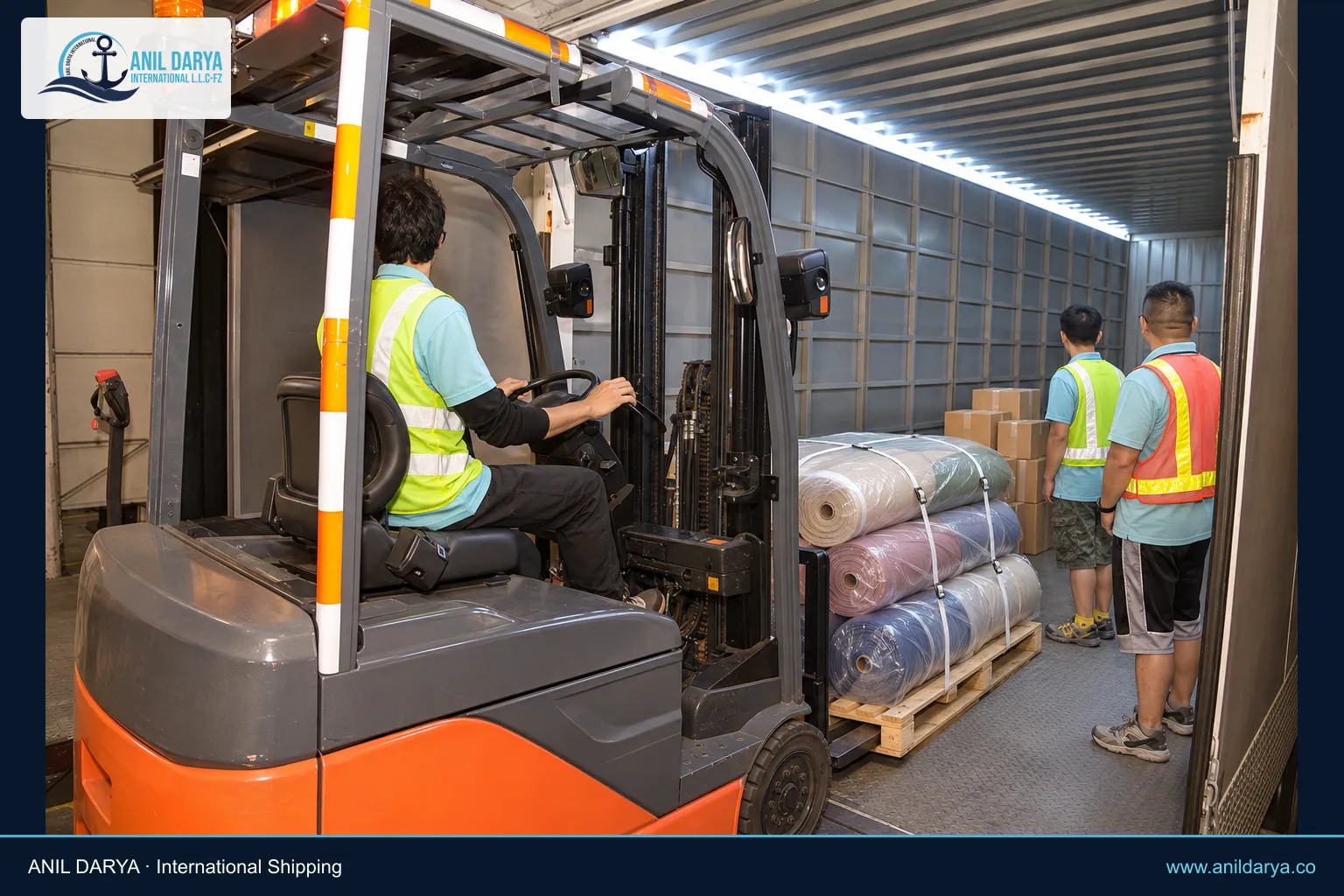
| LCL | Samples, first orders, mixed cartons from several suppliers | Unpacked at a container freight station; release waits on your own entry |
| Flat rack or open top | Textile machinery, generators, transformers slightly out of gauge | No out-of-gauge delivery to Dhaka on some lines |
| Reefer | Food ingredients, some pharmaceutical inputs | Maersk takes reefers at Chattogram CY only, not CFS or Dhaka |
Weight declarations need care. Maersk states that the gross weight and CBM on the B/L must match the packing list and the actual stuffing, and treats a mismatch as a breach of customs licensing rules. Ask the factory for weighed figures, not estimates. Our FCL vs LCL guide shows when a full box beats shared space, and our sea freight service covers booking and equipment.
Dangerous goods and project cargo to Chattogram
Bangladesh buys a lot of regulated cargo from China: dyes and textile chemicals, paints, adhesives, lithium batteries for solar systems and electronics. These move under the IMDG Code, and its 2024 edition (Amendment 42-24) became mandatory on 1 January 2026. China Customs inspects packaging for exported dangerous goods, so the supplier needs a packaging performance certificate and a use certificate for the filled packages before a Chinese terminal accepts the box.
The Bangladesh end is stricter than many lanes. Bangladesh Customs lists a dangerous goods certificate among its general import documents. Maersk's Bangladesh rules show what a carrier may add:
- no IMO Class 1 or Class 7 cargo for import as a general policy;
- DG only in 20ft, 40ft and 40ft high cube dry boxes, and no DG in reefers;
- IMO class, UN number and technical name printed on the B/L;
- the consignee's DG papers lodged at the line's Chittagong office 72 hours before the feeder arrives.
We confirm acceptance for your UN number before the factory packs. Maersk also gives only 2 days of import detention free time for DG boxes, against 4 for dry cargo, so the C&F agent must be ready. See our dangerous goods team for what we check.
Spinning frames, looms, boilers and power plant parts often exceed a standard box. A piece that fits a flat rack can stay on a container service. Bigger pieces need breakbulk tonnage, and at Chattogram the CPA lists mobile cranes up to 100 tonnes and six general cargo berths, with general cargo jetties 2 to 8 limited to ships drawing no more than 8.55 m. Send us drawings, weights and lifting points early. Our break bulk and project cargo service plans the sea leg.
The China export side: who files what
China Customs puts the export declaration on the consignor. The Shanghai municipal government's guide says the consignor, or a customs broker it appoints, declares the goods after they reach the customs supervision area and no later than 24 hours before loading. The consignor also needs foreign trade operator registration, which it can apply for through the China International Trade Single Window.
- We send the supplier or its origin forwarder the booking, cut-offs and vessel details.
- The value and description on the Chinese export declaration should match the invoice filed in Bangladesh.
- If your goods qualify for APTA preference, ask the supplier for the APTA certificate of origin at the time of export, not after the box has sailed.
Bangladesh importer setup: IRC, BIN and payment
Check three things with your buyer before any booking.
First, the Import Registration Certificate. The Chief Controller of Imports and Exports (CCI&E), under the Ministry of Commerce, issues it to commercial importers and private industrial users, generally within three working days. Firms inside Export Processing Zones register with BEPZA instead. Second, the VAT registration number (BIN). Carriers print it on the B/L, and Maersk rejects a BIN that is not 11 digits or that starts with a zero.
Third, the payment route. Bangladesh Bank told banks on 13 September 2026 that, under the Import Policy Order 2026-2029, industrial and commercial importers may bring in allowable goods on sales contracts without opening an LC, and it introduced open account payment. The order runs to 31 December 2029. Many China orders still move under LC, and then the bank is the B/L consignee and every document must match the credit.
What documents does Bangladesh Customs ask for?
The Bangladesh Customs Import Export Hub publishes the general document list. Not every line applies to every shipment. This is who usually provides each one on a China order.
| Document | Who provides it | What to check |
|---|---|---|
| IRC and BIN certificate | Importer in Bangladesh | Valid before the ship arrives |
| LC, or sales order and payment documents | Importer and its bank | Matches the chosen payment route |
| Proforma invoice and insurance cover note | Supplier and importer | Needed by the bank to open an LC |
| Commercial invoice, packing list, detailed packing list | Chinese supplier | HS codes, weights and carton counts match the B/L |
| Bill of lading | Shipping line, released through us | Bangladeshi consignee and notify party with valid BIN |
| Certificate of origin | Chinese supplier | APTA form if you claim the preference |
| Value declaration form | Importer | Supports the declared customs value |
| Regulator permit | Importer | Only for controlled goods |
| ISPM-15 certificate | Supplier | Wooden crates and pallets, common for machinery |
| Dangerous goods certificate | Supplier | For any DG cargo |

Bill of lading rules for Chattogram
A wrong B/L is the most common reason China cargo sits at Chattogram. Maersk's Bangladesh page sets out rules that we check on every draft, whichever line you sail with:
- The consignee is a Bangladeshi bank, a Bangladeshi importer with an 11-digit BIN, or a government-approved freight forwarder with a 9-digit AIN.
- A foreign consignee, "To order" or "To the order of shipper" is not accepted.
- The notify party is in Bangladesh, cannot be a bank as first notify, and cannot read "same as consignee".
- The description is accurate, with the HS code, and gives the technical name for chemicals and raw materials.
- The B/L carries the real seal number, and freight collect is not accepted for Bangladesh imports.
Customs clearance in ASYCUDA World
Bangladesh Customs, under the NBR, runs imports through ASYCUDA World. The system connects to banks for tax payments and letters of credit, and to the port's container terminal system for release. UNCTAD reports that in 2021, 82% of declarations were assessed within three days.
- The shipping line files the import manifest for the vessel.
- The importer's licensed C&F agent files the bill of entry with the documents.
- Customs checks value and HS code and may order a physical examination.
- The importer pays duty and taxes through a linked bank.
- Customs releases the goods and the port releases the box to the agent.
Some bulk-type commodities shipped in containers must be delivered through private off-dock depots under NBR and CPA circulars. Maersk lists 29, including raw cotton, wheat, lentils, waste paper, PVC resin, soda ash and staple fibre. Several of those come from China, so ask your agent which depot applies.
We do not sell customs clearance in Bangladesh. Before we confirm your booking, we agree with the importer's C&F agent which documents it needs and when, so the box never arrives without someone ready to file.
Import duty, VAT and the APTA preference
The import tax mix depends on the HS code; the Customs Hub shows the rates per code and has a duty calculator. Duty and taxes at destination are paid by the consignee or its broker.
| Tax | Basis | Rate |
|---|---|---|
| Customs duty (CD) | Main import duty | By HS code |
| Regulatory duty (RD) | Under the Customs Act, 2023 | By HS code |
| Supplementary duty (SD) | Goods in the VAT Act's Third Schedule | 10% to 67%, 500% in certain cases |
| VAT | Value added tax at import | 15% standard, reduced rates for some goods |
| Advance income tax (AIT) | Collected at import | Adjustable against corporate income tax |
| Advance tax (AT) | Under the VAT Act | Set by rule |
China cargo has one advantage many origins lack. Bangladesh Customs lists China among the countries covered by the Asia-Pacific Trade Agreement (APTA). Under SRO No. 267-Law/2018/40/Customs of 10 September 2018, listed HS codes get a margin of preference on customs duty of 10% to 70%, depending on the line. The preference cuts the customs duty only, not VAT or the other taxes, and the goods must meet the compliance terms in the SRO, including proof of origin. Have your agent check your HS code against the SRO table.
BSTI certificates and other product checks
Under Appendix-4 of the Import Policy Order 2021-24, importers needed BSTI certificates for 79 products, issued after the imported goods were tested and before customs set the final tax, according to a BSTI release reported by The Business Standard in January 2025. BSTI also said it would give conditional temporary certificates so industrial raw materials could leave the port while testing finished, provided they go to a named warehouse and are not used or sold before final certification. Check whether your product is on the current BSTI list before the factory ships.
- Food: Maersk asks for an analysis certificate, a radiation certificate, a veterinary certificate and a fumigation certificate for some food cargo, lodged 72 hours before arrival.
- Marking: the US government's Bangladesh guide states that the country of origin must be shown on products, packaging or containers, with a few exceptions such as industrial raw materials.
[AMIR-FACT: how our Bangladeshi consignees handle BSTI testing for China cargo (which products were held for testing, and the usual delay at Chattogram)]
Restricted and prohibited goods
The Bangladesh Customs Hub publishes the import prohibited list from the Import Policy Order. Several items on it come up on China orders:
| Goods | Rule |
|---|---|
| Old, used, reconditioned, factory-rejected, job-lot or stock-lot goods | Prohibited unless the order says otherwise |
| Reconditioned office equipment, old computers and accessories, old electronic goods | Prohibited |
| Polypropylene and polyethylene bags (HS 39.23 and 63.05) | Prohibited |
| Old or used motorcycles | Prohibited |
The list on the Hub is the Annexure of the 2021-24 order. The 2026-2029 order replaced it, so have your agent confirm the current list.
Typical cargo on this lane and the papers it needs
| Cargo | Usual equipment | Papers to plan |
|---|---|---|
| Fabric, yarn, trims for garment factories | 40ft high cube or LCL | Bonded warehouse licence if used, LC or contract, exact fibre content on the invoice |
| Textile machinery and spare parts | 40ft, flat rack or breakbulk | Drawings, ISPM-15 for crates, APTA check on the HS code |
| Dyes and textile chemicals | DG-approved dry box | SDS, DG certificate, Chinese packaging certificates, technical name on the B/L |
| Electronics, cables, small appliances | 40ft or LCL | BSTI list check, origin marking, new goods only |
| Solar panels and lithium batteries | 40ft high cube | Batteries as DG; BSTI check for solar equipment |
Routing via Dubai: when it helps
A direct China to Chattogram booking is simplest. Dubai helps only when your supply chain already runs through the UAE: a trader can keep China stock in Jafza next to Jebel Ali and ship to Bangladesh order by order, or combine China goods with cargo bought in the Gulf in one container for Chattogram. Dubai Chambers issues certificates of origin for re-exported goods, but APTA preference rests on Chinese origin proof, so check with the C&F agent before you route China goods through a third country.
See our Jebel Ali port guide and our article on re-exporting through Jafza. When cargo is landed, stored or re-exported in Dubai, we handle the UAE customs clearance for a fee.
[AMIR-FACT: whether we have routed China to Bangladesh cargo through Dubai (consolidation or Jafza stock), the carriers used from Jebel Ali to Chattogram and the real extra days compared with a direct China sailing]
Step by step: shipping from China to Bangladesh with Anil Darya
- Send us the product, HS code, weight, volume, the factory's city, the ready date and the delivery point in Bangladesh.
- Give us your C&F agent's details. We agree with the agent which documents it needs and who pays what at Chattogram before we confirm the booking.
- Confirm the importer's IRC, 11-digit BIN and payment route. For LC cargo, send us the LC terms.
- Check the HS code on the Customs Hub, the APTA table, the BSTI list and the prohibited list.
- We book the space with the line, direct or via a hub, and send the factory the booking and cut-offs.
- The factory or its origin agent stuffs the box, weighs it and files the Chinese export declaration.
- We check consignee, notify party, BIN, HS code, weights and seal on the draft B/L against the invoice and the LC.
- The line issues its B/L after loading and we release it to you or to the bank once freight is settled.
- Your C&F agent files in ASYCUDA World, the importer pays duty and taxes, and the box is delivered. We follow the shipment until it is released.
[AMIR-FACT: one real China to Bangladesh cross-trade shipment we handled (cargo, load port, carrier, direct or transhipped, what we coordinated and the outcome), cleared for publication]
What drives the cost of shipping from China to Bangladesh?
We do not publish prices, because rates move with every sailing. These are the parts of the total.
| Cost part | What moves it | Usually paid by |
|---|---|---|
| Origin charges in China | Trucking, export filing, terminal handling, LCL consolidation | Supplier under FOB |
| Ocean freight | Box type, season, direct loop or hub, carrier surcharges | Buyer under FOB, prepaid |
| DG and out-of-gauge | DG surcharges, flat rack premiums, lashing | Buyer under FOB |
| Chattogram charges | Port and terminal charges, off-dock depot fees, storage | Consignee |
| Duty and taxes | HS code, customs value, APTA preference, importer status | Consignee or its broker |
| Inland delivery | Truck, rail to Kamalapur or river to Pangaon | Consignee |
| Detention and demurrage | Late documents, BSTI testing, examinations | Whoever caused the delay, under your contract |
Free time is short. Maersk's Bangladesh tariff, effective 6 April 2026, gives 4 calendar days of import detention for dry and flat rack boxes and 2 for reefer and DG, and port storage is paid by the consignee directly to the port. Our article on demurrage and detention shows how the charges add up.
Checklist before the cargo leaves China
- C&F agent named and the clearance plan agreed before booking.
- Importer's IRC valid and BIN of 11 digits on the draft B/L.
- Payment route fixed; for LC cargo, shipment date and port match the credit.
- HS code agreed, duty and APTA preference checked.
- Product checked against the BSTI list and the prohibited list.
- ISPM-15 marks on wooden crates and pallets.
- For DG: carrier acceptance, SDS, Chinese packaging certificates and the DG certificate.
- Freight prepaid and cargo insurance arranged.
Mistakes that hold China cargo at Chattogram
- Shipping before destination clearance is agreed. With no C&F agent on the job, free days run out while the box waits.
- A B/L made out "To order" or to the Chinese seller's bank. Bangladesh needs a local consignee with a BIN or a local bank.
- Vague descriptions such as "chemicals" or "parts" with no HS code or technical name.
- Stock-lot or used goods bought cheap in China. Both are on the prohibited list.
- Forgetting the APTA certificate at export, so the buyer pays full customs duty.
Frequently asked questions
Which port in Bangladesh receives containers from China?
Chattogram (Chittagong), which handled 3,531,118 TEU in fiscal year 2025-26. Mongla took 29,714 TEU in the same year and suits some cargo for the southwest. Dhaka importers can use Kamalapur ICD or Pangaon when the carrier offers it.
How long does sea freight from China to Bangladesh take?
It depends on whether the ship sails direct or tranships. PIL quotes 9-14 days China to Bangladesh on its direct China Chittagong Express, while a hub connection at Singapore or Colombo can add one to two weeks. Ask for the carrier's schedule for your actual sailing.
Do goods from China get lower duty in Bangladesh?
Some do. Under APTA, Bangladesh gives a margin of preference of 10% to 70% on customs duty for HS codes listed in SRO 267 of 2018, if the goods meet its origin terms. VAT and the other import taxes still apply in full.
What documents does Bangladesh Customs need?
Typically the IRC and BIN, the LC or sales order, a commercial invoice, packing lists, the bill of lading, a certificate of origin and a value declaration form, plus permits, ISPM-15 or DG certificates where needed.
Does my Bangladeshi buyer still need an LC?
Not always. Under the Import Policy Order 2026-2029, Bangladesh Bank allows allowable goods on sales contracts without an LC and has introduced open account payment. Many buyers still use LCs, so fix the route before booking.
Does Anil Darya clear customs in Bangladesh?
No. The importer's licensed C&F agent files the bill of entry, and duty and taxes at destination are paid by the consignee or its broker. We agree the plan with that agent before we confirm the booking and send the documents in time.
Can I ship dangerous goods from China to Bangladesh?
Yes, within limits. The cargo needs IMDG papers, Chinese packaging certificates and a DG certificate, and carriers restrict some classes. Maersk, for example, does not take Class 1 or Class 7 for import.
Get a quote for shipping from China to Bangladesh
Send us the factory city, the goods with HS codes, the ready date, the payment route and your C&F agent in Bangladesh, and we will come back with a routing, a carrier and a price. Use our freight rate inquiry form, or contact our team to plan a DG or project shipment first. You can also read about our Dubai freight forwarding team.
Sources
- PIL: China Chittagong Express (CCE) rotation and transit time, August 2024
- The Financial Express: Dedicated China to Chattogram services, November 2025
- Chittagong Port Authority: Cargo, container and vessel statistics to 2025-26
- Chittagong Port Authority: Maximum draught and berth limits, January to June 2026
- Chittagong Port Authority: Jetties and moorings
- Chittagong Port Authority: Cargo handling equipment
- Maritime Gateway: Mongla Port results for fiscal year 2025-26
- Bangladesh Customs Import Export Hub: General import documents
- Bangladesh Customs Import Export Hub: Preferential agreements and SROs (APTA)
- Bangladesh Customs Import Export Hub: Import prohibited goods list
- Bangladesh Customs Import Export Hub: Tariff rates and duty calculator
- UNCTAD ASYCUDA: Bangladesh country profile
- US International Trade Administration: Bangladesh import requirements and documentation
- US International Trade Administration: Bangladesh prohibited and restricted imports
- UNB: Bangladesh Bank guidelines for the Import Policy Order 2026-29
- PwC Worldwide Tax Summaries: Bangladesh other taxes
- The Business Standard: BSTI conditional certificates and the 79 import products, January 2025
- Maersk: Bangladesh import information (B/L rules, DG, weights, delivery, free time)
- Shanghai Municipal Government: Customs registration and export declaration
- CIRS: China Customs inspection of DG packaging for export
- IMO: IMDG Code 2024 edition (Amendment 42-24)
- Dubai Chambers: Certificates of origin for re-exported goods
- Jafza: About the Jebel Ali Free Zone
Reviewed: 11 November 2026