
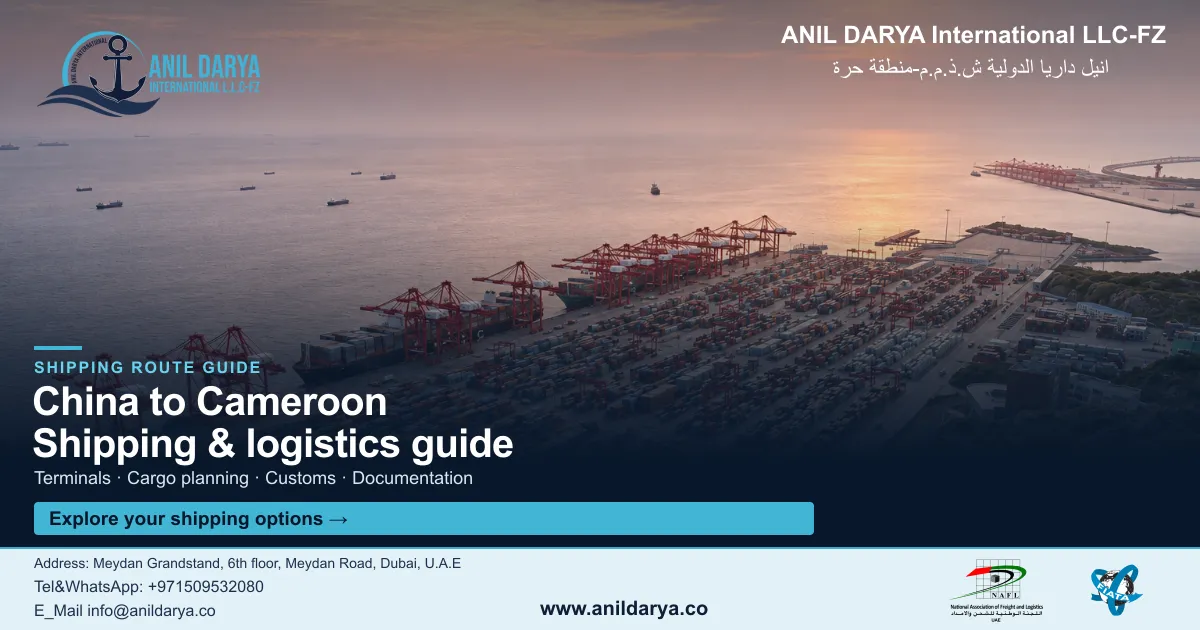
Shipping from China to Cameroon normally means a container loaded at Qingdao, Ningbo, Shanghai, Shekou or Nansha and discharged at Kribi, the deep-water port, or at Douala, the river port where most importers and clearing agents work. Before the ship arrives, the importer needs a BESC from Cameroon's shippers' council, and the clearing agent declares the goods in CAMCIS through the GUCE single window. We book the ocean freight from Dubai, release the carrier's bill of lading to you, and make sure the Chinese supplier and your broker in Cameroon work to the same dates.
Shipping from China to Cameroon at a glance
| Item | Detail |
|---|---|
| Usual load ports in China | Qingdao, Ningbo, Shanghai, Shenzhen (Shekou, Yantian), Guangzhou (Nansha), Xiamen, Tianjin |
| Cameroon sea ports | Kribi deep-water port (CMKBI) and Douala-Bonaberi (CMDLA) |
| Example carrier services | Maersk FEW1 and CMA CGM WAX1, both calling Chinese ports and then Kribi |
| China export filing | The consignor or its customs broker, at least 24 hours before loading |
| Cargo tracking note | BESC from the CNCC, submitted at least two days before the vessel arrives |
| Import declaration (DI) | On GUCE for goods of XAF 1,000,000 FOB or more |
| Valuation and classification report | RVC from SGS for goods of XAF 2,000,000 or more |
| Customs duty | Central African common external tariff; trade.gov lists 0%, 5%, 10%, 20% and 30% |
| VAT and levies | 19.25% VAT, plus 0.2% African Integration Contribution on non-AU goods such as Chinese goods |
| Who clears in Cameroon | The consignee's own clearing agent, agreed before the cargo ships |
How we run a China to Cameroon booking from Dubai
The cargo goes straight from China to Cameroon and never lands in the UAE unless you choose that. We book and coordinate from Dubai; three parties share the work.
- The factory in China, or its local forwarder, packs the goods, trucks them to the port or stuffs the box at the plant, and files China's export declaration.
- We secure space with the shipping line, send the supplier the booking and cut-offs, check the draft bill of lading against the invoice, and keep an eye on the vessel until it reaches Kribi or Douala.
- Your clearing agent in Cameroon files the declaration in CAMCIS, settles duty and taxes from the consignee's funds and takes delivery from the terminal.
The bill of lading you receive is the shipping line's own. We act as agent for many lines, so the carrier issues its B/L and it is released to you through us. Your agent in Douala presents a line document the carrier's local office and the terminal already recognise.
Fix the Incoterm first. FOB China is the usual choice for Cameroonian buyers: the factory handles export formalities and delivers to the ship, and you control the sea freight and the arrival. EXW leaves nobody in China to act as exporter of record. Our guide to Incoterms 2020 for sea freight shows where cost and risk pass under each term.
Which Chinese ports to load at for Cameroon
Pick the port closest to the factory, then confirm the sailing calls there. Loops collect boxes at several Chinese ports, so the first and last calls matter for cut-offs.
| Supplier region | Usual load port | Note for Cameroon cargo |
|---|---|---|
| Shandong, Hebei and the north | Qingdao, Tianjin | Qingdao is the first call on the Kribi loops below; Tianjin cargo may feed to Qingdao first |
| Zhejiang, Jiangsu, Shanghai and Yiwu | Ningbo, Shanghai | Wide LCL choice for mixed small orders from several factories |
| Guangdong (Shenzhen, Dongguan, Foshan, Guangzhou) | Shekou, Yantian, Nansha | Nansha and Shekou are late China calls, which helps a factory that runs late |
| Fujian | Xiamen | Fewer direct Africa calls; ask where the box changes ship |
Kribi or Douala: where Chinese cargo lands
| Point | Kribi | Douala-Bonaberi |
|---|---|---|
| Authority | Port Autonome de Kribi (PAK) | Port Autonome de Douala (PAD) |
| Water | 16 m at the Phase II container quay | Channel kept at -7 m, drafts of about 9 m on a favourable tide |
| Container quay | 715 m Phase II quay, in service since 9 May 2025 | 3 berths, 660 m, run by PAD through RTC SA |
| Recent volume | About 16 million tonnes in 2025, 559 ship calls, 110,593 full import TEU, 348,289 TEU transhipped | 12.9 million tonnes in 2024, 179,906 full import TEU |
| Fits best | Consignees in the south and around Yaounde, or cargo the big Asia loops discharge there | Consignees in Douala, the west and the north, and transit to Chad and the Central African Republic |
The draught gap is why the large Asia ships call Kribi rather than Douala. According to the US Commercial Service, an agreement signed in July 2023 lets bigger vessels discharge at Kribi with cargo then taken to Douala by feeder ship. So a box from Ningbo with Douala as final destination may sit at Kribi for a few days before its feeder. Ask whether the quote is port-to-port Kribi or through to Douala, and who pays the feeder leg.
Sea freight from China to Cameroon: services and transit
Since spring 2026, weekly Asia to West Africa sailings have called Kribi straight from China. Maersk announced in February 2026 that its new FEW1 service would rotate Qingdao, Ningbo, Nansha New Port, Shekou, Singapore, Abidjan, Lekki, Kribi and Vung Tau, with the first ship expected to leave Qingdao on 31 March 2026. CMA CGM markets the service as WAX1, on the same Chinese ports and Kribi. Its May 2026 release lists Qingdao, Ningbo, Nansha, Shekou, Singapore, Colombo, Abidjan, Lekki and Kribi, and says the Kribi call is a second weekly call there, next to its ASAF service.
| Routing | How the box moves | When it fits |
|---|---|---|
| Same ship to Kribi | Loaded in China, calls Southeast Asia and West Africa, discharged at Kribi | Most FCL for southern Cameroon and Yaounde |
| Kribi then feeder to Douala | Mainline ship to Kribi, feeder ship up the coast to Douala | Consignees in Douala, or transit to Chad and CAR |
| Transhipment at a hub | Changes ship once at a regional hub, then on to Douala or Kribi | Load ports without a direct call, or when the loop is full |
| Via Jebel Ali, Dubai | China to Jebel Ali, then a separate booking to Cameroon | When China goods join stock or cargo already in Dubai |
Neither carrier notice we opened publishes a day count from China to Kribi, and forwarder pages on this lane quote ranges that differ by two weeks or more. For a real date, ask for the carrier's schedule on the exact sailing.
[AMIR-FACT: the carriers and services we actually book from China to Kribi and Douala, whether each is direct or transhipped (and where), and our real port-to-port days from Qingdao/Ningbo/Shanghai and from Shekou/Nansha]
FCL, LCL and special equipment for Cameroon
| Option | Typical China to Cameroon cargo | What to watch |
|---|---|---|
| 20ft dry | Tiles, steel fittings, cement additives, cable drums | Weight limit for the box and for the road from Kribi or Douala |
| 40ft dry or high cube | Motorbikes in kits, furniture, solar panels, household goods | Free time at the terminal; file the declaration before arrival |
| LCL | First orders, phones and accessories, samples, mixed lots | Each consignee in the box needs its own house bill and its own BESC |
| Reefer | Some foods, medicines, temperature-sensitive chemicals | Frozen poultry is banned; permits ready before sailing |
| Flat rack or open top | Generators, tractors, machines a little too big for a dry box | Carrier acceptance at each transhipment port |
The LCL rule matters on this lane because much China cargo for Cameroon is consolidated. The CNCC ended the group BESC from 1 December 2024: every party in a consolidated box gets its own sub-bill of lading and its own BESC. If you buy from several factories in one province, it often costs less to have them deliver to one warehouse near the load port and ship one FCL with one BESC and one declaration. Our FCL vs LCL guide shows where that switch usually pays, and our sea freight service covers equipment and booking.
Dangerous goods, breakbulk and project cargo
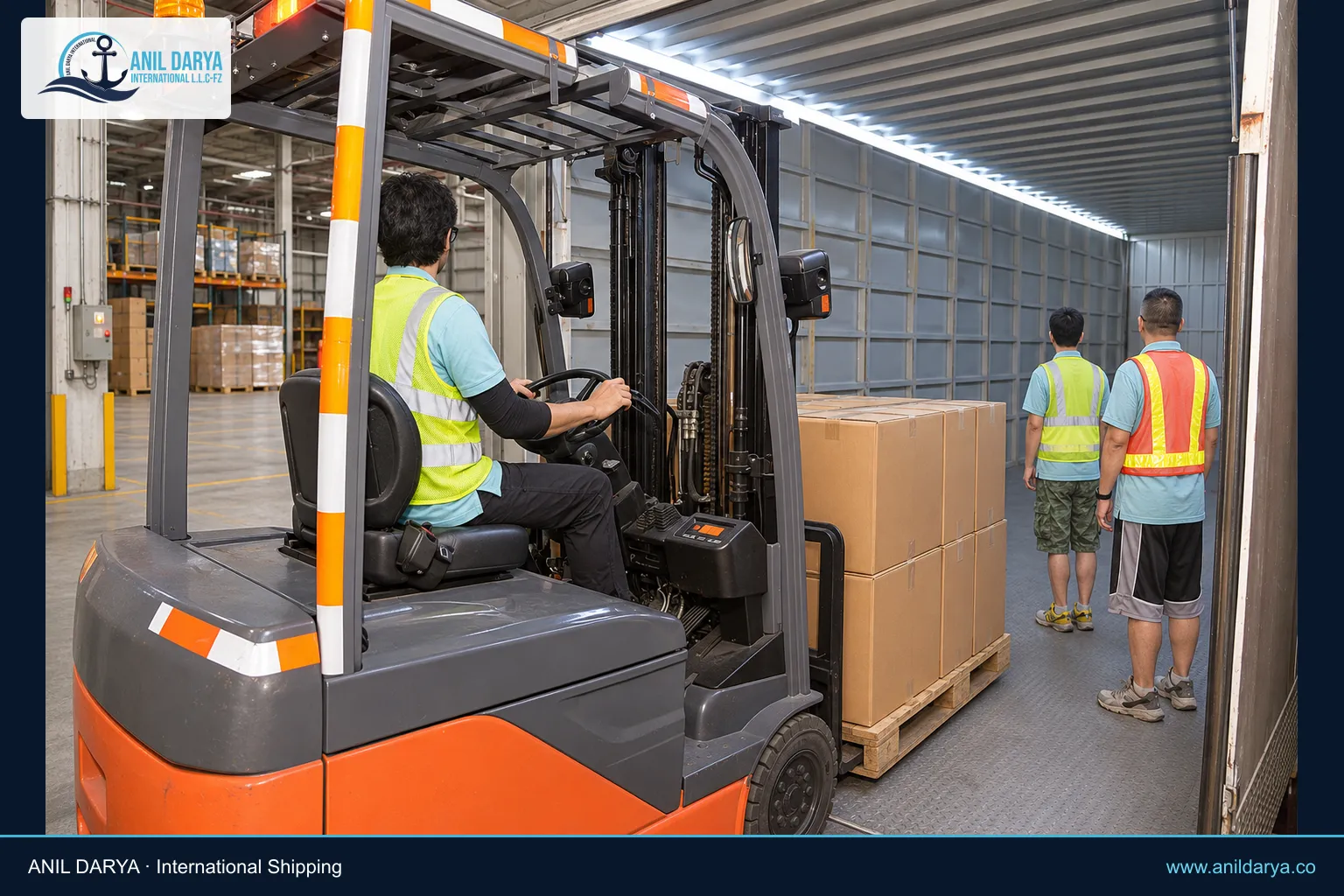
A lot of what Cameroon buys from China is regulated for sea transport: lithium batteries in solar kits and phones, paints, adhesives, cleaning chemicals, aerosols and gas accessories. These ship under the IMDG Code, and the 2024 edition (Amendment 42-24) has been mandatory since 1 January 2026, so the supplier's safety data sheet and DG declaration must follow it.
China Customs inspects the packaging of exported dangerous goods. The factory needs a packaging performance certificate for the package type and a use certificate for the filled packages, and carriers in China will not confirm a DG booking without them. Ask for both before you pay the deposit. At the other end, Douala keeps a dedicated dangerous goods park inside the port, but the line still has to accept your UN number and class on every leg, including any feeder from Kribi. Our dangerous goods team checks class, packing group and acceptance before you commit.
Crushers, gensets, steel structures and plant for mines, factories or road works often do not fit a standard box. Anything that fits a flat rack can still ride a container ship; anything bigger needs a breakbulk or heavy-lift sailing, and that ship's date sets the plan. At Douala, conventional cargo uses general cargo berths 3 to 11, and the container terminal has two mobile harbour cranes rated at 121 tonnes. Send drawings, weights and lifting points for each piece. See our break bulk and project cargo service.
The China export side: who files what
Chinese customs law places the export declaration on the consignor. The Shanghai municipal government's guide says the consignor, or a customs broker it appoints, declares the goods once they are in the customs supervision area and at least 24 hours before loading. The consignor also registers as a foreign trade operator, which it can do through the China International Trade Single Window.
- The supplier or its origin agent arranges pickup, stuffing and the export filing. We send them the booking number, terminal and cut-offs.
- Descriptions, quantities and values on the Chinese declaration should match the invoice your Cameroonian agent files. SGS and Cameroon Customs both compare them.
- Ask the factory early for a certificate of origin. Brokers in Cameroon usually want one, and origin decides whether the goods get any preference.
The BESC: Cameroon's cargo tracking note
The BESC (Bordereau Electronique de Suivi des Cargaisons) is Cameroon's electronic cargo tracking note, often called the ECTN. The Conseil National des Chargeurs du Cameroun (CNCC) issues it, and trade.gov says all cargo entering or leaving Cameroonian ports needs a validated one, apart from transhipment and in-transit cargo.
- Timing: the CNCC validates a BESC submitted at least two days before the vessel arrives, within 24 hours at most. A late one stays pending and is validated only after the penalty is paid.
- Penalty: trade.gov describes a late fee of up to 50% of the BESC cost when it is obtained within five days of vessel departure. Do not plan around a figure; apply early.
- Who applies: the importer opens an account on besc.cncc.cm, or uses one of the intermediaries the CNCC approves and lists on that site.
- Transit cargo: the CNCC announced on 15 June 2026 that the BESC is no longer required for goods in transit to neighbouring countries.
Start the BESC in the week the ship sails from China. We send the carrier B/L data, vessel and voyage to whoever applies, so the BESC matches the line's manifest exactly.
[AMIR-FACT: whether our Cameroonian consignees usually apply for the BESC themselves or through a CNCC-approved intermediary, and how many days before arrival it is typically validated on our bookings]
Cameroon import customs: GUCE, CAMCIS and SGS
Cameroon Customs (Direction Generale des Douanes) clears goods in CAMCIS, its customs information system. GUCE, the single window for foreign trade operations, links customs, banks, the Treasury, SGS, the port authorities and regulators. The US Commercial Service says GUCE aims at import clearance in seven days. We do not sell customs clearance in Cameroon. Before we confirm the booking, we agree with your clearing agent which documents they need and who pays what at the port, so the box never arrives without someone ready to clear it.
| Step or document | Who handles it | Trigger or check |
|---|---|---|
| Import declaration (DI) on GUCE | Importer or its agent | FOB value of XAF 1,000,000 or more |
| Valuation and classification report (RVC) | SGS | Goods of XAF 2,000,000 or more |
| BESC | Importer or CNCC-approved intermediary | At least two days before arrival |
| Commercial invoice and packing list | Chinese supplier | HS code and full description per line |
| Carrier bill of lading | Shipping line, released through us | Consignee matches the importer on GUCE |
| Certificate of origin | Chinese supplier | Requested by most brokers |
| Permits or technical approvals | Importer | Medicines, food, chemicals and other regulated goods |
| Customs declaration in CAMCIS | Licensed clearing agent | Quotes the DI number; duty and taxes paid through the banking link |
Trade.gov also states that Cameroon applies pre-shipment inspection carried out in the exporting country. For this lane that means SGS may need to see the goods in China, so the factory should have cartons packed and reachable a week before stuffing. The RVC then sits in the clearance file, which is one more reason to keep every document consistent.

Phones and tablets from China: the CAMCIS rule since April 2026
Handsets, tablets and accessories are among the most common goods on this lane, and the rules changed in 2026. The Minister of Finance announced that from 1 April 2026, customs clearance of mobile phones, tablets and other digital terminals is done only through an electronic mechanism: importers or their agents declare and settle duties and taxes in CAMCIS, and payment is electronic in local currency. Blocking of undeclared phones on Cameroonian networks took effect on 1 September 2026, according to Cameroon Tribune.
- Prepare the IMEI list for every device before the box leaves China. The status of each phone can be checked on mpie.camcis.cm.
- Customs taxes phones on reference values by device category, with a single 33.33% rate for duties and taxes, according to Cameroon Customs.
- Lithium batteries inside devices still need correct DG declaration where the quantity or packing requires it.
Duty, VAT and levies on goods from China
Cameroon does not set its own duty rates. It applies the common external tariff of the Central African customs area, and duty and taxes at destination are paid by the consignee or its broker. Goods made in China pay the standard rate; the EU and UK partnership reductions do not apply to them.
| Charge | Rate or basis | Source |
|---|---|---|
| Category I duty | 0%, certain cultural and aviation goods | trade.gov |
| Category II duty | 5%, essential goods such as medicines and books | trade.gov |
| Category III duty | 10%, raw materials and equipment | trade.gov |
| Category IV duty | 20%, intermediate and miscellaneous goods | trade.gov |
| Category V duty | 30%, fast-moving consumer goods | trade.gov |
| VAT | 19.25% (17.5% plus 10% municipal additional centimes) | Cameroon tax office |
| African Integration Contribution | 0.2% on imports from non-African Union countries | trade.gov |
| Excise | Listed goods such as drinks, tobacco, cosmetics and vehicles | Cameroon tax office |
One caution for 2026. A harmonised CEEAC-CEMAC customs code and common external tariff were due to apply from 1 January 2026, and Cameroon's 2026 finance law refers to them. Press reports of the new schedule mention rates of up to 40% for some goods, such as ready-to-wear clothing, and roll-out is still going on. Before you agree a price with the factory, have your agent check the current rate for the HS code in the customs simulator or in CAMCIS.
Restricted and controlled goods in Cameroon
| Goods | Rule |
|---|---|
| Frozen products, notably poultry | Import strictly banned, according to Cameroon Customs |
| Phones, tablets, digital terminals | Declared in CAMCIS with IMEI; undeclared devices are blocked |
| Medicines and other regulated goods | Specific permits or technical authorisations before clearance |
| Vehicles and motorbikes | Excise on top of duty and VAT; check the current rules with the agent |
| Dangerous goods | IMDG papers and carrier acceptance on every leg |
| Counterfeit branded goods | Seized; do not ship copies |
Transit through Cameroon to Chad and the Central African Republic
Douala is the main sea gateway for Chad and the Central African Republic: the port authority says two thirds of the hinterland countries' trade passes through it. A rail link runs from the port to the Transcameroon line towards Ngaoundere, with roads on to N'Djamena and Bangui.
- Transit goods are held in bonded warehouses, and Customs takes a guarantee equal to the import taxes, released once re-export is confirmed.
- Customs and SGS track transit trucks with a GPS system.
- No BESC is required for transit cargo since the CNCC notice of 15 June 2026.
If your buyer is in N'Djamena or Bangui, write in the contract who pays the leg from Douala or Kribi, and tell us at booking so the B/L shows the right place of delivery.
Routing via Dubai: consolidation, free zone stock and transhipment
A direct booking to Kribi or Douala is simplest. Dubai helps when your supply chain already runs through the UAE, for example China goods plus Gulf goods in one box for Douala.
| Option | How it works | What to watch |
|---|---|---|
| Consolidation in Dubai | China goods and other origins combined in one container for Cameroon | Separate BESC per consignee; origin papers per item |
| Free zone stock and re-export | You hold stock in Jafza and ship to Cameroon as orders arrive | Dubai Chambers issues certificates of origin for re-exported goods |
| Transhipment at Jebel Ali | The box arrives from China and connects to an Africa sailing | Dubai Customs treats transit as its own regime, separate from import |
Jafza is next to Jebel Ali port, so stock can be held, split and reloaded without long trucking. See our Jebel Ali port guide and our article on re-exporting through Jafza. When cargo is landed, consolidated or re-exported in Dubai, we clear it through UAE customs for a fee.
[AMIR-FACT: whether we route China to Cameroon cargo via Jebel Ali in practice (transhipment or Dubai consolidation), the carriers used from Jebel Ali to Douala or Kribi and the real extra days compared with a direct sailing]
Step by step: shipping from China to Cameroon with Anil Darya
- Send us the goods, HS code if known, weight, volume, factory city, ready date and the delivery point in Cameroon, Chad or CAR.
- Name your clearing agent in Cameroon. We agree the clearance plan with them, including documents and who pays port charges, before we confirm the booking.
- Agree the Incoterm with the factory. FOB China is the common choice.
- The importer files the DI on GUCE where the value requires it, and arranges the SGS inspection in China when it applies.
- We book space with the line, choose Kribi or Douala as discharge port, and send the supplier the booking and cut-offs.
- The supplier or its origin agent stuffs the container and files the Chinese export declaration.
- We check the draft B/L against the invoice and packing list; the line issues it after loading.
- We send the B/L data to the BESC applicant, who has it validated at least two days before arrival.
- The carrier B/L is released to you through us, your agent declares in CAMCIS, duty and taxes are paid, and the cargo leaves the terminal.
[AMIR-FACT: one real China to Cameroon cross-trade shipment we handled (cargo, load port, Kribi or Douala, carrier, what we coordinated and the outcome), cleared for publication]
What decides the cost of shipping from China to Cameroon?
We do not publish prices, because rates move with every sailing. These are the blocks your total is built from.
| Cost block | What moves it | Usually paid by |
|---|---|---|
| Origin charges in China | Trucking, export filing, terminal handling, LCL consolidation | Supplier under FOB |
| SGS inspection | Value of the goods and inspection scope | Importer, as set by the programme |
| Ocean freight | Box type, season, carrier, direct or transhipped, surcharges | Buyer under FOB |
| Feeder Kribi to Douala | Whether the line quotes through to Douala | Depends on the quote |
| BESC | CNCC fee, plus a penalty if late | Importer |
| Port and terminal charges in Cameroon | Handling, storage after free time, LCL unpacking | Consignee |
| Duty, VAT and levies | HS code, customs value, excise lists | Consignee or its broker |
| Inland delivery | Truck or rail to Yaounde, the north, Chad or CAR | As agreed in the contract |
A late BESC or a missing permit keeps the box in the terminal while storage and container charges grow. Our article on demurrage and detention shows how those charges build up.
Checklist before the container leaves China
- Incoterm written into the contract and cargo insurance arranged.
- Clearing agent in Cameroon named and the plan agreed before booking.
- Discharge port fixed: Kribi, Douala, or Kribi with a feeder to Douala.
- DI filed on GUCE and SGS inspection booked where the value requires it.
- BESC applicant known and ready to submit once the ship sails.
- HS code and duty category checked against the 2026 tariff.
- IMEI list ready for phones and tablets.
- Chinese export declaration filed with values matching the invoice.
- For DG: UN number, SDS, Chinese packaging certificates and carrier approval on every leg.
Mistakes that hold China cargo in Cameroon
- Shipping before destination clearance is agreed. With no agent ready in Douala or Kribi, the box waits and storage runs.
- A late BESC. The note stays pending until the penalty is paid.
- One BESC for a whole LCL box. Each consignee needs its own since December 2024.
- Assuming Douala when the ship ends at Kribi, and finding a feeder cost nobody priced.
- Phones shipped without an IMEI list, which slows the CAMCIS declaration.
- Pricing with an old duty band instead of checking the 2026 tariff for the exact HS code.
- Frozen poultry in a reefer order. It is banned, and the box will not be released.
Frequently asked questions
Which port in Cameroon receives ships from China?
The large Asia to West Africa loops call Kribi, the deep-water port with 16 m at its container quay. Douala is the main commercial port but has a shallower channel, so much China cargo for Douala reaches it by feeder from Kribi or through a hub.
How long does shipping from China to Cameroon take by sea?
It depends on the load port, the service and any transhipment or feeder. Ask for the carrier's schedule on the actual sailing, then add time for the BESC, clearance and inland delivery.
What is the BESC and when do I need it?
The BESC is Cameroon's electronic cargo tracking note, issued by the CNCC. The CNCC validates it if it is submitted at least two days before the vessel arrives; a late one is validated only after a penalty.
Do goods from China need inspection before shipment?
Trade.gov says Cameroon applies pre-shipment inspection in the exporting country, and SGS issues a valuation and classification report for goods of XAF 2,000,000 or more. Have the goods packed and accessible in China before stuffing.
What duty and VAT apply to Chinese goods in Cameroon?
Duty follows the Central African common external tariff, listed by trade.gov at 0%, 5%, 10%, 20% or 30% by category. VAT is 19.25%, and a 0.2% African Integration Contribution applies to non-AU goods. Check the 2026 CEEAC tariff for your HS code.
How are phones from China cleared in Cameroon?
Since 1 April 2026, phones, tablets and other digital terminals are declared and taxed in CAMCIS, and undeclared devices have been blocked on local networks since 1 September 2026. Ship with a full IMEI list.
Does Anil Darya clear customs in Cameroon?
No. The consignee's clearing agent clears the goods, and duty and taxes at destination are paid by the consignee or its broker. We agree the plan with that agent before we confirm the booking and then coordinate papers and arrival.
Can cargo from China to Cameroon go via Dubai?
Yes, where it helps: consolidation with other origins, stock held in Jafza, or transhipment at Jebel Ali. We clear the cargo through UAE customs for a fee when it is landed in Dubai.
Get a quote for shipping from China to Cameroon
Send us the factory city, the goods, the ready date and your clearing agent in Cameroon, and we will come back with a routing, a carrier and a price. Use our freight rate inquiry form, or contact our team to plan a DG, breakbulk or transit shipment first. You can also read about our Dubai freight forwarding team.
Sources
- Maersk: Asia West Africa network update, FEW1 and FEW3 rotations (February 2026)
- CMA CGM release in Fraternite Matin: WAX1 rotation and second weekly Kribi call (May 2026)
- Port Autonome de Kribi: key figures 2025
- Port Autonome de Kribi: Phase II in operation
- Port Autonome de Douala: infrastructure overview, DG park and rail
- Port Autonome de Douala: terminals and cranes
- Port Autonome de Douala: channel depth
- Port Autonome de Douala: statistics 2024
- Port Autonome de Douala: hinterland and transit
- CNCC: BESC import rules and approved intermediaries
- CNCC: end of the group BESC from 1 December 2024
- Cameroon Tribune: BESC no longer required for transit goods (June 2026)
- Cameroon Tribune: blocking of undeclared phones from 1 September 2026
- allAfrica: phone clearance through CAMCIS from 1 April 2026
- Cameroon Customs: phone categories and duties
- Cameroon Customs: ban on frozen poultry imports
- trade.gov: Cameroon customs regulations (DI, RVC, PSI, BESC, AIC, GUCE, transit)
- trade.gov: Cameroon import tariffs (CET categories, EPA)
- trade.gov: Cameroon distribution and the Kribi feeder agreement
- Direction Generale des Impots: VAT and excise leaflet
- Deloitte: Cameroon finance law 2026 and the CEEAC-CEMAC code
- LogistAfrica: CEEAC common external tariff in Cameroon
- Shanghai Municipal Government: customs registration and export declaration
- CIRS: China Customs inspection of DG packaging for export
- IMO: IMDG Code 2024 edition (Amendment 42-24)
- Dubai Customs: customs declaration regimes
- Dubai Chambers: certificates of origin for re-exported goods
- Jafza: about the Jebel Ali Free Zone
Reviewed: 11 November 2026