
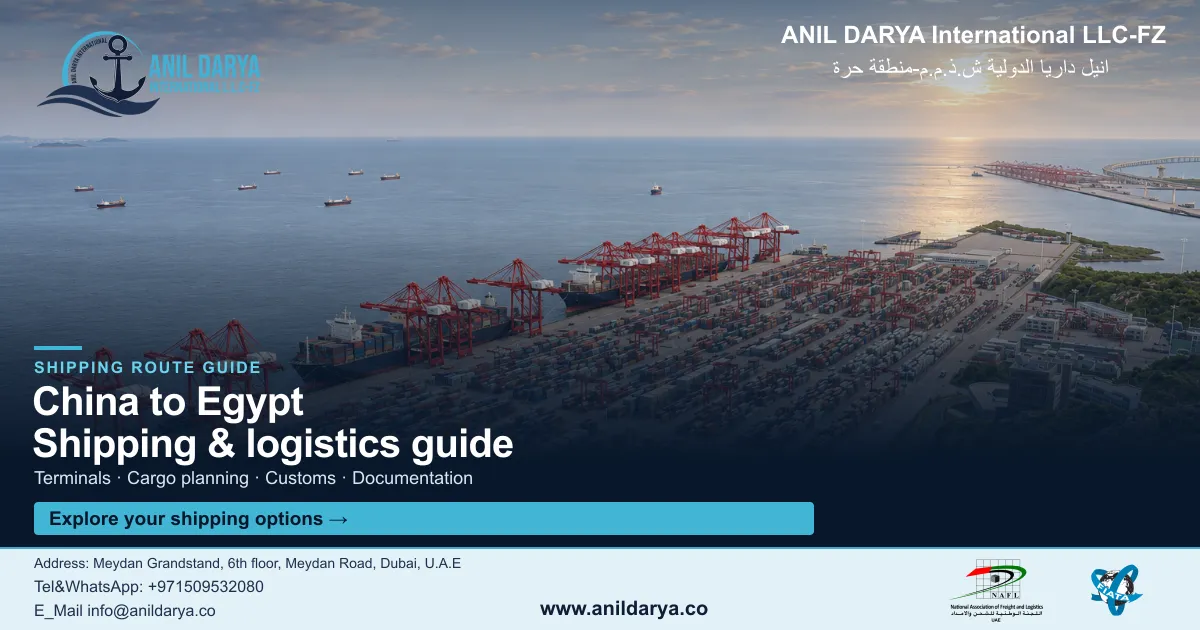
Shipping from China to Egypt is mostly a container move from a port such as Shanghai, Ningbo, Shenzhen or Qingdao to Sokhna, Port Said, Damietta or Alexandria. Before the box is loaded, the Egyptian importer must hold a 19-digit ACID for the shipment on Nafeza, and the Chinese exporter must send the documents under that number. We book the ocean freight from Dubai, release the carrier's bill of lading to you, and line up the shipper in China and the consignee's broker in Egypt before we confirm the booking.
China to Egypt shipping at a glance
| Item | Detail |
|---|---|
| Type of lane | Cross-trade: China to Egypt by sea, booked and coordinated by Anil Darya from Dubai |
| Main Chinese load ports | Shanghai, Ningbo, Shenzhen (Yantian and Shekou), Guangzhou (Nansha), Qingdao, Tianjin, Xiamen |
| Main Egyptian discharge ports | Sokhna on the Gulf of Suez; Port Said, Damietta and Alexandria (with Dekheila) on the Mediterranean |
| Modes | FCL, LCL, reefer, flat rack and breakbulk, dangerous goods |
| China export filing | Consignor or its customs broker files with China Customs, no later than 24 hours before loading |
| Egypt pre-shipment rule | Advance Cargo Information (ACI): importer declares the shipment at least 48 hours before it ships from China |
| Shipment number | ACID, 19 digits, issued through Nafeza within 48 hours of the importer's request |
| Exporter document channel | CargoX, linked to Nafeza |
| Egypt customs duty | By HS code; mostly 0% to 60% of CIF value, paid in Egyptian pounds |
| Egypt import VAT | 14% on CIF plus duty and other taxes; 5% on machinery for production lines |
| Brand and factory registration | GOEIC registration for listed consumer goods (Decree 43 of 2016) |
| Bill of lading | The shipping line's own B/L, issued and released to you through us as the line's agent |
| Destination clearance | Done by the consignee's licensed Egyptian customs broker, agreed before the cargo ships |
How shipping from China to Egypt works as a cross-trade
On this lane the cargo never touches the UAE unless you choose a Dubai routing. The goods leave a Chinese port and discharge in Egypt. Our part is the ocean booking and the coordination between three parties who often have never spoken to each other: the Chinese supplier, the shipping line and the Egyptian buyer's customs broker.
| Party | What they do on a China to Egypt shipment |
|---|---|
| Chinese supplier (or its origin agent) | Packs the goods, arranges pickup and stuffing, files the China export declaration, sends ACI documents through CargoX |
| Anil Darya, Dubai | Books space with the shipping line, checks the ACID and documents before loading, follows the vessel, releases the carrier's bill of lading |
| Shipping line | Verifies the ACID before loading, carries the cargo, files the manifest to Egyptian Customs |
| Egyptian importer | Requests the ACID on Nafeza, confirms the exporter's documents, pays duty and VAT |
| Importer's customs broker in Egypt | Clears the goods at the discharge port and arranges inspection and release |
The bill of lading is the shipping line's own document. Because we act as agent for many lines, the carrier's B/L is issued and released to you through us. We do not issue a house bill on this lane.
Customs clearance in Egypt is not a service we sell. Before we confirm a booking we ask who the consignee's broker is and whether the ACID, the importer registration and any GOEIC approval are in place. If those answers are missing, we hold the booking. Duty and taxes at destination are paid by the consignee or its broker.
Which Chinese ports and Egyptian ports should you use?
Pick the load port nearest the factory and the discharge port nearest the buyer's warehouse. Trucking goods across China, or across Egypt from the wrong coast, can cost more than the difference in ocean freight.
Load ports in China
| Supplier region | Usual load port | Common goods from the region |
|---|---|---|
| Zhejiang, Jiangsu, Shanghai | Ningbo, Shanghai | Household appliances, textiles, hardware, small machinery |
| Guangdong | Shenzhen (Yantian, Shekou), Guangzhou (Nansha) | Electronics, lighting, furniture, building materials |
| Shandong, Hebei, Tianjin | Qingdao, Tianjin | Tyres, steel products, heavy machinery, chemicals |
| Fujian | Xiamen | Footwear, ceramics, stone |
Discharge ports in Egypt
| Port | Main container terminal | Notes | Usually suits |
|---|---|---|---|
| Sokhna (Gulf of Suez) | DP World Sokhna | Berth 1 of 750 m and Berth 2 of 1,350 m, 17 m alongside, 904 reefer points in total | Cairo, the Suez Canal Economic Zone and Upper Egypt |
| East Port Said | Suez Canal Container Terminal (SCCT) | 3,355 m quay, 17 m draft, 7 million TEU capacity, 6,400 reefer plugs | The canal zone, the East Port Said industrial area, large mainline ships |
| Damietta | DCHC and Damietta Alliance Container Terminals | Mediterranean port east of the Nile Delta | The eastern Delta and Mansoura area |
| Alexandria and Dekheila | Container terminals in both harbours | Two harbours under the Alexandria Port Authority, handling containers, general cargo and bulk | Alexandria, the western Delta and much of Cairo's trade |
A practical rule for Cairo buyers: compare a Sokhna arrival with an Alexandria arrival on the full door cost, not on the ocean rate. Sokhna is the closer port for eastern Cairo and the canal zone. Alexandria has more carrier options for some cargo and suits factories in the western Delta. Ask the consignee's broker which port it works at, because a broker without staff at the discharge port adds time.
Direct sailings or transhipment: how the lane is served
Many sailings from China to Egypt are part of the large Asia to Mediterranean loops, so Egypt is often one call among many. Some loops call an Egyptian port directly from China. Others discharge in Asia or elsewhere and relay the box onto a second ship.
Carrier networks change often. As one example, Maersk announced in February 2026 that its AE15 loop would run Qingdao, Gwangyang, Ningbo, Tanjung Pelepas, Port Said, Damietta, Colombo and Singapore, adding Damietta to the rotation. A loop like this gives Qingdao and Ningbo shippers a call at two Egyptian ports, with one Malaysian call in between. Rotations of this kind are revised every season, so check the live schedule on every quote.
| Option | What it means | When it suits |
|---|---|---|
| Direct call | The ship loads in China and discharges in Egypt without changing vessel | Time-sensitive FCL, reefer, DG where fewer handlings help |
| Transhipment in Asia | Feeder or mainline to a hub, then a second vessel to Egypt | Smaller Chinese ports, or when the direct loop is full |
| Transhipment at Port Said or Damietta | Box lands at an Egyptian hub and moves on by feeder to another Egyptian port | Cargo for Alexandria or Sokhna on a loop that only calls the canal hubs |
| Routing via Jebel Ali | Cargo routed through Dubai for consolidation or re-export (see below) | Buyers mixing Chinese and Gulf suppliers, or holding stock in Dubai |
Port-to-port times for this lane from carrier schedule pages vary with the loop and the calls in between, and we could not open a carrier page that publishes a fixed figure for a named port pair. Forwarder blogs quote ranges that differ by weeks, so we quote the actual vessel and transit for your booking.
[AMIR-FACT: the carriers we actually book from Chinese ports to Sokhna, Port Said, Damietta and Alexandria, with real port-to-port transit days and sailing frequency]
Sea freight from China to Egypt: FCL, LCL, reefer and special cargo
| Option | Best for | Egypt-specific point |
|---|---|---|
| FCL 20ft | Dense cargo: tiles, steel, tyres, machinery parts | One ACID per shipment; invoice and packing list must match the Nafeza data exactly |
| FCL 40ft / 40ft high cube | Furniture, appliances, light bulky goods | Check the free time at the Egyptian terminal before booking delivery |
| LCL | A few cubic metres, first orders, samples | Every consignee in the box needs its own ACID; one late file can hold the whole unpacking |
| Reefer | Frozen and chilled food, some pharma | Health or veterinary certificates needed; Sokhna and SCCT both publish reefer plug counts |
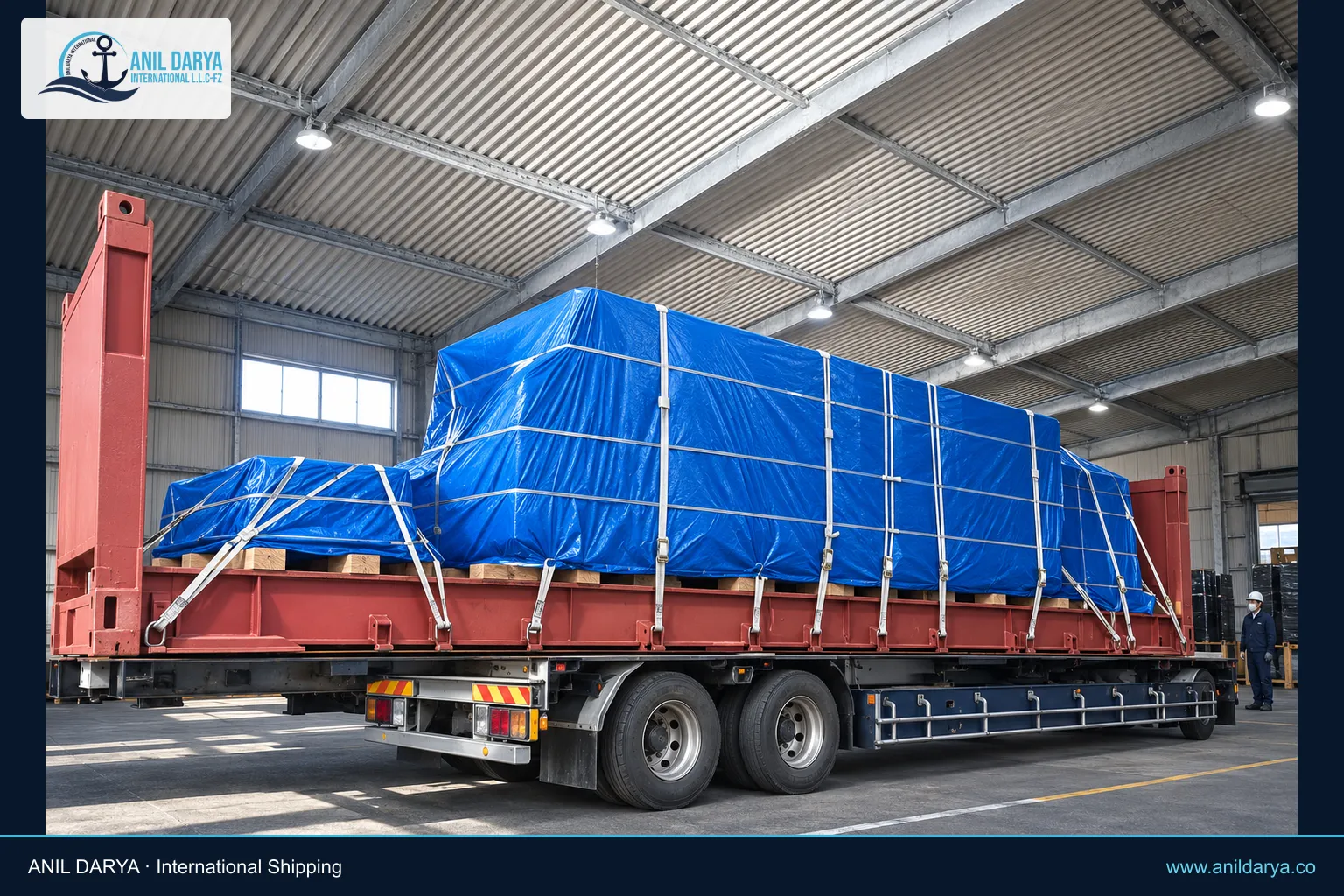
| Flat rack / open top | Machinery slightly over height or width | Piece-by-piece packing list with dimensions and weights for the Egyptian inspection |
| Breakbulk | Generators, transformers, steel structures, plant | An ACID is still needed; plan crane and road permits at the discharge port early |
If you buy from several suppliers in one Chinese region, consolidating them into one FCL usually beats several LCL lots. You also file one ACID instead of several. Our guide to FCL vs LCL shows where the break-even usually falls, and our sea freight service covers container bookings on this lane.
Dangerous goods from China to Egypt
Much of what Egypt buys from China counts as DG at sea: lithium batteries, paints, adhesives, aerosols, solvents and many industrial chemicals. DG on this lane has three gates. China Customs inspects the packaging used for exported dangerous goods, so the supplier needs the packaging certificates before booking. The shipping line checks the IMDG paperwork; the 2024 edition with Amendment 42-24 has been mandatory since 1 January 2026. Egypt then needs the safety data sheet in the ACI file where the product calls for it.
- UN number, proper shipping name, class and packing group from the supplier.
- Safety Data Sheet in English for each product.
- China DG packaging inspection results.
- A signed DG declaration and correct labels and placards.
- Any Egyptian product approval, confirmed by the consignee's broker before loading.
Our dangerous goods team gets carrier acceptance before you commit to a vessel.
Breakbulk and project cargo
Egyptian projects buy a lot of Chinese plant: power equipment, cement and steel plant parts, cranes and pre-fabricated steel. If a piece fits a 40ft flat rack by size and weight, a container service gives you more sailings. If it does not, you need breakbulk or heavy-lift tonnage and the vessel date drives the whole plan. Get drawings, weights and lifting points from the factory first, then agree the load port and the Egyptian discharge berth with the carrier. Our break bulk and project cargo service plans the booking side.
What does the Chinese supplier file before export?
China Customs controls the export side. The consignor, normally your supplier, makes the export declaration when the goods reach the customs supervision area and no later than 24 hours before loading. It can file itself or through a customs broker. Exporters, importers and brokers must hold market entity status and be recorded as foreign trade operators; the Shanghai government guide says this can be done online through the China International Trade Single Window.
For Egypt the supplier has a second job that most Chinese factories only learn on their first order: the ACI documents. Each document must carry three data elements, which the Nafeza shipping-line guide lists as the ACID, the Egyptian importer's 9-digit tax number, and the exporter's identification (country code, type of ID and the number itself). The supplier sends the invoice, packing list, certificate of origin and a copy of the bill of lading through a verified CargoX account under the ACID.
- Under FOB, the supplier files the export declaration and loads the cargo at the Chinese port. This is the cleanest term for this lane.
- Under EXW, a Chinese company must still act as exporter of record, because a buyer in Egypt cannot normally file a Chinese export declaration.
- Under CFR or CIF, the supplier books freight to Egypt. You lose control of the vessel choice, which matters when an ACID has a deadline.
Our Incoterms 2020 guide for sea freight shows where cost and risk pass under each term. Make sure the value and description on the Chinese export declaration match the invoice uploaded to Nafeza.
Egypt import customs: ACI, ACID and Nafeza
The Advance Cargo Information system makes the Egyptian importer declare full details of the goods at least 48 hours before the cargo ships from China. Nafeza issues a unique ACID for each request, within 48 hours of submission. The shipping-line guide is direct about the carrier's role: lines must check the ACID before loading and must never load a shipment for Egypt with an invalid ACID. Lines then file the manifest to Egyptian Customs through Nafeza at least 48 hours before the ship berths.
| Step | Who | What happens |
|---|---|---|
| 1 | Egyptian importer or broker | Enters the shipment data on Nafeza |
| 2 | Egyptian Customs | Issues the ACID within 48 hours and notifies both sides |
| 3 | Chinese exporter | Sends the documents under the ACID through CargoX |
| 4 | Importer | Confirms the exporter's data |
| 5 | Shipping line | Verifies the ACID, loads the vessel in China |
| 6 | Importer | Pays import taxes and fees |
| 7 | Port committee and customs | Cargo discharged, inspected by a joint committee if selected, then cleared |
CargoX states that a sent filing cannot be recalled. If a Chinese supplier uploads the wrong invoice, it sends a new envelope with corrected documents under the same ACID. Foreign sea freight forwarders must register and verify on CargoX, but they give the bill of lading to the exporter and do not file the documents themselves.
Documents Egypt expects for goods made in China
| Document | Who issues it | Egypt point to check |
|---|---|---|
| Commercial invoice | Chinese supplier | Carries the ACID; two copies plus the original; legalisation by the Egyptian consulate in China is required in most cases |
| Certificate of origin | Authorised issuing body in China | Shows China as origin; must be authenticated by the Egyptian consulate in China |
| Packing list | Chinese supplier | Weights and piece count match the invoice and the Nafeza entry |
| Bill of lading | Shipping line, released through us | Carries the ACID; only a copy goes into the ACI file |
| Safety data sheet, health or phytosanitary certificate | Supplier or Chinese authority | Only where the product needs it |
| Proof of GOEIC registration | Factory or brand owner | For goods on the Decree 43 list |
The consulate step is easy to forget on a China order. Build the days for legalisation into the timeline before the supplier promises a ship date.

Duty, VAT and GOEIC rules on goods from China
Egyptian duty depends on the HS code of each item. PwC reports average rates between 0% and 60% of the CIF value, with up to 135% on passenger cars, non-essential luxury goods and alcohol. Industrial machinery is generally 0% to 5%, and trucks and heavy equipment 10% to 20%. Duties are paid in Egyptian pounds.
Import VAT is 14%, charged on the CIF value plus customs duty and other taxes. Machinery and equipment for setting up production lines is taxed at 5%, excluding buses and passenger cars. A schedule tax also applies to certain listed products, sometimes on top of VAT.
| Typical China cargo | Duty guide (PwC) | VAT | Watch for |
|---|---|---|---|
| Production line machinery | Generally 0% to 5% | 5% reduced rate where it qualifies | Proof that the machinery is for a production line |
| Trucks and heavy equipment | Generally 10% to 20% | 14% | Year of manufacture and model rules |
| Consumer goods (appliances, furniture, toys, textiles) | By HS code within 0% to 60% | 14% | GOEIC factory or brand registration |
| Passenger cars and luxury goods | Up to 135% | 14% plus any schedule tax | Check the tariff line before ordering |
Many products Egypt buys from China fall under Ministerial Decree 43 of 2016. Factories, trademark owners and distribution centres exporting listed goods to Egypt must register with GOEIC. The list covers food and drinks in retail packs, cosmetics and detergents, household appliances, furniture, tableware and glassware, bathroom fixtures, lighting, toys, watches, bicycles and motorbikes, textiles, clothing and footwear. If your supplier is not registered, settle that before production ends, not when the box is at sea.
Restricted goods and approvals in Egypt
The official sources we opened do not give one list of prohibited goods for Egypt. They do show where Chinese cargo most often needs extra papers:
- GOEIC-listed consumer goods need the factory or brand registered.
- Goods may be inspected by GOEIC, and the US Commerce guide notes that some goods need factory registration and testing.
- Food, plant and animal products need health, phytosanitary or veterinary certificates.
- Telecom and wireless devices, medicines, medical devices and cosmetics may need approval from the sector regulator.
- Dangerous goods need safety data sheets in the ACI file.
Ask the consignee's broker to confirm the HS code and approvals before the supplier ships. A missing approval found after arrival means storage and container charges while the paperwork catches up.
The Dubai option: Jebel Ali transhipment, consolidation and re-export
Most cargo on this lane should go straight from China to Egypt. Routing through Dubai helps in three cases.
- Transhipment at Jebel Ali. Some services can relay Chinese cargo at Jebel Ali onto a sailing for Egypt. We present this as an option, checked against live schedules for each booking. Read our Jebel Ali port guide for the terminal side.
- Consolidation in Dubai. If you buy part of an order in China and part from suppliers in the UAE or the wider Gulf, the goods can be combined in Dubai into one container for Egypt.
- Stock in a free zone. Some buyers hold Chinese stock in a Dubai free zone and send smaller lots to Egypt as orders come in. Our article on JAFZA re-export explains how that works.
When cargo is re-exported from Dubai, Dubai Chambers issues a certificate of origin for foreign goods, which still names China as the country of manufacture. Egypt's ACI rules apply to the leg from Dubai exactly as they do from China, with a new ACID for that shipment. Where the lane touches Dubai, customs clearance in Dubai is a service we provide for a fee through our Dubai freight forwarding team.
[AMIR-FACT: which carriers, if any, we use to tranship China cargo for Egypt at Jebel Ali, and the real extra days compared with a direct sailing]
What affects the cost of shipping from China to Egypt?
We do not publish fixed prices because they change with each sailing. These are the parts of the bill and what moves each one.
| Cost part | What moves it | Usually paid by (FOB) |
|---|---|---|
| Origin charges in China | Pickup distance, export filing, terminal handling, LCL consolidation | Supplier |
| Ocean freight | Container type, season, direct or transhipment, surcharges | Buyer |
| Special cargo | DG surcharges, reefer, flat rack or breakbulk premiums, lashing | Buyer |
| Documents | CargoX filing fee per ACID, consulate legalisation, certificate of origin | Supplier for its documents, as agreed |
| Egyptian port charges | Terminal handling, delivery order, LCL unpacking, storage | Consignee |
| Duty and taxes | HS code, CIF value, 14% VAT, schedule tax | Consignee or its broker |
| Delays | Missing ACID or approval, inspection, demurrage and detention | Whoever caused the delay, by contract |
The line most buyers forget is storage while a document is fixed. Our article on demurrage and detention shows how those charges grow by the day.
How to arrange shipping from China to Egypt: step by step
- Agree the Incoterm with the Chinese supplier. FOB is usually simplest for this lane.
- Send us the cargo details: commodity, HS code, weight and volume or dimensions, supplier city, ready date, DG status and the Egyptian port or city.
- Name the consignee's customs broker in Egypt. We confirm with the broker that the importer is registered, the products are cleared for GOEIC, and the broker works at the chosen port. We do not confirm the booking until this is agreed.
- Get the ACID. The importer requests it on Nafeza and sends it to the supplier and to us.
- Book space. We compare direct and transhipment sailings and book with the line, with DG, reefer or out-of-gauge acceptance first.
- Prepare documents in China. The supplier puts the ACID, the importer's tax number and its own ID on the invoice, packing list and certificate of origin, and arranges consulate legalisation.
- File the ACI documents. The supplier sends them through CargoX at least 48 hours before the cargo ships.
- Export from China. The supplier or its origin agent collects and stuffs the cargo and files the China export declaration no later than 24 hours before loading.
- Release the bill of lading. We check the draft against the invoice and ACID, and release the carrier's B/L to you once paid.
- Clearance in Egypt. The consignee's broker pays duty and VAT, the port committee inspects if selected, and the goods are released.
[AMIR-FACT: one real China to Egypt cross-trade shipment we handled (cargo, load and discharge port, how the ACID and broker were lined up, door-to-door days)]
Checklist before the cargo leaves China
- Incoterm written in the contract and on the invoice.
- Egyptian importer registered and holding a valid ACID for this shipment.
- Consignee's customs broker named and agreed before booking.
- Products checked against the Decree 43 list, with GOEIC registration if needed.
- Supplier verified on CargoX.
- ACID, importer tax number and exporter ID on every document.
- Invoice and certificate of origin legalised by the Egyptian consulate in China where required.
- HS code, duty rate and 14% VAT confirmed with the broker.
- For DG: SDS, China packaging certificates, DG declaration and carrier acceptance.
- For project cargo: drawings, weights and a discharge and road plan in Egypt.
- Cargo insurance arranged and free time at the Egyptian terminal checked.
Common mistakes buyers make on this lane
- Shipping before destination clearance is agreed. If no broker in Egypt has accepted the job, the cargo can arrive with nobody to clear it.
- Booking before the ACID exists. The line will not load cargo for Egypt without a valid ACID.
- Different data in different places. A weight, value or description that differs between the invoice, packing list and Nafeza entry causes holds.
- Forgetting consulate legalisation. The Chinese supplier ships, and the original papers are not ready for the broker.
- Unregistered factory. Goods on the GOEIC list arrive and cannot be released.
- Undeclared DG. Batteries, paints and chemicals booked as general cargo are rejected or fined.
- Uploading a wrong file to CargoX. It cannot be recalled, only replaced by a new envelope under the same ACID.
- Wrong discharge port. A box for eastern Cairo landed in Alexandria, or the reverse, adds trucking cost and days.
Frequently asked questions
Which Egyptian port is best for cargo from China?
Use the port nearest the goods' final use and where the importer's broker works. Sokhna suits eastern Cairo and the canal zone, Port Said and Damietta suit the canal and eastern Delta, and Alexandria suits the western Delta and many Cairo importers.
Who applies for the ACID on a China to Egypt shipment?
The Egyptian importer or its customs broker requests it on Nafeza. Customs issues the 19-digit ACID within 48 hours, and the Chinese supplier then sends the documents under it through CargoX.
How long before sailing must the ACI documents be ready?
The importer must declare the shipment at least 48 hours before it ships from China, and the line checks the ACID before loading. Start the ACID request as soon as the order is confirmed.
Is there a direct sailing from China to Egypt?
Some Asia to Mediterranean loops call Chinese ports and then Port Said, Damietta, Alexandria or Sokhna directly. Others tranship in Asia. Rotations change each season, so we check the live schedule for each booking.
What duty and VAT apply to goods from China in Egypt?
Duty is set by HS code, mostly 0% to 60% of CIF value according to PwC, and is paid in Egyptian pounds. Import VAT is 14% on CIF plus duty, or 5% on qualifying production line machinery. The consignee or its broker pays these.
Do Chinese documents need legalising for Egypt?
Usually yes. The US Commerce guide says the commercial invoice is legalised by the Egyptian consulate in the country of origin in most cases, and the certificate of origin must be authenticated by it.
Does Anil Darya clear the cargo in Egypt?
No. We book the ocean freight, coordinate the supplier and release the carrier's bill of lading. Clearance in Egypt is done by the consignee's licensed broker, which we agree with you before we confirm the booking.
Can China cargo for Egypt go through Dubai?
Yes, as an option: transhipment at Jebel Ali, consolidation with Gulf suppliers, or stock held in a Dubai free zone and re-exported. Each leg into Egypt still needs its own ACID.
Get a quote for shipping from China to Egypt
Send us the supplier city, cargo details, ready date, Egyptian port and the name of the consignee's broker, and we will come back with sailing options and a price. Use our freight rate inquiry form, or contact our team to talk through a DG, reefer or project shipment first.
Sources
- Misr Technology Services via SCZONE: ACI Shipping Lines/Agents Guide v1.5 (48 hours, 19-digit ACID, data elements, verification before loading, manifest timing)
- US International Trade Administration: Egypt import requirements and documentation (ACID within 48 hours, legalisation, process steps)
- US International Trade Administration: Egypt customs regulations (Law 207 of 2020, GOEIC inspection, duties in Egyptian pounds)
- CargoX: Advance Cargo Information Egypt (exporter and forwarder roles, resubmission)
- PwC Worldwide Tax Summaries: Egypt, other taxes (customs duty and VAT)
- AHK Egypt: Registration of manufacturers with GOEIC (Decree 43 of 2016)
- Shanghai Municipal Government: Customs recordation and export declaration (24 hours before loading)
- CIRS: China customs inspection of exported dangerous goods packaging
- IMO: IMDG Code 2024 edition (Amendment 42-24), mandatory from 1 January 2026
- Maersk: Asia-Europe network update 2026 (AE15 rotation with Port Said and Damietta)
- DP World: Sokhna infrastructure and facts (berths, depth, reefer points)
- APM Terminals: About SCCT, East Port Said (quay, draft, capacity, reefer plugs)
- Dubai Legislation Portal: Dubai Chambers Resolution No. 7 of 2024 on certificates of origin (including re-export)
Reviewed: 11 November 2026