
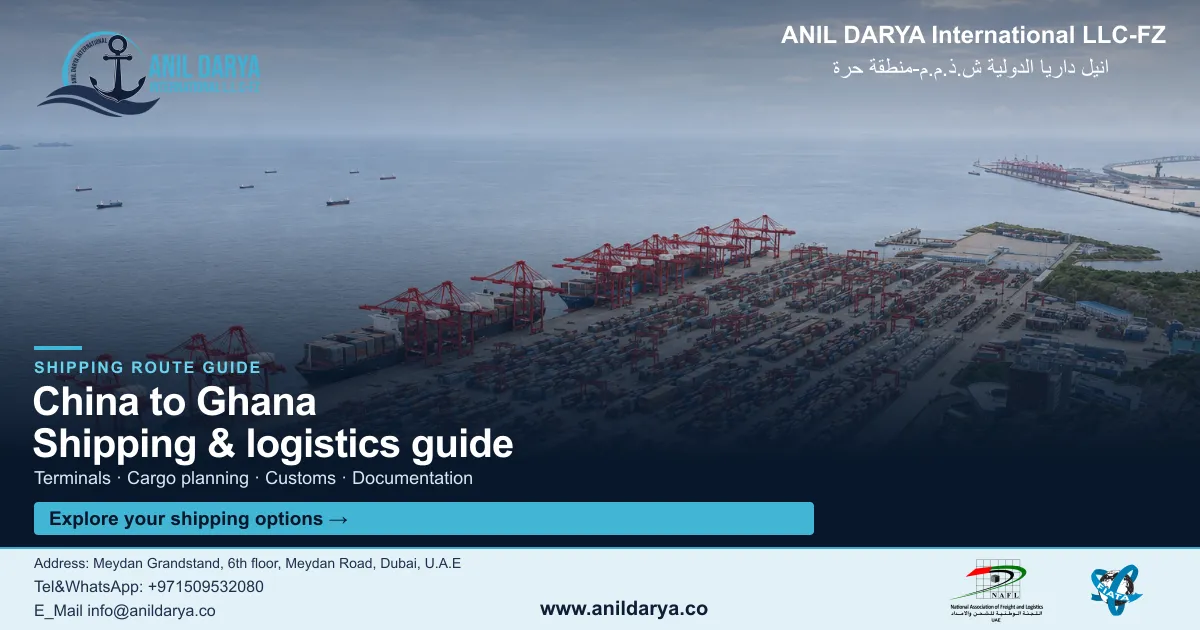
Shipping from China to Ghana is, for most buyers, a container loaded at Qingdao, Ningbo, Shanghai, Shenzhen or Nansha and discharged at Tema, the port that takes almost all of Ghana's boxes. The Chinese supplier files the export declaration, a licensed clearing agent in Ghana files the import entry in ICUMS, and many goods made in China are "high-risk goods" that need a test certificate for the Ghana Standards Authority. We book the sea freight from Dubai, release the carrier's bill of lading to you and keep the supplier and your Ghanaian broker working to the same plan.
Shipping from China to Ghana at a glance
| Item | Detail |
|---|---|
| Main modes | Sea FCL, sea LCL, reefer, flat rack, breakbulk and dangerous goods by sea |
| Usual Chinese load ports | Qingdao, Ningbo, Shanghai, Shenzhen (Shekou, Yantian), Guangzhou (Nansha), Xiamen, Tianjin |
| Main Ghana port | Tema: 1,668,688 TEU in 2024, more than 95% of Ghana's container traffic (GPHA) |
| Main container terminal | MPS Terminal 3 at Tema: 4 berths, 1,400 m quay, 16 m draught |
| Second Ghana port | Takoradi, Western Region: 32,558 TEU in 2024, mostly bulk and general cargo |
| Example carrier service | Maersk FEW3: Qingdao, Ningbo, Nansha New Port, Tanjung Pelepas, Tema, Abidjan, Pointe Noire |
| China export filing | Consignor or its customs broker, at least 24 hours before loading |
| Ghana customs system | ICUMS, filed by a licensed clearing agent (required by law at the ports) |
| Product conformity | Ghana Standards Authority checks on high-risk goods; CoA or CoC with each consignment |
| Import duty | ECOWAS Common External Tariff: 0%, 5%, 10%, 20% or 35% of CIF value |
| VAT and levies (from 1 January 2026) | VAT 15% plus NHIL 2.5% and GETFund 2.5%, 20% combined |
| Who clears in Ghana | The consignee's own clearing agent, agreed before the cargo ships |
How a cross-trade booking on this lane works
Your goods never touch the UAE on this lane. We run the booking from Dubai while the box moves straight from China to West Africa, and three parties share the work.
- The supplier in China, or its forwarder there, collects or packs the goods, stuffs the container and files the Chinese export declaration.
- We book the space with the shipping line, check that the invoice, packing list and B/L match Ghana's rules, and chase every party against the cut-off dates.
- Your clearing agent in Ghana lodges the ICUMS declaration, settles duty and taxes from the consignee's funds and takes delivery at Tema.
The bill of lading on this lane is the shipping line's own document, not a forwarder's paper. Because Anil Darya works as an agent for many shipping lines, the carrier issues its B/L and we release it to you, so the Ghanaian broker presents a line B/L at Tema that the terminal and the line's local office both recognise.
The Incoterm decides who pays which leg. Most Ghanaian buyers do best with FOB China: the factory handles Chinese export formalities, and you control the sea freight, insurance and arrival. EXW leaves you without an exporter of record in China. Our guide to Incoterms 2020 for sea freight shows where cost and risk move in each term.
Which Chinese ports to load at for Ghana
Load at the port nearest your factory, then check that a West Africa service calls there.
| Supplier region | Usual load port | What to know for Ghana cargo |
|---|---|---|
| Shandong and north China | Qingdao, Tianjin | Qingdao is the first call on the FEW3 loop; Tianjin cargo may feed to another port first |
| Zhejiang, Jiangsu and Yiwu | Ningbo, Shanghai | Good LCL options for small mixed orders from many suppliers |
| Guangdong (Guangzhou, Foshan, Dongguan, Shenzhen) | Nansha, Shekou, Yantian | Nansha is often the last Chinese call before the ship heads west |
| Fujian | Xiamen | Fewer direct West Africa calls; ask for the routing with every quote |
Tema or Takoradi: where your cargo arrives in Ghana
Tema is the answer for nearly every container from China. GPHA figures put Tema at 1,668,688 TEU in 2024, more than 95% of all containers handled in Ghana. Most of those boxes cross MPS Terminal 3, which has four berths along a 1,400 m quay and 16 m of water alongside, enough for the large ships on Asia to West Africa loops.
Takoradi, in the Western Region, handled 32,558 TEU in the same year. It is mainly a bulk and general cargo port that serves mining and oil and gas work in the west. Ship there only if your consignee is near Takoradi and the carrier confirms a call or a feeder, because most Far East services discharge at Tema and nothing else in Ghana.
Sea freight from China to Ghana: direct loops and transhipment
Most sailings on this lane are long weekly loops that collect boxes at several Chinese ports, call Southeast Asia and then run to West Africa. Maersk's FEW3, for example, rotates Qingdao, Ningbo, Nansha New Port, Tanjung Pelepas, Tema, Abidjan and Pointe Noire, then returns via Tanjung Pelepas. Maersk said in February 2026 that the first ship on this rotation would leave Qingdao on 29 March 2026.
Other bookings are transhipped: the box changes ship at a hub on the way. Always ask which vessel carries it on each leg and where it changes ship.
| Routing | How the box moves | When it fits |
|---|---|---|
| Same ship, multi-port loop | Loaded in China, calls Southeast Asia, discharged at Tema | Most FCL cargo; fewest handlings |
| Transhipment at a hub | Changes ship once on the way | When your load port has no direct call or the loop is full |
| Via Jebel Ali, Dubai | China to Jebel Ali, then onward to Tema | When you combine China goods with stock already in Dubai |
We did not find a carrier schedule page that publishes a port-to-port day count we could read with confidence for China to Tema, and forwarder estimates on the web differ by more than two weeks. Ask for the carrier's own schedule for the actual sailing.
[AMIR-FACT: the carriers and services we actually book from China to Tema, whether each is direct or transhipped (and where), and our real port-to-port transit days from Qingdao/Ningbo/Shanghai and from Shekou/Nansha]
FCL, LCL and reefer for Ghana-bound cargo
| Option | Typical China to Ghana cargo | What to watch in Ghana |
|---|---|---|
| 20ft dry | Tiles, steel fittings, cables, cement additives, other heavy goods | Maersk caps payload at 30 tonnes per box in Ghana |
| 40ft dry or high cube | Furniture, solar panels, household goods, motorbike kits | Free time at Tema is short, so file before arrival |
| LCL | First orders, samples, mixed small lots | Release waits on every consignee in the box at the freight station |
| Reefer | Frozen food, some medicines, temperature-sensitive chemicals | FDA permit ready before sailing; Maersk gives 5 free days for reefers |
| Flat rack or open top | Machinery a little too tall or wide for a dry box | Carrier acceptance and an inland route to the site |
Maersk's Ghana rules also bar aluminium containers and allow 45ft boxes only with twistlocks at 40ft positions. If you buy from several factories in one Chinese province, have them deliver to one warehouse near the load port and ship one FCL. One B/L and one ICUMS declaration cost less than several LCL entries. Our FCL vs LCL guide shows where the switch usually pays, and our sea freight service covers booking and equipment.
Dangerous goods, breakbulk and project cargo to Ghana
Much of what Ghana buys from China is regulated for sea transport: lithium batteries for solar kits, paints, adhesives, cleaning chemicals, aerosols and LPG accessories. These move under the IMDG Code, and its 2024 edition (Amendment 42-24) became mandatory on 1 January 2026, so the supplier's Safety Data Sheet and DG declaration must follow it.
On the China side, customs inspects the packaging used for exported dangerous goods. The supplier needs a packaging performance certificate for the package type and a use certificate for the filled packages. Carriers in China will not take a DG booking without them, so ask for both before you pay a deposit.
At Tema, time is the issue. Under the MPS Terminal 3 tariff, Category I DG boxes (explosives, flammable and toxic gases, oxidisers and organic peroxides, radioactive material) get no free storage days, and Category II goods such as flammable liquids and corrosives get 5. Your broker should file in ICUMS before the ship berths. Maersk also notes that chemical imports into Ghana may need an EPA certificate. Our dangerous goods team checks the UN number, class and packing group against the carrier's acceptance before you commit.
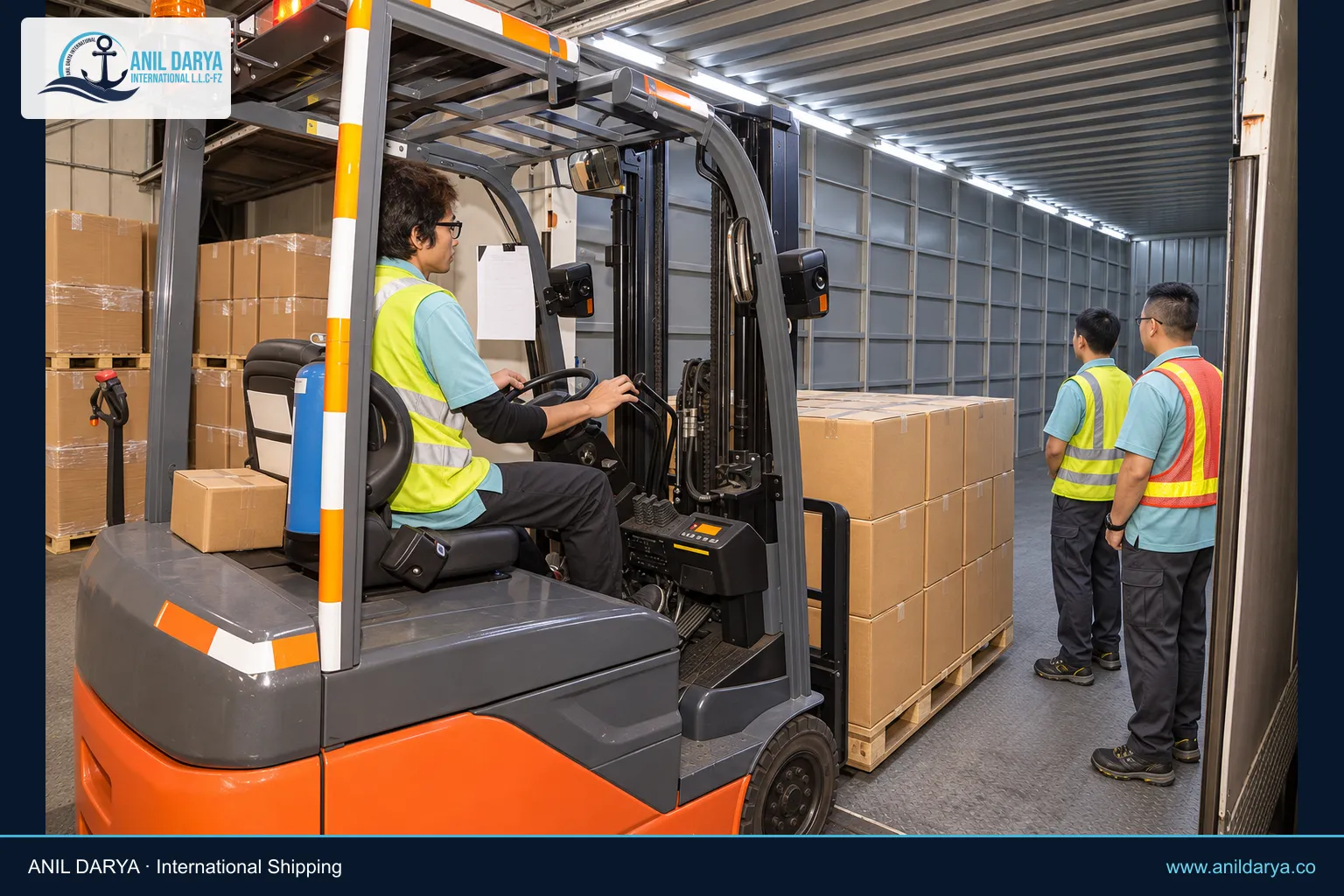
Generators, crushers, steel structures and plant for mines or factories in Ghana often do not fit a standard box. A piece that fits a flat rack can still ride a container ship. Anything bigger goes as breakbulk on a general cargo or heavy-lift vessel, and the sailing date of that ship drives the whole plan. Send us drawings, weights, lifting points and the centre of gravity for each piece. See our break bulk and project cargo service.
The China export side: who files what
Chinese customs law puts the export filing on the consignor. The Shanghai municipal government's guide states that the consignor, or a customs broker it appoints, declares the goods once they reach the customs supervision area and no later than 24 hours before loading. The consignor also needs foreign trade operator registration, which it can apply for through the China International Trade Single Window.
- Your supplier or its origin forwarder handles pickup, stuffing and the export declaration. We share the booking, cut-offs and vessel details with them.
- The description, quantity and value on the Chinese export declaration must match the invoice your Ghanaian broker files. A mismatch is a common reason for a valuation query at Tema.
- Ask the supplier for a certificate of origin when your broker wants one. It is not on GRA's core document list, but brokers often ask for it.
Ghana import customs: documents and ICUMS
Every import into Ghana is declared in ICUMS, the Integrated Customs Management System of the Ghana Revenue Authority's Customs Division. GRA states that clearance at the ports needs a licensed clearing agent by law. We do not sell customs clearance in Ghana. We confirm the plan with your agent before we book, so the box never lands at Tema without someone ready to clear it.
| Document | Who provides it | What to check |
|---|---|---|
| Original bill of lading | Shipping line, released through us | Consignee name matches the TIN or Ghana Card PIN holder |
| Attested commercial invoice | Chinese supplier | HS code and full description on each line; value matches the export declaration |
| Packing list | Chinese supplier | Carton count, marks and weights match the B/L |
| Import Declaration Form (IDF) | Consignee, from the Ministry of Trade | In place before the cargo sails |
| TIN or Ghana Card PIN | Consignee | Same name as on the B/L |
| CoA or CoC for high-risk goods | A competent laboratory, preferably in China | Refers to the applicable Ghana standard |
| FDA or other agency permits | Consignee | Food, drugs, cosmetics, medical devices and other regulated items |
The agent files the declaration with the documents, before or after arrival. ICUMS handles classification, valuation and approval and issues a tax bill, paid at a participating bank. A risk channel then decides the check: red for physical examination, yellow for a scan, and green for release with an automatic scan at the MPS exit.
Two 2026 changes affect China cargo directly. GRA fully deployed its Publican AI tool on 12 March 2026 to help officers with valuation, classification and origin checks, and it flags inconsistent documents and suspect values. Under-invoiced Chinese invoices are exactly what it looks for, so declare the real price. The Ghana Shippers' Authority also announced that mandatory shipper registration under the Ghana Shippers' Authority Act, 2024 (Act 1122) would be enforced on ICUMS from 3 August 2026, so the importer must be registered before shipments are processed.
Do not let a box from China sit. Under Section 53 of the Customs Act, 2015 (Act 891), uncleared general goods risk forfeiture to the state after 21 days, and vehicles after 60.
Ghana Standards Authority checks on high-risk goods
This is the part of the lane that catches most new importers. The Ghana Standards Authority (GSA) inspects "high-risk goods" at the point of entry, and its list reads like a catalogue of what Ghana buys from China:
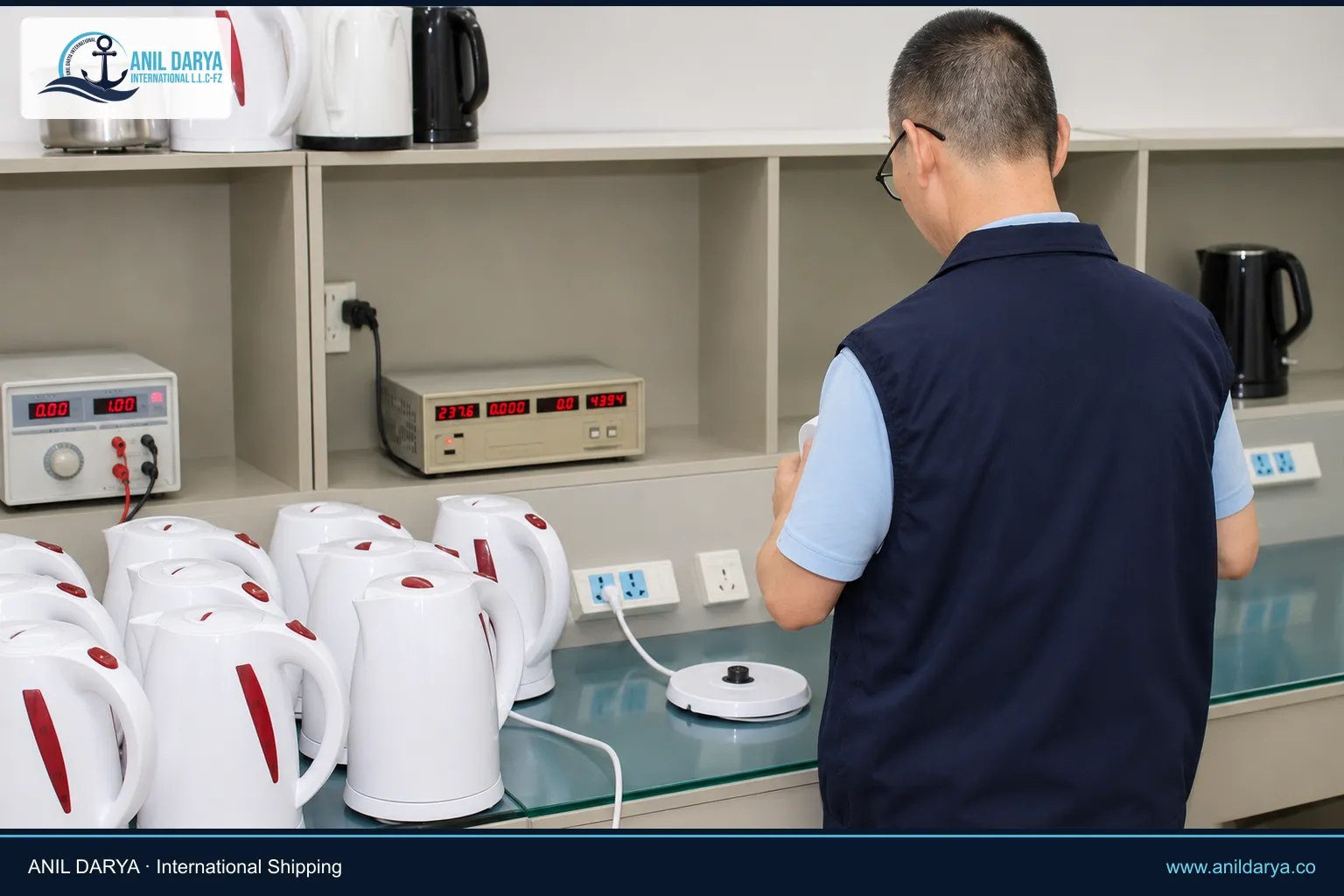
- electrical appliances, electrical products such as bulbs, switches, sockets and cables, and electronic products;
- building materials, industrial machinery and vehicle spare parts;
- chemicals and allied products, petroleum products and motor vehicle batteries;
- food, pharmaceuticals, cosmetics and medical devices;
- toys, African textile prints, LPG cylinders and accessories, pyrotechnic products, machetes and used goods such as second-hand clothing.
Importers of these goods must register with GSA. Each consignment should come with a Certificate of Analysis (CoA) or Certificate of Conformance (CoC) issued against the applicable standard by a competent laboratory, preferably in the exporting country. In practice that means a test report from a lab in China, arranged before the factory ships. Without a CoA or CoC, the goods stay put until samples are tested in Ghana and pass.
Labels matter too. GSA's labelling rules (L.I. 1541) require the product name, net content, the manufacturer's name and address, country of origin, a batch or lot number and, for non-food goods, the electrical or chemical characteristics. Ask your factory to print them before production, not after. If GSA cannot finish its checks within 24 hours, the importer can apply for provisional release to a named warehouse, but must not sell the goods until GSA issues a final release.
[AMIR-FACT: which laboratories or inspection firms our shippers in China use for GSA CoA/CoC reports, and the typical lead time from sample to report]
Ghana import duty, VAT and levies
Ghana applies the ECOWAS Common External Tariff. Import duty is charged on the CIF value at Tema, and VAT and most levies are charged on CIF plus duty. Duty and taxes at destination are paid by the consignee or its broker, not by the Chinese supplier and not by us.
| Charge | Rate | Applies to |
|---|---|---|
| CET band 1 | 0% | Essential social goods, for example medicine |
| CET band 2 | 5% | Essential commodities, raw materials, capital goods |
| CET band 3 | 10% | Intermediate goods |
| CET band 4 | 20% | Consumer goods |
| CET band 5 | 35% | Goods given extra protection |
| VAT, NHIL and GETFund | 15% + 2.5% + 2.5% = 20% | Most imports, from 1 January 2026 |
| ICUMS charge | 0.75% of FOB value | Imports processed through ICUMS |
The Value Added Tax Act, 2025 (Act 1151) took effect on 1 January 2026. VAT stays at 15%, NHIL and GETFund stay at 2.5% each, the 1% COVID-19 levy was abolished, and the three remaining charges now share one base for a 20% combined rate. Old landed-cost sheets from 2025 are wrong. Other levies appear on the tax bill as well, such as the ECOWAS and African Union levies, and some products carry excise or extra charges on plastics. Get the full tax bill for your HS code from your broker before you agree a price with the factory.
Restricted and prohibited goods in Ghana
GRA splits controlled goods into absolute prohibitions and restricted goods that need a permit first. Prohibited items include counterfeit money, obscene articles, contaminated food and dangerous weapons such as flick knives. Some product groups from China come up often.
| Goods | Rule or permit |
|---|---|
| Used handkerchiefs, underwear, mattresses and sanitary ware | Banned for commercial import when second-hand (L.I. 1586) |
| Food, drugs, cosmetics, medical devices | Food and Drugs Authority permit or registration |
| High-risk goods (electricals, building materials, toys, batteries) | GSA registration and CoA or CoC |
| Arms, ammunition, explosives, handcuffs | Ministry of the Interior |
| Gaming machines | Gaming Commission |
| Fireworks | Listed by Maersk as prohibited cargo for Ghana |
| Vehicles | No right-hand drive without a ministerial dispensation; used vehicles over 15 years old or with flood, fire or chassis damage banned from 1 October 2026 |
Routing via Dubai: consolidation, free zone stock and transhipment
A straight booking to Tema is simplest for most cargo. Dubai helps when your supply chain already runs through the UAE, for example when you buy from China and from Gulf suppliers and want one container for Accra.
| Option | How it works | What to watch |
|---|---|---|
| Consolidation in Dubai | China goods and goods from other origins are combined in one box for Tema | Each item still needs its GSA certificate and correct origin papers |
| Free zone stock and re-export | You hold stock in Jafza and ship to Ghana as orders come in | Dubai Chambers issues certificates of origin for re-exported goods |
| Transhipment at Jebel Ali | The box arrives from China and connects to a West Africa sailing | Dubai Customs treats transit as a regime of its own, separate from import |
Jafza sits next to the port, which makes holding and splitting stock practical. See our Jebel Ali port guide and our article on re-exporting through Jafza. When cargo is landed, consolidated or re-exported in Dubai, we handle the UAE customs clearance for a fee.
[AMIR-FACT: whether we route China to Ghana cargo via Jebel Ali in practice (transhipment or Dubai consolidation), the carriers used from Jebel Ali to Tema and the real extra days compared with a direct sailing]
Typical cargo from China to Ghana and the papers each needs
| Cargo | Usual equipment | Extra papers to plan |
|---|---|---|
| Electrical goods, cables, sockets, small appliances | FCL or LCL | GSA registration and CoA or CoC; labels to L.I. 1541 |
| Solar panels, inverters, lithium batteries | 40ft high cube | Batteries as DG with SDS and Chinese packaging certificates; GSA for electrical items |
| Tiles, sanitary ware, steel and building materials | 20ft (heavy) or breakbulk for long steel | GSA certificate; stay under the 30-tonne box limit |
| Textiles, African prints, garments | 40ft or LCL | GSA for African textile prints; used clothing is a high-risk good |
| Machinery and plant | FCL, flat rack or breakbulk | Drawings and piece list; capital goods often fall in the 5% band |
| Motorbikes, tricycles, spare parts | 40ft high cube | Spare parts are GSA high-risk goods; batteries may be DG |
| Chemicals, paints, adhesives | DG-approved FCL | Full DG papers, possible EPA certificate, short DG free time at Tema |
Step by step: shipping from China to Ghana with Anil Darya
- Send us the product, HS code if you have it, weight, volume, supplier city, ready date and the delivery point in Ghana.
- Name your clearing agent in Ghana. We agree the clearance plan with them, including the documents they need and who pays what at Tema, before we confirm the booking.
- Agree the Incoterm with the supplier. FOB China is the usual choice.
- Check GSA, FDA and any other permit. Book the lab test in China so the CoA or CoC is ready before stuffing.
- Make sure the importer has a TIN or Ghana Card PIN, the IDF and shipper registration in place.
- We book space with the shipping line and send the supplier the booking, cut-offs and the draft carrier B/L.
- The supplier or its origin agent stuffs the box and files the Chinese export declaration.
- We check the consignee, notify party, description and weights on the draft B/L against the invoice, then the line issues it after loading.
- The carrier B/L is released to you through us, your broker files in ICUMS before arrival, and the box is released after the risk channel check.
[AMIR-FACT: one real China to Ghana cross-trade shipment we handled (cargo, load port, Tema or Takoradi, carrier, what we coordinated and the outcome), cleared for publication]
What drives the cost of container shipping from China to Ghana?
We do not publish prices, because rates change with every sailing. These are the parts of your total.
| Cost part | What moves it | Usually paid by |
|---|---|---|
| Origin charges in China | Trucking distance, export filing, terminal handling, LCL consolidation | Supplier under FOB |
| Lab testing for GSA | Number of products and tests needed | Supplier or buyer, as agreed |
| Ocean freight | Box type, season, carrier, direct or transhipped, surcharges | Buyer under FOB |
| DG and out-of-gauge | DG surcharges, flat rack or breakbulk premiums, lashing | Buyer under FOB |
| Tema local charges | Terminal handling, line import charges, container deposit | Consignee |
| Duty, VAT and levies | HS code, CIF value, product levies | Consignee or its broker |
| Storage and demurrage | Late permits, late filing, examination | Whoever caused the delay, under your contract |
Free time is short. MPS gives 7 free storage days for normal import boxes at Terminal 3, and Maersk gives 7 days of free time for dry boxes delivered within Ghana. A missing GSA certificate can cost more in storage than you saved on freight. Our article on demurrage and detention shows how those charges build up.
Checklist before the cargo leaves China
- Incoterm written in the contract and cargo insurance arranged.
- HS code agreed with your Ghanaian broker and the duty band checked.
- Clearing agent named and the clearance plan agreed before booking.
- Importer's TIN or Ghana Card PIN, IDF and shipper registration ready.
- GSA registration and a CoA or CoC for each high-risk product.
- FDA or other permits in hand for regulated goods.
- Chinese export declaration filed with values that match the invoice.
- For DG: UN number, SDS, Chinese packaging certificates and carrier approval.
Mistakes that hold China cargo at Tema
- Shipping before destination clearance is agreed. If no Ghanaian agent has taken the job, the box sits at Tema while free days run out.
- No CoA or CoC for high-risk goods. The goods wait for sampling and testing in Ghana.
- Low invoice values. Publican AI flags suspect values, and a query costs more days than the duty you hoped to save.
- Labels without country of origin or a batch number.
- DG filed late. Category I dangerous goods get no free storage days at Terminal 3.
- Pricing with 2025 tax figures instead of the 20% VAT, NHIL and GETFund rate from 2026.
Frequently asked questions
Which port in Ghana receives containers from China?
Tema, which handled more than 95% of Ghana's containers in 2024, mostly at MPS Terminal 3. Takoradi takes a small share and is mainly a bulk and general cargo port.
How long does sea freight from China to Ghana take?
It depends on the load port, the carrier and any transhipment. Ask for the carrier's schedule for the actual sailing, then add time for testing in China, clearance at Tema and inland delivery.
Do goods from China need a Ghana Standards Authority certificate?
High-risk goods do, and the list covers electricals, electronics, building materials, spare parts, toys, chemicals, textiles and more. The importer registers with GSA, and each consignment should carry a CoA or CoC from a competent lab, preferably in China.
What import duty and VAT apply to goods from China?
Duty follows the ECOWAS Common External Tariff at 0%, 5%, 10%, 20% or 35% of CIF value, set by HS code. Since 1 January 2026, VAT of 15% plus NHIL and GETFund at 2.5% each give a 20% combined rate, and further levies appear on the tax bill.
What documents does Ghana Customs ask for?
The original bill of lading, an attested invoice, a packing list, the Import Declaration Form, the importer's TIN or Ghana Card PIN, and permits from agencies such as the FDA or GSA where the goods need them. A licensed clearing agent files them in ICUMS.
Does Anil Darya clear customs in Ghana?
No. The consignee's licensed clearing agent clears the goods at Tema, and duty and taxes at destination are paid by the consignee or its broker. We agree the plan with that agent before we confirm the booking, then coordinate the papers and the arrival.
Can I ship dangerous goods from China to Ghana?
Yes, if they are declared under the IMDG Code, packed in certified packaging and accepted by the carrier. At Tema the most hazardous classes get no free storage days.
Can cargo from China to Ghana go through Dubai?
Yes, where it helps. Goods can be combined in Dubai with cargo from other origins, held in a free zone and re-exported, or transhipped at Jebel Ali. We clear cargo through UAE customs for a fee when it is landed in Dubai.
Get a quote for sea freight from China to Ghana
Send us the supplier city, the goods, the ready date and the name of your clearing agent in Ghana, and we will come back with a routing, a carrier and a price. Use our freight rate inquiry form, or contact our team to plan a DG, breakbulk or project shipment first. You can also read about our Dubai freight forwarding team.
Sources
- Ghana Revenue Authority: Import procedures (documents, ICUMS steps, risk channels)
- Ghana Revenue Authority: Customs FAQs (licensed clearing agents)
- Ghana Revenue Authority: Import prohibitions and restrictions
- Ghana Revenue Authority: Vehicle importation
- Ghana Standards Authority: Import inspection of high-risk goods, labelling and L.I. 1586
- Citi Newsroom: Mandatory shipper registration on ICUMS from 3 August 2026
- Ghana Shippers' Authority: Sensitisation on mandatory ICUMS shipper registration (Act 1122)
- Ghana News Agency: GRA on Publican AI, deployed 12 March 2026
- GPHA: Customs advises importers to clear goods on time
- Citi Newsroom: GPHA container traffic for 2024 (Tema and Takoradi)
- Meridian Port Services: Terminal 3 capacity
- Meridian Port Services: Tariff and free storage days, including DG categories
- trade.gov: Ghana import tariffs (ECOWAS CET bands, CIF basis)
- trade.gov: Ghana VAT changes from 1 January 2026
- trade.gov: Ghana customs regulations (ICUMS charge)
- Citi Newsroom: Used vehicle age rule from 1 October 2026
- Maersk: Ghana import information (free time, payload, equipment, prohibited cargo)
- Maersk: Asia West Africa network update, FEW3 rotation (February 2026)
- Shanghai Municipal Government: Customs registration and export declaration
- CIRS: China Customs inspection of DG packaging for export
- IMO: IMDG Code 2024 edition (Amendment 42-24)
- Dubai Customs: Customs declaration regimes
- Dubai Chambers: Certificates of origin for re-exported goods
- Jafza: About the Jebel Ali Free Zone
Reviewed: 11 November 2026