
Shipping from China to Guinea means shipping to Conakry, the port that carries about 90% of the country's foreign trade. Most boxes leave Shanghai, Ningbo, Nansha or Qingdao and change ship at least once before they reach Guinea. Three papers have to be in order before the cargo can be cleared: the BESC cargo tracking note, the import authorisation (DDI) issued through the GUCEG single window, and the customs declaration in SYDONIA World. We book the ocean freight from Dubai, release the shipping line's bill of lading to you, and agree the clearance plan with your broker in Conakry before we confirm the space.
This page covers the Republic of Guinea (Guinea-Conakry), not Guinea-Bissau or Equatorial Guinea, which have their own ports and customs rules.
Shipping from China to Guinea at a glance
| Item | Detail |
|---|---|
| Main modes | Sea FCL, sea LCL, reefer, flat rack and open top, ro-ro, breakbulk and dangerous goods by sea |
| Usual Chinese load ports | Shanghai, Ningbo, Nansha (Guangzhou), Shekou (Shenzhen), Qingdao, Xiamen, Tianjin |
| Guinean port | Port Autonome de Conakry (PAC), about 90% of Guinea's foreign trade |
| Container berths | PQ10: 270 m at 10.50 m; PQ12: 340 m at 13 m; 600 m of quay in all |
| Access channel | 5 km long, 150 m wide, 10.00 m operating draught at low tide (PAC, May 2024) |
| Routing from China | Usually transhipped; Maersk lists a southbound WAF 7 route from Tanger Med to Conakry |
| Before loading | BESC (ECTN), mandatory for cargo bound for Conakry under a Ministry of Transport notice of 21 September 2020 |
| Import authorisation | DDI from the Ministry of Commerce, requested in the GUCEG DVT module, with bank domiciliation |
| Import duty | Five bands: 0%, 5%, 10%, 20% and 35%, under the ECOWAS Common External Tariff |
| VAT | 18% |
| Who clears in Guinea | A licensed customs broker (CAD) for the consignee, agreed before the cargo ships |
How the work is split on a China to Conakry booking
The box moves from a Chinese port to Conakry and never enters the UAE. We run the booking from Dubai, and the job splits three ways.
- The Chinese factory, or the forwarder it uses, trucks the goods to the port, stuffs and seals the container, declares the VGM and files the Chinese export declaration.
- We book the slot with the shipping line, pass the booking number and cut-offs to the factory, and check the draft bill of lading, invoice and freight invoice against what the BESC and the GUCEG file in Guinea will need.
- Your broker in Conakry follows the DDI and the customs entry, pays duty and VAT from the consignee's funds, and takes the container out of the terminal.
The bill of lading is issued by the shipping line itself. Many lines appoint Anil Darya as their agent, so after loading the line's B/L is released to you through our Dubai office once the freight is paid. Maersk's Guinea page says import boxes are delivered against the original bill of lading or a telex release, so the line's own B/L is the paper that frees your cargo at Conakry.
Guinean buyers usually buy FOB a Chinese port, so the factory owns the export side and you choose the line and routing. Maersk says freight collect into Conakry needs its Guinea office's approval and carries a 4% charge on the ocean freight. Read our guide to Incoterms 2020 for sea freight before you sign the contract.
Which load ports in China suit Conakry
Pick the port nearest the factory, then ask where the box joins the ship for West Africa. The transhipment plan matters more than the load port.
| Supplier region | Usual load port | What to ask the line |
|---|---|---|
| Shanghai, Jiangsu, Anhui | Shanghai | Which hub the box changes ship at, and the connection there |
| Zhejiang, Yiwu market goods | Ningbo | Same; Yiwu LCL often consolidates here |
| Guangdong, Pearl River Delta | Nansha or Shekou | Last Chinese call on many West Africa loops, so a shorter first leg |
| Fujian | Xiamen | Whether a feeder to a mainline port is needed |
| Shandong, Hebei, Tianjin, Beijing | Qingdao or Tianjin | Feeder or direct mainline call, and the total days to Conakry |
The Port of Conakry: berths, depth and terminals
Conakry sits on the Kaloum peninsula and also handles transit cargo for Mali. Bauxite and alumina use their own berths, so containers, vehicles and general cargo share the rest of the harbour.
| Facility | Length | Depth | Use |
|---|---|---|---|
| PQ12 (container terminal) | 340 m | 13 m | Container and ro-ro ships |
| PQ10 (container terminal) | 270 m | 10.50 m | Container ships |
| PQ02 and PQ03 (conventional) | 300 m | 8.50 m | General and bagged cargo |
| PQ04 and PQ05 (conventional) | 193 m | 8 m | General cargo |
| Oil jetty | 190 m | 11.50 m | Tankers, run by the national petroleum company |
| Access channel | 5,000 m | 10 m average | 150 m wide, 13 marker buoys |
The channel is the limit to watch. The container berth at PQ12 is 13 m deep, but the port's May 2024 report to the regional hydrographic commission gives the channel an operating draught of 10.00 m at low tide. That is why Conakry is mostly served by mid-size ships coming in from a hub rather than by the largest Asia loop vessels.
The container terminal is a 25-year concession signed with Bollore Africa Logistics and now run as Conakry Terminal by AGL (Africa Global Logistics). The port describes a 200,000 square metre platform with 600 m of quay that can work two ships at once, and AGL lists 3 ship-to-shore cranes, 12 rubber-tyred gantries and a mobile harbour crane. A Food Business MEA report of September 2026, citing the terminal's own figures, put 2025 throughput at 416,892 TEU, with a new quay and more yard due in phases from late 2026. Non-container cargo is handled under a separate concession held by Alport Conakry.
Sea freight from China to Guinea: transhipment and transit days
Expect at least one change of ship. On its Guinea routes page, Maersk lists a WAF 7 southbound route from Tanger Med to Conakry, and its import page asks for any amendment before the ship leaves "the last transshipment port", which tells you a transhipment is the normal pattern. Its Conakry export page names two services at the port, W7A and W5A, with Wednesday cut-offs.
So a China booking usually runs via a Mediterranean hub such as Tanger Med, via a West African hub and a regional feeder, or via Jebel Ali when the cargo joins Gulf stock (see the Dubai section below).
We found no carrier schedule that prints port-to-port days from China to Conakry, so we quote no figure. Forwarder pages give 25 to 55 days without naming a service or hub. Ask for the mother vessel, hub, connecting vessel and Conakry arrival in writing, and plan the DDI and BESC around that date.
[AMIR-FACT: the carriers and services we actually book from China to Conakry, the transhipment hub on each (Tanger Med, a West African hub or Jebel Ali), and our real port-to-port transit days from Shanghai, Ningbo and Nansha]
Container shipping China to Guinea: FCL, LCL and reefer
| Option | Typical cargo from China | What to plan at Conakry |
|---|---|---|
| 20ft dry | Tiles, rebar, cement additives, cable, pumps | Heavy cargo fills the payload of a 20ft before its volume |
| 40ft dry or high cube | Motorcycles, furniture, solar kits, household goods, textiles | Maersk gives 9 free days of demurrage and 5 of detention for dry boxes |
| LCL | Trial orders, spare parts, phone accessories | Each consignee needs its own DDI; the box needs a BESC for its B/L |
| Reefer | Frozen fish, chicken, some food ingredients | Only 6 demurrage and 3 detention days on Maersk's Guinea tariff |
| Flat rack or open top | Machinery over height or width | Hub acceptance, lashing and a road plan out of Kaloum |
One full container is often cheaper to clear than several LCL lots: one B/L, one BESC, one customs entry. Our FCL vs LCL guide shows where the switch usually pays, and our sea freight service covers equipment, booking and documents.
Dangerous goods, breakbulk and vehicles to Guinea
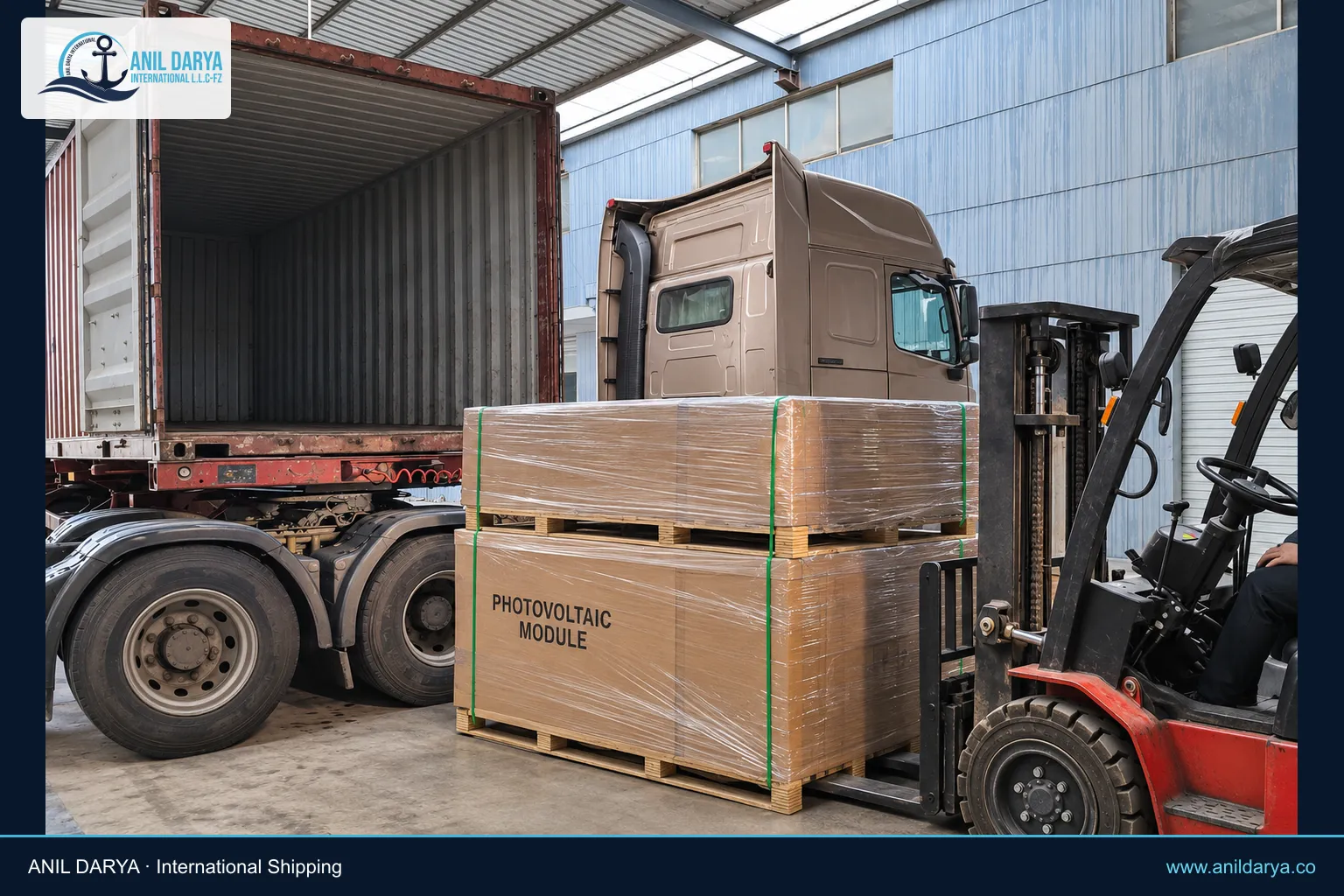
Solar batteries, e-bike batteries, paint, solvents, aerosols and cleaning chemicals usually travel as dangerous goods. They must be declared under the IMDG Code, whose 2024 edition (Amendment 42-24) has been mandatory since 1 January 2026. In China, customs inspects the packaging of exported dangerous goods, so the factory needs its packaging performance and use certificates before a line will take the booking. At Conakry, Maersk says import boxes declared as class 1, 4 or 6.1 go to direct delivery under terminal rules; if your broker cannot take them during the ship's call, they stay on board. Our dangerous goods team checks the UN number, class and packing group against each carrier's rules, including the hub's.
Generators, mining spares and road machinery that fit a flat rack can stay on the container route. Larger units need a multipurpose ship and the conventional berths, which are 8 to 8.5 m deep. Send drawings, weights and lifting points for each piece. See our break bulk and project cargo service.
Vehicles need extra care. trade.gov's Guinea guide (last published 1 May 2024) lists used vehicles over 13 years old as restricted from 15 July 2021, and Maersk's Guinea page applies the same age limit and asks for a technical inspection sheet showing the vehicle is fit for use. The same guide puts a 20% to 30% surtax on vehicles on top of duty.
[AMIR-FACT: confirm with a Conakry broker that the 13-year age limit on used vehicles is still applied in 2026, and what inspection document Guinean customs accepts today]
The China export side: who files what
The export declaration belongs to the Chinese consignor. Shanghai's municipal guide says the consignor, or a broker it appoints, declares the goods once they are inside the customs supervision area and at least 24 hours before loading. Registration as a foreign trade operator is done online through the China International Trade Single Window or the customs website.
- The supplier or its origin agent handles pickup, stuffing, the VGM and the export filing. We send them the booking number, vessel and cut-offs.
- Ask the factory for a copy of the export declaration. The CMA CGM notice on the Guinean BESC lists the export declaration among the four documents needed to issue it.
- Keep the description, quantity and value the same on the export declaration, the commercial invoice and the DDI. A mismatch is the most common reason a file gets queried.
- Ask for a certificate of origin. trade.gov notes Guinean customs require one for certain products under Article 26 of the 2015 Customs Code.
Guinea import customs: BESC, DDI and SYDONIA
We do not sell customs clearance in Guinea. A licensed broker, called a commissionnaire agree en douane (CAD), does that work for the consignee. Before we confirm a booking, we agree with that broker who requests the BESC, who opens the DDI file in GUCEG, and who pays which local charges, so the box never lands in Conakry without a clearance plan.
The BESC (ECTN) cargo tracking note
Guinea has used an electronic cargo tracking note, called BESC or ECTN, since 2018. In an advisory of 13 October 2020, CMA CGM reported that the Ministry of Transport's notice 0082/DNMM/MT/20 of 21 September 2020 made it mandatory for all shipments, including imports bound for Conakry, exports and transit cargo. The carrier said the procedure must be started in time under the shipper's responsibility and named four documents for issuing the BESC and for customs to accept the file:
| Document | Comes from | Check before sending |
|---|---|---|
| Bill of lading | Shipping line, released through us | Consignee and notify party in Guinea, exact description |
| Commercial invoice | Chinese supplier | Same value and goods as the DDI |
| Export declaration | Chinese supplier or its broker | Matches the invoice line by line |
| Freight invoice | Line or forwarder | Needed when the invoice does not show freight, for example FOB |
The BESC covers one bill of lading. Start it from the draft B/L and update it if the hub or vessel changes.
[AMIR-FACT: who applies for the Guinea BESC on our China bookings (shipper, origin agent or consignee's broker), through which platform it is issued in 2026, and the latest point before arrival it can still be validated]
The DVT file, bank domiciliation and the DDI
GUCEG, the Guinean foreign trade single window, opened in September 2019 and is run by Webb Fontaine under a concession from the state. Its DVT (virtual transaction file) module has three steps:
- The importer or its declarant files a declaration of intent to import, with the invoice (final or proforma), the Incoterm, the country of origin and the transport details, plus scanned attachments.
- The importer's bank in Guinea checks the file, especially the commercial invoice, and domiciles the transaction. Imports at or above the threshold set by the authorities must be domiciled with a local bank.
- The DDI fee, calculated by GUCEG, is paid. An agent of the Ministry of Commerce then reviews the file and issues the DDI (declaration descriptive d'importation), which the importer downloads as a PDF.
trade.gov states that a DDI is required for imports above 12 million Guinean francs, about USD 1,250 (guide last published 1 May 2024). Start the DVT as soon as the proforma invoice exists.
Manifest, declaration and payment
The shipping agent lodges the cargo manifest in the GUCEG e-Manifest module. Customs processes it in SYDONIA World, which is linked to GUCEG in real time, and gives it a manifest number. The licensed broker then files the detailed declaration in SYDONIA under the code customs issued to it. GUCEG's payment guide shows duty and tax invoices generated from the declaration, and trade.gov reports that payment can be wired to the Central Bank or made at a commercial bank through the portal, after which a virtual bank receipt lets the goods be cleared. Customs also checks the declared value before release.
Maersk warns that customs may confiscate cargo not cleared 90 days after arrival, and that the shipper and consignee stay jointly liable for unpaid freight and local charges.

Import duty, VAT and trade agreements for Chinese goods
Guinea adopted the ECOWAS Common External Tariff in 2017. trade.gov lists five import duty bands (droit fiscal d'importation): 0% for social goods, 5% for essential goods, raw materials and capital goods, 10% for intermediate products and inputs, 20% for final consumer goods and 35% for specific goods. The same guide says a 10% rate applies to most imports, puts some basic food at 1% to 2%, and adds a surtax of 20% to 70% on luxury items such as alcohol and tobacco. VAT is 18% on taxable goods. Small levies may also apply to the line, so ask your broker to price your exact HS code before you agree a price with the factory. Duty and taxes at destination are paid by the consignee or its broker.
No trade agreement lowers duty on Chinese goods entering Guinea. trade.gov lists a bilateral investment agreement with China, not a trade agreement. Guinea's preferences sit in ECOWAS and the Mano River Union, and it has signed the African Continental Free Trade Area, but all of these reward goods that originate in member states. Goods made in China pay the full CET rate whatever the route.
A Dubai stop does not change that. Goods made in China stay Chinese in origin when they are stored or split in Jafza, and the Dubai certificate of origin for a re-export states the real origin. There is no preference to lose, but keep the factory's origin papers, and ask your broker how the DDI and the valuation will treat a Dubai invoice.
Restricted and prohibited goods in Guinea
| Goods | Rule | Source |
|---|---|---|
| Firearms, ammunition, explosives, military equipment | Restricted | trade.gov (May 2024) |
| Poisonous and narcotic substances | Restricted | trade.gov (May 2024) |
| Products containing asbestos | Restricted | trade.gov (May 2024) |
| Live animals, fresh meat, live plants and soil fertilisers | Restricted | trade.gov (May 2024) |
| Fuel | Restricted | trade.gov (May 2024) |
| Used vehicles over 13 years old | Restricted from 15 July 2021 | trade.gov, Maersk |
| Medicines and pharmaceuticals | Maersk needs approval from its Guinea office before booking | Maersk |
| Frozen poultry, beef, liver and fish | Maersk needs confirmation for consignees that are not regular customers | Maersk |
| Charcoal, used items classed as toxic waste | Not accepted by Maersk | Maersk |
trade.gov notes that the standards body IGNM drafts Guinean standards but that they are rarely enforced. Still ask your broker about labelling and certificates for food, cosmetics or medicines before production.
Routing via Dubai: consolidation, free zone stock and transhipment
A booking straight from China suits most cargo. Dubai helps when you also buy in the Gulf and want one container for Conakry, or keep stock near Jebel Ali and ship as orders come in.
| Option | How it works | What to watch |
|---|---|---|
| Consolidation in Dubai | China goods and Gulf goods are packed into one box for Conakry | One BESC for the final B/L; invoices per origin for the DDI |
| Free zone stock and re-export | Stock waits in Jafza and ships to Guinea order by order | Dubai Chambers issues certificates of origin for re-exports |
| Transhipment at Jebel Ali | The box lands from China and connects to a West Africa sailing | Dubai Customs handles transit as its own regime, apart from import |
Jafza sits next to the port, so storing, relabelling and splitting stock is practical. See our Jebel Ali port guide and our article on re-exporting through Jafza. When cargo is landed, consolidated or re-exported in Dubai, we clear it through UAE customs for a fee.
[AMIR-FACT: whether we route China to Guinea cargo via Jebel Ali in practice, which carriers we use from Jebel Ali to Conakry, and the real extra days compared with a booking straight from China]
Typical cargo on the Conakry lane and the papers each needs
| Cargo | Usual equipment | Papers to plan |
|---|---|---|
| Motorcycles, tricycles and spare parts | 40ft high cube | Model and engine details on the invoice; batteries declared correctly |
| Solar kits, inverters, batteries | 40ft high cube | Lithium batteries as DG with SDS and Chinese packaging certificates |
| Building materials: tiles, steel, sanitary ware | 20ft for heavy lines | Weight per line and an HS code per product |
| Mining and plant spares | FCL, flat rack or breakbulk | Piece list, drawings, lifting plan; check any exemption regime with the broker |
| Textiles, garments, footwear | 40ft or LCL | Fibre content and quantity units in the description |
| Phones, electronics, appliances | FCL or LCL | Brand, model and quantity per line |
Step by step: shipping from China to Guinea with Anil Darya
- Send us the goods, HS codes if known, weight, volume, supplier city, ready date and the delivery point in Guinea.
- Name your customs broker in Conakry. We agree the BESC, the DVT and DDI file and the local charges with them before we confirm the booking.
- Agree the Incoterm, usually FOB China, and check rules for medicines, food, vehicles or DG.
- Your broker or the importer opens the DVT in GUCEG with the proforma invoice and gets the bank domiciliation and the DDI.
- We book the space with the line and send the supplier the booking, the cut-offs and the draft carrier B/L.
- The supplier or its origin agent stuffs the box, files the VGM and lodges the Chinese export declaration.
- We check the draft B/L for consignee, notify party, description, weights and marks; the line issues it after loading, and the BESC is requested on that B/L.
- The carrier B/L is released to you through us. Your broker files the declaration in SYDONIA, pays duty and VAT, and takes the box out within the free time.
[AMIR-FACT: one real China to Guinea cross-trade shipment we handled (cargo, load port, carrier, hub, what we coordinated with the shipper and the Conakry broker, and the outcome), cleared for publication]
What drives the cost of China to Guinea shipping?
We do not print rates, because they change with every sailing. These are the parts of the landed cost and who usually pays each.
| Cost part | What moves it | Usually paid by |
|---|---|---|
| Origin charges in China | Trucking, export filing, terminal handling, LCL consolidation | Supplier under FOB |
| Ocean freight | Box type, season, the hub and the connecting leg, surcharges | Buyer under FOB |
| DG, reefer, out-of-gauge | DG premium, reefer power, flat rack and lashing | Buyer under FOB |
| BESC | Fee per bill of lading | As agreed between shipper and consignee |
| DDI and bank domiciliation | DDI fee calculated in GUCEG, bank charges | Consignee |
| Conakry line and terminal charges | Import service, documentation and port security fees, container deposit | Consignee |
| Duty, VAT and levies | HS code and customs value | Consignee or its broker |
| Demurrage and detention | Late DDI, missing BESC, inspection, slow removal | Whoever caused the delay, under your contract |
Maersk's Guinea tariff, effective 1 April 2021, gives import boxes 9 free calendar days of demurrage for dry, flat rack, open top and IMO units, and 6 for reefers, counted from discharge. Detention adds 5 free days for dry boxes and 3 for reefers. Daily rates rise after day 7 and again from day 15. Maersk also takes a refundable container deposit on merchant haulage imports. Each line sets its own terms, so ask for them with the quote. Our article on demurrage and detention explains how the charges build up.
Checklist before the cargo leaves China
- Incoterm written into the contract and cargo insurance arranged.
- Broker in Conakry named and the clearance plan agreed before booking.
- DVT opened in GUCEG, bank domiciliation done and DDI issued.
- HS code, duty band and VAT checked by the broker.
- Invoice, packing list, export declaration and freight invoice ready for the BESC.
- BESC requested on the B/L and updated if the hub or vessel changes.
- Consignee and notify party in Guinea on the B/L, with an exact description.
- For DG: UN number, SDS, Chinese packaging certificates, carrier and hub approval, and a direct delivery plan for class 1, 4 or 6.1.
Mistakes that hold China cargo at Conakry
- Shipping before destination clearance is agreed. With no broker on the file, nobody follows the DDI or the declaration, and free days run out at the terminal.
- Starting the DVT after the ship sails. The bank and the ministry both review the file, and the DDI must exist before the declaration.
- No BESC, or a BESC on an old routing that no longer matches the B/L.
- Invoice values or descriptions that differ between the export declaration, the DDI and the BESC.
- Booking DG in classes 1, 4 or 6.1 without trucks ready for direct delivery at the ship's side.
- Expecting a trade agreement to cut duty on Chinese goods. Budget for the full CET rate.
Frequently asked questions
Which port in Guinea receives containers from China?
Conakry. Its container terminal has two berths, PQ10 at 270 m and 10.50 m deep and PQ12 at 340 m and 13 m deep, but the access channel limits ships to a 10.00 m draught at low tide.
How long does sea freight from China to Conakry take?
We found no carrier schedule that prints port-to-port days for this lane, and most boxes change ship at a hub. Ask the line for the mother vessel, the hub and the Conakry arrival in writing before you book.
Is the BESC compulsory for Guinea?
Yes. A Ministry of Transport notice of 21 September 2020 made the BESC (ECTN) mandatory for imports to Conakry, exports and transit, according to a CMA CGM advisory. It needs the B/L, invoice, export declaration and freight invoice.
What is the DDI and who issues it?
The DDI is the Guinean import authorisation. The importer requests it in the GUCEG DVT module, the bank domiciles the transaction, and the Ministry of Commerce issues it. trade.gov says it applies above 12 million GNF.
What import duty and VAT apply to goods from China?
Duty follows five bands from 0% to 35% under the ECOWAS CET, with many goods at 10%, and VAT is 18%. Chinese goods get no preferential rate.
Does Anil Darya clear customs in Guinea?
No. A licensed broker in Guinea clears the goods, and duty and taxes at destination are paid by the consignee or its broker. We agree the plan with that broker before we confirm the booking.
Can cargo from China to Guinea go through Dubai?
Yes, for consolidation with Gulf goods, free zone stock in Jafza or transhipment at Jebel Ali. The goods keep their Chinese origin, and we clear them through UAE customs for a fee when they are landed in Dubai.
Get a quote for sea freight from China to Guinea
Tell us the supplier city, the goods, the ready date and your broker in Conakry, and we will come back with a routing, a carrier and a rate. Use our freight rate inquiry form, or contact our team to plan a DG, breakbulk or project move first. You can also read more about our Dubai freight forwarding team.
Sources
- Port Autonome de Conakry: Port installations, berths and channel
- Port Autonome de Conakry: Port concessions (container terminal, Alport)
- Port Autonome de Conakry: Home page (share of foreign trade)
- Port Autonome de Conakry: National report to the IHO EAtHC, May 2024
- AGL: Conakry Terminal facilities and equipment
- Food Business MEA: Conakry Terminal targets 1 million containers by 2030 (September 2026)
- GUCEG: About the Guinea foreign trade single window
- GUCEG: DVT guide, declaration of intent, domiciliation and DDI
- GUCEG: e-Manifest guide for shipping agents
- GUCEG: Online payment of duties and taxes
- CMA CGM advisory: ECTN in the Republic of Guinea (October 2020)
- trade.gov: Guinea import tariffs
- trade.gov: Guinea import requirements and documentation
- trade.gov: Guinea customs regulations
- trade.gov: Guinea trade barriers (VAT)
- trade.gov: Guinea trade agreements
- trade.gov: Guinea prohibited and restricted imports
- trade.gov: Guinea standards for trade
- ECOWAS: Common External Tariff bands
- Maersk: Guinea import information (free time, restrictions, DG delivery)
- Maersk: Guinea export information (Conakry services)
- Maersk: Guinea routes (WAF 7 from Tanger Med)
- Shanghai Municipal Government: Customs registration and export declaration
- CIRS: China Customs inspection of DG packaging for export
- IMO: IMDG Code 2024 edition (Amendment 42-24)
- Dubai Customs: Customs declaration regimes
- Dubai Chambers: Certificates of origin for re-exported goods
- Jafza: About the Jebel Ali Free Zone
Reviewed: 11 November 2026