
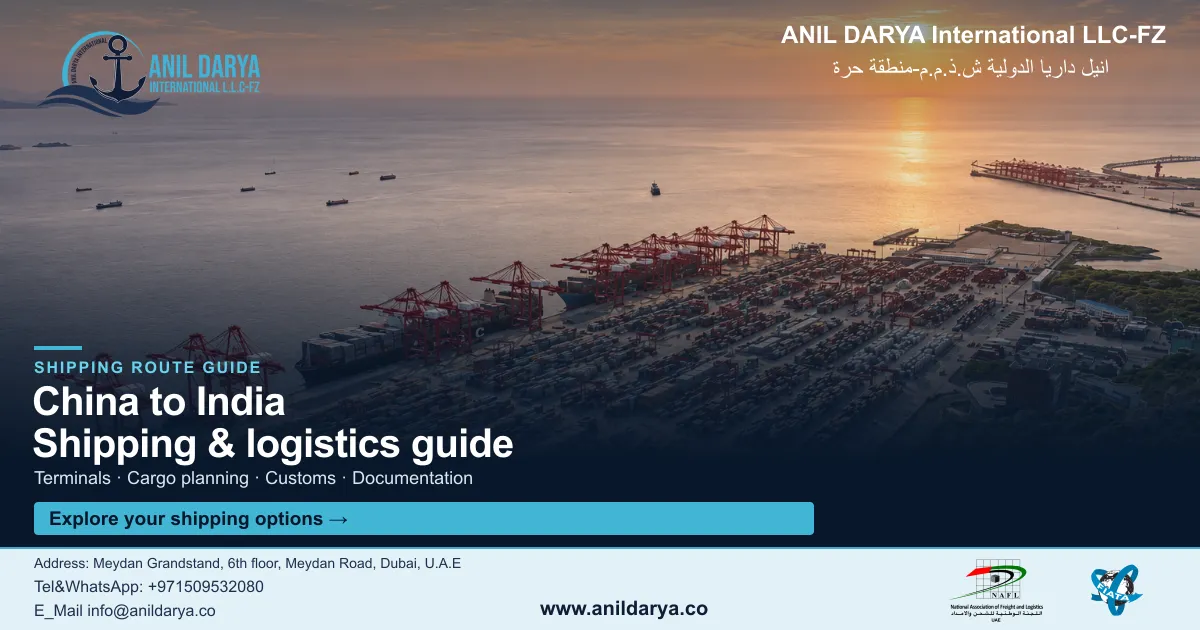
Shipping from China to India is one of the busiest intra-Asia container lanes: boxes load at Shanghai, Ningbo, Shekou, Nansha or Qingdao and discharge mostly at Nhava Sheva and Mundra on the west coast, or at Chennai and Kattupalli in the south. Several lines run same-ship loops from China to India, often with a stop at Singapore or Port Klang on the way. The Chinese supplier files the export declaration, and the Indian importer's customs broker files the bill of entry on ICEGATE. We book the ocean freight from Dubai, release the carrier's bill of lading to you and line up both ends before the box sails.
Shipping from China to India at a glance
| Item | Detail |
|---|---|
| Main modes | Sea FCL, sea LCL, flat rack and open top, breakbulk, dangerous goods by sea |
| Usual Chinese load ports | Shanghai, Ningbo, Shekou and Yantian (Shenzhen), Nansha, Qingdao, Tianjin (Xingang) |
| Main Indian gateways | Nhava Sheva (JNPA): 8,173,276 TEU in FY 2025-26; Mundra: 8.5 million TEU in FY 2024-25 |
| South and east India | Chennai, Kattupalli, Visakhapatnam, Kolkata and Haldia |
| Example same-ship services | Maersk FI2 and FI3, T.S. Lines CWX2, ESL CIX2; Wan Hai CI8 announced for late November 2026 |
| Published transit example | ESL CIX2 brochure: Qingdao to Nhava Sheva 20 days, Qingdao to Mundra 22 days |
| China export filing | Consignor or its customs broker, no later than 24 hours before loading |
| Indian customs | CBIC; bill of entry on ICEGATE, documents uploaded on e-Sanchit |
| Importer IDs | IEC (10 characters, same as the PAN) and GSTIN |
| Import taxes | Basic customs duty by HS code, Social Welfare Surcharge, IGST, plus anti-dumping duty where notified |
| Trade preference | APTA: India and China are both participating states; tariff concessions under Customs Notification 50/2018 |
| Product rules | BIS Quality Control Orders, compulsory registration for listed electronics, partner agency approvals |
| Who clears in India | The consignee's customs broker, agreed before the cargo ships |
How a cross-trade booking on this lane works
The box never touches the UAE; we run the booking from Dubai. The work splits three ways:
- The factory in China, or the forwarder it uses, packs and stuffs the goods and lodges the export declaration with China Customs.
- We get space on the right loop, pass cut-offs to the factory, and check the invoice, packing list and draft B/L against what the Indian bill of entry will need.
- The Indian buyer's customs broker files the bill of entry, the buyer pays duty and IGST, and the broker takes the box out of the port or the inland depot.
The bill of lading you get is the carrier's own. We are agents for many shipping lines, so the line issues its B/L for your cargo and we release it to you once freight is settled. For an Indian buyer, the names on that B/L matter: the consignee should match the importer whose IEC and GSTIN go on the bill of entry, or the bank that opened the letter of credit.
Most Indian buyers purchase FOB China. The supplier then handles export clearance and you choose the carrier and the sailing. If the buyer pays by LC, the credit usually fixes the port of loading and the latest shipment date, so read it before we ask for space. Our article on Incoterms 2020 for sea freight shows where cost and risk pass under each term.
Which Chinese port should India cargo load at?
Pick the port nearest the factory that a China to India loop actually calls at.
| Supplier region | Usual load port | Note for India cargo |
|---|---|---|
| Zhejiang, Jiangsu, Yiwu | Ningbo, Shanghai | First calls on Maersk FI2 and T.S. Lines CWX2; good LCL coverage |
| Guangdong (Shenzhen, Dongguan, Foshan) | Shekou, Yantian, Nansha | Nansha is on FI2; Shekou is on CWX2 and the announced CI8 |
| Shandong | Qingdao | ESL CIX2 calls here; other lines may feed it to Shanghai or a hub |
| Tianjin, Hebei, Beijing area | Tianjin (Xingang) | CIX2 starts here; check every quote for a transhipment |
| Guangxi and inland south-west | Qinzhou | On the announced Wan Hai CI8 rotation |
Nhava Sheva, Mundra, Chennai or the east coast?
Choose the Indian port by where the goods are used. A cheap rate to the wrong coast is soon lost to trucking inside India.
| Indian port | What the operator publishes | Best for buyers in |
|---|---|---|
| Nhava Sheva (JNPA, Navi Mumbai) | 8,173,276 TEU in FY 2025-26, about half of the container cargo of India's major ports | Mumbai, Pune, Maharashtra, central India |
| Mundra (Adani Ports, Gujarat) | 8.5 million TEU in FY 2024-25, including 2.2 million TEU of transhipment | Gujarat, Rajasthan, Delhi NCR, Punjab |
| Hazira (Gujarat) | Now a call on T.S. Lines CWX2 | Surat and south Gujarat |
| Chennai | Container berth CB4 at DP World's terminal, 15 m deep | Tamil Nadu, Karnataka, Bengaluru |
| Kattupalli (Adani, north of Chennai) | Maximum draft 15.0 m | Chennai industrial belt |
| Kolkata and Haldia | River port; draft about 8.5 m to Kolkata and 9 m to Haldia at high tide | East and north-east India |
Many Indian importers clear at an inland container depot near the factory rather than at the seaport. If your buyer wants that, ask the carrier for a through B/L to the ICD before booking, because the bill of entry is then filed at the inland station. The river draft at Kolkata also means only smaller ships go there, so east India cargo can be better off discharged at Visakhapatnam or Chennai. SITC, for example, announced its FIE 1 loop in September 2023 with Chennai and Visakhapatnam calls.
Sea freight from China to India: same-ship loops and hubs
On this lane most boxes stay on one ship from China to India. The ship often calls at Singapore, Port Klang or Tanjung Pelepas on the way, but your container is not unloaded there. A real transhipment, where the box changes ship at a hub, adds handling and waiting time.
| Service (carrier) | Published rotation | Note |
|---|---|---|
| FI2 (Maersk) | Shanghai, Ningbo, Nansha, Tanjung Pelepas, Nhava Sheva, Pipavav, Port Qasim | First westbound sailing from Shanghai on 4 June 2026; Maersk runs it next to its FI3 loop |
| CWX2 (T.S. Lines) | Shanghai, Ningbo, Shekou, Port Klang West, Nhava Sheva, Hazira, Mundra, Port Klang West | 42-day rotation; Hazira added in September 2026 |
| CIX2 (Emirates Shipping Line) | Xingang, Qingdao, Kaohsiung, Singapore, Port Klang, Nhava Sheva, Mundra, Colombo | 7 ships of 4,200-7,200 TEU; 49-day round trip; Qingdao to Nhava Sheva 20 days, to Mundra 22 days |
| CI8 (Wan Hai) | Haiphong, Qinzhou, Nansha, Shekou, Port Klang Northport, Mundra, Nhava Sheva | Announced for late November 2026; 2,800-3,000 TEU ships, 35-day cycle |
The CIX2 transit figures come from ESL's launch brochure of April 2024, and they match the weekday berthing windows in the same brochure. Loops on this lane change often, so we confirm the current rotation and the cut-off for your actual sailing.
[AMIR-FACT: the carriers and services we actually book from China to India, which are same-ship and which tranship (and where), and our real port-to-port days from Shanghai/Ningbo and from Shekou/Nansha to Nhava Sheva, Mundra and Chennai]
FCL, LCL, DG and project cargo to India
| Option | Typical China to India cargo | What to plan |
|---|---|---|
| 20ft dry | Chemicals in drums, steel parts, tiles, dense machinery spares | Gross weight limits of the line and of Indian road transport |
| 40ft dry or high cube | Electronics, solar modules, furniture, textiles, consumer goods | One HS code per line on the invoice; the BIS status of each item |
| LCL | Samples, first orders, mixed cartons from several factories | The box is opened at a CFS in India; each consignee files its own entry |
| Flat rack or open top | Presses, generators, transformers slightly out of gauge | Carrier approval, lashing survey, ICD acceptance if moving inland |
| Breakbulk | Plant equipment, heavy lifts for projects | Ship availability, port crane capacity, road permits in India |
LCL works well for a first order, but every consignee in the shared box waits for the slowest paperwork at the Indian CFS. When your volume gets close to a 20ft, price both. Our FCL vs LCL guide shows where the break-even usually falls, and our sea freight service covers booking and equipment.
India buys many regulated goods from China: lithium batteries, paints, adhesives, dyes, pesticides and industrial chemicals. These ship under the IMDG Code, and its 2024 edition (Amendment 42-24) became mandatory on 1 January 2026. China Customs inspects the packaging of exported dangerous goods, so the factory needs a packaging performance certificate and a use certificate for the filled packages before a Chinese terminal takes the box. We confirm the carrier accepts your UN number for both the load port and the Indian discharge port before the factory packs. Our dangerous goods team checks the SDS, the DG declaration and the labels.
For project cargo, a piece that fits a flat rack can stay on a container loop with weekly sailings. Anything larger needs breakbulk tonnage, and the ship date then drives the whole plan. Send drawings, weights and lifting points early. Our break bulk and project cargo service plans the sea leg.
The China export side: who files what
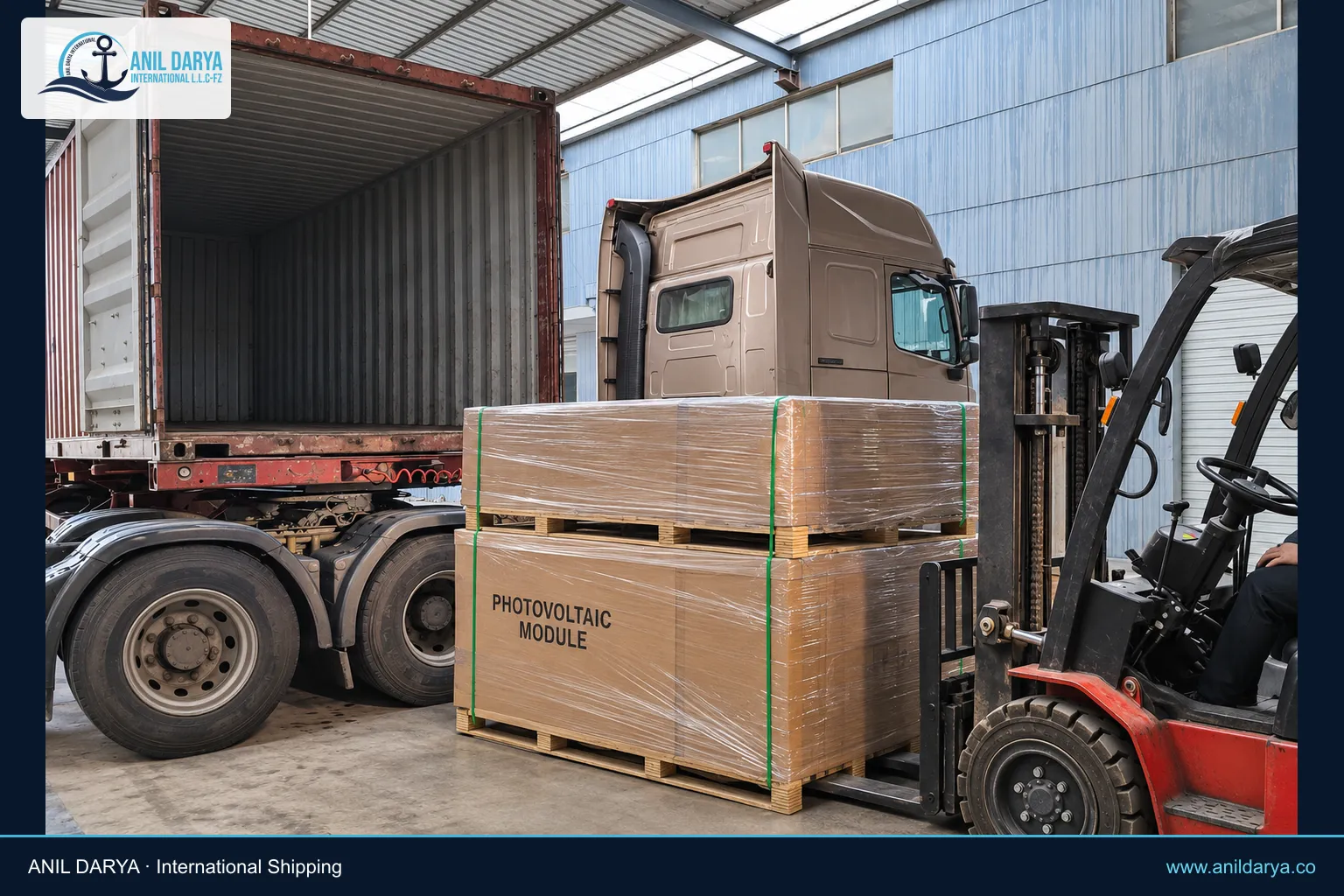
China Customs puts the export declaration on the consignor. The Shanghai municipal government's guide says the consignor, or a customs broker it appoints, declares the goods once they are in the customs supervision area and no later than 24 hours before loading. The consignor must also be registered as a foreign trade operator, which it can apply for through the China International Trade Single Window.
- We send the factory or its origin forwarder the booking number, the cut-offs and the vessel.
- The value, quantity and description on the Chinese declaration should match the invoice your Indian broker will upload.
- If the goods may qualify for APTA, the supplier applies for the APTA certificate of origin at export, not weeks later.
What the Indian buyer must have before you book
Check the importer's paperwork first.
- IEC: DGFT allots a 10-character code that is mandatory for any import, and since GST it is the same as the entity's PAN.
- GSTIN: CBIC tells importers to quote it on the bill of entry so they can take credit for the IGST paid at import.
- A customs broker at the discharge port or the ICD, named before booking.
- Product compliance in place: BIS licence or registration, and any partner agency approval the goods need.
We do not sell customs clearance in India. Before we confirm your booking, we agree with the buyer's broker which documents it needs, in what form and by when. That one step prevents most delays on this lane.
Bill of entry on ICEGATE: documents and deadline
Imports into India are declared on ICEGATE, the Indian Customs portal, through a bill of entry filed by the importer or its broker. Under Section 46 of the Customs Act, 1962, the bill of entry must be presented before the end of the day before the ship arrives. ICEGATE allows a prior bill of entry, which stays valid if the vessel arrives within 30 days of filing. Late filing without good reason brings a late presentation charge.
Supporting documents go up as PDFs on e-Sanchit. ICEGATE lists four mandatory documents under DGFT Notification 08/2015-2020:
| Document | Who provides it | What to check on a China shipment |
|---|---|---|
| Bill of lading | Shipping line, released through us | Consignee and notify party match the importer or its bank |
| Commercial invoice | Chinese supplier | Incoterm, currency, unit prices and HS codes per line |
| Packing list (or invoice cum packing list) | Chinese supplier | Weights and package counts match the B/L |
| Bill of entry | Importer's customs broker | Filed before the deadline, GSTIN quoted |
| Certificate of origin | Issuing body in China | Only if claiming APTA; issuing authority entered correctly |
| Agency approvals | Importer | BIS, food, plant or other agency papers for that HS code |
- The carrier files the import manifest for the vessel.
- The broker uploads the documents and files the bill of entry.
- Customs assesses value and HS code and either releases on risk rules or orders an examination.
- The importer pays duty and IGST. Self-assessed duty is due on the day the bill of entry is presented.
- After the out-of-charge order and the line's delivery order, the box leaves the port or ICD.
What duty and IGST does India charge on goods from China?
There is no single rate. The HS code decides the duty, and the broker should confirm it before your buyer sets a price. Duty and taxes at destination are paid by the consignee or its broker.
| Charge | How it is worked out | Recoverable by the buyer? |
|---|---|---|
| Basic customs duty (BCD) | Rate in the Customs Tariff for the HS code, on the assessable value | No |
| Social Welfare Surcharge | A share of BCD; 10% of BCD in CBIC's own example | No |
| IGST | On the assessable value plus BCD and other customs duties | Yes, as input tax credit when the GSTIN is quoted |
| Anti-dumping or safeguard duty | Only on the goods and origins named in a notification | No |
| GST compensation cess | Only on certain goods | Yes, as credit |
For China cargo, run the anti-dumping check early. Ask your broker whether a current notification names your HS code with Chinese origin, and whether the producer on your invoice has its own rate, before you commit to the order.
APTA: the duty preference most shippers miss
India and China are both participating states of the Asia-Pacific Trade Agreement (APTA). The 2005 agreement text, published by India's Export Inspection Council, lists Bangladesh, China, India, Lao PDR, the Republic of Korea and Sri Lanka as the signing governments. India gives its APTA tariff concessions through Customs Notification 50/2018 of 30 June 2018. Each concession is a percentage cut of the applied rate for a listed tariff line, and the importer must prove the goods' origin to customs.
The cut applies to customs duty on listed lines only. IGST is still charged in full. Three conditions decide whether you get it:
- Origin: the goods must meet the APTA origin rules for that product.
- Certificate: Rule 7 requires a certificate of origin issued by the authority China's government has designated, in the APTA format.
- Direct consignment: under Rule 5, goods may pass through a third country only for transport reasons. They must not enter trade or consumption there, and must not undergo any work beyond unloading, reloading or keeping them in good condition.
India adds its own checks. The CAROTAR 2020 rules (Notification 81/2020-Customs (N.T.), in force since 21 September 2020) require the importer to file certain declarations on the bill of entry when claiming a preferential rate. The Nhava Sheva custom house warned in Public Notice 126/2020 that many filings gave a certificate-issuing authority that did not match the country of origin, and that these fields drive risk assessment. Your broker must key the APTA certificate details exactly.
[AMIR-FACT: whether our Indian consignees actually claim APTA rates on China cargo, for which product groups, and which issuing body in China their suppliers use for the certificate]
BIS certification and other product rules
India's Foreign Trade Policy says domestic laws, technical specifications and safety and health norms that apply to goods made in India apply equally to imports, unless specifically exempted. For China cargo, the rule that bites most often is BIS certification.
BIS certification is voluntary in principle. But for a growing list of products, the government issues Quality Control Orders (QCOs) that make the Standard Mark mandatory under a BIS licence or certificate of conformity. BIS runs separate schemes, including Scheme I (the ISI mark) and Scheme II (registration, used for listed electronics and IT goods). The Chinese factory itself needs the licence or registration, usually model by model, before goods ship. BIS also publishes a list of QCOs notified and due for implementation, so check the date your product becomes covered.
- Electronics and IT goods under the Compulsory Registration Order must be registered. The Foreign Trade Policy treats unregistered products as prohibited.
- Some goods, food for example, also need a partner government agency (PGA) approval. ICEGATE lists PGA papers among the documents a bill of entry may need, depending on the HS code.

Restricted and prohibited goods
India's import policy sorts every HS code as free, restricted (import only with an authorisation) or prohibited. A few groups come up often on China orders:
| Goods | Rule |
|---|---|
| Second-hand desktop computers, refurbished laptops and PC spares | Restricted, authorisation needed |
| Second-hand air conditioners and diesel generating sets | Restricted, authorisation needed |
| Second-hand goods other than capital goods | Restricted |
| Refurbished spares of capital goods | Free only with a chartered engineer certificate showing at least 80% residual life |
| Metal scrap | Must be free of hazardous, toxic or radioactive waste, arms and explosives |
| Gifts through post or courier | Prohibited, with narrow exceptions |
Genuine trade samples of most restricted items need no authorisation; defence items, seeds, bees and new drugs are the exceptions.
Typical cargo on this lane and the papers it needs
| Cargo | Usual equipment | Papers and checks |
|---|---|---|
| Mobile phone parts, chargers, LED lights, laptops | 40ft or LCL | BIS registration per model, new goods only |
| Solar modules and lithium batteries | 40ft high cube | BIS status, batteries shipped as DG with SDS |
| Machinery and spare parts | 40ft, flat rack or breakbulk | ISPM-15 crates, APTA check on the HS line, chartered engineer certificate if refurbished |
| Organic chemicals, dyes, APIs | DG-approved dry box or ISO tank | SDS, Chinese packaging certificates, anti-dumping check |
| Toys, furniture, kitchenware | 40ft high cube | BIS QCO status for each product type |
| Fabric and garment trims | 40ft or LCL | Exact fibre content on the invoice |
Routing via Dubai: when it helps
A direct China to India booking is the simple path. Dubai helps only when your supply chain already runs through the UAE. A trader can hold China stock in Jafza next to Jebel Ali and ship to Indian customers order by order, or combine China goods with cargo bought in the Gulf in one container for Nhava Sheva or Mundra. Dubai Chambers issues certificates of origin for re-exported goods.
Watch the APTA rule here. Stock that is stored and sold from Dubai has entered trade outside China, and APTA's direct consignment rule then fails. Even a transit stop must stay within unloading and reloading. If your buyer plans to claim APTA, ship direct from China, and confirm any Dubai routing with the Indian broker first.
Our Jebel Ali port guide and our note on re-exporting through Jafza explain that set-up. If your India-bound goods are landed or stored in Dubai, UAE customs clearance is ours, for a fee.
[AMIR-FACT: whether we have routed China to India cargo through Dubai (consolidation or Jafza stock), the carriers used from Jebel Ali to Nhava Sheva or Mundra and the real extra days compared with a direct China sailing]
Step by step: shipping from China to India with Anil Darya
- Send us the goods, HS codes, weight, volume, the factory city, the ready date and the delivery point in India.
- Name the buyer's customs broker. We agree with the broker what it needs, and who pays which charges at the Indian port, before we confirm the booking.
- Confirm the importer's IEC and GSTIN, the payment terms and, for LC cargo, the LC terms.
- Check the HS code for BIS coverage, restrictions, anti-dumping duty and APTA eligibility.
- We book a loop to the right Indian port or ICD and send the factory the booking and cut-offs.
- The factory or its origin agent stuffs and seals the box and files the Chinese export declaration.
- We check consignee, notify party, HS codes, weights and seal numbers on the draft B/L against the invoice.
- The line issues its B/L after loading, and we release it to you or the bank once freight is paid.
- The broker files the bill of entry before arrival, the buyer pays duty and IGST, and the box is delivered. We follow the shipment until release.
[AMIR-FACT: one real China to India cross-trade shipment we handled (cargo, load port, Indian port or ICD, carrier, what we coordinated and the outcome), cleared for publication]
What drives the cost of shipping from China to India?
Rates move with every sailing, so we quote per shipment. These are the parts of the landed cost.
| Cost part | What moves it | Usually paid by |
|---|---|---|
| Origin charges in China | Trucking, export filing, terminal handling, LCL consolidation | Supplier under FOB |
| Ocean freight | Box type, season, loop or transhipment, surcharges | Buyer under FOB |
| DG and out-of-gauge | DG surcharges, flat rack premiums, lashing | Buyer under FOB |
| Indian port charges | Terminal handling, delivery order, CFS fees for LCL | Consignee |
| Duty and taxes | HS code, value, APTA claim, anti-dumping duty | Consignee or its broker |
| Inland move | Truck or rail to the ICD or factory | Consignee |
| Detention and demurrage | Late documents, BIS issues, examinations | Whoever caused the delay, under your contract |
Free days at the Indian end run out fast when papers are late. Our article on demurrage and detention shows how those charges build.
Checklist before the cargo leaves China
- Indian customs broker named and the clearance plan agreed before booking.
- IEC and GSTIN valid and matching the B/L consignee.
- HS code agreed; duty, anti-dumping duty and APTA eligibility checked.
- BIS licence or registration in hand for every covered model.
- APTA certificate of origin applied for at export, if claiming.
- Invoice, packing list and B/L show the same weights and package counts.
- For DG: carrier acceptance, SDS and Chinese packaging certificates.
- Documents sent to the broker in time for a bill of entry before arrival.
Mistakes that hold cargo at the discharge port
- Shipping before destination clearance is agreed. With no broker ready, the bill of entry misses its deadline and free days run out.
- Shipping BIS-covered goods from a factory without a licence or registration for that model.
- Claiming APTA without an APTA-format certificate, or after storing the goods in a third country.
- Keying the wrong certificate-issuing authority on the bill of entry.
- Buying used or refurbished goods that need an authorisation.
- Booking to Nhava Sheva for a buyer in Delhi without checking a Mundra loop or an ICD through B/L.
Frequently asked questions
How long does sea freight from China to India take?
It depends on the loop and the ports. ESL's CIX2 brochure shows 20 days from Qingdao to Nhava Sheva and 22 days to Mundra. Add time for Indian clearance and any inland move, and ask for the schedule of your actual sailing.
Which Indian port is best for cargo from China?
Nhava Sheva for Mumbai, Pune and central India, Mundra for Gujarat and the north, and Chennai or Kattupalli for the south. For east India, compare Kolkata with Visakhapatnam, since only smaller ships reach Kolkata.
Are there direct ships from China to India?
Yes. Maersk FI2, T.S. Lines CWX2 and ESL CIX2 carry boxes from Chinese ports to Nhava Sheva or Mundra on the same ship, with calls in Southeast Asia on the way. Wan Hai has announced CI8 for late November 2026.
Do goods from China get lower duty in India?
Some do, under APTA. India's Notification 50/2018 cuts customs duty by a set percentage on listed tariff lines, if the goods meet APTA origin rules, travel direct and carry an APTA certificate. IGST is not reduced.
What documents does Indian customs need for imports from China?
The bill of lading, commercial invoice, packing list and bill of entry, uploaded on e-Sanchit. Add a certificate of origin when claiming APTA, plus BIS or other agency papers when the HS code needs them.
Does my Indian buyer need an IEC?
Yes. The DGFT says no import can be made without an IEC unless specifically exempted. It is a 10-character code that matches the importer's PAN.
Does Anil Darya clear customs in India?
No. The buyer's customs broker files the bill of entry, and duty and taxes at destination are paid by the consignee or its broker. We agree the plan with that broker before we confirm the booking and send documents on time.
Can I ship lithium batteries from China to India?
Yes, as dangerous goods under the IMDG Code, with an SDS, a DG declaration, UN-approved packaging and the Chinese packaging certificates. Check the BIS status of the battery or the device that contains it before shipping.
Get a quote for shipping from China to India
Send us the factory city, the goods with HS codes, the ready date, the Indian port or ICD and your broker's details, and we will come back with a routing, a carrier and a price. Use our freight rate inquiry form, or contact our team to plan a DG or project shipment first. You can also read about our Dubai freight forwarding team.
Sources
- Maersk: FI2 service launch, Far East Asia to India Subcontinent, May 2026
- Maritime Gateway: T.S. Lines adds Hazira to CWX2, September 2026
- Emirates Shipping Line: CIX2 China India Express Service 2 brochure (rotation, ships, transit table)
- Maritime Gateway: Wan Hai CI8 service announced, October 2026
- Construction World: SITC FIE 1 service to Chennai and Visakhapatnam, September 2023
- JNPA: Operating performance profile FY 2025-26
- JNPA: Overview (share of major-port container cargo)
- APSEZ Annual Report 2025: Ports (Mundra TEU and transhipment)
- DP World: Chennai Container Terminal infrastructure
- Adani Ports: Kattupalli Port
- Syama Prasad Mookerjee Port, Kolkata: Draft forecast
- ICEGATE: FAQ (prior bill of entry, e-Sanchit mandatory documents)
- CBIC: Customs Act, 1962 (Sections 46 and 47)
- CBIC: Guidance note for importers and exporters on IGST
- CBIC: Customs clearance at a glance (SWS as a share of BCD)
- DGFT: Foreign Trade Policy 2023, Chapter 2 (IEC, domestic laws, samples, second-hand goods, scrap)
- Export Inspection Council of India: Asia-Pacific Trade Agreement text and rules of origin
- Text of Customs Notification 50/2018 of 30 June 2018 (APTA tariff concessions)
- Jawaharlal Nehru Custom House: Public Notice 126/2020 on CAROTAR 2020
- Bureau of Indian Standards: Products under compulsory certification
- Shanghai Municipal Government: Customs registration and export declaration
- CIRS: China Customs inspection of DG packaging for export
- IMO: IMDG Code 2024 edition (Amendment 42-24)
- Dubai Chambers: Certificates of origin for re-exported goods
- Jafza: About the Jebel Ali Free Zone
Reviewed: 11 November 2026