
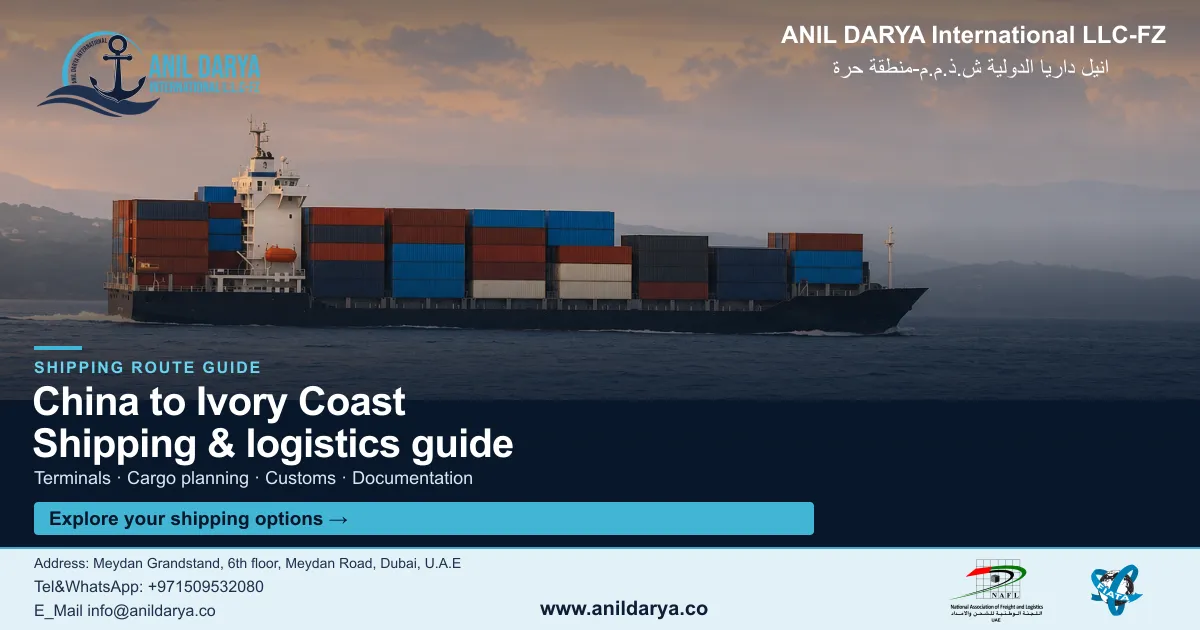
Shipping from China to Ivory Coast usually means a container loaded at Qingdao, Shanghai, Ningbo, Xiamen or Nansha and discharged at Abidjan, with San Pedro as the second port in the west of the country. Before the box sails, the Ivorian importer needs a cargo tracking note (BSC) and, for regulated goods, a certificate of conformity issued in China. We book the sea freight from Dubai, release the shipping line's bill of lading to you and line up the factory and your Ivorian customs broker before the booking is confirmed.
Shipping from China to Ivory Coast at a glance
| Item | Detail |
|---|---|
| Main modes | Sea FCL, sea LCL, reefer, flat rack, breakbulk and dangerous goods by sea |
| Usual Chinese load ports | Qingdao, Shanghai, Ningbo, Xiamen, Nansha (Guangzhou), Shekou (Shenzhen) |
| Main Ivorian port | Abidjan: 1,697,131 TEU and 46.6 million tonnes in 2025 |
| Deep-water box terminal | Cote d'Ivoire Terminal (CIT), Abidjan: 1,100 m quay, 16 m draft, 1.5 million TEU a year |
| Second port | San Pedro: channel dredged to 13.5 m, 9 to 12 m alongside, over 7.4 million tonnes in 2024 |
| Published transit example | ONE SW2 to Abidjan: 29 days from Nansha, 34 from Ningbo, 39 from Qingdao (carrier brochure, October 2024) |
| Before loading | BSC cargo tracking note from the OIC; certificate of conformity for regulated goods |
| Customs filing | FDI pre-declaration and declaration through the GUCE single window and SYDAM World |
| Import duty | ECOWAS Common External Tariff: 0%, 5%, 10%, 20% or 35% of CIF value |
| VAT | 18% on CIF value plus duties and taxes |
| Who clears in Cote d'Ivoire | The consignee or its licensed customs broker, agreed before the cargo ships |
How a cross-trade booking from China to Abidjan works
The container goes straight from China to West Africa. We run the booking from Dubai, and each party has a clear job.
- The Chinese factory, or the forwarder it uses, packs the goods, stuffs the box and files the Chinese export declaration.
- We reserve space with the shipping line, check that the invoice, packing list and draft B/L meet Ivorian rules, and keep everyone on the vessel cut-offs.
- Your broker in Cote d'Ivoire files the pre-declaration and the customs entry, pays duty and VAT from the consignee's funds and takes delivery at Abidjan or San Pedro.
You receive the carrier's own bill of lading. Anil Darya is an agent for many shipping lines, so the line issues its B/L and we hand it over to you once freight is settled. At Abidjan, the line's local office and the terminal deal with that same document, which keeps the release chain short.
Pay attention to the consignee box on that B/L. Maersk's import notes for Ivory Coast say the consignee or notify party must be located in Cote d'Ivoire or a neighbouring country, and that consignee addresses in Europe or Asia are not accepted on the B/L or manifest. If a trading company in Dubai buys from China and sells to an Ivorian buyer, put the Ivorian buyer (or its local notify party) on the bill.
FOB China suits most Ivorian buyers: the supplier clears the goods for export and you control the ocean leg and the arrival. Avoid EXW unless you have someone in China who can act as exporter. See our guide to Incoterms 2020 for sea freight.
Which Chinese ports to load at for Abidjan and San Pedro
Pick the port closest to the factory, then confirm that a West Africa loop calls there. The services we checked collect cargo at these ports.
| Supplier region | Load port | West Africa calls found |
|---|---|---|
| Shandong and the north | Qingdao (Tianjin cargo may feed in) | First Chinese call on ONE SW2 and Maersk FEW3 and FEW1 |
| Shanghai, Jiangsu | Shanghai | ONE SW2 |
| Zhejiang and Yiwu | Ningbo | ONE SW2, Maersk FEW3 and FEW1 |
| Fujian | Xiamen | ONE SW2 |
| Guangdong | Nansha, Shekou | Nansha on all three loops; Shekou on Maersk FEW1 |
Nansha is the last Chinese call on these loops, so it has the shortest sea time.
Abidjan or San Pedro: choosing the Ivorian port
Abidjan takes most of the country's container traffic. The Port Autonome d'Abidjan reported 1,697,131 TEU in 2025, up from 1,646,304 TEU in 2024, and total traffic of 46.6 million tonnes. Two container terminals sit side by side. Cote d'Ivoire Terminal (CIT), run by a joint venture of APM Terminals and Africa Global Logistics, opened in November 2022 with a 1,100 m quay, a 16 m maximum draft, six post-panamax cranes and 1,100 reefer plugs. The older Abidjan Terminal next to it has a maximum draft of 11.5 m. On the ONE and Maersk loops we checked, ships from China discharge at CIT.
San Pedro, in the south-west, is a different kind of port. The Port Autonome de San Pedro describes itself as the world's leading cocoa export port, shipping more than one million tonnes of cocoa a year. Its access channel is dredged to 13.5 m, quays offer 9 to 12 m alongside, and the concessioned container terminal works with four mobile cranes. Traffic passed 7.4 million tonnes in 2024. Maersk lists San Pedro as a discharge port in its Ivory Coast tariffs, but most Far East loops end their Ivorian call at Abidjan, so San Pedro cargo may need a feeder or a truck from Abidjan.
Sea freight from China to Ivory Coast: services and published transit days
Most sailings are weekly loops that load at several Chinese ports, stop in Southeast Asia and cross to West Africa on the same ship. Three examples from carrier pages:
- ONE SW2: Qingdao, Shanghai, Ningbo, Xiamen, Nansha, Singapore, Abidjan, Tema, Apapa, then Lekki or Onne on alternate weeks. Abidjan is the first West African call.
- Maersk FEW3, from late March 2026: Qingdao, Ningbo, Nansha New Port, Tanjung Pelepas, Tema, Abidjan, Pointe Noire.
- Maersk FEW1, from 31 March 2026: Qingdao, Ningbo, Nansha New Port, Shekou, Singapore, Abidjan, Lekki, Kribi, Vung Tau.
ONE publishes westbound port-to-port days for SW2 in its October 2024 brochure. We read the table on the rendered page and checked the direction labels: the rows are the Chinese load ports and the columns are the West African discharge ports.
| Load port (ONE SW2) | Days to Abidjan |
|---|---|
| Qingdao | 39 |
| Shanghai | 36 |
| Ningbo | 34 |
| Xiamen | 32 |
| Nansha | 29 |
These are one carrier's 2024 schedule figures, not a promise for every sailing. Rotations change, and transhipped bookings take longer. Ask for the vessel on each leg and any transhipment port before you book.
[AMIR-FACT: the carriers and services we actually book from China to Abidjan and San Pedro, whether each is direct or transhipped (and where), and our real port-to-port transit days from north China and south China]
Container shipping China to Ivory Coast: FCL, LCL and reefer
| Option | Typical cargo from China | What to plan for in Cote d'Ivoire |
|---|---|---|
| 20ft dry | Ceramic tiles, steel bar, cables, pumps | Maersk accepts 20ft and 40ft boxes up to payload capacity |
| 40ft dry or high cube | Furniture, solar modules, motorcycles, household goods | 45ft boxes are not accepted on Maersk's Ivory Coast service |
| LCL | Trial orders, spare parts, mixed small lots | Each consignee in the box needs its own BSC and papers before release |
| Reefer | Frozen food, some pharmaceuticals and chemicals | Plug-in fees at the terminal are billed apart from demurrage |
| Flat rack or open top | Machinery slightly over standard height or width | Carrier acceptance and a road route to site |
Maersk does not accept "pallets" as a package description or "general cargo" as a cargo description for Ivory Coast, and it lists retread tyres as a restricted commodity. Buying from several factories in one province? Consolidate them into one FCL: one B/L, one BSC and one entry cost less than several LCL files. Our FCL vs LCL guide explains where the switch usually pays, and our sea freight service covers booking and equipment.
Dangerous goods, breakbulk and project cargo to Cote d'Ivoire
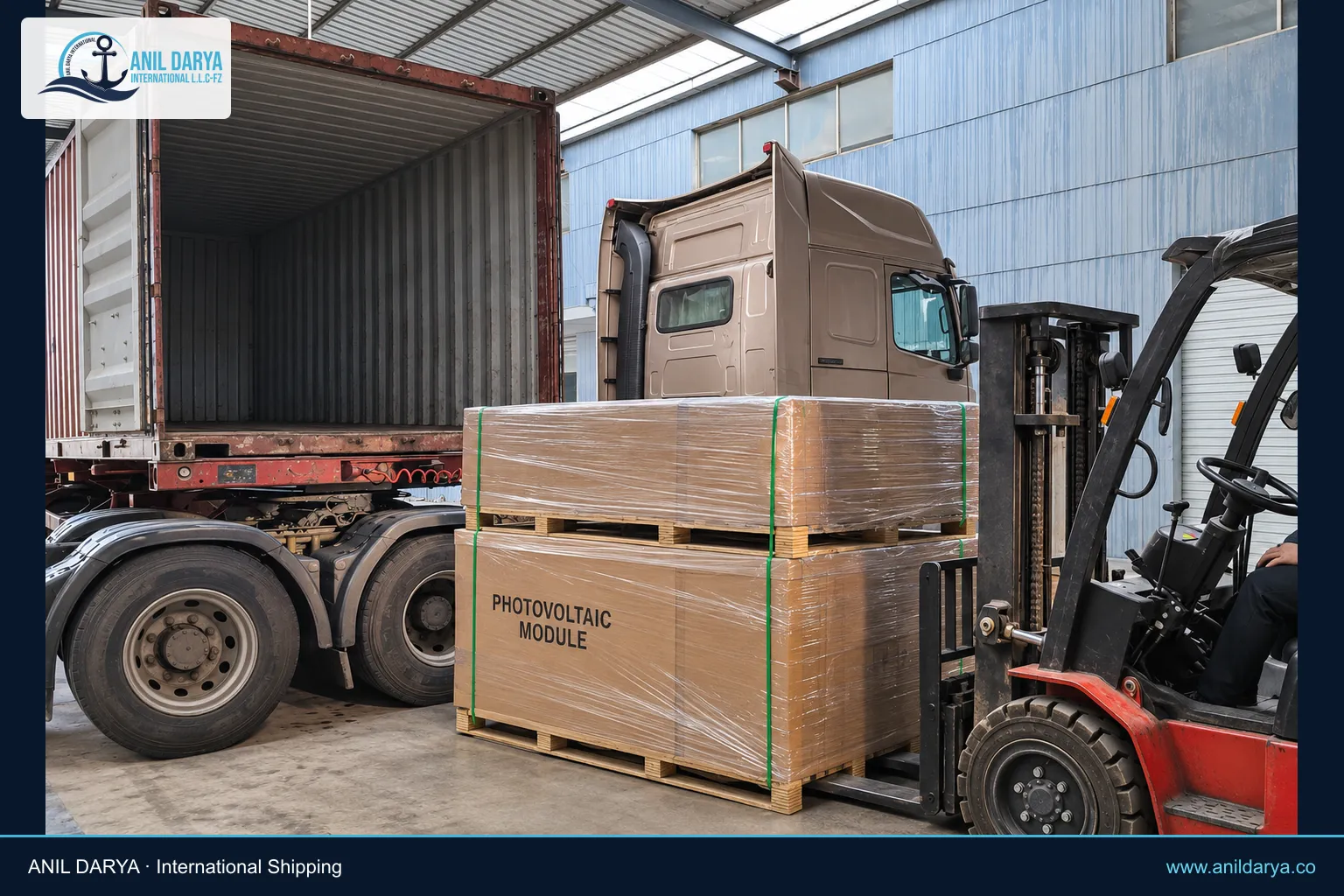
Lithium batteries for solar kits and e-motorbikes, paints, resins, aerosols and cleaning chemicals all travel as dangerous goods. They are declared under the IMDG Code, and its 2024 edition (Amendment 42-24) became mandatory on 1 January 2026, so the safety data sheet and DG declaration from the Chinese supplier must follow it.
Two extra papers apply on this lane. On the China side, customs checks packaging for exported dangerous goods, so the supplier needs a packaging performance certificate and a certificate for the filled packages before any line will take the booking. On the Ivorian side, Maersk asks for a letter of indemnity, signed and stamped by both the consignee and the shipper, for every dangerous cargo shipment to Ivory Coast, with no exceptions. Our dangerous goods team checks the UN number, class and packing group against carrier acceptance before you pay a deposit.
Generators, crushers, transformers and steel structures for mines, power plants and factories often exceed a standard box. A piece that fits a flat rack can still ride a container ship to CIT. Anything larger moves as breakbulk on a multipurpose or heavy-lift ship, and that ship's sailing date drives the whole plan. San Pedro has also brought a multipurpose industrial terminal (TIPSP) into service. Send drawings, weights, lifting points and the centre of gravity for each piece. See our break bulk and project cargo service.
The China export side: who files what
Chinese customs law places the export declaration on the consignor. The Shanghai municipal government's guide says the consignor, or a customs broker it appoints, declares the goods after they enter the customs supervision area and at least 24 hours before loading. The consignor must also be registered as a foreign trade operator, which it can do through the China International Trade Single Window.
- The supplier or its origin forwarder handles pickup, stuffing and the export filing. We send them the booking number, cut-offs and vessel details.
- Make the goods description, quantity and value on the Chinese export declaration match the invoice your Ivorian broker uses. Ivorian customs sets the customs value from the documents, and gaps invite questions.
- Ask the factory to issue the commercial invoice in French. Both trade.gov and Germany's trade agency GTAI say the invoice should be in French.
- Order a certificate of origin with the invoice. trade.gov lists it among the core documents for most imports.
Cote d'Ivoire import customs: BSC, FDI, GUCE and the RFCV
Ivorian clearance starts before the ship leaves China. We do not sell customs clearance in Cote d'Ivoire. Your broker handles it, and we confirm the plan with that broker before we confirm the booking, so the box never reaches Abidjan without someone ready to clear it.
The first paper is the BSC (Bordereau de Suivi des Cargaisons), the cargo tracking note run online by the Office Ivoirien des Chargeurs (OIC), the Ivorian shippers' council. GTAI states that an electronic BSC is mandatory for sea freight and must be requested from the OIC at the loading stage, with the exporter, carrier or forwarder and importer registered. Maersk's import notes add that customs clearance is not possible without the BSC, so the cargo cannot be delivered. The BSC number also goes on the bill of lading. In September 2025 the OIC trained customs officers in San Pedro on using the BSC to estimate customs value before arrival.
Then the importer files a pre-declaration, the FDI (Fiche de Declaration a l'Importation), electronically through the GUCE foreign trade single window. trade.gov says the FDI must be validated before the goods arrive. For most commercial shipments customs then issues a final classification and value report, the RFCV, which is needed before clearance and release. The customs declaration itself is lodged in SYDAM World, the Ivorian version of ASYCUDA, and duties are paid through GUCE.
| Document | Who provides it | What to check |
|---|---|---|
| BSC number | Requested through the OIC platform before loading | Number shown on the B/L before loading |
| FDI pre-declaration | Importer or its broker, in GUCE | Validated before the vessel arrives |
| Bill of lading | Shipping line, released through us | Consignee or notify party in Cote d'Ivoire |
| Commercial invoice | Chinese supplier | In French, with HS code, origin and price per line |
| Packing list | Chinese supplier | Matches cartons, marks and weights on the B/L |
| Certificate of origin | Chinese supplier | Same consignee and goods as the invoice |
| Certificate of conformity | Approved inspection company | Issued before loading for regulated goods |
| Permits | Consignee, from the ministry concerned | Medicines, cosmetics, alcohol, textiles and other controlled goods |
Most importers use a licensed customs broker (commissionnaire en douane agree). GTAI notes that the 2022 Customs Code no longer makes a broker compulsory, but the broker holds the GUCE and SYDAM access. If you disagree with the value set in an RFCV, the douanes.ci FAQ explains that the case can go to the Comite d'Arbitrage de la Valeur.
Certificate of conformity (VoC) for goods from China
This is where many first shipments from China go wrong. Cote d'Ivoire runs a verification of conformity (VoC) programme for regulated imports. Inspection companies approved by the government check the goods in the exporting country and issue a certificate of conformity (CoC) before loading. France's Treasury listed the approved firms as Bureau Veritas, Cotecna, Intertek and SGS, and gave the qualifying threshold as a FOB value of 1 million FCFA.
The regulated families are broad. Intertek lists food, electrical and electronic products, cosmetics, construction materials, packaging, vehicle spare parts and lubricants, machines, pressure equipment, personal protective equipment, textiles, footwear and toys. Cotecna reports that the scope widened to 4,299 HS codes for shipments with a bill of lading dated on or after 1 July 2026, including chemical products. In other words, most of what Ivorian buyers order from Chinese factories is now covered.
The penalty is heavy. Maersk's Ivory Coast notes say shipments that arrive without a certificate of conformity are rejected by customs, with a penalty of 50% of the cargo value plus confiscation and destruction at the importer's cost. Book the inspection in China when production is nearly finished, so the CoC is issued before the box is stuffed.
[AMIR-FACT: which inspection companies our shippers in China use for the Cote d'Ivoire CoC, which route (A, B or C) they usually get, and the typical lead time from inspection request to certificate]
Import duty, VAT and levies in Cote d'Ivoire
Cote d'Ivoire applies the ECOWAS Common External Tariff, with five duty bands charged on the CIF value. VAT of 18% is then charged on the CIF value plus duties and taxes. Duty and taxes at destination are paid by the consignee or its broker, not by the Chinese supplier and not by us.
Ivorian customs publishes the full tariff, updated on 27 March 2026, with each HS line showing duty, VAT and the extra levies. A few lines for goods that often come from China:
| Goods (HS) | Duty | VAT |
|---|---|---|
| Photovoltaic modules and panels (8541.43) | 0% | 18% |
| Inverters and battery chargers (8504.40) | 5% | 18% |
| Front-end loaders and excavators (8429.51, 8429.52) | 5% | 18% |
| Smartphones (8517.13) | 10% | 18% |
| Lithium-ion batteries (8507.60) | 20% | 18% |
| Ceramic floor and wall tiles (6907.21 to 6907.23) | 20% | 18% |
| Wooden furniture (9403.60) | 20% | 18% |
| Ribbed steel reinforcing bar (7214.20) | 20% | 18% |
On top of duty and VAT, almost every tariff line carries small percentages in the PCC (0.5%), PCS (0.8%) and PUA (0.2%) columns, which are the ECOWAS, UEMOA solidarity and African Union levies, plus a 1% statistical fee that trade.gov also lists. Some products carry excise, and trade.gov notes minimum import prices on items such as cooking oil, sugar, tomato paste, used clothing, broken rice and milk. Ask your broker for the full tax sheet for your exact 10-digit code before you agree a price with the factory.
Restricted and prohibited goods
trade.gov lists these import bans and controls for Cote d'Ivoire. Several are common on China orders.
| Goods | Rule |
|---|---|
| Ordinary plastic bags | Banned for import, sale and use (Decree 2013-327, amended 2014) |
| Analogue television sets | Banned if not compliant with national digital broadcast standards |
| Sugar; bakery flour | Banned or restricted to protect local production |
| Certain textiles | Prior authorisation from the Ministry of Commerce |
| Medicines, medical and cosmetic products | Registration or approval by the DPML before import |
| Spirits over 20% alcohol | Import licence from the Ministry of Commerce |
| Retread tyres | Restricted by Maersk on its Ivory Coast service |
Routing via Dubai: consolidation, free zone stock and transhipment
A direct booking from China to Abidjan suits most cargo. Dubai helps when your business already runs through the UAE, for example when you buy from China and from Gulf suppliers and want one container for Abidjan.
| Option | How it works | What to watch |
|---|---|---|
| Consolidation in Dubai | China goods meet goods from other origins and leave in one box | Each product still needs its CoC; the BSC follows the final sailing to Cote d'Ivoire |
| Free zone stock and re-export | You keep stock in Jafza and ship to Abidjan as orders arrive | Dubai Chambers issues certificates of origin for re-exports |
| Transhipment at Jebel Ali | The box lands from China and connects to a West Africa sailing | Dubai Customs lists transit as its own regime, separate from import |
Jafza is next to the port, so holding, relabelling and splitting stock is practical. Read our Jebel Ali port guide and our article on re-exporting through Jafza. When cargo is landed, consolidated or re-exported in Dubai, we handle the UAE customs clearance for a fee.
[AMIR-FACT: whether we route China to Cote d'Ivoire cargo via Jebel Ali in practice (transhipment or Dubai consolidation), the carriers used from Jebel Ali to Abidjan and the real extra days compared with a direct sailing]
Typical cargo from China to Cote d'Ivoire and the papers each needs
| Cargo | Usual equipment | Papers to plan |
|---|---|---|
| Solar modules, inverters, batteries | 40ft high cube | CoC for electrical goods; batteries as DG with SDS, packaging certificates and the consignee LOI |
| Motorcycles, tricycles and spare parts | 40ft high cube | CoC for spare parts; batteries declared correctly |
| Tiles, sanitary ware, steel and building materials | 20ft for heavy goods | CoC for construction materials; 20% duty on tiles and rebar |
| Phones, electronics, appliances | FCL or LCL | CoC; no analogue TVs |
| Textiles, garments, footwear | 40ft or LCL | CoC; prior authorisation for some textiles |
| Machinery and plant | FCL, flat rack or breakbulk | Drawings and piece list; many lines at 5% duty |
| Chemicals, paints, resins | DG-approved FCL | Full DG set, Chinese packaging certificates, LOI, chemical scope of the VoC |
Step by step: shipping from China to Ivory Coast with Anil Darya
- Send us the goods, HS code if known, weight, volume, supplier city, ready date and the delivery point in Cote d'Ivoire.
- Name your customs broker in Cote d'Ivoire. We agree the clearance plan with them, including BSC, FDI, documents and who pays which local charges, before we confirm the booking.
- Agree the Incoterm (usually FOB China), check VoC and permit needs, and book the inspection in China.
- We book space with the shipping line and send the supplier the booking, cut-offs and the draft carrier B/L.
- The BSC is requested through the OIC and the FDI is filed in GUCE, so both numbers are ready before loading.
- The supplier or its origin agent stuffs the box and files the Chinese export declaration.
- We check consignee, notify party, description, weights and the BSC number on the draft B/L, and the line issues it after loading.
- The carrier B/L is released to you through us. Your broker clears the goods once the RFCV is issued and duty is paid, then collects the box within free time.
[AMIR-FACT: one real China to Cote d'Ivoire cross-trade shipment we handled (cargo, load port, Abidjan or San Pedro, carrier, what we coordinated and the outcome), cleared for publication]
What drives the cost of China to Ivory Coast shipping?
We do not publish prices, because rates change with every sailing. These are the parts of your landed cost.
| Cost part | What moves it | Usually paid by |
|---|---|---|
| Origin charges in China | Trucking, export filing, terminal handling, LCL consolidation | Supplier under FOB |
| CoC inspection | Inspection route, value of goods, number of products | As agreed between buyer and supplier |
| BSC fee | Charged through the OIC platform | Importer or shipper, as agreed |
| Ocean freight | Box type, season, direct or transhipped, surcharges | Buyer under FOB |
| DG, reefer and out-of-gauge | DG surcharge, reefer plug-in, flat rack premium, lashing | Buyer under FOB |
| Abidjan local charges | Terminal handling, line import fees, delivery order | Consignee |
| Duty, VAT and levies | HS code and CIF value | Consignee or its broker |
| Demurrage and storage | Missing BSC or CoC, late FDI, examination | Whoever caused the delay, under your contract |
Free time at Abidjan is short. Maersk gives 4 calendar days of free time for dry containers delivered to the customer, counted from discharge and including weekends and holidays. Its notes also warn that from the 25th day customs takes uncleared boxes into its custody, and that after 90 days the cargo can be treated as abandoned and auctioned. A missing BSC can cost far more than the freight you saved. Our article on demurrage and detention shows how these charges build up.
Checklist before the cargo leaves China
- Incoterm written into the contract and cargo insurance arranged.
- Customs broker in Cote d'Ivoire named and the clearance plan agreed before booking.
- HS code, duty band and VoC status checked with the broker.
- Certificate of conformity issued for regulated goods.
- BSC number obtained and FDI filed in GUCE.
- Commercial invoice in French, packing list and certificate of origin ready.
- Consignee or notify party located in Cote d'Ivoire on the B/L, with a precise cargo description.
- For DG: UN number, SDS, Chinese packaging certificates, carrier approval and the signed LOI.
Mistakes that hold China cargo at Abidjan
- Shipping before destination clearance is agreed. With no broker on the file, nobody lodges the declaration and the four free days are gone.
- No BSC. Customs will not clear the box, and fixing it after arrival costs time and fees.
- No certificate of conformity. Rejection, a penalty of half the cargo value and possible destruction.
- A Dubai or Chinese consignee on the B/L instead of the Ivorian buyer.
- Vague descriptions such as "general cargo" or "pallets" on the bill.
- Invoices in English only, or values lower than the export declaration.
Frequently asked questions
Which port in Cote d'Ivoire receives containers from China?
Abidjan, which handled 1,697,131 TEU in 2025. Ships on the main Far East loops discharge at Cote d'Ivoire Terminal, which has 16 m of water. San Pedro, in the south-west, also takes containers but often through Abidjan.
How long does sea freight from China to Abidjan take?
ONE's SW2 schedule shows 29 days from Nansha, 32 from Xiamen, 34 from Ningbo, 36 from Shanghai and 39 from Qingdao to Abidjan. Those are 2024 brochure figures for one service; ask for the schedule of your actual sailing and add time for inspection and clearance.
What is the BSC and who gets it?
The BSC is the cargo tracking note managed by the Office Ivoirien des Chargeurs. It is requested online before loading, its number goes on the bill of lading, and Ivorian customs will not clear sea cargo without it.
Do goods from China need a certificate of conformity?
Regulated goods do, and the list covers electricals, building materials, spare parts, textiles, toys, food, cosmetics and, since July 2026, chemicals. An approved inspection company issues the certificate in China before loading.
What import duty and VAT apply to goods from China?
Duty follows the ECOWAS Common External Tariff at 0%, 5%, 10%, 20% or 35% of CIF value. VAT is 18% on CIF plus duties, and small community and statistical levies are added on most lines.
Does Anil Darya clear customs in Cote d'Ivoire?
No. The consignee's broker clears the goods, and duty and taxes at destination are paid by the consignee or its broker. We agree the plan with that broker before we confirm the booking, then coordinate papers and arrival.
Can I ship dangerous goods from China to Ivory Coast?
Yes, if they are declared under the IMDG Code, packed in certified packaging and accepted by the carrier. Maersk also requires a letter of indemnity signed by the consignee and the shipper for every DG shipment.
Can cargo from China to Cote d'Ivoire go through Dubai?
Yes, when it helps: consolidation with other origins, free zone stock for re-export, or transhipment at Jebel Ali. We clear cargo through UAE customs for a fee when it is landed in Dubai.
Get a quote for sea freight from China to Cote d'Ivoire
Tell us the supplier city, the goods, the ready date and the name of your broker in Cote d'Ivoire, and we will reply with a routing, a carrier and a rate. Use our freight rate inquiry form, or contact our team to plan a DG, breakbulk or project shipment first. You can also learn more about our Dubai freight forwarding team.
Sources
- Douanes ivoiriennes: FAQ (VAT 18%, value arbitration)
- Douanes ivoiriennes: ECOWAS Common External Tariff page
- Douanes ivoiriennes: Tariff with duties and taxes, updated 27 March 2026
- trade.gov: Cote d'Ivoire import tariffs
- trade.gov: Cote d'Ivoire import requirements and documentation
- trade.gov: Cote d'Ivoire prohibited and restricted imports
- GTAI: Cote d'Ivoire customs declaration (BSC, FDI, GUCE, RFCV)
- Office Ivoirien des Chargeurs: BSC online
- AIP: OIC training for customs officers on the BSC (September 2025)
- French Treasury: Cote d'Ivoire VoC programme
- Cotecna: Cote d'Ivoire certificate of conformity, scope from 1 July 2026
- Intertek: Cote d'Ivoire regulated product families
- Economie ivoirienne: Port Autonome d'Abidjan traffic in 2025
- APM Terminals: Cote d'Ivoire Terminal specifications
- Port Autonome de San Pedro: Port infrastructure
- Port Autonome de San Pedro: Traffic and cocoa exports
- Maersk: Ivory Coast import information (BSC, CoC, free time, DG LOI)
- Maersk: Asia to West Africa network update, FEW3 and FEW1 (February 2026)
- ONE: Enhanced WA1 and SW2 service brochure (October 2024)
- Shanghai Municipal Government: Customs registration and export declaration
- CIRS: China Customs inspection of DG packaging for export
- IMO: IMDG Code 2024 edition (Amendment 42-24)
- Dubai Customs: Customs declaration regimes
- Dubai Chambers: Certificates of origin for re-exported goods
- Jafza: About the Jebel Ali Free Zone
Reviewed: 11 November 2026