
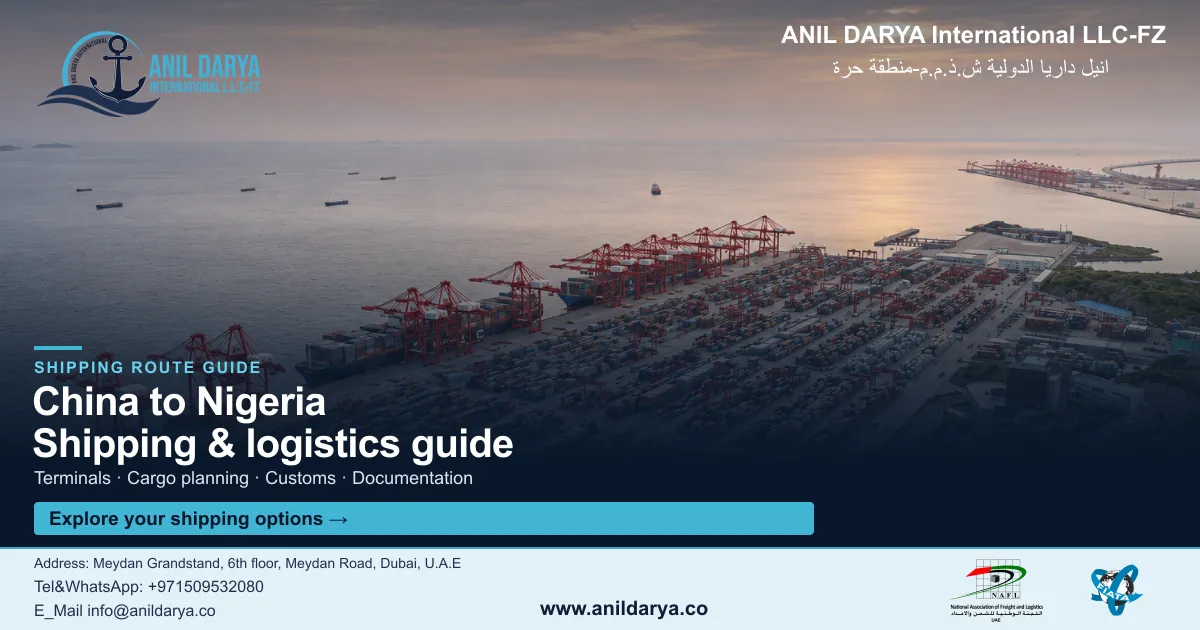
Shipping from China to Nigeria is mostly a container trade: boxes loaded at Shanghai, Ningbo, Nansha, Shenzhen, Xiamen or Qingdao and discharged at Apapa, Tin Can Island, Lekki or Onne. The Nigerian buyer must have an approved Form M, and regulated goods need SONCAP certification in China, before the container is loaded. We book the ocean freight from Dubai, release the shipping line's bill of lading to you and keep the Chinese supplier and your Nigerian clearing agent working to the same plan.
Shipping from China to Nigeria at a glance
| Item | Detail |
|---|---|
| Main modes | Sea FCL and LCL, flat rack and breakbulk for machinery, dangerous goods by sea, reefer for chilled cargo |
| Usual Chinese load ports | Shanghai, Ningbo, Guangzhou (Nansha), Shenzhen (Shekou, Yantian), Xiamen, Qingdao |
| Nigerian discharge ports | Lagos Port Complex (Apapa), Tin Can Island and Lekki Deep Sea Port in Lagos; Onne in Rivers State |
| Published carrier transit (example) | ONE WA1, October 2024 brochure: Nansha to Apapa 32 days, Shanghai to Apapa 37 days |
| China export filing | The consignor (usually the supplier) or its customs broker, at least 24 hours before loading |
| Nigerian import approval | Form M, opened by the importer through its Authorised Dealer Bank before shipment |
| Product conformity | SONCAP: Product Certificate before Form M, SONCAP Certificate per shipment; inspection firms work in China |
| Nigerian customs platform | B'Odogwu, the Nigeria Customs Service trade management system |
| Duty and VAT | ECOWAS Common External Tariff, 0% to 35% on CIF value, plus 7.5% VAT |
| Who clears in Nigeria | The consignee's licensed customs agent, agreed before we confirm the booking |
How a cross-trade booking on this lane works
The cargo never touches the UAE, but the booking is run from our desk in Dubai. Each party has a clear job.
- The supplier in China, or its own origin agent, packs the cargo, trucks it to the terminal or a consolidation warehouse and files the Chinese export declaration. We coordinate cut-off dates with them.
- We book space with the shipping line, check the draft documents against the Form M and SONCAP papers, and follow the box until it is discharged in Nigeria.
- The Nigerian importer's licensed customs agent files the PAAR-based declaration on B'Odogwu, and duty and taxes at destination are paid by the consignee or its broker.
The B/L you receive is the carrier's own bill of lading, not a forwarder's house bill. Because Anil Darya acts as agent for many shipping lines, the line issues that B/L and releases it to you through us. The Nigerian bank handling the Form M or a letter of credit will expect the carrier's document with the Form M number on it.
Nigerian rules expect imports to be insured by an insurer registered in Nigeria, so CIF cover bought by a Chinese supplier is a poor fit. FOB or CFR, with insurance placed in Nigeria, is the usual pattern. Our Incoterms 2020 guide for sea freight shows where cost and risk pass under each term.
Which Chinese ports to load at for Nigeria
Load at the port nearest the factory, and check that the loop you want calls there.
| Supplier region | Usual load port | What to know for Nigeria cargo |
|---|---|---|
| Guangdong (Guangzhou, Foshan, Dongguan, Shenzhen) | Nansha, Shekou, Yantian | Nansha is the last Chinese call on ONE's WA1 and SW2 loops, so it has the shortest published transit |
| Zhejiang and Jiangsu, including Yiwu traders | Ningbo, Shanghai | Both are on the WA1 and SW2 rotations; busy LCL consolidation for mixed orders |
| Fujian | Xiamen | A call on ONE's SW2 loops |
| Shandong and north China | Qingdao, Tianjin | Qingdao opens the SW2 and CMA CGM WAX1 loops; Tianjin cargo may feed to a southern port first |
Apapa, Tin Can, Lekki or Onne: where your cargo lands
The Nigerian Ports Authority is landlord and regulator. Private companies run the terminals under concessions, so the terminal on your B/L decides whose rules and charges apply.
| Port | Container terminal on China loops | When it suits you |
|---|---|---|
| Lagos Port Complex (Apapa) | APM Terminals Apapa | Consignees in Lagos and the south-west; the most common call on China services |
| Tin Can Island, Lagos | Tincan Island Container Terminal (TICT) and other operators | Lagos consignees; also handles general cargo and vehicles |
| Lekki Deep Sea Port, Lagos | Lekki Freeport Terminal | Larger ships and cargo for the Lekki side of Lagos or the Lagos Free Zone |
| Onne, Rivers State | West Africa Container Terminal (WACT) | Consignees in Port Harcourt, the south-south and south-east, oil and gas cargo |
Lekki is worth a closer look on a China lane. The NPA places it about 65 km east of Lagos and calls it the deepest seaport in sub-Saharan Africa. Its operator, Lekki Port LFTZ Enterprise, says it has been fully operational since 1 April 2023, with 5 ship-to-shore cranes and 15 rubber-tyred gantries, and lists China Harbour Engineering Company among its shareholders with Tolaram, the Lagos State Government and the NPA.
Onne, near Port Harcourt, saves buyers in the south-east a long truck run from Lagos. Goods for companies in the Onne Oil and Gas Free Zone follow free zone rules, and duty is charged when they leave the zone for Nigeria.
Sea freight from China to Nigeria: direct loops and transit days
China to Nigeria is served by long multi-port loops. A ship loads in China, calls Southeast Asia on the way, then works along the West African coast. Your box can stay on one vessel the whole way. ONE's brochure for its enhanced WA1 and SW2 services, published in October 2024, shows how this looks:
- WA1: Shanghai, Ningbo, Nansha, Singapore, Port Kelang, Apapa, Tin Can, Cotonou, Tema, Lome, then back to Asia.
- SW2 Loop A: Qingdao, Shanghai, Ningbo, Xiamen, Nansha, Singapore, Abidjan, Tema, Apapa, Lekki.
- SW2 Loop B: the same Asian calls, then Abidjan, Tema, Apapa and Onne. Loops A and B sail in alternate weeks.
| Load port | To Apapa | To Tin Can (WA1) | To Lekki or Onne (SW2) |
|---|---|---|---|
| Qingdao | 44 days (SW2) | Not on WA1 | 47 days |
| Shanghai | 37 days (WA1), 41 days (SW2) | 39 days | 44 days |
| Ningbo | 35 days (WA1), 39 days (SW2) | 37 days | 42 days |
| Xiamen | 37 days (SW2) | Not on WA1 | 40 days |
| Nansha | 32 days (WA1), 34 days (SW2) | 34 days | 37 days |
These are port-to-port days from one carrier's 2024 brochure. Rotations change, so treat them as a guide and check the live schedule on each quote. Other lines run their own loops. In March 2026 CMA CGM split its Asia to West Africa WAX network into three loops; Kuehne+Nagel's carrier update lists WAX1 as Qingdao, Ningbo, Nansha, Shekou, Singapore, Colombo, Abidjan, Lekki and Kribi, and WAX3 with calls at Apapa and Onne.
Some bookings are transhipped at a hub onto a second vessel, which adds days and a handling point. Ask whether a quote is same-vessel or transhipped before you compare prices.
[AMIR-FACT: the carriers we actually book from China to Apapa, Tin Can, Lekki and Onne, whether each sailing is same-vessel or transhipped (and where), and our real port-to-port days from Shanghai/Ningbo and from Nansha/Shenzhen]
Container shipping China to Nigeria: FCL, LCL and reefer
The Nigerian side adds a fixed paperwork cost to every shipment, whatever its size. That pushes the FCL or LCL decision towards fewer, fuller boxes.
| Option | Good for | Nigeria-specific point |
|---|---|---|
| 20ft FCL | Tiles, steel fittings, cables, sanitary ware, dense building goods | Truck weight limits from the Lagos ports; one Form M and one PAAR for the box |
| 40ft or 40ft high cube FCL | Furniture, solar panels, generators, household goods, mixed goods from one factory | Free time at the terminal is short; papers must be ready before arrival |
| LCL | Samples, first orders, small lots | Each consignee still needs its own Form M, SONCAP Certificate and PAAR |
| Reefer | Frozen fish, chilled food, some medicines | NAFDAC registration first; check the 2026 trade prohibition list for meat, poultry and eggs |
If you buy from several factories in the same province, have them deliver to one warehouse near the load port and stuff a single container. You then need one carrier B/L and one set of Nigerian entries instead of several. Our FCL vs LCL guide shows where the switch usually pays, and our sea freight service covers equipment and booking.
Dangerous goods, machinery and project cargo
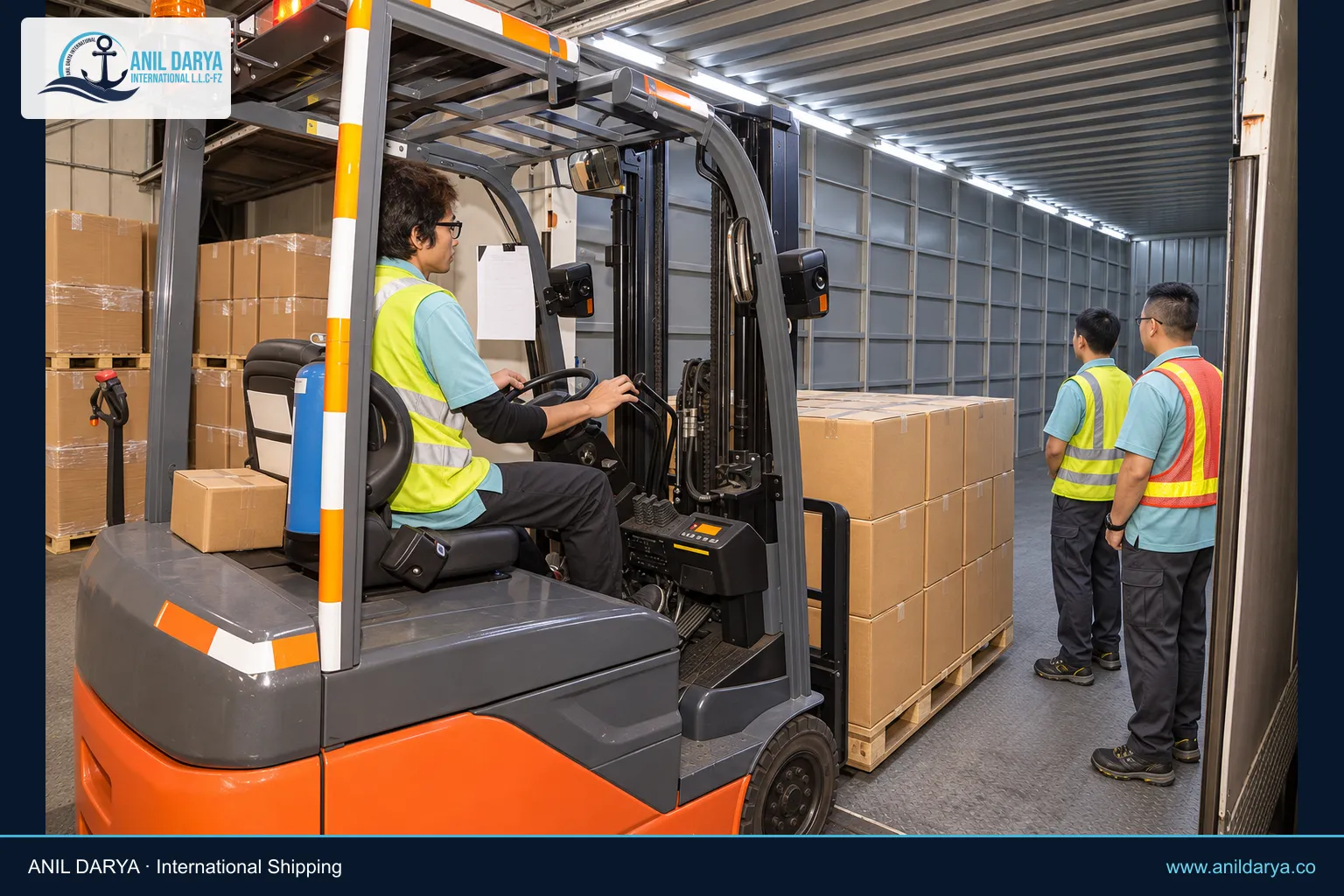
Lithium batteries for inverters and solar kits, paints, adhesives, solvents and aerosols are dangerous goods at sea and move under the IMDG Code. The 2024 edition, Amendment 42-24, has been mandatory since 1 January 2026, so the supplier's Safety Data Sheet and DG declaration must follow it.
China Customs checks the packaging used for exported dangerous goods. The supplier needs a performance appraisal for the packaging type and a use identification for the filled packages. Without these the line will not accept the booking at the Chinese terminal. On the Nigerian side, chemicals and cosmetics also need NAFDAC registration before they can be imported. Our dangerous goods shipping team checks the UN number, class and packing group against each carrier's acceptance list before you commit.
Generators, crushers, transformers, steel structures and factory lines are common Chinese exports to Nigeria. Pieces that fit a flat rack can travel on container ships. Larger or heavier units go breakbulk on general cargo or heavy-lift vessels. For these we need a piece list with weights, dimensions and lifting points, then we choose the vessel and the discharge port. See our break bulk and project cargo service.
The China export side: what the supplier must file
China puts export filing on the consignor. As the Shanghai municipal government sets out, the consignor or its customs broker declares the goods once they reach the customs supervision area and at least 24 hours before loading. The consignor needs market entity status and registration as a foreign trade operator, both of which can be done through the China International Trade Single Window.
- The supplier, or its origin agent, handles pickup, stuffing and the declaration. We share the booking number, cut-offs and the terminal so they file in time.
- Values and descriptions on the Chinese declaration should match the commercial invoice that goes to the Nigerian bank and to Customs. A mismatch invites a valuation query in Lagos.
On EXW terms someone in China must still act as exporter of record, so FOB is the safer choice for most Nigerian buyers.
Form M: the approval that must exist before loading
Nigeria controls imports through the Form M, and the order of steps matters. According to the NPA's import guidelines, the importer must first have a company registered in Nigeria, a Tax Identification Number and an Authorised Dealer Bank. Then:
- For regulated goods, the importer gets a SONCAP Product Certificate. SON says this is needed to open the Form M.
- The importer opens the Form M through its bank on the Nigeria Single Window, with the proforma invoice, the insurance certificate and the Product Certificate.
- The bank validates the Form M and passes it to the Nigeria Customs Service.
- Once Customs accepts it, the Form M number goes to the Chinese supplier for the invoice and to us for the bill of lading.
For a cross-trade booking, this is the point where we hold the booking until the Form M is approved. A container that sails before then can arrive in Lagos with no way to get a PAAR, and storage starts to run.
SONCAP for goods made in China
SONCAP is the Standards Organisation of Nigeria's conformity programme. Regulated goods are verified and tested in the country of supply before shipment, which for this lane means in China. SON gives three Product Certificate routes. PC1 is for unregistered products and covers one shipment. PC2 and PC3 are for registered or licensed products and last one year. After the shipment, an accredited inspection firm sends a Certificate of Conformity to SON, and SON issues the SONCAP Certificate, which is a mandatory customs clearance document.
SON's list of accredited firms includes two China-based groups, China Certification and Inspection Group (CCIC) and China Standard Inspection Co., alongside Intertek, Cotecna, TUV Austria, HQTS and others. SON assigns no territory to any firm, so your supplier can use any accredited firm or approved laboratory. Applications run through the SONCAP online platform.
- Out of scope, according to SON: food, medicines, medical items other than equipment, raw-material chemicals for genuine manufacturers, and used products other than vehicles.
- Genuine manufacturers importing machinery or spare parts for their own production apply for a SONCAP import permit instead.
- Food, drugs, cosmetics, chemicals and medical devices that sit outside SONCAP usually need NAFDAC registration, held by a Nigerian company or the maker's local agent.
[AMIR-FACT: the usual time we see from SONCAP application to Certificate of Conformity for China-origin cargo, and which accredited firms our Chinese suppliers use most]
Nigerian customs clearance on B'Odogwu
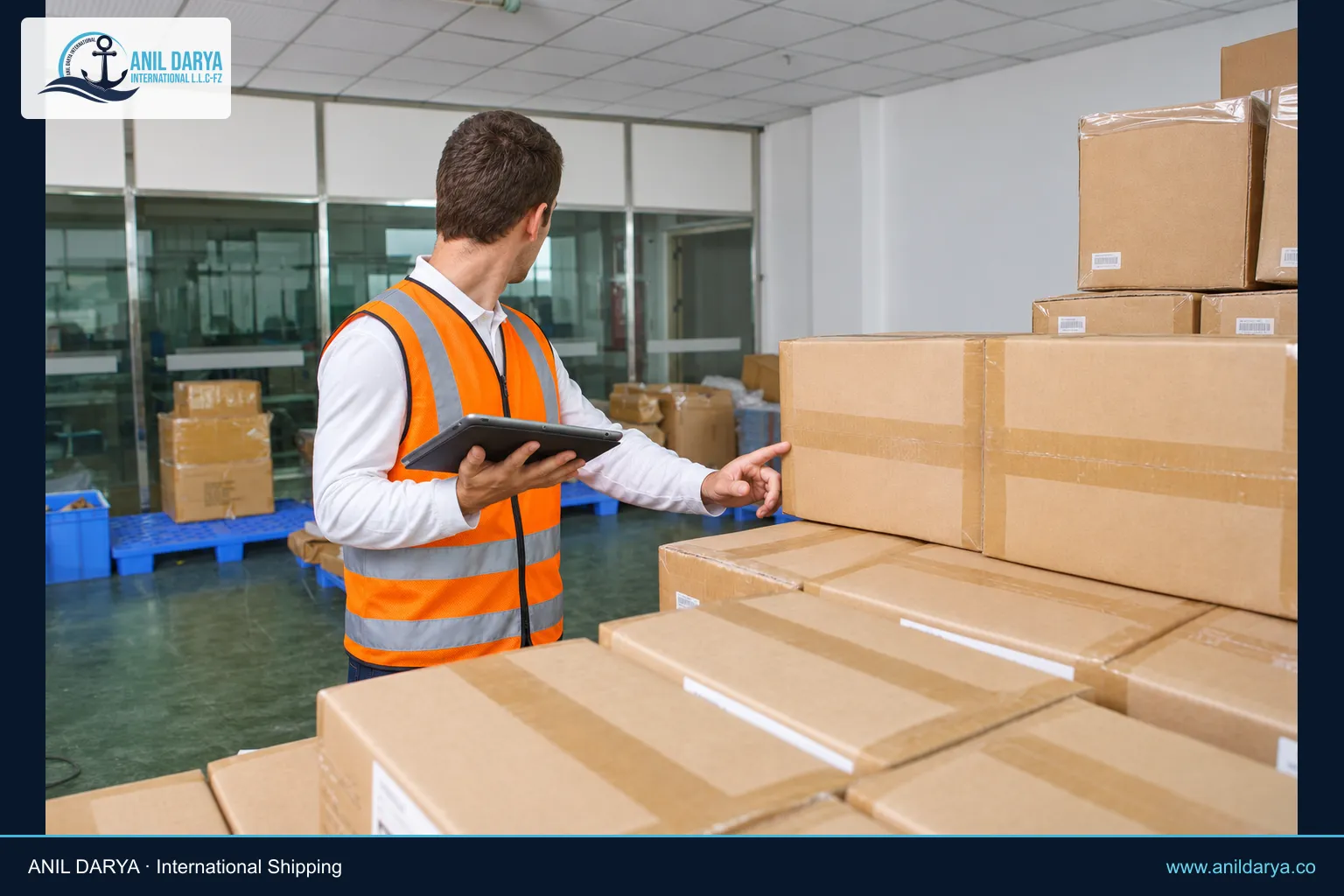
The Nigeria Customs Service now runs import declarations on B'Odogwu, its trade management system, rolled out command by command. The PAAR is created on B'Odogwu from the registered Form M, and the agent then files the declaration against it. Nigeria inspects on arrival rather than before shipment, and Customs uses scanners to cut physical examinations.
| Document | Who provides it | What your agent checks |
|---|---|---|
| Commercial invoice and packing list | Chinese supplier | Form M number, HS code, values and weights match the export declaration |
| Carrier bill of lading | Shipping line, released through us | Consignee, notify party, Form M number, discharge port and terminal |
| SONCAP Certificate | SON, after the inspection firm's Certificate of Conformity | Covers this shipment and these goods |
| Insurance certificate | Insurer registered in Nigeria | Matches the Form M |
| PAAR | Nigeria Customs Service, on B'Odogwu | Created before the declaration is filed |
| NAFDAC registration or permits | Importer | In place for regulated food, drugs, cosmetics and chemicals |
Duty is paid in naira, at the Central Bank of Nigeria exchange rate that B'Odogwu applies automatically, according to a February 2026 Customs statement. We do not clear cargo in Nigeria. Your agent gets the draft B/L and invoice before sailing, and we confirm the booking only once that agent has accepted the job.
Import duty, VAT and levies on Chinese goods
Nigeria applies the ECOWAS Common External Tariff to goods from outside ECOWAS, so Chinese goods pay the CET rate for their HS code. Most duties are ad valorem on the CIF value.
| Charge | Rate or basis | Typical China goods in the band |
|---|---|---|
| CET band 0 | 0% | Essential social goods |
| CET band 1 | 5% | Raw materials and capital goods, such as many machines |
| CET band 2 | 10% | Intermediate goods and inputs |
| CET band 3 | 20% | Finished consumer goods |
| CET band 4 | 35% | Specific goods for economic development |
| VAT | 7.5% standard rate | Applies on top of duty |
| Import Adjustment Tax, excise, vehicle levy | By tariff line | Revised in the 2026 fiscal policy measures |
The Nigeria Customs Service Act 2023 created a charge of at least 4% of FOB value to replace older levies, but Customs suspended it in February 2025 for consultation. Duty and taxes at destination are paid by the consignee or its broker, not by the Chinese supplier and not by us, so ask your agent which levies apply on the day of entry.
Restricted and banned goods for Nigeria
Nigeria keeps an absolute prohibition list and a trade prohibition list, revised in 2026. Check the HS code before the Form M is opened.
- From 1 April 2026 the revised trade list covers 17 categories of goods from outside ECOWAS. Items that matter on the China lane include selected steel products, corrugated paper and cartons, large glass bottles, ballpoint pens and their parts, soaps and detergents, and listed medicines.
- A 90-day window applied to deals backed by a valid Form M issued before 1 April 2026. New orders follow the revised list.
- The absolute list covers counterfeit goods, second-hand clothing, some weapons and toxic waste, among other items.
- Used vehicles more than 15 years past their year of manufacture cannot be imported, and a Green Tax Surcharge on certain vehicles started on 1 July 2026.
Read the current list on the Nigeria Customs Service website or ask your agent to check the code. Goods on a banned list that arrive in Nigeria can be seized.
Routing via Dubai: transhipment, consolidation and re-export
A direct loop is simplest for most cargo. Dubai helps when your supply chain already runs through the UAE, for example when a Nigerian trader buys from China and other origins and wants one shipment.
| Option | How it works | What to watch |
|---|---|---|
| Transhipment at Jebel Ali | The box arrives from China and connects to a West Africa service | Dubai Customs lists transit as its own regime, separate from import; extra port days |
| Consolidation in Dubai | Goods from China and other origins share one container to Lagos or Onne | The SONCAP route and Form M still follow the real country of supply |
| Free zone stock and re-export | Stock held in Jafza and shipped to Nigeria as orders arrive | Dubai Chambers issues origin certificates for re-exports |
Where cargo is landed, consolidated or re-exported in Dubai, we handle the UAE customs clearance for a fee. Jafza sits next to Jebel Ali port. Our Jebel Ali port guide covers the terminals, and our article on re-exporting through Jafza explains the free zone steps.
[AMIR-FACT: whether we route China to Nigeria cargo via Jebel Ali in practice (transhipment or Dubai consolidation), which West Africa services we use from Jebel Ali, and the real extra days against a direct China loop]
Typical cargo on this lane
Match the goods to their papers before you book.
| Cargo | Usual equipment | Extra papers to plan |
|---|---|---|
| Phones, electronics, small appliances | FCL or LCL | SONCAP; DG rules for loose lithium batteries |
| Solar panels, inverters, batteries | 40ft high cube | SONCAP; batteries as DG with SDS and Chinese packaging certificates |
| Generators and machinery | FCL, flat rack or breakbulk | Piece list and drawings; SONCAP or a SONCAP import permit for manufacturers |
| Tiles, sanitary ware, building hardware | 20ft FCL | SONCAP; check steel items against the 2026 trade list |
| Textiles, fabrics, shoes, bags | 40ft FCL or LCL | SONCAP where regulated; second-hand clothing is banned |
| Cosmetics, chemicals, food ingredients | FCL, DG-approved if hazardous | NAFDAC registration; DG papers where classed |
How shipping from China to Nigeria works, step by step
This is the order we follow on a cross-trade booking. Nothing ships until steps 1 to 4 are done.
- Send us the cargo details: product, HS code, weight and volume, supplier address in China, Nigerian city and Incoterm.
- Your Nigerian agent checks the HS code against the prohibition lists and confirms whether SONCAP, NAFDAC or a permit applies.
- The importer gets the Product Certificate, opens the Form M through its bank and arranges insurance with a Nigerian insurer.
- We confirm the Nigerian customs agent has accepted the clearance, then confirm the booking with the shipping line to Apapa, Tin Can, Lekki or Onne.
- The supplier books the SONCAP inspection, stuffs the container and files the Chinese export declaration before the cut-off.
- The line issues the carrier B/L with the Form M number, released to you through us. The inspection firm sends the Certificate of Conformity to SON.
- The importer gets the SONCAP Certificate and the PAAR on B'Odogwu while the ship is at sea.
- On arrival the agent files the declaration, pays duty and VAT from the consignee's funds, clears the box and returns the empty within free time.
[AMIR-FACT: one real China to Nigeria cross-trade shipment we handled: cargo, load and discharge ports, carrier, what we coordinated with the supplier and the Nigerian agent, and the outcome, cleared for publication]
What drives China to Nigeria shipping costs?
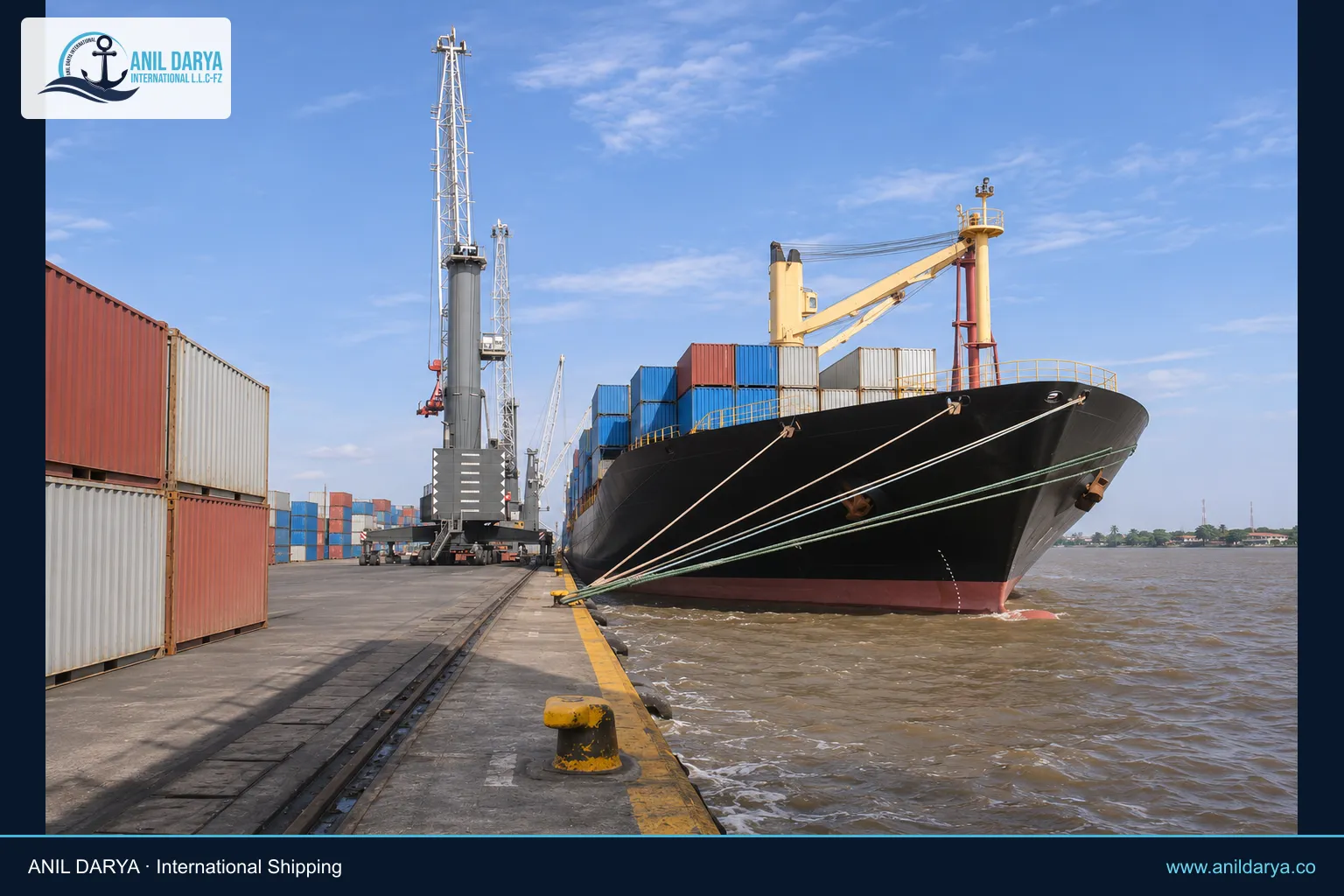
We do not publish prices, because they change with every sailing. These are the parts of the total.
| Cost part | What moves it | Usually paid by |
|---|---|---|
| Origin charges in China | Pickup distance, export filing, terminal handling, LCL consolidation | Supplier under FOB |
| SONCAP inspection and testing | Certificate route, product type, testing needed | Supplier or buyer, as agreed |
| Ocean freight | Container type, season, carrier, same-vessel or transhipped, surcharges | Buyer under FOB or CFR terms |
| DG and out-of-gauge | DG surcharges, flat rack or breakbulk premiums, lashing | Buyer |
| Nigerian terminal and shipping line charges | Port, terminal, container size | Consignee |
| Duty, VAT and levies | HS code, CIF value, exchange rate on the day | Consignee or its broker |
| Storage, demurrage and detention | Late Form M, late PAAR, slow clearance | Whoever caused the delay, under your contract |
A missing SONCAP Certificate or a Form M approved too late can cost more in port storage than any freight saving. Our article on demurrage and detention shows how those charges build up, and our Dubai freight forwarding team can go through a quote line by line with you.
Checklist before the box leaves China
- HS code agreed with your Nigerian agent and checked against the 2026 prohibition lists.
- Form M approved, and its number given to the supplier and to us.
- Product Certificate in hand, and the SONCAP inspection booked with an accredited firm.
- NAFDAC registration or other permits in place where the goods need them.
- Insurance placed with a Nigerian insurer, matching the Form M.
- Nigerian customs agent named and the clearance accepted before the booking is confirmed.
- Chinese export declaration filed, with values matching the commercial invoice.
- Carrier B/L draft showing the correct consignee, Form M number, discharge port and terminal.
- For DG: UN number, SDS, Chinese packaging certificates, DG declaration and carrier approval.
Mistakes that hold cargo in Nigerian ports
- Shipping before destination clearance is agreed. If no Nigerian agent has accepted the job, the container waits at Apapa or Onne while you look for one.
- Loading before the Form M is approved. Without it there is no PAAR, and without a PAAR there is no clearance.
- No SONCAP Certificate for regulated goods. Customs treats it as a mandatory clearance document.
- CIF insurance bought in China. Nigerian rules expect cover from a local insurer.
- Ordering goods on the revised trade list, such as cartons or selected steel products, without checking the 2026 changes.
- Different values on the invoice, the Form M and the Chinese export declaration. This leads to a valuation query.
Frequently asked questions
How long does shipping from China to Nigeria take?
Port to port, ONE's October 2024 brochure shows 32 days from Nansha to Apapa and 37 days from Shanghai to Apapa on its WA1 service, and 37 to 47 days to Lekki or Onne on SW2. Add time for the Form M, SONCAP, export filing and clearance in Nigeria.
Which Nigerian port should cargo from China go to?
For Lagos buyers, Apapa, Tin Can Island and Lekki all take China services, and the carrier's loop often decides. For Port Harcourt and the south-east, Onne is usually closer. Choose the port nearest the consignee that a regular service calls at.
Do I need a Form M before goods leave China?
Yes. The Nigerian importer opens the Form M through its Authorised Dealer Bank on the Nigeria Single Window, and Customs must accept it before shipment. The Form M number then goes on the invoice and the bill of lading.
Who arranges SONCAP for goods made in China?
The importer gets the Product Certificate before opening the Form M. An accredited inspection firm, which can be a China-based firm such as CCIC, inspects the goods in China and sends its Certificate of Conformity to SON, which then issues the SONCAP Certificate.
What duty and VAT do Chinese goods pay in Nigeria?
Nigeria uses the ECOWAS Common External Tariff, with bands of 0%, 5%, 10%, 20% and 35% charged mostly on CIF value. VAT is 7.5%. Some goods also pay Import Adjustment Tax, excise or a vehicle levy, so confirm the HS code with your agent.
Can I ship lithium batteries and solar kits from China to Nigeria?
Yes, as dangerous goods under the IMDG Code. The supplier needs an SDS, a DG declaration and Chinese packaging certificates, and the carrier must accept the booking. Solar products also need SONCAP where they are regulated.
Does Anil Darya clear customs in Nigeria?
No. The consignee's licensed customs agent clears the goods, and duty and taxes at destination are paid by the consignee or its broker. We agree the plan with that agent before we confirm the booking, and we handle UAE customs only if the cargo goes through Dubai.
Get a quote for shipping from China to Nigeria
Send us the product, HS code, weight, volume, supplier city and Nigerian port, and we will reply with a routing and a price. Use our freight rate inquiry form, or contact our team to talk through a DG, machinery or multi-supplier shipment first.
Sources
- ONE: Asia to West Africa service enhancement, WA1 and SW2 rotations and transit days (October 2024)
- Kuehne+Nagel: Carrier service update, CMA CGM WAX1, WAX2 and WAX3 (February 2026)
- Nigerian Ports Authority: Terminals and operators by port
- Nigerian Ports Authority: Import and export guidelines (Form M, SONCAP, PAAR)
- Nigerian Ports Authority: Lekki Deep Sea Port
- Lekki Port: Port facts, equipment and shareholders
- Oil and Gas Free Zones Authority: Free zone incentives
- Standards Organisation of Nigeria: SONCAP services and accredited firms
- Federal Ministry of Information: Customs on Form M and PAAR on B'Odogwu (July 2025)
- Nairametrics: Customs says CBN sets the clearance exchange rate (February 2026)
- Federal Ministry of Information: Customs suspends the 4% FOB charge (February 2025)
- Nigeria Customs Service: 2026 Fiscal Policy Measures and Tariff Amendments
- SCP Law: Nigeria's 2026 import restrictions
- US International Trade Administration: Nigeria customs regulations (CIF basis, naira, local insurance)
- US International Trade Administration: Nigeria import requirements (destination inspection)
- US International Trade Administration: Nigeria prohibited and restricted imports
- ECOWAS: Common External Tariff bands
- PwC Worldwide Tax Summaries: Nigeria other taxes (VAT 7.5%)
- Legal 500: Registration of imported products with NAFDAC
- Shanghai Municipal Government: Export declaration by the consignor
- CIRS: China Customs inspection of DG packaging for export
- IMO: IMDG Code 2024 edition (Amendment 42-24)
- Dubai Customs: Customs declaration regimes, including transit
- Dubai Chambers: Certificate of origin for exported and re-exported goods
- Jafza: About the Jebel Ali Free Zone
Reviewed: 11 November 2026